What to know about Magic Mountain’s new Thrill Glider roller coaster
It’s an exciting time for Southern California coaster fans. Universal Studios Hollywood is on the verge of officially opening Fast & Furious: Hollywood Drift, and Knott’s Berry Farm this summer unveiled the refurbished Montezooma: The Forbidden Fortress. Now Six Flags’ Magic Mountain is getting in on the coaster action.
Coming in 2027 to the Valencia park will be Thrill Glider, a first of its kind thrill ride designed by coaster manufacturer Vekoma exclusively for Magic Mountain.
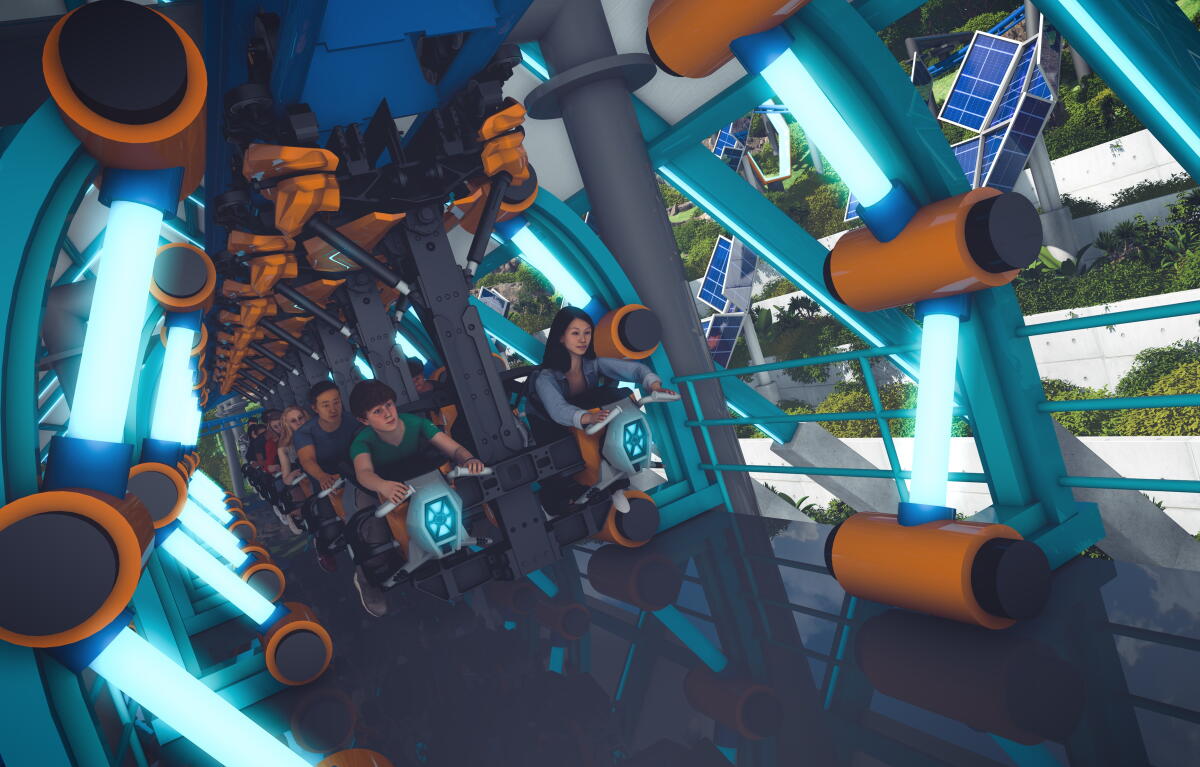
Magic Mountain in a release describes Thrill Glider as introducing a new coaster category, one that combines a motorbike-like seating arrangement with suspended coaster technologies. Riders will board what the park is referring to “hoverbikes,” essentially bike vehicles designed to simulate a flying sensation by being suspended from the track. Riders will be seated in a prone, face-forward position that will hang from the track above.

Concept art for Thrill Glider, which will boast bike-like vehicles and a sci-fi backstory.
(Six Flags Magic Mountain)
The ride will feature 20 different coaster elements and is slated to last 80 seconds. Speeds will reach 50 mph, and the coaster will boast five inversions that will take guests upside down. The various inversions will include a barrel roll, a zero-g roll and an overbanked stall turn, hinting at a heavily twisted track that will create drifts and swinging. There will be at least 12 moments, Six Flags promises, in which riders will experience airtime lifts.
“It is the latest milestone in Six Flags Magic Mountain’s renaissance and a reflection of the park’s enduring role as an industry innovator,” said Brian Oerding, park president of Six Flags Magic Mountain in a release.
The ride will come with a heavy sci-fi-inspired narrative. The story: The ride is a new technology from a fictional inventor, Rebecca Silva, who will introduce guests in the waiting area to what is described as a “Futurist Pavilion.” Throughout the queue, riders will encounter “holographic presentations and scientific exhibits,” culminating in the discovery of a new energy source, detailed by illuminated blue energy lines, that will power the ride.
The goal, says Six Flags, is to provide an optimistic view of the future, albeit with many sudden dives and weightless moments. The ride will feature multiple launches, reach a height of 107 feet and traverse 3,380 feet of track, which is more than a half mile.

Concept art of Magic Mountain’s new Thrill Glider, which will reach a top height of 104 feet.
(Six Flags Magic Mountain)
A specific opening window has not been detailed, but the ride is currently under construction. It will be located on the former site of the Golden Bear Theatre and will overlook the recently refurbished kiddie area, Looney Tunes Land.
Thrill Glider is arriving at a moment when Six Flags has been garnering national attention. Magic Mountain’s X2 remains shut down while state safety officials continue an investigation involving the attraction.
The ride, first opened in 2002 as X, has been the subject of controversy and at least one high-profile lawsuit stemming from a 22-year-old man’s death. Six Flags bills the ride as “a right of passage for the ultimate daredevil” that goes up to 76 mph. A CNN report recently took a look at other, more recent injuries allegedly stemming from the attraction.