moviepass

Nina Jacobson on ‘Hunger Games’ and the Hollywood ‘franchise machine’

This week, the newest installment of the dystopian “Hunger Games” franchise hits theaters, vaulting viewers back to the brutal world of Panem with a prequel focused on mentor Haymitch Abernathy.

“The Hunger Games: Sunrise on the Reaping” is the sixth film in the series, which has been helmed from the start by producer Nina Jacobson through her Color Force production company.

The former Walt Disney Co. studio executive launched Color Force in 2007 and, since then, has produced film adaptations of “Diary of a Wimpy Kid,” “The Goldfinch” and 2018’s “Crazy Rich Asians,” among other projects. Based in Los Angeles on the Fox lot, the nine-person company has had a big year so far, with the upcoming “Hunger Games,” as well as the FX limited series “Love Story: John F. Kennedy Jr. & Carolyn Bessette,” which was the most-watched FX limited series on Hulu and Disney+ and received six Emmy nominations.

Jacobson and her co-leader and producing partner Brad Simpson, who joined Color Force as partner in 2012, spoke with me ahead of “The Hunger Games: Sunrise on the Reaping” release about the appeal of the series nearly 15 years after the first film, the current landscape for independent producers and what Hollywood gets wrong about franchises.

This conversation has been edited for clarity and length.

What’s kept your interest in “The Hunger Games” franchise for more than a decade?

Jacobson: Suzanne [Collins] writes books that honestly, when I’m reading them, I can’t put them down, and when I put them down, I can’t stop thinking about them.

They’re rooted in unforgettable characters, and I think that there’s both a defiance that runs through these books, and anger, grief, and yet a deep hopefulness about our capacity to ultimately change corrupt and broken institutions and practices, but without ever glossing over the cost of resistance, the cost and consequences of violence, and how long it might take to actually see a change result from your acts of resistance.

After the original trilogy was done, [director] Francis [Lawrence] and I both thought we were done making the movies. We didn’t have any idea that “The Ballad of Songbirds & Snakes” was going to arrive until we got the phone call from Suzanne.

Franchises often have this inevitability to them, where they are scheduled before they’re actually conceived, let alone executed. We’re not making it on a schedule, not getting the books on a schedule, and just making [movies] if she writes a book, nor do we have any intention to make it if she doesn’t write a book.

Why has “The Hunger Games” resonated with audiences for so long?

Jacobson: Kids have grown up in a world very much reflected in the original trilogy. They’ve grown up in a world that has been at war for most of their lives.

In this one in particular, as Katniss was, these people with the least access and the least opportunity are the ones who don’t set out to be the heroes, but become ultimately activated, radicalized and ready to expand their circle of concern. And I think that the hopefulness and the power of seeing young people actually be agents of change in a very broken world, and this fundamental notion expressed in this movie that all machines can be broken, remains this hopeful and disruptive thematic current that I think speaks deeply to the times that we live in.

How has the industry’s thinking about franchises changed since “The Hunger Games” first came out in 2012?

Jacobson: As an executive at Disney from ’98 to 2006, we had to make somewhere between 20 to 22 movies a year, and of those, maybe two or three might be sequels. Mostly, we had to generate new material. And if something was a hit, we didn’t go out after “The Sixth Sense” and make “The Seventh Sense.” We went and made more M. Night Shyamalan.

I think that the pressure to crank out franchises as opposed to organically grown, audience-desired franchises, has changed in this last period. Especially when somehow, people got the idea that if everything were a franchise, that everybody would go [to the theaters] all the time, which I think is really faulty reasoning.

We just went through this with “Crazy Rich Asians.” If anything we worked on had been asked the most times, “When are you coming out with the sequel?” it was “Crazy Rich Asians.” We tried to work on a theatrical sequel, but we could not crack it, and we ultimately felt like better to make no movie than to make a movie that is not a satisfying sequel to the movie we made because the books are so big and rangy that you have to subtract a lot.

So in this case, television for us was actually very liberating because we have all these characters and all these crazy storylines that had to get boiled down for a theatrical romantic comedy for the first movie, and that’s part of why we were struggling to adapt the second book for film.

I think a lot of sequels get made because people think that they’re going to give you some kind of a guarantee of success. But there is no guarantee of success ever.

Do you see the trend toward franchises changing at all?

Jacobson: This year has been an amazing wake-up call that the issue is not that young people do not want to go to the theater to have communal experiences. The issue is that you need to give them something that they actually want to go see. Newer voices, more novel, innovative, original, fresh material.

But the franchise machine, I don’t know if it’s slowing down.

You had a big year with “Love Story.” What attracted you to that project?

Simpson: One of the things that people always love the most, we discovered, is a classic love story. When Ryan [Murphy] first pitched us doing JFK Jr. … we knew what most people knew, but it was really Elizabeth Beller’s book (“Once Upon a Time: The Captivating Life of Carolyn Bessette-Kennedy”) that cracked it open for us by telling the story of a commoner going into the kingdom and realizing that it fit a lot of classic tropes of love stories, but also we hadn’t seen a love story told that way on television.

What has all the consolidation in Hollywood meant for independent production companies?

Simpson: Consolidation is never good for anybody. It’s better to have more distributors, it’s better to have more buyers.

A lot of times what happens when things become too consolidated, new startup companies come in and find a way into the marketplace. Certainly, A24 has shown and Neon and some of these companies that they could be more nimble and more quick.

I actually think we’re in a very similar point to one of those pivot points, like the 1960s when the studio machines had become sort of lumbering and big, and you needed a lot of revolutionary filmmakers coming in to reset stuff. And I think that’s what’s happening right now, especially in film. You have a lot of movies that would have never made it through the studio system coming out in different ways, and audiences are embracing them.

What are the biggest challenges for independent producers today?

Simpson: There used to be a really robust and flush system where there were lots of studios, and they had producing deals with independent producers. And that’s where young producers went and got trained.

You hear about producers who are young and really want to make it. They’re the people who are going to discover the young voices and believe in things and push them through the system. And they just literally cannot earn a basic living.

Trump still backs the federal incentive

Last week, President Trump took to his social media website to say he was still working with Republican and Democrat co-sponsors of the federal film and TV tax credit proposal, despite the wide losses Republicans took in the midterm elections.

Calling the effort a “very bipartisan undertaking,” Trump said meetings were routinely being set up by leaders of both parties to get the proposal across the finish line during Congress’s lame duck session.

Rep. Laura Friedman (D-Glendale), who is one of the House leaders for this proposal, also urged lawmakers to get the incentive across the finish line.

“When the White House and this many members of both parties agree, there’s no excuse to wait,” she said in a statement Friday after Trump’s social media post. “A national film and TV incentive means jobs in California, Georgia, New York, New Jersey and every state across the country. Let’s get it done.”

A new Bond for a new generation

The internet lighted up Monday morning, as Amazon MGM Studios announced that “The Batman” and “The Odyssey” star Robert Pattinson would be the new James Bond.

Unlike past 007s, who were largely less known before they stepped into the superspy’s shoes, Pattinson comes with a lengthy film resume that includes several franchises (“Harry Potter,” “Dune” and “The Twilight Saga,” to name a few), as well as a popularity with younger moviegoers.

In addition to his blockbuster fare, Pattinson also starred in A24’s “The Drama” and “Primetime” this year, two films that resonated with Gen Z.

“By going for him in particular, I think they’re trying to create a bond that caters to fans that maybe first experienced Bond with Daniel Craig and maybe aren’t necessarily the 50-plus crowd that have grown up with Bond closer to its origins,” Brandon Katz, director of insights and content strategy at Greenlight Analytics, told me.

Stuff We Wrote

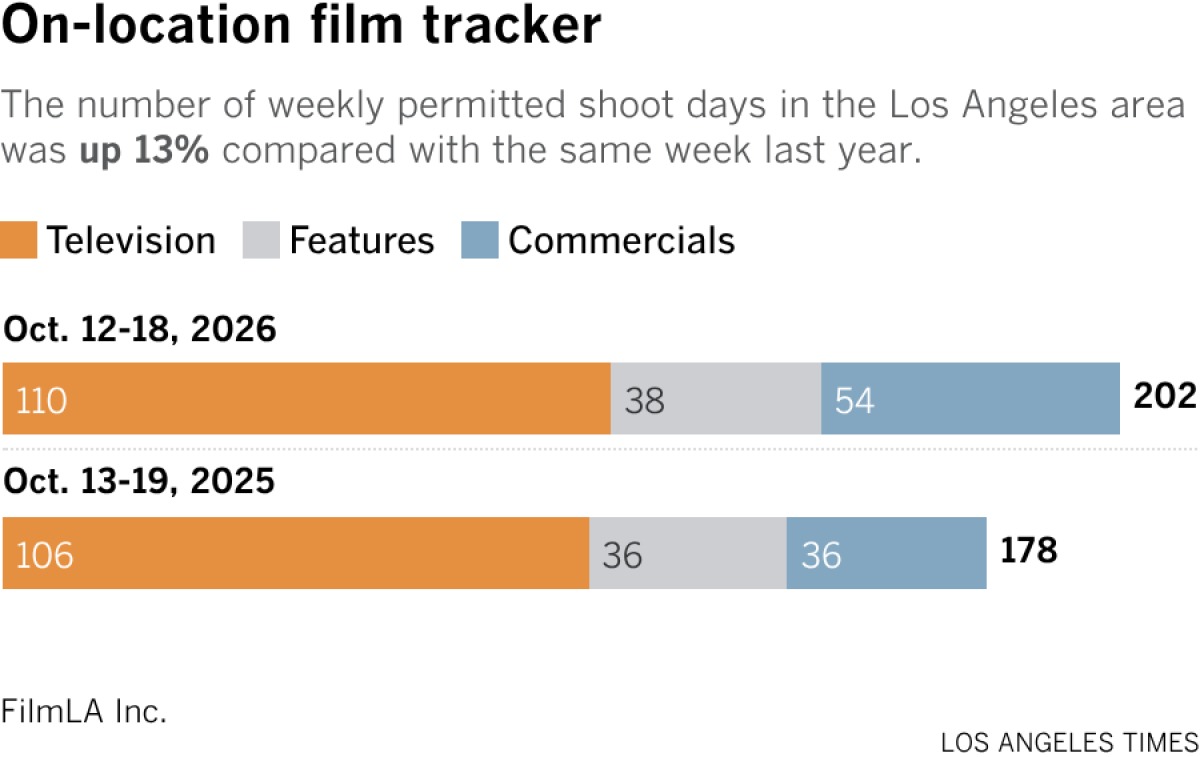
Film shoots

Number of the week

eight point seventy-six billion dollars

The domestic box office now stands at $8.76 billion as of Sunday, according to Rentrak data.

That’s a nearly 21% jump compared with the same time period last year, when the box office in the U.S. and Canada was about $7.26 billion. And with several big titles still to come, including Disney and Marvel Studios’ “Avengers: Doomsday” and Skydance-owned Warner Bros. Pictures and Legendary Entertainment’s “Dune: Part Three,” analysts expect that total could rise to $10 billion by year-end.

What I’m watching

This week, I watched the first episode of the new season of Amazon MGM’s “The Rings of Power.” It’s a show I haven’t always kept up with, but I love the dwarfs’ storyline so far.
Source link

With ‘The Greatest,’ Authentic Studios makes another IP play in Hollywood

Last week, sports drama series “The Greatest” debuted on Prime Video, detailing the life of Muhammad Ali and how he grew from Cassius Clay, the Olympic champion, to one of the biggest sports and civil rights icons of all time.

The show has gotten high marks from critics and counts Michael B. Jordan and Ali’s widow, Lonnie, as executive producers. But what might not be known is the role another major sports heavyweight played in its inception.

Authentic Brands Group, which owns the likeness of Ali, was inspired by the post-NBA career and platform of Shaquille O’Neal in thinking about how to tell Ali’s story to a new generation. Authentic also owns the likeness of O’Neal, who is a significant owner of the New York-based brand management company, and saw how he leveraged his basketball fame into all manner of endorsements after his retirement, from pitching Epson printers and Carnival Cruise Line to DJing at music festivals. (O’Neal also spoke with Lonnie Ali regularly, and was instrumental in helping to make her feel comfortable with the project and production team.)

“He’s still incredibly popular, and his businesses are doing amazing. It’s really all because of his platform,” Corey Salter, chief executive of entertainment at Authentic Brands Group, told me. “So what we wanted to do with Muhammad Ali, and this was a long time in the making, is what is Muhammad’s platform? How do we make that come to life again?”

Authentic Brands Group has an extensive portfolio, ranging from clothing brands (Quiksilver, Champion and Forever 21, to name a few) and media (Sports Illustrated), to likenessess of celebrities such as O’Neal, Marilyn Monroe, David Beckham and Elvis Presley. (The company recently filed lawsuits with other Presley music rights holders against AI companies Anthropic and Suno, alleging copyright infringement. Salter said the lawsuit is ongoing and that the company will “vigorously defend” its intellectual property.)

In 2023, Authentic Brands Group launched its film, TV, audio and commercial production arm that’s focused on telling stories around the company’s intellectual property.

In many ways, the origin story of “The Greatest” exemplifies how Authentic Studios thinks about its projects and why they’ve embarked on the production business.

Though Ali died in 2016, “The Greatest” will allow him to remain in the cultural zeitgeist, Salter told me.

You’re reading the Wide Shot

Samantha Masunaga delivers the latest news, analysis and insights on everything from streaming wars to production — and what it all means for the future.

“We are giving platforms for our living legends and our icons,” Salter said. “It just really brings him back to people that unfortunately didn’t get to see him in his prime and what he accomplished in his lifetime.”

The genesis of the studios segment goes back to the 2022 release of Baz Luhrmann’s “Elvis.”

Years earlier, Authentic Brands had licensed the Elvis IP to Warner Bros. and built a good working relationship with the Australian film director Luhrmann. But as the team sat as guests in the mezzanine section during the film’s premiere at the Cannes Film Festival, the group realized there could be more opportunities in being directly involved in production, rather than just licensing their IP.

“If we make compelling, interesting and great content, the brand should get that lift,” said Colin Smeeton, president of Authentic Studios. “It’s just a way for us to expand the reach and scope of the brands.”

The Authentic Studios banner has four labels: O’Neal’s Jersey Legends Productions, Beckham’s Studio 99, Sports Illustrated Studios and Authentic Productions, which includes all of the other Authentic-owned brands. The studio is based in Beverly Hills and has about 35 employees. The entertainment segment of Authentic Brands Group makes up about 25% to 30% of the company’s overall business, and the studio is profitable, Smeeton said.

Among the projects that O’Neal’s production company has released are a three-part docuseries on the life and career of NBA legend Allen Iverson and a Netflix show called “Power Moves with Shaquille O’Neal,” about his and Iverson’s plans to revitalize the Reebok brand. The company also has produced commercials.

“When a project comes to me, I like to do what’s known in my office as ‘Shaq it up,’” O’Neal told me in an interview. “You’ve got to allow the writers and everybody else to have their creative process, and then I’ll make it Shaq.”

What exactly does Shaqing it up entail?

“A lot of humor has to be involved,” he said. “When you get home and you turn on the TV, I want to make you smile.”

As I’ve written, IP has become the name of the game in Hollywood. With reboots and sequels, the entertainment business is betting that people will flock to familiar stories and names. Just look at the acquisition of Warner Bros. Discovery — a major draw for bidders Skydance and Netflix was the company’s extensive portfolio of IP, which includes “Harry Potter,” “The Lord of the Rings” and DC Studios.

Expanding that thinking to brands is a logical next step. After all, the success of 2023’s “Barbie” may be the best recent example of harnessing a brand name with a compelling storyline. And, for a while, that film boosted sales of Mattel’s Barbie dolls.

Authentic Studios wants to expand into digital, build on its YouTube footprint and explore vertical storytelling. The studio is developing projects based on the brand Quiksilver’s origin story and the story of retail brand Guess.

“It’s not about doing more; it’s about making sure that the projects that we do make and do develop actually matter and make them count,” Smeeton said. “If we’re going to spend the time and energy, we want to make sure that it is going to be entertaining for the viewer and the fan, but it ultimately is going to be a good outcome for the brand as well.”

Stuff we wrote

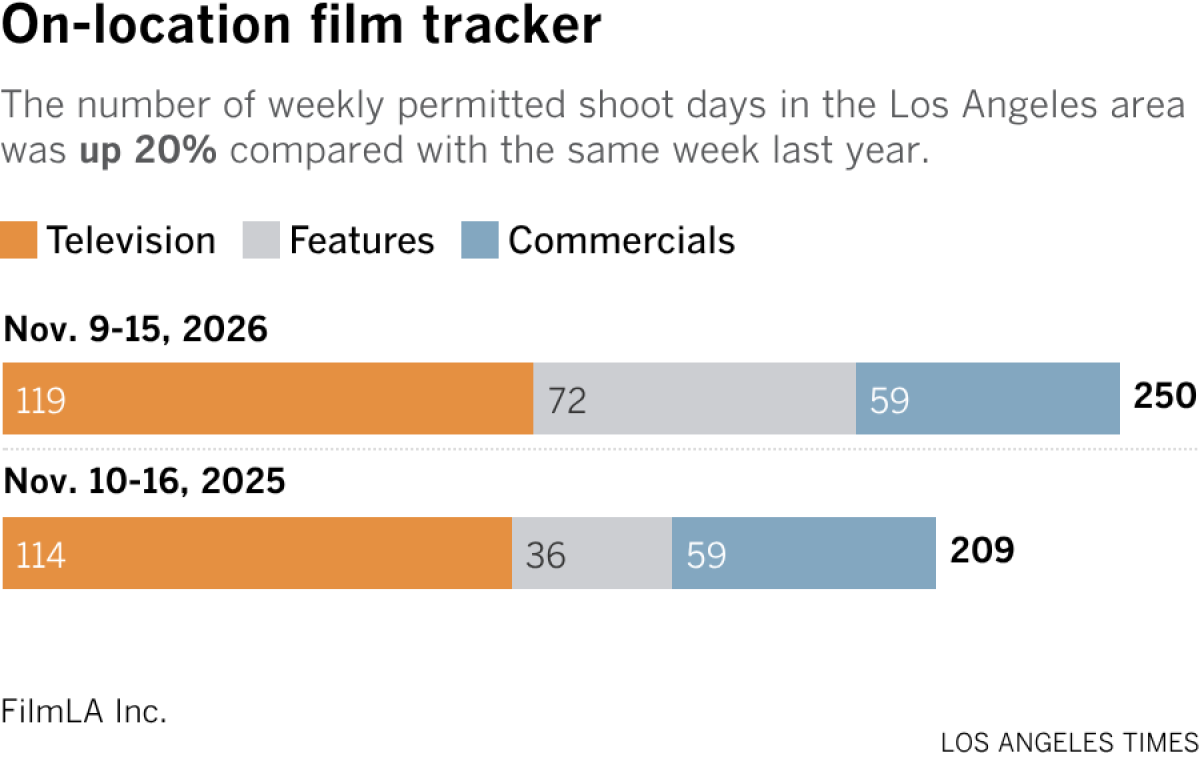
Film shoots

Number of the week

twenty-nine million

NBC News data analyst Steve Kornacki has become a mainstay of election coverage. And that paid dividends for the network last week, when its “Kornacki Cam” drew a record 29 million views across all platforms, my colleague Stephen Battaglio reported.

Kornacki’s coverage spanned 10½ continuous hours and was woven into NBC’s election night broadcast.

Final figures showed NBC averaged 6.7 million viewers in prime time, followed by ABC (5.2 million), Fox (4.31 million), CNN (4.1 million), MS NOW (3.7 million) and CBS (2.7 million).

What I’m watching

Other than watching UCLA continue its 9-0 season with a win over Minnesota this past weekend, I caught the first episode of “The Greatest,” as part of my reporting for the newsletter. The season starts with Cassius Clay’s gold medal-winning match at the 1960 Rome Olympics. I thought the acting was strong, and the theme of fighting racism and injustice at home was especially compelling.

Source link

‘Unsolved Mysteries’ ventures into a new realm: video podcasts

It’s been nearly 40 years since the dread-filled tones of the “Unsolved Mysteries” theme song first hit network TV airwaves.

In that time, the celebrated documentary series has been through nearly every iteration of the TV business — and is about to embark on a new one.

Next week, “Unsolved Mysteries” will launch a video podcast in partnership with the audio and entertainment firm Audacy. The weekly podcast, which will be available on YouTube and on all podcast platforms, will release new episodes starting Oct. 29 that explore cases such as mysterious deaths and unexplained disappearances.

The podcast will be hosted by actor and TV host Jordan Murphy and will include interviews with the people involved in the case, “Unsolved Mysteries” co-creator Terry Dunn Meurer told me in a recent interview.

“We’re still trying to expand the brand and pivot,” she said. “It just feels like that’s where the industry is heading. The YouTube audience is the biggest audience out there, and we are looking for the biggest audience because we’re trying to help solve these cases. So the more viewers we can get with these episodes, the better.”

You’re reading the Wide Shot

Samantha Masunaga delivers the latest news, analysis and insights on everything from streaming wars to production — and what it all means for the future.

“Unsolved Mysteries” isn’t the only Hollywood player to bet on video podcasts. Spotify has bet big on video podcasts, and Netflix has added them to its platform, both of which are attempts to compete with YouTube, diversify their offerings and keep consumers tuned in.

For “Unsolved Mysteries,” the move is just the latest way the show has tried to evolve with the TV industry’s ups and downs.

The show debuted in 1987 as a series of specials NBC used to fill holes in its lineup, Dunn Meurer said. That kind of pinch-hitting meant there was no marketing or publicity to get audiences excited about the show, but viewers started tuning in anyway.

Eventually, the specials became a weekly show that aired on NBC for nine seasons before moving to CBS. “Unsolved Mysteries” also had a syndication run on cable channels Lifetime and Spike TV.

Throughout its TV lifetime, the show would highlight stories of mysterious disappearances, escaped fugitives, lost connections and even the occasional paranormal story. “Unsolved Mysteries” made appeals to viewers, urging them that someone out there “knows the truth” and encouraged them to write in with tips or new suggestions for investigation, which has resulted in tens of thousands of submissions over the years.

More recently, “Unsolved Mysteries” was revived on Netflix for three seasons, with a format focused on a single story. The series also previously had an audio-only podcast.

In addition to the video podcast, “Unsolved Mysteries” also recently produced a full-length documentary on new evidence surrounding the so-called Tylenol Killer, a 1982 case in which seven people died after unknowingly taking cyanide-filled pill capsules.

Though the method of delivery has changed, Dunn Meurer said the show’s mission remains the same. Over the years, the series has helped to directly solve more than 260 cases, she said, though many are so-called lost love cases of missed connections, as well as fugitive whereabouts and some murders.

“There’s so many mysteries out there that need attention, cases that have gone cold,” she said. “For me personally, it’s hard to not keep putting those stories out there and helping these families and law enforcement that need the help to solve these cases.”

‘Musk’ advertising controversy

In notable media news, the TikTok ad account for Bleecker Street’s documentary “Musk” was “permanently suspended” Friday, the day the film opened nationwide, a spokesperson for the indie studio confirmed.

But on Sunday, a spokesperson for TikTok said the account was restored “after an error.”

The documentary, directed by Alex Gibney, follows billionaire Elon Musk and the effect he has had on politics and his support for the GOP and President Trump.

The ban raised suspicions in Hollywood as TikTok is now partially owned by Oracle, which was co-founded by billionaire Larry Ellison. Ellison, who still serves as executive chairman of the tech company, is briefly mentioned in the documentary when he offers to help Musk finance his acquisition of Twitter, according to the Hollywood Reporter.

The documentary will make its streaming debut on HBO Max, which is owned by Ellison’s son, David.

In its second weekend in theaters, “Musk” grossed about $306,700 across 472 screens in the U.S. and Canada, for a $650 per-screen average. The film has notched a 97% critics rating on aggregator Rotten Tomatoes.

Stuff We Wrote

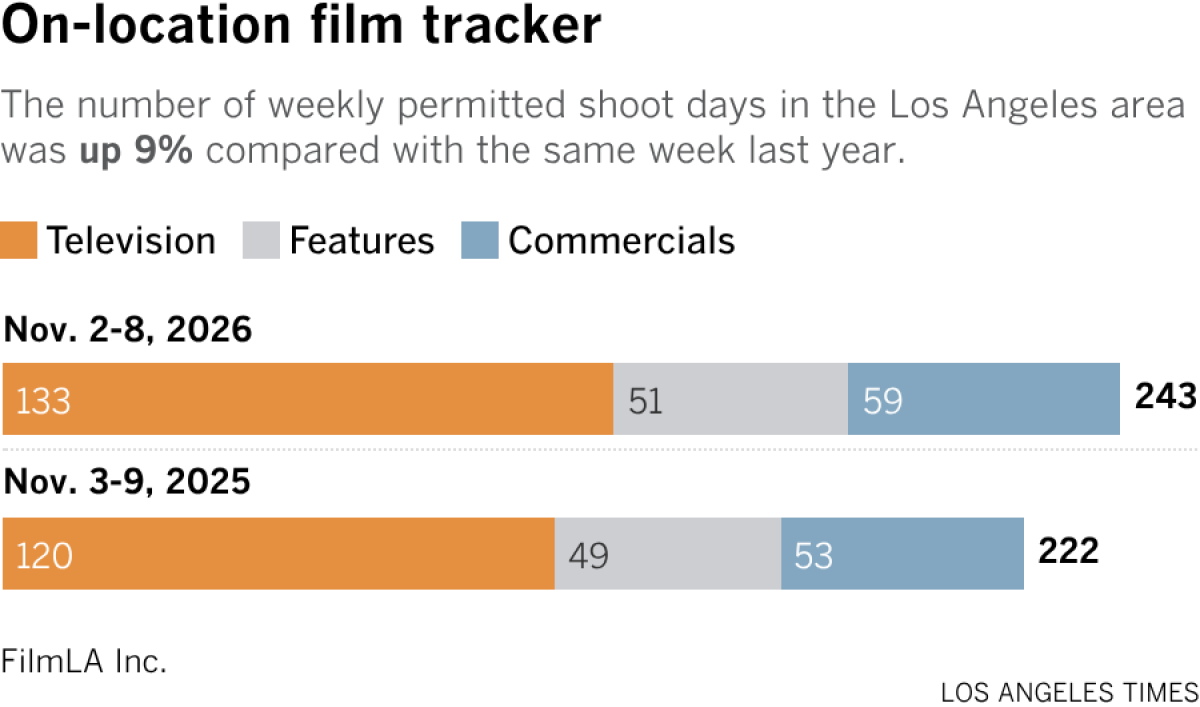
Film shoots

Number of the week

fifteen million dollars

A24’s “You Can See Everything” brought in $15 million at the domestic box office over the weekend, a huge feat for the nearly three-hour documentary that delves into the life of disgraced Theranos founder Elizabeth Holmes shortly before she reported to federal prison for defrauding investors.

The documentary, directed by deadpan comic Nathan Fielder and “Primetime” filmmaker Lance Oppenheim, got a ton of buzz after its surprise debut at the Telluride Film Festival last month. The $15-million opening is even more impressive given that it was available only on 855 screens.

That was good enough for second place at the weekend box office. In first was Skydance-owned Paramount Pictures’ “Street Fighter,” which scored $31 million domestically for a worldwide gross of $51.1 million.

What I’m watching

During a busy (news) week like last week, sometimes you just need a comfort watch. For me, that’s HGTV.

There’s nothing more calming than watching people try to redo their houses into the home of their dreams. But because it’s spooky season, I ended up watching “Scariest House in America,” a hilarious home makeover competition hosted by “Parks and Recreation” comedian Retta, where homeowners show off their creepy, strange or wildly dilapidated houses in hopes of winning a renovation. After watching the travails of people who chose to live in a former jail or a self-constructed giant gingerbread house with a rickety single-person elevator, I was oddly soothed.

Source link