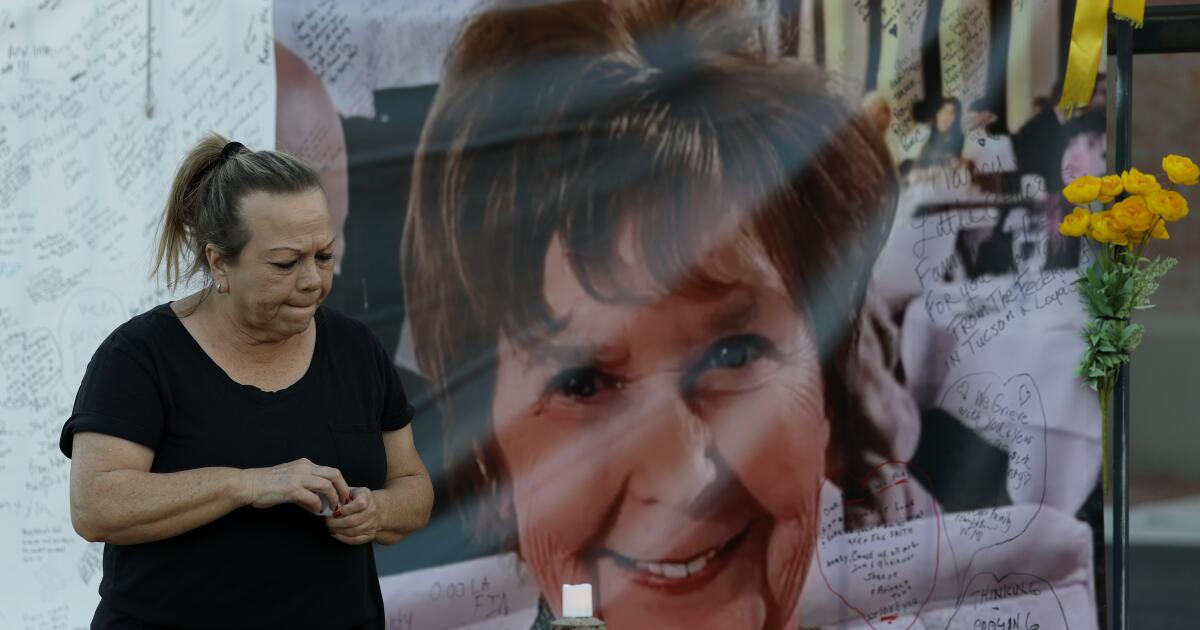
mother

Woman killed by ICE agent in Minneapolis was a mother of 3, poet and new to the city

The woman shot and killed by a U.S. Immigration and Customs Enforcement officer in Minneapolis on Wednesday was Renee Nicole Macklin Good, a 37-year-old mother of three who had recently moved to Minnesota.

She was a U.S. citizen born in Colorado and appears to never have been charged with anything involving law enforcement beyond a traffic ticket.

In social media accounts, Macklin Good described herself as a “poet and writer and wife and mom.” She said she was currently “experiencing Minneapolis,” displaying a pride flag emoji on her Instagram account. A profile picture posted to Pinterest shows her smiling and holding a young child against her cheek, along with posts about tattoos, hairstyles and home decorating.

Her ex-husband, who asked not to be named out of concern for the safety of their children, said Macklin Good had just dropped off her 6-year-old son at school Wednesday and was driving home with her current partner when they encountered a group of ICE agents on a snowy street in Minneapolis, where they had moved last year from Kansas City, Missouri.

Video taken by bystanders posted to social media shows an officer approaching her car, demanding she open the door and grabbing the handle. When she begins to pull forward, a different ICE officer standing in front of the vehicle pulls his weapon and immediately fires at least two shots into the vehicle at close range.

In another video taken after the shooting, a distraught woman is seen sitting near the vehicle, wailing, “That’s my wife, I don’t know what to do!”

Calls and messages to Macklin Good’s current partner received no response.

Trump administration officials painted Macklin Good as a domestic terrorist who had attempted to ram federal agents with her car. Her ex-husband said she was no activist and that he had never known her to participate in a protest of any kind.

He described her as a devoted Christian who took part in youth mission trips to Northern Ireland when she was younger. She loved to sing, participating in a chorus in high school and studying vocal performance in college.

She studied creative writing at Old Dominion University in Virginia and won a prize in 2020 for one of her works, according to a post on the school’s English department Facebook page. She also hosted a podcast with her second husband, who died in 2023.

Macklin Good had a daughter and her son from her first marriage, who are now ages 15 and 12. Her 6-year-old son was from her second marriage.

Her ex-husband said she had primarily been a stay-at-home mom in recent years but had previously worked as a dental assistant and at a credit union.

Donna Ganger, her mother, told the Minnesota Star Tribune the family was notified of the death late Wednesday morning.

“Renee was one of the kindest people I’ve ever known,” Ganger told the newspaper. “She was extremely compassionate. She’s taken care of people all her life. She was loving, forgiving and affectionate. She was an amazing human being.”

Ganger did not respond to calls or messages from the AP.

Biesecker and Mustian write for the Associated Press. Mustian reported from New York.

Source link

Best TV shows of 2025: ‘The Lowdown,’ ‘Pluribus,’ ‘The Pitt’ and more

After the eye strain, the greatest occupational hazard of being a TV critic is people asking what’s good on television. It’s a question I typically find impossible to answer on the spur of the moment, as a show will run out of my head as soon as a review is filed in order to make room for the next one. (I buy time by responding, “What do you like?”) It is only at this reflective season of the year that I can stop, look back and list them.

Our picks for this year’s best in arts and entertainment.

Every year, television has its ups and downs, its ebb and flow, depending on a host of reasons I will only ever vaguely understand. I will take this opportunity to say that there are way too many psychological thrillers on way too many platforms nowadays, but there are always more than enough shows to praise — and as always, I include only series that are new this year. Some are here because they deliver real surprises — not just plot twists and sudden revelations, but new directions and original formats. Others are here by dint of good old-fashioned storytelling, memorable characters and terrific performances — or just because they made me laugh.

Here they are, in no special order.

‘Hal & Harper’ (Mubi)

A woman and a man embracing a grey haired man, seen from behind.

Lili Reinhart and Cooper Raiff in Mubi’s “Hal & Harper.”

(Mubi)

Writer-director Cooper Raiff’s delicate drama looks at a brother and a sister — played by Raiff and Lili Reinhart both as adults and children, with no sacrifice of reality — made close by the early loss of their mother and the grief of their father (Mark Ruffalo, identified only as Dad). The sale of their old house and the prospect of a new sibling — Dad’s girlfriend (Betty Gilpin, going from strength to strength) — sets things in motion. The dialogue avoids exposition, the silences say much. (Read the review.)

‘The Lowdown’ (FX)

A man in a tan hat sitting next a teenage girl in a striped sweater.

Ethan Hawke and Ryan Kiera Armstrong in FX’s “The Lowdown.”

(Shane Brown / FX)

In Sterlin Harjo’s shaggy dog follow-up to “Reservation Dogs,” the ever-evolving Ethan Hawke plays Lee Raybon, a raggedy Tulsa “truthstorian,” citizen journalist and used-book dealer, looking into the apparent suicide of the oddball member of a powerful family. The series pays homage to noir film and fiction, even as it’s too bright, mischievous and full of love to qualify as noir itself (though Lee does get beat up a lot). Politicians, land developers, white supremacists and Natives collide. The cast also includes Kyle MacLachlan, Jeanne Tripplehorn, Peter Dinklage, Keith David, Kaniehtiio Horn (the Deer Lady in “Reservation Dogs”) as Ray’s ex-wife and the marvelous Ryan Kiera Armstrong as his teenage daughter and eager accomplice. Look for X’s John Doe as a purveyor of bootleg caviar. (Read the review.)

‘Women Wearing Shoulder Pads’ (Adult Swim), ‘Common Side Effects’ (Adult Swim), ‘Oh My God … Yes!’ (Adult Swim), ‘Long Story Short’ (Netflix)

1

A puppet dressed as a matador leans her face on the head of a guinea pig wearing a wig, glasses and red sweater.

2

A man leans down over a glowing blue mushroom.

3

An animated still of a woman with purple hair holding a robot baby with a snake-like tongue.

4

An animated still of a blonde woman smiling and sitting in an airplane seat next to a man with glasses.

1. “Women Wearing Shoulder Pads” on Adult Swim. (Warner Bros) 2. “Common Side Effects” on Adult Swim. (Adult Swim) 3. “Oh My God … Yes!” on Adult Swim. (Warner Bros. Discovery) 4. “Long Story Short” on Netflix. (Netflix)

Animation! “Women Wearing Shoulder Pads” is a queer Spanish-language stop-motion comedy melodrama, set in the aesthetic world of a 1980s Pedro Almodóvar film, involving the fate of the cuy, a South American guinea pig (pets? food?), and a struggle between two powerful women. (Read the review.)

“Common Side Effects” is a semicomical thriller with heart, centered on a mushroom with curative properties and pitting its discoverer against the pharmaceutical-industrial complex; Martha Kelly fans will be happy to find her here as a DEA agent. (Read the review.)

“Oh My God … Yes!” is an Afro-futurist, surrealist, girlfriends-in-the-city superhero comedy — like the Powerpuff Girls, grown up, earthy and Black — featuring humanoid robots, anthropomorphic animals and gayliens (the preferred term for gay aliens). (Read the review.)

And “Long Story Short,” from “Bojack Horseman” creator Raphael Bob-Waksberg is the sweet, melancholy, satirical, silly, poignant, hopeful, sometimes slapstick cartoon tale of a normal middle-class Jewish family; the world it portrays is (mostly) ordinary, but the drawings make it extra-special. (Read the review.)

‘Demascus’ (Tubi)

A man in laying down on a reclining chair with a white halo around his forehead placed by a woman in a grey dress.

Okieriete Onaodowan in Tubi’s “Demascus.”

(Jace Downs / AMC Networks)

In this Black science-fiction comedy about the search for identity and purpose, Okieriete Onaodowan plays the title character, propelled into alternative visions of his life and self by an experimental virtual reality gizmo that “follows the path of your conscious and subconscious impulses.” The settings change along with him — into a relationship reality show, a “sad Thanksgiving” domestic comedy, a setting out of “One Flew Over the Cuckoo’s Nest” — as supporting actors (Martin Lawrence among them) become different people around him. (Read the review.)

‘Pluribus’ (Apple TV)

A woman in a yellow jacket holds the arms of a doctor in green scrubs.

Rhea Seehorn in Apple TV’s “Pluribus.”

(Anna Kooris / Apple TV)

I find Vince Gilligan’s take on “The Invasion of the Body Snatchers,” in which a virus from outer space turns nearly all of humanity into one giant, contented, cultish hive mind, more interesting than compelling, but it’s interesting enough, and comes with a great performance by Rhea Seehorn as one of a dozen earthlings immune to the bug — jealous of her discontent, standing up for her right to be angry. This is a slow series, yet never a boring one, and Seehorn, in a kind of one-woman-versus-everyone show, is electric even when nothing much is happening. (Read the review.)

‘The Studio’ (Apple TV)

Two men sitting in office chairs at a desk looking at a laptop screen as two women stand behind them.

Clockwise from left: Ike Barinholtz, Kathryn Hahn, Chase Sui Wonders and Seth Rogen in Apple TV’s “The Studio.”

(Apple TV+)

Seth Rogen and Evan Goldberg’s breakneck farcical ode to the motion picture business (in which they do very well). Rogen stars as a new studio head, promoted from below, dealing with bad ideas (a Kool-Aid movie), big egos, and his own insecurities and need to feel appreciated. Episodes take place at the Golden Globes, a fundraising dinner and a Las Vegas trade show, with Ike Barinholtz and Kathryn Hahn on his team, Bryan Cranston as his boss — reminding you he was on “Seinfeld” and “Malcolm in the Middle” before he became Walter White — and Catherine O’Hara (brilliant, naturally) as the woman Rogen replaced. (Read the review.)

‘North of North’ (Netflix)

A smiling woman with long dark hair sits in front of a chess board.

Anna Lambe in Netflix’s “North of North.”

(Netflix)

A sweet small-town romantic comedy, set (and filmed) in Canada’s northernmost territory among the Indigenous Inuit people. A luminous Anna Lambe stars as the 26-year-old mother of a rambunctious 7-year-old, tied to a narcissistic husband and resentful of her mother, a reformed alcoholic and former bad girl; she dreams of something more, even if it just means hauling large items to the dump. Mary Lynn Rajskub plays the cheerful, credit-grabbing town manager whose assistant she becomes. Love and a family secret will arrive from the south. The beaded parkas are gorgeous. (Read the review.)

‘The Pitt’ (HBO Max), ‘Adolescence’ (Netflix)

1

A man in a blue hoodie and stethoscope around his neck and a woman in black scrubs sit in the back entrance of an ambulance.

2

A teenage boy looks up toward his father in a black jacket and orange collared shirt.

1. Noah Wyle and Tracy Ifeachor in HBO Max’s “The Pitt.” (John Johnson/HBO) 2. Owen Cooper and Stephen Graham in Netflix’s “Adolescence.” (Netflix)

These two series do their work in real time, making space for naturalistic acting and a special kind of pressure. “The Pitt,” whose 15 episodes are set in a hectic Pittsburgh ER over a 15-hour shift puts Noah Wyle back in scrubs, herding (with Tracy Ifeachor) a large cast of doctors, nurses and student doctors. Cases include electrocution, drowning, overdose, scurvy, sickle cell anemia, a nail in the chest, a fastball in the eye and gallstones, with all the personal drama one expects from a hospital show. (Read the review.)

The tightly focused, brutally intimate “Adolescence,” surrounding the arrest of a 13-year-old boy (Owen Cooper) for murder, unveils its unconventional mystery in four discrete episodes, each executed in a single tracking shot. A field day for actors, it earned Emmys for Cooper, co-creator Stephen Graham as his father and Erin Doherty as a child psychologist. (Read the review.)

‘Dope Thief’ (Apple TV), ‘Deli Boys’ (Hulu)

1

A man with a bandage on his face puts an arm around a man staring straight ahead. A van is in flames in the background.

2

Two men in jackets look intently at a phone.

1. Brian Tyree Henry, left, and Wagner Moura in Apple TV’s “Dope Thief.” (Apple) 2. Saagar Shaikh, left, and Asif Ali in Hulu’s “Deli Boys.” (James Washington/Disney)

Drugs are bad, but they fuel a lot of television. (I mean the plots; I wouldn’t know about the productions.) These two very different series feature heroes in over their heads, caught between cops and a cartel. “Dope Thief” gives Brian Tyree Henry (Paper Boi on “Atlanta”), as a man robbing low-level drug dealers dressed as a DEA agent, his first starring role, which would be sufficient for me to recommend it sight unseen — but it is excellent, seen. (Read the review.)

In “Deli Boys,” an old-fashioned comedy of Idiots in Danger, Asif Ali and Saagar Shaikh play temperamentally opposite Pakistani American brothers who inherit what they believed to be a chain of convenience stores but turn out to be the front for their father’s cocaine empire. Poorna Jagannathan is marvelous as their beloved, fearsome Lucky Auntie, who knows the score. (Read the review.)

‘Ludwig’ (Britbox)

A man standing near an iron fence holding open a brochure.

David Mitchell in Britbox’s “Ludwig.”

(Colin Hutton)

In this Cambridge-set dramatic comedy-mystery, irascible David Mitchell, of “Peep Show,” “Upstart Crow” and “Would I Lie to You?” fame, plays an awkward, isolated genius with little practical experience of the world, drawn right into it when he winds up impersonating his missing twin brother, a police detective. A professional puzzle-maker, he’ll turn out to be good at the job, though he calls a medical examiner’s report a “how-did-they-die test,” and, moving in with his sister-in-law, he’ll learn something about the benefits of family. Properly moving, and very funny. (Read the review.)

Source link

Scorer Daniel Blumberg on how he brought ‘The Testament of Ann Lee’ to life

If the Shakers have a lasting cultural legacy, it is their music — most famously “Simple Gifts,” the uplifting spiritual Aaron Copland immortalized in his ballet “Appalachian Spring.” It stands to reason, then, that a film about Ann Lee, the founding “mother” of this 18th century celibate Christian sect, would be a musical. But this was no conventional woman and “The Testament of Ann Lee,” directed by Mona Fastvold and opening in L.A. on Dec. 25, is no ordinary musical.

“Ann Lee was very radical and extreme,” says composer Daniel Blumberg, “and Mona is as well.”

As conceived by Fastvold and Blumberg, the entire tapestry of this film is musicalized — from the emphatic breathing, chest thumping and floor stomping that make up the worshipers’ rituals, to the songs, inspired by Shaker traditionals and performed by star Amanda Seyfried and the cast. Even the sounds of wind, the creaking of ships and a passing cow play a part.

“This cow walks past during the song ‘I Love Mother,’” says Blumberg, 35, visiting L.A. from his native England and speaking from a hotel room over Zoom. Bald with severe features but a soft and guileless disposition, he’s fidgety about the whole Hollywood press dance — this is only his fourth feature film score. But Blumberg is eager to dissect his music-making process and brag about his collaborators. “We were tuning the cows to the song,” he says.

Two people express chaste affection tensely on a bed.

Amanda Seyfried and Lewis Pullman in the movie “The Testament of Ann Lee.”

(Searchlight Pictures)

In a prologue about Lee’s harsh childhood in Manchester, England, her mother hums a tune to her based on the traditional Shaker hymn “Beautiful Treasures.” The melody is then completed on celeste in Blumberg’s score, surrounded by a liturgical choir. The entire film is this kind of holistic musical current: score, songs and environment all in conversation with each other, every component a part of the dance.

“The whole project was very dangerous,” says Blumberg, an indie singer-songwriter with a cult following in the U.K. and now an Oscar for last year’s “The Brutalist.” “It’s always on the edge. And for me that’s a good place to be when you’re making art.”

In one stunning montage, we see a newly married Lee subjugated to religiously-tinged sex (a catalyst for her dogmatic rejection of carnal relations), give birth to several babies, mourn their deaths and express her sorrow in a fervent dance for God. Erotic noises and the cries of childbirth weave together with prayerful moaning and a mother’s keening cries, all integrated into Blumberg’s instrumental score — a guided meditation for bells and strings — with Seyfried singing “Beautiful Treasures.”

“It was very important to me to try and create this hypnotic feel to the film,” says Fastvold, speaking on Zoom from her car during the awards-season whirlwind. “You had to understand it on a sensorial level. Because I think a lot of the appeal, especially early on, were these kinds of endless dance/voice/confession sessions that would last for days.”

“If it’s just someone preaching to you,” she adds, “I certainly can’t connect to that.”

The director, 44, grew up in a secular home in Norway, but her film about this radical American sect is strikingly earnest. Fastvold doesn’t judge Lee’s convictions; there isn’t an ounce of cynicism or condescension. After having a prophetic vision in which Lee is told she is the female incarnation of Jesus Christ, Seyfried sings, “I hunger and thirst / After true righteousness / I hunger and thirst” with utter heart-bleeding sincerity. The camera and the music share her faith completely.

“I never felt like I wanted to laugh at them,” says Fastvold. “I wanted to laugh with them and sometimes their naivete is funny and endearing. But I never wanted to ridicule them. Of course, it’s a very scary thing to try and do.”

When Seyfried read the screenplay two years ago, she experienced some of that intimidation.

“It was definitely the most confused I’ve been in a while reading a script,” she says, nursing a hot tea on Zoom, “because I’m seeing these placeholders for where the hymns will be, when the music comes in, when the diegetic sound goes out or if it doesn’t at all. It was all very foreign to me — which is not necessarily a bad thing. It just leaves me with so many questions.”

Fastvold co-wrote “The Testament of Ann Lee” with her partner, Brady Corbet, who directed “The Brutalist.” They were developing it while working on his breakthrough epic. Blumberg, who has made a number of solo albums and been part of several bands including Cajun Dance Party and Yuck, became friends with Corbet a decade ago. The trio became inseparable.

Fastvold was listening to Blumberg’s records when she decided to direct “The World to Come” in 2020, a warm historical romance about two women in a chilly frontier America. She remembers being captivated by the “beautiful dissonance” in his music. “There’s this mournful, slightly atonal quality to his compositions,” she says.

Fastvold hired Blumberg to score her film — his first — and invited him to the set in Romania to experience the time-traveling feeling of the woods and the sound of passing sheep. She even gave him a small on-screen part, selling a blue dress to Katherine Waterston’s character. It was emblematic of her and Corbet’s then-burgeoning philosophy: of making lavish films on a shoestring, using stunning foreign environments to portray a bygone America and roping crew members and family into the collaboration.

For her ambitious follow-up musical about the Shakers, Fastvold knew she needed Blumberg at the ground level, along with choreographer Celia Rowlson-Hall, a collaboration that required proximity. “We kind of move in together for a while and just start figuring it out,” Fastvold says.

A bald man in black looks at the lens, his hands clasped.

“The whole project was very dangerous,” says Blumberg. “It’s always on the edge. And for me that’s a good place to be when you’re making art.”

(Ian Spanier / For The Times)

They discussed how to cast a spell on the audience and how, with cinema, “you’ve got these tools to use,” says Blumberg, “with image, sound, the writing of it all and just to push those as far as possible. Obviously with the edit you can move in time very quickly, and then with sound you can bring people into the room that the characters are in, but also bring them into the heavens. It was trying to use the materials that we had to make an experience — with the story, but inside the story as well. An immersive experience.”

Fastvold and Blumberg immersed themselves in the thousands of songs the Shakers left behind, including hymns and what the group called “gift songs” and “dance songs.”

“What is our dialogue with this tradition and what is it that we’re bringing to this conversation?” Fastvold remembers them asking each other. “Because really that, to me, is what folk music is. It’s passed on, it’s transformed — it turns into something else and then passed on again.”

They found several Shaker songs that fit the needs of given scenes and moments; whenever they couldn’t, Blumberg wrote an original. The Jewish composer recalled the niguns — wordless, improvised prayers — that he grew up hearing in synagogue, and he drew on that sense memory. Many Shaker songs are mantra-like prayers addressed to God, simple rising and falling melodies based on a short repeated phrase. Blumberg got creative with the harmonies, creating demos that he sang himself.

“It was very nerve-racking,” he says, “because score is a moment where you can fix things — you do it after the edit — but this was going to define the pace of the film. There’s quite high stakes of it working.”

Seyfried was nervous too. Even though she’s a trained singer, with film credits including “Mamma Mia!” and “Les Misérables,” this peculiar religious epic required an enormous leap of faith.

“I knew Mona was going to shoot it beautifully,” Seyfried says, “and I knew that Daniel was going to be there every step of the way. And I knew that I was in good hands — but I didn’t know at that point that I could trust myself as a singer, as a musician. It was completely new territory for me. Terrifying.”

The songs were prerecorded for playback on set. The first thing Seyfried recorded in studio was an a cappella song for a scene late in the film — the lyric is “How can I but love my dear faithful children?” She says she felt miserable.

“I was just like: I sound terrible,” Seyfried says sincerely. “This song is not fun to sing. It’s beautiful, but I don’t sound beautiful. I don’t like the way I sound. And we kept doing it and my voice was dry.”

Blumberg patiently worked at finding the most comfortable key for her voice. “I had no idea how lucky I was,” she says.

People swirl around a stationary woman.

Amanda Seyfried in the movie “The Testament of Ann Lee.”

(TIFF)

In the process of working with Blumberg, Seyfried says she came to a deeper appreciation of the character as well as her own singing voice. “I was so critical of it,” she remembers, but the role gave her a different kind of freedom. “I was playing somebody who didn’t necessarily have to be a beautifully trained singer,” she says. “She sang because she wanted to feel alive, and she wanted to feel free, and she wanted to feel connected to her faith — and that already just liberates the performer.”

After extensive rehearsals that continued throughout production, Fastvold shot the film in Budapest. Blumberg was always on set, accompanying the actors with a small keyboard. (Thomasin McKenzie and Lewis Pullman are among the cast members who also sing in the film.) Sometimes the actors had a simple click track in an earpiece, other times a “stomp track” from the foot choreography. They would sing live in addition to lip-syncing to playback and Fastvold amassed a huge variety of live tracks — vocals, breaths and other bodily sounds — for her final mix.

“I wanted all of that life and that natural feel to it,” she says, “to not have it feel polished at all, to just be really raw. Because they weren’t singing to entertain. It’s never performative. It’s always from this place of prayer or pain.”

With her principal cast surrounded by Hungarian extras, Fastvold roped everyone, from the dialect coach to the first assistant director’s son to Blumberg’s sister, into the dance.

“If you came to visit, you were in the movie,” she says. “The cast is the crew and the crew is the cast. It’s how I like to do it.” Once again, Daniel Blumberg appears on-screen, in scenes of Shaker worship; he also sings an original duet, “Clothed by the Sun,” with Seyfried under the end credits.

But at this point his work was only half done. Armed with a cut of the film, pillared by the songs he wrote and arranged, Blumberg crafted a score that subtly teed up song melodies and established a sense of spiritual trance. He gravitated toward the sound of bells; he and Fastvold found a handbell from Ann’s era that they used in early demos and he ended up renting some 50 church bells, in different keys, all laid out on the floor of his London flat.

He extended the bell idea with the jangly celeste, also known as a bell piano, and he augmented those bells with a small string ensemble, a choir and, at one point, even an electric guitar.

It was Blumberg’s idea to have two veteran improvising singers, Phil Menton and Maggie Nichols (who also appears in the film), to each record a track where they improvised along to the entire film. Working with mixer Steve Single, Fastvold and Blumberg would occasionally bring up one of these stems and layer it into the rest of the soundtrack for an added color.

“We’d say, ‘Let’s hear what Maggie was doing at this point,’” Blumberg says, “and then we’d bring up her stem and be like, ‘Oh, wouldn’t it be nice if she follows that character there?’ Or, ‘Wouldn’t it be nice if she’s humming outside the window?’ Or if it’s almost like the heavens speaking down on Ann?”

The final result is utterly unique to Blumberg and Fastvold, a period character study by way of trance and an experiential approximation of religious fervor. By exploring a distant and somewhat alien community through the device of music, they somehow tapped into something universal.

One of Blumberg’s favorite moments in the film is a scene where a group of sailors, transporting Lee and her disciples to the new world, shout at the Shakers to stop singing. “They really sound like this out-of-tune rabble, and you hear what maybe other people might have heard,” he says. “And then a few minutes later they’re praying on the ship and I’ve used all these reverbs and there’s all these choirs singing in the background — it’s almost like what they felt from within.”

Like the Shakers and their songs and prized furniture, “Ann Lee” was made with craft and care by a small and familial utopian community of its own.

“There were no notes from film people,” says Blumberg. “It was our bubble. So the only fear was just them trying to release it and everyone going, ‘No, that’s just mad.’ But what I was trying to do from the start was: If I got to something that seemed good, how can I push that further? Like, really trying to push everything to the extreme.”

Source link

‘Father Mother Sister Brother’ review: Family tensions, subtly wrought

The holidays bring good cheer — an opportunity to reflect but also, most likely, the anxiety of family. Jim Jarmusch’s latest film isn’t set during the season, although the faint flickers of awkwardness, resentment and guilt that pass across its characters’ faces may be painfully familiar to audiences who have an uneasy relationship with their parents. “Father Mother Sister Brother” is here to commiserate, but because the veteran indie auteur remains a sharp chronicler of the quotidian, he has no patience for sentimentality or pat resolutions. The movie glides by so unassumingly, you may be stunned how moved you are by the end.

“Father Mother Sister Brother” is divided into three chapters, each examining a separate family. In the first segment, set somewhere in the Northeast, siblings Jeff (Adam Driver) and Emily (Mayim Bialik) visit their unnamed father (Tom Waits). The second tale shifts to Dublin, where sisters Timothea (Cate Blanchett) and Lilith (Vicky Krieps) arrive at the home of their mother (Charlotte Rampling) for their annual tea party. And in the final chapter, twins Skye (Indya Moore) and Billy (Luka Sabbat) reunite in Paris to close up the apartment owned by their parents, who recently died in a small-plane crash.

Jarmusch has occasionally sliced his narratives into pieces: His films “Night on Earth” and “Coffee and Cigarettes” were anthologies tied together conceptually. Initially, “Father Mother Sister Brother” appears to be similar, but there’s a cumulative power to the movie, which won the Golden Lion at the Venice Film Festival, that reveals a subtle but profound thematic undercurrent.

The first clue comes in the “Father” chapter, which begins with Jeff and Emily in the car. There’s a stilted quality to the conversation as they discuss their eccentric, inscrutable dad. The visit has the heavy air of obligation — they don’t see Dad very often — and when he clumsily welcomes them into his ramshackle house, pregnant pauses and pursed lips ensue. Nothing much happens, until the segment’s finale introduces a twist that suggests the yawning chasm between what we think we know about our parents and what the truth of their lives is.

Once we move to the “Mother” sequence, we’ve started to acclimate to the movie’s discomfiting rhythms — which is good considering that, if anything, Timothea and Lilith’s relationship with their mom is even frostier. Their mother’s polite, excessively formal demeanor cannot mask her befuddlement regarding how to relate to her children. Decked out in an unflattering haircut and eyeglasses, Blanchett plays Timothea as terminally mousy, still craving her aloof mom’s approval. By comparison, Krieps’ Lilith is more assertive, proudly showing off her pink-dyed hair and bragging about a Lexus she doesn’t actually have. Rampling crackles as a matriarch who can sniff out her kids’ lies and insecurities but has the good manners not to say anything. Or maybe it’s not kindness at all but, rather, a way to reassure herself that she will always have the upper hand.

The film’s persistent brittleness may make some viewers antsy. That’s partly the point, but hopefully, they’ll soon be swept away by the movie’s melancholy undertow. Working with a minimalist keyboard score he co-wrote, Jarmusch fills the silences with an ineffable despair. You can feel it in the way Emily looks out her father’s window to the lake beyond, the wintery tableau both tranquil and poignant. You sense it when Timothea quietly inspects herself in a bathroom mirror, wishing her life was more than it is.

Such moments could make you cry. But Jarmusch’s deadpan approach often chases that sadness with a wry chuckle during instances of unfiltered honesty. Krieps relishes portraying her character, a big-talking phony hoping to wow her mother and sister. (At one point, Lilith announces, “I almost hate to say it, but my life’s been like a dream.” Blanchett’s reaction is delicious.) Eventually, we learn to look past Jarmusch’s deceptively mundane surfaces to see the fraught, unresolved issues within these guarded families. The characters occasionally expose their true selves, then just as quickly retreat, fearful of touching on real conflict.

Which brings “Father Mother Sister Brother” to its most affecting sequence. It would be a spoiler to disclose anything about Skye and Billy’s intimate saga, but what becomes clear is that Jarmusch has fashioned the “Father” and “Mother” installments in such a way that the final “Sister Brother” segment hits differently. Just as importantly, Moore and Sabbat’s lovely performances slyly alter our impressions of those previous chapters, building to some of the tenderest moments of Jarmusch’s career.

Turning 73 in January, Jarmusch has lost none of his edge or preternatural cool, but the depth of feeling in recent works like 2016’s “Paterson” becomes, here, a bittersweet meditation on the anguish of trying to unlock the mystery of our aging parents. In “Father Mother Sister Brother,” family can be hell, but the only thing worse is when they’re no longer with us.

‘Father Mother Sister Brother’

Rated: R, for language

Running time: 1 hour, 50 minutes

Playing: In limited release Wednesday, Dec. 24

Source link