Poll shows most Californians support Becerra for governor, CEQA reform
Democrat Xavier Becerra holds a commanding lead in the California governor’s race in a new poll, which also shows broad voter support for a ballot proposition to reform the state’s landmark environmental law to speed up housing and infrastructure.
The survey by the Public Policy Institute of California, released Wednesday night, focused primarily on questions related to climate change and environmental policies.
The results show Californians have a strong distaste for building data centers for artificial intelligence technology, and largely favor the state’s efforts to protect the environment and cut emissions — with some exceptions.
The survey showed Becerra with a big lead over Republican Steve Hilton in the race to replace term-limited Gov. Gavin Newsom. Becerra, a longtime Democratic officeholder, received support from 61% of likely voters, compared with 36% for Hilton, a populist conservative who once advised a British prime minister.

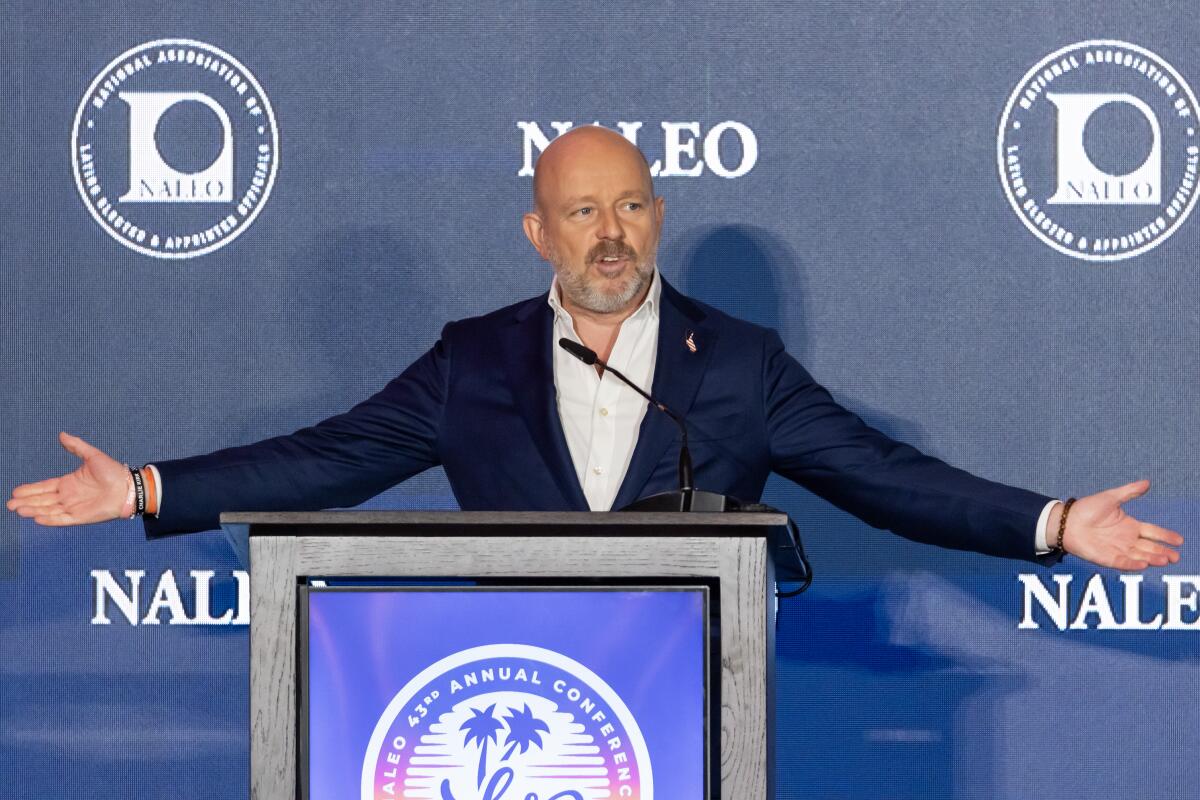
Gubernatorial candidate Steve Hilton speaks at the National Assn. of Latino Elected and Appointed Officials conference in L.A. on Wednesday.
(Myung J. Chun / Los Angeles Times)
The results are not surprising in a state where Democratic voters significantly outnumber Republicans. The GOP has not won a statewide election since 2008.
Just 2% of likely voters said they were unsure which candidate to support in the November election. The poll results skewed heavily partisan, with more than 9 in 10 Democratic and Republican voters picking their party’s respective candidate. Most independent voters leaned toward Becerra, 60%, over Hilton, 34%.
The results are similar to data from a poll conducted just before the June 2 primary election that asked voters to pick between the two candidates. In that survey, 52% said they supported Becerra and 31% were for Hilton.
In a statement Wednesday, Hilton characterized the race as “wide open,” contending that Becerra’s support was weaker than the poll’s headline figures would indicate.
“Instead of a 36-year career politician, we need a positive, energetic problem-solver with business experience and plans to make our state ‘Califordable’ — that’s me,” Hilton said.
Becerra spokesman Jonathan Underland said in a statement that “Californians got to know Xavier Becerra during the primary, and they’re ready to make him their next governor. We’re keeping our eyes on the prize — hitting the trail every day ’til November to turn that support into votes.”
Support for CEQA reform
A ballot measure aimed at reforming the California Environmental Quality Act to speed up construction notched a strong showing in the poll.
Nearly three-quarters of likely voters, including majorities of Democrats, Republicans and independents, said that they would vote for Proposition 45. The measure would shorten windows for environmental review, public comment and legal challenges for certain housing, transportation, water infrastructure and other projects.
“At this early stage in the campaign, California voters are feeling more aligned with Democratic candidates on the environment, and it shows in the polling,” said PPIC survey director Mark Baldassare. “But strong support for Proposition 45 reveals their desire to balance environmental priorities with housing and infrastructure needs.”
Strong data center opposition
The poll found large majorities of Californians do not want new data centers to support the AI boom built in their area; 44% of adults say they “strongly oppose” such projects, and 29% “somewhat oppose” them.
The majority opposition holds across political parties, geographic regions, gender, race and income. It’s especially pronounced in the Inland Empire, where plans for a 950,000-square-foot data center came to a halt after fierce resident pushback. Three-quarters of people surveyed in that region said they oppose building new data centers.
“Every day, we are hearing about how local communities across the nation are responding to plans for data centers,” Baldassare said. “Californians have weighed in and they share this growing concern.”
Support for environmental policies — except if they cost more
The poll also shows strong, if somewhat qualified, support for California’s efforts to reduce climate-warming greenhouse gas emissions and protect the environment.
Three-quarters of adults said policies to reduce greenhouse gas emissions have been a good thing overall, and 65% said they support California leaders’ efforts to make their own environmental policies separate from the federal government.
While most respondents — 62% — said they favor a law requiring 100% of the state’s electricity to come from renewable energy sources within the next two decades, just 38% said they were willing to pay more for electricity sourced from renewables.
“With energy prices spiking and affordability a growing concern, Californians are just not willing to pay more for renewable energy,” Baldassare said. A near-unanimous majority, 96%, said the cost of energy — including gasoline, natural gas and electricity — is a problem.
Newsom’s move to ban the sale of new gas-powered vehicles in the state by 2035 also appears to have fallen out of favor. Two-thirds of Californians oppose the policy, a significant slip in approval from 2021, when a PPIC survey showed 49% supported the move.
Still, majorities of likely voters — 53% and 51%, respectively — said they approve of Newsom’s and the state Legislature’s handling of environmental issues.
At 28%, President Trump’s approval rating on the environment was much lower. In his second term, Trump has moved to slash environmental regulations, including easing pollution regulations on coal-fired power plants and pushing for oil drilling off California’s coast.
“Given this ratings gap, it’s not surprising that Californians want to see the state take the lead on climate change policy,” Baldassare said.
The survey polled 1,578 California adults, 1,003 of whom were likely voters, in English and Spanish from June 29 to July 6 and had a margin of error of 3.8 percentage points in either direction.