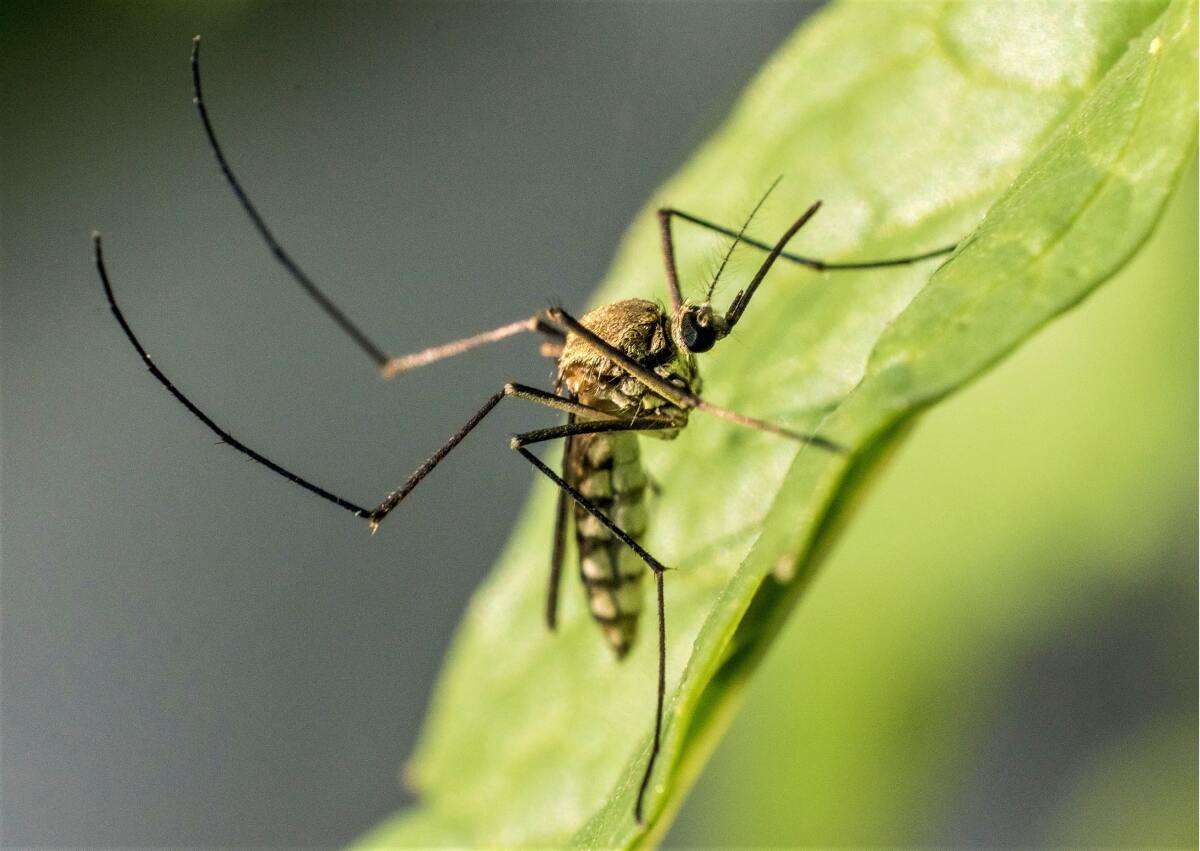
How L.A. hikers can protect themselves from mosquitoes this summer
Given the resilience and diversity of our local mosquito population and our warming climate, Los Angeles doesn’t really have an easily defined mosquito season.
That was one of my biggest takeaways — and bummers — from my conversation with Chris Barker, an epidemiology professor at UC Davis who has studied mosquitoes for almost 30 years, including at his lab.
“I hate to say it, but there are mosquitoes year-round,” Barker said, “and in Southern California in particular, many of your mosquitoes are active year-round, and they don’t go through a reproductive pause, so they’re really just waiting on conditions to be right for biting and for development. In that sense, the warmer [weather], the better for the mosquitoes, and the worse it is for us.”
For this week’s edition of The Wild, our weekly outdoors newsletter, I spoke to Barker about how hikers can best avoid nature’s rudest insect this summer. I wanted to understand what common misconceptions hikers have about mosquitoes, any behavioral changes we can make and what types of trails are most likely to have active mosquito populations. (Spoiler alert: It’s a lot of them.)
First, let’s quickly discuss the mosquitoes that you will find in Southern California, as Barker emphasized to me that we shouldn’t just imagine mosquitoes as one bloodthirsty monolith.
“There are many species of mosquitoes that exhibit a wide range of behaviors, and some species never bite people,” Barker said. “Knowing just a little bit of mosquito biology can help a hiker know when and” where to hike.
Types of mosquitoes found around L.A. hiking trails
In California, there are more than 50 species of mosquitoes, living from below sea level in the desert to above 10,000 feet in our mountains, according to the UC Agriculture and Natural Resources.
Thankfully, our local population is smaller than that and includes:
- Three mosquitoes in the Aedes genus: Often dubbed “ankle biters,” the black-and-white-striped female aedes mosquitoes bite during the day, often around the legs, often multiple times; the most prevalent in Southern California, Aedes aegypti, generally lives where people are, as it depends heavily on manmade water sources to lay its eggs; different species are vectors for different diseases, including Aedes aegypti, which can carry dengue fever.
- Six mosquitoes in the Culex genus: Adults are most active from dusk to dawn; they prefer to bite birds but will bite humans; otherwise, they will rest in cool, shaded dense vegetation; the Southern house mosquito in this genus can transmit West Nile.

Culex mosquitoes bite at dawn and dusk and tend to feed off birds. The Southern house mosquito in this genus can transmit West Nile.
(Orange County Mosquito and Vector Control District)
- Anopheles franciscanus: Living in warm sunny pools with algae; not known to carry disease in California; peak biting during dusk and dawn; included in this list to make us all feel a little better, just in case you worry as much as your local outdoors journalist about mosquito-borne diseases.
- Ochlerotatus sierrensis: Also known as “western treehole mosquitoes,” these little jerks lay their eggs in tree holes, especially oaks, laurels and eucalyptus, and emerge in spring, ready to unapologetically ruin your backpacking trip; these mosquitoes will bite in the day and evening, but are especially active at dusk.
- Ochlerotatus washinoi: Also known as “woodland pond mosquitoes,” which makes them sound more charming than they are, these aggressive daytime biters are typically found in floodwater habitats in early spring; not known to carry disease in California.
A quick 101 on West Nile virus
Outside of an itchy bite or, in rare cases, a severe allergic reaction, the most significant health threat that mosquitoes pose to hikers around L.A. is West Nile virus.
West Nile virus is typically contracted by humans through the bite of an infected mosquito. Most people infected with the virus, an estimated 80%, never know it, because they don’t get sick. About 20% of those infected experience flu-like symptoms, according to the Centers for Disease Control and Prevention.
Less than 1% develop serious illnesses that affect the central nervous system and usually require hospitalization.
Similar to the lack of clarity around who develops long COVID, scientists have yet to identify why certain people develop serious neurological conditions from West Nile. Advanced age, especially in people 65 and older, is thought to play a role, given that with age, the body’s immune system is slower to respond to threats, according to the National Library of Medicine. Other risk factors are thought to include being male; having diabetes, heart disease or chronic kidney disease; or being immunocompromised, according to research.
In recent years, reported West Nile human cases have typically peaked in early September, according to data analyzed by the L.A. County Department of Public Health. This year, West Nile has been detected in traps and in dead birds across L.A., but especially in Cerritos and Long Beach, according to the Greater Los Angeles County Vector Control District.
Given all that we know now about our local mosquito population and risks, let’s discuss Barker’s tips and tricks for how hikers can best avoid getting bit.
How L.A. hikers can best avoid getting bitten by mosquitoes

People walk in and around the Arroyo Seco.
(Carolyn Cole / Los Angeles Times)
1. Consider what water source is near.
I personally love hiking along the Arroyo Seco or San Gabriel River, where it’s often shady and cooler than other parts of Angeles National Forest. Unfortunately, mosquitoes love those areas too.
Mosquitoes prefer standing water, but not permanent water, Barker said. For certain species, this could be a segment of the river where the water has stopped flowing, leaving a nice warm pool for mama mosquitoes to lay their eggs, or even a small puddle.
“When I go hiking … especially in the mountains, I always look in the rock homes next to the streams that have captured snow melt water as it recedes,” Barker said. “Those rock holes keep water through much of the summer, and if you look in those rock holes, you often see hundreds or thousands of mosquitoes in individual rock holes. They’re the immatures that are still developing and will come out and eventually bite people and other animals in the area.”
I was honestly happier before I knew that.
2. Consider the day’s forecast and its effect on mosquito behavior.
“Often these mosquitoes are biting from late afternoon into early evening — so all the times we love to be outdoors,” Barker said.
Like us, mosquitoes are most active when temperatures are warm but not extremely hot. “On our hot days in the summer, mosquitoes will wait until the late afternoon, evening or even morning periods to bite instead of the hottest part of the day,” Barker said.
That said, if there’s a light breeze or it is windy, you’re far less likely to get bitten, as mosquitoes are thought to only fly up to 1 to 1.5 mph.

Dunsmore Canyon in Glendale.
(Jaclyn Cosgrove / Los Angeles Times)
3. Take extra precautions on morning and evening hikes.
Mosquitoes are often most active during these time periods — the ideal summer hiking time. As such, Barker advised hikers to wear baggy light-colored pants and hiking shirts, so that you will remain cool enough under the sun but your skin will be more protected.
You can also pre-spray your clothing with Permethrin, an insecticide that kills and repels mosquitoes.

An Aedes mosquito, commonly called an ankle biter, prefers humans over animals. While Aedes can carry dengue, they do not transmit West Nile virus.
(Orange County Mosquito and Vector Control District)
4. Reapply mosquito repellent.
I generally set a timer for around 50 minutes when out hiking to remind myself to reapply sunscreen, but I rarely remember to reapply bug repellent.
“Most people do kind of a one-and-done application and happily go off and hike, and if you hike for hours, especially if you’re using repellent with either a lower DEET concentration or some other alternatives, you often have to reapply those at more frequent intervals,” Barker said.

Mosquitoes inside a storage container are tested after capture by public health workers for West Nile virus. This particular station is in Pacoima.
(Ronaldo Bolanos / Los Angeles Times)
DEET has long been found to be a highly effective mosquito repellent, but as I reported back in 2024, DEET has a perception problem. Unlike some repellents, it isn’t naturally occurring, which has caused some members of the public to take pause.
“They want something that’s natural. They forget that strychnine [and] ricin are all natural products,” said Walter S. Leal, a UC Davis distinguished professor in molecular and cellular biology, in a 2024 interview, referencing poisons derived from plants. “Being natural does not necessarily mean it is good, and being synthetic doesn’t necessarily mean it is bad.”
Additionally, people often incorrectly associate DEET with the banned insecticide DDT. “This is a big mistake,” Leal said. “There is no chemical similarity between the two.”

The view from a bench at a lookout point near the Saddle Peak Trail in the Santa Monica Mountains.
(Jaclyn Cosgrove / Los Angeles Times)
5. Try coastal hikes to avoid mosquitoes.
“Coastal environments sometimes have fewer mosquitoes,” Barker said. “In L.A., you have that strong temperature gradient as you move away from the ocean, and things get warmer in the inland areas. Cooler areas slow mosquito development, and you tend to have fewer mosquitoes right along the coast.”
This excludes areas near tidal marshes, like the Ballona and Los Cerritos wetlands, where certain mosquitoes can become “quite numerous” if not controlled by local vector agencies.

The Ballona Wetlands Ecological Reserve in Marina del Rey in 2023.
(Genaro Molina / Los Angeles Times)
The coastal breeze also helps hikes along the ocean — like several routes you’ll find in the Santa Monica Mountains or Palos Verdes Peninsula — have fewer mosquitoes.
“And some of the coastal mosquitoes fly inland to find their blood meal hosts before they come back and lay eggs,” Barker said. “So right along the coast is not a bad place to be from a mosquito-biting perspective.”
Did somebody say Type-O Tuesday?

A Joshua Tree and rocks are lit up by the sunrise at Jumbo Rocks Campground in Joshua Tree National Park.
(Allen J. Schaben / Los Angeles Times)
6. If weather allows, hike in the desert to avoid mosquitoes.
“There is no real escape from mosquitoes, I would say, except possibly in the deserts in areas with less water,” Barker said. “That’s your best escape in California.”
If you head out to Joshua Tree, this generally means hiking before 10 a.m. and after 5 p.m., as you will otherwise almost certainly get overheated.
7. Be mindful when taking breaks.
It’s harder for mosquitoes to bite you when you’re moving or when there’s a breeze. Keep an eye out when taking breaks, as this will more likely be the time you get bitten. And often where we like to take breaks is where mosquitoes also like to rest.

A field sample of mosquitoes that could carry West Nile virus is seen at offices of the Riverside County Department of Environmental Health in Hemet.
(David McNew / Getty Images)
“Mosquitoes do tend to rest in areas with vegetation or other vertical structures that protect them from harsh conditions like direct sunlight or strong winds,” Barker said. “The female mosquitoes also search for their blood meal hosts in those areas, which include us.
“Unfortunately for us,” Barker added, “they like a lot of the same areas we do.”

3 things to do

A group of hikers at a Just Trek event.
(Victor Martinez)
1. Celebrate community in Malibu
Just Trek, a local hiking community, will host its seven-year anniversary party at 9:30 a.m. Sunday in Malibu. The group will take a two-mile hike and then hang out at a local beach near a seafood restaurant. Donations appreciated. Register at partiful.com.
2. Behold native botany in L.A.
The L.A. Parks Foundation will host From Trail to Seed, a botany-focused nature walk, from 8 to 10 a.m. Saturday at the Fern Canyon Trail in Griffith Park. Botanist Terry Huang and park ecologist Ryan Kinzel will lead the group as they take a moderately challenging route through the park. $20 donation requested. Register at los-angeles-parks-foundation.givecloud.co.
3. Use your nature skills in Baldwin Hills
The Nature Nexus Institute needs volunteers from 8 to 11 a.m. Saturday for a habitat restoration event in the Baldwin Hills. Volunteers must wear long pants and closed-toe shoes. The work site will include traversing uneven terrain. Learn more at the institute’s Instagram page.

The must-read

Jackie the eagle.
(Friends of Big Bear Valley)
Jackie, arguably the world’s most famous bald eagle mama, died Monday morning after a mysterious illness that veterinarians at the Ojai Raptor Center worked hard to combat. She was 14. Jackie and her mate Shadow transformed into avian all-stars after Friends of Big Bear Valley installed live cameras of their nest. Millions of people across the world tuned in to witness the two eagles raise their young and live their lives in our local mountains. That included Anny Liu of Altadena, who started watching Jackie and Shadow and their little eaglets after losing her community to the Eaton fire in 2025. “Jackie and her family gave me hope and gave me giggles and smiles that I thought were lost with the fires,” Liu wrote to The Times via a reader callout. “My heart felt lighter when I watched her even to this day as we try to rebuild. Never in my life did I expect an eagle would help me so much emotionally and mentally.”
May we continue to allow ourselves to feel these deep connections with our animal neighbors, as it leads to us wanting to protect their homes and, in turn, protect our world.
Happy adventuring,

P.S.
Do you want to help repair damage from the devastating fire that burned across Santa Rosa Island? The California Institute of Environmental Studies needs volunteers to help implement emergency fire recovery work on the island, including rolling erosion control wattles on steep slopes to better protect the Torrey Pine forest from erosion caused by winter rains. To learn more, you can email Destinee Rabelo, the center’s restoration ecologist field lead, by using the email linked in the organization’s Instagram post. Have fun out there!
For more insider tips on Southern California’s beaches, trails and parks, check out past editions of The Wild. And to view this newsletter in your browser, click here.