Can a new minor league team compete with Angels, attract fans?
The checklist to launch an independent minor league baseball team is long and daunting. Can you find a place to play? How do you find enough players, and make enough money to pay them? How can you persuade a community to support a home team?
Here’s a new one: If minor league baseball is all about affordability, how do you compete against a nearby major league team that might undercut you on pricing?
This astounding dilemma is brought to you by the Angels, and their combination of a consistent focus on affordability and a consistently bad team.
Zach Neto is the best player the Angels have drafted and developed since Mike Trout — that is, in the past 17 years — and the team is considering whether to trade Neto ahead of next week’s trade deadline. That might make the team better in the long run, but almost certainly not next year.
And, next year, the Angels will have competition for the Orange County baseball dollar, a few exits down Interstate 5. On Tuesday, the Irvine City Council approved a five-year agreement under which a yet-to-be-named minor league team would play at the sparkling ballpark within the city’s Great Park, starting next May.
“We might not, on certain days, be the cheapest ticket in town,” said Paul Freedman, co-founder of Innovation Baseball Partners, the company for which the Irvine team is the fourth in its portfolio of minor league teams, all based in California and all competing in the Pioneer League, where players are limited to no more than two years of professional experience.
No ticket prices have been announced for the Irvine team. Jamie Rosenberg, another IBP co-founder, told the Irvine City Council that the IBP team in Long Beach charges roughly $10 to $15 for general admission, with a $2 special every Tuesday.
“The idea is to make this an accessible, affordable entertainment option for the community,” Rosenberg said.

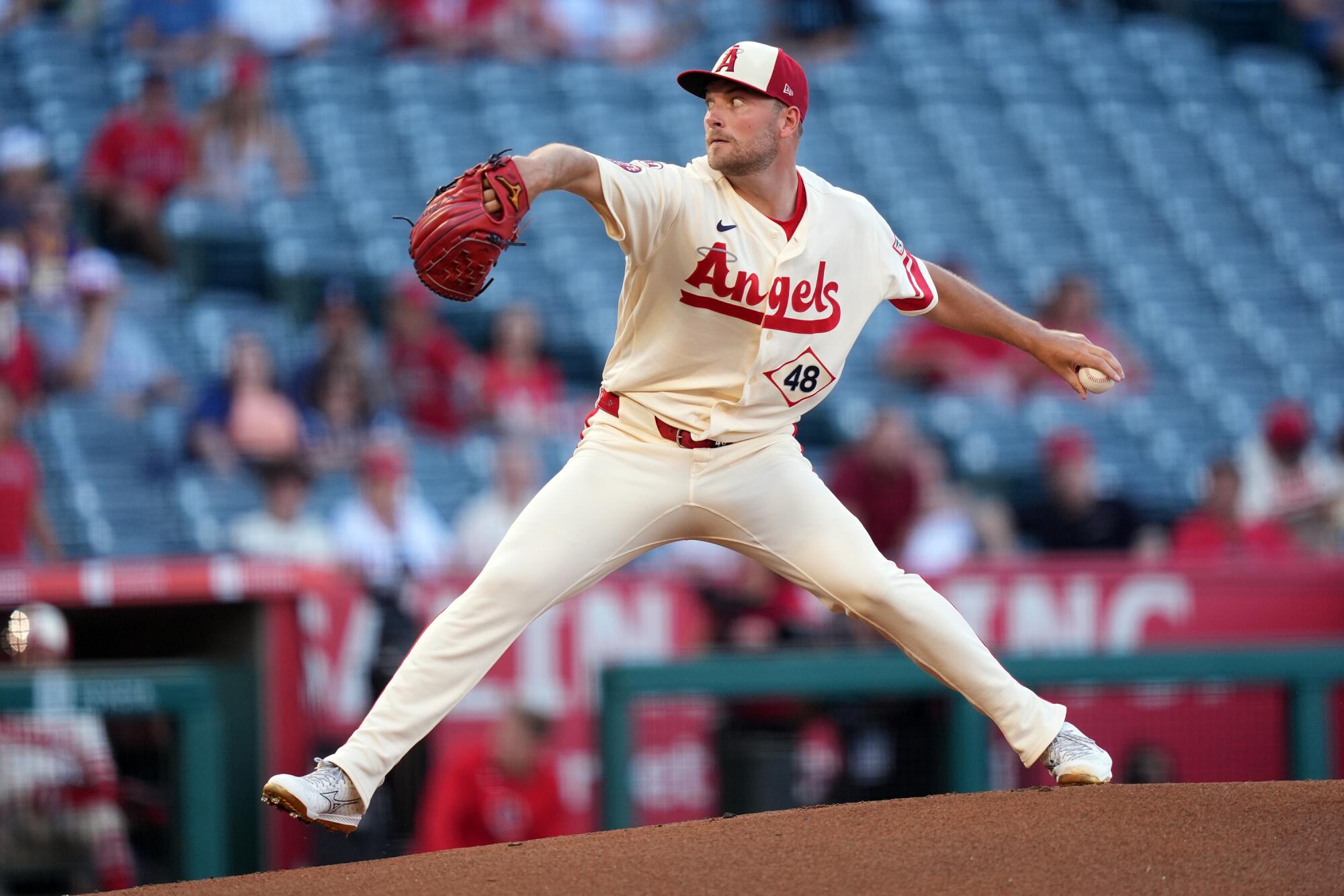
Angels pitcher Reid Detmers throws from the mound against the Houston Astros in front of a sparse crowd Tuesday at Angel Stadium.
(Scott Strazzante / Associated Press)
On Tuesday, three hours after Rosenberg spoke, the Angels played the Houston Astros at Angel Stadium. On StubHub, you could buy a ticket for $2.
“I think Angel fans would hope the team gets better and maybe those prices would go up,” Freedman said, “but what we’re confident in is that we’re going to have a value experience.”
On Tuesday and every other day at Angel Stadium, the Angels proudly display a sign advertising a collection of what the team calls its “family value merchandise.” A T-shirt or a cap can be yours for $9.99, and a souvenir baseball with the team logo sells for $7.99.
“We really focus on a family of four,” Freedman said. “Can a family of four afford a night out?”
The Angels offer a family package — four tickets, four hot dogs, and four drinks — for $44.
You may remember what Angels owner Arte Moreno said in spring training: “The number one thing fans want is affordability.”
That infuriated Angels fans, of course, since their team has baseball’s longest playoff drought — 12 years, counting this one. Freedman says the fans of his teams want affordability too, but he cautioned against stretching the comparison too far.
For one, Trout plays in Anaheim. You can see a future Hall of Famer there all summer, and stars from around the league, and you can see the Yankees and Red Sox and Dodgers every year.
“We’re not ever going to replace the majesty of going to see the Dodgers with Shohei [Ohtani] playing,” Freedman said, “but we can create an environment that’s more fun.”
For two, whatever $2 tickets you might find in Anaheim put you in the vicinity of the top of a foul pole. All the tickets in Irvine put you right behind home plate, because there are barely 1,000 seats.
And, for fun, Freedman and his partners are planning to become the first American team to integrate elements of the Asian fan experience into the game presentation.
“We want to be doing things you haven’t seen in an American baseball game before,” he said, “and we want to put a fair price on that, one that is reasonable and allows us to operate our business.”
The traditional minor league team operates far from the shadow of a major league team. The Pioneer League, for instance, has teams in the California towns of Modesto and Marysville, and in Idaho Falls and Missoula, Mont.
The Irvine launch will be different and challenging — and, yes, fun. But success depends on paying customers, and nothing attracts customers like a trial offer.
And it just so happens that major league owners could still be locking out players by the time the Irvine team opens play next May.
“It would be terrible for the game,” Freedman said.
“As a baseball fan, it would break my heart. But it could be good for business.”