moratorium

Becerra would extend moratorium on death penalty if elected governor

Democrat Xavier Becerra defended the death penalty while serving as California’s attorney general, a punishment his office actively sought in the case of a gunman convicted of an Orange County mass shooting, but as the front-running candidate for governor he has vowed to block executions if elected in November.

Becerra said he will extend the blanket reprieve for all death row inmates that Gov. Gavin Newsom enacted by executive order in 2019, saying he supported “moving our state away from a costly, flawed system that disproportionately impacts Black and brown communities and too often gets it wrong.”

Those comments have reassured anti-death penalty advocates wary of Becerra, who has stated throughout his career that capital punishment should be an option for victims seeking justice. He reiterated that stance just a decade ago during his confirmation hearing for attorney general, though he also expressed concerns about the unjust application of the punishment.

“I support the death penalty, but I hate the way it’s being executed,” Becerra told state lawmakers in 2017.

“If you commit some heinous crime where you have taken the life of someone else, and you knew that there was a death penalty in place in that place where you committed that crime, then you should face the punishment for what you’ve done,” he explained. “It doesn’t give me pleasure to say that, but I simply do believe there’s a simple justice in that.”

Becerra’s challenger in the Nov. 3 election, former Fox News commentator Steve Hilton, opposes the death penalty but said he would rescind Newsom’s moratorium because it defies the will of voters.

Becerra has said he is concerned by how death sentences historically have been applied, including a highly disproportionate number of condemned inmates who are Black or Latino men and cases in which they later have been exonerated of crimes.

He repeated similar positions last year during a gubernatorial forum in Los Angeles.

“I do not believe every Californian has gotten a fair verdict in these fights,” he said in response to a question about extending Newsom’s moratorium. “But here is what I will tell you: We have to be aggressive in going after crime, especially the most heinous crime. … I will make sure that we have a judiciary system and a prosecution system that takes into account that we must show fairness.”

Though California has not performed an execution since 2006, prosecutors in some areas of the state continue to seek and win death sentences. As of early August, there were 565 condemned inmates in California prisons, according to the state Department of Corrections and Rehabilitation.

Newsom’s moratorium stops the state from carrying out those sentences.

In California, county district attorneys are responsible for prosecuting the vast majority of accused murderers when they go to trial and also deciding whether to seek the death penalty. The office of the state attorney general is responsible for defending death penalty convictions on appeal.

Becerra sought the death penalty in a murder case his office prosecuted early in his tenure, though unsuccessfully. Scott Dekraai, who was convicted of killing his ex-wife and seven others in a shooting at a Seal Beach beauty salon, was sentenced to life in prison without the possibility of parole after a prosecution scandal involving his case.

Some death penalty opponents criticized Becerra for fighting to uphold the death sentence of Robert Lewis Jr., who was deemed by the California Supreme Court in 2018 to have an intellectual disability that made him ineligible for execution.

“I find that reprehensible,” said Mike Farrell, president of Death Penalty Focus, an advocacy group. A longtime anti-death penalty activist, Farrell is better-known for starring as B.J. Hunnicutt in the TV show “M*A*S*H.”

“It may not have been his idea, but he was part of that process,” he said of Becerra.

Others said Becerra cannot be blamed for doing his job. Former Vice President Kamala Harris faced the same dilemma when she served as state attorney general, as does Rob Bonta, who currently holds the office.

“The AG is in a different position because it’s just inherent in their role to defend convictions and sentences,” said Natasha Minsker of the California Anti-Death Penalty Coalition. “For example, Kamala Harris is very strongly personally opposed to the death penalty and still, while she was AG, the office defended hundreds of death sentences. Same with Rob Bonta. He’s very clearly personally against the death penalty, and his office continues to defend death sentences.”

Becerra’s campaign declined an interview on the subject and referred to his statement in support of extending Newsom’s freeze on executions.

Hilton, his Republican opponent in the race, holds starkly different views.

“If you’re arguing that taking a life is such a serious crime, then I don’t think responding by taking a life actually makes that argument,” he said in an interview last month.

But he said California voters spoke clearly by voting twice — in 2012 and 2016 — against ballot measures that would have repealed the death penalty. “I don’t think it’s OK for a governor to just substitute their personal opinion on an issue where the voters had an explicit and direct say,” he said.

“I strongly believe in holding people accountable for what they do,” Hilton said. “But my sort of fundamental belief is that if we’re saying it’s wrong to kill someone, then the state shouldn’t be doing it, either.”

Hilton also would roll back Democratic-led reforms that have shortened many inmates’ prison sentences by allowing them to seek parole sooner.

End or extend? It’s not that simple

Even if a governor rescinds the moratorium, resuming executions would be a long and complicated process because the state has no approved protocol or facilities to carry out death sentences.

Newsom ordered the dismantling of San Quentin’s death row and execution chamber. Even before he took office, the state’s use of lethal injection drugs was part of a long-running and now-dormant legal battle. And a dwindling number of attorneys who specialize in death penalty cases meant 70% of condemned inmates did not have a lawyer at the end of last year, according to a state report.

California’s death penalty also faces a new legal challenge from groups arguing that capital punishment cases have been administered in a way that is racially discriminatory. In May, the California Supreme Court ordered the attorney general’s office to respond to the arguments and assigned the case to a superior court.

The shifts in California’s criminal justice system are reflected in legal battles waged by the pro-death penalty Criminal Justice Legal Foundation, a nonprofit that supports victims of crime and their families in court.

“We used to do a lot of work in the capital punishment area because that was the area where justice and the sentences were under the greatest attack,” said Kent Scheidegger, the group’s legal director.

But as California’s Democratic-controlled Legislature, governor and, at times, voters adopted measures aimed at reducing the prison population, Scheidegger said the foundation’s efforts increasingly are focused on preserving “the finality of sentences.”

Many capital cases were negotiated as “plea bargains to life without parole on the express promise that this will provide the finality that the victims need most,” he said. “Life without possibility of parole, until recently, meant life without possibility of parole. And now we’ve got one action after another coming out of the government to break down that finality and give people sentenced to life without parole opportunities to get out.”

The group has challenged attempts to expand early release for violent offenders under 2016’s Proposition 57 and new regulations that would allow people sentenced to life without the possibility of parole to seek release.

Twenty-seven states allow the death penalty, but governors in four of them — California, Ohio, Oregon and Pennsylvania — have paused executions.

Slow shifts in public opinion

Attitudes about capital punishment have shifted over time. A 2025 Gallup poll showed 52% of Americans favor the death penalty for people convicted of murder, down from its peak of 80% in 1994.

In a 2023 survey by the Public Policy Institute of California, 62% of adults in the state said they “strongly favor” or “somewhat favor” the death penalty in murder cases. When asked which punishment they prefer for a first-degree murder case, 55% said life without parole and 43% chose the death penalty. More than three-quarters believe there “is some risk that an innocent person will be put to death.”

Despite the changing opinions, Minsker, of the California Anti-Death Penalty Coalition, said there’s little appetite for another repeal attempt because of how expensive ballot measure campaigns have become.

“I am personally one of the strongest proponents of ending the death penalty, and I am not sure I would spend $30 million on that right now, given all the other needs that California has,” said Minsker, a former attorney for the American Civil Liberties Union who ran the unsuccessful 2012 death penalty repeal measure.

Putting an anti-death penalty measure on the statewide ballot also could have put Newsom in an precarious political position. If it failed, Californians would be sending a stinging rebuke to the Democratic governor’s executive decision to grant a blanket reprieve to all condemned inmates.

Minsker is leading a group of criminal justice advocates, faith organizations, prosecutors, murder victim family members and others urging Newsom to commute every death sentence in California before he leaves office.

But advocates are unsure whether Newsom, who is considering a run for president in 2028, would risk the backlash a mass commutation would probably bring. The California Supreme Court also must review executive clemency actions for inmates with more than one felony charge.

Commuting all death sentences to life in prison “would be the coup de grâce,” Farrell said. “However, politically, I’m sure those who are advising him are urging him to have caution in that regard.”

Source link

California lawmakers reach deal in high-stakes fight over regulating data centers

After weeks of intense negotiation, state lawmakers on Friday reached a compromise on legislation to regulate energy use by California’s growing data center industry, action triggered by community anger over the facilities and fears of high utility bills in some communities.

The goal, according to legislators and advocates, is to protect consumers from growing electricity costs driven upward by the sprawling facilities and to track the centers’ immense energy and water consumption.

Business groups representing tech companies argued that some of the proposed restrictions and requirements, along with California’s high energy costs and lack of available land, would make it difficult for data centers to open in the state.

Municipalities risk missing out on tax revenues and jobs from the centers if the industry goes elsewhere, they said.

Two bills to regulate the controversial industry consumed the state Legislature in the final weeks of the 2026 session, drawing in Gov. Gavin Newsom and industry organizations and lobbyists representing some of the world’s most influential companies, including Google, Meta, Amazon and artificial intelligence firms such as Anthropic and OpenAI.

Proposed legislation by Sen. Steve Padilla (D-Chula Vista) and Assemblymember Rick Chavez Zbur (D-Los Angeles), finalized Friday, would establish special rules for data centers’ electrical use. The legislation requires the California Public Utilities Commission to create special rates and updated rules for data centers’ use of electricity, including the costs for new power for infrastructure upgrades.

The debate in Sacramento around the data centers centered on how much they should pay for power and infrastructure, and whether that should be mandated by the state Legislature or the California Public Utilities Commission, which regulates investor-owned utilities and is controlled by a board appointed by the governor.

Unlike some other states, California hasn’t seen an overwhelming wave of new large-scale data centers, nor have state leaders sought moratoriums such as the ones enacted by governors in Texas and New York.

An aerial view of a 49.5-megawatt data center under construction in Vernon last month.

An aerial view of a 49.5-megawatt data center under construction in Vernon last month.

(Myung J. Chun / Los Angeles Times)

Nevertheless, advocates focused on reforming the state’s utilities sought this year to seize the moment to enact tough regulations, including forcing data centers to pay for transmission upgrades and wildfire mitigation efforts.

Utility reform advocates and environmental leaders offered mixed reaction on Saturday.

Matthew Freedman, a senior staff attorney for The Utility Reform Network (TURN), praised the final language in the two bills, saying the legislation would prevent data center costs from “being foisted on other customers” while helping California meet its clean energy goals.

Monica Embrey, the founder of Affordable Energy Campaign, called the last-minute amendments “concerning.”

In particular, she pointed to a lack of clean energy requirements for data centers who use their own energy, and a provision that allows a utility to enter into its own agreement with a data center for energy in the interim period before the state finalizes its regulations.

A representative for the Data Center Coalition, whose members include Google and Microsoft, didn’t immediately respond to a request for comment.

Data centers have existed for decades but are rapidly expanding because of the rise of artificial intelligence, or AI. The centers help power everything from streaming services to videoconferencing calls.

Data centers in California are typically smaller than the mammoth, 500+-megawatt AI facilities making headlines in other parts of the country. Electricity costs and state regulations on gas-powered generators limit the vast majority of them to under 100 megawatts.

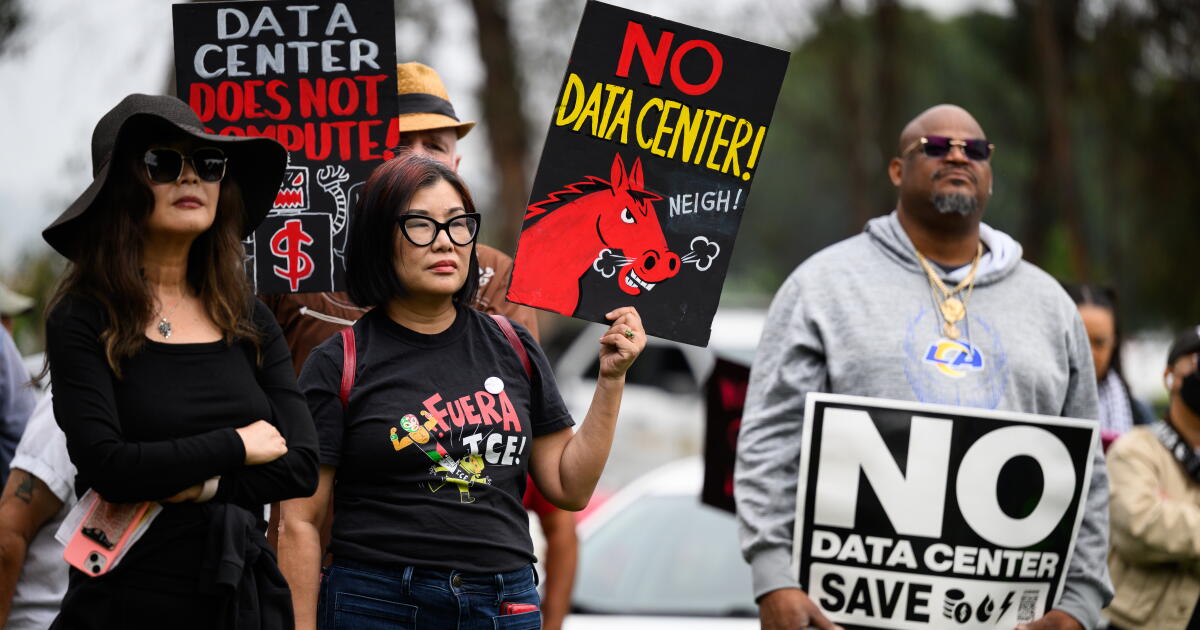
But as proposals increase in number, opposition has been fierce and growing.

A Public Policy Institute of California poll from July showed that 73% of residents oppose the construction of data centers in their communities.

Opposition centers on water use, air and noise pollution, and the potential for data centers to raise utility bills as they add strain to the grid requiring costly upgrades and new electricity supply.

The California Energy Commission expects data center electricity use, currently 2% of the state’s demand, to double in the next 10 years.

Monterey Park became the first city in the country in June to permanently ban data centers by a popular vote, and at least four other San Gabriel Valley cities have enacted moratoriums.

Southeast of L.A., Imperial County, Desert Hot Springs, and Palm Springs also voted on moratoriums, while Coachella permanently banned the facilities. In the Central Valley, Tulare County adopted a moratorium this month as residents voiced opposition to proposals to develop tiny data centers on local fairgrounds in the region.

And in San José, the state’s hot spot of data center development, residents flooded a recent public hearing to call for a moratorium while the city updates its data center standards.

Newsom last year vetoed legislation by Assemblymember Diane Papan (D-San Mateo) that would have required data centers to disclose and certify their water consumption. The governor said he was reluctant to impose “rigid” reporting requirements on the development of “this critically important digital infrastructure.”

Separate bills that would require the centers to disclose their energy and water use were recently approved by state lawmakers.

Like other state legislators, Papan said she wants to work with the centers, not ban them.

“I constantly say, ‘Help us help you.’ We will all get this right if we can just be transparent and methodical,” said Papan, whose district includes Silicon Valley.

Padilla’s district includes Imperial Valley, where a developer’s plans for a data center on 75 acres is sparking fierce backlash.

Advocates and lawmakers fought over two approaches on the issue of regulating data centers’ energy use.

A wider coalition of environmental groups supported the bill from Padilla, SB 886, sponsored by TURN, that would have required data centers to pay up front for broader power grid updates required to meet their demand. That approach made it into the final package.

TURN pointed to a recent transmission plan from California’s grid operator projecting that increased power demands from data centers in PG&E‘s service territory, where the majority of current and proposed data centers are concentrated, would create up to $1.8 billion in upgrade costs for the power grid, including transmission lines.

PG&E favored a less stringent approach. In an email earlier this week, a PG&E spokesperson argued SB 886 would “risk higher costs for customers and delay critical infrastructure needed to serve the state’s growing energy demand.”

The Data Center Coalition had opposed both bills for “singling out” one type of power user.

The high cost of land and power, as well as lack of available land, are just some of the reasons that California hasn’t seen a flood of data centers, said Khara Boender, a director of government affairs at the Data Center Coalition. She said dozens of states offer some type of exemption for data centers, but California does not.

Additional regulation in the Golden State, she said earlier this week, “would be another signal that the state is a more challenging place for data center development.”

Source link