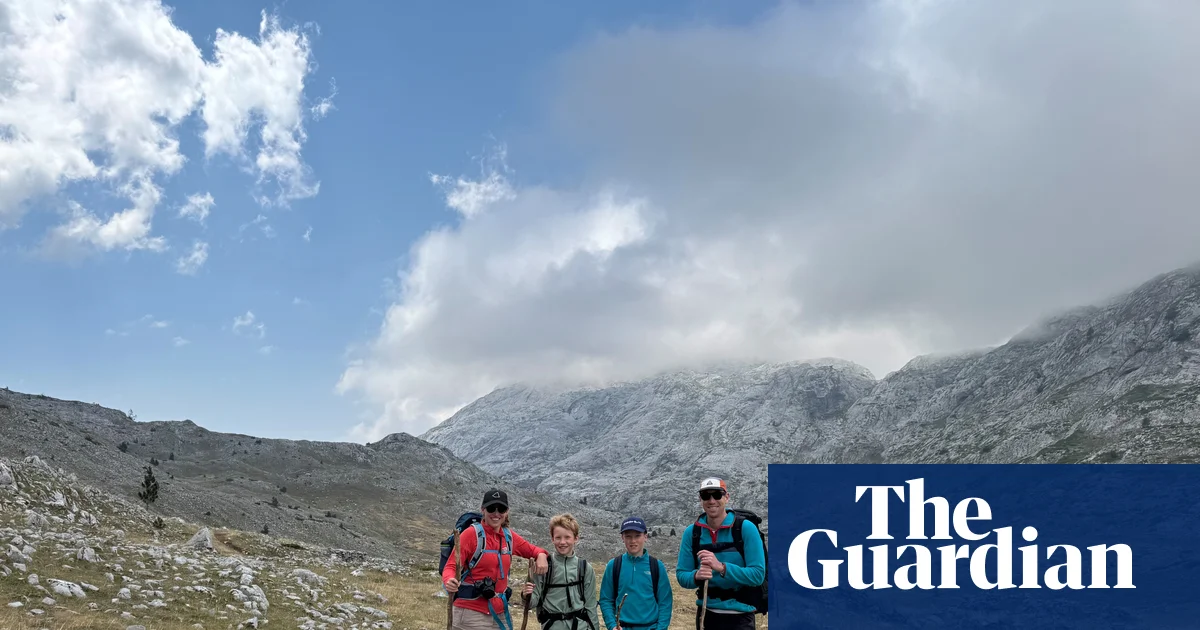
‘Landscapes as wild as they get in Europe’: family hiking in Albania and Montenegro | Albania holidays
‘Uno, Uno, Uno No Mercy!” the six-year-old son of our hosts for the day bellows while leading my boys, 10 and 12, into his dimly lit corrugated iron home. I let out a little sigh of relief. The popular card game is a much-needed icebreaker as ominous clouds close in on the remote stan (the Albanian word for a shepherd dwelling). Despite the language barrier, much laughter and consternation soon spill out of the darkness, just as hail hammers down on the tin roof. Dogs bark, chickens cluck and sheep bleat as the thunder grows louder, and we all – our eight hosts, seven guests and one guide – shelter in the tiny kitchen, the living room-cum-bedroom (now Uno parlour), or on the veranda.
It’s day two of a seven-day trip with Undiscovered Balkans, crisscrossing between Albania and Montenegro on foot and by car. Having always wanted to hike the Peaks of the Balkans trail, a 119-mile (192km) hike linking Montenegro, Kosovo and Albania, I jumped at the chance to sample this new guided itinerary. Combining some of the region’s most famous hikes with gentler excursions for kids, such as a day experiencing life as a shepherd, or visits to remote swimming spots, it seemed a novel alternative to our usual “get a map and hope for the best” approach to hiking holidays.
The trip starts in Podgorica, Montenegro’s unassuming capital, where we meet our guide, Aurora (one of just a handful of female Albanian mountain guides), Emma, a cofounder of Undiscovered Balkans, and her daughter and friend, who join us for the first few days. Before any of us can complain about the heat (it’s edging up towards the high 30s), we jump in a minibus to cool off at a popular local swimming spot on the Cemi River, then cross into Albania and weave up cooler mountain roads to the remote village of Lëpushë.
Here, surrounded by orchards, beehives and terraced fields, and mesmerised by the dense forest and serrated limestone peaks beyond, we make Bujtina Lëpushë guesthouse our home for two nights. “You’ll realise how quiet this is when you get on the main Peaks of the Balkans trail,” Emma says. The trail receives more than 40,000 visitors a year, so spreading the love outside the well-trodden route helps reduce overcrowding and provides an economic lifeline for villages like Lëpushë.
Our day playing Uno under a tin roof is our first taste of Albania’s easy-going hospitality and millennia-old rural routines. The day trip from Lëpushë to the stan is organised by Nina, who runs the Shepherd’s Way, a community tourism project that helps Malësorë (highlander) shepherds earn extra income while sharing their way of life. “The ancient transhumance [moving sheep to high ground in summer] still carried out by 12 families here was recently awarded Unesco world heritage status,” she says as we walk to the stan from our guesthouse, swifts darting overhead. “While working on that project as a photographer, I felt compelled to do something to support this precious culture, and so now work with the families to offer experiences on their terms.”
The weather soon scuppers the plan to spend the day herding and milking sheep. Instead, hours drift by baking bread, playing Uno, losing arm-wrestling contests and sipping mountain tea. “Boredom is a big part of shepherd life,” Aurora explains, noticing our slight discomfort at doing nothing. By the end of the day, however, as the sun breaks and the boys rush out to play football in fields of butterflies, we realise communal boredom is probably the best cultural immersion you can find.
The next day is our first hike of the trip, following a deserted footpath from Lëpushë through beech forest and open plains to the 1,859-metre summit of Maja e Vajushës (Volušnica in Montenegrin). “And that’s Montenegro – we’ll be sleeping down there tonight,” Aurora announces, as we look out towards a sea of mist pierced only by an eerie flock of choughs. It’s supposedly spectacular on a clear day. At the second of our five border crossings, the kids take a while to wrap their heads around the geography, but Aurora explains that the border follows the Accursed Mountains, as we are doing. Having raced up, we take our time meandering back down, picking wild blueberries, stopping for freshly made yoghurt in a stan and buying honey from the village hive cooperative along the way.
After our hike, a 40-minute drive from Lëpushë – via a brilliant blue, refreshing swim spot at Kanioni i Bashkimit canyon – whisks us back into Montenegro to spend the night at Eko Katun Rosi, a cabin camp in Vusanje. The presence of hiking groups from all over Europe gives away that we’re now on the main Peaks of the Balkans trail, as do the surrounding soaring peaks and the portion sizes (there’s no shortage of meat and cheese in these parts). On the way, we notice that the call to prayer has replaced church bells. “It’ll be churches tomorrow and mosques the day after,” Aurora says. Even religion is dictated by geography here – Christianity survived in the valleys that the Ottomans couldn’t reach.
The next morning, we drive around small farms to the Prokletije national park and start a 10-mile hike over the border at Qafa e Pejës pass and into Theth valley – the heart of the Peaks of the Balkans trail. It’s the longest and steepest hike of the trip, and we’re grateful for Aurora’s careful pacing as butterfly- and cricket-filled meadows give way to a steep hairpin path. At the top, we shelter behind an abandoned gun post to eat a picnic lunch straddling the border. With about six gun posts for every square kilometre of land in Albania, we’re not short of opportunities to ask Aurora about life under communism. Tales of hiding goats underground to make sure there’s enough milk for all the family keep any moans about sore legs at bay.
The descent into the sprawling village of Theth feels a world away. Hot pine forests tumble down steep yellow cliff faces, lizards dart between fallen rocks, and caves offer shady water stops. In the valley below, dry riverbeds carve ashen-grey scars across dense forest as far as the eye can see. Exhausted, we hitch a lift to our bed for the night from the first cafe we find.
As we drive past Theth’s sprawling bars, camps and lodges, some of which have been destroyed recently as part of a government clampdown on unofficial development, we’re grateful to spend the night in a quieter hamlet just above the town. Marash Rrgalla guesthouse is a 200-year-old working kulla (farmhouse) with five comfortable rooms, a bucolic garden and a cat called Sweetie. The boys run off to meet the pigs and the cow, and in true Albanian style it’s not long before we’re enjoying a homegrown, homemade feast as the sun dips, turning the Albanian Alps pink.
After a day off the trails, dipping in and out of Theth’s swimming spots at Nderlyse pools and the Blue Eye of Kaprre – “Finally, we get a day to swim!”, the 10-year-old exclaims – we embark on the iconic hike from Theth to Valbona. Unlike on our previous hikes, the path is packed with people from all over the world, so the day is peppered with passing chats. “Wow, so young! Well done, boys!” an American hollers as we reach the narrow top of the 1,800m Qafa e Valbonës pass. With no other kids in sight, the boys are rightfully chuffed and celebrate with a plate of chips – the first of the holiday – once we’ve completed the dusty and hot descent to Valbona.
From Valbona, we spend the next two days travelling by car and ferry towards our final stop, Shkodër. Despite pockets of nature and peace, including a ferry trip down the steep-sided Komani Lake, and standup paddleboarding with egrets and kingfishers on Lake Shkodër with Drini Times, we soon find ourselves longing for the mountains.
Although grateful for holiday staples like ice-creams, chips and Fanta in Shkodër, building sites, roadworks and litter bring home the fast pace of change in a country on the move. The contrast makes our time in the mountains, surrounded by centuries-old traditions and landscapes as wild as they get in Europe, feel like an enormous privilege, particularly with the kids in tow.
Undiscovered Balkans’ seven-day Albania and Montenegro family hiking trip costs from £1,195pp, with departures on any Sunday in June, July or August