monsters

Why ‘Monsters of God’ is personal for director Eric Goode

This time, it’s personal for Eric Goode.

The director’s first two docuseries — “Tiger King” and “Chimp Crazy” — were smash hits about larger-than-life characters engaging in questionable and illegal activity surrounding the care and ownership of animals. Both had an underlying conservation message but drew viewers in with the colorful and chaotic worlds they depicted.

Goode’s third, “Monsters of God,” premiering Thursday on HBO, is both a direct descendant and forges a new path. While it also features a hugely entertaining menagerie of criminals, who speak frankly about many of their illegal acts and how much they dislike each other, “Monsters” is largely a historical look at reptile smuggling going back more than half a century — unlike the contemporaneous stories in “Tiger King” and “Chimp Crazy.”

Goode had opportunities to bring in current events — one dealer was rearrested shortly after being filmed and there were major smuggling arrests in California in recent years — but realized he couldn’t keep piling on more stories. “We’re just setting the tone of this multibillion-dollar reptile-smuggling industry that you’ve probably never heard of,” says Goode’s producing partner Jeremy McBride.

But the other difference is that Goode has spent his entire life immersed in the world of reptiles, starting long before he even contemplated making a documentary. Goode had a pet tortoise when he was 6 and slept with a tegu lizard in his bed as a teen. He also saw the industry underbelly up close and personal. “In the ’70s and ’80s, I even bought reptiles from some of the very people that I chronicle in ’Monsters of God,’” he says.

“I had personal connections in these worlds, which helped us go much deeper than in my other stories,” he says. “I don’t know if it’ll be anywhere near as successful, but in terms of investigative journalism, we went much further.”

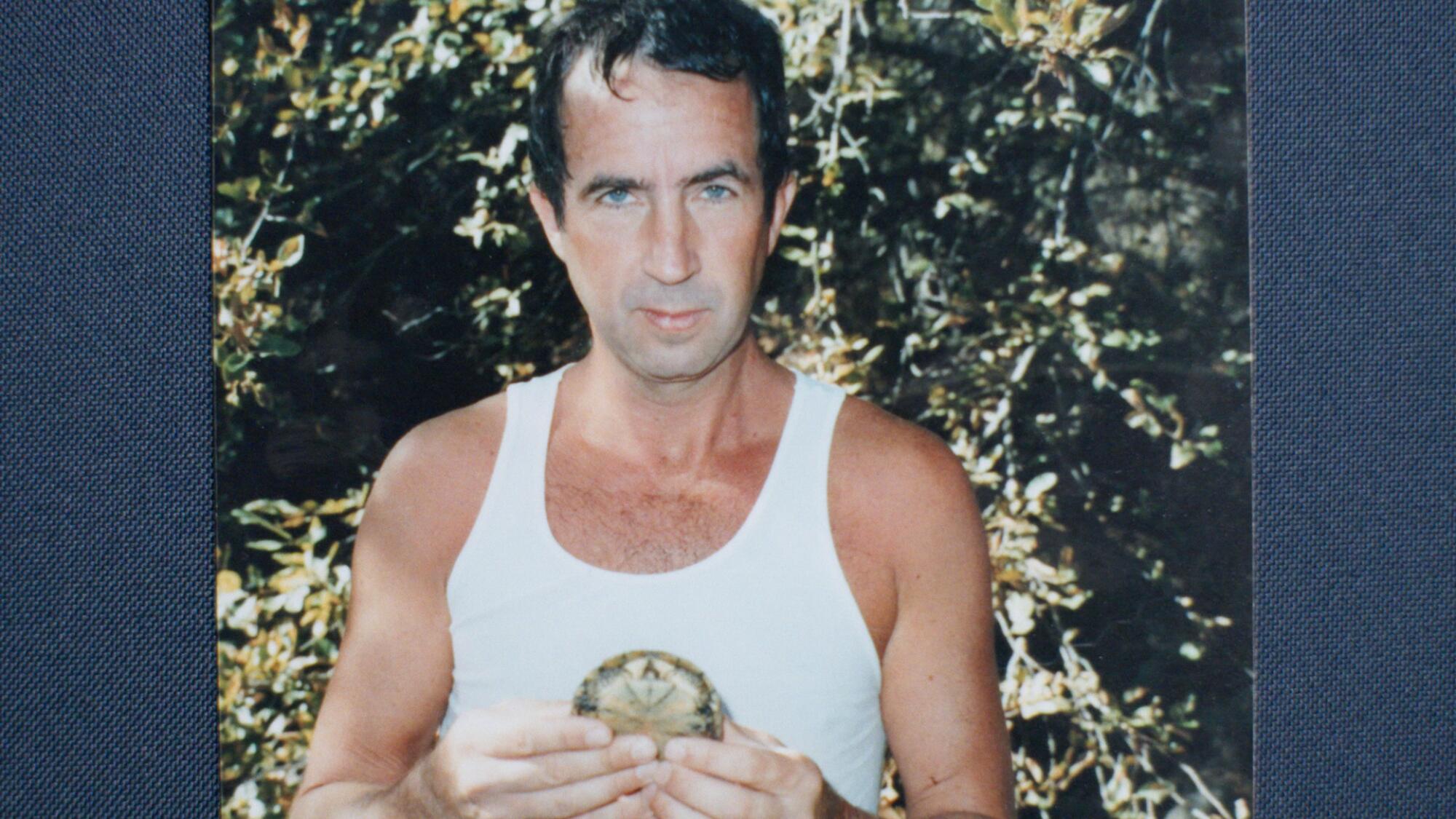
A man in a white tank top holding a small turtle in his hands.

An archival photo of director Eric Goode with a southwestern pond turtle. In addition to filmmaking, he created the Turtle Conservancy in Ojai.

(A24 / Goode Films / HBO)

(He also acknowledges that his earlier series could tilt toward sensationalism and be exploitative. “I was naive when I started all this and learned a lot from ‘Tiger King,’” he says, adding that there was internal friction about what direction to go with the material. “Now we’ve refined the like-mindedness of what we were trying to do.”)

He credits his mother with opening his eyes to the larger issues when he was younger. “She struggled with me keeping things in captivity and would say, ‘You can’t play God, these animals belong in the wild.’”

That said, while he is proud the Big Cat Public Safety Act passed in the aftermath of “Tiger King” and believes people should be banned from raising chimps at home, he views reptiles differently. “Kids should be able to have a bearded dragon or a leopard gecko or ball python. It nurtures a love for nature and for reptiles,” he says, adding that he’s focused more on the harm caused by smuggling.

Despite his love of animals and a high school obsession with making Super 8 film, Goode was not, for much of his life, a likely candidate to be directing these documentaries. “My whole trajectory doesn’t make a lot of sense on paper,” he acknowledges.

After attending the School of Arts and Sciences, which his father founded in Marin County, Goode moved to New York. He worked as a production assistant on big films. “I hated it,” he recalls. “I hated being a cog in a wheel, just moving things around.” (Today, even as his productions have grown more elaborate, he still goes into the field with a small team. “I like that intimacy.”) He also went to art school but was largely bored there.

“I saw the creative energy in New York in the nightlife there,” he says. So while Goode was working as an artist, he also created Area, one of the city’s biggest nightclubs of the 1980s, where he brought in collaborators like Jean-Michel Basquiat, Keith Haring, David Hockney and Kenny Scharf, with rotating themes like a carnival or natural history (which featured snakes and lizards). “Everyone came from somewhere else or were misfits and I was bringing in these interesting characters, which is very similar to what I’m doing in these films,” he says. “I like lifting up the rocks and finding the eccentrics out there.”

Area’s success led to a big career in nightclubs, restaurants and hotels. Then 20 years ago, he took his profits, along with his passion for reptiles, and created the Turtle Conservancy in Ojai. “I realized that the two most endangered groups of vertebrates in the world were primates and turtles,” he says, adding that nearly half of the smuggled animals seized at LAX in the last three years were turtles. When officials recently confiscated 350 turtles there, they brought them to the conservancy to care for them. “I’m going to go feed them after this interview,” Goode says.

The conservancy now has a worldwide reach in protecting turtles and their habitats and has become a leader in trying to stave off extinction for the ploughshare tortoise, whose fate is a major storyline in “Monsters of God.”

A giant lizard on a log with a man in a white T-shirt and blue shorts kneeling behind it.

Tom Crutchfield, one of the reptile smugglers featured in the docuseries, with a monitor lizard in a photo taken circa 1970s.

(Photograph by Bill Love. Courtesy of Goode Films / HBO)

As filming was finishing, the conservancy became home to the first ploughshare births in captivity. “It was such a coincidence but really meaningful,” McBride says. “It anchors the film’s purpose and gives a little bit of hope in what otherwise feels bleak.”

This docuseries has been in the works for nearly 20 years, since Goode read Brian Christy’s “The Lizard King” in 2008 and tried to option it. “I even filmed him badly back then — the sound was terrible and the camera fell off the tripod during the interview,” he recalls. (Christy appears in the docuseries.)

In 2014, he finally got started but it was always on and off again as other projects got in the way. In “Tiger King,” Goode shows he’s first drawn to that story when he sees a guy with a snow leopard in his van, which happens while he’s filming Tom Crutchfield, one of America’s most notorious reptile smugglers. “But while I was making these other stories, I was always opportunistically filming reptile people,” he says, adding that they interviewed not only the criminals but federal law enforcement and others, seeking a broader scope than his previous films. “It was critical for us to get all sides of the story. Part of the reason it took so long was it sometimes took years to get someone to agree to talk.”

McBride says they finished with 1,500 hours of footage and interviews with a hundred different people, including the most notorious smugglers (some of whom were also murderers and drug dealers) and the law enforcement officials who dedicated years of their life undercover to catch them.

It’s a true crime story on some level but Goode says the series is more layered and complex than his previous projects.

“I don’t want people to think we’re the animal police,” Goode says. “Law enforcement has good intentions but they sometimes backfire with unintended consequences. Often, the more laws you create to prevent people from having a reptile, the more they want them. But sometimes prohibition does work.” (In Asia’s wet markets, the most endangered animals sell for more money with their protected status used as a marketing tool.)

“Hopefully, people come away recognizing that we have to think about doing things differently than maintaining the status quo, because a lot of what we’re doing is not working,” Goode says. “It’s a messy story without easy answers.”

Source link

‘Minions & Monsters’ tops the box office with lower-than-expected haul

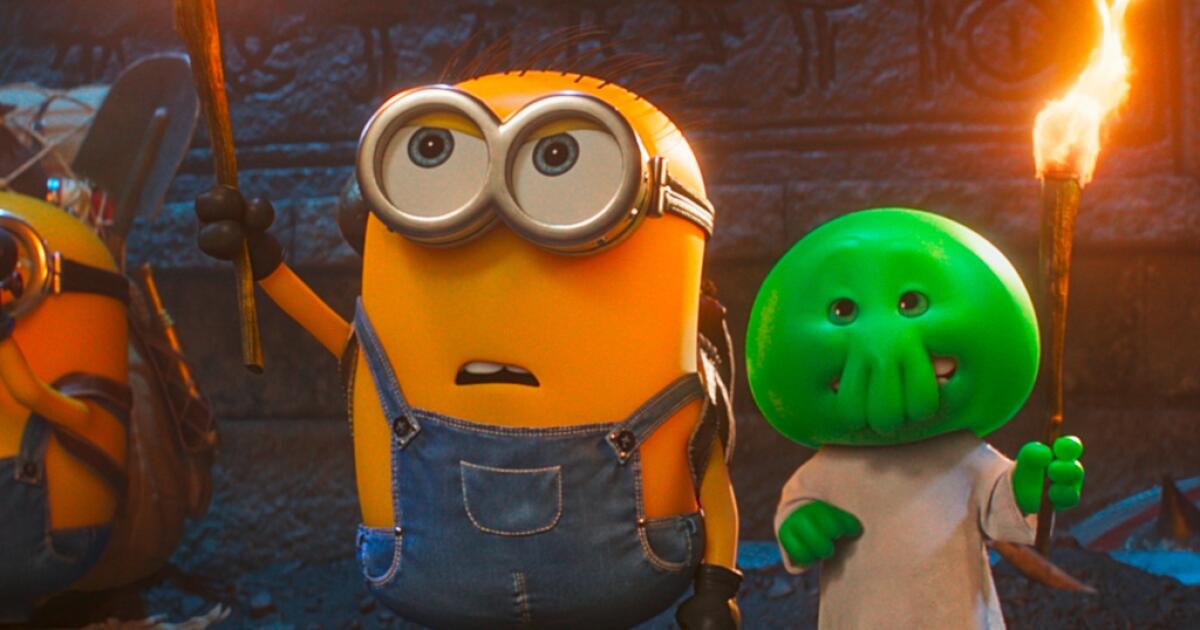
The Minions took over theaters this weekend as Universal Pictures and Illumination’s “Minions & Monsters” won the top spot at the box office, though with a lower-than-expected domestic haul.

The animated movie, which follows the Minions’ takeover of Hollywood, took in $61.4 million in the U.S. and Canada for the five-day Fourth of July holiday weekend, according to studio estimates. That haul was lower than analysts’ expectations for a domestic opening of about $68 million. The movie’s three-day total was $36.4 million.

But the Minions performed well internationally, bringing in about $85 million. In total, “Minions & Monsters” made $159.9 million worldwide on a production budget of about $85 million.

The film is the latest in the powerhouse franchise that began with “Despicable Me” in 2010. Across its previous six installments, the “Despicable Me” and “Minions” franchise has made more than $5.6 billion at the global box office. The last movie, 2022’s “Minions: The Rise of Gru,” made more than $940 million worldwide.

“Minions & Monsters” marks the lowest opening for the franchise. Part of the issue could be timing — the box office can be negatively affected when the Fourth of July lands on a Saturday, said Paul Dergarabedian, head of marketplace trends at Rentrak.

Walt Disney Co. and Pixar’s “Toy Story 5” came in second at the box office this weekend with a domestic three-day gross of $31 million. Angel Studios’ biopic “Young Washington” ($20.8 million), Warner Bros. and DC Studios’ “Supergirl” ($9.6 million) and Universal’s “Disclosure Day” ($6 million) rounded out the top five, according to Rentrak.

The haul for “Minions & Monsters,” coupled with the strong holdover performance of “Toy Story 5,” proved again that family films are making a dent in the summer box office.

“Toy Story 5” has now brought in a total of $764.3 million worldwide, and last month, Universal, Illumination and Nintendo’s “The Super Mario Galaxy Movie” crossed $1 billion at the global box office, becoming the first film of any kind to do so this year.

The rest of the summer theatrical lineup is also expected to bring in audiences and push domestic box office totals closer to pre-pandemic figures. Next week, Disney will release its live-action “Moana,” followed by Christopher Nolan’s “The Odyssey” and Sony Pictures’ “Spider-Man: Brand New Day.”

To date, the summer box office is now about $2.3 billion, a nearly 12% increase compared with the same period a year ago, according to Rentrak data. Compared with pre-pandemic 2019’s numbers, however, it is still down about 7%.

Source link

Walk in the footsteps of gods, heroes and monsters: five trips to mythical Greece | Greece holidays

Some stories never get old. The poems and songs from Greek mythology – tales of tragedy, love and loss, war and revenge, jealous gods, magic and monsters – have been retold through the ages for good reason. Like all stories that really resonate, they deal in the flawed nature of humankind.

To the ancients, though, they were far more than legends; they explained the universe. From the Earth’s origins and the stories of constellations to ideas of justice and morality, they shaped the arts and sciences, and carved a shared cultural identity. Visiting Greece today, it’s clear how deeply rooted the myths still are in modern culture. From the capital (named after wise Athena) and beyond, this is a country steeped in legends.

Photograph: Guardian Graphics

Blaze a trail in the footsteps of heroes and monsters, but pay due respect to the gods – particularly Zeus (king of all, commanding the sky), and his brothers Poseidon (ruler of oceans) and Hades (overseer of the underworld) – lest, like Odysseus, you inadvertently anger them and spend the next 10 years trying to get home.

Ancient Greek column at the Delphi archaeological site. Photograph: Ankarb/Getty Images

When Zeus wanted to find the world’s centre, the story goes that he released a pair of eagles. One flew east; the other west. They met “in the middle” – on the slopes of Mount Parnassus, at Delphi, navel of the ancient Greek world. While Athens’ Acropolis occupied Greece’s political centre, Delphi was its spiritual heart. Apollo established his temple here, and the seat of the oracle. Anyone seeking guidance – from lowly shepherds worrying about their goats to kings mulling matters of state – headed up the mountain to consult Apollo through his tongue-speaking vapour-sniffing priestess Pythia. Answers were considered divine truth, but notoriously cryptic (a bit rich after a three-day slog).

Today’s pilgrims are better-served by the present-day town of Delphi, beside the stunning archaeological site. Its tavernas and hotels, terraced into the southern edge of the cliffside, share the jaw-dropping panorama. Eat, drink and seek guidance at Apollo’s old pillars. Gawp at the impressive amphitheatre, framed by the peaks of Mount Kirfi, and the Pleistos valley below (a million-strong grove of ancient olive trees). Gaze west as the sun sets over the Corinthian gulf. Eagles or no eagles, you will feel yourself at the centre of the universe.
Where to stay: Kastalia Boutique Hotel, Delphi, doubles from £62 room-only, kastaliahotel.gr

Bathe in Hades’ river in Epirus

The Acheron Springs near the village of Glyki in Epirus. Photograph: Hercules Milas/Alamy

When the infernal heat of July and August hits, the only reasonable response is a refreshing dunk in a shady river. I favour the Acheron (as recommended by Circe to Odysseus when he needed a fast route into the underworld). Seek out this “River of Woe” – one of the five rivers encircling Hades’ realm of the dead. Not the happiest destination for the poor souls Hermes delivered to its banks, a coin for the ferryman clamped in their cold dead mouths. But for us? Absolutely delightful.

Cool, clear waters wind from the Tomares mountains, through the Acheron valley and out to sea. Its banks are fringed by lush forest and verdant hillsides. Visit Mesopotamos for the Necromanteion (oracle of the dead) and the fishing hamlet of Ammoudia where the river slows and spreads out to a delta (watch for otters) before pouring into the deep blue sea.

Swim, raft or zipline at the scenic Acheron Springs near Glyki. Head into the mountains, to the historic Souli watermills, and a laid-back taverna or Paradosiako, (literally a “traditional cafe”) by a stream, all rough-hewn tabletops on giant stones.

For the most magical trip, round the mountain to the Gates of Hades, where the river cuts through towering limestone cliffs, like an entrance to the other realm. Electric-blue dragonflies, bright butterflies and raptors fly overhead. Strong currents and deeper pools mean that some care is needed. Like Orpheus, Heracles and Odysseus, you’ll want to make sure to return from the underworld.
Where to stay: Atman Eco Lodge, near Glyki, doubles from £103 room-only, atmangreece.com

Float up to Nestor’s cave at Pylos

Homer’s ‘Sandy Pylos’ – a handsome seaside town inside the lovely Navarino bay. Photograph: Georgios Tsichlis/Alamy

Homer’s “Sandy Pylos” is a handsome seaside town with a great deal going for it. Strategically placed inside the deep, well-protected – and gorgeous – Navarino bay, it was the site of a triumphant naval battle against the Ottoman empire during the war of Greek independence (proud locals re-enact it each October). It features prominently in both the Odyssey and the Iliad as the manor of wise old King Nestor (Nestor’s Palace, nearby, is Greece’s best preserved Mycenaean monument). It’s also an easy distance for a day trip to ancient Messine, a wonderful and underrated archaeological site.

Guarding Pylos itself is the well-preserved Ottoman castle, Niokastro, but I prefer the old ruined Paliokastro to the north of the bay. It overlooks Voidokilia, a bay where turtles nest. No sunbeds, no cafes, just piles of soft sandy dunes, backed by wetlands hosting hundreds of migratory birds and rare reptiles. You’ll want to go down there. Nestor’s cave is here, the spot where a precocious infant Hermes hid the cattle he stole from Apollo. If you can’t face another ascent, float in turquoise water and stare up at its gaping entrance.
Where to stay: Dio Pigadia ecovillage and farm, cottages from €50 a night, tiny cabins from €25, dio-pigadia.com

skip past newsletter promotion


Marvel at Mycenae’s Lion Gate

Inside the treasury of Atreus, a beehive-shaped tomb at Mycenae. Photograph: Image Broker/Alamy

Mycenae, the bronze-age citadel, is steeped in myth, founded, the ancients believed, by Perseus, son of Zeus. This is the legendary homeland of Agamemnon, king of “well-built Mycenae, rich in gold” as Homer had it (archaeological excavations confirmed his accuracy). The acropolis straddles a hilltop in the Argolid plain, overlooking the Saronic gulf’s approaches towards Nafplion and Argos. Strategic for the Mycenaeans, breathtaking for us.

You’ll want to stop at the Lion Gate entrance, an impressive example of megalithic architecture: a pair of lions are sculpted in stone relief. I stood with my father and stared. He always found the myths rather nonsensical, but even he had pause for thought at these Cyclopean walls, colossal blocks, 20 tonnes apiece.

Inside are the ancient palace ruins, the tomb of Clytemnestra and the treasury of Atreus. Admire Mycenaean craftsmanship and culture in the museum – excavated artefacts include tablets in Linear B (the earliest attested form of written Greek). Don’t miss the copy of Agamemnon’s golden funeral mask (the original is in Athens).
Where to stay: Grand Sarai hotel in Nafplion, doubles from £130 B&B, grandsarainafplio.com

Poseidon’s love shack on Paxos

Lakka bay and Lakka village on the island of Paxos. Photograph: Hercules Milas/Alamy

This is one for the romantics and lovers of nature – and is a laid-back holiday. It’s a rare treat to see the gods’ softer side, and the ridiculously pretty island of Paxos came about thanks to Poseidon at his most tender. The usually raging, storm-stirring god created this little Eden (now a protected site) in the throes of passion – his trident is the island’s emblem. Smitten at first sight by the sea nymph Amphitrite, who fled to the deepest ocean to evade him, a deeply infatuated Poseidon sent Delphin, a kind of charming dolphin, in pursuit to talk up his good side. It worked – she returned, as his queen (and mother of dolphins and seals).

Poseidon struck off the southern tip of Corfu to form Paxos – effectively one large olive grove – as their love nest, and placed Delphinus among the stars as a reward. Honour the couple by enjoying that uncannily turquoise sea, snorkel over beautiful (and protected) posidonia seagrass meadows, and look out for the dolphins that are often seen here (depicted pulling Amphitrite’s chariot along with seahorses that are very occasionally spotted in the area).

The famous blue caves here are said to be the pair’s love-shack-cum-palace, and attract numerous boat trips in season. Take care on approach to avoid disturbance to sealife. Visit lovely Lakka for its horseshoe bay and Gaios, the pretty little main town. End your days stargazing and remember to toast the five-starred Dolphin constellation in thanks for this paradise.
Where to stay: Village Life Penthouse from €195, paxosownersdirect.com

Susan Smillie’s book, The Half Bird, recounts her sailing voyage from the UK to Greece, and the mythical destinations she encountered along the way. To support the Guardian, order your copy at guardianbookshop.com. Delivery charges may apply

Source link