DOJ sends monitors to Michigan poll sites as lawmakers warn of partisan aim | Elections News
While FBI poll monitoring is not new, US lawmakers raise alarm amid Trump’s years-long, evidenceless claims of election fraud.
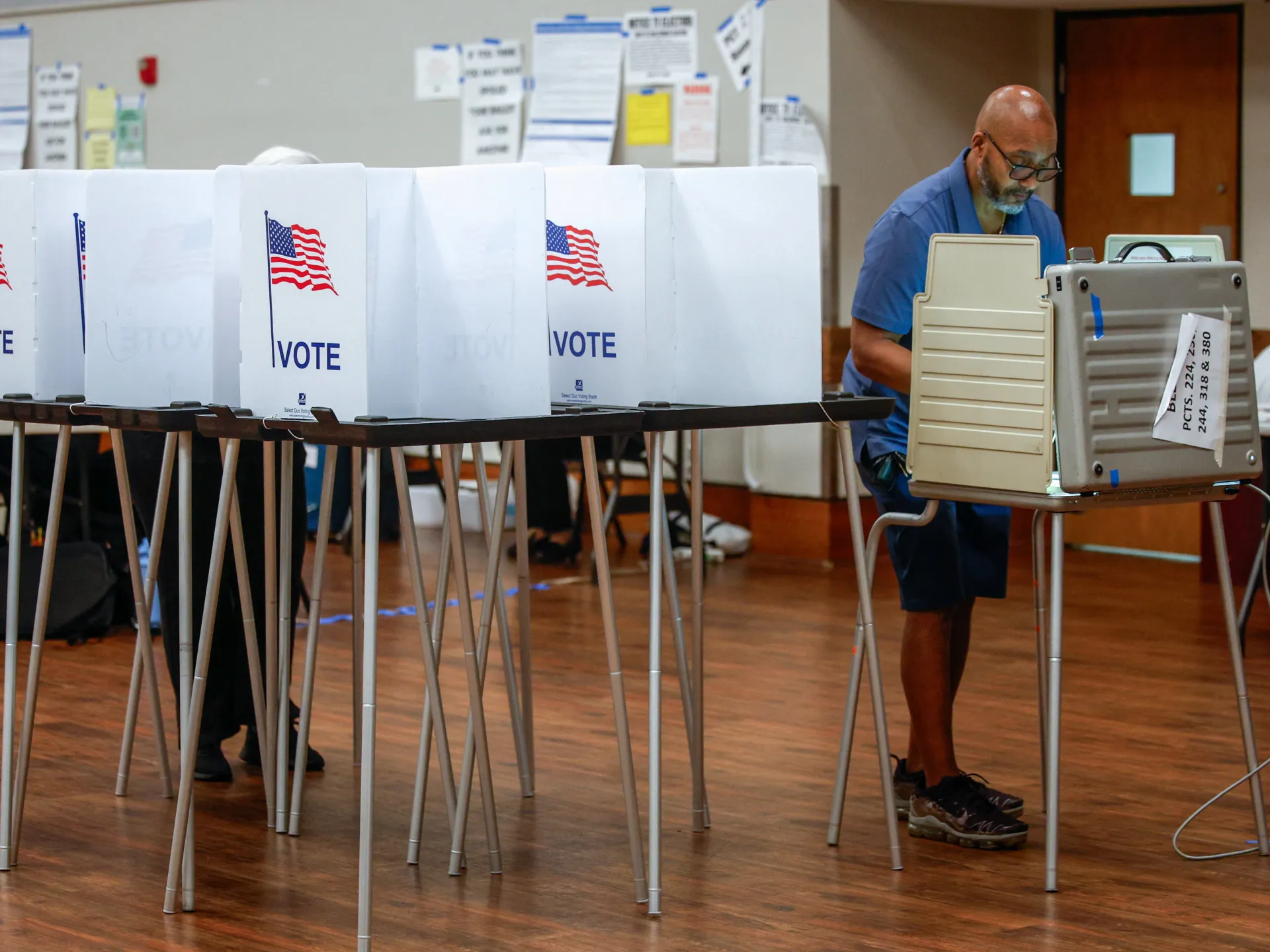
The US Department of Justice (DOJ) has announced it has sent federal monitors to polls in four Democratic-leaning cities in Michigan, amid warnings that the administration of United States President Donald Trump could use such monitors for partisan aims.
The DOJ announced the monitors would be present during Michigan’s primary vote on Tuesday as part of an effort to “ensure free and fair elections nationwide”, according to Assistant Attorney General Harmeet Dhillon.
Recommended Stories
list of 3 itemsend of list
“The Department of Justice is devoting extensive resources to ensure uniform and nondiscriminatory monitoring,” it said.
While the department has for decades overseen an election monitoring programme to ensure compliance with federal civil rights laws, lawmakers and advocates have raised concerns over how such a programme could be used under the current administration.
Trump has for years alleged, without evidence, that US elections have been marred by widespread fraud. He has never acknowledged his 2020 loss to US President Joe Biden.
Michigan has played a major role in those claims.
In a primetime speech delivered in mid-July, Trump re-upped a previously concluded probe into alleged voter fraud in the city of Muskegon as he called on the FBI to reinvestigate the case. Local officials had already determined that several voter registration forms had been fraudulently filled out in the city by employees of a consulting firm attempting to falsely reach their quotas.
No fraudulent ballots were cast in connection with the fake voter registration forms. State officials have highlighted the situation as proof of the efficacy of their election security practices.
The announcement on Tuesday came weeks after the Department of Justice said it planned to monitor 15 jurisdictions across six states: Arizona, Massachusetts, Michigan, Minnesota, New Hampshire and Virginia. The DOJ has said it will expand the use of monitors leading into November.
The department did not give a reason for why the four Michigan cities – Detroit, Hamtramck, Lansing, and East Lansing – were selected.
Detroit, Lansing and East Lansing are all heavily Democratic leaning. Hamtramck, considered the first Muslim-majority city in the US, has historically leaned Democratic, but has shifted increasingly Republican in recent years.
Residents of the state on Tuesday were casting ballots to determine party nominees in local, state and US Congressional races for the midterm election in November.
Key races include a fierce Democratic Senate race, with progressive Abdul El-Sayed hoping to defeat US Representative Haley Stevens, widely viewed as a weathervane for the party’s future.
Voters will also decide the candidates for the gubernatorial race, with Trump-backed US Representative John James facing off with former presidential candidate Perry Johnson on the Republican side, as Democrat Jocelyn Benson, the current Michigan state secretary, is expected to sail to victory in her party’s primary.
Democrats ask for assurances
In a letter to the Department of Justice dated Monday, 10 Democratic senators asked for assurances that FBI monitors deployed across the country will not “target jurisdictions in a partisan manner; discourage voter participation or interfere with the voting process; or pressure, harass, or interfere with state and local election officials as they do their jobs”.
They noted the wider context in which the monitors are being deployed, including efforts by the Trump administration to obtain state voter rolls. On Tuesday, a judge ruled the administration could not access Colorado’s voter data, the latest in a string of similar rulings.
Trump has also called for Republicans to “nationalise” elections. Under the US Constitution, state governments administer elections, in a system of decentralisation that advocates have long argued protects against wholesale interference.
The senators said that the DOJ has characterised the monitors as “routine” and “non-partisan”.
“However, it would be remiss not to acknowledge concerns that monitors are being deployed disproportionately to jurisdictions in states governed by Democratic leaders or with Democratic chief election officials,” they wrote.
“Moreover, election monitors are being deployed in the context of President Trump’s ongoing threats to nationalise, militarise, and otherwise interfere with the conduct of free and fair elections.”