America split from monarchy 250 years ago. Trump’s presidency is testing how far it’s come
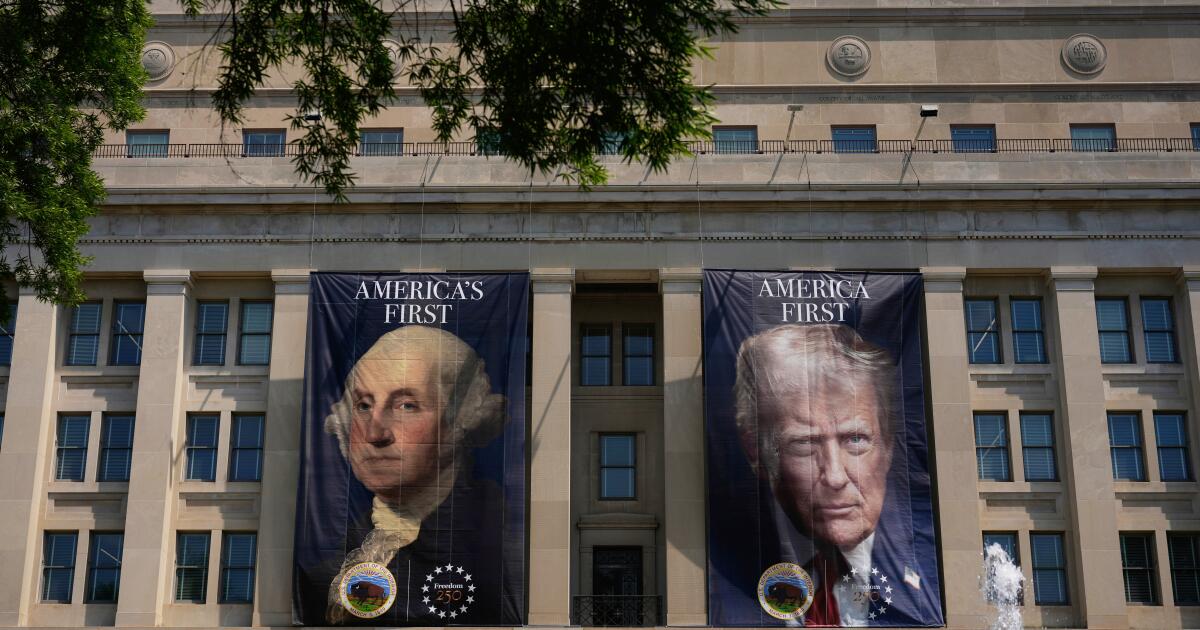
The 250th anniversary of America’s liberation from a king kicked off with a campaign-style rally on the National Mall by President Trump, whose face already stares down from banners fluttering from federal buildings across the nation’s capital.
The images illustrate how the president has dominated daily life since returning to power, evoking more the style of a monarch than the leader of the world’s oldest democracy. But more than anything, it is how he has wielded that power that has led to comparisons of an imperial reign.
Since returning to office in January 2025, Trump has nominated one of his personal lawyers to serve as attorney general, ordered the Department of Justice to pursue his political enemies, deployed the U.S. Marines to the nation’s second largest city and leveraged the presidency to enrich himself and his family.
He has demanded that comedians who mock him be fired, has slapped his name on the Kennedy Center, has pushed to seize control of elections, has filed lawsuits against news organizations whose coverage he disliked and has sued his own government seeking $10 billion in taxpayer money.
Trump also is the only convicted felon to hold the presidency, and a separate felony indictment over his attempts to keep himself in power after losing the 2020 election was dismissed only after he was reelected four years later despite those facts.
With the 250th anniversary of the nation’s founding approaching, Trump’s own celebrations have overshadowed the bipartisan, congressionally authorized commission that was supposed to coordinate events commemorating the moment. He plans to return to the National Mall on July Fourth for what he calls a “Trump rally.”
The president’s actions have led to comparisons with King George III, the British monarch whose rule inspired the American Revolution. It is a parallel Trump rejects.
“I’m not a king,” he told CBS’ “60 Minutes” earlier this year. “If I was a king, I wouldn’t be dealing with you.”
A different view of the presidency
There is a long American political traditional of opponents reviling presidents as kings. But Julian Zelizer, a Princeton University historian, said the label fits differently on Trump.
“It’s more about how he imagines who is he and what the presidency is,” Zelizer said. “We’re celebrating founding principles, and that was a driving issue — fears of how a centralized power can be corrupted. And here we are again.”
When King Charles III visited Trump this year, the official White House X account posted an image of the two men with the caption “Two Kings.” At the start of his second term, Trump declared he had ended a New York City transportation program and posted: “LONG LIVE THE KING.” The posts also seemed to indicate a willingness to leverage the label and the reaction it provokes in his critics.
The main resistance movement in Trump’s second term has adopted the slogan “No Kings.” Ezra Levin of the group Indivisible said activists were thinking ahead to 2026 and the America 250 celebration when they chose the label.
“It looks like the same kind of tyranny we were rebelling against 250 years ago, the type of domination of Americans by a secret police force that’s murdering people in the streets like in Minneapolis this year and in Boston in 1770,” Levin said, referring to demonstrations against the administration’s immigration crackdown that led to the fatal shootings of two protesters this year by federal officers.
When asked for comment, the White House referred to Trump’s statements about his use of executive power. The president has weighed in multiple times defending his maximalist approach.
During his first term, he referred to Article II of the Constitution when he told participants in a youth summit, “I have the right to do whatever I want as president,” while declaring that it “gives me all of these rights at a level nobody has ever seen before.” He told the New York Times in an interview this year that the only check on his global power was “my own morality. My own mind. It’s the only thing that can stop me.”
Yet he also has said that portrayals of his approach as authoritarian were wrong: “I’m not a dictator,” he told reporters last year. In response to a question about whether he was concentrating power in the presidency, Trump told Time in an interview last year, “I don’t think so. I think I’m using it properly, and I’m also using it as per my election.”
Supreme Court has sided with him
With a deferential, Republican-controlled Congress, courts have become the last check on Trump. The president has harshly criticized judges who have ruled against him, and his administration has sometimes defied their orders.
Yet his quest to expand presidential power has been aided by the conservative majority — including three of his appointees — on the U.S. Supreme Court, which has sided with Trump numerous times after lower court rulings hampered him.
In the middle of his 2024 campaign, the high court ruled that presidents have broad immunity from prosecution. The decision derailed multiple investigations stemming from Trump’s first term, including the one focused on his attempts to overturn his loss to Joe Biden in the 2020 election.
Trump has argued the courts cannot constrain the president on key issues, including his claims that he has the ability to fire members of independent agencies. The most notorious example was in 2024, when a judge asked during the immunity case whether a president could be prosecuted for ordering the assassination of a political rival. Trump’s lawyer, D. John Sauer, answered with a “qualified yes.”
Sauer is now solicitor general, the administration official who oversees arguments before the high court. He has continued to insist that courts cannot review presidential acts.
“Once the president has made a determination … at that point, there’s no work for the reviewing court to do,” Sauer said during Supreme Court arguments in a case over whether Trump could fire Lisa Cook, a Federal Reserve governor.
But the Supreme Court has allowed Cook to remain on the board while it considers the case. The majority also slapped down his global tariffs, finding that only Congress had the authority to impose them.
Such rulings demonstrate that presidential power does have its limits, according to John Yoo, a conservative law professor at UC Berkeley who served in the George W. Bush administration.
“The presidency today, even when colored by President Trump’s worst excesses, is not a monarchy,” he said.
Direct financial enrichment
Trump was the richest man to ever become president. During his first term, he was criticized for owning properties where foreign dignitaries and others hoping to curry his favor spent lavishly. The conflicts of interest have escalated in his second term.
Trump launched cryptocurrencies before and after returning to office. By conservative estimates, one has pulled in $320 million this year alone, while another sold $550 million worth of tokens. A third received a $2-billion investment from a foreign wealth fund.
Trump took a new step earlier this year, filing a private $10-billion lawsuit against the IRS for the leak of his tax returns during his first term. His Department of Justice directed the IRS to settle the litigation to create a $1.776-billion fund to pay damages to people who claimed the federal government unfairly prosecuted them.
The administration pulled back the settlement amid an outcry from congressional Democrats and some Republicans. But Todd Blanche, a former personal lawyer for Trump who is now acting attorney general, said at least one provision remains — a ban on the IRS auditing Trump.
Zelizer said Trump’s financial entanglements might be the most monarchical part of his administration.
“We have not seen a person who has a business operation of this scale and scope benefiting directly from the decisions he makes,” Zelizer said.
Targeting political rivals
The Justice Department’s role in the IRS lawsuit is one example of how Trump has decreed that executive branch employees should act as agents of his will.
In breaching what is supposed to be a firewall between the White House and Justice Department, Trump has demanded that federal prosecutors target his foes. In one social media post last year, he called out by name Pam Bondi, who was attorney general at the time, in pushing her to prosecute several of his political opponents: “JUSTICE MUST BE SERVED, NOW!!!” Trump wrote.
Indictments followed shortly after, including against former FBI Director James B. Comey and New York Atty. Gen. Letitia James. The charges against both eventually were dismissed, but the department under Blanche filed new charges against Comey.
The pursuit is not limited to Trump enemies of the past.
For his 80th birthday this month, the president hosted a fight held by UFC — a company he invested in — on the White House lawn. The event was broadcast on a network owned by the son of one of the president’s major donors. The spectacle drew a rebuke from California Gov. Gavin Newsom, a persistent critic and potential 2028 Democratic presidential contender.
“The White House was built to serve the American people. Tonight it was used to promote a company the President owns stock in, sell subscriptions, promote corporate sponsors, push Trump crypto, and enrich the President and his family,” Newsom wrote on X. “The founders warned us about kings enriching themselves from public office.”
Days later, Newsom disclosed that Trump’s Department of Justice was investigating him and his wife.
Riccardi writes for the Associated Press. AP writers Lindsay Whitehurst and Fatima Hussein contributed to this report.