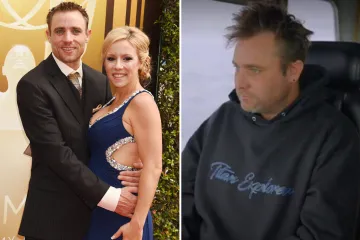
Deadliest Catch’s Todd Meadows fell overboard to his death in a tragic fishing accident in February 2025Credit: Facebook/Todd MeadowsThe 25-year-old had an eerie last FaceTime call with his children just moments before he fellCredit: Facebook/Todd Meadows
The rookie deckhand fell off the Aleutian Lady in a fishing accident on The Bering Sea and died from downing with possible hypothermia on February 25, 2026.
In the final episode of Season 22, a touching segment showed before and after his death, and captured his final conversation with his children just moments before the accident.
Sign up for the Showbiz newsletter
Thank you!
In a FaceTime call, he told his three children, all under five, that he was “being safe” and promised a fishing trip when he saw them again.
“I hope you’re being safe,” his daughter said on the call.
He promised his son a salmon fishing trip when he returned, telling producers on-camera that it was a “heart-wrencher” to leave his children at home for long stretches.
“It’s been one of my dreams and goals to make it up here,” he said, speaking of joining the crew for the season.
Most read in Entertainment
“That’s why I’m up here to make it and to try to support my family.”
Another part of the season finale captured the chaos surrounding the moment he fell overboard, without the actual fall or subsequent actions being shown on camera.
Captain Rick, who announced Meadows’ death, is filmed manning the vessel and asking “Everybody OK?” before the crew say that a man has gone overboard.
As he turns the boat and instructs them to ready the ring and crane, he tells the crew: “I got my eye on him.”
They successfully got Meadows out of the frigid sea and the Captain instructed them to perform CPR.
“Come on, man, come on, someone go get the AUD right now,” he says off camera with him tearfully telling the crew to “keep pumping” before a producer says, “He’s gone, Rick.”
In his last conversation with his three children, Meadows told them he was being safe and promised to take his son on a fishing trip when he was backCredit: DiscoveryThe impact of Meadows’ death on the crew was depicted in the season finale of Season 22Credit: Facebook/Todd Meadows
A statement on screen read: “On February 25th, 2026, deckhand Todd Meadows went overboard.
“After six minutes and twenty-six seconds in the water, he was recovered unresponsive.”
The episode then showed the aftermath of his death and its impact on the crew.
It ends with a cut back to Meadows as he prepares food in the kitchen and answers a producer’s question about what he would want to say to his children.
“Work towards your dreams and goals, don’t let anything slow you down. If you put your mind to it, you can do anything.
“Just want my kids to know I want them to work hard and be successful in life.”
Weeks before his fall, Meadows suffered a serious head injury onboard and was sent home on medical leave before being cleared again for work on September 18.
His week of medical leave saw him go back to his family while nursing his concussion which would tragically be the last time he saw them.
“The last photo I got of him was when he was building a fire. He was listening to music in the moment and was so happy,” his mom Angela said at the time.
MADONNA has already appeared to take over this weekend’s MTV Video Music Awards, after scoring the most nominations and is expected to hit the stage with a record-breaking performance.
The notorious Queen of Pop outshines Taylor Swift with the most nominations of the night (a whopping 11) and is expected to sweep many categories with songs from her 15th studio album, Confessions II.
She’s also opening the ceremony for the fifth time before handing the mic over to this year’s host, Snoop Dogg, to continue the show at the Los Angeles Peacock Theater on Sunday.
But long before Madonna, 68, collaborated with Sabrina Carpenter for their pop-dance hit, Bring Your Love, and introduced Gen-Zers to her classics like Vogue and Like a Prayer, she delivered many other memorable moments at the VMAs.
Sign up for the Showbiz newsletter
Thank you!
Below are some of the most talked-about memories from Madonna’s past VMA appearances throughout her decades-long career.
Madonna’s white dress (1984)
Madonna wore a full wedding gown and veil while perfomring Like A Virgin at the 1984 MTV Video Music AwardsCredit: Getty
For those who’ve followed Madonna since the early days of her singing career, her infamous 1984 VMAs opening performance of Like a Virgin immediately comes to mind as one of her wildest moves.
The singer kicked off the show with a fiery performance of her hit track, wearing a full wedding gown and veil.
Her dress featured a skintight, lace, corset-like top with a sweetheart neckline and a poofy tulle skirt that fell to her knees.
Madonna sang on top of a massive wedding cake before rolling and twirling around on stage.
The performance was controversial at the time, and her publicist even thought it was a career-ender before it became an iconic moment for the books.
Most read in Entertainment
Infamous on-stage kiss (2003)
Madonna famously kissed both Britney Spears and Christina Aguilera on stage during their performance at the 2003 VMAsCredit: Getty
Viewers were once again enamored when Madonna joined pop princesses Britney Spears and Christina Aguilera on stage for a super-sized performance.
The trio made history with their super-sexy outfits and provocative routine, first as Britney and Christina honored Madonna with a duet of Like a Virgin while wearing wedding gowns.
Madonna then emerged from a giant wedding cake and belted out her track Hollywood, before meeting the ladies on the dance floor.
The performance continued with the threesome stripping down into skimpy lingerie and Madonna sharing a steamy kiss with both pop stars.
Rapper Missy Elliott then joined them to finish out the performance, as the star-studded audience looked in awe.
Marie Antoinette in Vogue (1990)
The singer transformed herself into Marie Antoinette for her 1990 VMAs performance of her hit song VogueCredit: Getty
Madonna gave another show-stopping performance of her classic song Vogue at the 1990 awards show, where she completely transformed herself into Marie Antoinette.
She fully committed to the part, wearing an 18th-century dress that accentuated her chest, a sky-high blonde wig, and heavy makeup.
Many male and female dancers also joined her onstage doing racy moves, including climbing on her skirt, kissing her cheek, and bringing their heads to her chest.
Team Ariana (2018)
Madonna shaded Camila Cabello after she won the VMA for Video of the Year in 2018 over Ariana GrandeCredit: Getty
If there’s one thing Madonna might not be the best at, it’s hiding her true feelings from the camera.
She demonstrated this in 2018, when she failed to mask her disappointment over Camila Cabello winning Video of the Year over powerhouse singer Ariana Grande.
Madonna presented the coveted award, which she won in 1998, but looked disapproving before announcing Camila as the winner.
She could then be heard saying under her breath, “Y’all suck for that,” while the former Fifth Harmony star made her way to the stage.
Camila then praised Madonna during her acceptance speech, as the legendary singer stood there looking annoyed.
Leather Goddess (2021)
Madonna stunned in a skintight black leather bodysuit at the 2021 VMAsCredit: Getty
Madonna again stole the show in 2021 when she attended the VMAs in an extremely skimpy leather outfit.
The Material Girl singer opened the show by taking off a massive trench coat to reveal her skintight leather thong bodysuit.
She strutted around onstage in the sexy ensemble, which completely exposed her bare butt beneath her fishnet stockings.
Her boobs also nearly busted out of the tight corset-like suit, which she paired with black leather gloves, a matching hat, and high heels.
Madonna stood out with her racy costume, even in a room packed with A-list stars commemorating MTV’s 40th anniversary.
It wouldn’t be surprising if the iconic singer rocked similar attire at this year’s ceremony, perhaps even as she marks her fifth time opening the show.
Other performers include LISA and RAYE, who will make their VMAs performing debuts, as well as Shaboozey, Sienna Spiro, among others.
The two-hour-long ceremony will air live nationwide on CBS and be simulcast on MTV on Sunday at 7:30 p.m. EST/4:30 p.m. PST.
Former The Great British Bake Off host Mel Giedroyc opened up about past moments of jealousy in a candid insight into her friendship with a co-star
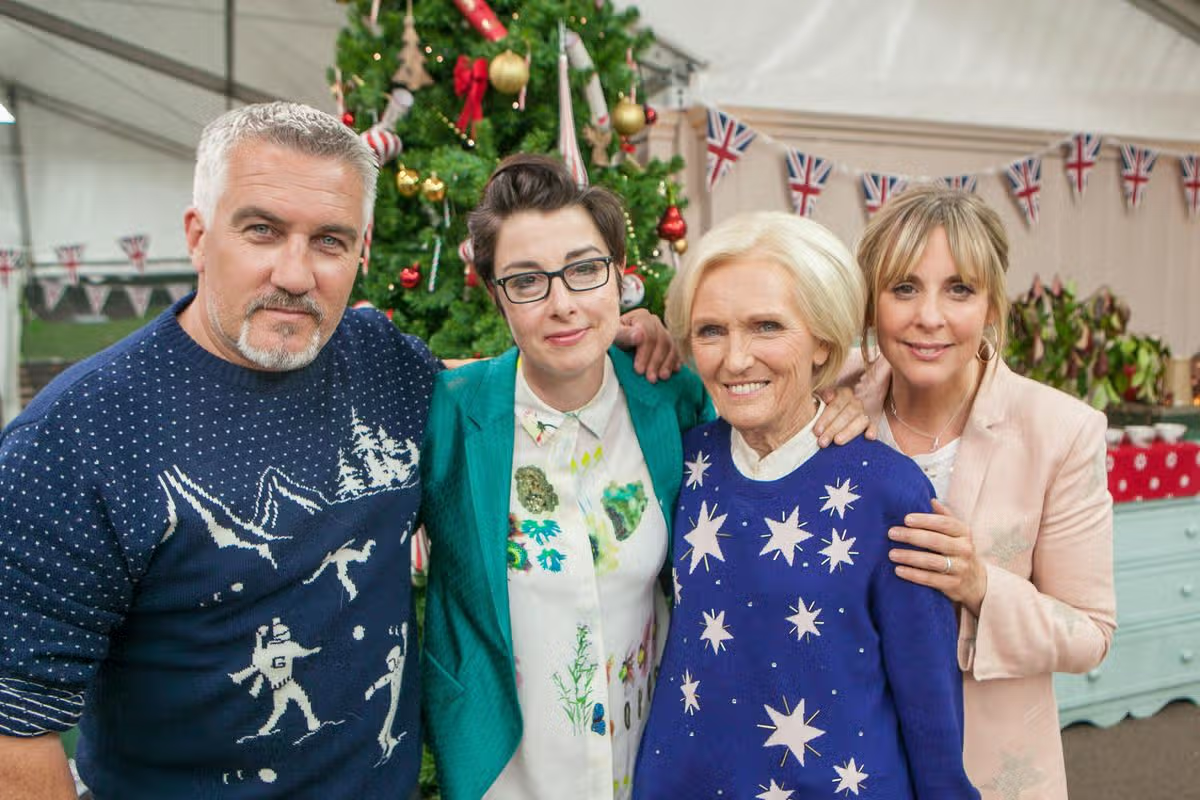
GBBO hosts Mel and Sue with Paul Hollywood and Mary Berry
The Great British Bake Off returns for its 17th series, with hosts Alison Hammond and Noel Fielding at the helm alongside judges Paul Hollywood and Nigella Lawson, who makes her debut on the show. Before the programme moved to Channel 4, presenters Mel Giedroyc and Sue Perkins fronted the series for six years.
The gig was one of many the pair took on together during their long-running friendship, which Mel has now revealed hasn’t always been smooth sailing. The broadcaster said their relationship has gone through “phases”, with periods when they’re inseparable and other times when they’ve been “off” with each other.
Speaking on the Dig It podcast with Jo Whiley and Zoe Ball, Mel explained that she and Sue are currently in one of their closer spells, chatting and seeing each other frequently. At the time of recording, the pair were also preparing to reunite at the Edinburgh International Book Festival.
“There’s a real friendship there, you’ve known each other for ages and you know you’ve got each other’s backs and I think that is such a lovely thing,” she shared. Though keen not to be “disingenuous”, Mel admitted there had been moments of jealousy.
“There’s been times over the last 39 years or whatever that I’ve known Sue, I’m sure that we’ve had moments of a little bit of jealously and, sort of, off with each other but, you know, at base you’ve got each other and it’s everything,” she shared.
“It really is everything and the older I get the more I realise that you have to cling to the real proper quality.”
Mel and Sue released a statement in 2016 when the show left the BBC, saying they were “very shocked and saddened” by the news. In the statement at the time, they praised the BBC for helping shape the programme’s tone and for growing its audience from two million to nearly 15 million.
They also confirmed they were “not going with the dough”, while wishing the future bakers well.
After their departure, the hosting role passed to Sandi Toksvig, who left in 2020, and Noel Fielding, who now presents the show alongside Alison Hammond.
The current judging panel consists of Paul Hollywood, who has been part of the programme since it began, and Nigella Lawson, who makes her debut after stepping into Prue Leith’s shoes.
The new series returns tonight, with 12 amateur bakers entering the tent in the hope of impressing the judges and being crowned this year’s champion.
Away from Bake Off, Mel and Sue have also returned to screens with their Saturday night gameshow Win Win with Postcode Lottery.
The 78th Primetime Emmy Awards saw a number of firsts: A first-time host, a first-time Emmy winner and the first to win two lead acting Emmys in a night. These notable achievements were coupled with moments of remembrance for legendary actors and creators, like Dolly Parton, Rob Reiner and Catherine O’Hara, among many others.
With Mariska Hargitay at the helm, the show ran at a quick pace without feeling rushed, giving room to winners to say their thanks in acceptance speeches while still having moments of fun in between. Here, our writers discuss some of the best moments of the ceremony. — Maira Garcia
Best moment of overdue recognition: Rhea Seehorn
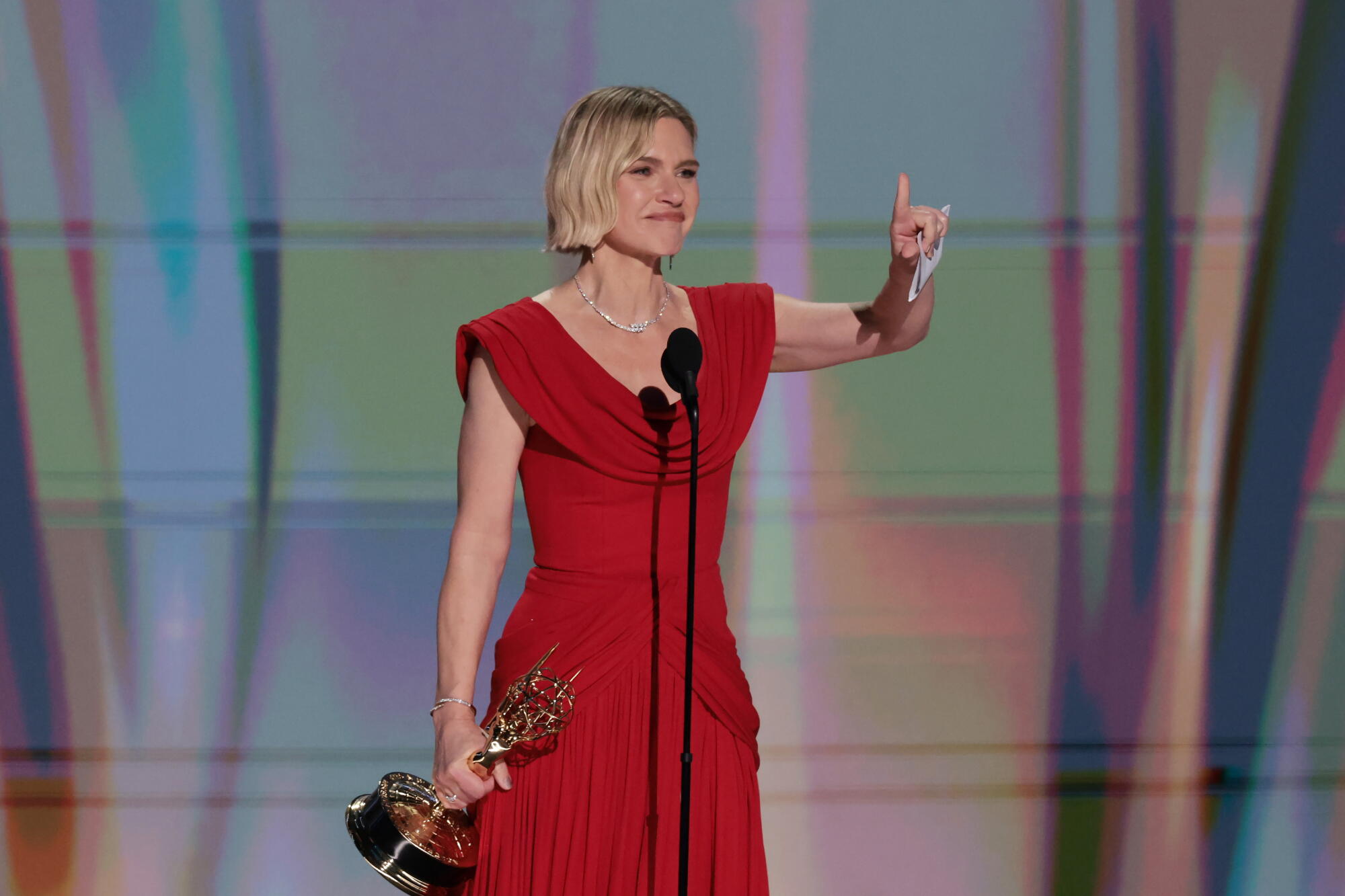
Rhea Seehorn finally won an acting Emmy, an accolade that was long overdue.
(Robert Gauthier/Los Angeles Times)
If you appreciate Rhea Seehorn’s complex, subtle acting, her dynamic range and her deadpan humor, then you’ve probably found the Emmys to be maddening over the years. She famously wasn’t nominated for playing poker-faced attorney Kim Wexler on “Better Call Saul” until the show’s two-part final season. And she never won, not even for the raw, heartbreaking work she did in those last episodes. So seeing her win, finally, for her lead turn on “Pluribus” was thrilling, long overdue recognition that, given her history, made you wonder if it would ever come. Awards voters typically don’t appreciate nuanced acting, too often equating “best” with “most.” But Seehorn’s work on “Pluribus” was undeniable. Playing Carol Sturka, a sad woman forced to save the world from happiness and hive mind, Seehorn had the role of a lifetime and ran with it. This Emmy was a long time coming, and you could feel that when she choked up on stage accepting it. Her palpable joy thanking “Pluribus” creator Vince Gilligan, wiping away tears, is one reason why we keep watching the ceremony. — Glenn Whipp
Best double Emmy haul: Matthew Rhys
Matthew Rhys with his double Emmy haul for “The Beast in Me” and “Widow’s Bay.”
(Ronaldo Bolanos/Los Angeles Times)
It was the sort of epic night that might make life vest-wearing mayor Tom Loftis jolt from his boat seat in shock or compel the villainous real estate heir Nile Jarvis to scarf down a whole rotisserie chicken with a glint in his eye — Matthew Rhys, the actor who brought both characters to life on screen, won two Emmys during Monday’s ceremony.
In doing so, he achieved a feat no actor has accomplished in 78 editions of the Emmy Awards: he won two lead acting Emmys in the same night. He was recognized for lead actor in a limited series for his turn in Netflix’s psychological thriller “The Beast in Me,” where he played Nile equal parts charming and terrifying. Later, he took the stage to accept the lead comedy actor prize for his optimistic but skeptical take on a mayor of a small, haunted island town in Apple TV’s horror comedy “Widow’s Bay.”
Rhys didn’t react like his characters might have — instead, he thanked his homeland: “To the great and good people of Wales… we are a small but mighty nation!”) And he took in the moment being feted by his partner, Keri Russell, who hung on him with pride as he made his way back to the main seating area after his first win.
The double wins add to Rhys’s collection of gold across the acting categories. In 2018, he took home the prize for lead drama actor for “The Americans.” — Yvonne Villarreal
Best reaction to someone else winning: Martin Short
Martin Short, left, with his “Only Murders in the Building” co-star Steve Martin on the red carpet at the Emmys.
(Christina House/Los Angeles Times)
Rhys may have taken home lead actor Emmys for limited series and comedy series, but the award for best reaction belongs to Martin Short.
During Rhys’ acceptance speech for lead actor in a comedy, the camera briefly panned to Short, who was nominated for “Only Murders in the Building,” just in time to catch him ripping paper into pieces — presumably his speech — and throwing it on the floor in anger and disbelief.
It lasted only a few seconds, but Short took advantage of the moment.
The timing. The commitment. The expressive performance. Short’s full comedic arsenal was on display before the camera moved on. It was the kind of quick visual gag that was easy to miss, and plenty of people probably did. But for those who caught it, I hope it was worth the spit-take. I am certainly glad I had a napkin at hand.
Short may have lost the Emmy, but his comedic timing remains undefeated. Stay funny, Short. — Anthony Solorzano
Best emotional moment that emptied our tissue box: Michael J. Fox
Michael J. Fox received the Bob Hope Humanitarian Award for his work and advocacy on Parkinson’s disease.
(Robert Gauthier/Los Angeles Times)
In an Emmys telecast full of genuine emotion — Reba McEntire’s musical celebration of Dolly Parton, a heartbreaking In Memoriam segment that ended with Jamie Lee Curtis’ personal tribute to Rob Reiner — the most moving moments were claimed by Michael J. Fox, receiving the Bob Hope Humanitarian award.
Fox’s decades-long battle with Parkinson‘s disease, and for those who suffer from it, is well known, as is his refusal to let it define him or his career — he received his 19th Emmy nomination this year, for guest actor in “Shrinking.” But when he first came out on stage, in a wheelchair and classic black, he spoke first about his admiration for Bob Hope, a man whose tireless support of soldiers “and military families like mine” illuminated, for Fox, the necessity of showing up for others. “When it starts to get tough, you show up, you help, and if you add a little joy while you’re doing it, that’s so you know it’s even better.”
The utter silence of that room as he spoke, the admiration on all those famous faces said it all. Fox remains as he has long been — funny, sincere, wildly talented and one of the most courageous people many of us will ever know. — Mary McNamara
Best self-depricating host: Mariska Hargitay
Mariska Hargitay didn’t take herself too seriously as host, cracking a number of silly jokes throughout the night.
(Robert Gauthier/Los Angeles Times)
Host Mariska Hargitay was refreshingly lewd and charmingly self-deprecating as the first female host of the Emmys in 15 years.
By not taking herself too seriously, she set a laid-back tone for a high pressure show that for many nominees feels like a life or death moment.
Winning is not everything, Hargitay regularly reminded the crowd, with bits that grounded actors’ experience, like a clip from a 1984 B-horror film she starred in called, “Ghoulies,” which, as she explained to everyone, is a film, “where a monster pops out of a toilet.”
“Jamie Lee Curtis isn’t the only scream queen around here,” Hargitay quipped.
That joke came after an ongoing series of goofy, blue wisecracks, including one about “Law & Order” producer Dick Wolf, saying his real name was “Richard Penis;” that her “SVU” character, Olivia Benson, was “America’s sweetheart sex cop;” that aging fans who once loved and watched “Hannah Montana” would soon need “Hannah Mammogramas;” and an aside about her packed work schedule, noting that “Margo may have money troubles, but Mariska’s doing just fine.”
She ended the night with a mic drop by introducing Woody Harrelson and Matthew McConaughey as “my two favorite flavors of vape.” — Jessica Gelt
Best changes to a host’s hair: Hargitay and her hairstylist
A sampling of Mariska Hargitay’s hairstyles at the Emmy Awards.
(Robert Gauthier/Los Angeles Times)
Beach waves, bombshell, Targaryen-inspired twists, luscious locks and a tousled bob. Mariska Hargitay changed her hairstyle so many times throughout the Emmy Awards it was hard to keep track. One can only imagine the quick work happening backstage to get her hair coiffed amid costume changes. And one can only hope there was a wig wall somewhere inspired by Catherine O’Hara’s Moira Rose. The bombshell blowout was reportedly a tribute to her late mother, ‘50s starlet Jayne Mansfield — Hargitay took home two Emmys earlier this month for a documentary she directed about her. Her quick-turn tresses were yet another example of the first-time host’s infectious enthusiasm. — Brittany Levine Beckman
Best presenter who should host the next awards show: John Mulaney
John Mulaney introduced the award for lead actor in a drama series, but not before sending up men.
(Robert Gauthier/Los Angeles Times)
I’ll say it: I’m not sure how I feel about John Mulaney. I’ve waffled over the years. I used to love his work, then I found it tired, then I fell off the bandwagon altogether. So believe me when I tell you: I wasn’t sure how I’d feel about him presenting lead actor in a drama series. I wasn’t primed to like his speech. And yet.
He won me — I’m not necessarily a certified Mulaney hater, but certainly not a full-blooded Mulaney lover — over with a truly funny arpeggio of riffs about the mediocrity we accept from men and male actors. I was trepidatious, as was the live audience. (“This award is for the guys. Just men being men,” is a scary start.)
But then Mulaney rounded the curve with a tongue-in-cheek reference to the “Bluey” dad controversy and I sat up straighter. If the line, “some of the men in this category do method acting, and some do regular, less annoying acting” didn’t get me, then “they can play anything, these nominees, not just doctors — they can play a cop or an FBI agent or a secret agent, and then that’s it, no other examples,” certainly did. Don’t get me started on the DJ Khaled quote (I loved it).
Let this man host an awards show, as he is clearly trying to do. I recognize the game, and I respect it.
Also: a very honorable mention to Meg Stalter dressed as a literal Emmy statue. Meg, you are the only method actor I respect. — Laura Zornosa
Best Targaryen family reunion: Emma D’Arcy and Emilia Clarke
Emma D’Arcy and Emilia Clarke nodded to “Game of Thrones” before presenting the award for lead actress in a limited series or television movie .
(Robert Gauthier/Los Angeles Times)
One of the last things I ever expected to see on an awards show in 2026 is the Mother of Dragons speaking in High Valyrian on stage. So “Game of Thrones” star Emilia Clarke hitting the stage with “House of the Dragon’s” Emma D’Arcy to present the award for lead actress in a limited series or television movie was a pleasant surprise.
“In the ‘Game of Thrones’ universe, Emilia is my great-great-great-great-really-great granddaughter,” D’Arcy said. “And in honor of our shared Targaryen lineage, Emilia is going to address you in High Valyrian — our mother tongue — and I will translate.”
Clarke earned four Emmy nominations during “Game of Thrones’” run for portraying Daenerys Targaryen, one of the last surviving members of the family that long reigned over Westeros. D’Arcy, meanwhile, plays Rhaenyra Targaryen in “House of the Dragons,” which is set at a time when there are so many Targaryens that a war of succession became inevitable.
The Targaryen team-up was my favorite but it wasn’t the only name-based collaboration of the night. An earlier segment saw Olivia Benson, the fan-favorite “Law & Order: SVU” character played by Hargitay, share the screen with another Olivia Benson — Taylor Swift’s cat that is named after her. The cat made a surprise cameo along with the mega pop star in a pre-recorded segment about the likelihood of Swift appearing at the Emmys. — Tracy Brown
Best invitation to dinner at their house: Marcello Hernández
Marcello Hernández presented an award, but not before presenting some dinner invitations to a few people in the crowd.
(Robert Gauthier/Los Angeles Times)
When I saw “SNL’s” Marcello Hernández would be presenting at the Emmys, I knew it would be a special moment, and he didn’t let me down. The actor, who presented the award for directing for a comedy series, promptly made himself at home, shouting out, “Donde ‘tan los Latinos?” He then took the opportunity to say hello to a few fellow actors in the room.
“Very quickly, I would like to say hello to Harrison Ford,” he said, looking at the actor sitting in the audience, who gave an exasperated look and waved. “You are a legend and a real inspiration to me and I would like to invite you to have dinner at my house.”
The room erupted in laughter, but he wasn’t finished. He then extended an invitation to Zendaya and her partner, Tom Holland: “I want to say hi to Zendaya, you’re a beast and you’re amazing. And I saw you and I wanted to play it cool, and I decided I can’t do that. So I would like to invite you and Spider-Man to have dinner at my house.”
Then he proceeded to invite Oscar Isaac, the Guatemalan actor who utilizes his given name professionally, suggesting they might be related. “You are so good in ‘Beef’ and you are also Hernández, like I am. So we could be cousins, you never know. And I will see you at Christmas, I will cook you whatever you want.”
Lastly, he said a hello to Matthew McConaughey, and quoted his Cuban tía, who told him if he works very hard, he can hang out with “Matthew McCon-i-purse.” It was a light-hearted speech that spoke to anyone who suddenly finds themselves in a room wondering how they got there. — M.G.