mom

‘Phony’ review: Connie Britton captivates as an altered mom. Or is she?

Young adult stories come in every imaginable flavor, and flavor combination, and several are present in “Phony,” premiering Tuesday on Hulu. Based on the four episodes (of eight) out for review, I am all in with this show, but as Doris Day so memorably sang, the future’s not ours to see.

Created and directed in part by Nick Paley (“Marcel the Shell With Shoes On”), it’s a mystery driven by an uncanny event, with the beating heart of a high school dramedy, in the sense that what is dramatic about adolescence is at the same time comical. (Given time.) Temperamentally, it’s closer to “Freaks & Geeks” or “Dazed and Confused” than, say, “Stranger Things,” but I also wrote “Robert Altman” in my notes.

To begin, we are in some mountainous slice of small-town Pacific Northwest, where the Canadian tax breaks call American producers across the 49th parallel and the landscape presses in from all sides. (A reference to Lewis & Clark College suggests the story is set in Oregon, but I can’t remember any other clues; also, it isn’t important.) It’s an ordinary world wrapped in mystery and sometimes mist, but it’s the ordinariness that gives the show its power as much as, or more than, the mysteriousness.

Sonny Cooke (Sam Nivola, from the third season of “White Lotus”) attends Delby High, where his mother, Ellen (Connie Britton), is the principal. This would be a nightmare for many teens, but for Sonny and Ellen, it’s more of a dream, as the two are unusually (which is not to say perversely) close. (There is no father in the picture, nor is one even mentioned.) He operates in the corridors as a kind of unofficial lieutenant to his mother, bringing cheer and care to his fellow students, spreading sunshine all over the place. This is a little strange, but he is not accounted a weirdo.

He has a nice girlfriend, Chloe (Mahaela Park), with whom he has just “decided to be official”; Ellen clucks at this — she’s a little protective. Sonny and Chloe call each other “Bobo,” and in a nice, authentic touch we see he has written that nickname in ballpoint pen on the white sidewall of his sneaker. As we open, Sonny and Chloe are planning to have sex for the first time; there is some comedy written around this. He’s the less mature, more nervous party. (He also has a tendency to fall over and bump into things.) His best friend, Vogel (Maliq Johnson), an injured basketball player, is miffed that he had to hear about this from Chloe and not Sonny, but not seriously and only for a moment.

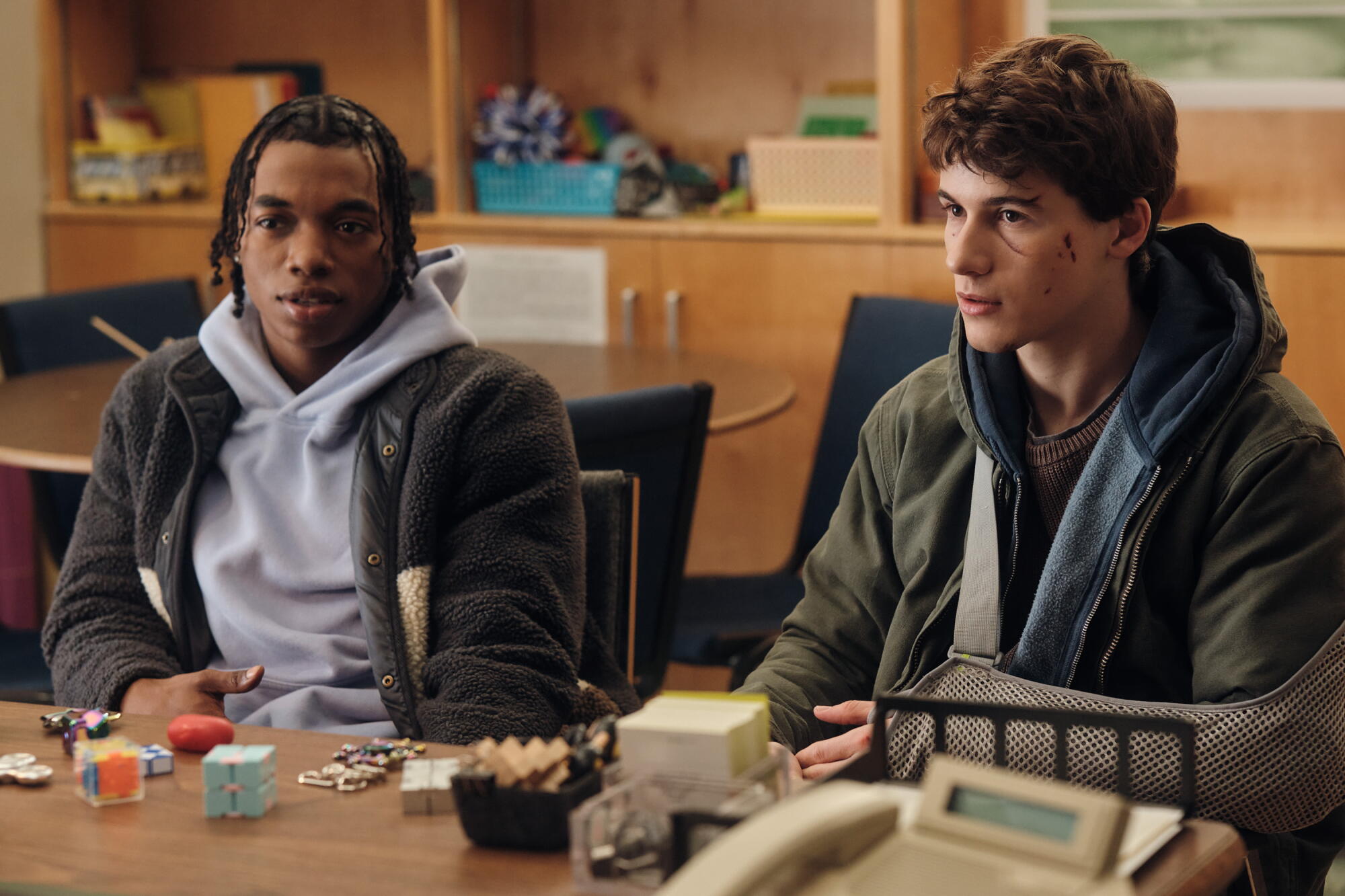
A teenage boy in a grey hoodie and fleece jacket sits next to a boy with bruised and scratched face wearing a sling.

Best friends Vogel (Maliq Johnson), left, and Sonny (Sam Nivola), who is trying to make sense of his feelings about his mom.

(David Astorga / Disney)

Driving to meet Chloe for their Big Night, after a rare argument with his mother, Sonny swerves to avoid a downed tree and drives into Bucket Pond, where an official sign commemorates the many deaths that have occurred there. When he wakes from a coma a week later, he doesn’t recognize Ellen, and you won’t quite either. However it’s been accomplished, by makeup (or an absence of makeup), prosthetics, digital manipulation, hypnosis or some combination of the above — and by acting, of course — this alteration of Connie Britton, a face we know well, is just enough off to be incredibly creepy. (What have you done with Connie Britton? we want to ask.) There is nothing more frightening than when the familiar starts acting strange, in movies or in life. Sonny’s symptoms mirror an actual condition, Capgras syndrome, which no one here mentions, though to be fair, he hasn’t told anyone who might offer that diagnosis, and is too freaked out to look it up himself. Only Sonny and the viewer notice the difference, which suggests that he may be wrong, or, alternatively, that everyone else is.

Completing a not-quite Scooby Gang are Mallory (Grace Brennan), returning to public school after three years of homeschooling, and her cousin Weldon (Colter Lee), a deadpan original turn on the nerd. Sonny and Mallory shared a kiss once, on a class camping trip, but for … reasons, they meet again on tentative terms. Despite or perhaps because of her offbeat upbringing (religious parents), Mallory is the embodiment of the cool girl who doesn’t need to demonstrate how cool she is, and perhaps doesn’t even know or, more to the point, care. In a series thoroughly well cast (by Jessica Kelly and Lisa Parasyn), Lee and Brennan, especially, stand out as originals, their performances drawn from life, or some private corner of their imagination.

Weldon, who is ready to credit Sonny’s story — he believes, for example, that Avril Lavigne died and was replaced by “someone named Melissa, who has a clubfoot” — connects him with Sharla (Meera Syal), a private investigator he knows from an online forum. “She’s into alternative knowledge. So cryptids, One World Order, face peelers…”

“I know what it’s like to be called crazy,” says Sharla, “but all you really need is one person to believe you.”

“Or two people,” adds Weldon.

“Yep, two people. Two weird people.”

Much of what makes “Phony” special happens alongside the main plot, or doesn’t involve any plot at all — it’s pure atmosphere, bits of background business and chatter in the school halls, and at a party in the woods that occupies much of Episode 4. (Nice use of long lenses by cinematographer Andy Rydzewski.) Party scenes are a yardstick by which I measure the authenticity of a teenage movie — are these characters acting their age, or have they been designed to?

With only four episodes available for review, and nothing revealed, it’s impossible to say where the show is going — is it science fiction, or fantasy, or some super-complicated conspiracy, though why such a thing would be constructed around these people is beyond me. There’s a chance it’ll be brilliant, a chance it’ll be less than brilliant, and a greater than zero chance it’ll be dumb, but given the résumés of the co-showrunners Paley and Anthony King — whose credits include “Search Party,” “The Afterparty” and “Broad City” — I expect it to be interesting. Everything so far is so well done, I don’t mind how it ends; I don’t want it to end at all.


Source link

Halle Berry’s daughter Nahla defends mom in legal battle with ex

Halle Berry has several loved ones in her corner amid her contentious custody case with ex-husband Olivier Martinez, who accused the Oscar winner of physically abusing their 12-year-old son. Among the actor’s supporters is Nahla Aubry, the 18-year-old daughter Berry has kept largely out of the public eye.

Aubry, whom Berry shares with ex-boyfriend Gabriel Aubry, spoke against her former stepfather Martinez and in support of her mother in a declaration filed Monday in Los Angeles Superior Court. In his request for a restraining order filed last week, Martinez accused Berry of physically abusing their son, Maceo, “putting her hands around his neck, and choking him” during a Sept. 26 incident. Martinez was granted the restraining order and is seeking sole legal and physical custody. Nahla Aubry said in her declaration, obtained by The Times, that Martinez’s allegations left her “shocked, very sad, and very upset.”

“The statements Olivier claims my mom made are wholly inconsistent with the values she has taught me my entire life,” Aubry said. She added elsewhere in her declaration: “I have never witnessed her act violently toward anyone.”

A legal representative for Martinez did not immediately respond on Thursday to The Times’ request for comment.

In her declaration, Aubry spoke about her experiences splitting time between her mother and father’s homes amid their separation and and said her mother “consistently provided me with stability, support, guidance” and that she “never heard” the actor speak negatively about her family or her ex-boyfriend. Aubry said she lived with her brother for most of her life and has “never heard my mom say anything about Olivier” to her brother, contradicting claims Martinez raised in his request for a protective order.

Martinez pointed to an alleged 2023 incident when Berry is accused of telling their son, then 9, that his father is “ ‘a white b— trying to rob a Black woman’ due to child support issues,” according to court documents. She added that Berry has “always” encouraged her children to keep “loving relationships with our fathers.” Aubry also said in her declaration that while Berry can be strict, she is also “warm, supportive and deeply involved in our lives.”

“I have never witnessed her act violently toward anyone, however, I do remember Olivier beating up my father in our driveway when I was little,” she said, referring to a 2012 brawl between Gabriel Aubry and Martinez.

In addition to denying the claims of abuse against her mother, Aubry spoke about her stepbrother’s behavior, writing in his declaration he can be “very impulsive” and “often acts without thinking and then refuses to take responsibility for his actions.” Aubry noted she last spoke to her brother a day after the alleged September incident and that he did not seem upset, and that the current restraining order prohibits her from contacting her brother.

Berry’s fiancé, Van Hunt, and her attorneys also filed declarations in favor of the “Monster’s Ball” actor. Attorney Marina Z. Beck in her declaration accused Martinez of refusing to provide information to Berry about their son and his education, of interfering with their son’s therapy and of refusing to follow therapist recommendations. The court documents also include screenshots of text message exchanges between Berry and Martinez and an email from their son’s school about his disruptive behavior days after the alleged incident.

Berry and Martinez were married from 2013 from 2015. Their divorce finally ended in August 2023, when they agreed to joint custody of their son and Berry agreed to pay Martinez $8,000 a month in child support.

In his request for a restraining order, Martinez also asked that Berry refrain from drinking or partaking in other substances during her visitation time and asked that she complete sobriety testing “before, during and after” her visitation, according to court documents. The judge denied those sobriety testing requests until a further hearing for the order on Oct. 16.

Patrick Baghdaserians, an attorney for Martinez, told The Times last week the welfare and safety of Berry and Martinez’s child remains paramount.

Source link

His mom was detained by ICE. Two months later, he died by suicide

In May, when Samuel Gonzalez Terrones was diagnosed with depression and schizophrenia, he started seeing a therapist and taking medication that he hoped would finally alleviate the dark thoughts that had begun creeping up so frequently he would sometimes seek help by calling the police on himself.

A month later, his mom, Minerva Terrones Dominguez, 54, had just hopped off a bus on her way to a grocery store in San Bernardino when immigration agents arrested her for being in the country illegally. While she languished in detention, the family said, Samuel grew increasingly despondent.

To help pay for an immigration lawyer, his siblings and dad had taken up extra shifts at their jobs. But because Samuel’s condition meant he couldn’t hold a steady job, he spent more and more time alone at home in Rialto.

“My mom was the one who would take care of him when he would have those bad thoughts,” said his older sister Sari Gonzalez, 32. “Everybody would be at work or at school, so my mom was the only one that would be here to calm him down, to say, ‘Your siblings will be here in a bit, just wait.’”

The lawyer, Arturo Burga, had figured out a way to free Minerva from detention and allow her to stay permanently in the U.S. The legal pathway, called cancellation of removal, hinged on proving that her deportation would cause extreme hardship to a U.S. citizen: Samuel.

They never got to file the paperwork.

A young man.

Samuel Gonzalez Terrones, 21.

(Gonzalez family)

At 3:55 a.m. on Aug. 12, San Bernardino police responded to a railroad crossing. Samuel was pronounced dead at the scene, according to a San Bernardino County coroner’s news release. He was 21.

In a letter Samuel wrote before his death, an excerpt of which was shared with The Times, he talked about his mother’s detention. He said her being taken away by Immigration and Customs Enforcement made him feel like he’d hit “one last wall.”

“To the ICE agent who took away my mother: I hope it was worth it,” Samuel wrote. “I can’t handle anymore injustices in this world.”

Suicide prevention and crisis counseling resources

If you or someone you know is struggling with suicidal thoughts, seek help from a professional or call 988. The nationwide three-digit mental health crisis hotline will connect callers with trained mental health counselors. Or text “HOME” to 741741 in the U.S. and Canada to reach the Crisis Text Line.

Motivations for suicide are often complex and unknowable, and it’s unclear how the Trump administration’s aggressive immigration policies may have moved an immigrant or family member to harm themselves. But immigrant advocates say they have heard of such deaths.

This month, a 20-year-old Haitian man in Springfield, Ohio, walked into oncoming traffic after the Trump administration ended his Temporary Protected Status and ICE fitted him with an ankle monitor.

In May, the Associated Press found that at least 10 detainees had died by suicide since President Trump took office — a pace that far exceeds the growth in the detainee population.

ICE did not respond to requests for comment.

Samuel’s family describes him, the second youngest of seven siblings, as a caring and generous person who, at his best, was quick to laugh, loved chocolate conchas and video games, and dreamed of becoming a graphic designer.

He kept a dark aesthetic, with a lip piercing and nails frequently painted black or red. But he also had a lighter side, Sari said, as evidenced by the Hannah Montana stickers decorating his bedroom wall.

When the siblings were younger, they worked out together and would challenge each other to see how many pull-ups they could do. They liked hanging out at a skate park, laughing as he guided Sari’s small dog, Polar, down a rail on a board.

His mental health struggles started in 2021, when he was a freshman at Cajon High School. Little by little, he lost his passion for the gym, Sari said, and everything else.

A boy sits on a log.

An undated photo of Samuel Gonzalez Terrones.

(Gonzalez family)

Sari said she and her siblings each played a different role in helping Samuel through his struggles. He and his younger sister played video games. Sari would talk to him about adulthood. Their older brother would take him to church. On good days, their father would bring him along to landscaping jobs.

“He really did try to get better,” she said. “He held on for a really long time, and I’m proud of him for being so strong.”

The day Minerva was detained, Samuel and Sari were at home.

According to a federal court petition seeking Minerva’s release from ICE custody, federal agents stopped her, said she “looked like someone” they were seeking and mocked her when they found her EBT card while searching her belongings.

Minerva has lived in the U.S. for 33 years, had never been arrested or convicted of a crime and had never been in removal proceedings, according to her lawyer.

Sari said an ICE agent called her and said she had an hour to pick up her mother’s things from the agency’s local office and to say goodbye before ICE moved her to a detention center.

Samuel was inconsolable. “I’ve never seen him cry like that,” Sari said.

Sari took up extra hours at the plastics factory where she works as a machine operator. On Sundays, her only day off each week, she would take Samuel and their youngest sister to visit their mom at the Adelanto ICE Processing Center. The drive was 45 minutes without traffic, but they’d always arrive three hours early to join other families on the wait list to see loved ones.

On the way to the facility, Samuel was visibly happy. But on the way home, Sari said, all would be crying.

Ten people stand next to a tree.

Friends and relatives attend the graveside service for Samuel Gonzalez Terrones.

(Gina Ferazzi/Los Angeles Times)

The extra expense of legal representation left the family struggling to pay for bills and food. In the evenings, Samuel stopping spending time with his siblings and retreated to his bedroom.

Burga, the lawyer, alerted ICE of Samuel’s death via email and requested Minerva’s emergency release under humanitarian grounds. He said the ICE deportation officer who replied struck a softer tone than usual, offering sincere condolences to the family.

“Our office was devastated,” said Amber Burga, executive director of the law firm. “I thought to myself, it takes somebody committing suicide for them to have compassion.”

Sari waited two weeks to tell Minerva. She waited, in part, because her mom had an upcoming court hearing and she didn’t want grief to cloud her thinking.

Sari was given 10 minutes in a visitation room to break the news about Samuel’s death to her mother.

“It was just me, my aunt and the officer who was watching,” she said. “When I told her, they wouldn’t even let me hug her while my mom was crying. They told me, ‘You can’t hug her. You can’t touch her.’”

Three days later, on Aug. 31, a federal judge — who didn’t know about Samuel’s death — issued an order granting her petition for release from detention, finding that she had been held illegally “based solely on DHS’s mistake.”

In her ruling, U.S. District Judge Brianna Fuller Mircheff wrote that when Minerva was detained, another federal judge had already declared it unlawful for Homeland Security to require mandatory detention for people who, like her, had entered the U.S. illegally.

Minerva had been arrested without a warrant, and an immigration judge had not determined whether she was a flight risk or a danger to the public.

Referring to Minerva and similar cases, Mircheff wrote, “Hundreds, if not thousands of individuals were held without process that was owed to them.”

Lawyers for the federal government had argued that Minerva could simply wait until she had been detained for six months, at which point she’d be entitled to a bond hearing, court records show. That suggestion didn’t fly with Mircheff, either.

“It is beyond cruel to suggest that this Court would let her sit in custody another four months,” she wrote.

Minerva is still in deportation proceedings. Without Samuel, she no longer qualifies for the legal pathway her lawyers had built a case around. Sari said she’s now considering joining the U.S. military to access the immigration benefits available for undocumented parents of enlisted members.

The family started a fundraiser to cover the cost of Samuel’s funeral.

Samuel’s parents, siblings, and a few dozen other family members and friends arrived on Sept. 22 at noon to bury him at the Rialto Park Cemetery. Each person held a white, long-stemmed rose.

Sari sobbed. Minerva looked on at the black casket holding her youngest boy, the goofball who loved his family, the one who had longed for her support while she was detained.

Times staff photographer Gina Ferazzi contributed to this report.

Source link