Modis

Will India’s ‘Cockroach’ movement force Modi’s BJP to rethink its politics? | Narendra Modi News

New Delhi, India – On the night of August 4, in a counting hall in the eastern Indian city of Patna, some 1,000km (620 miles) from the national capital, Prime Minister Narendra Modi’s Bharatiya Janata Party (BJP) suffered one of its most stunning political setbacks in 12 years.

Bankipur, a constituency in the legislature of the state of Bihar, had been held by the BJP for three decades. But the fledgling Jan Suraaj Party, led by political strategist-turned-politician Prashant Kishor, ended that reign, winning a seat that the BJP’s national president, Nitin Nabin, had held until just a few months earlier.

The defeat came less than two weeks after India’s Education Minister Dharmendra Pradhan resigned, bowing to seven weeks of student-led protests that had shaken New Delhi and spread to several cities. The Cockroach Janta Party (CJP), a satirical outfit born on Instagram in May after India’s chief justice, Surya Kant, compared unemployed young Indians with “cockroaches” and “parasites”, had led those protests.

Nabin, the BJP chief, had spent the Bankipur campaign denouncing the country’s Gen Z protesters as “a virus and a cockroach gang devoted to breaking the country”.

Instead, it was the BJP’s stranglehold over the constituency that was broken. That surprise electoral verdict has thrust upon India a broader question, say analysts: Will India’s most formidable political machine — the BJP — be forced to change?

A charm offensive, gone slightly wrong

The clearest sign that the BJP treats the Gen Z uprising as more than a passing nuisance is the sheer awkwardness of the party’s response. During the peak of the protests, Modi released a string of selfie-style videos on Instagram addressing the exam paper leaks that led to the protests. He reportedly told cabinet colleagues that young people were “just on Instagram”, urging ministers to court them on the platform with reels rather than media briefings.

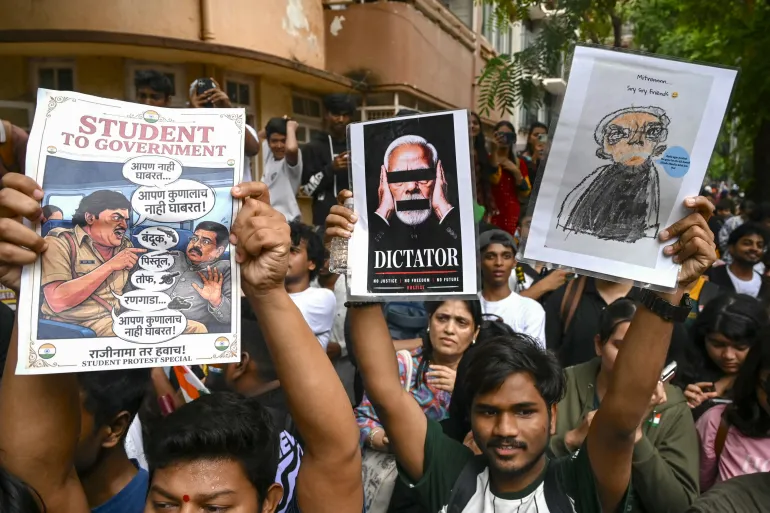
Demonstrators holding posters take part in a protest rally in Mumbai in solidarity with the ongoing protest by the Cockroach Janta Party (CJP) in New Delhi, India on July 24, 2026.
Demonstrators holding posters take part in a protest rally in Mumbai on July 24, 2026, in solidarity with the CJP at New Delhi’s Jantar Mantar [Indranil Mukherjee/AFP]

In Uttar Pradesh, India’s most populous state, the party has launched a Gen Z outreach initiative directing civil administrative officers into schools for career counselling sessions.

The BJP has also released a gym-set video in which young people trade internet slang with an older trainer who steers the talk towards the government’s development record. The slang was laid on so thick that many Instagram users mocked the party, joking that it had seemingly paid young people to write propaganda aimed at their own generation.

After another video of Modi that briefly vanished from Facebook, the parliamentary committee on information technology demanded an apology from Meta chief executive Mark Zuckerberg.

New Delhi-based analyst Asim Ali says this sudden scramble for social media relevance reveals a lot about the party itself.

The BJP once produced narratives that its own supporters would circulate unprompted. Today, he said, much of its messaging “feels more managed and paid for” – a mismatch for a decentralised space that rewards top-down discipline far less than Facebook and WhatsApp once did.

“The party’s communications machinery remains powerful, given its control over the mainstream media,” Ali told Al Jazeera. “But on social media, especially Instagram, it is unable to generate the kind of organic emotional identification that it could around 2011 to 2014.”

Gilles Verniers, a researcher at the Center for International Studies (CERI) at Sciences Po in Paris, described the BJP’s outreach as “a battle for perception” rather than a policy shift.

“There haven’t been any proposals that fundamentally change anything,” he said. “There’s a new minister for education, but he comes from the same background, an old man from the RSS.” The Rashtriya Swayamsevak Sangh (RSS) is the far-right ideological parent of the BJP.

Verniers argued that what was genuinely broken is the BJP’s usual playbook against dissent: branding protesters antinational, foreign-funded or terrorists, as they did during demonstrations against the controversial Citizenship Amendment Act (CAA) in 2019-20. The changed citizenship law, for the first time, introduced a religious test for naturalised citizenship: non-Muslim asylum seekers from India’s neighbouring nations were given a faster track to citizenship.

That past approach towards protests failed this time partly because the movement mocked itself before the state could, and partly because it was pluralistic.

Bollywood and Assamese singer Zubeen Garg, centre, sings during a protest rally by the All Assam Students’ Union and 30 other Indigenous organisations against the Citizenship Amendment Act in Guwahati, Assam, India, on January 9, 2020
Bollywood and Assamese singer Zubeen Garg, centre, sings during a protest rally by the All Assam Students’ Union and 30 other Indigenous organisations against the Citizenship Amendment Act in Guwahati, Assam, India, on January 9, 2020 [Anupam Nath/AP Photo]

Unlike the anti-CAA or farmers’ protests, it could not be pinned to one religion or community, and also drew in young people from the BJP’s own so-called “upper-caste” Hindu base. It was a “truly caste-blind movement”, Verniers said.

The episode also punctured a notion pushed by the BJP, he said, that Modi held a natural command over the youth.

For the first time, the prime minister “appears his age”, Verniers said of 75-year-old Modi.

“What the movement has done is really turn him into a boomer in the public imagination, and that must really, really hurt,” he added.

Does any of this show up in the numbers?

The BJP lost two of the three by-elections held in the first week of August, in states it governs – Bankipur in Bihar and Datia in Madhya Pradesh. However, it comfortably retained the third, Manjalpur in Gujarat, Modi’s home state.

Opposition leaders drew a straight line from the losses to the student protests, but analysts were more cautious. Ali warned against reading too much into the Bankipur vote.

By-elections, Verniers added, are decided by a fraction of the electorate, “barely a third of the population vote”, and that the BJP’s system of power “has proved very resilient to absorbing setbacks”.

Verniers points to Haryana, where the BJP won a majority a few years after the northern state’s farmers joined a yearlong movement to oppose three controversial agricultural laws. It was an election fought “not on farmers, but on caste”, he said.

What had shifted was not the vote count but a surrounding story now building “into a broader narrative of challenges to the BJP”.

An MP on the ground

Few politicians visited Jantar Mantar, the epicentre of the Gen Z protests in New Delhi, as often as Pushpendra Saroj, 27, a Samajwadi Party member of parliament from Kaushambi in Uttar Pradesh. The Samajwadi Party is the main opposition to the BJP in Uttar Pradesh, India’s most populous state.

Saroj watched a gathering of a few hundred swell into thousands after activist Sonam Wangchuk was hospitalised following a 20-day hunger strike. He credited this to “the aggression from the government” – weeks of silence, alleged cuts to power and water and the July 20 baton charge against protesters in New Delhi. The crowd had grown beyond its student base to include army veterans and even serving police officers.

The politician pointed out that the education minister’s resignation came only after “fingers got pointed at the prime minister directly”.

A simpler sympathy helped, too. “Nobody likes to see children getting beaten up,” Saroj said.

‘This is not a victory in any terms’

For many who marched in New Delhi, the story is bigger than a satirical “Cockroach” Instagram page or a single resignation. Anjali, a postgraduate student and secretary of the All India Students’ Association (AISA) at the University of Delhi, an older left-aligned group that mobilised alongside the CJP, reads the protests as the surfacing of a longer-term anger.

“We know for a fact that this did not originate from a particular remark or any particular leak,” she told Al Jazeera. “This is an accumulated anger of the youth of this country for the last 12 years. As long as communal, casteist, anti-women politics is not ended, this is not a victory in any terms,” she said.

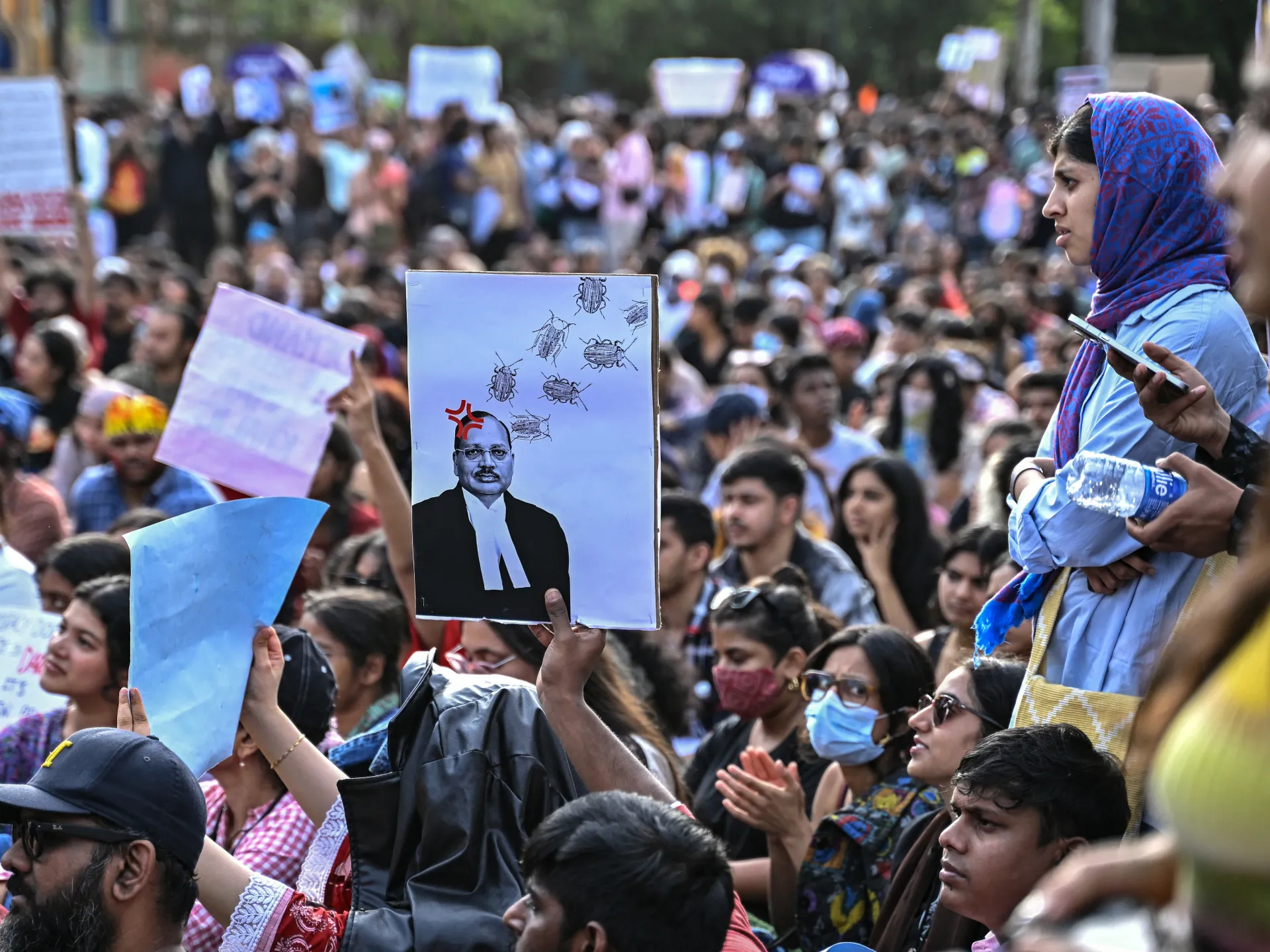
Student activists take part in a demonstration demanding educational reforms as part of the Cockroach Janta Party's ongoing protest movement in Kolkata, India on July 24, 2026.
Student activists take part in a demonstration demanding educational reforms as part of the CJP’s movement, in Kolkata, India, on July 24, 2026 [Bikas Das/AP Photo]

Anjali was also critical of who paid the price once the protests ended. Muslim and Dalit students, she said, were “the first to be put behind bars”, the first to face intimidation and police complaints, echoing the 2019 raid on Jamia Millia Islamia, the New Delhi university at the heart of the anti-CAA protests.

In the western state of Goa, police detained two young men for allegedly backing jailed activists Umar Khalid and Sharjeel Imam while celebrating Pradhan’s exit, an episode she reads as part of the same pattern.

What comes next for the CJP movement?

Ali, Verniers and Anjali all agree that a leap into electoral politics is unlikely for the CJP.

Verniers called that restraint from the group so far “tactically smart”, citing the example of the Aam Aadmi Party (AAP), a protest movement that built a successful party but, a decade into power, is “seen as a disappointment” and “on the verge of disappearance” in some former strongholds.

A national campaign demands money, volunteers and organisation that a young, often underemployed movement lacks. Its more durable influence, Verniers suggested, will be on other parties’ agendas, “as an interest group, rather than as a separate political force”, one the opposition has been unusually willing to embrace.

Anjali described AISA’s posture in similar terms: present at Jantar Mantar, but unwilling to let the fight narrow to one resignation. The group, she said, plans to keep building the argument against the government on campuses nationwide.

Al Jazeera reached out to 18 BJP national spokespeople for their responses to this article, but did not receive any replies.

The gap between power and legitimacy

Ali said he did not expect the BJP to trade its Hindu majoritarian politics — an ideology known as Hindutva — for one built on jobs and education, as demanded by CJP-led Gen Z protesters.

“I don’t think the BJP would dilute its Hindutva agenda; if anything, it would double down on it, so that the most salient issue in any election is religious identity.”

That may be, but what has changed, Verniers suggested, is not so much the BJP’s raw political power as its legitimacy.

“Electorally speaking, they are as dominant as they’ve ever been, perhaps more,” Verniers said. He cited the party’s ability to win elections, engineer defections, and outspend rivals, as proof of their continued success and of the BJP having pushed “the boundaries of what is democratically admissible”.

But the authority behind that dominance is what the protests have dented. And that gulf “between the actual power that the BJP has, and its ability to have citizens comply and obey” is harder to repair with a by-election win or a polished reel, he said.

That gap, Verniers said, “is the really important, interesting disconnect” the party now has to live with.
Source link

India’s youth have broken Modi’s spell | Opinions

The recent uprising of the youth in India might seem to have subsided after forcing Dharmendra Pradhan, the education minister of India, to resign. Still, he was never the true target of this historic youth revolt. The slogans, the placards, the irreverent digital art and the collective anger of the young were directed at one man alone: Narendra Modi.

There exists a pervasive prejudice among the intelligentsia that young Indians today are politically indifferent, consumerist and unconcerned with politics or the erosion of democratic norms. The events at Jantar Mantar have laid bare the shallowness of this assumption. The young harboured no illusions about the nature of this regime. They understood with absolute clarity that in the present constitutional setup, no minister possesses independent agency.

The Indian state today has been reduced to a single face, a single voice and an unyielding hub of authority: Narendra Modi. To demand the resignation of a minister, therefore, was not an administrative plea; it was a deliberate act to compel the supreme leader himself to yield.

Walking through Jantar Mantar, the protest site in central Delhi, occupied by thousands of young people for weeks, one could not escape this truth. What these young people achieved was nothing short of the iconoclasm of our times: the systematic demolition of the carefully curated, mythic public persona that this regime has spent a decade building as the sole visage of the nation.

What was most remarkable about this uprising was its radical decentralisation.

There were no high-budget, professionally printed banners. There was no vanguard organisation dictating the visual language of the protest or distributing uniform slogans for the benefit of television cameras. Scraps of cardboard, discarded paper and cheap marker pens sufficed. Each placard bore the unmistakable, authentic imprint of individual moral agency.

Yet, beneath this extraordinary heterogeneity, there remained an unwavering thematic unity.

Everything revolved around Modi.

The prime minister was mocked, caricatured and systematically stripped of the sacral aura that had been constructed around him for more than 10 years. In a matter of weeks, this generation transformed an imposing figure of state authority into a subject of collective laughter.

The young were outraged, above all, by the sheer, unbridled arrogance of power.

This uprising did not spring from material grievances alone; it arose from a profound sense of humiliation. The immediate symbolic spark was the deeply insensitive remark made by the chief justice of India, who publicly compared unemployed young people to “cockroaches”.

Coming after years in which the higher judiciary has increasingly appeared less like an independent guardian of the Constitution and more like an extension of executive power, the remark was understood as an articulation of the regime’s own contempt for its youth.

The formation of the “Cockroach Janta Party” (CJP) was an act of counter-humour born of deep injury. The already unfolding scandal over irregularities in the NEET examinations provided the movement with a concrete institutional focal point. The scandal became the occasion to demand accountability not just for a single test, but for an entire culture of governance.

The regime, meanwhile, suffered from its own hubris. It had persuaded itself that Indian society was thoroughly managed. Preoccupied with engineering electoral outcomes through the manipulation of rolls, managing parliamentary majorities through party defections, and consolidating its hold over state institutions, it failed to notice the quiet, gathering storm beneath the surface.

Those who possessed platforms, prestige and the power to shape public discourse were engrossed in celebrating the grand narrative of national glory. Television studios debated the nation’s civilisational destiny and its global standing. The mainstream press sang panegyrics to a “New India”. Scarcely anyone looked towards the young who found every avenue of mobility blocked. Their anxieties were rendered invisible because the state and its allied media did not consider them worthy of serious democratic attention.

Deprived of traditional spaces, they constructed their own. Their smartphones became their public square; social media platforms became their political assemblies; and satire became their primary democratic vocabulary.

The ruling ideology had convinced itself that the project of cultural hegemonisation was complete: once the majority was mobilised around a politics of religious identity and grievance against minorities, material realities would cease to matter. The aspirations, anxieties and dignity of an entire generation simply did not figure in this political imagination.

It was against this backdrop of institutional indifference that Sonam Wangchuk began his fast at Jantar Mantar. The government’s initial response was its standard weapon: calculated silence. As Wangchuk’s health deteriorated, the refusal to even acknowledge his presence generated profound moral outrage. Then came the fateful decision to forcibly remove him.

It proved to be a fatal miscalculation. The young perceived the treatment of Wangchuk as an insult to their own citizenship. What was done to him could be done to anyone who dared to stand up. His humiliation became their collective provocation. The response was immediate: Jantar Mantar was flooded by thousands of young bodies.

When the young marched towards parliament on July 20, the state relied on its familiar playbook: barricades, prohibitory orders and violent suppression. It had deployed these very methods against the anti-CAA protesters and the farmers’ movement. But this time, the internal mechanics of fear failed to operate. The blows they received did not shatter their spirit; they deepened their moral clarity.

Their struggle was not merely about securing a policy change or extracting a routine administrative concession. They set out to breach that institutional arrogance. When the Delhi police rained blows on the protesters on July 20, beating young citizens with a ferocity typically reserved for enemy combatants, the protesters did not view those batons as the instruments of an indifferent police force. They recognised them as the direct expression of Narendra Modi’s political will.

Yet, fear failed to perform its intended historic function. Many returned to Jantar Mantar carrying their wounds like badges of honour. Some returned barefoot. Their injuries became symbols of moral persistence rather than reasons for retreat. Their resolve was remarkably simple: they would force Modi to sacrifice one of his own.

Crucially, the protesters refused to yield to the temptation of violence. Their weapons remained language, images and satire. Armed with their phones, they launched an unrelenting assault on the prime minister’s public image, the very asset he has guarded most fiercely throughout his political life. For the first time, Modi was drawn onto a battleground where he could not dictate the rules.

When the prime minister attempted to intervene directly on social media, addressing the youth as “friends”, the rebuttal was instant and devastating:

“We are not your friends.”

It was more than a clever slogan; it marked the psychological collapse of a carefully cultivated paternalistic relationship. For years, Modi had sought to speak directly to the populace, bypassing mediating institutions and independent media. The young rejected that calculated intimacy in a single sentence. The authority of the patriarch dissolved into the irreverence that a free people reserve for their elected officials. The spell of fear was broken.

The assault on Modi’s public image appears to have shaken the regime far more deeply than any routine electoral setback ever could. For more than a decade, his authority has rested not merely on the coercive power of the state, but on the illusion of invulnerability: an image of a leader who never retreats, never admits error and never compromises.

The movement had to be contained before the satire hardened into permanent collective memory and the laughter of the young became the common language of the republic.

Pradhan’s resignation must be read precisely in this light. It is not the sacrifice of a minister; it is a desperate attempt to construct a firewall around the prime minister himself. The government will undoubtedly frame this as evidence of its responsiveness and democratic sensitivity. But the young understand it differently. For them, the resignation is a political concession extracted from an authority that had run out of options.

Before arriving at this point, the state had exhausted its standard repertoire of delegitimisation. It ignored the movement, questioned its motives, accused the youth of being proxies for opposition parties and deployed its media networks to allege foreign plots. When these slurs failed to stick, it resorted to force. Having endured all of this, the young do not view the minister’s exit as an act of state benevolence; they see it as the reluctant admission of a defeat that could no longer be disguised.

Ordinarily, the vocabulary of victory and defeat should not dominate a constitutional democracy. A government is expected to listen to its citizens, not view them as adversaries to be crushed. Dissent is not treason. But when a state consistently treats criticism as hostility and peaceful protesters as enemies of the state, it transforms democratic dialogue into a confrontation. When that happens, it cannot complain if citizens celebrate its retreat as a democratic victory.

The ultimate significance of this movement lies in its moral and creative form. The young answered state coercion with speech, wit, art and an extraordinary mastery of contemporary cultural forms. Their elders have often lamented that a generation raised on short-form content lacks political depth and endurance. Jantar Mantar has demolished that patronising assumption.

The meme was elevated to a potent instrument of political resistance. Laughter accomplished what solemn political rhetoric often fails to do: it punctured fear, dismantled false authority and deprived power of the uncritical reverence upon which authoritarian politics depends.

Authoritarianism requires not just obedience, but awe. It survives as long as people believe the ruler is beyond challenge, beyond satire and beyond defeat. The young at Jantar Mantar refused to grant Narendra Modi that sacral status. They restored him to the position he must occupy in a constitutional republic: an ordinary, accountable political leader, subject to the scrutiny, criticism and satire of the citizenry.

The protest site at Jantar Mantar may now be empty. The barricades have been moved aside and the crowds have returned to their hostels, campuses and homes. But movements of this nature do not end when the physical space is vacated. The critique inaugurated on the streets will continue in countless quiet spaces: university libraries, rented rooms, bus rides and millions of illuminated screens. The language that has been discovered cannot easily be unlearned.

If this youth uprising leaves behind an enduring lesson for the republic, it is a simple, fundamental truth: democracy begins the moment a people recover confidence in their own voice.

The views expressed in this article are the author’s own and do not necessarily reflect Al Jazeera’s editorial stance.

Source link

‘Televising our revolution’: India’s Gen Z flips Modi’s social media game | Protests

New Delhi, India — She darted through a sprinting crowd, running from a cloud of tear gas just above her head. Her eyes stung so badly she could barely see, yet she filmed the chaos on her phone.

“I saw policemen brutally beating up unarmed girls and peaceful children,” said Avanshika Singh, who has been turning up for student protests that shut down the national capital, demanding the education minister’s resignation.

On her return home, the 18-year-old put together a rough cut from the chaos and captioned it on Instagram: “Today, we rang Parliament’s doorbell and ran.”

The march to the Indian parliament on July 20 against serial examination paper leaks brought the nation’s capital to a standstill as tens of thousands of protesters occupied central roads leading to the country’s corridors of power. More than 100 students were injured in a crackdown by police, operating under the direct instructions of Prime Minister Narendra Modi’s government.

But since then, Indian internet has turned into a relentless reel of police excesses: shaky smartphone footage, rapid-fire edits pulsing to hip-hop tracks, and a tidal wave of memes and expletives.

“This is the only thing anyone is talking about. If nothing, we are televising our revolution,” Singh, a teenager, told Al Jazeera, standing amid a sea of protesters choking Parliament Street on Wednesday. “The entire country today feels the sting of batons and tear gas with us.”

Twelve years ago, Modi rode to power and pioneered in many ways, leveraging social media platforms to reach the masses. Today, Gen Z is flipping his Hindu majoritarian party’s dominance on social platforms, weaponising against it the very tools the Bharatiya Janata Party has long relied on.

“Hating Modi is cool on the internet now, after years of criminalising dissent,” she said, before bursting into slogans: “Uncle Modi, go back, go back.”

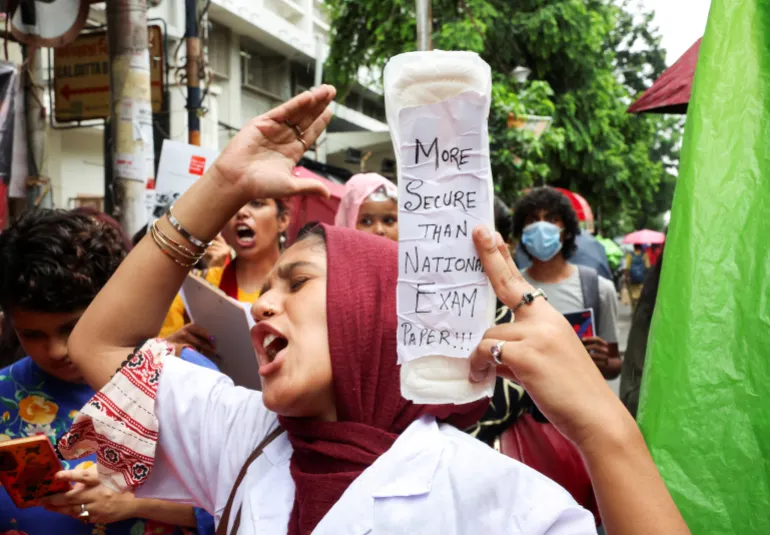
A woman holds a sanitary pad with a slogan in solidarity with India’s Cockroach Janta Party protests held at Jantar Mantar in New Delhi, which demand the resignation of Education Minister Dharmendra Pradhan over exam paper leaks, in Kolkata, India, on July 22, 2026
A woman holds a sanitary pad with a slogan in solidarity with India’s Cockroach Janta Party protests held at Jantar Mantar in New Delhi, which demand the resignation of Education Minister Dharmendra Pradhan over exam paper leaks, in Kolkata, India, on July 22, 2026 [Sahiba Chawdhary/Reuters]

Evidence of police excess

After the July 20 demonstrations against the government’s handling of paper leaks, the police denied all the protesters’ allegations and media reports of excess force in the crackdown.

But by then, social media was flooded with evidence, recorded by the protesting students.

A New Delhi police officer thrusting a baton on a female protester’s back; usage — potentially by a paramilitary force that was deployed alongside the police — of lethal pellet guns, for the first time in the national capital; a mother crying and pleading with dozens of police officials; another officer slapping and chasing unarmed students; police officers wearing Meta glasses; law enforcement agents planting a damaged car outside a protest strip; and footage where an officer casually trips the students running from tear gas.

No sight escapes the cameras at the Jantar Mantar protest strip, where thousands of protesters keep recording round the clock. The visuals from July 20 have prompted protests across India, in cities like Mumbai, Bengaluru, Patna, Lucknow and Aizawl.

The Cockroach Janta Party, a political pressure group that has been leading the students’ protest, has said the demonstrations would continue “peacefully” until three demands are met. They want Dharmendra Pradhan, the education minister, to resign; for the Modi government to assure that no criminal cases would be pursued against protesters; and for compensation of about $105,000 for families of students who died by suicide due to exam paper leaks and cancellations.

Niharika Soni, a 19-year-old, stood among the thousands-strong crowd that occupied Parliament Street on Wednesday, distributing water bottles to protesters. She did not take part in the July 20 march and did not care much about it either.

Then, the visuals appeared on her feed.

“My mother and I cried for two hours, watching the videos together at home,” she said, adding that her mother has been a staunch supporter of PM Modi.

“We hugged each other and come here every day now,” she added, now holding her mother’s hands, as part of a human chain, ready to confront government forces if attacked.

A supporter of India’s Cockroach Janta Party (CJP) sits on the ground as he rests during ongoing protests, two days after thousands of protesters marched towards parliament demanding the resignation of Education Minister Dharmendra Pradhan over examination paper leaks, at Jantar Mantar in New Delhi, India, on July 22, 2026
A supporter of India’s Cockroach Janta Party (CJP) sits on the ground as he rests during ongoing protests, two days after thousands of protesters marched towards parliament demanding the resignation of Education Minister Dharmendra Pradhan over examination paper leaks, at Jantar Mantar in New Delhi, India, on July 22, 2026 [Anushree Fadnavis/Reuters]

‘Leaking any responsibility’

It is also a meme fest on the Indian internet.

Protesters pose, mock and tease police personnel stationed near the protest site. Some offer flowers to them while reminding them that the officers only offered baton hits.

A stroll through the protest site and nearby roads is like scrolling an Instagram feed: posters and graffiti now line central New Delhi.

Even when they speak, protesters use language riddled with smart one-liners and mockery of the government.

“This government is leaking any responsibility towards the youth of this country,” Ipshita Gulyari, a 20-year-old, told Al Jazeera. Modi, she said, had messed with the “wrong generation”.

“There is a lot of arrogance in him — and, you know, teenagers do not tolerate that, bro.”

Another duo carried the popular Japanese manga One Piece, a symbol adopted by Gen Z protest movements worldwide. A group of friends donned fictional superhero costumes from Marvel’s Avengers: Spider-Man, Iron Man and Hulk, sitting together on police barricades, looking onto Parliament Street.

“We, the Gen Z people, are born on and for the internet. We were using Instagram before I could read a clock,” said Gulyari.

Mainstream television news channels friendly to Modi have faced accusations of not covering the protests adequately. But young people like Gulyari rely increasingly on independent small publications, and, even more, on social media.

“Gen Z is taking it lightly, being funny about it, because humour is our coping mechanism,” said 18-year-old Yashvi Kumar, a friend of Gulyari at the protest.

“In the middle of all chaos, somewhere we decided that to rebel, we need to find a way that unites us. The memes are uniting us.”

On the other hand, social media posts put up by the BJP are spammed by thousands, calling for the minister to resign.

Supporters of India’s Cockroach Janta Party (CJP) take shelter at a protest site, two days after thousands of protesters marched towards parliament demanding the resignation of Education Minister Dharmendra Pradhan over examination paper leaks, at Jantar Mantar in New Delhi, India, on July 22, 2026
Supporters of India’s Cockroach Janta Party (CJP) take shelter at a protest site, two days after thousands of protesters marched towards parliament demanding the resignation of Education Minister Dharmendra Pradhan over examination paper leaks, at Jantar Mantar in New Delhi, India, on July 22, 2026 [Anushree Fadnavis/Reuters]

Flipping the game

In 2014, Modi was among the first world leaders to understand and leverage social media to take his narrative to the masses. The Congress party, now in opposition, was trounced by Modi’s BJP in national elections that year, and has long struggled to keep up with the BJP’s social media dominance.

But with years in power, as India slid in multiple democratic indices, Modi’s government faced mounting accusations that it was criminalising dissent, with several critics jailed for years without a trial.

Modi’s party also mobilised extensive resources in the last decade in its so-called IT Cell, where a bunch of anonymous accounts, or creators friendly to the government, dox, troll and delegitimise social media criticism.

It is fitting, therefore, analysts say, that the biggest challenge Modi has faced on the streets stems from an online joke. After India’s chief justice casually likened the youth to “cockroaches” and “parasites”, the resulting fury led to the formation of the Cockroach Janta Party.

Before the Cockroach movement, “there was an undercurrent of memes from anonymous accounts, masked people, mocking the government,” said Anurag Minus Verma, a cultural critic and author of The Great Indian Brain Rot.

“In a post-ironical world, anything said with irony travels faster — and irony becomes a central feature of the internet during this kind of protest,” he said. “The pent-up anger found a channel at Jantar Mantar, allowing youth to do their thing, speak in their language.”

The most remarkable turnaround for Verma, he said, has been the unmasking of critics at the protest, where demonstrators ridicule and mock Modi, erasing the fear.

Verma argued that the Modi government had crushed and criminalised protests by labelling them anti-nationals and breaking them into sections. “The Gen Z protesters already identify themselves ridiculously enough: they are cockroaches,” he said. “It becomes a single identity — and that becomes easier to penetrate the virality zone.”

“Some are recreating the popular memes from Nepal, Bangladesh and Hong Kong uprisings,” he told Al Jazeera. “The criticism and hate directed at Modi in the capital is not only acceptable now, but even cool.”

Modi, in a tacit acknowledgement of the power of the social media wave that’s against his government, on Thursday morning offered his first comments on the student protests — on X.

“Nothing is more important than the welfare and future of our youth!” he wrote, before mentioning that his government had set up fast-track courts to punish those behind the paper leaks.

But the CJP’s leader Abhijeet Dipke was quick with his riposte on X.

Playing on Modi’s own words, overlaid on a photo of Education Minister Pradhan, Dipke wrote: “Hi, my name is Nothing”.

Source link