
mobbed

Clinton Vows to Help California : Economy: President is mobbed in campaign-style stops in inner city and Valley College. He says he will pick a ‘compassionate but hard-headed’ INS chief.

Closing a two-day Western trip, President Clinton on Tuesday pledged to Los Angeles audiences his special commitment to help the California economy, while asking state residents to do their part for the economic plan he is pushing through Congress.

Clinton, in mobbed campaign-style stops in South-Central Los Angeles and at Los Angeles Valley College in Van Nuys, asserted that the U.S. economy won’t recover until the nation’s largest state can pull itself out of its slump. “We can’t turn this economy around unless we’re going to lift California up,” Clinton told students at the community college.

The President also signaled his interest in California immigration problems, saying that he will soon pick a “compassionate but hard-headed” person to head the Immigration and Naturalization Service. He said he hopes to get Atty. Gen. Janet Reno’s recommendation for that post as early as this week.

Clinton, who has traveled out of Washington for part of the past two weeks trying to drum up support for his economic plan, visited a black-owned apparel store on South-Central’s Florence Avenue to illustrate his view that the riot-torn area can only be rebuilt through a joint effort of government and business. He used the community college stop to stress his advocacy of continually retraining workers to make them competitive in a world economy.

The Clinton road show has been part economics seminar and part campaign extravaganza, and his visit to Los Angeles was no exception.

At the community college, he sat on a wooden stool under flowering mimosa trees to field questions from students on education, jobs, immigration and other subjects. At the South-Central stop, he and Commerce Secretary Ronald H. Brown toured the store, then stripped off their suit jackets and ties and shot baskets for a few minutes with a group of youngsters.

The crowds were large and warm, but Clinton’s most impassioned defense of his program came when hecklers taunted him at the community college. To their chants “You broke your promise”–referring to his pledge not to raise taxes on the middle class–and “No new taxes,” the President rejoined:

“You know what the ‘no new tax’ crowd did for 12 years? They cut taxes on the rich, raised taxes on the middle class and left the country in a ditch,” he said. “The free lunch crowd has had their chance.”

He cited as proof of his commitment to California the efforts of Commerce Secretary Brown, who has visited the state seven times since January to help coordinate the government’s effort to help the economy. He said he had asked Brown to “map a specific plan to turn this economy around.”

The President told the college students he would like to help the state’s economy through increased aid for laid off defense workers and their communities, additional community policing and financial aid to offset immigration-related costs.

He made again a pitch for the central idea of his economic plan, that the country needs to cut its deficit while increasing spending–”investment”–for other purposes that will strengthen the economy over the long term.

In South-Central Los Angeles, Clinton visited The Playground, a community center and sporting goods store on Florence Avenue just one mile west of where rioting erupted last year. It was founded by a business person, a lawyer, a doctor and ex-gang members from the Crips. A basketball court was established in back so youths could play as well as buy merchandise.

While the store has received no federal aid, Clinton used it to illustrate his Administration’s redevelopment strategy, which also calls for the use of tax-advantaged “empowerment zones” to bring commerce to distressed areas.

After touring the store and meeting its owners, Clinton headed for the basketball court. He shed his coat, removed his shoes and socks and deposited the contents of his pockets in a shoe box.

In front of a phalanx of several dozen photographers, Leonard Baylor, 8, presented Clinton with a gift of size 13 sneakers.

“Thank you, Mr. President, for coming,” Leonard told the President. “Here, take these shoes.” Then, the boy said to the President: “Shoot some hoops with us?”

Baylor broke into tears–because he was overcome with emotion, a store owner later said. The President pulled Baylor close to comfort him.

Clinton pulled off his tie and pulled on athletic socks and the sneakers. Brown did the same. They then joined 18 youths on the court ranging in age from 6 to 17.

The President captained one team and Brown led another while a friendly crowd of about 200 as well as reporters and camera crews looked on.

Clinton, with shirttails flapping from the back of his baggy suit pants, missed his first two shots, then saved face by hitting from 10 feet out. Brown, however, swished from 20 feet away.

Clinton also grabbed five rebounds. “I made some good passes,” he said, but seemed to acknowledge that his commerce secretary stole the show, declaring, “Can Ron Brown shoot a jump shot or what?”

After the game, Clinton told the crowd: “I want everybody in America to know that there are people here in Los Angeles who believe that we can bring business to this area, that we can put people to work, if you have the help you need.”

“I wanted to come here today not just to have a little fun with a basketball, but to say to you and all of America that we’re going to have to rebuild this country from the grass roots up,” Clinton said. “This is an incredible untapped resource for America. If everyone in this country who wanted a job had one, we wouldn’t have half the problems we’ve got.”

Clinton said that he and Brown planned to go back to Washington to try to pass an economic program that will put “you back to work.”

The crowd in South-Central was clearly with him. Dorothy Redmond, a nursery school owner in the neighborhood, said: “I’m very encouraged. I am an entrepreneur of a small business and I think this is a step in the right direction.”

“I’m just speechless,” said Flora Lane, who traveled to South-Central from her home in the Wilshire district. “He is a person who cares about all people. I am for him 100%, plus his wife.”

But all the reviews of Clinton’s program weren’t favorable.

In Washington, Senate Minority Leader Bob Dole (R-Kan.) characterized Clinton’s trip as “heading West while his poll numbers go South.”

“His West Coast public relations blitz is just another political make-over to try to convince people he’s cutting spending when he’s really breaking all world records for tax increases,” Dole said.

In Sacramento, the Wilson Administration released a report contending that Clinton’s five-year plan would cost Californians $11.6 billion more than their “fair share” of spending cuts and tax increases.

The state Department of Finance said it drew its figures from Clinton’s proposals for defense cuts, defense conversion and retraining, tax increases on personal income and energy, and tax credits for investment. The analysis also included estimates of the indirect effect of changes in spending and tax policy and a possible reduction in interest rates.

The study said it was assumed that “California will receive a disproportionate share of benefits included in the Clinton proposals–tax credits, investment spending and defense conversion spending.”

But those benefits, it said, will only partially offset the “dampening effect” of the defense cuts. Although California’s population is about 12% of the nation, the study said it appeared the state would absorb at least 25% of the cuts.

Overall, the report said, the plan would cost Californians $68.7 billion, or 14.6% of the total. Based on the state’s 12% share of the nation’s population, the “fair share” of the deficit-cutting burden would cost the state and its residents $57 billion, the report said.

Times staff writer Daniel M. Weintraub contributed to this story from Sacramento.

* RELATED STORIES: A3, B1

Source link

UK’s most beautiful village brings in strict rules for tourists after locals mobbed

The village has been crowned the world’s most beautiful by Forbes and receives 20,000 visitors on weekends – but overtourism has caused serious problems

A UK village crowned the most beautiful in the world has moved forward in the fight against overtourism, with a huge cash boost and a raft of new potential measures.

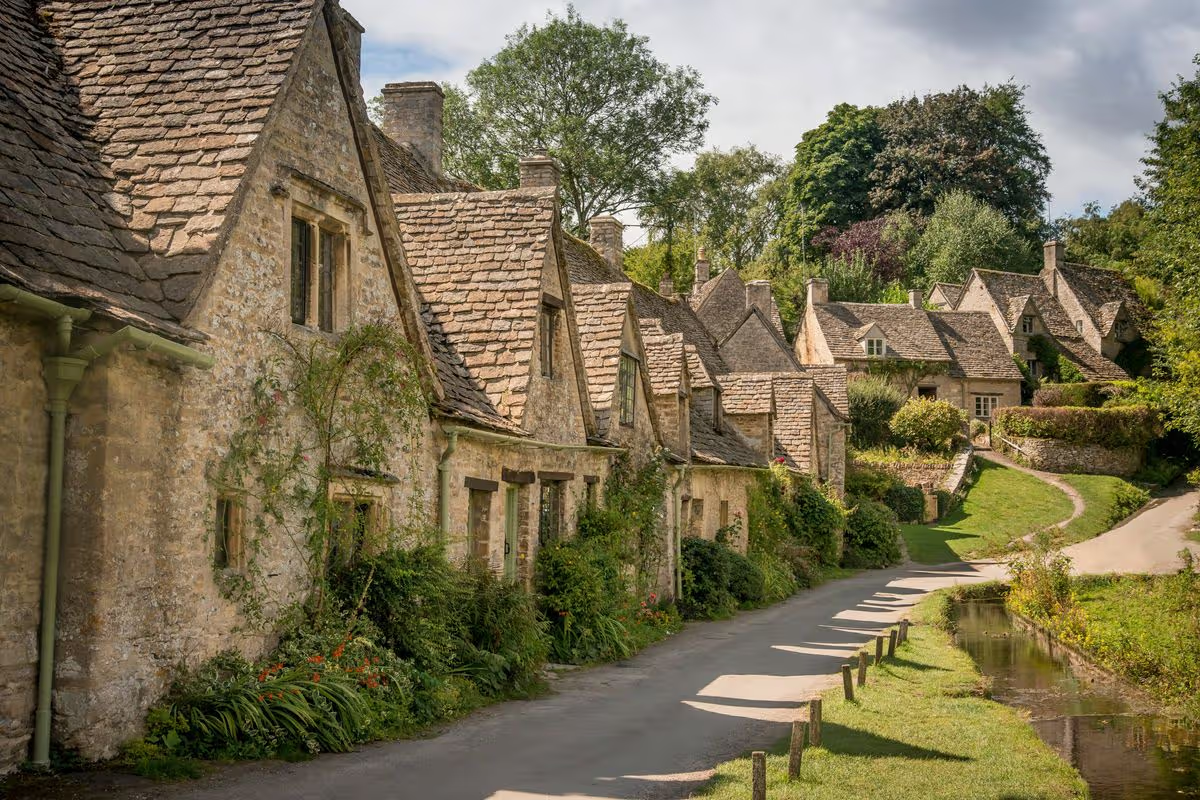
Bibury, nestled in the Gloucestershire Cotswolds, is an undeniably charming spot. It boasts honey-hued stone cottages, a gently winding river, and a historic, fairytale-like atmosphere. Its allure led Forbes to name it the world’s most attractive village for 2025, approximately 150 years after poet William Morris declared Bibury “the most beautiful village in England.”

The cottages of Arlington Row are often hailed as the most photographed and breathtaking cottages in Britain. Built in 1380 as a monastic wool store, it was later converted into a row of weavers’ cottages in the 17th century.

It’s easy to see why Bibury garners such accolades, with accommodation options like the Swan Hotel and The Catherine Wheel pub both welcoming inside and festooned with climbing plants outside. The village’s charm has put Bibury firmly on the tourist trail. And now, some locals say, things are getting out of hand.

Do you have a story to share? Email webtravel@reachplc.com

READ MORE: Brits ditch Balearics for other hotspots leaving livid locals asking ‘where are our customers?’READ MORE: Spain tourist rules for Brits from flip-flop ban to dress codes and vaping fines

Chairman of the local parking action group, Mark Honeyball, who has resided in Bibury for a decade, has had some rather unpleasant experiences with visitors. He revealed to the Express that he asked a coach driver to move on from some double yellow lines before drama unfolded.

He said last year: “I’ve been physically attacked four times now, but once really quite badly two weeks ago, I was kicked in the chest and stomach and kneed and punched in the face full force by a driver that I’d just asked simply to move on from double yellows at the top of the village.

“The coach drivers themselves are being pushed here by their coach companies, they don’t really want to be here, they find it really difficult to park. The tour operators are the key behind this, the coach operators are doing what the tour operators ask them to do, primarily with people from China, India, and South Korea at the moment.”

Up to 20,000 tourists flood into Bibury over weekends in the high season, with as many as 50 coaches arriving daily. That’s a staggering number for a village home to merely 600 residents.

This week, Gloucestershire County Council announced it was investing £175,000 in a project to combat ‘overtourism’ in Bibury, Punchline Gloucester reports.

Following the period of consultation, the county council is considering a series of measures to control the impact of tourism. They include:

  • Permanent removal of coach parking bays and implementation of on-street parking restrictions.
  • Additional enforcement of parking restrictions.
  • Introducing pay-and-display parking.
  • Restricting coach parking/waiting using enforcement officers to support traffic flow.
  • Exploring if there are improvements that can be made to local bus services including options such as park and ride.

Restrictions on coaches entering the village were implemented in May last year. At that point, parking bays in the heart of the village were shut and new public bus stop clearways were established. The objective was to put a stop to “unsafe coach manoeuvres.” Following the summer trial period, Gloucestershire County Council decided to implement permanent restrictions on coaches entering the area.

Cllr Lisa Spivey, leader of the county council, said: “Hopefully we are getting somewhere. We did a trial last year which has been extended where we essentially removed the coach parking bays in the centre of the village and created drop off and pick up points for coaches, so we are now going to make that a more permanent solution.

“They have currently got some red and white plastic barriers which don’t look very nice in a historic village so we want to make that look nice. We are going to introduce pay and display parking so we can pay for more enforcement to make sure people aren’t parking where they shouldn’t be and causing an issue.

“We’ve been working alongside the coach operators and other stakeholders to really encourage the use of smaller vehicles to come into the village. There’s been a huge amount of engagement with the coach operators, Cotswold Tourism, the parish council, businesses, the police etc. Lots of people have been involved.”

Source link