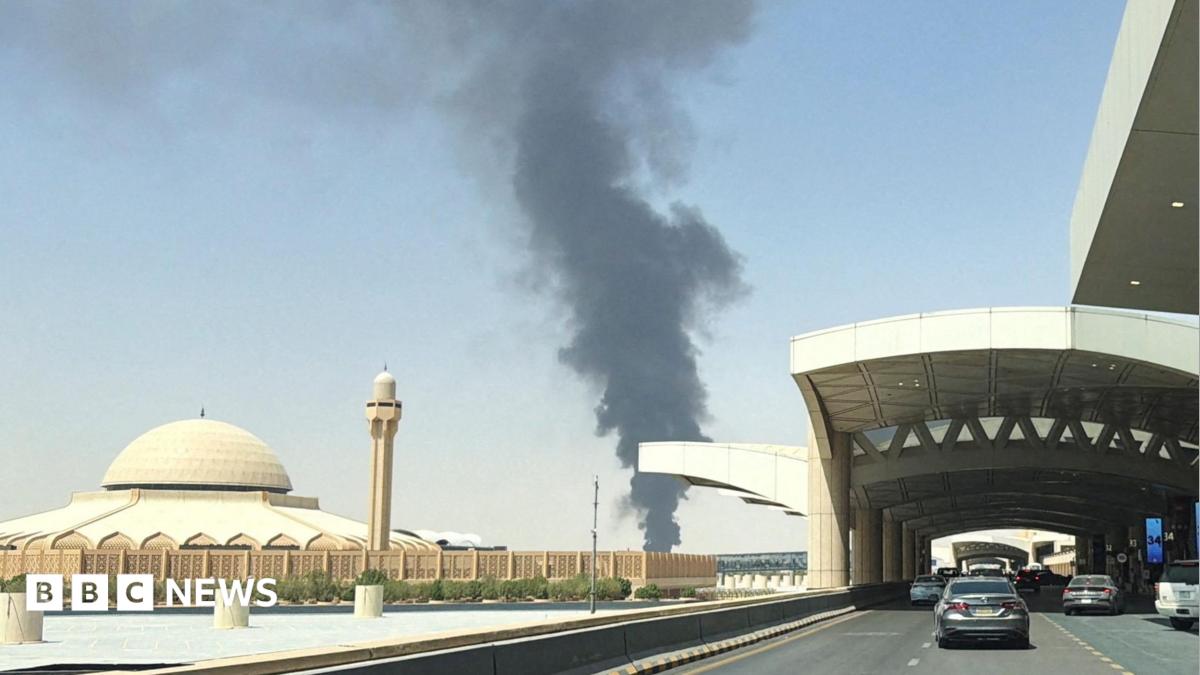
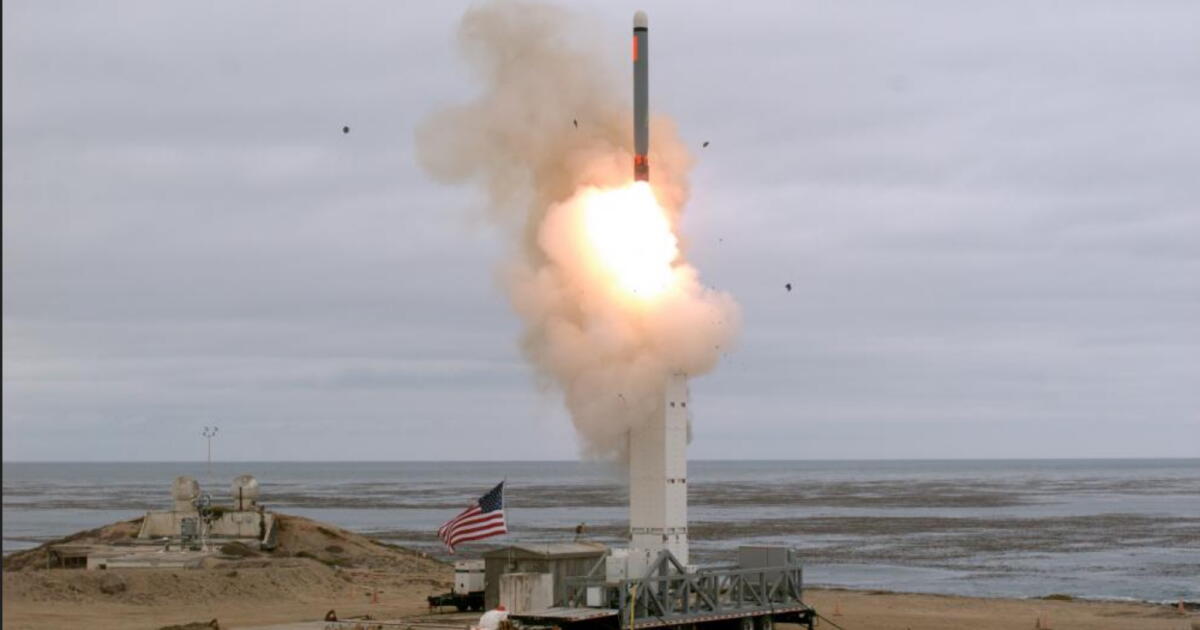
Iranian state media says two missiles have struck a US navy destroyer to prevent it entering the Strait of Hormuz after the warship ignored warnings to halt. The attack comes after US President Donald Trump announced a naval mission to ‘guide’ stranded ships through the strait.
Weekly insights and analysis on the latest developments in military technology, strategy, and foreign policy.
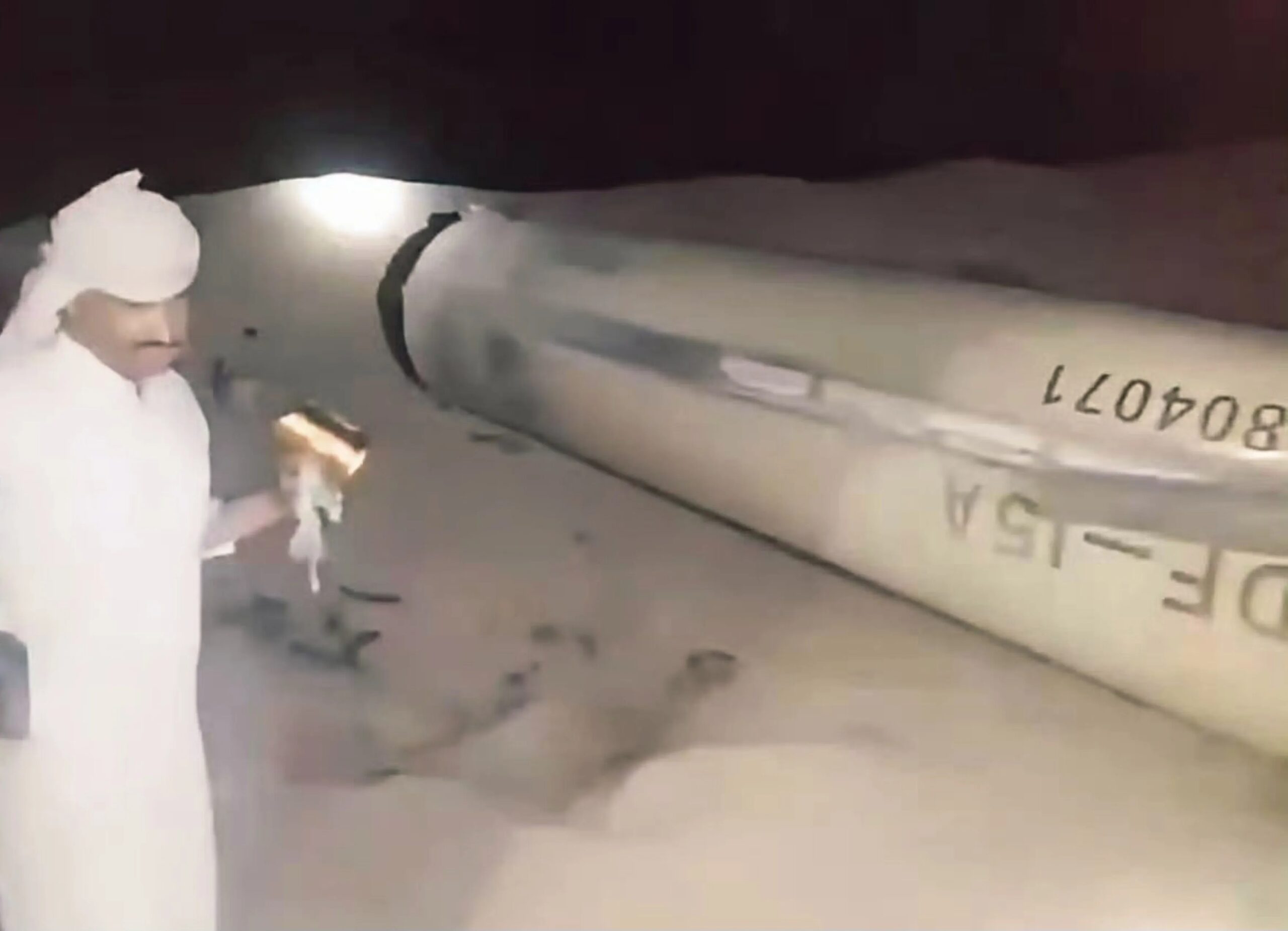
Recently uncovered wreckage of an Advanced Medium-Range Air-to-Air Missile (AMRAAM) reveals that Ukraine is employing the AIM-120C-8 version, a weapon that is close to the ‘top of the line’ for these missiles. Ukraine can employ AMRAAMs of all types from its F-16 fighters, as well as from the ground-based National Advanced Surface-to-Air Missile System (NASAMS) air defense system.
The wreckage of an AIM-120C-8 missile, apparently found in the aftermath of a Russian air attack on Dnipro. via Dnipro Main News/Telegram
A photo showing part of an AMRAAM missile body clearly marked with the AIM-120C-8 designation began to circulate online recently. According to available accounts, the wreckage was found in the aftermath of a Russian air attack on Dnipro in central Ukraine, during which the Ukrainian Armed Forces were active in defense of the city.
Previous imagery of Ukrainian F-16s had confirmed they were using some version of the AIM-120C, which can be identified on account of its cropped fins for internal carriage in the F-22 and F-35. This appears to be the first confirmation that the AIM-120C-8, specifically, has been supplied to Kyiv, in addition to earlier AIM-120A/B versions.
As we’ve discussed in the past, the AIM-120C offers some significant advantages over the earlier AIM-120A/B models.
In general, the ‘Charlie’ version offers a range of advanced capabilities that reflect the continuous development of both this specific sub-variant and the AIM-120 series overall. Even in its earliest sub-generation versions, the C-model features notable upgrades in terms of range, guidance, resistance to countermeasures, and other key areas.
An F-35C launches an AIM-120C AMRAAM from its internal weapons bay over a controlled sea test range in the Pacific Ocean. U.S. Air Force/ Christopher Okula
Successive improvements reportedly introduced on the AIM-120C family include a new WDU-41/B warhead (AIM-120C-4), a new WPU-16/B propulsion section with a larger motor and electronic counter-countermeasures (ECCM) upgrades (AIM-120C-5), and an updated proximity fuze (AIM-120C-6). Meanwhile, the AIM-120C-7 features further improved ECCM, an upgraded seeker, and a longer range.
The exact differences between the AIM-120C-8 and the AIM-120D are somewhat unclear, although the D-model, at least, is understood to feature two-way datalink with third-party targeting capabilities. The AIM-120D may also feature an active electronically scanned array (AESA) seeker, while the C-8 remains a mechanically scanned antenna. There have been previous suggestions that the AIM-120D is reserved for the U.S. military and its closest allies, while other international customers receive the AIM-120C-8.
Maintainers prepare AIM-120D AMRAAMs for carriage by F-15s during an exercise at Kadena Air Base, Japan. U.S. Air Force/Senior Airman Peter Reft
It was an AIM-120D that was used for what the U.S. Air Force described as the “longest known” air-to-air missile shot, during a series of tests in airspace near Eglin Air Force Base, Florida, in the fall of 2024. The launch platform on that occasion was an F-22. This would fit with reports that the D-model features significantly greater range than earlier versions, although, once again, the precise differences between AIM-120C-8 and AIM-120D are unclear.
Both the AIM-120C-8 and the AIM-120D have also been further enhanced under the F3R program, developed for the U.S. Air Force. F3R stands for form, fit, function refresh, and is primarily intended to eke out more performance from the missile, as you can read more about here. It’s not clear if Ukraine’s AIM-120C-8s also benefit from the F3R improvements.
A recent promotional video from Raytheon includes footage of a separation launch of the latest-generation AMRAAM F3R from a U.S. Navy F/A-18F Super Hornet:
Air Dominance With a Digital Edge
The plan was for the U.S. Air Force to begin to receive AMRAAMs incorporating F3R starting early 2023, as part of the Lot 33 production run. The U.S. AMRAAM program of record is expected to continue into around 2027 or 2028. As for the AIM-120C-8, these missiles are expected to remain in production for international partners long beyond 2030.
Regardless, the AIM-120C-8 offers Ukraine a notably long-range weapon.
While official performance figures are classified, it is generally assumed to be able to hit targets at a distance of between 75 and 100 miles. Of course, in practical applications, a whole range of factors impact a missile’s reach, above all, the energy and altitude state of the launching aircraft and the target.
In an air-to-air context, the weapon goes some way toward closing the gap with Russia’s R-37M missile, known to NATO as the AA-13 Axehead. According to the manufacturer, at least in its export form, the R-37M can defeat “some types” of aerial targets at a range of up to 124 miles. This likely refers to only larger, less agile, aircraft targets and is very much a “sales brochure figure,” with all the caveats that entails.
A Russian Aerospace Forces Su-35S fires an R-37M missile during a weapons test. Russian Ministry of Defense screencap
At this stage, we don’t know for sure whether the wreckage in Dnipro came from an air-launched AMRAAM, i.e., fired by an F-16, or if it was an effector from a ground-based NASAMS.
In the case of the F-16, the importance of the AMRAAM cannot be overstated. This was the first active-radar-guided air-to-air missile to be fielded by Ukraine. This is a class of weapons that the Ukrainian Air Force long campaigned for. One of its fighter pilots, the late Andrii Pilshchykov, better known by his callsign “Juice,” told TWZ back in 2022: “The lack of fire and forget missiles is the greatest problem for us.”
More recently, Ukrainian F-16s have had to rely more heavily on AMRAAMs. Earlier this year, reports emerged indicating that Ukraine had been left late last year with only “a handful” of U.S.-made AIM-9 Sidewinder air-to-air missiles for its F-16s, after the supply of these short-range weapons dried up.
A U.S. Air Force F-16C armed with AIM-120C AMRAAM, AIM-9L/M Sidewinder, and AGM-88 HARM missiles. U.S. Air Force
This left the F-16 pilots with AMRAAMs plus the jet’s internal 20mm M61 Vulcan cannon.
As we have discussed many times before, taking out slow-moving drones via another fixed-wing aircraft with guns can be very challenging and downright dangerous, especially for fast jets. AMRAAMs can be employed against drones and cruise missiles, too, but are more expensive weapons than the Sidewinders. Each AMRAAM costs around one million dollars.
An earlier view of a Ukrainian F-16 carrying AIM-120 AMRAAM and AIM-9L/M missiles, underwing fuel tanks, plus the Terma pylons with integrated self-defense systems. The AMRAAMs have uncropped fins, so they are AIM-120A/B versions. Ukrainian Air Force
To help plug the gap, Ukrainian F-16s have begun using laser-guided 70mm Advanced Precision Kill Weapon System II (APKWS II) rockets. These rockets provide an extremely valuable, lower-cost option for engaging long-range kamikaze drones and subsonic cruise missiles. U.S. Air Force F-16s began using them in combat last year, as we were first to report.
A photo showing one of Ukraine’s F-16s apparently carrying a pair of LAU-131/A seven-shot 70mm rocket pods loaded with APKWS II rockets. via Avia OFN/Telegram
While somewhat less likely, there’s also a possibility that the Dnipro wreckage came from an AIM-120C-8 fired by a NASAMS.
As we explored at the time, a critical advantage of NASAMS is the fact that it fires the exact same missiles used in air-to-air applications. It does not require a special AMRAAM variant or major modifications to existing missiles. In addition, it can fire other types of effectors, including the AMRAAM-ER, which is a hybrid of the AIM-120 and the RIM-162 Evolved Sea Sparrow Missile (ESSM), and the infrared-homing AIM-9X Sidewinder and IRIS-T missiles.
It might be expected that Ukrainian NASAMS is being fed with older AIM-120A/Bs, which, in the ground-launched application, are capable of engaging targets from relatively close ranges to up to roughly 20 miles away and from around 1,000 feet to 50,000 feet. These targets include everything from cruise missiles — which it is very good at engaging — to crewed aircraft and drones.
Soldiers load AIM-120s training rounds into a NASAMS launcher. Public Domain
Another major factor behind the appearance of the AIM-120C-8 wreckage could be the indication that stocks of older (AIM-120A/B and earlier C-version) missiles have been depleted, leading to the inclusion of higher-end C variants. If so, this would increase the pressure on at least some of the foreign partners who are supporting Ukraine with weapons, particularly given the global imbalance between the supply and demand for munitions. The conflict in Iran is likely to intensify this strain, as the United States is reportedly delaying deliveries to customers to prioritize replenishing its own inventories.
As it stands, we now have confirmation that Ukraine is using what is almost certainly the most advanced and capable version of the AMRAAM that is available to all but the very closest U.S. military allies. As such, it should provide Ukraine with a particularly powerful tool in its ongoing battle against Russian air attacks.
Weekly insights and analysis on the latest developments in military technology, strategy, and foreign policy.
The U.S. Navy has shared details about what looks to be a previously undisclosed effort to rapidly arm ships in two carrier strike groups with radar-guided Longbow Hellfire missiles to protect against drones. This reflects a larger push to expand shipboard defenses against uncrewed aerial threats, which now includes four Arleigh Burke class destroyers sailing with new launchers to fire Coyote interceptors. TWZ was first to report on the appearance of one of these launchers on the USS Carl M. Levin, with Naval News subsequently sharing more information.
“Supplemental funding was provided to rapidly field CUAS [Counter-Unmanned Aerial Systems] solutions for the Gerald R Ford Carrier Strike Group (CSG) which included the procurement of Longbow Hellfire launchers, Coyote launchers, and the installation/integration work,” according to a line item in the Navy’s 2027 Fiscal Year budget request, which the service rolled out in full earlier this week. “Funding was also provided to rapidly field CUAS solutions on the Theodore Roosevelt CSG to include Longbow Hellfire Launchers, Coyote launchers, and the installation/integration work.”
A stock picture of the Navy’s supercarrier USS Gerald R. Ford. USN
“FY2024 and FY2025 [Fiscal Years 2024 and 2025] funding utilized to rapidly field CUAS solutions for the Gerald R Ford Carrier Strike Group (CSG) and the Theodore Roosevelt CSG, which included the procurements of Longbow Hellfire launchers, procurements of Coyote launchers, installations, and integration work,” the newly released budget documents also note.
The same line item is present in the Navy’s proposed budget for the 2026 Fiscal Year, but makes no mention of the Hellfire or Coyote integration efforts. An early type of naval launcher for Coyote was first seen on Arleigh Burke class destroyers assigned to the Gerald R. Ford Carrier Strike Group last year, and we will come back to developments on that front later on.
The Navy’s latest budget documents do not say which ships in the Gerald R. Ford and Theodore Roosevelt CSGs may have received the Longbow Hellfire launchers, or whether they are currently installed. TWZ has reached out to Naval Sea Systems Command (NAVSEA), as well as the Long Hellfire’s prime contractor, Lockheed Martin, for more information about this integration work and what it has entailed to date.
The millimeter-wave radar-guided Longbow Hellfire, which also carries the designation AGM-114L, has a demonstrated counter-drone capability, as well as the ability to strike targets on land or at sea. The Navy previously announced modifications to its Freedom class Littoral Combat Ships (LCS) to allow them to engage uncrewed aerial threats with AGM-114Ls fired from launchers specifically designed for those vessels. However, LCSs are not a component of a typical carrier strike group. On the surface, Navy carriers are usually escorted by a mix of Ticonderoga class cruisers and Arleigh Burke class destroyers.
The Freedom class Littoral Combat Ship (LCS) USS Milwaukee fires an AGM-114L Longbow Hellfire. USN
In June 2025, Naval News did report that two Arleigh Burke class destroyers – the USS Jason Dunham and USS The Sullivans – had previously been involved in testing of various new capabilities, including Longbow Hellfire in the counter-drone role. Neither of those ships were assigned to the Gerald R. Ford or Theodore Roosevelt CSGs at that time. No specific details were available then about what the integration of AGM-114L had consisted of, either.
In March, Lockheed Martin did unveil a containerized Hellfire launcher called Grizzly, development of which started last year. At the time, the company said Grizzly could be adapted for shipboard use.
A picture showing a test of Lockheed Martin’s Grizzly containerized Hellfire launcher. Lockheed Martin
As an aside, the Navy has talked about a containerized counter-drone launcher able to hold up to 48 Hellfires as being a future armament option for its forthcoming FF(X) frigates. There has been no indication, though, that this is an operational capability now.
Lockheed Martin has also been developing a ship-based launch capability for its AGM-179 Joint Air-to-Ground Missile (JAGM), which is derived from the laser-guided AGM-114R variant of the Hellfire. For more than a year now, the company has been publicly displaying a model of an Arleigh Burke class destroyer fitted with six four-cell JAGM Quad Launchers (JQL; pronounced jackal). At the same time, there have been no signs so far that the Navy is actively moving to field those launchers on ships of this class.
A close-up look at the JQLs on Lockheed Martin’s Arleigh Burke class destroyer model, as seen at the Navy League’s Sea Air Space 2026 exposition. Jamie Hunter
With all this in mind, it is not surprising that Longbow Hellfire in some configuration would be an attractive immediate option for the Navy to help bolster shipboard defenses against ever-growing drone threats.
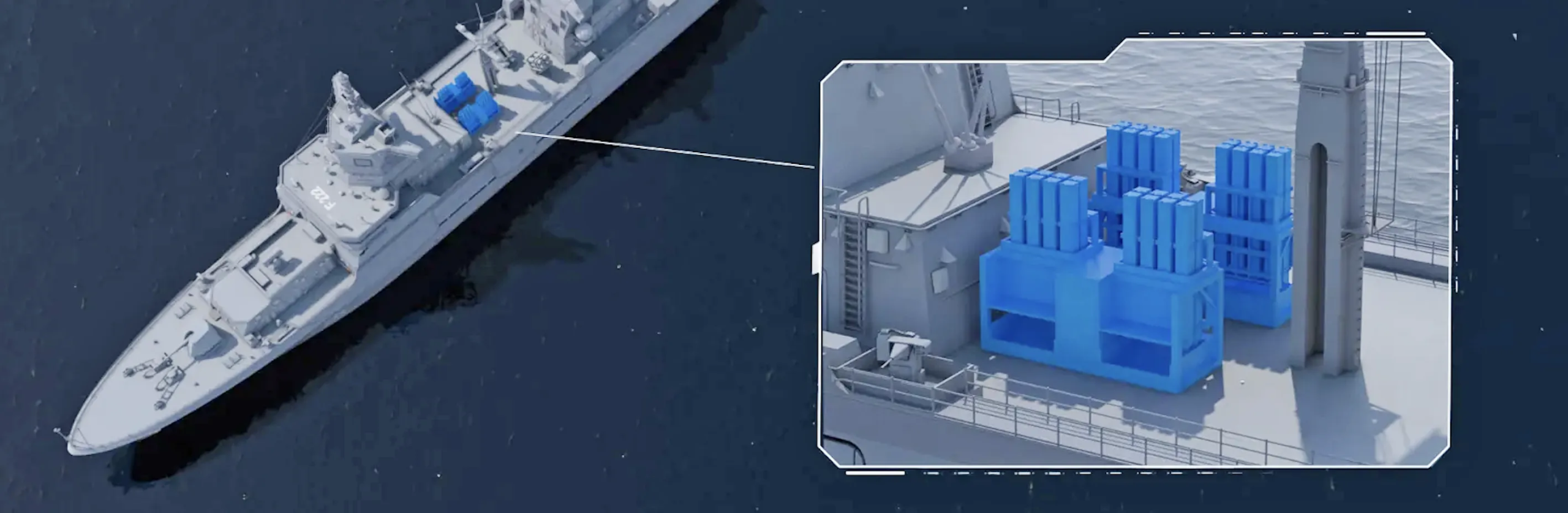
As the Navy’s latest budget documents note, the service has also been working to add other counter-drone interceptors to its ships, such as the combat-proven Coyote. The USS Carl M. Levin, as well as the USS John Paul Jones, the USS Paul Hamilton, and the USS Decatur, have all now received new eight-cell Coyote launchers. All of those warships are currently assigned to the Harry S. Truman Carrier Strike Group. This builds on the integration of the earlier four-cell launchers on at least two other ships in the class, the USS Bainbridge and the USS Winston S. Churchill.
An annotated image highlighting the new eight-cell Coyote anti-drone interceptor launcher as seen on USS Carl M. Levin. USN Another annotated image highlighting the earlier Coyote installation as seen on the USS Bainbridge. A stock image of a Coyote Block 2 interceptor is also seen at top right. USN
“This is the first deployment of this launcher which increases the cell count from four to eight and provides increased marinization,” a Navy spokesperson told TWZ when asked for more information after Carl M. Levin emerged with the new Coyote capability. “We are working [on] plans for future carrier strike group deployments to install these and potentially other containerized launchers.”
“This is a non-permanent change; launchers can be removed after the completion of a deployment and transferred to other ships—accelerating the deployment of advanced capabilities throughout the Fleet,” that spokesperson added.
Roadrunner successfully deploys from prototype launch enclosure.
In 2024, @DIU_x selected Anduril to develop cUAS for the @DeptofWar’s Counter NEXT program. Today, we’ve been awarded additional funding to move into the next phase of development and ultimately deliver these… pic.twitter.com/PAScfvIRHZ
Zone 5 White Spike Counter UAS drone interceptor flight tests
Navy plans for additional shipboard counter-drone capabilities go beyond physical interceptors, as well. Just this week, the service disclosed a live-fire test of a palletized version of the AeroVironment LOCUST laser counter-drone system onboard the Nimitz class aircraft carrier USS George H.W. Bush. You can read more about that test, which occurred in October 2025, here.
Demand within the Navy, as well as the rest of the U.S. military, for an array of layered counter-drone capabilities is likely to remain high for the foreseeable future. As noted, these threats are not new and are continuing to expand in scale and scope, driven now in large part by advances in artificial intelligence and machine learning. Automated targeting and fully networked swarming capabilities are not only proliferating, but the barrier to entry, even for non-state actors, is low.
More launchers for counter-drone interceptors, whether they are loaded with Longbow Hellfires, Coyotes, or something else, are only likely to continue appearing on Navy warships as the service works to further address this threat.
Weekly insights and analysis on the latest developments in military technology, strategy, and foreign policy.
The U.S. Navy has handed Lockheed Martin a formal contract to integrate the Patriot PAC-3 Missile Segment Enhancement (MSE) surface-to-air missile with the Aegis Combat System. The Navy’s main Aegis-equipped ships today are its Arleigh Burke class destroyers. The service is also seeking just over $1.73 billion to order its first-ever tranche of PAC-3 MSEs, 405 in total, as part of its proposed budget for the 2027 Fiscal Year.
A rendering of an Arleigh Burke class destroyer firing a PAC-3 MSE missile. Lockheed Martin
Lockheed Martin announced it had received the PAC-3 MSE/Aegis integration contract, said to be a multi-million dollar deal, earlier today, around the Navy League’s annual Sea Air Space exposition, at which TWZ is in attendance. The Navy has separately shared more details about its PAC-3 MSE acquisition plans as part of the full rollout of the Pentagon’s budget request for Fiscal Year 2027, which also occurred today.
Per the Navy’s Fiscal Year 2027 budget request, the service sees PAC-3 MSE integration with Aegis as providing an additional means of intercepting “a wide range of threats, including tactical ballistic missiles, air-breathing threats, cruise missiles, and unmanned aerial systems.” As mentioned, Arleigh Burke class destroyers make up the vast majority of American warships equipped with the Aegis Combat System today. There are also a steadily shrinking number of Ticonderoga class cruisers with this combat system.
PAC-3 MSE has been in full-scale production since 2018. Pairing it with Aegis “has been in the works, I probably think, close to 10 years,” Chandra Marshall, Vice President and General Manager of the Multi-Domain Combat Solutions business unit within Lockheed Martin’s Rotary and Mission Systems division, told our Jamie Hunter on the floor of Sea Air Space. She added that the goal now is for the Navy to achieve initial operational capability (IOC) with this combination in approximately 18 months, or by the end of 2027 if the clock starts now.
A briefing slide offering a general overview of the PAC-3 MSE missile, as well as its improvements over the previous PAC-3 CRI surface-to-air interceptor. Lockheed Martin An overview of the improvements found on the PAC-3 MSE variant over its predecessors, including a “New LE [lethality enhancer].” Lockheed Martin
“So, there’s two pieces of it. So the PAC-3 missile, there’s a small update to it to be able to communicate with S-band radar. So, currently it communicates with X-band [radars]. So, now with this update, it will be able to communicate both with S and X-band,” Marshall explained. “And then we have to integrate PAC-3 as a missile type with the Aegis Combat System.”
“We have a very open architecture [with Aegis], so the way that we componentize everything, we feel like it’s a very short putt for the Aegis integration of the PAC-3 missile,” she added. “So, it’ll just be another missile in the inventory for the Navy to be able to diversify based on the threat.”
You can read more about the Aegis Combat System and how it has evolved to adopt a modular, open architecture approach, specifically to make it easier to add new capabilities and functionality, in this previous TWZ feature. Lockheed Martin has already demonstrated the ability of a modular and scalable version of the system, called the Virtualized Aegis Weapon System, to fire a PAC-3 MSE from a containerized Mk 41-based launcher on land.
Aegis: Capable. Proven. Deployed.
No changes to the Mk 41 VLS – another Lockheed Martin product – are planned or required as part of the PAC-3 MSE integration. Work has been ongoing on adapting the interceptors into launch canisters, allowing them to slot right into existing Mk 41 cells. At just over 17 feet long, PAC-3 MSE should fit in shorter so-called tactical length versions of the Mk 41, as well as one with longer strike-length cells.
A graphic showing existing missiles compatible with tactical and strike-length versions of the Mk 41 VLS. Lockheed Martin A graphic showing various missiles already compatible with the tactical and strike-length versions of the Mk 41. Lockheed Martin
Lockheed Martin has said in the past that each canister will contain a single PAC-3 MSE missile. At around 11 inches wide, the PAC-3 MSE is just over half the maximum diameter available in a Mk 41 cell. This raises the question of whether future canisters could be designed to hold multiple interceptors, which would give ships valuable additional magazine depth.
From a capability standpoint, PAC-3 MSE is generally discussed in comparison to SM-2 surface-to-air missiles in the Navy’s arsenal today. In terms of missiles that can be fired via the Mk 41, SM-2 is a middle-tier anti-air capability that sits between shorter-range RIM-162 Evolved Sea Sparrow Missiles (ESSM; which can also be quad-packed into a single cell) and upper-tier SM-6s and SM-3s. The SM-6 is a multi-purpose weapon that can also be employed against targets on land and at sea. SM-3s, of which there are multiple variants in service today, are specifically designed as anti-ballistic missile interceptors.
“A lot of places the Navy has said ‘I got red or yellow challenges that I can’t deal with.’ This missile does a really good job at that. When you marry them all together, it is very complimentary to SM-6,” Chris Mang, Vice President of Strategy & Business Development at Lockheed Martin’s Missiles and Fire Control, told TWZ at last year’s Sea Air Space conference. “You’d always want a layered defense, right? I’ll pick the longest shot I can get, but then at a certain point, MSE really starts to outperform in certain envelopes.”
An SM-6 seen at the moment of launch. USN
For the Navy, PAC-3 MSE also presents important logistics, cost, and supply chain benefits. The latest conflict with Iran has only underscored now long-standing concerns about U.S. munition expenditure rates, especially when it comes to anti-air interceptors. A large-scale, high-end fight with a near-peer adversary like China would put much more pressure on munition stockpiles and the U.S. industrial base working to restock them. As such, it would be a boon for the Navy to have an additional stream of interceptors to arm its warships.
As noted, the Navy is already moving to buy hundreds of what documents currently refer to as the “PAC-3 MSE / Navy” missile, as well as launch canisters. The service’s Fiscal Year 2027 budget request puts the unit cost for each missile at $4.05 million. The canister adds another $200,000 to the price tag. The Army’s Fiscal Year 2027 proposed budget says the unit cost for standard PAC-3 MSEs has risen now to $5.3 million. The exact reasons for the cost discrepancy between the Army and Navy versions are unclear.
A PAC-3 MSE missile seen being fired from a ground-based launcher. US military A Patriot launcher fires a newer PAC-3-series missile during a test. DoD
“Both quantities and unit cost are estimates based on U.S. Army contract pricing. Both quantities and unit cost will adjust based on award of DoN CLINs [Department of Navy Contract Line Item Numbers] on ARMY contract in execution and final cost of the Navy components (radio, canister, etc),” per the Navy’s latest budget request.
At $4.05 million, the Navy’s PAC-3 MSEs will be slightly cheaper per missile than the Block IA version of the SM-6. The service’s latest budget request puts the unit cost of the latter missiles at $4.348 million. The cost of a current-generation Block IIICU variant of the SM-2 is unclear, given that they have often been procured as upgrades of existing Block IIICs rather than new-production missiles. Historically, the average price point for an SM-3 Block IIIC has been around $3.6 million.
“By leveraging the high-volume Army PAC-3 MSE production contract, the Navy achieves significant cost avoidance through economies of scale, as unit price decreases with larger quantities,” the Navy’s latest budget documents also note.
Lockheed Martin announced in January that it had reached an agreement with the U.S. government to ramp up annual PAC-3 MSE production, for domestic and foreign customers, from 600 to 2,000 missiles. Last week, the company received a contract to help further accelerate production of these missiles. This could all help drive down the unit cost of the missiles going forward, as well as speed up their delivery.
Lockheed Martin Receives Contract to Accelerate PAC-3® MSE Production
It is worth pointing out here that PAC-3 MSE’s performance in the Middle East, as well as in Ukraine in recent years, has also prompted a significant increase in demand from the U.S. Army, as well as foreign Patriot operators. The overall Patriot user base is also expanding.
Adding the Navy to the mix will add to that demand, even with the production ramp-up, and could add to already growing concerns about production backlogs now. Integrating PAC-3 with Aegis and the Mk 41 VLS could also spur additional interest from other navies globally that have ships with that combat system and/or launchers.
Reutersreported just last week that U.S. officials had informed allies and partners in Europe that deliveries of unspecified munitions could now be delayed due to American needs in relation to the war with Iran. When it comes to PAC-3 MSE, the budget documents the Army released today, at least, do not appear to show any changes to the delivery schedule for foreign customers.
🇺🇸 Is the US re-sequencing scheduled PAC-3 MSE deliveries away from FMS customers to the US Army’s inventory?
The J-books say no. In fact, FMS customers are scheduled to receive the majority of production.
A test-fire of strategic cruise missiles and anti-warship missiles from the destroyer Choe Hyon in North Korea, 12 April 2026 (issued 14 April 2026). File. Photo by KCNA / EPA
April 19 (Asia Today) — North Korea launched multiple ballistic missiles on Saturday, just 11 days after its previous test, in what analysts describe as an effort to expand and demonstrate its nuclear delivery capabilities.
South Korea’s Joint Chiefs of Staff said the missiles were fired around 6:10 a.m. from the Sinpo area on the country’s east coast and flew about 140 kilometers over the East Sea.
The launch site, near a key submarine facility, has raised the possibility that the weapons could be linked to submarine-launched ballistic missile development, though officials said further analysis is needed.
The Joint Chiefs of Staff said it is assessing the missiles’ specifications and whether they were launched from land or underwater.
Sinpo is home to North Korea’s main submarine shipyard, where vessels such as the “Kim Gun-ok Hero” submarine have previously been unveiled.
Recent satellite imagery cited by the North Korea-focused outlet 38 North indicated that another submarine had been moved to dry dock, suggesting possible preparations for additional testing.
Yang Wook, a research fellow at the Asan Institute for Policy Studies, said the relatively short flight distance raises questions about whether a full submarine-based launch was conducted.
“Given the 140-kilometer range, it is unclear whether this was a full SLBM test, but the location suggests it could be part of efforts to verify repeated launch capability,” he said.
If confirmed as an underwater launch, the test would mark North Korea’s latest step in diversifying its nuclear delivery systems, following demonstrations involving land-based missiles and sea-based platforms in recent weeks.
Under its latest defense development plan, North Korea has been expanding a range of strategic capabilities, including short-range ballistic missiles, hypersonic weapons, cruise missiles and solid-fuel intercontinental ballistic missile engines.
Analysts say the timing may also reflect broader geopolitical considerations. With the United States focused on conflict in the Middle East, North Korea could be seeking to exploit a perceived security gap while reinforcing its deterrence posture.
Some experts also suggest the launch may be intended to strengthen Pyongyang’s bargaining position ahead of potential diplomatic engagement tied to an expected visit by President Donald Trump to China next month.
This image, released on March 20, by the North Korean Official News Service (KCNA), shows North Korean leader Kim Jong Un and his daughter, Kim Ju Ae, observing a military exercise involving tanks, drones, and other munitions. File Photo by KCNA/UPI | License Photo
April 19 (UPI) — South Korea’s Defense Ministry said North Korea test launched multiple, short-range ballistic missiles into the East Sea, also known as the Sea of Japan, Sunday morning.
“Detailed specifications are currently under close analysis by South Korean and U.S. intelligence authorities,” officials in Seoul said in a statement, according to ABC News.
“Our military is closely monitoring North Korea’s military activities under a firm combined defense posture and maintains an overwhelming capability and readiness to respond to any provocation.”
The Japan Times said the Defense Ministry of Japan also confirmed the activity.
“North Korea’s series of actions, including the repeated launches of ballistic missiles and other weapons, threaten the peace and security of Japan, the region and the international community,” the ministry said in a statement.
Newsweek said Pyongyang has increased its ballistic missile testing and nuclear weapons development since the conflict between the United States, Israel and Iran began nearly two months ago.
Sunday’s missile launches appear to have come from Sinpho, a coastal city in North Korea where submarines capable of launching such weapons are built.
Sakie Yokota, mother of Megumi Yokota, who was abducted by North Korea, speaks during a rally demanding the immediate return of all abductees in Tokyo on November 3, 2025. Photo by Keizo Mori/UPI | License Photo
Weekly insights and analysis on the latest developments in military technology, strategy, and foreign policy.
L3Harris is pushing its modular Wolf Pack family of “launched effects vehicles” for the U.S. Army, including to equip its H-60 Black Hawk series and AH-64 Apache helicopters, with an eye on the specific demands of a future conflict in the Pacific. The family of vehicles includes the Red Wolf, configured for long-range precision strikes against targets on land or at sea, and the Green Wolf fitted with an electronic warfare payload. Overall, these are part of a wider drive toward fielding modular, relatively cheap, and small systems that increasingly blur the line between uncrewed aerial systems, especially longer-range kamikaze drones, and cruise missiles, as well as decoys.
Readers can refer to our previous coverage of the Wolf Pack family, and it is also worth noting that the company is under contract with the U.S. Marine Corps to deliver the related PASM, the Precision Attack Strike Munition.
At the Army Aviation Association of America’s Army Aviation Warfighting Summit in Nashville, Tennessee, this week, TWZ caught up with Brad Reeves, the director of strategy and requirements for the Agile Development Group at L3Harris, to talk about the company’s vision for the Wolf family with the Army.
A rendering of the Red Wolf launched effects vehicle. L3Harris L3Harris
TWZ: What is the primary driver behind the Wolf family, and how is it relevant to the Army’s rotary-wing fleets?
Brad Reeves: The Department of War has a heavy emphasis on the Pacific and a conflict over there. Mass is an issue. We have a lot of exquisite weapons today, but the numbers are not maybe as high as we might hope for a conflict over there. So, they’re trying to solve that problem. Affordable mass has kind of become the buzzword, which basically means, “hey, how do we get capability that we can buy in quantity without breaking the bank?” And so, with that, the Department of War, actually Secretary Hegseth, issued a memo on April 30 of last year. And one of the things he called out specifically was launched effects, the urgency to get that fielded beginning this year. So, that’s a high-emphasis item for those guys.
A U.S. Army UH-60M Black Hawk. U.S. Air Force photo
Launched effects are really meant to be an affordable mass solution for the Army. But the real story behind this is what we call our Wolf Pack family of systems, and our offering and the capability it brings. And the story here is it’s very capable, but it’s what it does for the Army and for Army aviation. So it’s transforming Army aviation, and it’s addressing platforms that lack some relevancy today in the fight. Black Hawks, Apaches, etc, have a very short-range capability, relatively speaking, when you’re talking about the Pacific, and you have the tyranny of distance and anti-access/area-denial threats. It’s a much harder challenge than what we’ve dealt with in the decades since those aircraft were first invented.
Now we’re basically bringing relevancy to those platforms. We’re transforming from a weapons-effectiveness range and lethality range of single-digit kilometers, maybe up to a dozen kilometers, and we’re now extending that to hundreds of kilometers. We’re taking what before was a single-mission aircraft that’s supporting the Army; it’s doing close combat attack missions for Army soldiers on the ground, and is basically specific to that single service. And we’re now expanding that, and we’re giving that platform a joint or coalition viability in a Pacific flight. And so, the relevance now has increased. We’re taking what was before, a single-domain, fully land-based capability. We’re turning it into multi-domain, so now surface, meaning maritime, and land. And then we’re taking the target sets, which were traditionally tanks, maybe threats that we get from ground forces, etc. Again, we’re expanding that so it can be maritime threats and ground threats. It’s kind of a revolution in the way that the Army is going to fight and what they’re going to contribute to the joint coalition force. The Army desperately needs this capability.
A U.S. Army AH-64D Apache fires a Hellfire missile during training. The basic Hellfire has an operational range of anywhere between four and just under seven miles (seven to 11 kilometers). U.S. Army photo by Spc. Dean John Kd De Dios
TWZ: And what are the differences between the Wolf Pack family members?
Brad Reeves: Our launched effects offering, we call it the Wolf Pack family of systems. Today, we have two high-level mission capability variants. We have the Red Wolf, which is the kinetic variant, so a cruise missile. We have the Green Wolf, which has a purely (non-kinetic) electronic warfare payload. So now you’re also doing suppression of enemy air defenses. These types of missions, the DILR mission — detect, ID, locate, report — and/or electronic attack to suppress this threat.
Wolf Pack is designed to have multiple variants, so one aircraft, let’s say an Apache in this instance, you could launch multiple variants, Green and Red. You have a Green Wolf that goes out ahead and is searching and building the EMBM, the electromagnetic battle management. Through some software we call DISCO, which is AI-driven software, it’s building the landscape where the threats are, whether on the surface or on the land.
The wait is over.
Introducing Red Wolf ᵀᴹ and Green Wolf ᵀᴹ, the first vehicles in our expanding pack of launched effects systems. pic.twitter.com/d4oG7fgeE4
Brad Reeves: It comes out of our Wolf Pack family. It’s a unique variant designed for the U.S. Marine Corps AH-1Z Viper, and we’re delivering early operational capability. They did a long-range precision fire, LRPF, last September, and that was somewhat of a graduation event. Now we’re basically starting to work with production at our plant in Virginia.
In February 2025, NAVAIR released this image of a Red Wolf-toting AH-1Z, at which time the munitions were identified only as “a new Long Range Precision Fire (LRPF) capability.” U.S. Navy
TWZ: So these are basically loitering munitions?
Brad Reeves: We don’t consider it a loitering munition, but technically, by definition, yes, what it’s doing is it’s flying a pattern. It’s very smart: it goes out, starts detecting threats, then it will set up a pattern to make sure that a) it’s survivable itself, so it doesn’t fly over a threat and get shot down. But b), it will maximize the search pattern, and then it will deconflict with the others in the pack, so that you can, if you have a large area, you can have one, one will say, “hey, I’m going to go do maybe a zigzag pattern over here looking for threats. You go do a zigzag pattern and then report those back.” Once they find the threats, they’ve got options. Either the aircraft can just avoid the threats because they know where they are, or if they need to go through them, then you can either use electronic attack to jam them, or you can send a signal to one of the kinetic variants. Then the kinetic variant does the destruction of enemy air defenses mission.
That’s kind of why we call it the Wolf Pack: working together collaboratively in a pack to perform a mission that’s assigned by the pilot, and they do that autonomously. They have been ground-launched. They have been air-launched from both manned and unmanned platforms, and they can be launched from rotary-wing or fixed-wing. Since we’re here with the Army, the target is Black Hawks and Apaches very specifically.
In the past, L3Harris has also highlighted the potential benefits of pairing its Red Wolf miniature cruise missile with the U.S. Air Force’s OA-1K Skyraider II. L3Harris
TWZ: Would you say that the Wolf Pack is oriented generally towards the SEAD/DEAD mission?
Brad Reeves: It is much broader. But certainly one of the main applications is SEAD/DEAD. With the EW variant, that’s really applicable when you’re doing SEAD/DEAD, or you’re just looking for platform survivability, meaning you’re going towards a mission, but you want to maybe send something out ahead. These fly at high subsonic speeds. They’re going out ahead when launched from a helicopter. They’re scouting out the area, giving them the picture, and allowing them to either avoid, suppress, or defeat threats that may be in their way.
A graphic depicting a notional ground mission scenario involving the employment of Red Wolf and Green Wolf launched effects vehicles. L3Harris
TWZ: Presumably, the cost point of these means the numbers can be fairly scalable, depending on the requirement?
Brad Reeves: Absolutely, it depends on the mission set. One of the advantages is that, while it is an affordable mass munition, it also comes with significant capability. There are some, what I would call differentiators, that put this capability at the high end of the affordable mass, meaning it’s very inexpensive compared to traditional legacy weapons that the forces are using today. We usually say it’s about five times cheaper than what these aircraft would be using today. There are BAAs, broad area announcements, something the U.S. government will release to industry, asking for different capabilities. Right now, when they’re asking for this type of capability, they’re usually targeting somewhere between $300,000 to $500,000 for that market, per round, and we’re certainly in that sweet spot.
TWZ: Aside from the small turbine engine that they share, how modular are the Wolf Pack vehicles themselves?
Brad Reeves: Some people call it a truck, but for some reason, that offends me. But you’ve got the platform, and we’ve designed it modularly with what’s called WOSA, weapon open systems architecture. And so you can interchange the payload. You can take the platform, you can put a warhead in it, and it becomes kinetic. You can take the warhead out, you can put an EW payload in it. I’m oversimplifying a little bit because with the kinetic variant, there are sensors and other stuff. So you probably wouldn’t physically take a kinetic one and swap out the warhead for an EW payload.
Side-by-side renderings of the Red Wolf and Green Wolf, showing them to be functionally identical, at least externally. L3Harris
TWZ: When it comes to Green Wolf, which has no warhead, is this designed to be expendable or recoverable?
Brad Reeves: We have both. We have a recoverable variant. It depends on what the customer wants. In some instances, they want recoverability. And with recoverability, you lose a little bit of range. So in some instances, it’s going to be on a one-way mission; they just want maximum range. Basically, the parachute equipment we use to recover it takes up a little bit of space that otherwise would be fuel tank space.
The Deceptor small-form-factor software-defined radio frequency (RF) electronic warfare (EW) payload from L3Harris. In its promotional material, the company has indicated that this is a potential payload for the Green Wolf. L3Harris
TWZ: How do these vehicles navigate?
Brad Reeves: It has the standard inertial navigation and GPS. It has those capabilities inside of it, and then the seeker effectively is used purely for in-game targeting.
TWZ: To what degree would you be able to surge production to meet urgent demands?
Brad Reeves: We gave our manufacturing team the problem and said, “Hey, multiple customers are asking for as many as a thousand per year. We expect this to really blow up. How do we know how big a plant to build? How do we know what we can do?” And so they actually designed a modular, scalable production plan. In theory, you can scale up to as many as you want. But right now, what we’re doing is we’re scaling towards a thousand a year, which is the current path, and then if the demand signal spikes, we have the ability to scale above that.
The beauty of this vehicle is that there’s a lot as a significant amount of commonality, which does allow us to scale, and also gives us economies of scale, price, etc.
Meet the “Wolf Pack”
TWZ: Where are you now with testing?
Brad Reeves: We’ve flown over 50 times in test events with the military. So we’ve done multiple services. We’ve done formal testing with those services. It’s been launched twice off the AH-1Z. We’ve launched off fixed-wing UAS, but this gets a little sensitive with the customers, as to what those platforms are. And we’ve done ground launch.
TWZ: Do you have a pathway toward testing on the Black Hawk and Apache?
Brad Reeves: I am very passionate about making sure this gets fielded to U.S. Army soldiers, specifically the Apache and the Black Hawk. Right now, we’ve obviously got Epic Fury. But if something lights off in the Pacific, this just pales in comparison. If I were young enough to be flying in that fight, I would want more capability. And so I am a little bit of a zealot. The U.S. Army, I know, has to have this capability, and I believe they want it. It’s going to be a game-changer for them, and it’s going to be important to the joint force and coalition forces. It is a significant transformational capability.
The missiles were fired near the city of Sinpo on North Korea’s east coast at about 6:10am on Sunday (21:10 GMT, Saturday), South Korea’s military said in a statement. It added that South Korea had bolstered its surveillance posture and was closely exchanging information with the United States and Japan.
Japan’s government posted on social media that the ballistic missiles were believed to have fallen near the east coast of the Korean Peninsula. No incursion into Japan’s exclusive economic zone was confirmed.
South Korea’s presidential office said it has held an emergency security meeting, according to media reports.
Such tests violate United Nations Security Council resolutions against North Korea’s missile programme. The diplomatically isolated country rejects the UN ban and says it infringes on its sovereign right to self-defence.
The launches come as China and the US prepare for a summit in mid-May, in which Chinese President Xi Jinping and his US counterpart, Donald Trump, are expected to discuss North Korea.
North Korea has made “very serious” advances in its ability to turn out nuclear weapons, with the probable addition of a new uranium enrichment facility, International Atomic Energy Agency chief Rafael Grossi said on Wednesday.
Late last month, North Korean leader Kim Jong Un said his country’s status as a nuclear-armed state was irreversible and that expanding a “self-defensive nuclear deterrent” was essential to national security.
Antiwar protesters rally in Tel Aviv and US cities, as attacks kill a family of four in Iran’s Bushehr province and damage a water facility in Khuzestan.
Iranian missiles have caused widespread damage across Israel in the latest wave of attacks, as President Donald Trump says US-Israeli strikes have destroyed the majority of Iran’s missile launchers.
A week into the United States-Israeli war on Iran, and Iran’s attacks on its Gulf neighbours, Jaya Khuntia spoke – as he often did – to his Doha-based son Kuna on the phone.
It was March 6, about 10pm, and Khuntia and the family were worried. “He told me, ‘I am safe here, don’t worry,’” the father recalled from the conversation with Kuna.
It was the last time they spoke.
The next day, the family in Naikanipalli village of India’s eastern Odisha state received a phone call from Kuna’s roommate telling them that the son had suffered a heart attack after hearing the sound of missiles and debris from interceptions falling near their residence. He collapsed and was later declared dead. Kuna’s body reached home days later.
Al Jazeera cannot independently confirm the cause of Kuna’s death, but the family of the 25-year-old, who worked as a pipe fitter in Qatar’s capital, is among millions across South Asia directly affected by the war in the Middle East.
Of the eight people killed in the United Arab Emirates in Iranian attacks, two were Emirati military personnel, a third a Palestinian civilian, and the remaining five were from South Asia: Three from Pakistan, and one each from Bangladesh and Nepal. All three people killed in Oman were from India. An Indian national and a Bangladeshi national are the only deaths in Saudi Arabia.
Migrant workers from South Asia total nearly 21 million people in the Gulf nations, a third of the total population of the region. At stake, for their families back home, is the safety of their loved ones and the future of their dreams.
The Khuntia family had taken on a 300,000-rupee ($3200) debt in 2025 for the marriages of their two daughters. Kuna’s income in Doha – where he had moved only in late 2025 – of 35,000 rupees ($372) was helping them collect what they needed to pay back the loan. Kuna had been sending back about 15,000 rupees ($164) every month.
“We thought our suffering was finally ending,” Jaya said, his voice trembling. “My only son would say, ‘Baba, don’t worry, I am here.’ He was our only hope… our everything.”
That hope is now extinguished. “That one call finished us,” Jaya cried. “He promised to return after clearing our debts … but he came back in a coffin. We have nothing left now. Losing our only son is the biggest debt we have to live with.”
Kuna Khuntia, a 25-year-old pipe fitter from India’s Odisha, who died of a heart attack in Doha, Qatar [Photo courtesy the Khuntia family]
‘I thought we would be next’
In all, Bahrain, Kuwait, Oman, Qatar, Saudi Arabia and the UAE – the six Arab countries in the Gulf – host 35 million foreign nationals, who form a majority of their total population, 62 million.
They include 9 million people from India, 5 million each from Pakistan and Bangladesh, 1.2 million from Nepal, and 650,000 from Sri Lanka. Most of them are engaged in blue-collar work, building or supporting the industries and services that are at the heart of the Gulf’s success and prosperity.
But since the US and Israel launched their war on Iran, these migrant workers have often been among the most vulnerable. That vulnerability extends beyond deaths and injuries to the very nature of their work: Oil refineries, construction areas, airports and docks, where many work, have been targeted in Iranian attacks.
The suspension of work at many of these facilities, coupled with fears of a major economic downturn in the region, has also left many workers and their families worried about the future of their jobs.
Hamza*, a Pakistani migrant labourer working at an oil storage facility in the UAE, recalled a recent attack that he witnessed. “A drone struck a storage unit right in front of us. We were completely shaken. Most of us there are from India, Pakistan and Bangladesh.
“We couldn’t sleep for nights after that. The drone was so close that it could have killed us, too,” Hamza added. “For a moment, I thought we would be next.”
Despite these dangers, he said, leaving is not an option.
“We want to go back, but we can’t,” Hamza said. “Our families depend on us. It’s dangerous here, but if we stop working, they will have nothing to eat. We have no choice.”
Experts say Hamza’s sentiment is common across South Asian blue-collar workers in the Gulf, because of poverty and limited employment opportunities back home.
Imran Khan, a faculty member at the New Delhi Institute of Management working on migration economics, said migrant labourers from South Asia are often driven by desperation to take up jobs in the Middle East. He said Western countries have, in recent years, dramatically raised entry barriers for less-educated blue-collar foreign workers.
“These workers are the worst affected during crises – whether war or natural disasters,” he says. “I have been speaking to several migrant labourers, particularly Indians in the Middle East, and many are living in distress since the conflict began.”
But, like Hamza, most cannot afford to leave, Khan said.
“They cannot simply quit. Their income would stop immediately, and there are very limited opportunities back home,” he explained. “They have families to support, and without these jobs, survival becomes difficult.”
Indian labourers work at the construction site of a building in Riyadh, November 16, 2014 [Faisal Al Nasser/Reuters]
Families – and societies – that depend on remittances
Middle Eastern countries remain a key source of remittances for South Asian nations such as India, Pakistan, Bangladesh, Sri Lanka and Nepal. The remittances these five countries receive from the region, $103bn, are comparable to Oman’s total gross domestic product (GDP).
Just the remittances that India receives from the Gulf, $50bn, are more than Bahrain’s entire GDP. Pakistan receives $38.3bn in remittances, Bangladesh $13.5bn, Sri Lanka $8bn, and Nepal $5bn.
With the recent escalation of conflict in the Middle East, experts warn these flows could be significantly affected, especially if Gulf economies contract and layoffs follow.
Faisal Abbas, an expert in international economics and director at the Centre of Excellence on Population and Wellbeing Studies, a Pakistan-based research institute, said remittances from the Middle East form a crucial economic backbone for South Asian nations, not just families.
“Remittances are a critical pillar for Pakistan and other South Asian economies, and a large share comes from Middle Eastern countries,” he explained. “If the situation worsens, it will not be a positive development for the region.”
Pakistan’s remittances from the Gulf constitute nearly 10 percent of its GDP, about $400bn.
Abbas added that the effect may extend beyond remittance flows. “Migration patterns could also be disrupted. Many workers may return home, while those planning to migrate might reconsider,” he said. “This could further increase unemployment in a region already facing job shortages.”
Unlike Hamza, a number of South Asian workers are planning to return home.
Noor*, a migrant worker from Bangladesh employed at an oil facility in Saudi Arabia, said he no longer feels safe and plans to return home once his contract ends.
“I will never come back here again,” he said. “It’s too dangerous. We can’t even sleep at night. The fear never leaves us.”
Noor said drone attacks had occurred close to his workplace. “We saw it happen in front of us,” he said. “That fear stays with you… It doesn’t go away.”
His family, too, is deeply affected. “My children cry every time they call me. They are scared for my life,” he added.
He said he knows that returning to Bangladesh would mean more economic hardship for his family. But Noor said he had made up his mind.
“I would rather go back and struggle to survive with my family than live here in constant fear,” he said. “At least there, I will be with them.”
*Some names have been changed at the request of workers who fear retribution from contractors for speaking to the media.
As the United States-Israeli war on Iran rages on, schools across Israel have been closed, cultural venues shuttered and large gatherings cancelled under police orders.
Dissent against the war, if there is much at all, has little chance of being aired.
Recommended Stories
list of 4 itemsend of list
A few demonstrations against the war, such as those staged by the Israeli-Arab activist group Zazim, still flicker through central cities, but they do so under heavy supervision, with officers warning crowds to disperse when sirens sound or when assemblies grow beyond what commanders deem safe.
The effect is a public sphere constrained less by decree than by the constant threat hanging overhead.
“Kids aren’t going to school, while employers are insisting their parents go to work,” Zazim’s co-founder and executive director, Raluca Ganea, says. Everyone is too overwhelmed by the daily grind to voice any dissatisfaction, she adds.
“We’re enduring multiple missile attacks daily, which means people aren’t sleeping. It’s like a manual for tyrants. It’s how you suppress protest or opposition and it’s working so far,” she added.
“We’ve attempted a couple of protests, but people are just too tired to engage,” Ganea says of Zazim’s efforts to resist the war. “It’s not so much that people are telling you that you can’t so much as protesting becomes impossible when a missile attack could happen at any time.”
Support for the war on Iran has remained strong in Israel, a fact borne out by polls. But as exhaustion grows and resentment builds over having their fates decided by often distant leaders such as Israeli Prime Minister Benjamin Netanyahu and US President Donald Trump, who have shown little investment in their welfare, the societal fractures that came to define the war on Gaza are almost inevitable, she warns.
“It’s depressing,” she says. “The only response people have is to feel helpless when their fate is in the hands of people like Trump and Netanyahu, who really don’t care about them.”
Those who have put their heads above the parapet to object openly to the war are shunned anyway, as 19-year-old Itamar Greenberg knows only too well. People spit at him in the street.
“It comes in waves,” he says of the criticism he faces for his opposition to the war on Iran on the streets of his hometown, near Tel Aviv. “Sometimes they follow me, shouting ‘traitor’ or ‘terrorist’.”
Itamar is clear enough that he isn’t a terrorist, though he seems ready to accept the label of traitor if it means halting the war on Iran.
“At my university, everywhere, they say my opposition to the war on Iran is somehow crossing a red line. For instance, because of the [danger to the Israeli] hostages, some people could understand opposition to the genocide on Gaza, but opposing the war on Iran, the great evil, is somehow too much,” he says.
Emergency personnel work next to a damaged car at a site following Iranian missile barrages in central Israel, amid the US-Israel conflict with Iran, in Tel Aviv, Israel [Ronen Zvulun/Reuters]
Rising censorship
Across Israel, journalists and activists like Itamar describe a pervasive atmosphere of self-policing and censorship that, they say, has left people less informed about the consequences of the war than the citizens in Iran, whom many in their media encourage them to pity.
In a country largely unified against a threat that, for generations, politicians have told them is existential, criticism, dissent or opposition is, for the majority, beyond the pale.
This way of thinking is baked into Israeli society. The systems employed by the country’s military censor today to curtail media reporting predate the establishment of Israel in 1948.
Furthermore, new wartime restrictions on what can and cannot be broadcast of the Iranian missile barrages targeting Israel, where they land and what damage they have done – introduced on March 5 – mean these largely go entirely unreported, Israeli journalists say.
Reporting on the new media restrictions in mid-March, the Israeli magazine +972 documented one instance when journalists were permitted to report on debris that had hit an educational facility, but did not mention the actual strike by an Iranian missile, which had successfully hit its intended target nearby. Nor were they allowed to examine the site.
In another case reported by +972, journalists photographing damage to a residential block said they were approached by a man they believed to be linked to a security agency. He asked police to stop reporters from recording the real target of the attack, which was located behind them. The police officer replied that the journalists would not have noticed that site at all had it not been pointed out, since the visible destruction was concentrated on the civilian building.
The censorship, which had been growing more relaxed in recent years, had been tightened once more during the current war, Meron Rapoport, an editor at +972’s sister paper, Hebrew language Local Call, told Al Jazeera, “We don’t really know what is being or with what explosives,” he said, “The IDF [Israeli army] announcements always refer to strikes being on ‘uninhabited areas,’ which is peculiar, because there aren’t that many uninhabited areas in Tel Aviv. It’s a very compact city.”
Indeed, Iran has launched multiple missiles at Tel Aviv, some of which have resulted in damage and injuries – either by the missiles themselves or by debris falling following interception. Most recently, on Tuesday, missiles triggered air raid sirens in the city, where gaping holes were ripped through a multistorey apartment building.
Israel’s Magen David Adom emergency medical service said: “Six people were lightly injured at four different sites.”
“It’s curious,” Rapoport says. “Israeli commentators are always saying how the Iranian public has no real idea how badly they’re being hit. The irony is that they probably have a better idea of how hard Israel is being hit than most Israelis.”
Iran has launched a round of missiles targeting Israel, causing damage and injuries in Tel Aviv, as uncertainty swirled over possible talks to end the three-week US-Israel war on Iran.
The missiles triggered air raid sirens in Israel on Tuesday, including in Tel Aviv, where gaping holes were torn through a multistorey apartment building. It was not immediately clear whether the damage was caused by a direct hit or debris from an interception.
Israel’s Magen David Adom emergency medical service said: “Six people were lightly injured at four different sites.”
Police in Tel Aviv said they were dealing with “several impact sites of munitions”.
Israel’s National Fire and Rescue Authority said the search was on for people trapped in one building in Tel Aviv, adding that civilians were found in a shelter in another damaged building.
Meanwhile, the Israeli military said on Tuesday that its jets carried out a wave of strikes in central Tehran on Monday, targeting key command centres, including facilities associated with the Islamic Revolutionary Guard Corps’ intelligence arm and the Iranian Intelligence Ministry. It said more than 50 additional targets were hit overnight, including ballistic missile storage and launch sites.
One of themissiles firedreportedly failed in flight, while the other was intercepted by a US warship. The BBC understands the reports are accurate. There are doubts whether Iran has missiles which are capable of reaching Diego Garcia, which is about 2,350 miles from Iran.
At least 15 people have been killed by attacks in Israel since the war on Iran started late last month. Israel operates a network of shelters to keep people safe, but not all Israeli citizens enjoy the same level of protection.
Qatar, UAE, Kuwait and Saudi Arabia report new blasts, interceptions, with war edging to 3-week mark.
Published On 18 Mar 202618 Mar 2026
Iran has fired missiles and drones at several Gulf Arab nations, which have sought to intercept them, in a now-daily fallout from the United States-Israel war launched on Iran nearly three weeks ago that has engulfed the Middle East with deaths, destruction, assassinations, and an energy crisis spreading far beyond the region.
Early Tuesday, Qatar’s Ministry of Defence said its armed forces intercepted a missile attack against the country.
Recommended Stories
list of 4 itemsend of list
The Kuwait National Guard said it shot down an unmanned aircraft at dawn. The statement came hours after the Kuwaiti army said it was intercepting hostile missile and drone attacks.
The UAE, Saudi Arabia and Bahrain have also reported intercepting missiles and drones in recent hours.
Saudi Arabia’s Ministry of Defense reported the interception and destruction of a drone in the Eastern Region.
Earlier Tuesday, the UAE Ministry of Defence said the country’s air defences were “currently responding to incoming missile and drone threats from Iran”. The announcement came four hours after another reported attack from Iran. Later, a loud bang was heard in Dubai as authorities said air defences were dealing with a missile threat.
Al Jazeera’s Zein Basravi, reporting from Dubai, said, “The UAE has been the hardest hit by Iran’s retaliation. For instance, there have been 3000 different projectiles – missiles and drones – fired at GCC countries by Iran in terms of its retaliation. More than half, well over half, have targeted places in the UAE. Overnight was no different … Multiple explosions heard throughout the city.
“That glow of defensive weapons and interceptions in the night skies, something that has become all too familiar, not just in Dubai, but in cities across the GCC. Once again seen over the skies here.
“Dubai’s media office confirming that they were the result of air defence interception operations,” he added.
There have been several deaths in the Gulf nations, where an economic effect is also being acutely felt since the war began.
Gulf economies bear brunt of Iran war
The economies of the Gulf are suffering some of the worst damage.
Iran has launched continuous attacks on Gulf states since the onset of the conflict on February 28, arguing that it is attacking military bases used by the US for the war. Gulf nations have rejected Tehran’s claims, insisting the attacks on them are unjustified.
The Iranian strikes have upended energy production and inflicted major disruption to tourism and travel, putting the region at risk of some of the most severe economic harm since the 1990-1991 Gulf War.
After nearly three weeks of war, the economic effect on the region has already been substantial.
Middle Eastern oil producers’ daily output declined from 21 million barrels to 14 million barrels after a little more than a week of conflict as they deal with the closure of the Strait of Hormuz, according to Rystad Energy.
Weekly insights and analysis on the latest developments in military technology, strategy, and foreign policy.
For more than three weeks, Ukraine was left with only “a handful” of U.S.-made AIM-9 Sidewinder air-to-air missiles for its F-16 fleet, after the supply of the weapons dried up. This is the conclusion of a Reuters report, citing three sources, all of whom are said to have direct knowledge of the situation. It also comes as Kyiv is increasingly in competition with the U.S. military and its Gulf allies as they come under continued pressure from Iranian drones and missiles in the Middle East.
A live AIM-9L/M launched from the wingtip rail of a Ukrainian F-16. Ukrainian Air Force screencap
The shortage of infrared-guided air-to-air missiles occurred between late November and mid-December of last year, the three sources said. This was a critical time, just before Russia began its winter campaign of bombardment against Ukrainian cities and infrastructure.
According to one of the sources, during the period when AIM-9s were in short supply, F-16 pilots were forced to fly daytime sorties and instead try to shoot down drones with their internal 20mm M61 Vulcan cannon. This is hardly ideal, since the Russian drone attacks normally come at night, but gunning down targets in the hours of darkness is judged too dangerous.
An armorer loads an F-16 with 20mm ammunition for its M61A1 cannon. Ukrainian Air Force screencap
🚨 BREAKING
🇺🇦 Video reportedly shows a Ukrainian Air Force F-16AM using its M61A1 Vulcan rotary cannon to shoot down a Russian Shahed-136 attack drone over Ukraine.
If confirmed, this would mark one of the first publicly seen gun kills by a Ukrainian F-16 against a Shahed… pic.twitter.com/ULIuDHcVyY
As we have discussed many times before, taking out slow-moving drones via another fixed-wing aircraft with guns can be very challenging and downright dangerous, especially for fast jets. There is also the risk of the grenade-like cannon rounds impacting the ground below over a relatively wide area, potentially killing innocent people. Doing it at night is a whole other level of danger.
Meanwhile, the situation was reportedly so desperate that pilots were flying F-16s loaded with missiles that had failed to launch on earlier missions, after these weapons had undergone another round of maintenance. This achieved mixed results, a source said.
So far, Ukrainian F-16s have been noted flying with older AIM-9L/M Sidewinders as well as the more modern AIM-9X Sidewinder infrared-guided air-to-air missiles.
Compared with the AIM-9L/M, the AIM-9X offers a more potent short-range air-to-air missile capability that can be used in conjunction with the F-16’s Joint Helmet Mounted Cueing System (JHMCS) for high off-boresight (HOBS) engagements. Even without JHMCS, the AIM-9X is a very valuable weapon that is particularly relevant for defending against drones and cruise missiles.
It’s worth noting, too, that Ukrainian F-16s use the radar-guided AIM-120 Advanced Medium-Range Air-to-Air Missile (AMRAAM). These can also be employed against drones and cruise missiles, but are more expensive weapons than the Sidewinders. Each AMRAAM costs around one million dollars, meaning they are not prioritized for use against drones.
Air-to-air with two F-16s. Both jets carry wingtip AMRAAM. Ukrainian Air Force screencap
According to the three sources, the Sidewinder shortfall was plugged in December when additional missiles were received from undisclosed partners. These reportedly arrived just in time to help defend against one of the largest Russian attacks of the winter.
A fourth source, also anonymous, told Reuters that Canada and Germany had supplied Kyiv with Sidewinders in recent months. Canada has confirmed it’s now delivering AIM-9M-8 missiles from Canadian Armed Forces stocks. “This new donation will complement the past donation of hundreds of Canadian AIM missiles and related components that are being used by Ukraine for its air defense,” Canada’s Department of National Defense said.
Interestingly, the timing of the apparent missile shortage also coincides with the appearance of another air-to-air weapon for the Ukrainian F-16.
In early December, TWZ reported on the appearance of laser-guided 70mm Advanced Precision Kill Weapon System II (APKWS II) rockets on Ukrainian F-16s. This was not an unexpected development, since these rockets would provide an extremely valuable, lower-cost option for engaging long-range kamikaze drones and subsonic cruise missiles. TWZ has been very closely tracking the evolution of the APKWS II in the air-to-air role, a capability U.S. Air Force F-16s began using in combat last year, as we were first to report.
What is believed to be the first known footage showing an F-16 fighter jet operated by the Ukrainian Air Force intercepting a Russian Shahed/Geran-type long-range OWA-UAV with the APKWS II low-cost, laser-guided anti-aircraft rockets.
Without a durable supply of Sidewinders, the APKWS II would have been an even more useful weapon for the Ukrainian Air Force, although there’s nothing to suggest, at this point, that the laser-guided rockets were hurried to Ukraine to make up for the AIM-9 shortfall.
It’s also not clear to what degree the reported Sidewinder shortage was connected with the new system by which the United States supplies Ukraine with weapons.
President Donald Trump introduced the Prioritized Ukraine Requirements List (PURL) system, replacing the direct military aid sent under the Biden administration.
Under PURL, weapons are sold by the United States to NATO allies, which then deliver them to Ukraine.
A tracked self-propelled Buk-M1 system — known in the West as SA-11 Gadfly — that has been adapted to fire the RIM-7 Sea Sparrow, a missile that previously provided point defense for numerous NATO and allied warships. Operational Command East
In the case of the AIM-9L/M and RIM-7, one likely factor in the shortages is the simple fact that these are older weapons, production of which has now ceased, meaning that there is only a finite number available. Surplus stocks have likely been whittled down to a point where remaining users are more cautious about giving them up. At the same time, the individual rounds are aging and also expiring.
Regardless of weapons supplies, the Ukrainian Air Force says it has made good use of its F-16s in the fight against Russian drones and cruise missiles.
As of the beginning of this year, the Ukrainian Air Force said its F-16s had destroyed “more than a thousand” aerial targets, including Shahed-type long-range one-way attack drones.
Ukrainian explosives experts and police officers examine parts of a Shahed-136 drone following an attack in Kharkiv on June 4, 2025. Photo by SERGEY BOBOK / AFP SERGEY BOBOK
The Ukrainian Air Force flew its first F-16 combat sorties against aerial targets in August of 2024.
According to one Ukrainian F-16 pilot, on one occasion, one of his squadrons destroyed six cruise missiles and seven attack drones in a single sortie. This is a remarkable tally, by any measure, and would have required extremely precise use of the gun, even if all available missiles were successfully expended.
На шляху до F-16: ексклюзивна історія від українського пілота
With Russia continuing to bombard Ukraine, any potential holdup in the delivery of critical air-defense effectors is a significant problem. Since the start of Russia’s full-scale invasion, Ukraine has been desperately seeking additional air defense assets, particularly those of Western manufacture.
Currently, there is no end in sight for the conflict in Ukraine, which means the demand for air-defense effectors, including Sidewinders, will continue.
This is also being felt by Ukraine as it seeks to secure critical missiles for its Patriot air defense systems.
Volodymyr Zelensky, the president of Ukraine, stands in front of a Patriot air defense missile system at a military training area in Germany. Photo by Jens Büttner/picture alliance via Getty Images picture alliance
Even before the conflict in Iran, bottlenecks in the production of the U.S.-made Patriot meant that Ukraine’s stockpiles were drained and its European allies were on waiting lists for future deliveries. The Ukrainian shortfalls have made it easier for Russia to find gaps in Ukraine’s air defenses, something that has been felt especially heavily by Ukrainian cities and energy infrastructure.
According to some analysts, Gulf states possess only days of interceptors if Iran maintains a sustained level of drone and missile attacks. Yesterday, Gen. Dan Caine, the chairman of the Joint Chiefs of Staff, said that Iran had fired more than 500 ballistic missiles and 2,000 drones since the start of the campaign. He said that the U.S. has sufficient munitions for the Iran operation.
While Ukraine may have plugged its Sidewinder gap for now, the apparent shortage late last year underscores the vulnerability of the country’s air defenses and its continued reliability on Western allies. With many of these allies now looking at the potential demands of a sustained conflict in the Middle East, growing pressure on air-defense effectors could well see Russia emerge as one of the big beneficiaries.
North Korea on Saturday staged another of its show-of-force ballistic missile launches — pictured is one launch during a test in December — that sent 10 missiles off its west coast, which traveled more than 200 miles and landed just outside the Japanese exclusive economic zone in the Sea of Japan. Photo by KCNA/EPA
March 14 (UPI) — North Korea launched 10 ballistic missiles into the sea on Saturday — which landed just outside Japan’s economic zone in the East Sea — in a show of force amid a U.S.-South Korea military exercise.
The launch, confirmed by the Japanese and South Korean defense ministries, is one of the largest North Korea shows of force that it has ever launched, The Japan Times and The Independent reported.
The missiles were launched from the west coast of North Korea, flying roughly 211 miles before falling just outside the Sea of Japan.
The Japanese Ministry of Defense in a statement called the launch a continued effort to “threaten the peace and security of Japan, the region and the international community.”
Shinjiro Koizumi, the Japanese defense minister, added that the ministry would remain in close contact with the United States and other allies “to remain fully vigilant and maintain surveillance in preparation for any unforeseen contingencies.”
The launch is the largest since at least November 2022, when Kim Jong Un’s regime launched a volley of 23 missiles that included short-range ballistic missiles and surface-to-air missiles, among others.
Analysts have said that it is unlikely that North Korea would attack U.S. or other nation’s assets in the region while the United States has diverted missile defense systems, among other things, to the Middle East amid the war in Iran.
They say, rather, that the show of force is meant to show that it can defend itself if it is invaded.
North Korea’s launch also comes as the United States and South Korea are about halfway through the annual 11-day Freedom Shield combined joint exercise that includes land, air and sea training events to allow the two nation’s armed forces to integrate seamlessly in combat.
One warship that was involved with the exercise, the USS Tripoli, an amphibious assault ship carrying 2,500 Marines and 2,500 sailors, has been redeployed to the Middle East to bolster U.S. military power there amid the war in Iran.
President Donald Trump speaks during an event celebrating Women’s History Month in the East Room of the White House on Thursday. Photo by Bonnie Cash/UPI | License Photo
Over the first 10 days of Operation Epic Fury, American forces destroyed 50 Iranian naval vessels “using a combination of artillery, fighters, bombers, and sea-launched missiles,” Chairman of the Joint Chiefs of Staff U.S. Air Force Gen. Dan “Razin” Caine said at a press conference at the Pentagon this morning. U.S. officials have consistently stressed that the neutralization of Iran’s naval capabilities is a core objective of the ongoing campaign against Iran.
A PrSM missile seen being fired from an M142 HIMARS in support of Operation Epic Fury. CENTCOM
TWZ subsequently reached out for further clarification about what Caine was referring to here when he said “artillery” and for any additional information about the use of those assets against the Iranian Navy. A U.S. official told TWZ that HIMARS were used against Iranian Navy ships, but would not comment on what type of munitions they had fired or which ships were attacked that way.
However, U.S. Central Command (CENTCOM) has released several videos and pictures showing HIMARS operating in support of Operation Epic Fury. As noted, that imagery has only shown them firing ATACMS and PrSM ballistic missiles. CENTCOM has also now explicitly touted the first-ever combat use of PrSM in the current conflict. U.S. officials have yet to confirm where specifically ATACMS or PrSM missiles are being fired from.
In a historic first, long-range Precision Strike Missiles (PrSMs) were used in combat during Operation Epic Fury, providing an unrivaled deep strike capability.
“I just could not be prouder of our men and women in uniform leveraging innovation to create dilemmas for the enemy.”… pic.twitter.com/bydvIv5Tn5
U.S. Army High Mobility Artillery Rocket Systems (HIMARS) provide unrivaled deep-strike capability in combat against the Iranian regime. pic.twitter.com/Onsp1FUrz4
Imagery also began circulating on social media yesterday that is said to show an empty ATACMS ammunition ‘pod’ in Kuwait discovered by locals in the midst of ongoing operations against Iran. Wheeled HIMARS launchers, as well as tracked M270 Multiple Launch Rocket Systems (MLRS), fire ATACMS, PrSM, and 227mm guided artillery from pods with standardized dimensions. ATACMS are loaded one to a pod, while pods for PrSM contain two missiles.
Empty ATACMS missile container found in the deserts of Kuwait, suggesting the U.S. may be launching HIMARS strikes on Iran from Kuwaiti territory.
ATACMS is a U.S. short-range tactical ballistic missile launched from HIMARS, capable of striking targets up to ~300 km. pic.twitter.com/aVJvdAv1w6
A video also emerged online this past weekend showing two HIMARS being employed from a beach in Bahrain. When the footage was captured is unknown. What munitions they see are also unclear.
Geolocation of a U.S. M142 HIMARS launcher seen in the footage confirms it was operating in Bahrain at 26°17′18.48″N, 50°36′40.07″E, from where it was launching strikes against targets in Iran. pic.twitter.com/NjkExpwYkD
No evidence has emerged so far that HIMARS are being used to fire 227mm guided artillery rockets, which come six to a pod, in support of Operation Epic Fury. Even new extended-range variants of these rockets can only fly out to around 93 miles (150 kilometers) away, severely limiting the areas in and around Iran they could reach from available launch points in the region, to begin with. For example, the shortest distance between Bahrain and Iranian soil across the Persian Gulf is around 120 miles. The longest ranged variants of ATACMS can hit targets out to around 186 miles (300 kilometers), with PrSM’s maximum range at least 310 miles (500 kilometers).
It should also be noted that there is no known operational variant of ATACMS capable of engaging moving targets, meaning that it would have to be used against stationary ships. This is very possible, as we’ve seen multiple examples of Iranian ships struck in port or while appearing to be at anchor offshore already.
U.S. forces aren’t holding back on the mission to sink the entire Iranian Navy. Today, an Iranian drone carrier, roughly the size of a WWII aircraft carrier, was struck and is now on fire. pic.twitter.com/WyA4fniZck
There have been indications that the U.S. Army has already begun to field PrSMs that can hit ships on the move, though it is unclear if this represents the full planned Increment 2 capability. In 2024, the service announced it had successfully hit a moving vessel with an unspecified version of PrSM in a test exercise in the Pacific. In a report released in 2025, the Pentagon’s Office of the Director of Test and Evaluation (DOT&E) disclosed that the Army had actually “shot two PrSM EOC [early operational capability] missiles at a maritime target in June 2024.” At that time, the service was only known to have reached early operational capability with the baseline version of PrSM, also known as Increment 1.
The US Army previously released this low-resolution picture of a PrSM being launched during the test in the Pacific in 2024. US Army
It is possible that the Army has begun to field Increment 2 PrSMs, at least on a limited level, as well. The Army announced that it had begun initial flight testing of the new seeker system in 2023. Whether or not Increment 1 missiles can be readily converted into Increment 2 versions is also unknown. Like ATACMS, PrSMs without a moving target capability could still be fired at ships that are stationary, as well.
Regardless, Operation Epic Fury looks to be the first known instance of the U.S. military using ballistic missiles to target ships, at anchor and/or on the move, in real combat.
In general, ballistic missiles are especially well-suited to long-range standoff strikes against time-sensitive and well-defended high-value targets based on the speed at which they fly. They also reach especially high velocity as they come down in the terminal phase of flight. This all, in turn, creates additional challenges for enemy defenders attempting to intercept them compared to other kinds of missiles, including some subsonic air-breathing cruise missiles, and compresses the overall time available to react in any way. That speed also gives ballistic missiles an inherent ability to burrow more deeply into hardened targets. This could be particularly valuable when engaging larger and better-armored warships.
If nothing else, HIMARS has now been used in real combat to target enemy naval vessels, very likely with ballistic missiles. In doing so, experience is gained that could be very relevant beyond the current conflict with Iran.
Weekly insights and analysis on the latest developments in military technology, strategy, and foreign policy.
In a surprising development, Serbia has emerged as an operator of the Chinese-made CM-400 air-launched supersonic standoff missile. The weapon has been integrated into Serbia’s Soviet-era MiG-29 Fulcrums, which have undergone various upgrades. As it stands, the Balkan state, which has had a turbulent recent history, likely fields a missile capability otherwise unmatched in Europe (outside of Russia, at least).
A photo recently emerged showing a Serbian Air Force and Air Defense MiG-29 carrying a pair of CM-400 missiles on its inboard underwing hardpoints.
As we reported yesterday, Serbian Air Force showcased, for the first time, that they are in possession of Chinese made CM-400 supersonic air-ground missiles, with a reported range of up to 400 km.
This makes Serbia the second foreign customer, after Pakistan.
There had also been previous clues that Serbia might be poised to introduce a powerful new weapon of some kind.
According to Belgrade-based defense journalist Petar Vojinović, the chief of the General Staff of the Serbian Armed Forces, Gen. Milan Mojsilović, stated last month that “in the air component, we have weapons of a similar maximum range and lethality [to the PULS rocket artillery system].”
Mojsilović was referencing the Israeli-made PULS (Precise and Universal Launching System) since this has been recently introduced by the Serbian Army. You can read more about this ground-launched artillery rocket here.
Serbia’s Acquisition of PULS Systems and Hermes 900 UAVs from Israel
Serbia ordered 1,000 kamikaze drones from Iran in 2023. In 2025, it made significant purchases from Israel’s Elbit Systems: a $335 million rocket and drone deal in January, and a $1.6 billion PULS (Precise and… pic.twitter.com/IiHPqyo5BZ
Furthermore, Serbian President Aleksandar Vučić recently alluded to recently introduced military capabilities, stating: “…people couldn’t dream about everything we have, everything we are acquiring, they couldn’t dream.”
As for the CM-400, this weapon was developed and is manufactured by the China Aerospace Science and Industry Corporation (CASIC), apparently primarily for export. So far, it is not known to be in Chinese military service.
Unveiled in 2012, the CM-400 has a length of around 17 feet, a diameter of 16 inches, and weighs roughly 2,000 pounds. This includes one of two types of warheads, either a high-explosive charge weighing 330 pounds or an armor-piercing warhead weighing 440 pounds.
The CM-400 is a supersonic weapon, and CASIC claims it can reach a speed of Mach 4.5 in the terminal phase of flight. It has often been described as a hypersonic missile, but this is likely not the case: Mach 5 is typically considered to be the boundary between high-supersonic and hypersonic speed.
Nevertheless, it is clearly a very fast missile.
The missile’s range remains unclear, with varying accounts of this aspect of its performance.
At the very least, it is reported to have a range of 155 miles, while some sources claim it can hit targets at a range of 186 miles or even 250 miles.
The CM-400AKG anti-radiation missile on display during Airshow China 2024. Photo by Shen Ling/VCG via Getty Images VCG
The CM-400 has also been described as a quasi-ballistic missile, though this is also probably not entirely accurate.
Generally speaking, a quasi-ballistic missile is capable of being used on a depressed trajectory. This makes the missile more capable of significant maneuvering in flight, presenting greater challenges even for opponents with more robust missile defense capabilities.
In the case of the CM-400, the missile reportedly flies on a relatively high ballistic trajectory, powered by its solid rocket motor. It then careens toward its target at a steep angle of descent. While it may also be able to maneuver dynamically during its terminal attack phase, to attack moving ships, it doesn’t fly on a depressed trajectory, as far as we know.
In terms of target sets, the missile has been widely described as an anti-ship missile, specifically even as a ‘carrier-killer’. In fact, the basic weapon can also be configured as an anti-radiation missile, and it is presumed to also have the capability to attack non-emitting ground targets.
Depending on the different targets, the CM-400 can have different seeker heads fitted. All of the versions have an inertial guidance system with Global Navigation Satellite System (GNSS) correction. For the terminal phase, it relies on an infrared/optoelectronic seeker for attacking naval targets, or a passive radar seeker to take out electromagnetic emitters. The circular error probable (CEP) for the anti-radiation version is claimed to be 16-33, reduced to 16 feet or less for the anti-ship version.
Previously, the only confirmed export operator of the CM-400 was Pakistan, which uses it on its JF-17 Thunder multirole fighters. Pakistani officials claimed that the missile saw successful combat use against Indian S-400 air defense systems during the conflict between the countries in May last year. However, this remains unconfirmed.
A JF-17 Thunder of the Pakistan Air Force armed with CM-400 missiles. via Chinese internet
Pakistan shows footage of its JF-17 Thunder jet taking off to hit Indian S-400 air defence system with Chinese-origin CM-400AKG hypersonic missiles in anti-radiation variant.
The missile features a passive radar guidance mode, allowing it to home in on radar emissions, making it… pic.twitter.com/DUQTOQciDk
In Serbian service, the CM-400 is carried by the MiG-29 fighter. These aircraft were first acquired by the then Yugoslavia in the 1980s. Survivors of Operation Allied Force in 1999 were later supplemented by secondhand MiG-29s from Russian and Belarusian stocks. The aircraft have also been moderately upgraded and are now known as MiG-29SM+. Fourteen examples are currently in active Serbian service.
A Serbian MiG-29 accompanies the Airbus of the German chancellor after a visit to Serbia in 2024. Photo by Michael Kappeler/picture alliance via Getty Images picture alliance
The long-term plan for the Serbian MiG-29s is somewhat unclear, since the country ordered 12 Dassault Rafale multirole fighters, in a deal that you can read more about here.
For the time being, however, in the CM-400, Serbia looks to have secured a capability that is very likely unique in the wider region.
With its combination of very high speed, long range, and ‘fire and forget’ guidance, the missile is ideal for deep standoff strikes. It is optimized for striking hardened strategic targets, day and night, and in all weather.
Thanks to CATIC’s Standalone Weapon Fire Control System (SWFCS), also designated as WZHK-1 by China, the CM-400 (and other Chinese missiles) areis designed to allow foreign models of aircraft to operate Chinese missiles and bombs.
Speaking to Janes during the exhibition, a CATIC official said that the system is designed to equip a range of Chinese air-launched weapons and can be installed on existing weapon hardpoints.
“The system gives air forces around the world the ability to easily integrate Chinese-made weapons with their aircraft without requiring them to make software or hardware changes to the host aircraft,” a CATIC official toldJanes about the SWFCS back in 2024.
CATIC’s Standalone Weapon Fire Control System (SWFCS). Petar Vojinović
“The [SWFCS] uses a wireless data system that connects to a tablet in the cockpit that can be worn by the pilot. The tablet acts as a portable wireless controller that the pilot can use to launch the missiles,” the official added. Similar tablet-based soluiions have also been used by Ukraine to rapidly integrate Western weapons on Soviet-era jets, as you can read about here.
Ukrainian Air Force Su-27 Flanker Wild Weasel operations, seen here conducting multiple low level standoff strikes against Russian radars with US-supplied AGM-88 HARMs. pic.twitter.com/7CosjXFNkO
The same SWFCS interface is also being used to carry another Chinese air-to-ground weapon, the LS-6 precision-guided munition. This is a 1,100-pound-class weapon that combines a general-purpose bomb with a strap-on upgrade package to provide range extension and precision strike capabilities.
Meanwhile, weapons in the CM-400 class are a response to the growing threat posed by ground-based air defense systems, which are pushing combat aircraft ever further from the targets they are assigned to destroy.
With its very high maximum speed, the CM-400 is also well suited to attacking time-sensitive targets, which could also include mobile air defense systems or mobile ballistic missiles, provided their coordinates can be established in the required timeframe.
For Serbia, the new missile would appear to offer a relatively easy way to expand its air-launched, precision standoff strike capability. With a high degree of flexibility, fast reaction time, and the ability to penetrate most enemy air defenses, it is a notably hard-hitting weapon for what is otherwise a fairly modest air force.
It is also interesting that Serbia is looking to China to fulfil its missile needs, rather than Russia.
A Serbian pilot gets ready for takeoff aboard a MiG-29 at Batajnica Air Base in 2024. Photo by Andrej ISAKOVIC / AFP ANDREJ ISAKOVIC
While Belgrade and Moscow have traditionally had good relations, acquiring Russian arms has become far harder since the West imposed sanctions in response to the full-scale invasion of Ukraine.
Even before this, however, there were signs that Serbia was looking to move away from Russia as its main arms supplier. As such, it has increasingly moved into a more Western-oriented orbit, with acquisitions from Airbus, for example, but it is also buying weapons from China and Israel.
A U.S. Air Force HH-60G Pave Hawk and a Serbian Mi-17 Hip during CSAR maneuvers conducted over Serbia in 2023. U.S. Air Force photo by Airman 1st Class Edgar Grimaldo
At the same time, the Serbian military is increasingly switching to more NATO-style doctrine, as well as equipment, including exercises alongside the U.S. Air Force, as you can read about here.
Bearing in mind the fact that it can be integrated on non-Chinese platforms, it will be interesting to see if other nations also adopt the CM-400.