


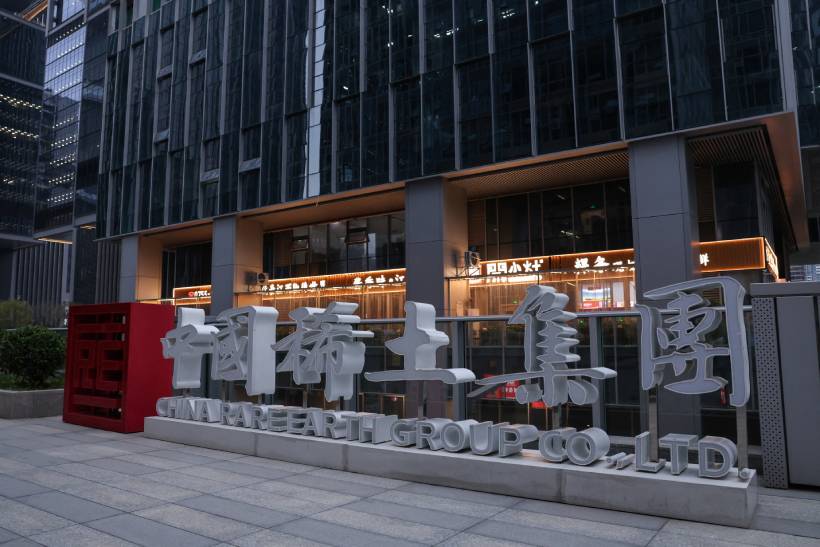
- Australian Treasurer Jim Chalmers on Monday ordered six shareholders to divest their stakes in Northern Minerals (NOURF), citing concerns over attempted Chinese control of the rare earths miner.
- Northern Minerals is developing the Browns Range heavy rare earths project in

To Beat a State-Capitalist Rival, Washington Became One: Inside the New Critical Minerals Race
On July 10, almost exactly a year after the Pentagon announced it was becoming the largest shareholder in MP Materials, the International Energy Agency put a number on what that deal was designed to prevent: $6.5 trillion in global downstream production now sits exposed to China’s rare-earth export curbs — restrictions currently suspended under an October 2025 truce that lapses again around October 2026. In the year between those two dates, Washington did not simply subsidize its way out of dependency on Chinese processing. It bought in: $400 million for 15 percent of MP Materials, a decade-long price floor for neodymium-praseodymium set nearly double the market rate, and a ten-year promise to buy everything a new Texas magnet plant produces. The Pentagon is now, functionally, a mining shareholder. The interesting question is not whether that has worked — MP’s private financing round attracted $1 billion from J.P. Morgan and Goldman Sachs within weeks — but what it costs to win a state-capitalist contest by becoming a state capitalist.
The stakes are structural, not cyclical. China controls roughly 70 percent of the world’s rare-earth and critical-mineral refining capacity, a chokepoint built over three decades while Western producers treated minerals as ordinary commodities rather than strategic assets. Beijing’s October 2025 tariff-war truce with Washington postponed, rather than cancelled, an expanded licensing regime that already cut U.S. yttrium imports from 333 tonnes to 17 tonnes in eight months — a squeeze aerospace manufacturers say could force production pauses. Washington’s answer has three parts: Project Vault, a $12 billion public-private stockpile signed by executive order on February 2, 2026, covering all 60 minerals on the USGS critical list; a fast-growing portfolio of direct government equity stakes in miners and processors; and a parallel push to sign allied-supply agreements with eight partners, including Australia, Japan, the UK and the UAE. Europe, meanwhile, is running a different playbook: a €3 billion RESourceEU plan, a joint-purchasing platform, and a stockpiling pilot — procurement and coordination, not ownership.
The MP Materials deal is the template, and its mechanics matter more than its headline. The Department of Defense’s July 2025 investment made it MP’s largest shareholder, attached a $150 million loan for expanding the Mountain Pass mine, and guaranteed a $110-per-kilogram floor price for NdPr oxide — a level industry analysts put at nearly double the prevailing market price — alongside a ten-year offtake covering the full output of a planned magnet facility in Fort Worth. Private capital followed the government’s signal almost immediately, which is precisely the point: Washington concluded that a guarantee was worth more to investors than a grant. That logic has since scaled. The administration has taken a $670 million stake in magnet producer Vulcan Elements, a 10 percent, $35.6 million position in Trilogy Metals, converted a renegotiated Energy Department loan into equity in Lithium Americas, and expanded the official critical-minerals list to include copper and metallurgical coal. Total direct equity commitments now exceed $1 billion, on top of Project Vault’s $12 billion stockpile.
The backlash has been immediate and specific, and it is worth taking seriously rather than waving off as sour grapes. Rival producers argue the price floor lets MP “undercut commercial bids, using federal subsidies to shield its margins,” while former White House and Pentagon officials warn the arrangement could “distort global NdPr pricing, crowd out innovation, and deter private investment in alternative supply chains” — in effect, recreating the very state-directed monopoly the policy exists to counter. That is the strongest objection, and it does not fully land: a government willing to take equity risk, rather than hand out grants, at least has an incentive to see the investment succeed and can in principle profit from the upside, which is the argument the Treasury and National Energy Dominance Council make for why this is smarter policy than Cold War-style stockpiling alone. But the objection identifies a real cost even if it doesn’t defeat the policy: an above-market, government-guaranteed price for one company makes every unsubsidized competitor in the same commodity harder to finance, which narrows rather than widens the eventual supplier base — the opposite of the diversification the strategy claims to deliver.
Stay ahead of the geopolitical week.
MD Briefing delivers expert analysis across five global fronts — the Indo-Pacific, energy, geoeconomics, European security, and the Middle East — every Monday morning. Free.
There is a second problem the price-floor logic obscures: capital committed is not the same as metal produced. The Center for Strategic and International Studies frames this as the difference between “distance” — how much progress has been announced — and “displacement” — how far supply chains have actually moved from their starting point. Japan’s experience with Lynas Rare Earths is the sobering comparison: fifteen years and $250 million of patient, low-drama investment before Lynas achieved the first commercial dysprosium production outside China, in 2025. Washington’s approach substitutes speed and scale for that patience, which may be the correct trade given the urgency, but it means the MP deal’s real test has not yet arrived — it arrives when the Fort Worth facility is supposed to reach full commercial output, not when Wall Street decides to match the Pentagon’s bet.
None of this is happening in a China-versus-America vacuum, either. The Democratic Republic of Congo has extended its cobalt export suspension specifically to tighten leverage over Chinese refiners, and Indonesia has repeatedly resisted pressure to loosen nickel export quotas, forcing processing onshore on its own terms. Producer states, not only the two superpowers, are now treating minerals as instruments of strategic leverage rather than commodities to be sold at whatever price clears the market. That reframes the whole contest: this is not simply Washington racing to catch Beijing, but a broader shift in which every government that sits on a mineral deposit is deciding whether to sell it or wield it.
Which is where Europe’s exposure becomes concrete. RESourceEU gives Brussels coordination and buying power, but no board seats and no offtake priority — and Chatham House’s own assessment is blunt that the UK and EU “cannot match the scale of what the US is attempting” and risk being “left behind” without equity of their own. That matters because Washington’s price floors do not stay domestic: a guaranteed $110/kg for MP’s output resets the benchmark every other buyer, including European manufacturers, has to price against, while offtake agreements tied to U.S. defense production can put European buyers behind the queue when supply tightens. The diversification Europe wants — away from dependence on Beijing — is real, but the replacement supply chain now runs increasingly through companies Washington part-owns and whose output is pre-committed to American industry first. Substituting one chokepoint for another is not the same as building a market.
What Happens Next
Base case (our estimate: roughly 55 percent probability). Washington’s equity-and-price-floor model extends to more minerals — copper and metallurgical coal are already on the list — and more companies, Project Vault’s stockpile builds through 2026–27, and the October 2025 China truce holds past its lapse date. Europe continues a purchasing-only strategy, remaining a price-taker on a benchmark increasingly set in Washington rather than Shanghai. This depends on Congress and private markets continuing to treat government equity as a credible signal rather than a fiscal liability, and on China preferring managed leverage over an open rupture.
Downside case. China allows the truce to lapse on schedule around October 2026 and resumes full licensing enforcement — already quietly restarting, according to recent customs-audit reports — before Vault-funded and MP-style projects reach meaningful output. Aerospace and defense manufacturers, already forced to ration yttrium and dysprosium at a fraction of pre-2025 volumes, face renewed production pauses in the exact window (2026–2028) when domestic capacity is still years from scale, exposing the gap between announced investment and actual tonnage.
Upside case. Government stakes prove to be a bridge rather than a permanent structure: MP, Vulcan Elements and Lithium Americas hit production targets on schedule, price floors become unnecessary as Japan’s Lynas eventually showed is possible after fifteen years of patient investment, and the eight-nation allied-supply framework matures into a genuinely plural, competitively priced market that Europe can buy into on equal terms rather than through Washington’s balance sheet.
The Pentagon’s bet on MP Materials shows that the fastest way to out-compete a state-directed rival was to become one — and by the only metric available so far, capital raised, that gamble is working. But capital raised is not resilience, and every mineral now being withheld or weaponized elsewhere, from Congolese cobalt to Indonesian nickel, shows the world’s supply chains are being redrawn along political lines everywhere, not simply rerouted away from Beijing.
Watch whether China lets its rare-earth export truce lapse on schedule around October 2026, and whether MP Materials’ Fort Worth magnet plant is producing at commercial scale when it does. If the truce holds and the plant delivers, Washington’s ownership model will keep expanding. If either fails, the U.S. will have discovered it bought a shareholding in a company, not a supply chain immune to the country it was built to out-manoeuvre.