miller

Miller is set to push hard-line Trump agenda. Courts stand in the way

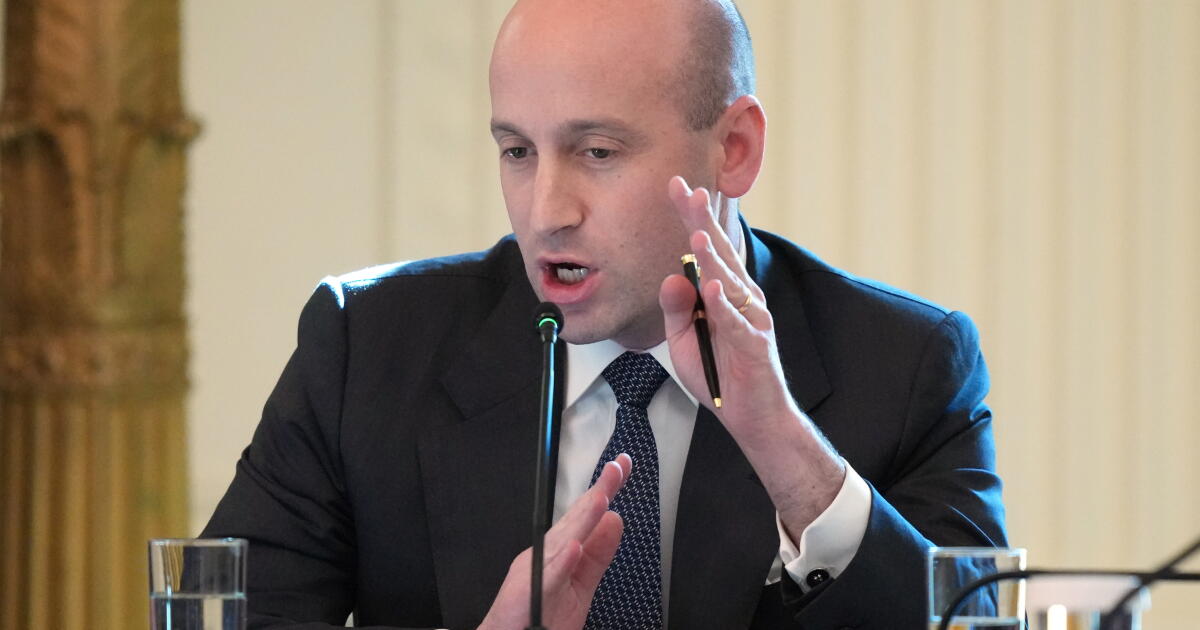
Stephen Miller was already one of the most powerful people in Washington when he stepped in to replace Susie Wiles as President Trump’s chief of staff on Monday, a position that expands his extraordinary influence over the hard-charging executive.

But whether the bellicose former Santa Monica High School Viking can make good on his muscular threats as Trump’s new right-hand man remains an open question — one the courts have begun to answer, even as pundits disagree.

“The single biggest takeaway of this whole announcement is what it symbolizes and the message it sends to Democrats,” said Josh Hammer, senior counsel for the Article III Project, a conservative advocacy organization that promises to “bring brass knuckles to fight leftist lawfare.”

Miller has long sought to jail journalists, undermine the authority of judges, surge armed soldiers into American streets and suspend the writ of habeas corpus, a legal process that allows immigrants to challenge their detention.

But despite his “Darth Vader Sith lord persona,” Hammer said, the new White House chief of staff may find himself hemmed in by the role of a bureaucrat.

“I can’t imagine anything like that is remotely under consideration,” Hammer said. “He’d be the first to admit that he’s essentially there as an operative.”

Many critics echoed that assessment, with caveats.

“Stephen Miller has been calling a lot of the shots already,” said Bruce D. Brown, president of the Reporters Committee for Freedom of the Press. “The combination of his elevation and the shake-up in the national security division at the Justice Department suggests that we might be in for a rocky ride in the remaining two years of the administration.”

Still, Miller’s power to avenge the president may be limited after his party was pummeled in the midterms.

The drubbing has already put the pair at odds over Miller’s much-maligned mass deportation program, which Trump acknowledged “was too tough,” in an interview Sunday with Ross Douthat on “60 Minutes.”

“I’d love to do something on immigration,” Trump said. “I think that’s something that’s actually doable.”

That could inflame Miller, the effort’s architect.

“This is his baby,” Hammer said. “I’m sure he’ll be poring over the data to try to talk the president out of” walking it back.

Miller also faces growing opposition from the courts to his wish list, with recent appellate decisions on press leaks and military deployments breaking in his opponents’ favor.

In October, one of Trump’s 9th Circuit Court nominees joined a Biden pick in quashing any future attempt to federalize National Guard troops without invoking the Insurrection Act — a move the president has regularly threatened but never yet followed through on.

Then, on Tuesday, a 4th Circuit panel ruled the Justice Department could not compel LinkedIn to hand over a trove of records that the department hoped would help it ferret out leaks, noting that “press freedom is among those things viewed by autocrats worldwide as a threat to their grip on power.”

“This ruling is a big deal and will quickly become one of the leading opinions in the area,” Brown said. “The court recognized that confidential sources are the ‘lifeblood’ of investigative reporting and that dragnet demands from technology companies to reveal those sources violate the law.”

Miller has also floated removing “crazy communist” federal judges or suspending the right of habeas corpus, which has increasingly been used by immigrants held in federal detention facilities to petition judges to order their release.

President Lincoln took the extraordinary step of suspending habeas corpus in order to detain Confederate sympathizers, spies and saboteurs during the U.S. Civil War — a move that earned him the epithet “King Lincoln” and spurred bitter court fights and ugly battles in Congress.

Miller has argued that Trump has the authority to suspend the law because immigrants arriving at the border constitute an “invasion” — a legally dubious claim, especially as the president likes to boast that the border is more secure than ever.

Miller would face almost insurmountable opposition from both the Supreme Court and a newly Democratic Congress, both of which are likely to argue the power to impeach judges or suspend basic rights belong to Capitol Hill, experts said.

“You can’t just fire a federal judge because you don’t like what they’re doing,” said retired U.S. District Judge Jeremy Fogel of Keep Our Republic’s Article III Coalition. “One of the reasons we went to war with Britain is because the king kept firing judges because he didn’t like their rulings.”

Sowing distrust in the judiciary and sweeping judges off the bench have become a go-to play for autocrats in countries such as Turkey and Hungary, he said. Similar attempts have sparked widespread street protests in Israel and Mexico in recent years.

“It’s not like we’re the only country where these kinds of conflicts come up, but what’s unique about us is we probably have stronger guardrails,” Fogel said.

He and others worried the rough-and-tumble rhetorical style Miller helped define could continue to cause problems, even if legal efforts to remove judges or muzzle journalists fail.

“When judges are called rogues or radicals, not long after that you start seeing memes on social media saying that person should be dead,” Fogel said.

“I’m sure the debasement of journalists will continue,” Brown agreed. “That threat continues to be the highest priority.”

Despite Miller’s pugnacious pronouncements, his best bet may be quiet backroom dealing to consolidate what remains of Republican power — including efforts to push through confirmation of Trump’s pending judicial nominees before the end of the year.

“At a bare minimum, the pending lower court nominations have to be confirmed — it should be the lowest of the low-hanging fruit,” Hammer said. “Now’s really the time. This is the race.”

There are currently 11 District Court nominees pending, and more than a dozen additional vacancies Trump could struggle to fill once the new Congress is sworn in on Jan. 3.

After that, pundits predict a flurry of official inquiries that could sweep up many top administration officials, including Miller himself.

“Stephen Miller is at the center of the major policy decisions happening in the administration,” said Rep. Robert Garcia (D-Long Beach), who will head the House Oversight Committee next year. “We believe he’s been at the center of actions that are unconstitutional, unjust and possibly illegal, so we’re of course going to investigate that.”
Source link

Stephen Miller: Immigration hard-liner and critic of Democrats

President Trump’s new White House chief of staff, Stephen Miller, is behind many of the administration’s signature domestic policy initiatives, especially its sweeping crackdown on immigration.

An outspoken defender of Trump’s most far-reaching goals to remake government going back to his 2016 run for president, Miller is known for his harsh language and unrelenting bombast, attracting outsize attention from supporters and critics alike. His record is likely to be scrutinized by Democrats in his powerful new role as he leads Trump’s White House through a lame-duck period after the Republican Party lost both houses of Congress in overwhelming fashion.

Here are some memorable things Miller has said through the years:

On immigration

During a surge in illegal border crossings during the Biden administration, Miller described migrants as invaders, even though many were escaping poverty and violence in their home countries.

“We are being conquered,” he told Fox News in December 2023. “We have millions of people coming in from different cultures and different ways of living and different belief systems.”

Miller also warned that “a generation from now,” people “will not know the country that they are living in. These consequences are permanent. Unless there’s massive large-scale deportations by the millions, it will be irrevocable.”

On federal agents’ killing of Alex Pretti

After federal agents shot and killed Alex Pretti during protests against the Trump administration’s immigration crackdown in January, Miller posted on social media that the 37-year-old Minneapolis resident was a “domestic terrorist” and an “assassin” who had “tried to murder federal agents.”

Later, Miller said in a statement that the federal officers in Minneapolis “may not have been following” protocol.

On Venezuela and Greenland

In January, after a U.S. military invasion captured Venezuelan President Nicolás Maduro, Miller used a lengthy post on X to decry “reverse colonization” in which he suggested that Western nations were sacrificing too much for the developing world and that such a practice “has been a long self-punishment of the places and peoples that built the modern world.”

In another post, he defended the right of the U.S. to take over Venezuela’s vast oil reserves, writing: “American sweat, ingenuity and toil created the oil industry in Venezuela. Its tyrannical expropriation was the largest recorded theft of American wealth and property. These pillaged assets were then used to fund terrorism and flood our streets with killers, mercenaries and drugs.”

He defended Trump’s assertion that the U.S. was now running Venezuela, by telling CNN’s Jake Tapper: “You can talk all you want about international niceties and everything else. But we live in a world, in the real world, Jake, that is governed by strength, that is governed by force, that is governed by power. These are the iron laws of the world.”

In the same interview, Miller also argued that the U.S. could seize Greenland by military force from NATO ally Denmark. “Obviously, Greenland should be part of the United States,” he said.

“Nobody’s going to fight the United States militarily over the future of Greenland,” Miller said.

On deportations

In May of 2025, Miller suggested that the Trump administration was looking for ways to expand its power to deport migrants who are in the United States illegally. To achieve that, he said, officials were “actively looking at” suspending habeas corpus — the constitutional right for people to legally challenge their detention by the government.

“The Constitution is clear — and that, of course, is the supreme law of the land — that the privilege of the writ of habeas corpus can be suspended in a time of invasion,” Miller said. “So, I would say that’s an option we’re actively looking at. Look, a lot of it depends on whether the courts do the right thing or not.”

In the nearly 18 months since, the idea has not been publicly pursued by the Trump administration.

On family separation

During Trump’s first term, Miller championed a strict immigration deterrence policy that previous administrations had been hesitant to adopt: family separation. It called for routinely having federal agents separate children from their parents if families were apprehended illegally crossing the border.

Miller defended the policy to the New York Times in 2018, saying it “was a simple decision by the administration to have a zero-tolerance policy for illegal entry, period.”

“The message is that no one is exempt from immigration law,” he added.

The tactic sparked widespread outcry, and the Trump administration did not revive it in its second term. Still, Miller has helped promote mass deportation of people already living illegally in the U.S. that has divided families according to legal status.

On the Statue of Liberty

During Trump’s first term in 2017, Miller appeared in the White House briefing room to detail for reporters plans to cut back on the number of green cards issued, while prioritizing English speakers and skilled workers.

Asked if doing so might violate the spirit of the poem on the Statue of Liberty, that reads in part, “Give me your tired, your poor, your huddled masses yearning to breathe free,” Miller responded, “I don’t want to get off into a whole thing about history here.” He then did just that.

“The poem that you’re referring to, that was added later, is not actually a part of the original Statue of Liberty,” Miller said.

On birthright citizenship

When the U.S. Supreme Court blocked Trump’s attempt to throw out birthright citizenship — which grants citizenship to any child born on U.S. soil — Miller said immigrants and their children pose an existential threat to the nation.

“This is absolutely a deep knife wound in the heart of the American republic,” he told Fox News in June. “If your ruling requires you to suicide your civilization, your reading of the Constitution is wrong.”

On vaccines

Miller is one of many members of the administration who has expressed skepticism about childhood vaccines. In August, he praised the president for signing an executive order aimed at curtailing the vaccine schedule for children.

“Millions and millions of parents feel they’ve been pressured when their children are just weeks out of the hospital to take five shots, six shots, seven shots all at once,” said Miller, a father of four, including an infant born in June. “Nobody has studied it. Nobody’s looked at it. Nobody’s thought about it.”

His comments contradict what the Centers for Disease Control and Prevention has said, which is that research shows getting several vaccines simultaneously “does not cause any chronic health problems.”

On the Democratic Party

In August 2025, Miller appeared on Fox News to respond to criticism from Democrats over Trump’s deployment of the National Guard in Washington and other U.S. cities — brushing aside concerns that the presence of troops was frightening residents, while having only a questionable impact on crime.

Miller used the occasion to take aim at Democrats more broadly.

“The Democrat Party does not fight for, care about or represent American citizens,” he said. “It is an entity devoted exclusively to the defense of hardened criminals, gang bangers and illegal alien killers and terrorists.”

Miller added: “The Democrat Party is not a political party. It is a domestic extremist organization.”

Weissert and Balingit write for the Associated Press.

Source link

Stephen Miller rises, but California hopes it can blunt his force

President Trump’s appointment of Stephen Miller — the architect of the administration’s extreme crackdown on immigration — to White House chief of staff is sparking alarm among immigrant advocates and politicians across California.

But this week’s sweeping Democratic victories are giving immigrant communities hope that control of Congress will give them more tools to fight Miller’s policies.

Miller grew up in Santa Monica but has become a relentless critic of California, specifically its immigration policies, protections and, in many ways, identity. Southern California was the first city targeted by widespread immigration raids last year, upending the region in ways that continue to reverberate, particularly for immigrant communities.

Miller’s promotion, announced Friday, is seen by many as an indication that the president has no intention of backing away from some of his most polarizing policies during his last two years in office, despite devastating midterm losses for Republicans across the country. Many viewed the nationwide Democratic swing — in South Carolina, Texas, California’s Central Valley and across the Midwest — as a rebuke of the administration’s first two years, particularly the major immigration crackdown that went far beyond Trump’s promise to focus on the “worst of the worst,” instead arresting thousands without criminal convictions, many of whom had lived in the country for decades.

“We’re concerned that this means the president may be doubling down on his domestic agenda of ICE crackdowns and on deportations if Stephen Miller is at the helm,” said Jamal Abdi, the president of the National Iranian American Council. “He thinks that every problem starts with the immigrant community — and that getting rid of them is the solution.”

Abdi worries that Miller’s latest promotion will further anti-immigrant policies, which have long painted Iranians and other immigrant communities as threats. He is hopeful Miller will help end the military’s war in Iran but fears that may mean more focus domestically on immigrants, especially Iranians, who have been demonized amid hostilities. The diaspora is highly concentrated in Los Angeles, which is home to the largest group of people of Iranian descent outside of Iran.

“We are definitely not out of the woods, and it seems like maybe the president might do less damage abroad but will really focus energy domestically,” Abdi said.

Angelica Salas, executive director of the Coalition for Humane Immigrant Rights in Los Angeles, said seeing more power in the hands of Miller — who she said was behind the Trump administration’s strategies that included “warrantless arrest, racial profiling, excessive use of force, medical neglect in detention centers, people deported illegally” — is threatening.

“Now he’s the chief of staff, and so that means that he has access to every single Cabinet secretary to unleash his reign of terror on our people,” Salas said. During the midterm elections, she said her team was aware of an influx of Department of Homeland Security sightings and activity in the Southland.

“We saw people arrested the day after the election in a massive way and it almost feels very vengeful,” she said. “Almost [like saying], ‘You know you can’t stop us.’”

Now, she and other immigration advocates are preparing themselves for “even more abuse from this administration,” Salas said.

But Ahilan Arulanantham, faculty co-director of UCLA’s Miñana Family Center for Immigration Law and Policy, said Miller’s promotion doesn’t change anything for him.

“He’s been adopting the most extreme authoritarian and racist views and espousing it publicly … for the entire two years of this administration,” Arulanantham said. “Whether he does it as the deputy chief of staff or chief of staff … I don’t have a view of the difference.”

Despite widespread backlash to the immigration raids last year, particularly after federal agents killed two civilians in Minnesota, the administration did pull back some of its most aggressive tactics. But Miller has remained intensely focused on his goal to limit immigration dramatically and deport undocumented migrants.

Miller’s new role will come as the administration prepares to face a Democratic-led House of Representatives and Senate, which could provide the strongest check yet on the executive branch since Trump began his second term.

“Congress has tremendous opportunity to constrain what the federal government can do in the form of abusive immigration practices,” Arulanantham said. “Congress has a huge amount of leverage that it could choose to use to force the administration to change its conduct — in the way that voters have clearly demanded.”

He hopes Congress will pass laws that limit how the Department of Homeland Security enforces immigration laws, including how agents use warrants — or don’t, what they wear while on duty and what factors they can consider when stopping someone.

Members of Congress appeared to agree with that approach.

“Stephen Miller should lawyer up,” U.S. Rep. Robert Garcia (D-Long Beach), who is set to lead the House Oversight Committee once the next Congress is sworn in, wrote in a statement Friday. He and his colleagues are committed to fighting “against his hateful policies in Congress and the courts.”

“Just days after the American people rejected his corrupt and lawless presidency, Donald Trump is doubling down,” Garcia said. “Stephen Miller is the architect of the unconstitutional ICE raids that have terrorized our communities and kidnapped and killed American citizens and immigrant families.”

Sen. Alex Padilla (D-California) characterized Miller as the man most responsible for “the cruelest immigration policies this country has seen in modern times: family separations, detainment of babies and children, militarized raids, arbitrary arrest quotas, and the horror unleashed in communities across the country,” Padilla said.

“We will use every tool at our disposal — oversight, investigations, subpoenas, and our leverage over federal funding — to expose this Administration’s abuse of power and hold those responsible accountable.”

Standing up to the administration was a similar response for lawmakers in Los Angeles. City Councilmember Eunisses Hernandez, whose district was targeted by some of the most extreme immigration sweeps last year, called Miller’s appointment an act of desperation by Trump.

The councilmember said it won’t deter her office or the community from resisting harsh immigration policies and continued activity in L.A.

“We’re going to fight back,” Hernandez said. “Even when we were on the losing side, when we didn’t have the majority in the Senate or the House, many of us were still fighting against those raids, fighting for our communities, fighting to make sure people are fed and housed.”

Source link

With Stephen Miller pick, Trump readies for a battle

Miller is best known for being the driving force behind the Trump administration’s aggressive immigration enforcement policies, which has included ramping up funding for enforcement operations across the US.

He made headlines when he called Alex Pretti, who was shot and killed by federal immigration officials during a massive deportation operation in Minneapolis, a “domestic terrorist” and an “assassin”. He would later walk back those words, saying federal agents “may not have been following” proper protocol.

He has also reportedly played a leading role in the US military operations in Venezuela and against suspected drug trafficking operations in the Caribbean and eastern Pacific, which critics have condemned as extra-judicial killings.

Miller joined Trump’s political operation early in his 2016 presidential bid as a strategist and incendiary warm-up speaker at his raucous campaign rallies.

He was one of the few senior White House staffers to persevere through the entirety of his first term. He stayed loyal to Trump during his political exile following attempts to overturn his ballot-box defeat in 2000 failed. He then returned in the influential role of deputy chief of staff for policy in Trump’s second term.

Wiles, who co-managed the president’s successful 2024 re-election campaign, developed a reputation as a cool professional who avoided the White House staffing upheavals, dramatic policy reversals and personality clashes that typified Trump’s first presidential term.

The president, however, began souring on Wiles in recent months, as his political standing in the US declined, culminating in Tuesday’s electoral rout. He also reportedly chaffed at news stories indicating that those in Wiles’ orbit were landing lucrative consulting jobs through their connections to the president.

Source link

Trump names Stephen Miller chief of staff, replacing Susie Wiles

President Trump on Friday announced his appointment of Stephen Miller as his chief of staff, to replace Susie Wiles.

Miller, the current deputy chief of staff, has helped design Trump’s immigration policies and spearhead his mass deportation campaign.

His appointment as chief of staff, a powerful position for driving the president’s policy agenda, managing his staff and twisting the arms of allies and opponents alike to bend to the executive’s will, ends speculation that Trump might ease back from his less popular policies or moderate following devastating losses for his party in the midterms. The losses were driven in part to losing Latino voters and many congressional seats along the southern border.

Miller is widely seen as among Trump’s more extreme advisors. But Trump on Friday called Miller one of his “most trusted advisors,” and said he would take over as chief of staff Monday.

Trump said Wiles “has done an outstanding job,” and will be moving to his political operation.

This is a developing story and will be updated.

Source link

Trump says making adviser Stephen Miller White House chief of staff | Donald Trump News

United States President Donald Trump has said he is making Stephen Miller his new White House chief of staff.

Trump made the announcement on his Truth Social account on Friday, calling Miller “one of my most trusted advisors”. He said Miller would become chief of staff starting Monday, replacing Susie Wiles.

“Susie Wiles, who has done an outstanding job, will be moving over to the Trump Political Operation. I want to thank her for her service as Chief of Staff — She has done a great job!”

Miller has been one of Trump’s closest confidants and advisers across both his presidential terms, after joining then-candidate Trump as a campaign adviser in 2016.

He has been the main architect behind the president’s hardline border and deportation policies, a rallying issue in the US midterm elections.

Democrats are widely expected to launch investigations into Miller upon taking control of the US House of Representatives and Senate in January.

Trump had been widely expected to shake up his staff following the midterm drubbing, which saw Democrats net seven US Senate seats, with two states, Alaska and Mississippi, still counting their results. Democrats have also won 253 seats in the 435-member US House, with 27 races still set to be counted.

Despite the vote largely seen as a referendum on Trump, Miller’s appointment largely represents a doubling down on his most controversial policies.

Miller has not yet commented on the election results, but in a post on X on election day, he urged Trump supporters to vote.

“Send a message to the corrupt media, corrupt Democrats and corrupt leftwing politicians who want to steal your future and destroy the inheritance of your children,” he wrote. “Get to the polls and protect the ones you love.”

For her part, Wiles, who has been credited with orchestrating Trump’s election comeback in the 2024 race, said serving as a chief of staff was “the honor of a lifetime”.

“I’m so proud to have been a part of what we’ve accomplished together from securing our border and cutting taxes to strengthening our economy and putting America First,” she said.

Source link