A US pilot has been killed in Indonesia’s Papua region after separatist rebels said they shot him and set his aircraft on fire. The attack highlights the decades-long independence struggle, which has displaced more than 122,000 people since 2022.
Prosecutors allege a yacht was used in the sabotage of pipelines, with the suspect leading the operation.
By Reuters and The Associated Press
Published On 2 Jul 20262 Jul 2026
German federal prosecutors have filed charges against a 50-year-old Ukrainian national over a series of explosions that destroyed two Nord Stream underwater gas pipelines linking Russia to Europe in 2022.
The federal prosecutor’s office declined to comment on the specifics of the indictment on Wednesday against the accused, who is identified only as Serhii K in court documents under German privacy rules.
Recommended Stories
list of 4 itemsend of list
Serhii K is accused of attacking civilian energy infrastructure, causing an explosion, and destroying structures, according to the German public broadcaster ARD.
The underwater explosions damaged both the Nord Stream 1 and Nord Stream 2 pipelines so severely that no gas could be transported through them, knocking out the key routes for Russian gas to Europe for months after Moscow’s full-scale invasion of Ukraine in February 2022.
In a December 2025 detention filing by the Federal Court of Justice, prosecutors allege that Serhii K helped coordinate a team that used a sailing yacht, the Andromeda, to place explosive devices on the pipelines near Denmark’s Bornholm Island in September 2022.
According to those documents, Serhii K is suspected of acting as the on-board coordinator and team leader, not as a diver or bomb expert.
The Berlin law firm Menaker, which is representing the accused Ukrainian, has not provided any details on the indictment.
Federal prosecutors confirmed to the AFP news agency that Serhii K was the same suspect who was arrested in August 2025 in Italy and extradited to Germany the following November, and who was named at the time as Serhii Kuznietsov.
At the time of his arrest, German prosecutors said Kuznietsov had used forged identity documents to charter a yacht, which departed from the German city of Rostock to carry out the attacks.
Kuznietsov has denied being part of the sabotage operation. He said he was a member of the Ukrainian armed forces and in Ukraine at the time of the incident, a claim his defence team has said would give him “functional immunity” under international law.
Answering a question from Germany’s Der Spiegel magazine during a news conference in Dublin on Wednesday, Ukrainian President Volodymyr Zelenskyy said it was too soon to comment on the charges against Serhii K in detail.
“We have not officially received any details; at least I have not seen them”, Zelenskyy said. “It is too early to say yet,” he added.
Ukraine’s government has previously denied any involvement in the sabotage or knowledge of the plot to bomb the Nord Stream 1 and Nord Stream 2 pipelines.
Plan includes more than 5 billion pounds for drones and autonomous systems over four years, Ministry of Defence says.
Published On 30 Jun 202630 Jun 2026
Outgoing Prime Minister Keir Starmer has announced that Britain will spend almost 300 billion pounds ($397bn) over the next four years to modernise its armed forces amid rising threats.
Starmer, expected to leave office next month after losing the support of Labour MPs, announced on Tuesday that the overall defence budget would increase by 15 billion pounds ($20bn) over the next four years to almost 300 billion pounds as he launched his long-awaited defence investment plan.
Recommended Stories
list of 3 itemsend of list
“Last year I made the decision in the national interest to reprioritise aid spending towards defence and achieved the biggest uplift in defence spending since the end of the Cold War,” Starmer said.
“That was the right choice because the world has changed. National security is economic security.
“Today we uplift defence spending further – an additional 15 billion pounds worth of funding – by … reprioritising spending across government.”
The plan includes more than 5 billion pounds ($6.6bn) for drones and autonomous systems over the next four years, the Ministry of Defence said in a news release.
The announcement followed months of wrangling within Starmer’s Labour government over the resources required to modernise the United Kingdom’s armed forces in the face of rising threats, including from Russia.
Two defence ministers quit this month in a row over the spending proposals, including Defence Secretary John Healey, who said the plans risked making Britain “less safe”.
Starmer’s pledge came as United States President Donald Trump has repeatedly urged NATO allies to spend more on defence and become less reliant on Washington for security.
Starmer will take the plan, which foresees spending nearly 80 billion pounds ($105.7bn) a year by 2029, to Ankara for a NATO summit on July 7-8. He wants to signal Britain is on track to spend 3.5 percent of its gross domestic product on defence by 2035.
With likely successor Andy Burnham due to take power as early as July 20, Starmer acknowledged new governments could “build” on his blueprint.
Critics said the plan, delayed for more than nine months, was too little, too late.
US president says talks will take place on Tuesday, but Tehran has not confirmed the negotiations in Doha.
President Donald Trump says a meeting will take place between Iran and the United States in Qatar on Tuesday, suggesting that diplomacy is still on track despite the recent military skirmishes in the Gulf.
Trump’s announcement on Monday came less than two hours after a top Iranian official said that technical talks over the memorandum of understanding (MoU) between Washington and Tehran “are not planned” for this week.
Recommended Stories
list of 3 itemsend of list
“IRAN HAS REQUESTED A MEETING. IT WILL TAKE PLACE TOMORROW IN DOHA!” Trump wrote in a social media post.
Iranian Deputy Foreign Minister Kazem Gharibabadi said the meeting would take place after conditions are met, without providing details.
“Although consultations with Qatar, including regarding the follow-up of the implementation of the other party’s commitments, are ongoing as usual, the news from some media outlets that technical talks of the working groups will be held in Doha cannot be confirmed,” Gharibabadi told Tasnim news agency.
The two statements from Washington and Tehran appear to contradict each other, but it is possible that a breakthrough finalising the meeting occurred after Gharibabadi’s comment.
Iran, however, has not confirmed that talks have been scheduled.
White House spokeswoman Karoline Leavitt said special envoy Steve Witkoff and Trump’s son-in-law, Jared Kushner, will lead the US negotiating team in Doha.
“Special Envoy Witkoff and Jared Kushner will be flying to Doha for high-level meetings this week as we continue to discuss the memorandum of understanding,” she told Fox News.
Leavitt added that technical talks will take place on the sidelines of the high-level negotiations.
The US and Iran reached a deal to end the war earlier this month, kicking off a 60-day period of negotiations over the thorniest issues in the relationship – Tehran’s nuclear programme.
But the deal has been tested by Israel’s continuing attacks in Lebanon and Iran’s assertion of control over the Strait of Hormuz.
The first sentence of the 14-point MoU calls for a full ceasefire in Lebanon, “ensuring the territorial integrity and sovereignty” of the country.
But the US has sponsored a separate agreement between the Lebanese government and Israel that conditions Israeli withdrawal on the disarmament of Hezbollah across the country.
Hormuz has been another sticking point. Iran has rejected routes through the strait outside of its control and fired at ships passing through lanes not designated by Tehran.
The US has struck Iranian positions near the waterway, to which Iran responded with missile and drone attacks against American bases in Bahrain and Kuwait.
But diplomatic and de-escalation efforts appear to continue, despite the trading of attacks.
“As far as we’re concerned, we’re holding up our end of the ceasefire,” Leavitt said on Monday, but she warned that “violence will be met with violence” if Iran attacks commercial ships or US interests.
On Monday, Trump hailed the drop in oil prices that followed the deal, which lifted Tehran’s blockade on Hormuz and eased US sanctions on Iran’s energy products.
“GAS PRICES COMING DOWN, FAST! REPORT ANY ABUSES AT RETAIL LEVEL,” the US president wrote on his Truth Social platform.
The average price of one gallon (3.8 litres) of gasoline in the US has dropped to $3.86, down from a peak of $4.56 in May. It was less than $3 before the war.
Khartoum, Sudan – As drone attacks rain down on el-Obeid and the Rapid Support Forces (RSF) tighten their months-long siege, the capital of North Kordofan has emerged as the latest flashpoint in Sudan’s grinding war of attrition.
Despite mounting international alarm and renewed US diplomatic pressure aimed at securing a nationwide truce, Sudan’s warring generals remain deeply entrenched. Both the Sudanese Armed Forces (SAF) and the RSF appear locked in a pursuit of outright military victory, largely sustained by a continuous flow of foreign weapons.
Through the lens of the escalating crisis in el-Obeid, a grim reality is unfolding: Civilian suffering is increasingly weaponised amid polarised domestic narratives, while geopolitical manoeuvring repeatedly stalls any viable path to peace.
A strategic prize and international alarm
El-Obeid holds immense strategic value. Located 550km (340 miles) southwest of Khartoum, it acts as the primary gateway linking Khartoum to the vast Darfur region. The city is also a major military stronghold, hosting the SAF’s 5th Infantry Division, known as “Al-Hagana”, and has become a refuge for hundreds of thousands of displaced civilians fleeing violence elsewhere.
The looming threat of a full-scale ground invasion has triggered urgent global warnings. Recently, 38 international nongovernmental organisations (NGOs), alongside the UN and countries including Qatar, sounded the alarm over the escalating use of drones and the potential for mass atrocities, warning that el-Obeid could face the same devastation recently seen in el-Fasher.
Yet these warnings have failed to alter the calculus on the ground.
Polarised narratives of a stalled peace
Recent United States diplomatic efforts, led by Massad Boulos, an adviser to US President Donald Trump, have pushed for a comprehensive ceasefire. However, the push for peace has collided with absolute domestic polarisation.
SAF commander Abdel Fattah al-Burhan has firmly rejected unconditional truces, stating that the army will operate with the precision of “digging with a needle” until the RSF is entirely dismantled.
This deadlock reflects a deeply fractured political landscape. Fathi Abu Ammar, a Sudanese academic, told Al Jazeera that the SAF is primarily responsible for the prolonged suffering by obstructing peace initiatives and refusing to establish safe corridors for civilians to leave el-Obeid.
He accused the army of using the city’s residents as “human shields” to garner international sympathy, while arguing that the RSF is fighting to address legitimate historical grievances.
Conversely, Sudanese journalist and political analyst Yousef Abdel Mannan vehemently rejected these claims.
Speaking to Al Jazeera from Sudan, Abdel Mannan accused the RSF of widespread atrocities, including a recent drone attack on a girls’ school in el-Obeid and the systematic killing of thousands of civilians in el-Fasher, including patients inside the Saudi Hospital.
Abdel Mannan dismissed the US-backed truce proposals as inadequate measures that merely “treat the wounds of the conflict while leaving the root cause intact”, arguing that only a comprehensive political settlement, not a temporary ceasefire, can resolve the crisis.
He maintained that civilians in el-Obeid are not being held hostage by the army, but rather prefer to remain in their homes rather than face displacement at the hands of paramilitaries.
Foreign arms and the geopolitical deadlock
Beneath the domestic blame game lies a critical factor sustaining the conflict: Foreign interference.
David Shinn, a former US diplomat and assistant secretary of state for African affairs, noted that despite years of US engagement and sanctions targeting both SAF and RSF leaders, neither side has shown a genuine interest in halting the violence.
“There is a desire from both sides to continue fighting until one side wins,” Shinn told Al Jazeera.
The escalating use of uncrewed aerial vehicles (UAVs) over el-Obeid underscores this external lifeline. “Neither the RSF nor the Sudanese army manufactures drones,” Shinn pointed out, meaning these advanced weapons must be imported.
He highlighted that the warring parties are actively backed by regional powers, pointing to the United Arab Emirates as a backer of the RSF, and Egypt and Saudi Arabia as supporters of the SAF, arguing that the conflict has transformed into a proxy war.
For the siege of el-Obeid to end and a genuine peace process to begin, the geopolitical spigot must be turned off.
Until the international community forces external actors to halt their military support, analysts warn that Sudan will remain hostage to a war its generals believe they can still win.
The president’s son said he did not believe in a free press as military personnel were deployed to the media offices.
Published On 28 Jun 202628 Jun 2026
The chief of Uganda’s military says he has ordered the closure of two of the country’s biggest media outlets.
Muhoozi Kainerugaba said on Sunday that the Daily Monitor, the country’s largest independent daily newspaper, and NTV Uganda, one of the largest private broadcasters, were being shut down and would not reopen without his permission.
“In Uganda, I do not believe in a free press!” Kainerugaba, who is the president’s son, wrote on X.
“From now on ALL bad stories about Uganda have to be cleared by my office!” he said in one of a series of posts, adding that all media in Uganda would follow the rules, going forward.
Military personnel deployed
Both the Daily Monitor and NTV Uganda are owned by the Nation Media Group (NMG) conglomerate. The Daily Monitor said armed security personnel were outside NMG Uganda’s headquarters in Namuwongo, Kampala and its Serena Hotel location, with staff reporting “no one was being allowed to enter or leave.”
NTV Uganda, Spark TV and other TV and radio broadcasters owned by NMG were down in the country on Sunday, the Reuters news agency reported.
According to Kainerugaba, he has had the power to shut down any media outlet since 2017, when his father, President Yoweri Museveni, granted him this ability.
Kainerugaba is seen as the likely successor to his father, who has ruled Uganda since 1986 and is also known to write controversial social media posts.
His government shut down the Daily Monitor for 10 days in 2013, and in 2007, NTV Uganda was taken off air months after its launch, following government criticism of its coverage.
The Uganda People’s Defence Forces (UPDF), Uganda Police Force and Uganda Communications Commission (UCC) are yet to release a statement on the operation.
Uganda’s National Association of Broadcasters said it was closely monitoring the situation, adding that it was “deeply concerned about this action and its impact on the media ecosystem” and the rights enshrined in the constitution.
For a second day in a row, the United States has launched strikes on Iran, once again citing an attack against a commercial vessel as a motivation.
Saturday’s renewed attacks are the latest indication that a Middle East ceasefire, established as part of a June 17 memorandum of understanding between the US and Iran, might be at breaking point.
Recommended Stories
list of 3 itemsend of list
In a statement, US Central Command (CENTCOM), which directs military action in the Middle East, explained that the latest attacks came “at the Commander in Chief’s direction”.
“CENTCOM forces launched strikes today in direct response to continued Iranian aggression against commercial shipping,” the command centre wrote.
“U.S. military aircraft targeted Iranian military surveillance infrastructure, communication systems, air defense sites, drone storage facilities, and minelayer capabilities.”
Explosions were reported in southern Iran, around the village of Tahrui, near the port of Sirik, which was also the focal point of Friday’s US attacks. State media also indicated that Qeshm Island had been hit.
Responses to cargo ship strikes
Saturday’s strikes against Iran followed a similar playbook to Friday’s.
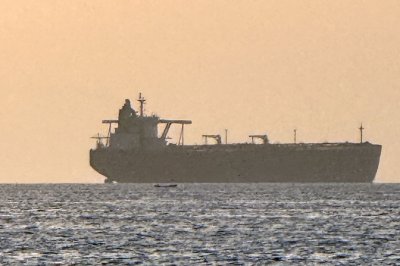
Early on Saturday morning, at about 4:30am Eastern US time (08:00 GMT), the Panama-flagged tanker Kiku was travelling through the Strait of Hormuz when it was reportedly hit by an unidentified projectile.
No crew members were injured, and no leakage was reported from its cargo.
CENTCOM said the ship had been carrying more than 2 million barrels of crude oil when it was hit by a “one-way attack drone”.
The website MarineTraffic.com indicates that the tanker left the Al Shaheen oilfield on Thursday and is due to dock in Fujairah, in the United Arab Emirates, on Sunday.
A similar sequence of events prompted Friday’s volley of US attacks.
In that case, a Singapore-registered container ship, the Ever Lovely, was struck by a drone as it sailed through the Strait of Hormuz on Thursday. No one on board was injured, and the boat continued on its travels.
But US President Donald Trump denounced the drone strike on Friday as a “foolish violation” of the June 17 memorandum.
By that evening, the US and Iran had exchanged fire, with the US targeting the area around Sirik, and Iran hitting US military installations in the Middle East.
CENTCOM referenced Friday’s actions in announcing the latest round of strikes.
“After yesterday’s U.S. strikes in response to the Iranian attack on M/V Ever Lovely, Iran was given a chance to honor the ceasefire agreement,” CENTCOM wrote.
Iran “elected not to”, it added, citing the Kiku drone strike. CENTCOM also maintained that commercial traffic through the Strait of Hormuz, a sticking point in ceasefire negotiations, would continue, with US military backing.
“U.S. forces remain vigilant, lethal, and ready,” CENTCOM said in its statement.
Controlling the strait
Central to the latest round of fighting is control over the Strait of Hormuz, a key artery for maritime traffic. Nearly 20 percent of the world oil supply passed through the narrow waterway in peacetime, as well as significant quantities of fertiliser and natural gas.
But after the US and Israel launched attacks on Iran on February 28, launching the present-day war, Tehran moved to shut down traffic through the strait, which sits between its shores and Oman’s.
Iran’s decision sent global fuel prices skyrocketing, and that generated pressure, both domestic and international, for the Trump administration.
The June 17 memorandum was designed to provide relief. Though it was a prelude to further negotiation, the deal called for the US, Iran and their allies to “declare the immediate and permanent termination of military operations on all fronts, including in Lebanon”.
It also outlined a 60-day period during which time Iran was to make its “best efforts” at allowing commercial traffic to transit through the Strait of Hormuz at no charge.
That part of the memorandum specified that Iran and Oman, the two countries that border the strait, would determine “future administration and maritime services” in the waterway.
But continued fighting in Lebanon has prompted Iran to threaten the strait’s closure once more.
Then, there is the question of the memorandum’s terms. Experts say the US and Iran have come to different understandings of how the June deal should be enforced.
Al Jazeera correspondent Resul Serdar Atas explained that Iran believes it should be allowed to restrict commercial traffic that does not have prior clearance to pass through the strait.
“Article Five of the memorandum of understanding, according to the Iranian officials, is clearly saying that any ship, whether it’s going through the Iranian territorial water or the Omani territorial water, has to be in full coordination with the Iranian authorities,” he said.
“But that is not understanding of Americans. The Americans are saying, ‘Well, if it is going through the Omani territorial waters, they do not need to coordinate with the Iranian authorities.’”
That, in turn, is leading to a disagreement over who is violating the terms of the ceasefire. The US sees Iran as violating the agreement by interfering with commercial vessels, while the Iranians perceive the US as breaking its commitment to stop fighting.
“That is the pattern,” Serdar Atas said. “For Americans, keeping the Strait of Hormuz open is quite important for the stability of the global economy. But for Iran, the Strait of Hormuz being under Iranian control is the ultimate deterrence and the biggest leverage.”
Tit-for-tat ‘could get out of hand’
Some of the hostilities are a result of the high level of distrust between Iran and the US, according Hassan Ahmadian, a professor at the University of Tehran.
He noted that Iran’s insistence that ships passing through the Strait of Hormuz receive its clearance could be read as a defensive action.
“I think the Iranians will not let go of this because obviously they want only commercial ships, according to the MoU, to pass through the strait. So any ship that doesn’t coordinate might be a military one, might carry military stuff,” Ahmadian said.
He believes that the latest flurry of US attacks may prompt Iran to halt any deliberations with the Trump administration as they seek to cement a peace deal.
The US side, meanwhile, is likely to face pressure from rising oil prices as the result of the renewed fighting, according to Harlan Ullman, a retired US naval officer and chairman of The Killowen Group, a global advisory firm.
Still, Ullman warned that the latest exchange of fire could spiral into an escalation in violence, rendering the memorandum of understanding moot.
“The agreements are very, very fragile, and this tit-for-tat could get out of hand,” Ullman said.
“If prices go up, as I suspect they will, that will be a moderating influence, and I think the United States will consider that rising oil prices are not good, and it will probably continue the negotiations. But right now, who knows?”
Israel and Lebanon have agreed on a new framework agreement after four days of marathon talks in Washington, DC, brokered by the United States, trying to end the months-long conflict.
Israel has been occupying almost 20 percent of Lebanese territory in the south and has killed more than 4,000 people since fighting erupted on March 2. A previous bout of fighting ended in a ceasefire in November 2024, but Israel carried out almost daily attacks and refused to end its occupation in breach of the deal.
The new deal, however, does not specifically call for the withdrawal of the Israeli forces and instead ties it to the disarmament of Hezbollah – a condition repeatedly rejected by the Iran-backed armed group.
Hezbollah chief Naim Qassem on Saturday rejected the framework agreement, calling it “null and void”. Hezbollah has demanded that Israel first end its occupation.
Hezbollah supporters flooded the streets of the capital, Beirut, on Friday evening to oppose the deal.
So, what is the new agreement, which does not include Hezbollah, and can it lead to peace in Lebanon?
US Secretary of State Marco Rubio looks on as State Department Counsellor Daniel Holler, Israel’s ambassador to the US, Yechiel Leiter, and Lebanon’s ambassador to the US, Nada Hamadeh, sign a framework agreement between Israel and Lebanon, at the State Department in Washington, DC, June 26, 2026 [Ken Cedeno/Reuters]
What’s in the Israel-Lebanon agreement?
After the trilateral signing in Washington, the US Department of State released the text of the agreement, which talks of a “sequenced process” that will see the Lebanese army restore “effective sovereign authority over all Lebanese territory, pending the verified disarmament of non-state armed groups” – a clear reference to Hezbollah.
The deal does not mandate Israeli withdrawal from the fifth of Lebanese land it occupies. Instead, the framework notes that Israel shall “progressively redeploy” out of Lebanon, offering two “pilot zones” where the Lebanese military “will gradually assume full and effective security responsibility”.
“One [pilot zone] is south of the Litani River and outside the security zone altogether, and the other is north of the Litani – a small area in the expanded security zone that we conquered in the last two weeks, and which the [Israeli military] says it does not need,” Israeli Prime Minister Benjamin Netanyahu later said in a statement.
Once these conditions are met, “Lebanese civilians will be able to safely return to these areas under the exclusive control of Lebanese state authorities,” the framework says. More than 1.2 million people have been forcefully displaced.
Israel says that successfully returning southern Lebanon to Lebanese government control would “eliminate any future need for [Israeli military] action or presence in Lebanon” and “[declared] that it has not territorial ambitions in Lebanon”.
The Lebanese government has signed that it rejects “the claims of any state or non-state actor to use force on its behalf without its explicit authorization,” deeming such attacks “illegal” and “contrary to Lebanese national interests”.
Hezbollah supporters block the old airport road in the southern suburbs of Beirut, with burning tyres to protest against the trilateral agreement that was signed between the US, Israel and Lebanon on June 27, 2026 [Ibrahim Amro/AFP]
How have parties to the conflict reacted to the agreement?
Israel
Netanyahu issued a video statement shortly after the agreement was announced, stressing that the framework would allow the Israeli military to remain in the occupied Lebanese land.
“We will maintain [the buffer zone] until Hezbollah disarms and as long as there is a threat to the State of Israel,” Netanyahu said.
It is also a partial, momentary win for Netanyahu, who faced intense domestic criticism after the US and Iran sidelined Israel to sign the Islamabad Memorandum of Understanding, which mandates an end to hostilities in Lebanon as well.
Lebanon
President Joseph Aoun expressed gratitude to Trump and other regional mediators after the signing of the trilateral agreement, which he hailed as “the first step on the path to restoring Lebanon’s sovereignty”.
In a statement from the Lebanese presidency, Aoun noted that the framework also “marks the beginning of the road to fructify [Lebanese citizens’] sacrifices, so that they may return to their fully liberated land”.
His statement has done little to tamp down the tensions in the capital, where supporters of Hezbollah took to the streets, burning tyres and blocking a road leading to the airport.
People react, as they watch Hezbollah chief Naim Qassem deliver a televised speech on a giant screen at the burial site of former Hezbollah leader Hassan Nasrallah, on the outskirts of Beirut, Lebanon, June 17, 2026 [Mohamed Azakir/Reuters]
Hezbollah
Though the armed group is not a party to the agreement, and was not present at the negotiating table, its posture and actions will dictate where the conflict heads in the future.
The Hezbollah leader on Saturday condemned proposals to tie the Israeli withdrawal to the group’s disarmament. “Linking the Israeli withdrawal to the disarmament of the resistance throughout Lebanon is a very dangerous proposition that crosses all red lines,” he said.
“The framework agreement in Washington is humiliating, shameful, and a surrender of sovereignty,” he said.
He added that the framework agreement should be replaced by the Iran-US Memorandum of Understanding (MoU) signed on June 15.
Earlier, Hassan Fadlallah, a Hezbollah representative in the parliament, said Lebanese authorities would not be able to enforce the framework agreement unless, with US support, “they go to civil war”.
In a televised speech before the agreement was signed, Qassem said that Hezbollah would hold its weapons closer, ready to fight Israel for Lebanon, if the Lebanese state fails to do so.
The Iran-US MOU called for the “territorial integrity and sovereignty of Lebanon” – a similar wording has been used in the framework agreement.
United States
US Secretary of State Marco Rubio, Washington’s point person in Israel and Lebanon talks, announced an “immediate” $100m donation by the US towards humanitarian assistance in coordination with the UN.
At the signing ceremony at the State Department in Washington, Rubio appeared to acknowledge the limited scope of the agreement, calling it “the beginning of the beginning.”
“There’s a lot of work ahead. We don’t in any way underestimate the difficulty of the task ahead, but we understand the importance of it, how vital it is, and we are honored to have played a part in bringing this together,” he said.
Two previous ceasefire agreements brokered by Washington failed to stop the fighting in Lebanon, as well as the Islamabad MOU, signed by President Trump and his Iranian counterpart Masoud Pezeshkian, earlier this month.
Iran
Though Tehran is yet to officially react to the agreement, its state media has been pressing against the deal.
Fars news agency noted that the agreement is essentially the US permitting Israel to violate the first clause of the Islamabad MOU, which mandated the cessation of hostilities on all fronts, including Lebanon.
Does the Israel-Lebanon agreement contradict the Islamabad MOU?
Analysts point towards two direct contradictions between the preliminary deal signed by the US and Iran, and the latest agreement between Israel and Lebanon.
In short, the Islamabad MOU mandates the end of hostilities on all fronts, including Lebanon, with no conditions – while the Israel-Lebanon agreement ties it to Hezbollah’s disarmament.
Israel has not adhered to any of the ceasefire agreements, including earlier ones, and continued with its assault on Lebanese territories. On Saturday, Lebanese state news agency NNA reported that the Farah amusement park intersection in Nabatieh al-Fawqa was targeted by an Israeli drone strike.
Israel has killed at least 4,192 people in Lebanon since the start of the war on Iran four months ago.
Secondly, the Islamabad MOU does not refer to or mention any of the Iran-backed proxy armed groups among its listed clauses to take forward the negotiations to end the war.
Tahani Mustafa, a visiting fellow on the Middle East and North Africa programme at the European Council on Foreign Relations, told Al Jazeera that Israel and Washington would “definitely use the fact that Hezbollah refuses to disarm and capitulate to blame Hezbollah for derailing the entire process”.
Mustafa further added that Israel “has also proven that it is acting in bad faith, which really gives no confidence to Hezbollah to disarm or capitulate in the way that is being demanded.”
Washington is not blame-free either, she noted, arguing that “the American negotiators actively work behind the scenes to try and decouple Lebanon and Iran.”
“This has really just been something that both the Israelis and the Americans have attempted to cook up behind the scenes and once again obfuscating the blame for its failure,” she told Al Jazeera.
Mourners put wreaths on the grave during the funeral of Israeli soldier Alexander Filin, who, according to the Israeli army, was wounded and later died in an explosive attack by Hezbollah in southern Lebanon, in Haifa, Israel, June 21, 2026 [Shir Torem/Reuters]
Can a deal work if Hezbollah rejects?
This is not the first time that Hezbollah’s disarmament is on the table – and the existing challenges remain. The 2024 deal also called for Hezbollah’s disarmament, but it could not be achieved as Israel continued to attack Lebanon and refused to withdraw its troops in breach of the deal.
Alon Pinkas, an Israeli former ambassador and consul general in New York, says he is “very doubtful and sceptical” that this will work out because the deal is between Israel and Lebanon with the US; the issue here is Hezbollah.”
Iran’s linking of the Lebanon conflict to the maturation of an agreement with the US, Pinkas says, “complicates things [because] Netanyahu said that [Israel] would not yield to any linkage to Iran and that Israel would defend itself in Lebanon”.
Al Jazeera’s Ali Hashem said that the agreement is an “existential threat” to Hezbollah’s presence.
“Without Hezbollah’s consent, this is not going to happen,” Hashem said. “This is going to be a recipe for another confrontation. The Lebanese government isn’t capable of imposing this deal. It’s not the de facto force on the ground.”
Thousands have been reported missing following the collapse of dozens of buildings in La Guaira. (Archive)
Caracas, June 26, 2026 (venezuelanalysis.com) – Venezuelan casualties from Thursday’s double earthquake continue to rise amid ongoing search and rescue efforts to remove survivors from flattened buildings.
On Thursday night, Venezuelan authorities reported 235 people dead and over 4,300 injured. There are 250 buildings with serious damage or completely collapsed.
The death toll is expected to rise sharply with unofficial missing people databases compiling more than 40,000 unaccounted persons. However, the figure has steadily decreased in recent hours, while organizers have also pledged to remove duplicate filings.
Social media channels have been flooded with reports of missing friends and relatives.
The Caribbean nation was struck by 7.2 and 7.5-magnitude earthquakes in quick succession on Wednesday. The tremors were concentrated in central and northern states, including the capital. Coastal La Guaira State was the worst affected, with government officials reporting over 100 collapsed buildings.
Search and rescue efforts continued on Thursday as civil protection teams and volunteers rushed to locate survivors and remove them from under the rubble. The Venezuelan government called on the private sector to collaborate with heavy machinery. Several areas of La Guaira are also hard to reach.
Venezuelan grassroots organizations also mobilized, organizing the collection of food, clothes and medicines for displaced families and setting up makeshift shelters.
Videos on social media showed the Venezuelan armed forces likewise moving equipment and mobile surgical units to the coastal area. Commercial flights to and from Simón Bolívar International Airport airport in La Guaira, the main air hub serving Caracas, have been temporarily suspended following damage to a major runway and the air traffic control tower.
Acting President Delcy Rodríguez visited the most affected areas on Thursday afternoon and oversaw ongoing efforts to deploy heavy machinery and provide food and shelter for displaced families.
“We express our support and solidarity to all those affected and we hope to find as many survivors as possible,” she told reporters. “We are working around the clock and we have called for international assistance.”
Venezuelan efforts were reinforced on Thursday night with the arrival of emergency teams from Mexico, the Dominican Republic, and El Salvador. Additional brigades are reportedly on the way from Colombia, Brazil, and the US, among others.
Alongside search and rescue teams, the US Department of War announced a deployment of logistical support assets.
In a statement, the US Southern Command (SOUTHCOM) announced the deployment of the amphibious transport ship USS Fort Lauderdale and the littoral combat ship USS Billings alongside Hercules transport aircraft. Marine Corps Major General Kevin J. Jarrard landed on Thursday night and will reportedly oversee the efforts.
The Trump administration is providing $150 million in humanitarian aid to be channeled through “assistance” partners including Catholic Relief Services and multiple UN agencies.
Washington has, however, opted to maintain its punishing economic sanctions regime against the South American country. On Thursday, the US Treasury Department issued General License 60 (GL60) authorizing transactions related to earthquake relief efforts. However, Venezuelan assets abroad, including bank accounts, remain frozen, meaning that aid efforts will still face hurdles or require US approval.
Caracas has also been unable to access around $4.8 billion in gold held by the Bank of England as well as nearly $5 billion in IMF Special Drawing Rights issued during the Covid-19 pandemic.
Since January, the Trump administration has issued multiple sanctions waivers to allow Western corporations to secure favorable energy and mining agreements with the acting Rodríguez government. Transactions between Caracas and its historic allies in China, Russia, Cuba, and Iran continue to be prohibited by the waivers and subject to secondary sanctions. The White House has likewise seized control of Venezuelan export revenues, disbursing a portion back to Caracas at US officials’ discretion.
Edited and with additional reporting by Lucas Koerner in Caracas.
Iran’s Islamic Revolutionary Guard Corps (IRGC) has warned commercial vessels to only use routes through the Strait of Hormuz approved by Tehran, reopening a point of friction in fragile negotiations between the United States and Iran over the future of the strategic waterway.
The warning came after Oman announced a new shipping transit route through the strait on Wednesday, saying it had coordinated the route with the International Maritime Organization (IMO) as maritime traffic slowly resumes following weeks of disruption.
Recommended Stories
list of 4 itemsend of list
The dispute remains one of the unresolved issues after a memorandum of understanding (MoU) was signed by the United States and Iran last week, which largely halted hostilities in the four-month US-Israel war on Iran and which launched a 60-day negotiation process aimed at reaching a broader peace agreement.
The MoU, which includes the reopening of the strait, followed months of severe disruption to shipping after Iran effectively closed it, and the US imposed a corresponding naval blockade on Iranian ports.
Both Washington and Tehran have declared the strait open to commercial shipping, but questions remain over whether Iran will seek greater control over vessel movements, whether it will impose transit or service fees on ships using the strait following the 60-day negotiating period, and whether disagreements over the waterway could derail efforts to reach a permanent agreement altogether.
Why is the Strait of Hormuz so important?
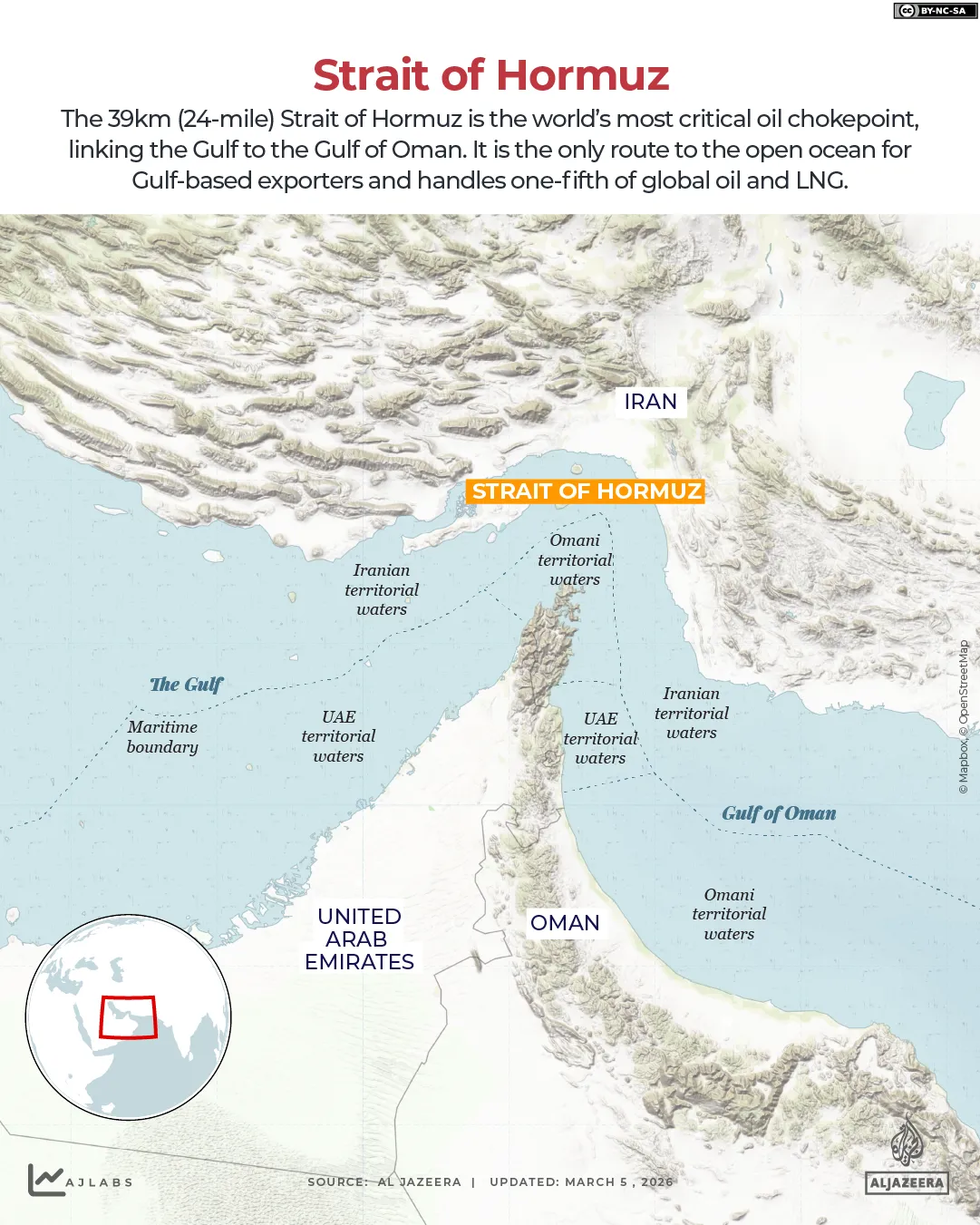
The Strait of Hormuz is one of the world’s most strategically significant waterways, with around one-fifth of global oil and liquefied natural gas (LNG) supplies normally being shipped through the narrow passage linking the Gulf to the Arabian Sea.
Bordered by Iran to the north and Oman and the United Arab Emirates (UAE) to the south, the strait is only about 50km (31 miles) wide at its entrance and exit, narrowing to about 33km (21 miles) at its tightest point. Despite its width, it is deep enough to accommodate the world’s largest oil tankers.
According to the US Energy Information Administration, about 20 million barrels of oil and petroleum products transited the strait each day in 2025, representing hundreds of billions of dollars in annual energy trade.
The route is used not only by Iran but also by Iraq, Kuwait, Qatar, Saudi Arabia and the UAE. It is also vital for global fertiliser exports, with roughly one-third of international fertiliser trade normally passing through the strait.
Because disruptions to shipping there rapidly push up global energy prices and destabilise US markets, control of the waterway has become one of Iran’s strongest sources of strategic leverage in its conflict with the US.
(Al Jazeera)
Why is Iran objecting to Oman’s new route?
The IRGC says Oman and the IMO announced the new shipping corridor without consulting Tehran. “Certain authorities have announced a new shipping route through the Strait of Hormuz without prior notification to or coordination with the Islamic Republic of Iran. The proposed route is unacceptable and poses serious safety risks,” the force said.
“The only authorised transit routes through the Strait of Hormuz are those designated by the Islamic Republic of Iran,” it said, adding that ships must maintain contact with the IRGC Navy while transiting the waterway.
Iran first issued its own map of acceptable routes through the strait in April, showing that ships should pass much closer to the Iranian coast than they had previously.
(Al Jazeera)
The IRGC’s warning came after a Liberian oil tanker passed through the strait on Thursday using a route much closer to Oman’s coastline.
Al Jazeera’s Resul Serdar, reporting from Tehran, said the IRGC appeared frustrated because the Omani route partially bypasses Iran’s direct control over shipping.
“The control of the Strait of Hormuz has been a huge leverage for Iran to put pressure on its adversaries and the global economy since the beginning of the war,” Serdar said.
Oman defended the corridor route it had announced, saying it was intended to restore safe navigation while complying with international law. Foreign Minister Badr Albusaidi said Oman remained committed to ensuring freedom of navigation through the waterway and stressed that “future arrangements related to the strait do not involve imposing any transit fees”.
What does the US-Iran agreement say about the strait?
In the MoU signed last week, Iran agreed that it would “make arrangements using its best efforts for the safe passage of commercial vessels with no charge, for 60 days only, from the Persian Gulf to the Sea of Oman and vice versa”.
While the agreement states that “the traffic of commercial vessels will immediately start”, it also acknowledges that demining operations will be required before normal shipping routes can fully resume, stating that “demining by the Islamic Republic of Iran will be instated within 30 days”. It also provides for discussions between Iran, Oman and other Gulf states on future arrangements for managing the waterway.
However, the memorandum does not specify what will happen after the initial 60-day period. Ali Vaez, Iran project director at the International Crisis Group, said the temporary rerouting of vessels had always been expected because of the mine-clearing operations outlined in the agreement.
“We always knew that if there was a deal, there would be several weeks of mine-clearing operations in the international shipping lane running through the middle of the Strait of Hormuz,” he said.
“During that period, vessels would have to transit through Iranian and Omani territorial waters instead.”
However, Vaez said the latest announcement by Iran was unexpected. “The important thing now is that the Iranians do not start taking fees or other tolls,” he said, “because that is not provided for in the memorandum of understanding.”
Asked whether the IRGC’s position differed from that of Iran’s government, Vaez said: “There is no distinction between the IRGC and the state. They are effectively one and the same. The IRGC is calling the shots.”
Can Iran charge ships fees?
International law generally protects the right of transit through international straits, including Hormuz, making it difficult for coastal states to impose unilateral transit fees on vessels simply passing through international shipping lanes, even where they are within territorial waters.
Last week, Iran announced it would waive planned fees through the strait for 60 days while talks with the US continue in Switzerland, suggesting charges may be introduced once the negotiating period expires.
Iran’s chief negotiator, Mohammad Bagher Ghalibaf, has signalled that Tehran views the post-war arrangement as fundamentally different from the status quo that existed before the conflict.
“Hormuz will never return” to its prewar status, Ghalibaf said.
The suggestion that Iran could charge fees was dismissed by US Secretary of State Marco Rubio this week. Speaking at the start of a regional tour in the United Arab Emirates, he said: “It’s an international waterway. No country is allowed to charge tolls or fees on an international waterway.”
Rubio added that he believed “all the countries in this region would agree”.
Speaking in Manama, Bahrain, after meeting with the Gulf Cooperation Council (GCC) – a bloc comprising Bahrain, Kuwait, Oman, Qatar, Saudi Arabia and the UAE – on Thursday, Rubio also told reporters: “Iranians are saying one thing, but then something else is actually happening.
“It’s now obvious to us that … the Iranian system is going to produce all sorts of maximalist rhetoric. What we’re interested in is not their press conferences. What we’re interested in is whether or not ships are moving. If ships are moving as they should be moving, then that’s what we’re going to judge.
“If, on the other hand, this rhetoric is backed up by actual ships being threatened and ships are not moving, then that’s a violation of the agreement, and we’re going to have a problem with it.”
Rubio claimed there is no regional support for Iranian transit fees, saying, “There is zero support among Gulf countries for any sort of toll or fees charged for the use of international waters … that isn’t going to happen.”
His comments came after UAE presidential adviser Anwar Gargash said that new “geopolitical facts” could not be imposed on the Arab Gulf states as a result of what he described as the “treacherous aggression against them”.
Are ships returning – and which route are they taking?
Some commercial shipping through the strait has resumed, although traffic remains well below normal levels. Before the conflict, between 120 and 140 vessels typically transited the strait each day.
According to shipping analytics company Kpler, confirmed crossings rose to 70 vessels on Wednesday as demining progressed and more operators began using the Omani route.
“The US-Iran MoU framework and apparent lifting of the US blockade appear to have supported a short-term confidence boost, although IRGC warnings against use of the Omani route could create a new source of contention,” Kpler reported.
The company added that incomplete demining, continued “dark” routing by some vessels – when ships limit or switch off their tracking transponders – and unresolved questions over inspections, sanctions and future governance meant shipping had not yet returned to prewar conditions.
This comes as oil prices drop to the lowest level since before the Iran war, with Brent crude, the global benchmark, falling to a low of $72.24 a barrel on Thursday. This remains above the prewar price of $66, however.
The chart below shows how shipping through the strait before the war compares to its status in recent weeks:
Is a peace deal achievable?
The future administration of the Strait of Hormuz is only one of several issues still to be resolved before negotiators hope to reach a comprehensive agreement within 60 days, with another major sticking point being Iran’s nuclear programme.
International Atomic Energy Agency (IAEA) Director-General Rafael Grossi has said the agreement explicitly provides for international monitoring of Iran’s nuclear activities.
However, Kazem Gharibabadi, Iran’s deputy foreign minister for legal and international affairs, has said inspectors’ access to nuclear sites damaged during the conflict will only be considered as part of a final agreement.
Questions also remain over the fate of Iran’s enriched uranium stockpile, the sequencing of sanctions relief and the release of frozen Iranian assets, while regional tensions continue to pose additional risks.
Israeli forces remain deployed in parts of southern Lebanon occupied during the conflict, according to a Lebanese military source, while Israeli strikes have continued, despite the MoU explicitly calling for “a permanent end to the war on all fronts, including Lebanon”.
Vaez said visible progress would be essential if negotiations are to survive, noting, “Both sides have to see progress, whether that’s greater access for UN nuclear inspectors, sanctions relief, or resolving the issue of Iran’s uranium stockpile.”
He cautioned against viewing the interim agreement as a series of smaller deals. “Nothing is agreed until everything is agreed,” Vaez said.
“They [the Iranians] are determined to reach a comprehensive agreement within 60 days. That’s a very ambitious timetable, but there has to be visible momentum or the process risks falling apart.”
However, Vaez said both Washington and Tehran have strong economic incentives to bring about a lasting peace. “The situation in the Strait had become one of mutually assured economic destruction,” he said.
“The United States was facing rising energy and oil prices ahead of the midterm elections … At the same time, Iran was already in a deep economic hole before this conflict began. The war only made that worse.
“It became a lose-lose dynamic, and both sides needed a way out.”
Smoke rises in late May as a result of an Israeli strike in the south of Lebanon as seen from the Israeli side of the border in the Upper Galilee, Israel. The Israeli military says it has trapped dozens of Hezbollah fighters in an underground complex in southern Lebanon. Photo by Atef Safadi/EPA
June 24 (UPI) — The Israeli military has surrounded an underground base in southern Lebanon in which dozens of Hezbollah militants are trapped, Israeli officials said.
The base is located under the village of Tebnit, in an area where fighting taken place despite an Israel-Hezbollah cease-fire, The New York Times reported. The standoff, if it escalates, could disrupt ongoing peace negotiations between the United States, which backs Israel, and Iran, which backs Hezbollah.
Israeli officials said the trapped militants were running out of supplies. On Tuesday, Israeli troops killed at least two people in the area. Israel said those targeted were Hezbollah operatives, while Hezbollah said they were civilians.
The underground base is beneath the Ali al-Taher ridge, not far from the border with Israel and a strategic point. Israeli officials said Hezbollah built the complex of tunnels over 20 years with Iran’s help.
“From this place, you can launch missiles and munitions at Israel,” Sarit Zehavi, president of the Alma Research and Education Center, said to The New York Times.
The Jerusalem Post reported that Israeli leaders are concerned that operatives in the area could carry out a kidnapping attack against Israel’s forces to help their negotiations for those trapped. Soldiers have been told to stay in pairs or groups at all times.
Israel once occupied the ridge after its 1982 invasion of Lebanon. It was once outside the “buffer zone” that Israel established in Lebanon near the border, but Israeli redrew the line last week to include the ridge, The New York Times reported. Israel considers any armed fighter south of the line a threat and a target.
Bethlehem, occupied West Bank – In the narrow alleyways of the Dheisheh refugee camp, three children debate which of their encounters with the Israeli military is worth telling, and who gets to tell it.
Yanal, 14, wins the opening round on language skills alone. He speaks three languages: Arabic, English and Spanish, and insists on telling his story in English.
Recommended Stories
list of 3 itemsend of list
“Life in the camp is complex,” he says, because, as he explains, there is nowhere to run away to when the army comes.
Yanal keeps returning to one memory: a football match, soldiers entering the field, and there being no way out.
Mustafa Abu Aliyah, 13, counters with a raid that he ran into as he was on his way to his grandfather’s house. The Israeli army fired live rounds and tear gas, he says. “We were in the middle of the fire.”
He can’t remember his first encounter with soldiers, “but I definitely saw them when I was little, because they are always coming here”.
His sister Diyar, 12, was mid-piano lesson the last time the army came through.
“Whenever the army comes, there will be tear gas,” she says. “People will be beaten. There’s usually someone injured or killed.”
She compares it to life elsewhere. “I see children in other countries, in other worlds, living in safety, but we can’t even leave our front door without suffering.”
The raids happen so often that the children often can’t remember the dates of specific incidents. But what they do remember is the fear they experienced and the aggression displayed by the Israeli soldiers.
In the first nine months of 2025 alone, Israeli forces carried out nearly 7,500 raids across the occupied West Bank, or about 27 a day, and a 37 percent increase compared with the same period in 2024.
‘Essence of childhood destroyed’
The children in the Dheisheh refugee camp reflect a wider pattern of childhood experiences under Israeli occupation, set out in a report the UN’s Independent International Commission of Inquiry on the Occupied Palestinian Territory released on Tuesday.
It examines Israel’s treatment of Palestinian children in Gaza and the occupied West Bank since October 2023.
Titled, “The essence of childhood has been destroyed”, it found that Israeli forces have killed at least 20,179 Palestinian children and wounded more than 44,000 across the occupied territory, most of them in Gaza – where it said that the deliberate targeting of children constituted part of the genocide in the Palestinian territory.
The report also documents a pattern of killings, mass arrests, torture, sexual violence and attacks on schools and hospitals.
In the West Bank, it records a sharp rise in settler violence against children and killings by Israeli forces, among them a two-year-old girl shot dead in January 2025. Children, the report notes, are held in Israeli detention, with no lawyer and no word sent to their parents, a separation it says can amount to enforced disappearance. Schools, too, are targets: 85 across the West Bank are under demolition or stop-work orders, and others have been closed or attacked by soldiers and settlers.
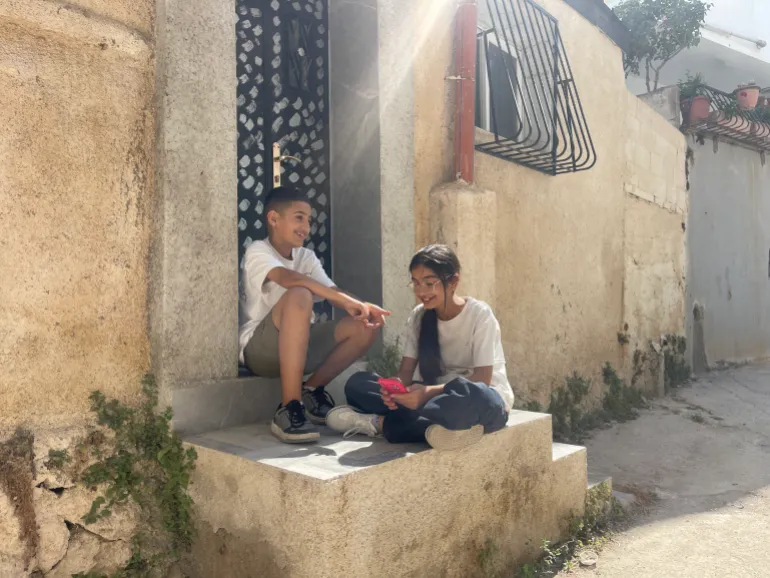
Mustafa Abu Aliyah, 13, and his sister Diyar, 12, sit in the alleyways of Dheisheh refugee camp in the occupied West Bank [Leila Warah/Al Jazeera].
Beyond the casualty count
The UN commission argues that Israel has created conditions in which Palestinians live in a constant state of “diffused, ambient terror, that does not require constant bombing to remain effective”.
“We are talking about repeated shocks, about continuous events that never end,” says Lemis Farraj, a psychologist and the project coordinator at Shorouq in Dheisheh, emphasising that a child’s physical and mental health cannot be separated from each other.
The report calls this continuous traumatic stress, distinct from Post-Traumatic Stress Disorder (PTSD), because there is no single event to recover from. The danger does not just come from experiencing one raid, but from the fear that comes with waiting for the expected raids that will likely come in the future.
Diyar explains that when the army enters her neighbourhood, she has to stay home and wait, no matter what her plans were. “Our life stops,” she says.
Her brother, Mustafa, says that the repetition has worn the fear flat.
“When I see the army, I [am] used to it and I stop being afraid.”
Farraj sees the same in the young children she treats: a startle at an ordinary sound, certainty that a raid has begun, and regression – skills already learned suddenly lost again.
Five-year-old Khour Hammad, who lives a few alleys away from the older children, has experienced the same raids.
She explains that both of her parents are in prison. Israeli forces arrested her father in July 2023 and her mother last March, according to the family.
Khour remembers the night the army came for her mother. Half-asleep, she heard a man’s voice and thought her father had finally come home. She climbed out of bed expecting him. Instead, she found soldiers inside the house.
The soldiers tried to question Khour. She says that she “felt like I was going to throw up”.
Handed an old family photo, she brightens at once, pointing out her mother, Islam Amarna, and her father, Osama Hammad, and rattling off memories in bursts.
Khour Hammad, 5, stands on a rooftop overlooking Dheisheh refugee camp in Bethlehem, in the occupied West Bank. Both of her parents have been arrested by Israeli forces [Leila Warah/Al Jazeera].
Generational trauma
While Palestinian children in Gaza and the West Bank face different lived experiences, the UN finds the same cause behind the harm: a military occupation described as a “long-term mechanism of domination, subjugation and oppression”.
Farraj adds that children are affected not only by their own experiences of trauma, but also by what is passed down from parents and grandparents.
“The first generation of the Nakba lived in shock and passed it on to their children,” she says, referring to the ethnic cleansing of at least 750,000 Palestinians following the formation of the state of Israel in 1948.
The report similarly notes that Palestinian refugees, now in their fifth generation, have internalised a sense of “dispossession from the Nakba” alongside present-day experiences of occupation.
In the West Bank, roughly one in four Palestinians are refugees; in Gaza, it is about 70 percent.
Israeli violence and forcible displacement have been carried through generations of Palestinians, compounding as the cycle repeats. Farraj says trauma recovery depends on stability: family support, schooling, safe spaces and a predictable routine, all of which remain precarious under Israel’s occupation.
For Khour, that stability begins with her parents.
“I want the whole world to listen and see my picture,” Khour says, “and get my mom and dad out of prison.”
One of Europe’s largest military equipment producers, KNDS, rolled out long-awaited details of its initial public offering (IPO), aiming for a dual listing in Paris and Frankfurt in the coming weeks.
ADVERTISEMENT
ADVERTISEMENT
The IPO could value KNDS, the maker of Leopard and Leclerc tanks, at between €12bn and €15bn, according to the Financial Times, potentially making it one of Europe’s largest defence listings in recent years.
The listing comes at a time when European military budgets are surging, driven by the war in Ukraine and doubts over the reliability of the US as a security guarantor.
The company declined to comment on the precise date, but CEO Jean-Paul Alary told reporters the offering was expected within weeks.
According to Alary, the move comes as the continent enters what he called a new era of defence and security, with armed forces modernising rapidly and rebuilding the land-warfare capabilities run down during decades of lower spending.
According to Reuters, the firm has now formally launched the IPO process, which is expected to take place in mid-July.
The announcement comes days after Germany unveiled plans to acquire a 40% stake in KNDS, saying the move would secure long-term influence over a company it considers strategically important to European security and defence.
France, which currently owns 50% of KNDS, is expected to reduce its stake to 40%.
The remaining 20% of the company is set to be floated on the stock market, with France and Germany each retaining 40% stakes following the transaction.
According to the Financial Times, the shares are expected to be marketed primarily to institutional investors amid strong demand for European defence stocks.
Once the listing is completed, KNDS shares will begin trading on Euronext Paris and the Frankfurt Stock Exchange, giving investors direct exposure to one of Europe’s largest land-defence manufacturers.
KNDS was created in 2015 through the merger of Germany’s Krauss-Maffei Wegmann and France’s Nexter.
A growing headache for Rheinmetall
The rapid emergence of the rival adds to the pressure on Rheinmetall, Europe’s largest ammunition maker and KNDS’s main competitor in subsectors such as land systems.
The Düsseldorf-based group, whose shares have shed roughly a quarter of their value this year, had itself reportedly hoped to buy into KNDS, only to be shut out by the governments’ intervention.
Rheinmetall, which had been poised to take over the project, fell 13% in early trading on Wednesday due to the news.
The squeeze also coincides with regulatory scrutiny at home.
Germany’s Monopolies Commission has warned that defence procurement is concentrated among a small number of suppliers, potentially weakening competition and driving up costs.
Calling for reforms to procurement rules, commission chairman Tomaso Duso said competition was “the fundamental pillar of Europe’s economic order” and should play a greater role in the defence sector.
A listed KNDS will give investors a direct yardstick against which to measure Rheinmetall’s order momentum and margins.
The United States Senate has voted in favour of invoking its war powers to force President Donald Trump to halt his military campaign against Iran or seek congressional approval before any further action is taken.
Here is a closer look at Tuesday’s vote – the 10th attempt Congress has made to rein in the US-Israel war on Iran – and what this means for the US government.
Why did this vote take place?
A similar measure had already been approved in the House of Representatives on June 3 by a vote of 215 to 208, and on Tuesday, the Senate passed it in a 50-48 vote. Trump’s Republican Party has slim majorities in both chambers.
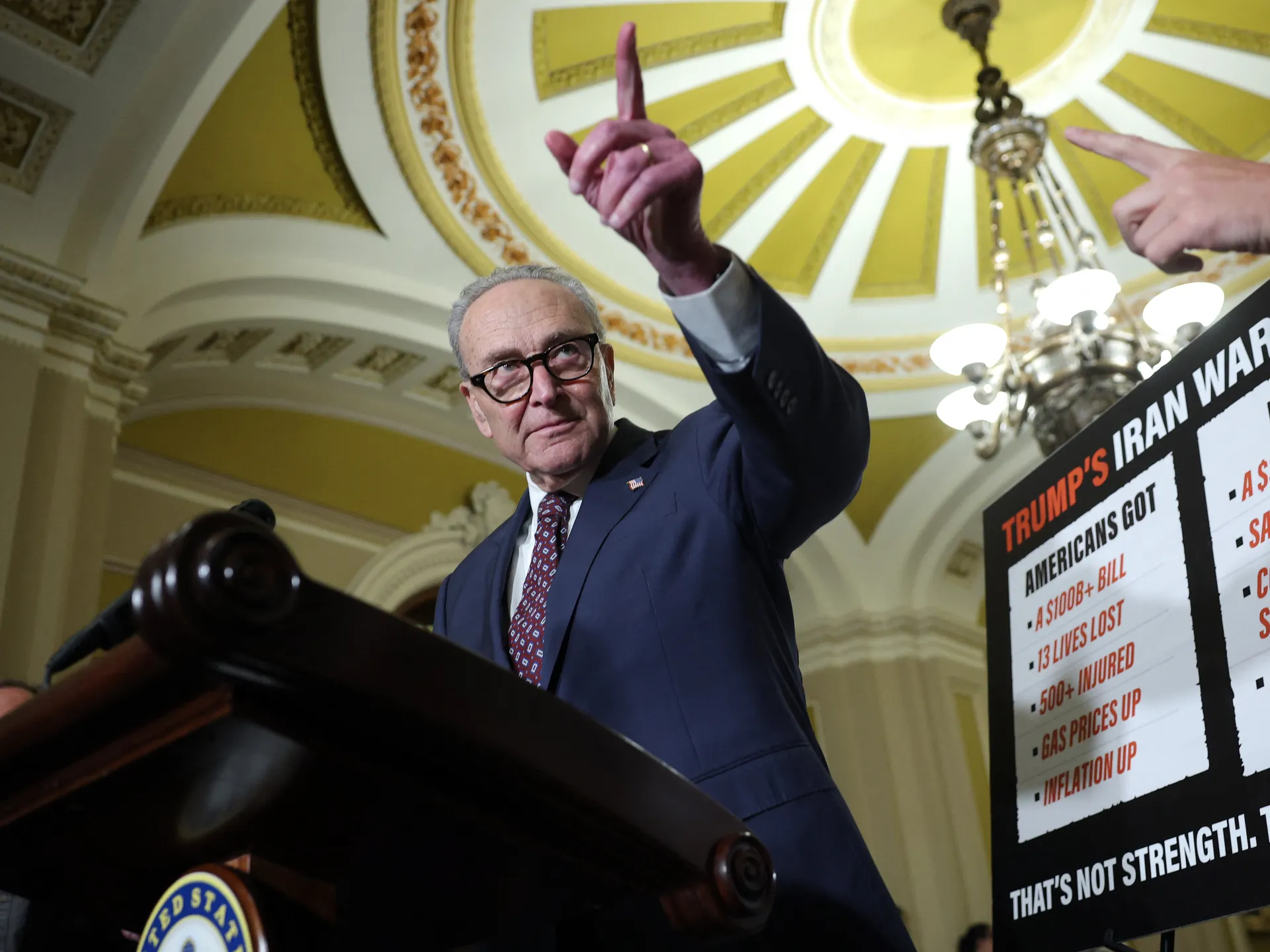
Speaking on the Senate floor before the vote, top Democrat Chuck Schumer advocated for the war powers resolution as he criticised Trump’s military campaign against Iran.
“For years, Trump promised to put maximum pressure on Iran, but he ended up delivering maximum confusion, maximum chaos, maximum cost to the American people with his disastrous war,” Schumer said.
“Time after time, the vast majority of Senate Republicans sided with Trump and his war instead of the American people. The American people have paid the price for Trump’s historic blunder in Iran. It’ll go down in the history books as one of the worst foreign policy forays America has ever made.”
The war against Iran has proved highly unpopular in the US. A poll released on Tuesday by the news agency Reuters and the research firm Ipsos found that 24 percent of respondents felt the war had been worth the cost.
Four Republican senators crossed party lines to vote for the resolution, and all but one of the chamber’s Democrats also voted in favour.
Tuesday’s breakaway Republicans were Bill Cassidy of Louisiana, Lisa Murkowski of Alaska, Susan Collins of Maine and Rand Paul of Kentucky. A further two Republicans did not vote: Mitch McConnell of Kentucky and Dave McCormick of Pennsylvania.
The lone Democrat to vote against the measure was Pennsylvania’s John Fetterman.
What does the resolution say?
The war powers resolution “directs the President to remove United States Armed Forces from hostilities against the Islamic Republic of Iran”.
Only if “explicitly authorised by a declaration of war or a specific congressional authorisation” would Trump be allowed to use further military force against Iran, it says.
The resolution, however, does allow for a limited military presence to remain in the Middle East to prevent any “imminent attack” against the US or its allies.
What is the significance of the vote?
The vote reflects growing unease even among some of Trump’s Republican supporters about the unpopular conflict, which began with US-Israeli air strikes on Tehran on February 28.
This is the first time both chambers of Congress have passed a resolution directing a president to remove US armed forces from a warzone under the War Powers Act although it was not immediately clear how the votes might affect the conflict.
Technically, the Trump administration should now seek explicit congressional approval for further strikes on Iran. However, previous administrations have found routes around this by securing more limited authorisations for the use of military force (AUMFs) instead.
For example, in the wake of the 9/11 attacks in 2001, Congress passed an AUMF that gave then-President George W Bush broad powers to conduct what would become the global “war on terror”.
And one year later, it passed another AUMF, allowing the use of the military against the government of Saddam Hussein in Iraq, which became the basis of the 2003 invasion.
The two authorisations remain in place, and presidents continue to rely on them to carry out strikes without first seeking congressional approval. The assassination of top Iranian General Qassem Soleimani in 2020 in Baghdad was authorised by Trump under the 2003 AUMF.
In addition, a resolution does not have the force of law. Experts said, therefore, that while the Senate vote is viewed as a rebuke to Trump, it is largely symbolic.
What effect will this have on US-Iran talks in Switzerland?
Before the vote on Tuesday, some Republican senators had warned that the war powers resolution would weaken Trump’s standing in the Switzerland negotiations.
“If this passes, the Iranians are going to simply stand up and walk away from negotiations,” Senator James Risch of Idaho told the Senate on Tuesday.
“They’re going to say: This thing’s over. The Congress has told the president of the United States, ‘Leave us alone. We can do whatever we want to do,’ and they will walk away.”
How will the Trump administration respond?
Risch also argued that the resolution is essentially useless, given its symbolic nature. “It’s going to have no effect. The president isn’t going to pay any attention to it,” he said.
The US Constitution gives Congress the sole power to declare war, but that division of power has eroded over the past 75 years as successive presidents alone have committed US forces to overseas conflicts.
Trump has pointed to that precedent to argue that he does not need congressional authorisation at all.
In an appearance on The Axios Show last week, Trump denied learning any “lesson” about the limits of his executive powers during the Iran war. “There are no limits,” he said.
The last time Congress voted to go to war was during World War II although it has passed AUMFs in the decades since, which allow for limited military engagement without congressional approval for all-out war.
During Trump’s first term, there were concerns that he could use the 2001 AUMF to strike Iran under the unfounded claim that Tehran supports al-Qaeda.
Some critics pointed out that Republicans may be more willing to confront Trump over the issue of congressional authorisation now as they defend their seats before November’s midterm elections.
Iran and the US clash over nuclear inspections and Hormuz as negotiators push for a final deal within 60 days.
Published On 24 Jun 202624 Jun 2026
Iran and the United States have offered conflicting accounts of key issues as negotiators work towards a final agreement within a 60-day window. Differences remain over nuclear oversight and the implementation of any deal, underscoring the challenges facing both sides.
US Secretary of State Marco Rubio said Iran would not be allowed to charge tolls in the Strait of Hormuz under a final agreement, stressing that the strategic waterway must remain open to international shipping.
Meanwhile, Iran rejected US claims that it had agreed to allow nuclear inspectors back into the country after President Donald Trump said Tehran had accepted the “highest level” of monitoring. The conflicting statements highlight the gaps that negotiators are still trying to bridge.
Here is what has happened:
In Iran
Iran’s military shifts to ‘offensive doctrine’: General Ahmad Reza Pourdastan, head of Iran’s Army Strategic Studies and Research Center, said Tehran has moved away from a purely defensive posture and now includes preemptive operations in its military strategy. Quoted by the semi-official Fars news agency, Pourdastan said Iran could “severely surprise the enemy” if national interests required it and added that much of the country’s military capability has yet to be used.
Iran says no IAEA inspections planned: Tohid Asadi, reporting from the Strait of Hormuz, says the Iranian Foreign Ministry spokesperson Esmaeil Baghaei has denied reports of a meeting with International Atomic Energy Agency (IAEA) chief Rafael Grossi and said there are currently no plans for visits or inspections by the UN nuclear watchdog. Baghaei said Iran’s dealings with the IAEA would be governed by existing procedures, its safeguards obligations, parliamentary legislation and decisions by the Supreme National Security Council. Iran suspended cooperation with the IAEA after US and Israeli strikes on its nuclear facilities in June 2025, and while diplomacy continues under a 60-day framework, Tehran says it has not granted permission for inspectors to return.
War diplomacy:
‘No way’ US and Iran can finalise deal in 60 days, analyst says: Charles Kupchan, a senior fellow at the Council on Foreign Relations, told Al Jazeera there is “no way” Washington and Tehran can complete a final agreement within the 60-day timeframe repeatedly cited by President Donald Trump. “I think we’re talking about at least into the next calendar year,” he said, adding that he would not be surprised if both sides simply “run out the clock” by continuing negotiations and keeping the Strait of Hormuz open without reaching a final deal before the end of Trump’s presidency.
Qatar says LNG production could return to normal within weeks: Prime Minister Sheikh Mohammed bin Abdulrahman bin Jassim Al Thani told the Financial Times that Qatar is preparing to restore normal liquefied natural gas (LNG) production after the interim US-Iran deal. Qatar, the world’s second-largest LNG producer, halted output in March following an Iranian drone attack on the Ras Laffan facility. Sheikh Mohammed said most production could resume within weeks, except at the damaged site, adding that QatarEnergy would only lift its force majeure declaration once it is satisfied that all safety and operational concerns have been addressed.
In the Gulf:
Rubio ‘trying to sell the deal’ with Iran on Gulf tour: Alan Fisher, reporting from Washington, DC, said US Secretary of State Marco Rubio is visiting the United Arab Emirates, Kuwait and Bahrain, three Gulf countries seen as having been among the most affected by the war with Iran. Rubio, who also serves as Trump’s national security adviser, is expected to reassure regional allies that US security commitments remain intact. He will also address the Gulf Cooperation Council in Bahrain, where he is “really trying to sell the deal”, amid concerns over Washington’s response to Iranian attacks.
In the US
US Senate approves resolution to curb Trump’s war powers on Iran: The Senate voted 50-48 to pass a measure requiring congressional approval for further US military action against Iran, marking the first time a war powers resolution on the conflict has cleared both chambers of Congress. Four Republicans – Bill Cassidy, Lisa Murkowski, Susan Collins and Rand Paul – joined nearly all Democrats in backing the measure, while Pennsylvania Democrat John Fetterman voted against it. The resolution is expected to face a veto from President Trump.
In Israel
US ‘very naive’ on Iran, Ben-Gvir says: Israeli National Security Minister Itamar Ben-Gvir said the US would be “very naive” if it believed Iran would abandon its nuclear programme, and hinted that Israel may act independently against Tehran. “It is Israel’s responsibility to confront this Iranian threat and act against it alone,” he told Israel’s Channel 7, adding that “no circumstances” could force Israel to act “according to the dictates of a friend, even if that friend is truly great”. His remarks come amid reported tensions between Washington and Tel Aviv over Israel’s attacks on Lebanon and ongoing US-Iran negotiations. Last week, US Vice President JD Vance publicly criticised Israeli cabinet ministers for “attacking” Washington, calling the US Israel’s “only powerful ally” left in the world.
In Lebanon
UN says ceasefire ‘largely holding’ in southern Lebanon: The United Nations said the ceasefire in southern Lebanon appears to be “largely holding”, although peacekeepers continue to observe Israeli military ground and air activity. UN spokesperson Stephane Dujarric said UNIFIL troops witnessed “heavy” machine-gun fire and three tank rounds fired by Israeli forces near Biyyada on Monday, while drones were also seen “apparently to monitor UNIFIL peacekeepers”. The incident came a day after peacekeepers reported the first day without exchanges of fire since fighting escalated on March 2. The UN urged all sides to “adhere fully to the ceasefire and refrain from any escalation, particularly during this delicate period of ongoing negotiations”.
U.N. High Commissioner for Human Rights Volker Turk called on the international community to re-engage in support for the people of Myanmar as his office reported Myanmar’s military is responsible for more than 700 civilian deaths over a six month period. File Photo by Salvatore Di Nolfi/EPA
June 22 (UPI) — The United Nations Human Rights Office reported Monday that the Myanmar military is responsible for at least 702 civilian deaths between August and January.
The United Nations published its report on human rights abuses in Myanmar during conflict from the military’s announcement of elections through the end of the ensuing voting period. The United Nations notes that foreign actors have continued to supply the military with arms and ammunition, potentially facilitating human rights violations.
Of the deaths it says have been credibly verified, 476 were due to airstrikes. Victims included 224 women and 153 children. More than 500 civilians were killed in attacks from jet fighters, drones, paramotors and gyrocopters.
The highest volumes of civilian deaths spiked between two periods: August through September and December through January.
The absence of international assistance has also played a role, the United Nations said. Access to emergency healthcare declined due to military blockades and cuts to foreign aid.
U.N. Human Rights Chief Volker Turk called on the international community to re-engage in support for the people of Myanmar.
“As if the people of Myanmar have not suffered enough at the hands of the military, they have now seemingly been forgotten by those outside the country,” Turk said in a statement. “Funding for localised protection efforts was in many areas the only solace from the suffering caused by constant targeting and indiscriminate attacks by the military. The pullback just compounds the injury.”
The German government announced on Monday that it intends to acquire 40% of the defence contractor KNDS, a move designed to bolster European arms production in partnership with its NATO and EU ally France.
ADVERTISEMENT
ADVERTISEMENT
The decision deepens state involvement in a company whose hardware has become central to Europe’s rearmament efforts.
KNDS was created in 2015 through the merger of Germany’s Krauss-Maffei Wegmann and France’s Nexter. The French state holds a 50% stake, while the other half belongs to the German family behind Krauss-Maffei Wegmann, whose planned exit has opened the door for Berlin to step in.
Based in Amsterdam, the group reported revenue of €4.4 billion last year and employs more than 11,000 people.
The timing reflects a broader scramble across Europe to expand military spending and manufacturing capacity, as governments weigh the continued threat from Russia’s war in Ukraine against growing doubts about the reliability of the US as a security guarantor.
Berlin framed the investment in explicitly strategic terms, saying it would secure lasting influence over a business it considers vital to European security and defence.
The German government added that the stake would reinforce domestic industrial output, technological independence and the safeguarding of key national security interests and technologies.
In a joint statement, Germany and France said they had agreed on the future strategy and governance of KNDS, which they intend to co-own through arrangements aimed at giving both countries equal shareholdings.
Clearing the path to a stock market listing
Neither government specified a timeline or the final level at which their holdings would settle, but they stated the agreement opens the way for a possible flotation of KNDS in the near future.
According to people familiar with the matter cited by the Associated Press, the two states plan to trim their stakes to around 30% within two to three years of any listing, while retaining equal voting rights regardless of the size of each holding.
The two governments cast the deal as a joint commitment to building up Europe’s defence industry and armed forces, and to securing the continent’s strategic independence well into the future.
State participation in the firm was first floated by German Defence Minister Boris Pistorius in 2025 as a way to protect strategic expertise and jobs.
Beyond its tanks, KNDS also manufactures the Puma infantry fighting vehicle and the Boxer and Dingo armoured personnel carriers, equipment which is in growing demand as European armies replenish stocks depleted by years of underinvestment and donations to Ukraine’s defence.
The Chinese strategy employs research and intelligence institutions working to foster closer ties between Iranian national security institutions and the Egyptian military, aiming to undermine the American presence in the Middle East. Prominent among these institutions are the Middle East Studies Institute at Shanghai International Studies University, the China Institute of International Studies, and the Center for West Asian and African Studies. These Chinese research centers, which shape China’s relations with countries in the region and the Gulf, include the Middle East Studies Institute at Shanghai International Studies University (SISU), which directs studies related to security and defense issues and facilitates direct dialogue between think tanks in Iran and research centers in Egypt. Another example is the China Institute of International Studies (CIIS), which reports directly to the Chinese Ministry of Foreign Affairs and works to engineer diplomatic plans that align Egypt’s strategic interests with the objectives of Tehran and resistance movements in the region. Chinese think tanks and intelligence agencies also rely on a number of People’s Liberation Army-backed space intelligence companies, such as MizarVision and EarthEye. These Chinese companies have provided high-resolution satellite imagery and intelligence data to support operations targeting US bases in the Gulf and the Middle East. These Chinese entities coordinate and plan operations through various mechanisms and initiatives officially launched by China, most notably the Global Security Initiative (GSI). Beijing also uses forums, such as the China-Arab Cooperation Forum, to pressure Middle Eastern and Gulf countries to withdraw foreign forces and end US hegemony in the Gulf and the Middle East. This is framed as ending direct interference in the internal affairs of countries in the region. Beijing is also seeking to establish permanent overseas bases, most prominently the Djibouti naval base in East Africa, to support its regional alliances and ensure the continuity of global supply lines for Chinese interests and investments within the framework of the Belt and Road Initiative.
The relationship between Chinese military and intelligence think tanks and the Egyptian army is highlighted by their shared goal of countering American hegemony and expelling US military bases from the Gulf and the Middle East. China is strengthening its strategic cooperation with the Egyptian army as part of the Djibouti-UAE-Egypt axis, with Beijing relying on Cairo as a key launching pad to secure maritime navigation and reduce American military influence. Beijing is utilizing its strategic institutions and think tanks to provide technological and logistical support to the Egyptian army, aiming to create a regional power capable of maintaining strategic balance in the region against American hegemony and interventions. This escalating security and strategic relationship between the Egyptian and Chinese armies rests on several key pillars, most notably intelligence and military partnership. China aims to train the Egyptian military elite through Egyptian military academies and coordinate threat assessments and mutual monitoring of the military movements of the United States and its allies in the Gulf and the wider region. With the implementation of several joint exercises between the two sides, the Chinese vision crystallized in the (Civilization Eagles maneuvers), which brought together the air forces of China and Egypt. This paves the way for the transfer of military technology and the integration of Chinese systems with Egyptian defenses independent of the West, along with the localization of Chinese military industries in the heart of Cairo. China is negotiating with the Egyptian Ministry of Defense to develop local manufacturing capabilities and transfer defense technology. There are also reports of integrating Chinese systems into Egyptian systems to reduce Egypt’s dependence on American-supplied weaponry. Beijing seeks to create a counterweight to American hegemony in the Middle East and the Gulf. China sees Egypt’s refusal to host any American military bases as a cornerstone of its strategy, relying on the Egyptian and Emirati armies to guarantee regional security as an alternative to the traditional American presence in the Gulf and the Middle East.
Chinese research, military, and intelligence think tanks are working to engineer an asymmetric strategic partnership to end American hegemony in the Middle East and the Gulf. Chinese think tanks, military research centers, and intelligence agencies are operating according to a clear strategic vision aimed at building asymmetrical partnerships in the Middle East and the Arabian Gulf to reduce American influence and establish a multipolar world order. Beijing provides Tehran with technical and intelligence support to deter Washington, while simultaneously seeking to strengthen military cooperation with Egypt as a pivotal regional power. This strategy aims to diminish American influence and secure China’s vital economic interests. The Chinese strategy in the region rests on several pillars, most notably its strategy toward Iran and its technical and intelligence support for the country. China has secretly supplied Iran with advanced satellite technology from its BeiDou satellite system, bypassing Western and American GPS systems, as well as sophisticated air defense systems. This has significantly enhanced the Iranian Revolutionary Guard’s ability to monitor and target American military bases in the region and the Gulf.
The objectives of Chinese think tanks, political, strategic, military, and intelligence research centers become apparent here, as they attempt to plan a path to link Iran to China’s Belt and Road Initiative and transform Iranian military pressure into a tool for destabilizing the US bases deployed in the region and the Gulf. The convergence between China and the Egyptian military is highlighted through the comprehensive strategic partnership between the two countries. Beijing is inclined to strengthen military cooperation with Egypt, capitalizing on its political stability and its geographic location controlling vital maritime trade routes, and to transfer advanced Chinese military technology to Egypt. Beijing has revealed its desire to be a major supplier of equipment to the Egyptian army, such as the J-10 aircraft. This aims to increase Egypt’s strategic maneuvering room and reduce the dominance of Western weaponry.
The stability achieved by the Egyptian leadership is a fundamental pillar supporting the comprehensive strategic partnership, as Beijing seeks to secure its economic and military interests with a stable and influential regional power. Therefore, China is investing in the Belt and Road Initiative, for which the Suez Canal is a vital artery in the Middle East. Cooperation extends to the exchange and transfer of military technology, joint military manufacturing, advanced air defense systems, and the evaluation of potential acquisitions of modern Chinese fighter jets. Furthermore, joint air exercises have been conducted, with the Egyptian Armed Forces carrying out their first-ever joint air exercise, dubbed Eagles of Civilization with China, involving multi-role fighter aircraft from both countries, underscoring the deepening defense partnership between them.
In this context, China relies on the Egyptian military within the framework of its strategic and African axis to counter American influence. For China, Egypt represents its strategic gateway to the African continent and a cornerstone in its maneuvers against the US Africa Command (USAFRICOM). In addition to joint military exercises, China and Egypt have conducted joint air force drills, a clear indication of an unprecedented military rapprochement that has drawn close American scrutiny. With China’s move to transfer technology and arms deals to Cairo, it is positioning itself to support the Egyptian army with advanced air defense systems, such as the HQ-9B. This enhances Egypt’s air deterrence capabilities and forms part of strategic military deals aimed at reducing dependence on the United States and its Western allies. On the other hand, China relies on Iran as a deterrent and direct driver, exerting pressure on American bases in the region. Iran represents the spearhead of China’s brinkmanship policy against American military bases in the Gulf, Iraq, and Syria, with Tehran threatening to strike them should any regional conflict erupt. In conjunction with the economic and diplomatic alliance between Beijing and Tehran, China uses emerging alliances, such as the BRICS group and the Shanghai Cooperation Organisation (SCO), to establish Iran’s political foothold. It sometimes resorts to mediation policies as a tool to reduce the likelihood of a direct confrontation with Iran, which could harm its commercial interests, such as China’s sponsorship of Pakistani mediation efforts between Iran and the United States to stop the war against Iran and allow the Strait of Hormuz to be opened to global trade and navigation.
China’s major objectives in the Middle East lie in a strategy of attrition against the United States. China uses Iranian actions as a clever pressure tactic to test and deplete American military technology without direct involvement in wars of attrition, while simultaneously attempting to create a new regional order. Here, Chinese intelligence agencies coordinate networks of overlapping interests to push countries toward understandings that transcend the American security umbrella, paving the way for the future withdrawal of foreign military bases. The pillars of China’s strategy for alternative hegemony are based on asymmetric partnerships. Beijing focuses on presenting itself as a reliable economic and technological partner without political conditions or interference in internal affairs, unlike the American model based on conditionality and direct military alliances. With China’s emphasis on the economy as a gateway to security, it utilizes the Belt and Road Initiative and its massive investments in infrastructure and ports, such as the Khalifa Port in the UAE and the Port of Duqm in Oman, to solidify its strategic presence and transform economic dependence into long-term geopolitical influence. With Beijing’s use of security diplomacy and mediation, Chinese decision-making centers have adopted a common security approach and offered political mediation, such as sponsoring the Saudi-Iranian agreement, to solidify Beijing’s role as an international peacemaker and portray the United States as a destabilizing force through the militarization of the region. This is coupled with China’s technological and intelligence penetration of the region and the Gulf, where Chinese partnerships focus on transferring 5G technologies, artificial intelligence, and space cooperation with Gulf states. This grants Beijing intelligence-gathering capabilities and allows it to connect the region’s vital systems to the Chinese technological infrastructure. Chinese think tanks and intelligence agencies are planning to cautiously fill the void, as China avoids direct military confrontation with Washington in the region and prefers to capitalize on the Gulf states’ desire to diversify their partnerships and hedge against the gradual decline of American interest in the Middle East.
Accordingly, we analyze that China’s military strategy in the Middle East and Africa relies on building defense partnerships with diverse objectives. It utilizes the Egyptian army as a pivotal regional power to bolster its influence and counterbalance the American presence through advanced training cooperation while simultaneously leveraging its relationship with Iran to exert pressure on American bases, particularly in the Gulf, and secure its oil interests all within a comprehensive policy aimed at dismantling American hegemony in the region.
United States President Donald Trump has pledged there will be no tolls for passage through the Strait of Hormuz, unless they are collected by his own country.
Trump’s statement, made in a Saturday afternoon post on Truth Social, is the latest sign that a recently signed memorandum of understanding (MOU) may be unravelling.
Recommended Stories
list of 3 itemsend of list
“There will be NO TOLLS in the Hormuz Strait for 60 days during the Cease Fire Period, and there will be NO TOLLS after the 60 day period has expired,” Trump wrote, “unless they are imposed by and for the United States of America.”
Since the US and Israel launched a war against Iran on February 28, Iran has successfully used the Strait of Hormuz as a pressure point, closing the strategic waterway to traffic.
But under the terms of Wednesday’s ceasefire memorandum, the strait is supposed to reopen for an interim period of 60 days. During that time, Iran is barred from charging vessels for passage.
On Saturday, however, Iran’s joint military command said it had closed the Strait of Hormuz, citing a “clear breach” of the memorandum’s commitments.
US Central Command (CENTCOM), the agency that oversees military operations in the region, denied that report and maintained that the traffic continues to flow through the waterway.
The Strait of Hormuz has long been a flashpoint in the conflict between the US and Iran. Nearly 20 percent of the world’s oil and natural gas is transported through the strait, as well as about 30 percent of the global fertiliser trade.
Closure of the strait has caused global fuel costs to soar and has tested agricultural sectors across the world.
Trump had responded to Iran’s chokehold over the strait by imposing a US naval blockade on Iran’s ports in the region.
But that naval blockade was lifted under the terms of Wednesday’s memorandum. The deal also paused fighting on all fronts in the regional conflict, including in Lebanon.
The memorandum, though, was not intended as a long-term deal. It serves as a launching point for negotiations on key issues, including the future of Iran’s nuclear programme.
Several points of divergence also went unaddressed in the memorandum. Nowhere does the memo say that future tolls cannot be collected from the strait after the 60-day period expires.
Before the war, there was no charge for passage through the strait. Trump himself said in an interview with The New York Times that the waterway should remain “permanently toll-free”.
But he appeared to reverse course in Saturday’s post, once again floating the possibility that the US could extract tolls in the strait, while barring Iran from doing so.
No fees should be levied, Trump wrote, “unless they are imposed by and for the United States of America, should the deal not be completed”.
He explained that such a charge would compensate the US “for services rendered as the Guardian Angel to the countries of the Middle East for purposes of both past, present, and future reimbursement of costs”.
Trump used similar language in his New York Times interview earlier this week, floating the US becoming “the guardian of the Middle East” in exchange for 20 percent of its revenue.
Saturday’s post is not the first time Trump has mused about the US imposing tolls in the strait, either.
In April, for instance, he discussed the idea with reporters, saying, “What about us charging tolls? I’d rather do that than let them have them. Why shouldn’t we? We’re the winner. We won.”
There has been no indication that Trump’s plans have been officially presented to countries in the region, many of whom have struck a careful balance in their dealings with both the US and Iran during the war.
Iranian officials, meanwhile, have repeatedly said they will not rule out imposing tolls in the strait, framing the issue as a matter of sovereignty and regional negotiation. The strait sits between Iran and Oman.
Further discussions are expected on the matter in the coming weeks.
But such negotiations have been thrown into jeopardy amid ongoing Israeli military operations in Lebanon, which threaten to violate Wednesday’s ceasefire memorandum.
Iran claimed that Saturday’s closure of the strait was a result of new Israeli attacks in southern Lebanon, which killed dozens of people after the ceasefire was announced.
Iranian officials have also said that any upcoming talks should focus on proper implementation of the initial memorandum, and that the 60-day negotiating period stipulated in Wednesday’s deal would begin after that was settled.
Pakistan, a top mediator between the US and Iran, has said that follow-up talks are set to begin in Switzerland on Sunday.
Switzerland’s Federal Department of Foreign Affairs has confirmed that an Iranian delegation, led by parliamentary Speaker Mohammad Bagher Ghalibaf and Foreign Minister Abbas Araghchi, has already arrived for the negotiations.
On the US side, Trump’s son-in-law Jared Kushner, special envoy Steve Witkoff and Vice President JD Vance are expected to attend.
June 18 (UPI) — The U.S. military on Thursday lifted naval blockades in the Persian Gulf and Gulf of Oman, with reports showing that shipping vessels have departed the region through the Strait of Hormuz.
U.S. Central Command said in a series of posts on X that, following direction from President Donald Trump, blockades on maritime traffic along the coasts of Iran have ended.
Centcom noted, however, that the U.S. Navy will stay in the “general area” to be sure that “all aspects” of the peace agreement signed by the United States and Iran “are adhered to, obeyed and in full force and effect.”
Trump signed the agreement Wednesday at the Palace of Versailles in France after the G7 Summit wrapped up, which included among its 14 points reopening the Strait of Hormuz, which is a vital shipping route for the region and much of the world.
Iranian President Masoud Pezeshkian had signed the deal earlier in the day.
“American forces are not impeding the transit of vessels to or from Iranian ports,” Centcom said in one of the posts on X on Thursday.
“All U.S. military blockade efforts have ceased,” it said.
At least 12 energy tankers transited the Strait on Thursday, reopening a sailing route through which roughly 20% of the world’s oil supply is shipped around the globe, CNBC and the New York Post reported.
Among the vessels that transited the Strait were three Saudi Arabian supertankers, which together are carrying six million barrels of crude oil and are the kingdom’s first tankers to sail the shipping route since before the three-month-long U.S.-Iran war launched in February.
Vice President JD Vance also told reporters that more than 12 million barrels of oil had shipped through the Strait overnight Wednesday after the deal had been signed.
Pakistan’s Prime Minister Shehbaz Sharif has signed a US-Iran memorandum of understanding aimed at ending the war between the two countries. US President Donald Trump and Iran’s President Masoud Pezeshkian signed on Wednesday.
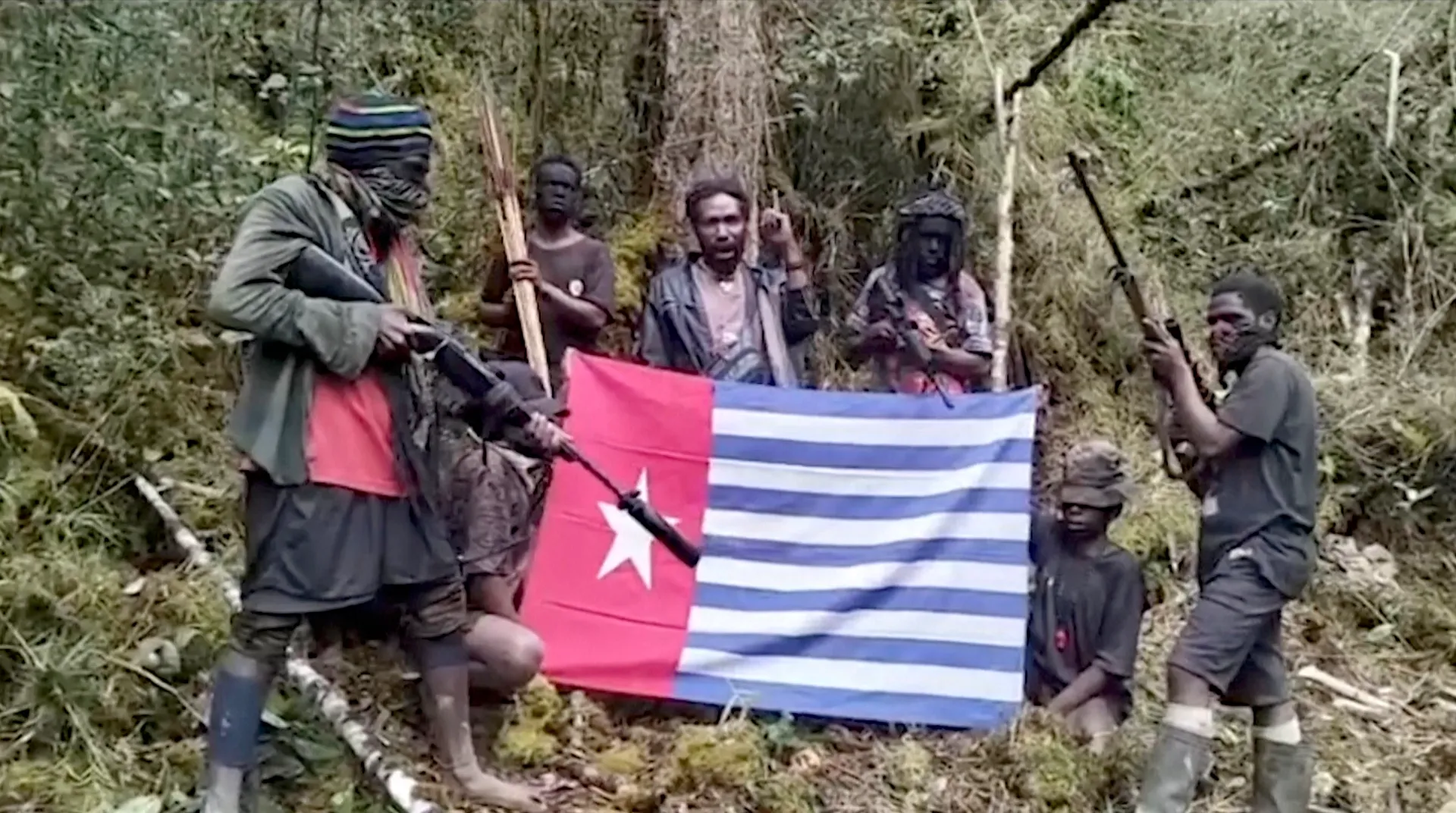
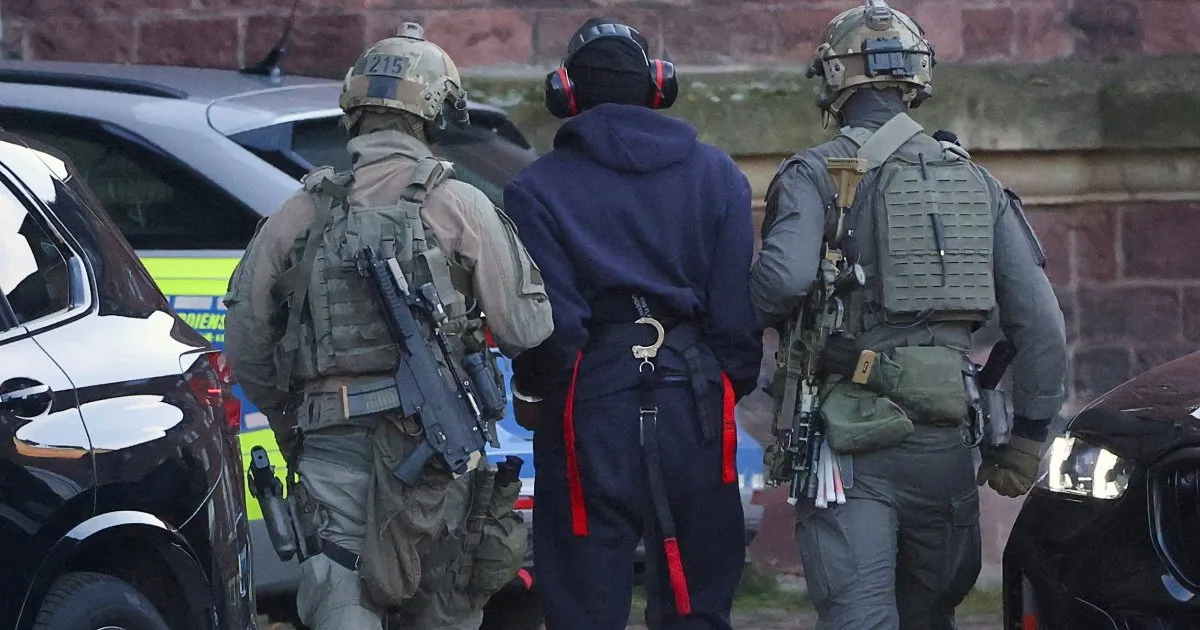
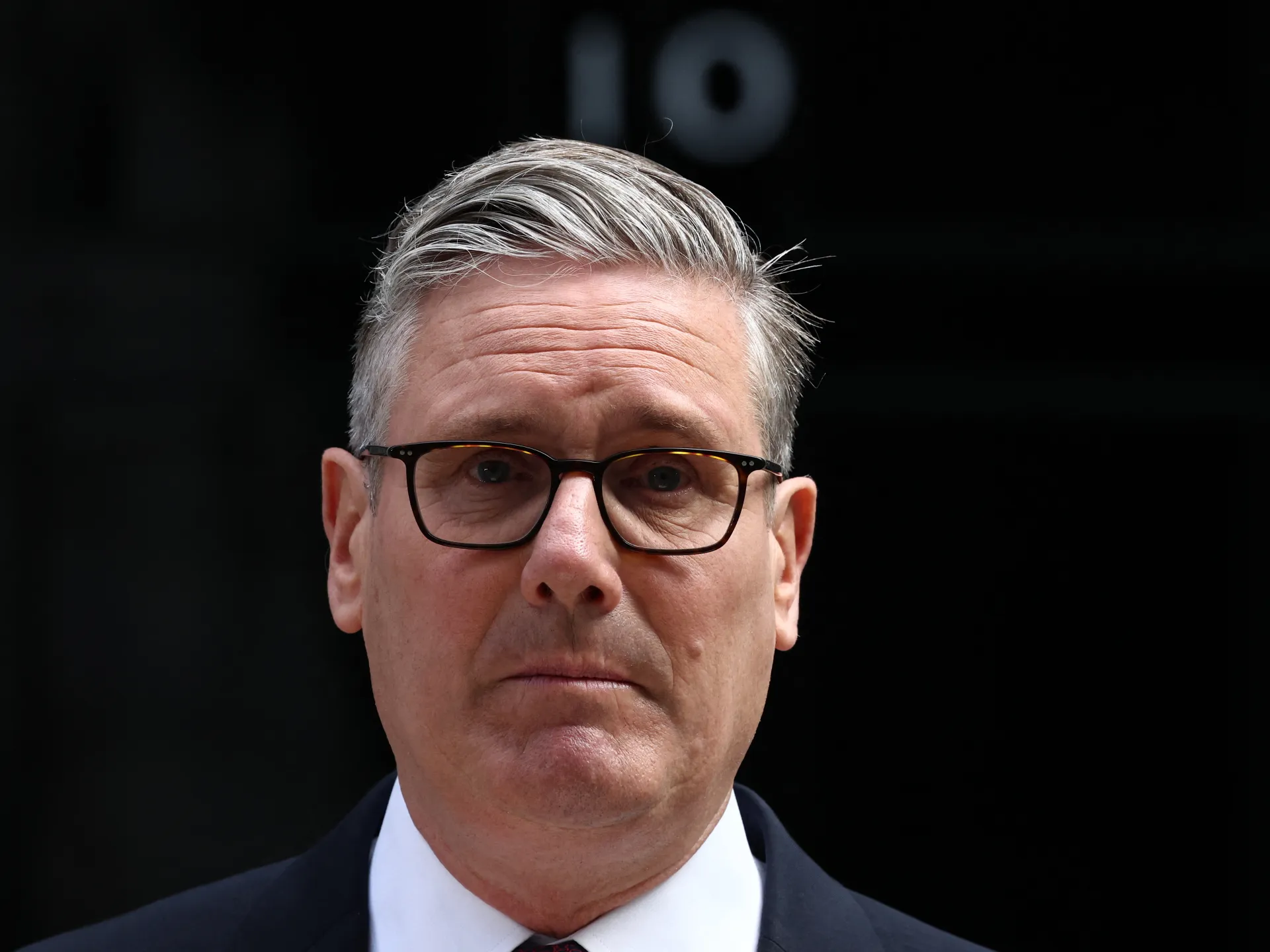
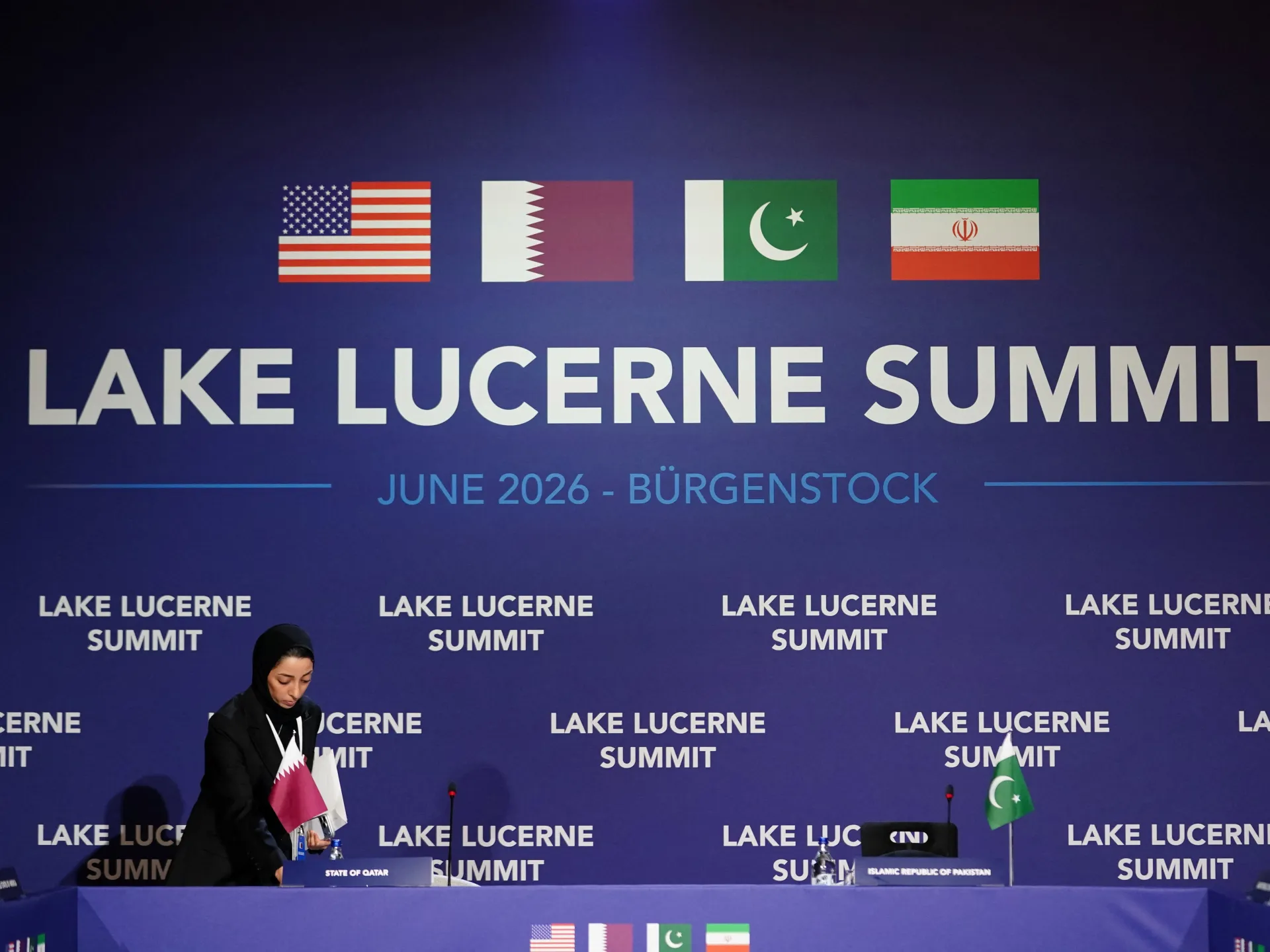
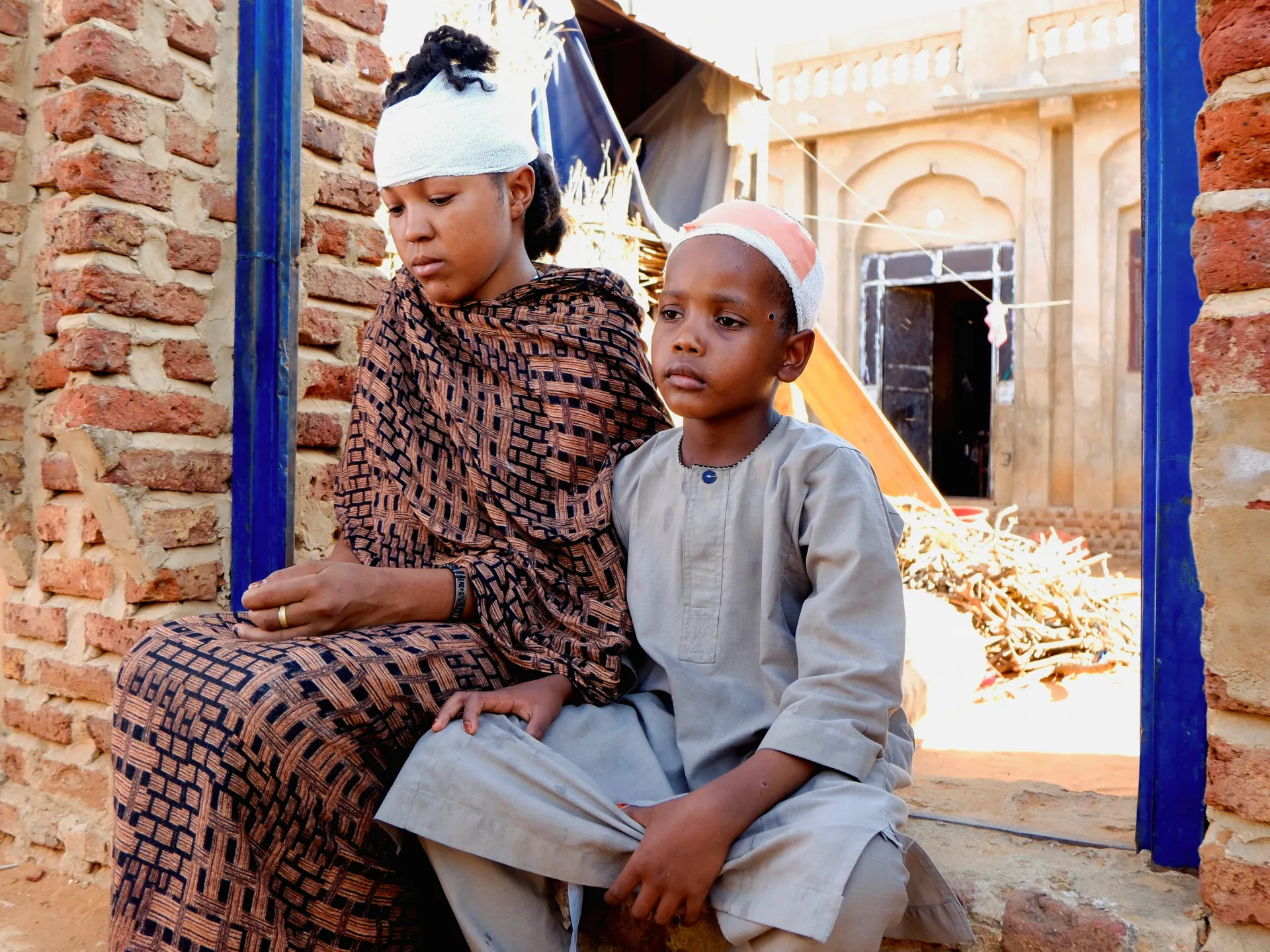

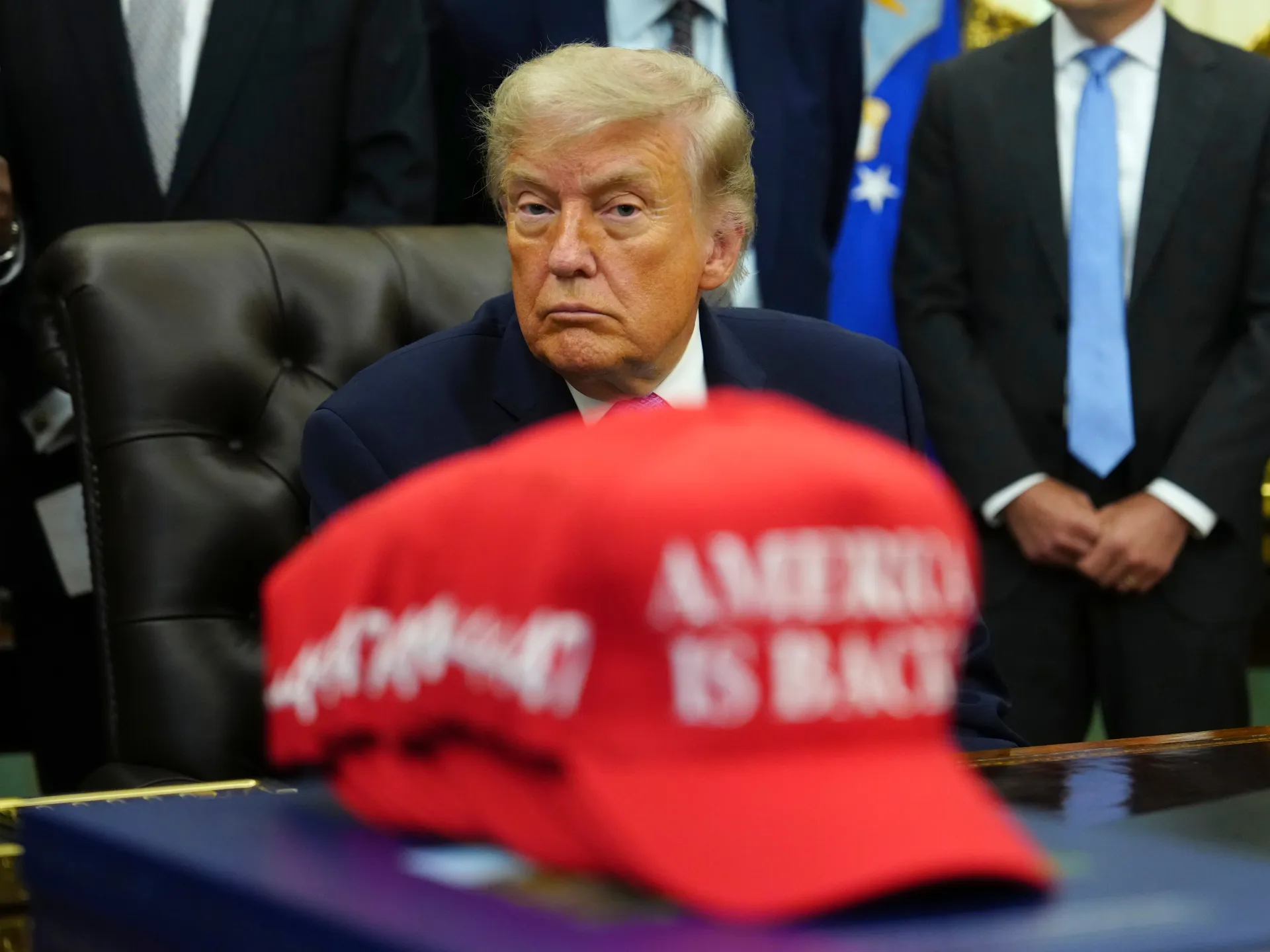
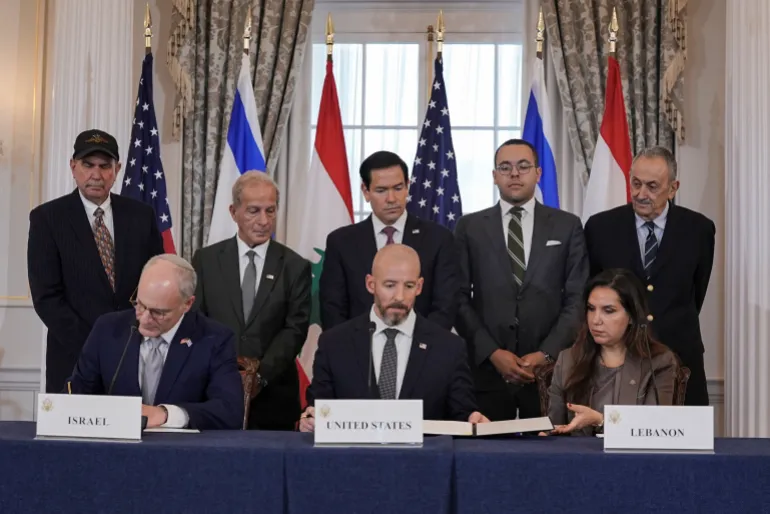
![US Secretary of State Marco Rubio looks on as State Department Counselor Daniel Holler, Israel's Ambassador to the US Yechiel Leiter and Lebanon's Ambassador to the US Nada Hamadeh sign a framework agreement between Israel and Lebanon, at the State Department in Washington, DC, June 26, 2026. [Ken Cedeno/Reuters]](https://i0.wp.com/occasionaldigest.com/wp-content/uploads/2026/06/2026-06-26T175227Z_1896892704_RC2T1MA2VJJ9_RTRMADP_3_IRAN-CRISIS-LEBANON-ISRAEL-1782496481.jpg?w=640&ssl=1)