The US president repeats claims that Cuba is ready to negotiate as it faces a spiralling energy and economic crisis.
Published On 10 Mar 202610 Mar 2026
Share
United States President Donald Trump has signalled that his administration is still pursuing a government overthrow in Cuba even as the US-Israeli war on Iran enters its second week.
Trump said on Monday that the US Department of State is still focused on Cuba, where plans by the White House may or may not include “a friendly takeover” of the island, according to the Reuters news agency.
Recommended Stories
list of 4 itemsend of list
US Secretary of State Marco Rubio is “dealing” with Cuba, the president told reporters in Florida.
“He’s dealing [with it], and it may be a friendly takeover, it may not be a friendly takeover. Wouldn’t really matter because they’re really down to … as they say, fumes. They have no energy, they have no money,” Trump said.
“They are going to make either a deal or we’ll do it just as easy, anyway,” he said.
Cuba has been grappling with an energy crisis since January, when US forces abducted Venezuelan President Nicolas Maduro and halted fuel exports from Caracas to Havana, cutting the country off from one of its few allies and a key source of oil for the Cuban economy.
White House officials have suggested that Cuba is facing an economic collapse and that its government is ready to negotiate with Washington.
Trump has said on multiple occasions that Cuba’s government is ready to “fall” and that its leaders want to “make a deal” with Washington, according to NBC News.
Cuba has denied reports of high-level talks, according to Reuters, but it has not “outright” denied US media reports of “informal talks” between Raul Guillermo Rodriguez Castro, the grandson of former Cuban President Raul Castro, and US officials.
Cuba has been in the crosshairs of the US for decades, but Trump is the first US president since the Cold War to openly discuss and pursue a government change in Havana.
Trump’s attacks on Venezuela and Cuba are in line with his revival of the “Monroe Doctrine”, a 19th-century policy that states the Western Hemisphere should be solely under the sway of the US and no other foreign power.
Trump first raised the notion of a “friendly takeover” of Cuba in February.
North Korea’s Kim Yo Jong said the annual ‘Freedom Shield’ exercises could lead to ‘unimaginably terrible consequences’.
Published On 10 Mar 202610 Mar 2026
Share
Kim Yo Jong, the powerful sister of North Korean leader Kim Jong Un, has accused the United States and South Korea of “destroying the stability” of East Asia, as the two countries start their annual 10-day joint military exercises on the Korean Peninsula.
“The muscle-flexing of the hostile forces near the areas of our state’s sovereignty and security may cause unimaginably terrible consequences,” Kim Yo Yong said on Tuesday, according to the state-run Korean Central News Agency (KCNA).
Recommended Stories
list of 4 itemsend of list
“The enemies should never try to test our patience, will and capability,” Kim said.
“We will watch to what extent the enemy violates the security of our state and what it is playing at,” she continued.
Kim’s remarks follow the start of the joint Freedom Shield exercises on Monday, which will run for 10 days and involve 18,000 South Korean and US military personnel.
The military manoeuvres are designed to “enhance the combined, joint, all-domain, and interagency operational environment, thereby strengthening the Alliance’s response capabilities,” United States Forces Korea said.
This year’s Freedom Shield will involve 22 field training drills, according to South Korea’s Yonhap News Agency, which is fewer than half the number carried out last year.
Kim added on Tuesday that there was no justification to hold the exercises, which have been called a “defensive” action by Washington and Seoul in the past.
“No matter what justification they may establish and how the elements of the drill may be coordinated, the clear confrontational nature of the high-intensity large-scale war drill staged by the most hostile entities in collusion at the doorstep of [North Korea] never changes,” she said.
“The recent global geopolitical crisis and complicated international events prove that all military manoeuvres of the field warfare troops, to be conducted by the enemy states, assume no distinction between defence and attack, training and actual warfare,” she continued, in an apparent reference to the US-Israel war on Iran.
South Korea and North Korea have technically been at war since 1953, when an armistice agreement paused fighting but did not formally end the armed confrontation.
North Korean leader Kim Jong Un said in 2024 that he would no longer pursue reconciliation with South Korea, although it remains Seoul’s long-term goal.
An official at South Korea’s Ministry of Unification told Yonhap that Kim’s remarks on Tuesday were relatively muted by North Korean standards.
The statement did not refer directly to the US or threaten to use nuclear weapons, the official said, speaking on condition of anonymity.
“Kim appears to have limited her response to merely pinpointing the South Korea-US exercise, taking the current security situation into account,” the official told Yonhap.
Australian Prime Minister Anthony Albanese said air-to-air missiles and a reconnaissance plane will be sent to region amid conflict with Iran.
Published On 10 Mar 202610 Mar 2026
Share
Prime Minister Anthony Albanese said Australia will deploy a long-range reconnaissance aircraft and send air-to-air missiles to help countries in the Gulf region defend against Iranian attacks.
“The Iranian conflict in the Middle East began just over a week ago, and Iran’s reprisal attacks continue to escalate, already at a scale and depth we haven’t seen before. Twelve countries across the region, from Cyprus through to the Gulf, are continuing to be targeted,” Albanese said in a news conference on Tuesday.
Recommended Stories
list of 4 itemsend of list
He said the Royal Australian Air Force will send an E7A Wedgetail surveillance aircraft and supporting personnel to “protect and secure airspace above the Gulf” for the next four weeks, and help the region with its “collective self-defence”.
Australia will also send advanced medium-range air-to-air missiles to the United Arab Emirates, he said, following a phone call with UAE President Mohammed bin Zayed Al Nahyan.
Albanese cited the 115,000 Australians living in the Middle East – among them, 24,000 in the UAE – as a major factor behind the deployment of military assets.
“Helping Australians means also helping the United Arab Emirates and other Gulf nations defend themselves against what are unprovoked attacks,” he told reporters, stressing that the deployments were for defensive purposes only.
“My government has been clear: We are not taking offensive action against Iran, and we are clear we are not deploying Australian troops on the ground in Iran,” he said.
Some 2,600 Australians have left the Middle East since last week, Albanese said, but “significant challenges” remain in helping those who want to leave but remain in the region.
The prime minister’s announcement was immediately slammed by the opposition Greens party, which said Australia risks becoming embroiled in another US-led “forever war”.
Australia joined the US-led invasions of Afghanistan and Iraq in 2001 and 2003, and lost more than 50 personnel during the conflicts, according to the Australian War Memorial.
Greens Senator Larissa Waters said she feared more Australian lives were at risk with the announced deployments, which the government, led by the Labor Party, said would be accompanied by 85 Australian personnel.
“Australians do not want to get dragged into Trump and Netanyahu’s illegal war on Iran. Labor shouldn’t be sending troops to help a military that’s killed 150 schoolchildren in a primary school bombing. That will only escalate an illegal conflict that’s already spiralling out of control, and leave Australia trapped in yet another forever war,” Waters said in a statement on Tuesday.
“Every day Trump and Netanyahu’s demands of Australia keep growing. It was refuelling US spy planes yesterday, a recon jet and missiles today, and could be ever more troops tomorrow. Labor has no red lines when it comes to appeasing Donald Trump and Benjamin Netanyahu,” she said, referring to the US president and Israeli prime minister, respectively.
Albanese said separately on Tuesday that Canberra has formally granted asylum to five members of Iran’s women’s football team, who were visiting Australia for the Asian Football Confederation Women’s Asian Cup 2026 in Queensland.
Albanese said the women had been issued with humanitarian visas and moved to a safe location with the assistance of Australian Federal Police.
“Australians have been moved by the plight of these brave women. They’re safe here, and they should feel at home here,” Albanese told reporters.
Ukrainian President Volodymyr Zelenskyy has said that Kyiv could provide defensive systems as well as assistance to civilians and American soldiers “deployed in certain countries” in the Middle East as the war in Iran continues.
He has reportedly proposed an exchange of Ukrainian defensive technology to combat Iranian drones in return for advanced US defensive systems to use in the war against Russia.
The US-Israel-Iran conflict, which started 10 days ago when the United States and Israel launched strikes on Iran and killed Iran’s supreme leader, Ayatollah Ali Khamenei, has continued to escalate. Iran has responded with strikes on Israel and US military assets and other infrastructure in Kuwait, Bahrain, Qatar, Saudi Arabia and the United Arab Emirates.
As Gulf and other Middle Eastern states continue to attempt to intercept incoming drones and missiles with US-supplied air defences, the US has asked Ukraine to contribute some of its own air-defence systems.
Here is what we know.
What has the US requested from Ukraine and why?
The US has asked for Ukraine’s help in defending Washington’s allies in the Middle East against Iranian missile attacks on infrastructure and US military assets, Ukraine’s president confirmed last week.
At the moment, the US is using air defence systems such as the Patriot, Terminal High Altitude Area Defense (THAAD) batteries and Airborne Warning and Control System (AWACS) aircraft, to intercept Iranian drones and missiles targeting its military assets in the region. The Patriot Advanced Capability-2 (PAC-2) and PAC-3 are advanced surface-to-air missile defence systems.
However, these types of systems are extremely expensive, costing millions of dollars for each interceptor missile fired, and there are concerns that supplies of US interceptor missiles could run low.
“We received a request from the United States for specific support in protection against ‘shaheds’ in the Middle East region,” Zelenskyy wrote in an X post on March 5.
Shahed drones, particularly the Shahed-136, are Iranian-designed “kamikaze” or loitering munitions which are very low cost compared to the interceptors being used by the US. Costing roughly $20,000-$35,000 each, these GPS-guided drones are about 3.5m (11.5 feet) long and fly autonomously to pre-programmed coordinates to strike fixed targets with explosive payloads. They blow up as they hit their targets.
Over the course of the Iran war, Shahed-136 drones have targeted Middle Eastern countries including Saudi Arabia, Bahrain, Qatar and the UAE where US military assets and troops are hosted. Experts estimate that Iran has thousands of these drones.
Iran has also been supplying Moscow with many thousands of Shahed drones during Russia’s war on Ukraine.
During the course of Russia’s four-year war on Ukraine, Ukraine’s domestic arms industry has been forced to innovate, building low-cost interceptor drones priced at roughly $1,000 to $2,000 to counter Russian attacks with imported Iranian Shahed-136s.
Kyiv is now mass-producing these low-cost interceptor drones.
“The role of Shahed-type drones in long-range attacks has become more prominent in Ukraine after Russia took Iranian technology, improved it, and built it in previously unimaginable numbers,” Keir Giles, a Eurasia expert for the UK-based think tank Chatham House, told Al Jazeera.
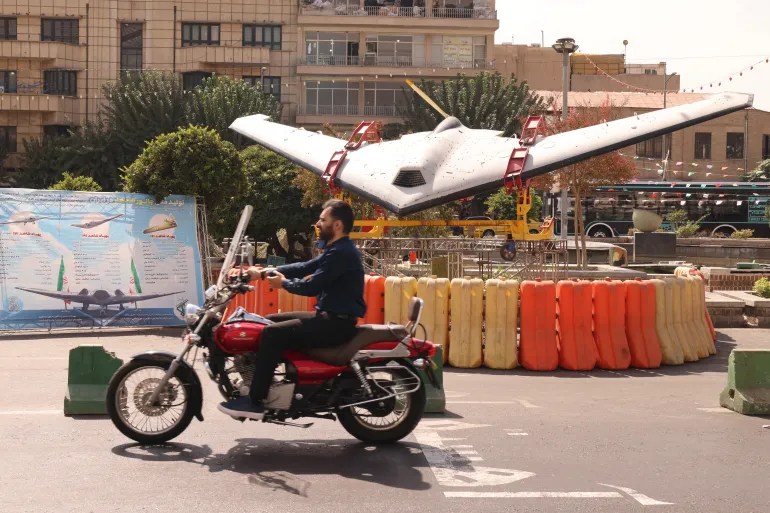
A man rides a motorcycle past a Shahed drone in Tehran’s Baharestan Square on September 27, 2025, as part of an exhibit to mark the ‘Sacred Defence Week’ commemorating the 1980-88 Iran-Iraq War [Atta Kenare/AFP]
What has Zelenskyy said?
Zelenskyy has posted several statements on social media confirming that he is ready to help Middle Eastern countries defend their territories by providing technical expertise.
“Ukrainians have been fighting against ‘shahed’ drones for years now, and everyone recognises that no other country in the world has this kind of experience. We are ready to help,” he wrote on X on March 5.
“I gave instructions to provide the necessary means and ensure the presence of Ukrainian specialists who can guarantee the required security.
“Ukraine helps partners who help ensure our security and protect the lives of our people.”
It is understood that Ukraine is in talks with several Middle Eastern countries about this.
On Monday, Zelenskyy said Ukraine has deployed interceptor drones and a team of specialists to help protect US military bases in Jordan.
Zelenskyy wrote on X that he has also spoken directly to Saudi Crown Prince Mohammed bin Salman (MBS) about “countering threats from the Iranian regime”.
He also said he had spoken with the leaders of Bahrain, Jordan, Kuwait, Qatar and the UAE.
Zelenskyy has repeatedly stressed that Ukraine must not weaken its own air defences. However, it is mass-producing this equipment now, and may well be able to afford to share.
“The fact that there are surplus capabilities ready to be sent to the US and the Middle East is unsurprising because Ukraine has led this innovation,” Giles said.
Zelenskyy has therefore proposed an exchange of air defence systems with the US ones being used in the Middle East.
“We ourselves are at war. And I said, completely frankly, that we have a shortage of what they have. They have missiles for the Patriots, but hundreds or thousands of ‘shaheds’ cannot be intercepted with Patriot missiles – it is too costly,” Zelenskyy said.
“Meanwhile, we have a shortage of PAC-2 and PAC-3 missiles. So, when it comes to technology or weapons exchange, I believe our country will be open to it.”
Zelenskyy may also have good political reasons for extending help, analysts say.
“The US has declined support for Ukraine on the ground that it had insufficient supply of air defence munitions, and now more of those Patriots have been fired in the Middle East in a few days, than have been supplied to Ukraine in four years,” Giles said.
“Zelenskyy will be aware that in providing this assistance, he is not only shaming the US, but also directly supporting potential friends and partners in the Middle East, who before now have been ambivalent to the situation in Ukraine,” Giles said.
Who else has sent defensive backup to the Gulf?
European countries including the United Kingdom, France, Spain, Portugal, Greece and Italy have pledged to provide defensive backup to Gulf nations over the past week. Additionally, Australia said it was deploying military assets to the region.
Wary of becoming directly involved in the US-Israeli war on Iran, European countries have nevertheless been drawn into the conflict by attacks on a British base on Cyprus in the Mediterranean and Iranian strikes on Western allies in Gulf countries that host US troops in military bases.
What will happen next?
Just as Ukraine is getting involved in the war, Russia might too, say experts.
“We should not be surprised if before long, as well as Russian technology in Iranian drones, we see Iran launching Shaheds manufactured in Russia,” Giles said.
He described Russia as a “primary beneficiary of current US actions,” pointing to how the surge in oil prices, the relaxation in US curbs on Russian energy exports to keep crude and gas prices under control, and the diversion of air defence munitions from Europe to the Middle East all helped Moscow. These, he said, “are all lifelines for Russia”.
Ministry of National Defence says no casualties or damage after missile shot down over southern city of Gaziantep.
Published On 9 Mar 20269 Mar 2026
Share
The Turkish Ministry of National Defence says NATO air defences have intercepted a ballistic missile launched from Iran towards Turkiye as concerns grow that the United States-Israel war against Iran will escalate.
The missile was intercepted on Monday over the Sahinbey district of Gaziantep in southern Turkiye, the ministry said in a statement. No casualties or damage were reported.
Recommended Stories
list of 3 itemsend of list
“Ankara emphasized its capability and determination to protect national airspace and border security, while warning that further escalation in the region must be avoided,” the statement said.
The ministry also urged all sides, especially Tehran, “to refrain from actions that could endanger civilians or undermine regional stability”.
Monday’s incident was the second time an Iranian ballistic missile was fired towards Turkiye since the US and Israel launched a war against Iran on February 28, according to local authorities.
The US-Israeli attacks have prompted a wave of Iranian missile and drone strikes across the wider region, including on targets in Arab Gulf countries.
Iran did not immediately comment on the Turkish ministry’s statement.
NATO spokesperson Allison Hart confirmed that the military alliance had intercepted “a missile heading to Turkiye”. “NATO stands firm in its readiness to defend all Allies against any threat,” Hart said in a post on X.
Iran denied firing a ballistic missile towards Turkiye on Wednesday after Turkish authorities said NATO air defences shot down a projectile over the Eastern Mediterranean.
NATO condemned that launch, expressing its “full solidarity” with Turkiye.
“This is a tangible demonstration of the Alliance’s ability to defend our populations against all threats, including those posed by ballistic missiles,” NATO said of the interception.
Article 5 of the alliance’s North Atlantic Treaty says an attack on one NATO country will be considered an attack on all. It also commits each NATO member state to taking action deemed necessary “to restore and maintain” security.
In an interview with the Reuters news agency last week after the first ballistic missile heading towards Turkiye was shot down, NATO chief Mark Rutte said there was no talk of invoking Article 5.
Iranian authorities have said they are firing at US military bases and other US- and Israel-linked targets across the region in self-defence, but civilian infrastructure has also been attacked.
“Iran’s targets are not just US bases; they are, in fact, primarily large-scale infrastructure and civilian targets as well,” said Rob Geist Pinfold, a lecturer in defence studies at King’s College London.
“This is not a mistake. This is by design,” Pinfold told Al Jazeera, explaining that Tehran is seeking to “unleash as much chaos as possible to destabilise the region and global markets” in an effort to force Washington to abandon the war.
“We’ve seen that Iran is targeting every single [Gulf Cooperation Council] state. It’s prepared to burn its bridges with all of them to pursue this very uncertain and high-risk strategy,” he said.
“It really shows you how Iran feels like it’s facing an existential threat. For them, this is a real do-or-die moment.”
The Ukraine war has increased Europe’s dependence on arms imports in the past five years, but it may also have helped to turn Europe into a rising arms manufacturer and exporter, new research suggests.
Imports of major arms by European states more than tripled during 2021-25, when the Ukraine war has raged, compared with the previous five-year period of 2016-20, the Stockholm International Peace Research Institute (SIPRI) said in its annual Arms Transfers report released on Monday.
Recommended Stories
list of 4 itemsend of list
Almost half of those weapons – 48 percent – came from the United States, suggesting that Europe is failing in a commonly shared ambition of becoming more weapons-autonomous.
Poland and the United Kingdom are Europe’s biggest importers of weapons, said SIPRI.
Europe’s growing market
However, there are caveats to that picture.
“Ukrainian arms imports over the last five years made 43 percent of the overall increase in European imports,” said Katarina Djokic, a leading SIPRI researcher.
That figure measures only direct imports from the US to Ukraine, she said. It does not include imports made on Ukraine’s behalf by other European states. So in reality, Ukraine’s needs made up an even bigger proportion of Europe’s imports.
Beneath that headline figure of growing European imports lies another picture of Europe.
“Taken together, the arms exports of the 27 current EU member states went up by 36 percent,” said SIPRI’s report.
That is a faster growth rate than the US’s 27 percent over the same period, and China’s 11 percent.
The European Union’s combined arms exports accounted for 28 percent of total global arms exports in the past five years, nearly replacing its imports, which account for a third of the world’s total.
That 28 percent of the global market is “four times higher than Russia’s export volume and five times higher than China’s”, said SIPRI.
Russia’s market crumbling
At the same time, Russia, seen as Europe’s main security threat, has seen its share of arms exports collapse by 64 percent in the past five years compared with the previous five years.
“Their exports have dropped off partly because they desperately need what they make themselves,” said General Ben Hodges, a former commander of US forces in Europe.
“But nobody wants to buy Russian kit because it’s been proven to be not that good … their technology has been defeated by Ukrainian technology,” he told Al Jazeera.
Russia’s top clients are abandoning it, Djokic said.
“China has promoted its own defence industry and has become independent in arms production. For a while, they were importing at least, for instance, Russian-produced engines for Chinese-produced aircraft. Now they have their own design, they don’t really need it,” she said.
Will the US continue to dominate Europe?
Europe depends on the US for a number of reasons, said Djokic.
Some items, such as multiple-launch rocket systems, are not manufactured in Europe, she noted.
Then there is the desire to go for the best-in-class.
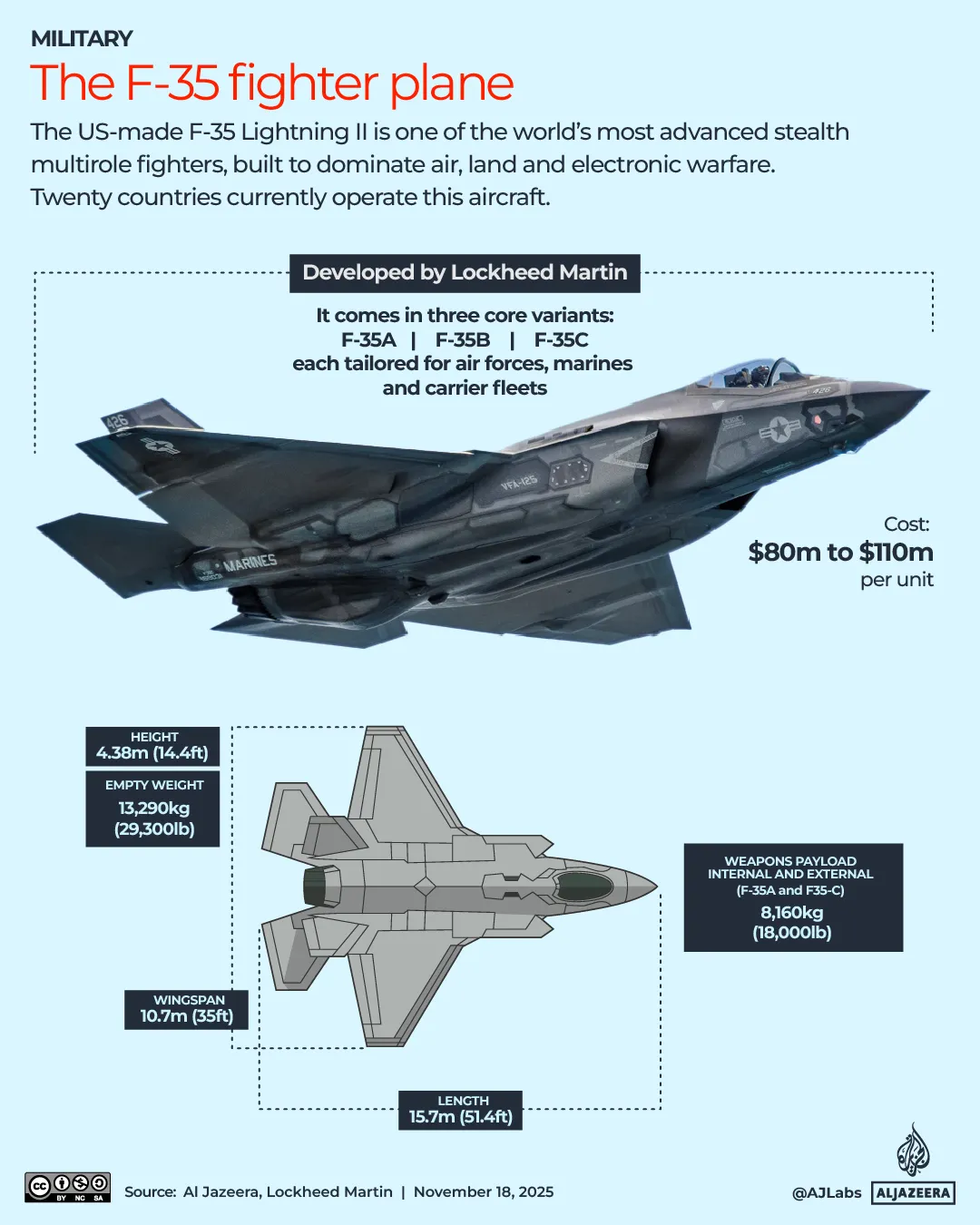
“[States] go for something they perceive as superior technology, so you have many air forces wanting to have the F-35 [jets] even though some of them can’t use all the capabilities they gain with that,” said Djokic.
But perhaps the biggest reason is the desire to strengthen the security partnership with the US, which has been perceived as the biggest security partner, “especially in the eastern part of the EU”, Djokic said.
For example, Poland, which says it is building Europe’s largest land army, is equipping its armed forces almost exclusively with US weapons.
That may be changing.
Unlike in previous support packages from the EU, Brussels is now insisting that Ukraine give preferential treatment to weapons it can buy in Europe.
That is because after the US moved away from providing aid to Ukraine under President Donald Trump, the EU has become Ukraine’s biggest donor and supporter, sending 195 billion euros ($230bn) to date and voting to lend Ukraine another 90 billion euros ($106bn) over the next two years. Much of that money will now flow back into the EU.
The perception of the US as a security partner is also likely to suffer, said Hodges.
“The transatlantic relationship is still there, but it’s not the same and probably will never be the same,” he said. “Europeans are realising that they have to become less and less dependent on the US if an American president can say, ‘S**** you guys’.”
‘Dangers are not going to go away’
Hodges was referring to Trump’s abandonment of Ukraine in the midst of Russia’s invasion, his questionable commitment to NATO and his threat this year to invade Greenland, a territory belonging to a NATO ally.
“Given Russia’s war in Ukraine, the fighting in the Middle East, the dangers are not going to go away. So most European countries have a more sober, realistic view of the threats and the need for stronger capabilities for deterrence, especially if they sense that the US is not as present or capable or reliable as it has been,” Hodges said.
“You’ll continue to see growth, and investors are more willing to invest in defence now – pension funds, insurance companies – who have traditionally shied away from defence.”
Europe has ploughed 150 billion euros ($175bn) into Security Action for Europe (SAFE), a low-cost loan programme given to member states that buy weapons from other member states. More than 113 billion euros ($113bn) of that have been allocated to member states.
None of these changes in spending and perception is yet reflected in SIPRI’s numbers.
“What we are witnessing now are new orders being placed for European weapons systems, prominently Aristide air defence systems from Germany, or Cesar howitzers from France, where you can tell that this kind of support through the European Union does play a role in promoting within-EU procurement,” said Djokic.
March 8 (UPI) — The Pentagon on Sunday afternoon announced that a seventh U.S. service member has died during the U.S. and Israeli conflict with Iran.
The service member was seriously wounded during an attack on U.S. troops in Saudi Arabia on March 1, military officials said.
“Last night, a U.S. service member passed away from injuries received during the Iranian regime’s initial attacks across the Middle East,” U.S. Central Command said in a post on X.
“Major combat operations continue. The identity of the fallen warrior will be withheld until 24 hours after next of kin notification,” CENTCOM said.
The seven service members have been killed during the first week of Operation Epic Fury, which the United States and Israel launched on Feb. 28.
Since the beginning of the onslaught, Iran has launched retaliatory strikes at its neighbors, some of which host U.S. bases and assets that are being used in the war.
A March 1 retaliatory strike on an Army sustainment unit based in Kuwait killed six service members and injured 18 others, whose remains returned to the United States on Saturday.
Overall, Iran’s retaliatory strikes have killed at least 20 people across the region, The New York Times reported, while between 800 and 1,300 hundred people in Iran have died during the widening conflict.
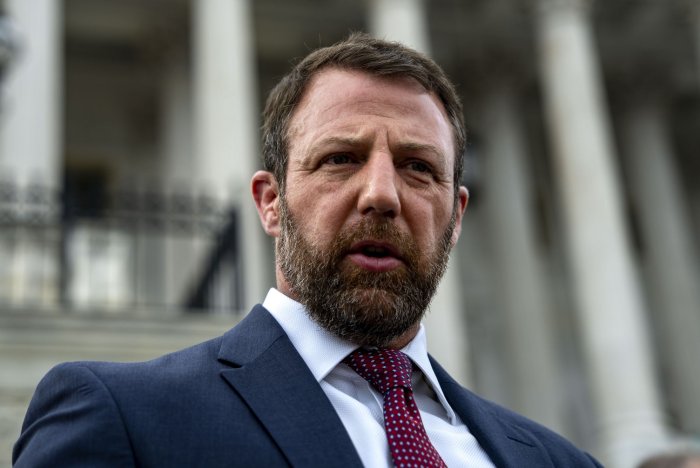
Sen. Markwayne Mullin, R-Okla., speaks to the press outside the U.S. Capitol on Thursday. Earlier today, President Donald Trump announced Mullin would replace Kristi Noem as Secretary of the Department of Homeland Security. Photo by Bonnie Cash/UPI | License Photo
Decree strips parties of legal status and assets, as opposition leader calls on Guineans to resist
By AFP and The Associated Press
Published On 8 Mar 20268 Mar 2026
Share
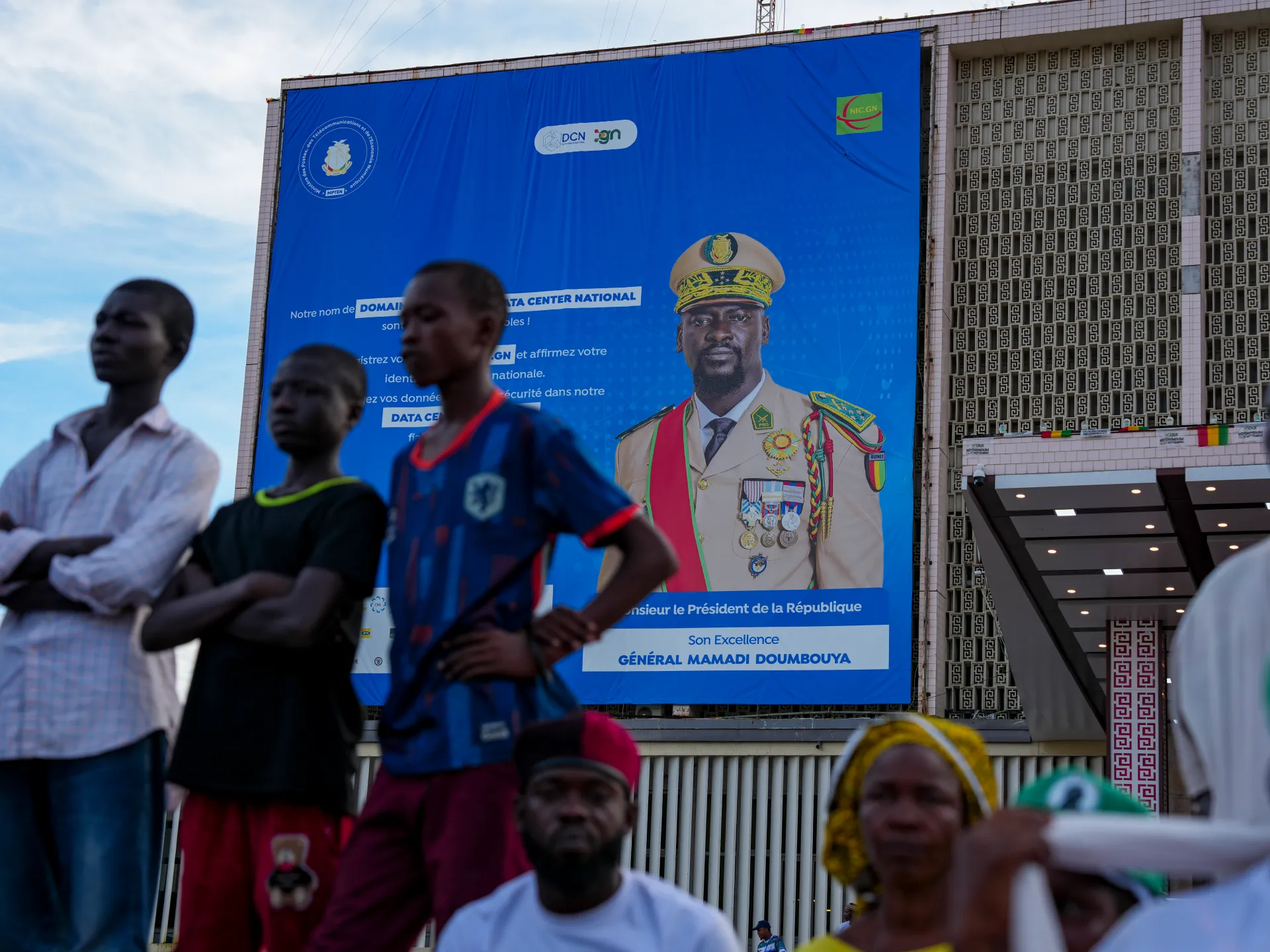
Guinea’s government has dissolved 40 political parties, including the country’s three main opposition groups, in a move critics say marks the final step towards a one-party state under President Mamady Doumbouya.
The Ministry of Territorial Administration and Decentralisation issued the decree late on Friday, citing the parties’ failure to meet their legal obligations.
Recommended Stories
list of 2 itemsend of list
Beyond stripping them of their legal status, the order froze their assets and banned the use of their names, logos and emblems, with a government-appointed curator assigned to oversee the transfer of their holdings.
The three most prominent parties dissolved are the Union of Democratic Forces of Guinea (UFDG), the Rally of the Guinean People (RPG) – the party of ousted former President Alpha Condé – and the Union of Republican Forces (UFR).
All three had already been suspended last August, weeks before a constitutional referendum that cleared the way for Doumbouya to stand in December’s presidential election.
UFDG leader Cellou Dalein Diallo, speaking from exile, accused Doumbouya of dismantling democratic life to entrench his grip on power. In a video posted to Facebook on Sunday, he said the dissolution was part of a deliberate drive to build a “party-state” and urged supporters to “rise as one” against a government that had lasted “far too long”.
He said that dialogue and legal routes had been exhausted, while his party’s communications coordinator went further, describing the decree as “the final act of a true political farce” aimed at cementing single-party rule.
Ibrahima Diallo, a leader in the pro-democracy National Front for the Defence of the Constitution, said the move had “formalised a dictatorship” and warned that Guinea was sinking into “profound uncertainty”.
The crackdown is the latest in a sustained campaign against dissent under Doumbouya, who seized power in a 2021 coup before winning a presidential election in December, a vote from which all major opposition figures were barred.
Since taking power, his government has shut down media outlets, banned protests and arrested or driven into exile scores of opposition figures and civil society activists.
Several relatives of prominent dissidents have also been abducted, and two well-known pro-democracy activists have been missing since July 2024.
Wave of coups
A wave of coups has brought military leaders to power in Africa, across a belt stretching from the Atlantic through the Sahel region to the Red Sea since 2020, while an attempted coup in Benin failed in late 2025.
The development has led to what analysts have described as a “coup belt“.
Madagascar’s and Guinea-Bissau’s armies most recently removed civilian leaders in their respective countries from power in late 2025, underscoring growing discontent with elected governments.
Although often carried out with popular backing, the military takeovers have also seen civil liberties clawed back.
A 2025 study found that while military takeovers have declined globally, the risk of coups in Africa remains comparatively high.
The Pentagon and the Federal Aviation Administration agreed to conduct anti-drone laser tests in New Mexico after the military’s deployment of the lasers led the FAA to suddenly close airspace in Texas twice in the last month.
The newly announced testing was being carried out to “specifically address FAA safety concerns,” the military said Friday in a statement. It was to take place over the weekend at the White Sands Missile Range in New Mexico.
Lawmakers were concerned about an apparent lack of coordination after the Pentagon allowed U.S. Customs and Border Protection to use an anti-drone laser in early February without notifying the FAA. The federal agency that ensures safety in the skies decided to close the airspace over El Paso for a few hours, stranding travelers.
The Trump administration said it was working to halt an incursion by Mexican cartel drones, which are not uncommon along the southern border.
On Feb. 26 the U.S. military said it used the laser to shoot down a “seemingly threatening” drone flying near the U.S.-Mexico border. It turned out the drone belonged to Customs and Border Protection, lawmakers said.
The incident led the FAA to close the airspace around Ft. Hancock, about 50 miles southeast of El Paso.
“We appreciate the coordination with the Department of War to help ensure public safety,” the FAA said of the testing in a separate statement, referring to the Department of Defense. “The FAA and DOW are working with interagency partners to address emerging threats posed by unmanned aircraft systems while maintaining the safety of the National Airspace System.”
The military is required to formally notify the FAA when it takes any counter-drone action inside U.S. airspace.
Sen. Tammy Duckworth (D-Ill.), the ranking member on the Senate’s aviation subcommittee, previously called for an independent investigation after the two February incidents.
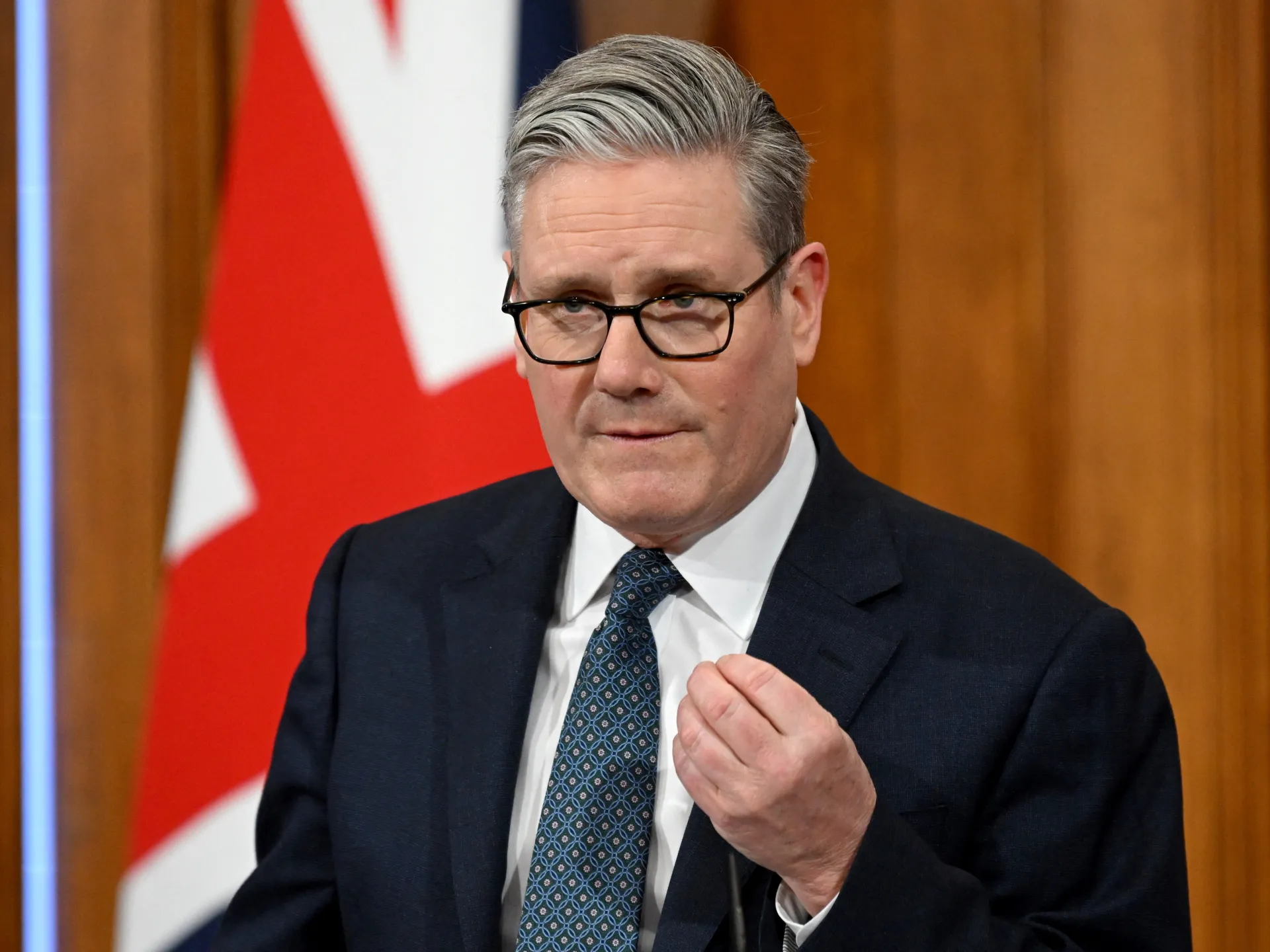
United States President Donald Trump has posted on social media that he does not need the United Kingdom to deploy aircraft carriers to the Middle East, amid the ongoing war with Iran.
Saturday’s post on Truth Social follows a statement from the UK’s Ministry of Defence that one of its two flagship aircraft carriers, the HMS Prince of Wales, has been placed on “high readiness”.
Recommended Stories
list of 3 itemsend of list
“The United Kingdom, our once Great Ally, maybe the Greatest of them all, is finally giving serious thought to sending two aircraft carriers to the Middle East,” Trump wrote.
“That’s OK, Prime Minister Starmer, we don’t need them any longer — But we will remember. We don’t need people that join Wars after we’ve already won!”
The post, with its reference to the UK as a “once great ally”, signals a deepening rift between the two countries that has emerged since Trump returned to office last year.
The divide appears to have deepened over the past week, as the US and Israel continue to hammer Iran as part of a war they launched on February 28.
The conflict has sparked fears across the Middle East, as retaliatory strikes from Tehran target US allies across the region.
Already, an estimated 1,332 people have been killed in Iran, and the US has confirmed the deaths of six of its service members. More deaths have been reported in countries like Lebanon, Kuwait, the United Arab Emirates and Iraq.
The UK government has increased its involvement in the war on Iran, widely considered illegal under international law.
The UK Defence Ministry, for instance, said on Saturday that the government of Prime Minister Keir Starmer had allowed the US to use its military bases for what it termed “limited defensive purposes”.
The bases include RAF Fairford in Gloucestershire and the Diego Garcia site in the Chagos Islands, located in the Indian Ocean. Initially, there had been reports that Starmer had blocked the US use of the bases.
In the immediate aftermath of the initial US-Israeli strike, Starmer appeared to blanche at the prospect of joining the war.
He and the leaders of France and Germany issued a joint statement, underscoring that any actions they might take would be defensive in nature.
“We will take steps to defend our interests and those of our allies in the region, potentially through enabling necessary and proportionate defensive action to destroy Iran’s capability to fire missiles and drones at their source,” the joint statement said.
“We have agreed to work together with the US and allies in the region on this matter.”
But Starmer has had to push back on domestic criticism both for and against joining the war.
On Monday, he told the UK Parliament, “We are not joining the US and Israeli offensive strikes”, citing the need to protect “Britain’s national interest” and “British lives”.
The war in Iran remains largely unpopular in the UK. The polling firm Survation conducted a survey over the last week of 1,045 British adults, in which 43 percent of respondents called the war not justifiable.
When asked if they supported Starmer’s initial decision not to allow the US to use UK bases, 56 percent of respondents approved. Only 27 percent said it was the wrong choice.
Thousands of protesters gathered outside the US Embassy in London on Saturday to call for an end to the ballooning conflict.
The US president, meanwhile, has upped his criticism of Starmer over the past week, further fraying relations with the UK government.
On March 3, for instance, Trump held an Oval Office meeting with German Chancellor Friedrich Merz, in which he said repeatedly he was “not happy with the UK”.
Of Starmer, Trump said, “This is not Winston Churchill that we’re dealing with.”
Trump has long admired Churchill, and last year installed a bust of the late UK wartime leader in the Oval Office, just as he had during his first term.
By contrast, Trump has issued a flood of criticism against Starmer, particularly for his 2024 decision to transfer control of the Chagos Islands to Mauritius.
The transfer came after the International Court of Justice found the UK acted unlawfully in 1965 by separating the islands from Mauritius to create a separate colony.
The deal with Mauritius allows the US and the UK to maintain a military base on Diego Garcia, part of the archipelago.
However, Trump has repeatedly slammed the transfer, writing on social media that “giving away extremely important land is an act of GREAT STUPIDITY”.
Tensions between the US and UK also rose in January after Trump told Fox News that NATO allies had “stayed a little off the front lines” during the US war in Afghanistan.
Starmer had responded that he found Trump’s comments “to be insulting and frankly appalling”.
The Trump administration has signalled it is pivoting away from its traditional European allies in favour of more politically aligned countries.
At a summit on Saturday with right-wing Latin American leaders, US Secretary of State Marco Rubio appeared to praise the attendees while casting shade on other allies.
“At a time when we have learned that, oftentimes, an ally, when you need them, maybe may not be there for you, these are countries that have been there for us,” Rubio told the summit.