If you grew up in the ‘70s or ‘80s, your vision of suburban America probably looks a lot like South Pasadena. There’s good reason. The picturesque town on the western edge of the San Gabriel Valley was often used as a backdrop in films like “Halloween,” “Pretty in Pink” and “Back to the Future” (the street where George McFly, Lorraine and Biff lived is actually Bushnell Avenue).
Today in South Pasadena, you’ll still find this idyllic Anytown USA landscape — but with a twist: Along with verdant parks, Craftsman bungalows and tree-lined streets, the city gleams with cool new developments like the recently opened Sid the Cat Auditorium, an all-ages live music venue in a converted 1930s elementary school; the always-packed Cannonball from chef Matt Molina; L.A.’s first nonalcoholic bottle shop Burden of Proof and a high-tech head spa imported from Japan. Add on a walkable downtown and a bustling Thursday night farmers market and it’s easy to see why so many Angelenos are drawn to this increasingly hip community.
Get to know Los Angeles through the places that bring it to life. From restaurants to shops to outdoor spaces, here’s what to discover now.
“So few pockets of L.A. County are actually great for families and that’s what makes South Pas so compelling,” said my friend Tom, who moved to the area after having a baby two years ago. “Plus, it has light-rail.”
Located six miles from downtown L.A., South Pasadena was marketed as a “garden community” when it was founded in the late 19th century. New residents were promised homes with flowering vines and sweet-smelling gardens, all just a short cable car ride away from a bustling metropolis.
“It was that early promise of suburbia,” said Becky Nicolaides, a historian and author of the book “The New Suburbia: How Diversity Remade Suburban Life in Los Angeles After 1945.” “When it was incorporated, there weren’t cars, so the town was built to be walkable.”
But that peaceful facade hid an ugly truth. Like many suburbs in the L.A. area, the town’s officials put race restrictive covenants into place soon after its founding, making it illegal for residents to sell property to people of color.
Those covenants became illegal in 1948, but the town continued to discourage people of color from living within its boundaries for several more decades. That began to change in the 1960s and South Pasadena has diversified, particularly over the past decade. In recent years, town leadership has taken steps to acknowledge its racist past.
Now, even as a new energy permeates, the city continues to lean into its early suburban history. The town is just 3.4 square miles, but it encompasses 100 acres of parks and playgrounds as well as 21,000 trees. There’s an old-fashioned pharmacy where parents have taken their kids for a phosphate soda (or just a regular old milkshake) for over 100 years and volunteers from the community still decorate a float for the Tournament of Roses each year, just as they have since 1911.
And though its historic Red Car trolleys have been discontinued for decades, today it’s still a comfort to take the Metro home from work at the end of a long day and enjoy the peace and quiet of this pastoral suburb, just like its founders did more than a century ago.
What’s included in this guide
Anyone who’s lived in a major metropolis can tell you that neighborhoods are a tricky thing. They’re eternally malleable and evoke sociological questions around how we place our homes, our neighbors and our communities within a wider tapestry. In the name of neighborly generosity, we may include gems that linger outside of technical parameters. Instead of leaning into stark definitions, we hope to celebrate all of the places that make us love where we live.
Our journalists independently visited every spot recommended in this guide. We do not accept free meals or experiences. What L.A. neighborhood should we check out next? Send ideas to guides@latimes.com.
I heard the ribbit of a Pacific chorus frog and couldn’t stop my feet as they veered me off the official trail and onto a foot path leading down to Wiley Creek.
I grew up with a pond in the pasture behind my house where I could listen to the riotous sound of amphibians any evening I wanted. The soundscape of freshwater habitats is such a comfort to me.
I sat down on a boulder near the water, trying to remain still. The frog had quieted after spotting me, and I hoped it would restart its song, understanding I was not a threat but instead just a big fan.
This was the first of many beautiful moments I experienced on my recent hike through Ed Davis Park in Towsley Canyon in Newhall. It features shady canyons with blooming wildflowers and wildlife that appear to be thriving. I would later learn that a walk through Towsley Canyon is also a journey through the history of environmental activism in the Santa Clarita Valley. This area was once slated to become a landfill.
You are reading The Wild newsletter
Sign up to get expert tips on the best of Southern California’s beaches, trails, parks, deserts, forests and mountains in your inbox every Thursday
By continuing, you agree to our Terms of Service, which include arbitration and a class action waiver. You agree that we and our third-party vendors may collect and use your information, including through cookies, pixels and similar technologies, for the purposes set forth in our Privacy Policy such as personalizing your experience and ads.
And because I got confused by this, I will point out: The Rivendale Park and Open Space is also nearby, at the mouth of Towsley Canyon near the northeast corner of Ed Davis Park. So you could find yourself hiking along one of its trails as well.
Ed Davis Park offers access to multiple trails, including:
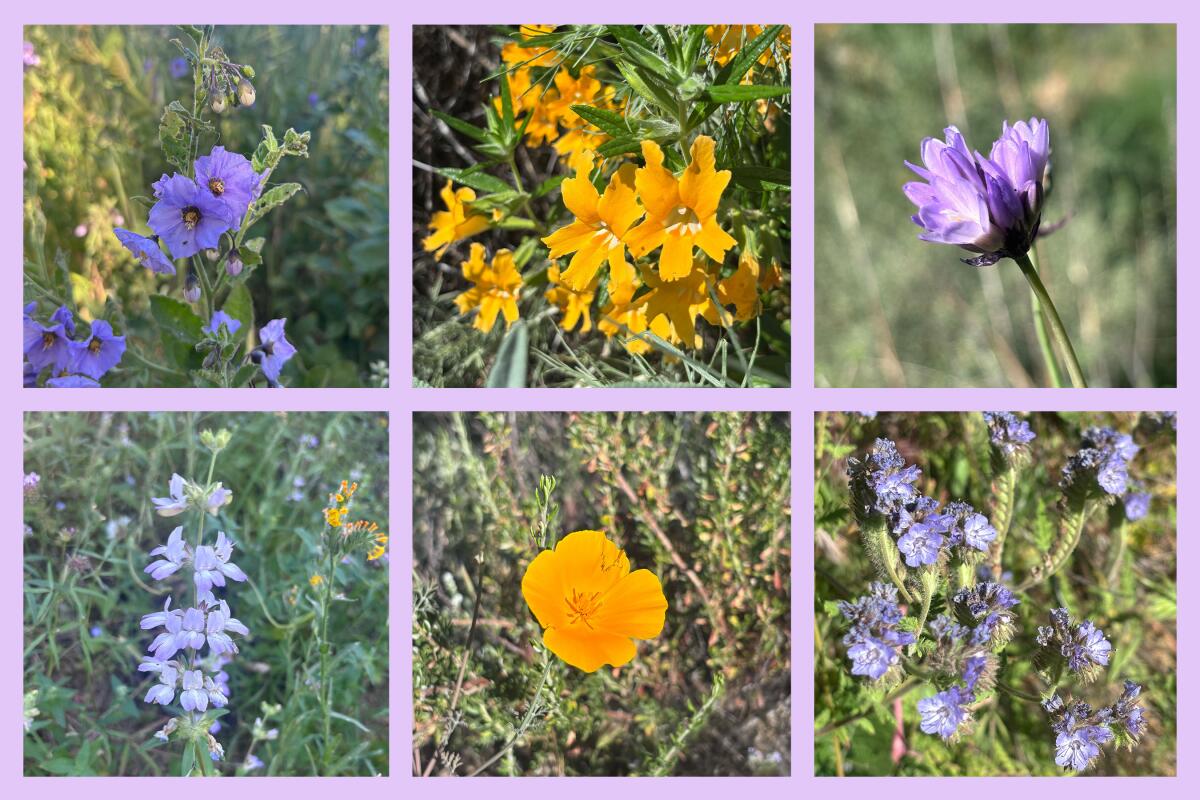
Clockwise, southern bush monkeyflower, blue dicks, phacelia, California poppy, a flower and purple nightshade that appears to be a collinsia heterophylla.
(Jaclyn Cosgrove / Los Angeles Times)
I arrived at Ed Davis Park just after 9 a.m. last week with a plan to take a short hike, given the high temperatures forecast that day. I parked near the entrance in the large dirt free lot. Note: There were no restrooms or portable toilets that this outdoors reporter could find anywhere nearby, so plan accordingly.
From the parking lot, I headed west, quickly turning south onto Wiley Canyon Trail. I was immediately greeted by a lesser goldfinch, perched on a strand of wild rye like a feathered park ranger.
The trail was initially a bit rutted but quickly smoothed out. As I headed into Wiley Canyon, I found myself in a crisp cool landscape shaded by large oak and California black walnut trees. I quickly heard running water. When I checked the thermometer hanging on my backpack, it read 69 degrees.
Clockwise, lesser goldfinch, western whiptail, convergent lady beetle and a lizard.
(Jaclyn Cosgrove / Los Angeles Times)
Although I could hear nearby traffic and a Southwest plane passing overhead, it didn’t block out the dynamic soundtrack of the canyon’s avian residents: the oak titmouse, northern mockingbird, blue-gray gnatcatcher and Hutton’s vireo, which, according to my birding app, were all above and around me.
As you travel along the canyon, you’ll find purple sage bursting out of the ground, and blue dicks starting to bloom. I passed by several ceanothus with white and blue-violet blooms. I really took my time taking in the native plant landscape and was lucky to spot a convergent lady beetle sipping on dew on a blade of grass.
After my short visit to the creek to find frogs, I was looking up to observe a turkey vulture and red-tail hawk circling overhead, seemingly competing for airspace, when I noticed the California dodder nourishing itself atop several plants on the hillside. Although it is a parasitic vine, this orange otherworldly being does indeed serve an important ecological purpose.
California dodder in the Towsley Canyon area around Newhall.
(Jaclyn Cosgrove / Los Angeles Times)
“Dodder will flower during the hot summer months, providing native insects with a valuable meal and drink during the months when many other California native plants are dormant,” Jorge Ochoa, an associate professor of horticulture at Long Beach City College, wrote for the Friends of Griffith Park regarding the plant’s purpose.
I continued south, passing a spotted towhee digging in the dirt for its breakfast. Then, just under half a mile in, I turned northwest onto the Don Mullally Trail. The trail is named after a naturalist who, according to park signage, “traversed every canyon, led countless hikes to unforgettable destinations, and shared the Woodlands’ unparalleled native tree associations and ecological majesty.” May we all be so lucky!
A shady portion of a trail in the Towsley Canyon area around Newhall.
(Jaclyn Cosgrove / Los Angeles Times)
This is where you’ll start to gain some elevation — and sun exposure. But it’s also where you will find the most blooming wildflowers! I quickly spotted phacelia with bright purple blooms, and as I headed west, an increasing number of California poppies and southern bush monkeyflower.
Towsley Peak near Towsley Canyon in Newhall.
(Jaclyn Cosgrove / Los Angeles Times)
Ed Davis Park is home to a robust butterfly population. I found a kaleidoscope of pollinators among the wildflowers and weeds, including a checkered white butterfly who was eagerly drinking from invasive mustard. I chuckled to myself. It didn’t seem to mind feasting on one of the most hated plants in Southern California.
The trail does turn into a narrow single track with thick vegetation, so please take good care as you’re hiking. I was very aware of the likelihood that I would encounter a rattlesnake, and I made sure to stomp my feet and pause from gaping at the flowers to make sure I wasn’t about to step on anyone. Additionally, watch out for poison oak, which I found growing among California black walnut.
Purple sage grows thick along the trails in Towsley and Wiley canyons. You might also spot an outdoors journalist who doesn’t realize their shadow is in the photograph until they get home.
(Jaclyn Cosgrove / Los Angeles Times)
Just over a mile in, I paused to take in the view. Several peaks in the Sierra Pelona Mountains, including Liebre Mountain, Burnt Peak and Jupiter Mountain, were easy to see from the trail, even though they’re about 20 to 25 miles away. I didn’t spend too long there, though, as my thermometer informed me it was 93 degrees in the direct sun. Where did spring go?
I took the Don Mullally Trail down and then the paved Towsley Canyon Road back to where I parked. You’ll notice as you head back that there are at least two paid lots should the free lot be full. You’ll need $7 in cash or a check, which you can deposit in the iron ranger.
The Sierra Pelona Mountains are visible from Towsley Canyon.
(Jaclyn Cosgrove / Los Angeles Times)
A turkey vulture flies low in Towsley Canyon.
(Jaclyn Cosgrove / Los Angeles Times)
Given its astounding beauty, it’s hard to comprehend how this parkland almost became a dump. But around 1989, an intense battle broke out between the Los Angeles County Sanitation Districts, which, at the time, managed wastewater and trash for 78 cities in L.A. County, and the Santa Monica Mountains Conservancy.
In early 1991, the Santa Monica Mountains Conservancy acquired 453 acres of Towsley Canyon, strategically buying a 180-acre parcel at the eastern entrance of the canyon and a 273-acre piece in the heart of it, according to The Times’ archive.
County officials mulled over whether they could still build a smaller dump in Towsley Canyon, but there was a major hiccup. The conservancy’s land was directly across the only two roads into the area, meaning the agency could hinder garbage trucks from using the roads.
“For all practical purposes, the coffin has been nailed on the proposal to turn Towsley Canyon into a landfill,” Joseph T. Edmiston, the conservancy’s executive director, said in a 1991 news article.
At the time, county officials were also considering building a dump at Elsmere Canyon — an effort also successfully fought off by local advocates.
Reflecting on my visit to Towsley and Wiley canyons, I thought about how our trash does indeed end up in someone’s neighborhood, whether that be a canyon wren, a jellyfish or your neighbor in another neighborhood (if we think about humanity and neighbors in a global sense). It’s a further incentive to practice the five Rs: refuse, reduce, reuse, recycle and rot.
I hope your journey through these canyons brings you a similar experience of joy, wonder and deep reflection!
3 things to do
An Egyptian goose in the Sepulveda Basin Wildlife Refuge.
(Amanda Thompson)
1. Better your birding in Pasadena The Sierra Club Angeles Chapter’s Pasadena group will host “Photographing the Sepulveda Basin Wildlife Reserve” from 7 to 9:30 p.m. Wednesday at Pacific Oaks College. Guests will hear from photographer and storyteller Amanda Thompson and visual communicator Joe Doherty about how to better navigate the Sepulveda Basin to observe the flora and fauna that lives there. RSVP at act.sierraclub.org.
2. Cycle on over to Cudahy Nature for All, an L.A. climate justice nonprofit, will host an 8-mile bike ride from 9:30 a.m. to 1 p.m. Saturday starting at Hollydale Regional Park in South Gate. Riders will peddle along the L.A. River before arriving at Cudahy River Park. Participants can reserve a bike by emailing Priscila Papias at priscila@lanatureforall.com. Register at cosechasoftware.com.
3. Frolic under a full moon in L.A. We Explore Earth will host a free full-moon gathering from 5:30 to 8:30 p.m. Wednesday at Elysian Park. Participants will come together for a guided group hike cleanup followed by a sound bath and live music, all under the rising full moon. Register at eventbrite.com.
The must-read
Manatees rest at Blue Spring State Park in Orange City, Fla.
(Explore.org)
As I glided my kayak along the aptly named Crystal River in late March 2019, I couldn’t believe just how close the 1,000-pound manatees came to me and my friends. Nearby, my best friend Jenny squealed as a massive sea cow poked its whiskered snout out of the water next to her kayak. Whenever I’m stuck working indoors, I often turn on the live feed of the manatees at Explore.org. Apparently I’m very much not alone! Times staff writer Lila Seidman wrote that the number of nature-themed 24/7 livestreams created per year swelled by about 3,000% between 2019 and 2025. This genre of entertainment has been dubbed “Slow TV,” as it’s unedited and can be quite calming (although there are grisly moments that remind us of nature’s brutality too).
Regardless, during this heat wave, I’d highly recommend checking out some Slow TV, including local livestreams such as Big Bear’s celebrity eagle couple Jackie and Shadow.
Happy adventuring,
P.S.
For Wild readers who’ve felt like there’s been a real lack of turtle news featured as of late, this one’s for you: During a recent trip, a visitor at Joshua Tree National Park reported to rangers about multiple Mojave Desert tortoises stuck inside a historic dig site in the northern part of the park. Rangers and the visitor ventured into the park and located three trapped male tortoises. “It’s unknown how long the tortoises were stuck in the hole, so biologists immediately began assessing and rehydrating them,” a staffer wrote on Joshua Tree National Park’s Instagram page. As a quick aside, is anyone else rethinking their life’s choices and wondering why they didn’t consider rehydrating tortoises as a profession? Does it include carrying a tiny water bottle? I digress. The park workers built a ramp out of natural materials to ensure any tortoise who scrambled by the dig site didn’t find themselves stuck inside. After the tortoises experienced the world’s cutest rehydration experience, the biologists discerned they were healthy and strong enough to keep trundling along. Shout out to this thoughtful visitor and our hardworking and earnest park workers for being great stewards to our natural world!
For more insider tips on Southern California’s beaches, trails and parks, check out past editions of The Wild. And to view this newsletter in your browser, click here.
TUCSON — Savannah Guthrie is renewing pleas to neighbors, friends and residents of Tucson to jog their memories in hopes of sparking new leads in the disappearance of her mother, Nancy.
The “Today” show co-host posted a new family statement on her personal Instagram account Sunday morning, hours after the show’s Instagram account shared it.
After expressing gratitude to the community, the family said in its statement that it believes someone in Tucson or in southern Arizona may “hold the key to finding the resolution in this case.”
“Someone knows something. It’s possible a member of this community has information that they do not even realize is significant.”
The family urged people to go over their memories of Jan. 31 — when Nancy Guthrie was last seen — and Feb. 1 as well as the evening of Jan. 11.
“Please consult camera footage, journal notes, text messages, observations, or conversations that in retrospect may hold significance,” the statement said. “No detail is too small.”
They also acknowledged in the statement that their family’s matriarch may no longer be alive.
“We cannot grieve; we can only ache and wonder.”
Nancy Guthrie was reported missing Feb. 1. Authorities believe the 84-year-old was abducted or otherwise taken against her will. The FBI released surveillance videos of a masked man who was outside Guthrie’s front door on the night she vanished.
The Guthrie family has offered a $1-million reward for information leading to the recovery of their mother.
On March 5, Savannah Guthrie visited the NBC “Today” show studio in New York City for the first time since her mother’s disappearance. The show said she plans to return to the air at some point but “remains focused right now supporting her family and working to help bring Nancy home.”
Tucson is a little more than 100 miles south of Phoenix and 70 miles north of the Mexico border. The Catalina Foothills, the neighborhood where Nancy Guthrie lives, is known as an affluent area with popular hiking trails.
Savannah Guthrie has been a co-anchor of the longtime NBC morning show since 2012. One of her former colleagues, Hoda Kotb, has returned to “Today” to fill in during Guthrie’s absence.
Most people think you can’t walk without an Achilles tendon. Jo Giese begs to differ, especially since she hikes without one.
The L.A. hiker, journalist and community activist shares her journey of recovery in her new 240-page book, “You’ll Never Walk Alone: A Hiker’s Memoir of Adventure, Tragedy, and Defying the Odds” (Amplify Publishing). Giese outlines how one fall down the stairs led to eight surgeries and a relentless search for answers for how she could return to the trails she loved.
“The reason I wrote the book is to inspire others,” Giese said, “that if you’re given a grim diagnosis — and it certainly doesn’t have to be your left Achilles — you do not have to accept it.”
You are reading The Wild newsletter
Sign up to get expert tips on the best of Southern California’s beaches, trails, parks, deserts, forests and mountains in your inbox every Thursday
By continuing, you agree to our Terms of Service, which include arbitration and a class action waiver. You agree that we and our third-party vendors may collect and use your information, including through cookies, pixels and similar technologies, for the purposes set forth in our Privacy Policy such as personalizing your experience and ads.
Like many of us, Giese’s love of the outdoors started early. At age 5, she regularly took walks alone from her family’s home on Lake Washington Boulevard in Seattle. Wearing a frilly pinafore dress and Mary Jane shoes, she’d walk a few blocks to Seward Park, pausing at the playground, where she’d persuade someone to push her on the swing. That wasn’t the main goal of the trip, though.
“There is a path that leads up into the middle of the peninsula in this old growth forest. The canopies of the trees are two and three stories high. You’re just walking in this green wonderland,” Giese said. “And then after I finished walking all the way up as far as I wanted to go, I’d come back, and I’d walk back along [the route] and go home.”
The cover of “You’ll Never Walk Alone”; and a photo of author Jo Giese.
(Amplify Publishing; Dan Fineman)
Giese has been a walker and hiker ever since, falling in love with waterfall hikes in particular. Giese and her husband, Ed, split time between their house near L.A. and a home in Bozeman, Mont. They hike in the Santa Monica Mountains when they are home in Southern California, but Giese isn’t picky.
“I mainly hike anywhere I am,” Giese said.
That includes an epic vacation “jumping out of helicopters in New Zealand … in my late 60s,” she said. But neither that adventure nor any other is how Giese got injured.
It was a rainy night in late November in L.A. Giese was upstairs when her friend Lana arrived, and not wanting her friend to get drenched, Giese raced down the stairs to open the front door.
“I miss the bottom two steps, and I literally go flying horizontally,” Giese said. “My husband heard the crash. He came running, and I said, ‘Go let in Lana. She’s getting wet!’”
The trio immediately rushed to a nearby urgent care, where an X-ray showed a complete rupture of Giese’s left Achilles tendon, a thick band of tissue that attaches a person’s calf muscle to their heel bone.
Giese quickly called an orthopedist whom she’d seen for a simple knee procedure. He told her to come to his office the following day at 8 a.m. At the appointment, the doctor said, “‘I can do this. I did [an]
Hikers dressed in Dodger Blue gather for a group photo midway through a hike at Griffith Park on March 24, 2024.
(Brian van der Brug / Los Angeles Times)
Achilles repair 20 or 30 years ago. I can do this,’” Giese recalled.
Giese at Point Dume.
(Jo Giese)
In hindsight, it’s clear she should have found someone who’d done an Achilles repair “20 or 30 minutes ago,” she said. But the relief of not having to wait for surgery mixed with the shock of the moment made Giese and her husband impulsive.
“We were so frightened then — I’m in a wheelchair, and I’m all black and blue and bruised. I cannot walk. And there is someone in front of me who says he can do this,” Giese said. “And that should be a lesson to anybody.”
After the surgery to reattach her Achilles, her doctor left for a two-week vacation while Giese was at home recuperating, studiously following the doctor’s after-care guidelines. At her follow-up appointment, the nurse was unwrapping the bandage when the doctor observed, “That’s necrotic.” At the time, Giese didn’t know that word essentially meant “dead.”
The doctor immediately blamed her, saying it was from an ice burn. Both she and her husband knew that wasn’t true. Another doctor would later suggest that the surgeon introduced the infection during that first surgery.
“I don’t think I’d been so scared since my encounter with a bear,” Giese wrote in her book.
Exactly 49 days from her accident, Giese was scheduled for another surgery (with a different doctor) to debride the wound and reattach her Achilles. It was supposed to take several hours. But less than an hour into surgery, her physician told Ed that Giese’s Achilles had died. Soon, he asked Giese if she wanted to see what was left of the largest and strongest tendon in the body.
It looked like “a nasty little caterpillar that had turned fetal, curled in on itself, and died in a sea of black-and-green muck,” Giese wrote.
Next, Giese needed a skin graft to cover the wound from the previous surgeries. After that, she returned to her doctor’s office — 114 days after her accident — where her doctor removed the bandages from that third surgery and suggested something revelatory: that Giese should put her left foot down, putting her whole weight on it.
“My naked left foot — heel and five toes — made intimate contact with a floor, a cold linoleum floor, for the first time since this medical journey had begun four months earlier,” Giese wrote. From here, she walked her first 20 steps.
But recovery would come in fits and spurts. About a month later, Giese wanted to attend a festival while in Austin, Texas, only to find the 10 blocks of booths and vendors too daunting. She went back to the hotel and screamed, “I cannot walk!”
From here, she demanded better care. Giese was tired of hearing medical professionals say they’d never encountered someone without an Achilles. She wanted to find someone who was experienced with complex muscle injuries.
Her search ended 274 days after her accident when she learned about the Center for Restorative Exercise in Northridge. Giese felt dubious about another physical therapist, though. She’d already been to three physical therapy clinics, and “those had been a waste of time, energy and hope,” she wrote. But here, she was met with science and intentionality.
Taylor-Kevin Isaacs, the clinic’s co-founder, told Giese that she had other muscles still intact that could help her walk again, and she luckily hadn’t suffered any nerve damage, Giese wrote in the book. She spent the next 2½ years working with the center’s staff, which included receiving acupuncture, shockwave therapy and scar tissue massage, which was so painful “you could have heard me screaming from where you are,” Giese said.
After she completed care at the center, Isaacs nominated Giese for an award she won — an Oboz Footwear “Local Hero” award in 2024.
On the photo shoot for the award, Giese hiked with a photographer along a trail to Ousel Falls, a 50-foot waterfall in Big Sky, Mont.
It had been five years since her accident, and Giese thought back to a medical appointment in Montana the first summer after her fall. A physical therapist that Giese had been working with for about a month asked her to walk about 50 feet across the room.
“I hate to be a Debbie Downer,” the therapist said, “but you’re going to be compromised for the rest of your life.”
At that point, Giese told me, all she had was hope — that she’d get better, that she’d walk again.
Here at the waterfall, Giese told the photographer they should take the steps down to the splashdown area for a better shot. She was ready, navigating black ice like she’d done many times before the accident.
“My thought was, ‘If only that person could see me now,’” she said. “This person who said, ‘You’re going to be compromised the rest of your life, and you have to accept it.’ I thought, ‘No, I don’t.’”
3 things to do
Hikers dressed in Dodger Blue gather for a group photo midway through a hike through Griffith Park on March 24, 2024.
(Brian van der Brug / Los Angeles Times)
1. Have a home run of a hike in L.A. The Dodgers Blue Hiking Crew will host an intermediate hike at 6:30 a.m. Sunday at Griffith Park. Participants are required to wear hiking or trail shoes or boots. The group’s hikes are usually six miles and last about three hours. Register at facebook.com.
2. Clear the trail near Ojai Los Padres Forest Assn. will host a workday from 8 a.m. to 3 p.m. Saturday along the Potrero John Trail. Volunteers will meet at the Cozy Dell Trailhead before carpooling to the work site. The trail features jagged rock formations, a perennial creek and bigcone Douglas fir. Register at lpforest.salsalabs.org.
3. Wander through nature’s wonders in Whittier The California Native Plants Society San Gabriel Mountains chapter will host an easy hike from 9 to 11 a.m. Sunday through Sycamore Canyon in the Puente Hills. Cris Sarabia, conservation director for the Palos Verdes Peninsula Land Conservancy, will educate hikers on plants along the trail, both native and nonnative species. Participants should wear long pants to protect against poison oak. Register at eventbrite.com.
The must-read
Sturtevant Falls, a 55-foot waterfall, in Big Santa Anita Canyon in the San Gabriel Mountains.
(Jaclyn Cosgrove / Los Angeles Times)
Perhaps you’re reading this from a dark room, blinds drawn, fan blowing, praying for a return to spring. That’s definitely the scene where I’m writing to you! Whenever L.A. experiences an intense heat wave, I feel a little trapped. That’s why this week I updated our list of the best hikes around L.A. that will offer you shade and, in most cases, streams and rivers where you can cool down.
Please take good care, though. Hike before 11 a.m., stay hydrated and only cross creeks when you feel safe doing so.
Happy adventuring,
P.S.
Our recent weather pattern — heavy rains followed by intense heat waves — has meant wildflower season came earlier than expected in several regions of Southern California. Times contributor Jessie Schiewe outlines in this guide the hiking areas where you’ll most likely find recent blooms. For example, Towsley Canyon in Newhall, an area I have yet to visit, is likely a spot where you’ll find bright orange poppies. Want to learn a quick hack that I use to better ensure I will see blooms? Search iNaturalist, a citizen science app, for the flower you’d like to see, using the filter option to only view posts from the last two weeks. If users have recently posted, for example, about spotting poppies, your chances are higher that you will too. Keep on reading The Wild, and I promise I will keep giving you my secrets of outdoors reporting!
For the Record: Last week’s edition of The Wild said decentralized seed banks would be built by procuring seeds from L.A. County nature centers. A decentralized seed bank will be developed to procure seeds for and by L.A. County nature centers.
For more insider tips on Southern California’s beaches, trails and parks, check out past editions of The Wild. And to view this newsletter in your browser, click here.
“The mile is a really cool event and it’s nice to do something different.
“I’m just really excited to learn and to move in. I’m not moving up full time, I’m going to go back to the 800m outdoors.
“I’m enjoying it so far. I think in the future I might be a great 1500m runner. So, I’m kind of dipping my toes in to see how it goes. I’m enjoying it, the training’s really good.”
With her recent indoor success, the two-time Olympian is pleased with her form heading to Torun, but insists her enjoyment remains the priority before the outdoor season.
Reekie spoke candidly about how failing to make the 2024 Olympic 800m final pushed her to prioritise her mental health.
The 1500m heats in Torun are on Friday, with the final taking place on Sunday.
“It’s definitely getting there,” she said. “We’ll see how I go this weekend over that distance. I’m definitely having a lot of fun, and that’s the main aim.
“I’ve got no pressure this weekend at all, other than myself. So, I’m just going to go out there and have fun and see what I can do.
“The past two outdoor seasons I’ve missed out on finals, so that’ll definitely be the first step forward to get into that final.”
Reekie, alongside fellow Team GB star Laura Muir, started working with coach Jon Bigg in March 2023, but has brought other people, including psychologists, into her set-up to extract small advantages.
“I’ve been with Jon for a while now, and we’ve been working on lots and I’ve got stronger and stronger as the years have gone by,” she said.
“It’s just adding in those one per cent gains and new people to your team, which I’m really enjoying. I think athletes always can work on something.”
I couldn’t stop looking at the thick bunches of California brittlebush, their bright yellow daisy-like flowers bursting alongside the sandy trail at Eaton Canyon.
I’d last walked the path a week after the Eaton fire, when I observed that “charred limbs of manzanita and other small trees and shrubs jerked out of the earth like seared skeletal remains. Heaps of leathery brown prickly pear pads sagged into the dirt and ash. Even the rocks were burned.”
Last Saturday, almost 14 months later, I marveled at how healthy Eaton Canyon looked as I attended L.A. County Department of Parks and Recreation’s launch of its Landscape Recovery Center. This is in large part thanks to volunteers who’ve dedicated hundreds of hours to restoring the canyon. I’m excited to tell you how you can be a part of those efforts.
You are reading The Wild newsletter
Sign up to get expert tips on the best of Southern California’s beaches, trails, parks, deserts, forests and mountains in your inbox every Thursday
The Department of Parks and Rec’s effort is a major step in repairing the damage wreaked by the Eaton fire that started Jan. 7 of last year.
The center includes a nursery full of native plants that will be used not only in Eaton Canyon but also in six other parks damaged by fire, including five in Altadena, and Castaic Lake State Recreation Area. Workers will also reestablish vital tree canopy lost in the fire, planting coast live oak, Engelmann oak and Western sycamores.
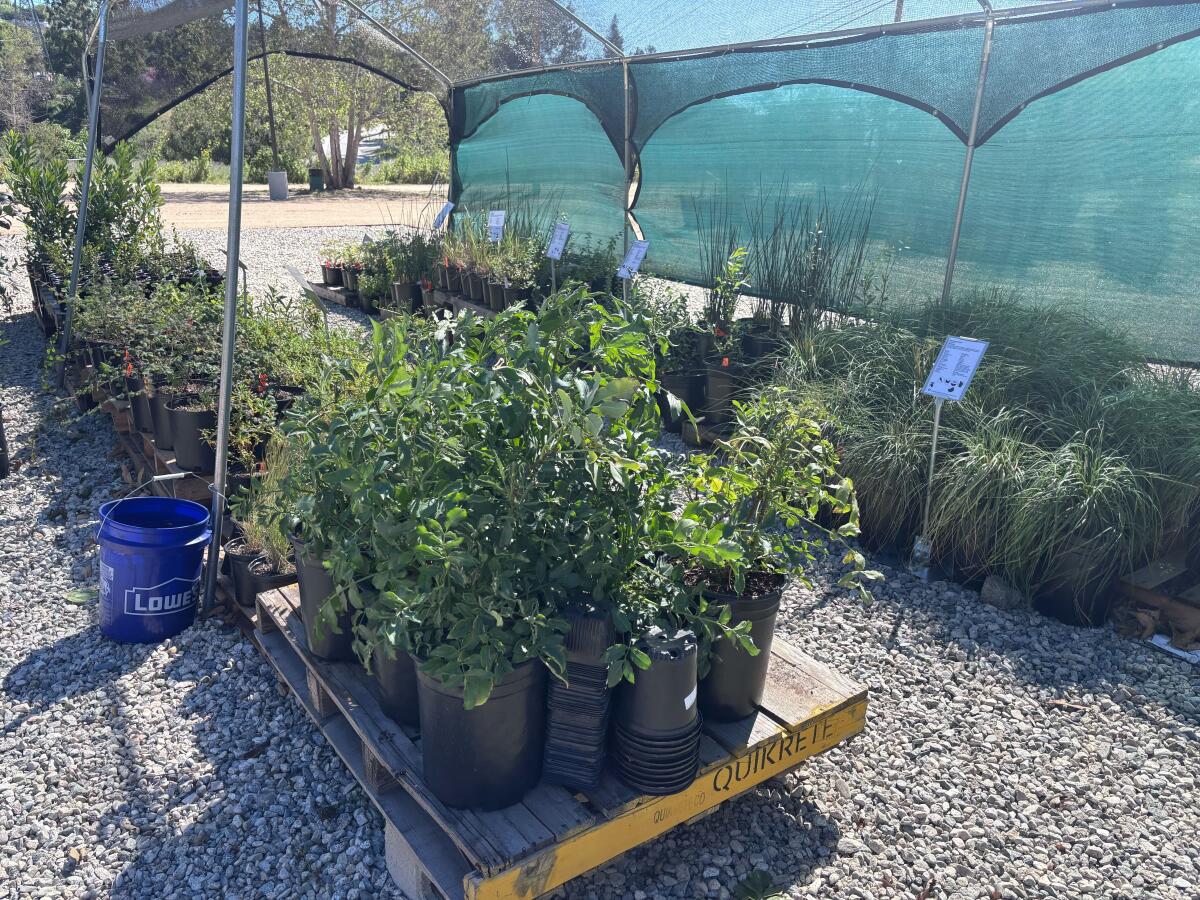
Native plants at the nursery at the Landscape Recovery Center at Eaton Canyon.
(Jaclyn Cosgrove / Los Angeles Times)
L.A. County is partnering with the Theodore Payne Foundation and the Altadena Seed Library to achieve two key goals: 1) Grow the plants in the recovery center’s nursery from locally sourced seeds. 2) Build decentralized seed banks by procuring seeds from L.A. County nature centers.
The latter involves the “process of conserving plant genetics by dehydrating and securely storing seeds for future potential restoration or research projects,” said ecologist Nina Raj, founder of Altadena Seed Library, who is working with the county to develop the seed bank project.
“By carving out space at existing nature centers for a bit of tabletop equipment and storage space, the seeds from their adjacent natural areas [will] be conserved alongside backup populations from partnering nature centers — like an insurance policy in case of, or rather, in preparation for the next natural disaster,” Raj said.
A path near the parking lot of Eaton Canyon Natural Area, as seen on Jan. 14, 2025, and on Saturday.
(Jaclyn Cosgrove / Los Angeles Times)
In the coming months, officials estimate that more than 100,000 seeds sourced from Eaton Canyon will be propagated to aid recovery efforts. The county has also purchased more than 1,000 native shrubs and understory plants, chosen not only for their ecological value but also their cultural significance to the San Gabriel Band of Mission Indians Gabrieleno/Tongva, whose leaders have been advising the county on its canyon restoration efforts.
The county also bought 200 native trees whose seeds came from “mother” trees grown in soil “extremely compatible with the organic matter here at Eaton Canyon,” said Norma Edith García-González, director of L.A. County Parks and Recreation.
All of this intentional sowing and planting is a 180-degree turn from previous recovery efforts. After the Kinneloa fire burned through Eaton Canyon in 1993, officials rushed to stabilize the hillsides. An expert team recommended grass seed be dropped from helicopters all over the hillsides, which present-day experts say may have introduced nonnative grasses to the region.
The nursery at L.A. County’s Landscape Recovery Center at Eaton Canyon.
(Jaclyn Cosgrove / Los Angeles Times)
“The Landscape Recovery Center represents a best-practice model for restoring nature, rebuilding habitat diversity and supporting disaster recovery,” García-González said. “[We are] rebuilding with intention, using climate-resilient native species informed by both ecological science and cultural knowledge.”
Most of Eaton Canyon, including its beloved nature center, burned in the 2025 fire. The recovery center’s modular building and the land around it are among the first built improvements, and the area now has electricity, water access, irrigation systems and restrooms. (The recovery center’s footprint is south of the burned nature center, and no announcement was made Saturday regarding when it might be rebuilt.)
These improvements will allow the Landscape Recovery Center, which will have five full-time and four part-time staff members, to host volunteers interested in caring for habitat, supporting the plant nursery or working in local outreach or on community science.
Volunteer events, including hands-on nursery work, will be scheduled Tuesday through Saturday, with times varying depending on the program. Those age 14 and older can sign up by calling or texting (626) 662-5091. (A quick note: Eaton Canyon remains closed to the public, outside of volunteer opportunities.)
A cultural sign welcomes visitors to Eaton Canyon.
(Jaclyn Cosgrove / Los Angeles Times)
Many volunteers have already been hard at work. Organized by the Eaton Canyon Nature Center Associates, volunteers have donated hundreds of hours to clear out short-pod mustard, castor bean, tree tobacco and fountain grass, which choke out native plants and serve as flashy fuel for wildfires.
All of this work must be done before hikers and other outdoors lovers can return to Eaton Canyon.
Jeremy Munns, a trails planner for L.A. County Parks and Recreation, said rebuilding the Eaton Canyon Trail and other county trails in the Eaton Canyon Natural Area will be part of a future phase.
The fire and subsequent flooding washed out the trail and caused hillsides to collapse into and around the canyon. Contractors, county staff and conservation corps crews will need to install retaining walls, repair drainages and add rock walls (called rock armoring) to stabilize the canyon and protect it from further erosion, Munns said.
A path near the Landscape Recovery Center.
(Jaclyn Cosgrove / Los Angeles Times)
Munns said there isn’t currently a plan to include volunteers in that work because of safety concerns.
“In the future, there will be opportunities for volunteers to help with the maintenance of these trails, but the timing of that has not yet been determined,” he said.
As I walked through the nursery during Saturday’s event, I found myself feeling hopeful. Several rows of California sagebrush, California buckwheat, chaparral beard tongue, sticky monkey flower and more sat in their pots, awaiting their new homes in the nearby ground.
It’s easy to imagine a future in which the entire canyon is healthy once again.
3 things to do
Workers tend to plants growing at the Santa Monica Mountains Fund seed farm.
(Jacsen Donohue / Santa Monica Mountains Fund)
1. Nurture yourself and nature in Newbury Park The Santa Monica Mountains Fund and Second Nature Collective will host a yoga and volunteer day from 8 a.m. to noon Saturday in Newbury Park. Participants will first be led through a 45-minute mindful and meditative yoga session before placing hundreds of native plants in the ground. Register at eventbrite.com.
2. Nosh on nonnative plants in Studio City Urban forager Nick Mann will lead a 3-mile foraging walk from 9:30 a.m. to noon Saturday through Fryman Canyon. He will teach participants how to identify edible nonnative plants commonly found along local trails. Donations requested but not required. Register at eventbrite.com.
3. Ride the river near Azusa Active SGV will host a 12.4-mile bike ride from 9 a.m. to noon Saturday along the West Fork National Scenic Bikeway north of Azusa. Carpooling is encouraged, as the parking lot at the trailhead fills up. Register at eventbrite.com.
The must-read
Condor A1 (a.k.a. Hlow Hoo-let) soars across the sky in far Northern California.
(Matt Mais / Yurok Tribe)
In a potentially historic win for condor conservation, Yurok wildlife officials say there might be a condor pair tending to an egg in the tribe’s Northern California homeland — where condors haven’t nested for more than a century. Times staff writer Lila Seidman wrote that condors vanished from the state’s North Coast because of violence carried out by European settlers. “The pair believed to be nesting in Yurok country were captive born and released in 2022, as part of the first group reintroduced in that region,” Seidman wrote. “The pair, formally known as A1 and A0, are the oldest birds from their release cohort at nearly 7 years old — and the only ones old enough to reproduce.”
Happy adventuring,
P.S.
It’s officially baby season at the San Dimas Raptor Rescue. The L.A. County facility, which rehabilitates birds of prey, took in its first great horned owlet in early February. The center anticipates taking in dozens of great horned owlets who are found starving and need to be nursed back to health before being released. Generally, the center tries to release a bird back to the area where it was found. In this little baby’s case, that would be Venice Beach. The center is run, in part, by volunteers who are trained by the county before working with the birds. If you ever find a raptor that you perceive is in need, you can call the center at (626) 559-5732 before interacting with the animal. A great service to our local wildlife!
For more insider tips on Southern California’s beaches, trails and parks, check out past editions of The Wild. And to view this newsletter in your browser, click here.
Many of us go into the mountains to think and practice gratitude.
For the hundreds of thousands of Muslims across Los Angeles County observing Ramadan this month, spending time in nature can offer an opportunity for quiet reflection and growth.
“This sacred month provides an opportunity to merge the spiritual with the physical, finding solace and inspiration in nature,” nonprofit Muslim Outdoor Adventures notes. “Through mindful hiking, we aim to embrace the challenges of staying active during Ramadan, using the trails as a space for reflection and collective growth.”
You are reading The Wild newsletter
Sign up to get expert tips on the best of Southern California’s beaches, trails, parks, deserts, forests and mountains in your inbox every Thursday
Ramadan is considered the holiest month of the Islamic calendar. The holiday typically lasts 29 or 30 days, and during that time, Muslims will fast from sunup to sundown, including not drinking water. This excludes those who are exempt from fasting or not observing the holiday.
This year’s Ramadan started in mid-February and will end around March 19. (The Islamic calendar is based on lunar events, so Ramadan’s start and end dates vary from year to year.)
For fasting hikers, it’s important to ensure you plan accordingly, given your limited daily water and food intake.
Nadiim Domun, materials engineer at INOV8, said in a blog post that fasting hikers should plan ahead, and if they feel up to it, plan to break their fast at the top of a hill, taking their time to arrive at sunset. “On some days you’ll feel better than others. Be kind to yourself and only go hiking on days when your body feels up to it,” Domun said.
Below you’ll find three hikes and walks in places open after sunset. If observing the holiday, may your fasting be easy. Happy Ramadan!
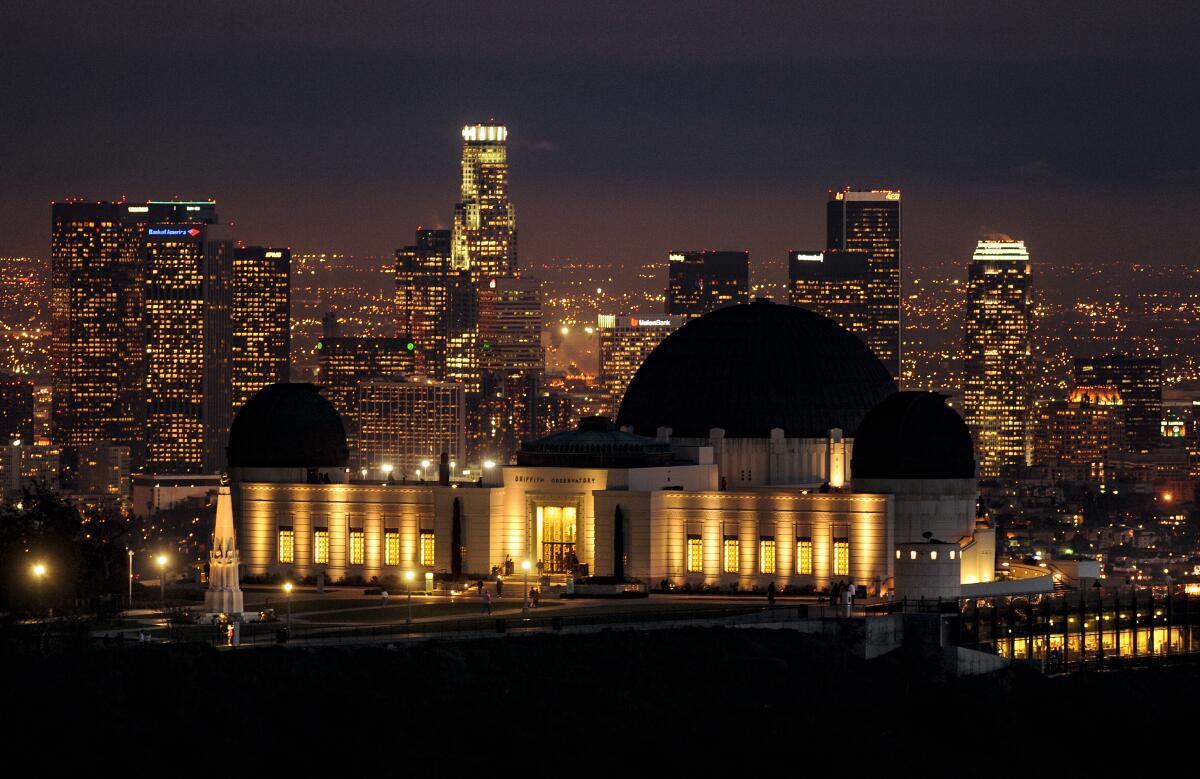
A view of the Griffith Observatory with downtown Los Angeles in the background.
(Wally Skalij / Los Angeles Times)
1. Crystal Springs – Atwater Park in Griffith Park
Distance: 2.7 miles Elevation gained: 130 feet Difficulty: Easy Dogs allowed? Yes Accessible alternative:Los Angeles River Bike Path
The Crystal Springs – Atwater Park route is a 2.7-mile easy stroll through the southeast side of Griffith Park that includes a quick side trip over the L.A. River.
Griffith Park is open from 5 a.m. to 10:30 p.m., although you’ll want to mind where you park, as some areas are open only until sunset.
To begin, you’ll take the wide dirt Main Trail north for just over half a mile before reaching a tunnel. Congrats! You’ve just completed the hilliest portion of this hike. It’s time to turn on that headlamp as you take the tunnel beneath the 5 Freeway, marveling at the wonders of human ingenuity.
Next, you’ll head over to the North Atwater Bridge, or La Kretz Bridge, an impressive modern design you’ve probably noticed from your car in gridlock traffic.
The North Atwater Bridge, or La Kretz Bridge, over the L.A. River.
(Emil Ravelo / For The Times)
The route next takes you to North Atwater Park. This area was separated from the rest of the park when the 5 Freeway was built in the late 1950s, resulting in 200 “prime acres of parkland” being destroyed, according to Friends of Griffith Park. Perhaps you’ll notice the squawk or chirp of birds settling in for the night.
From here, the path loops around the area for about a third of a mile before taking you back to the bridge. You’ll pass a corral and interpretive signs, among other things.
After crossing back over the bridge and under the tunnel (headlamp!), you’ll have a clear view of Beacon Hill, another great hiking destination in the park that offers stunning views of downtown L.A. You will head north again on the Main Trail, walking parallel to the 5. Hopefully the sound of the freeway is blocked by the lush trees that line the path.
You’ll take the Main Trail for about a third of a mile. At 1½ miles in your hike, you’ll bear left (or west), passing the Anza Trail Native Garden, planted by volunteers using seeds harvested from the park.
You’ll loop southwest around the path, passing the golf course and a baseball field before arriving at the newly renovated Griffith Park Visitor Center, open daily from 8 a.m. to 7 p.m. (It also has restrooms!)
From the visitor center, you’ll head east along a dirt path before looping back up with the Main Trail, which you’ll take south back to your car.
And if you’d like to go with a group, L.A. City Department of Recreation and Parks’ junior ecologist Ryan Kinzel and Emerson College professor Jacob Lang are hosting a free night hike through Griffith Park this Thursday.
So grab your headlamp, and have a great time!
Louisa McHugh, of San Pedro, jogs at Cabrillo Beach.
(Carolyn Cole / Los Angeles Times)
2. Beach path at Cabrillo Beach
Distance: 1.6 miles Elevation gained: Minimal Difficulty: Easy Dogs allowed? No Accessible alternative: The route below is a paved flat path.
This 1.6-mile beach walk is a gentle stroll along the mile-long Cabrillo Beach, where during the day you might spot kite surfers, barges and Catalina Island in the near distance.
To begin, start your walk in the northeast corner of the parking lot where the sidewalk begins. Walk south down the sidewalk, unless you’d like to walk on the sandy beach instead. Near the Cabrillo Beach Bath House, the path will curve east. You’ll continue east along the jetty until you reach the Cabrillo Beach Pier, where you might spot people fishing. You can pause to take in the views for as long as you’d like before heading back.
Although there are many beach walk options in Southern California, the reason I’m recommending Cabrillo Beach is because it’s a great place to observe grunion runs. At night, these small silvery fish come completely out of the water to lay their eggs in the wet sand, according to the California Department of Fish and Wildlife.
Beachgoers witness an unusual fish spawning ritual known as a grunion run on Cabrillo Beach in San Pedro.
(Luis Sinco / Los Angeles Times)
“Grunion make these excursions only on particular nights and with such regularity that the time of their arrival on the beach can be predicted a year in advance,” according to the agency.
Depending on how late you’d like to stay up, you can take a beach walk and stay for the grunions, which are expected to arrive at 10:25 p.m. Thursday and 10:50 p.m. Friday.
Hikers walk down a path at Kenneth Hahn State Recreation Area.
(Kayla Bartkowski / Los Angeles Times)
3. Gwen Moore Lake to Western Ridgeline in Kenneth Hahn State Recreation Area
Distance: Around 2½ miles Elevation gained: About 300 feet Difficulty: Moderate Dogs allowed? Yes Accessible alternative: Gwen Moore Lake path
This 2½-mile journey through Kenneth Hahn State Recreation Area will take you past a charming lake and will gain just enough elevation to provide you with striking views of the city. It is more challenging than the other two paths, so please plan accordingly. (And pack that headlamp!)
Kenneth Hahn State Recreation Area is open from 6 a.m. to 8 p.m. Wednesday through Sunday. The park is around 330 acres and includes the stunning Baldwin Hills Scenic Overlook, which thousands access every year via a straight staircase with 282 steps.
Upon arriving at the park, you’ll pay $10 to park. Ask the staff member at the toll booth whether they have a map, as it’s great to have one on hand as you hike. For this hike, I’d recommend parking near the Gwen Moore Lake if you can.
To begin the hike, you’ll start at Gwen Moore Lake. You can either take the paved path that takes you along the western side of the lake or the straight paved path on the eastern side of the lake. It will take you due south.
About a third of a mile in, you’ll walk east past the Kenneth Hahn Visitor Center before quickly joining with the Park to Playa Regional Trail, a 13-mile path that guides hikers from near Windsor Hills to the ocean (near Ballona Creek). That’s an adventure for another day!
You’ll take Park to Playa, a short jaunt, bearing left (northwest) toward a large green space to join the Bowl Loop Trail, or on some maps, Park to Playa Alternate. Follow this path in the northerly direction until it jags left where you’ll join the Western Ridgeline Trail (or Park to Playa Alternate, depending on your map). From here, say hello to beautiful views of the city!
You will next take Diane’s Trail (who is she?) just over half a mile before heading down via the Forest Trail. Pause along the way to appreciate more gorgeous views of the city, including of downtown L.A.
Head south past the Japanese garden, and then take the paved road from the Japanese garden back to where you parked, hopefully near the lake.
3 things to do
During a previous Dana Point Festival of Whales, guests attend a sacred ceremony given by the Acjachemen Nation and observe the Dana Point Surf Club as their members paddle out to welcome the whales to Dana Point’s shores.
(Dana Point Harbor)
1. Whale-come the cetaceans in Dana Point The 55th Annual Dana Point Festival of the Whales, which celebrates gray whale migration, is scheduled for Friday through Sunday in Dana Point Harbor. Visitors can attend the “Welcoming of the Whales” ceremony at 4:30 p.m. Friday at the Ocean Institute, or on Saturday, observe the cardboard boat race, learn at the marine mammal lecture series or chow down at the clam chowder cookout. On Sunday, attendees will pick up trash at 9 a.m. near at the Richard Henry Dana Jr. statue before attending a concert from noon to 5 p.m. performed from a floating dock. Learn more at festivalofwhales.com.
2. Stand up for public lands in Ventura Environmental advocacy groups Los Padres ForestWatch and Climate First: Replacing Oil & Gas will host a hike at 11 a.m. Sunday through the Harmon Canyon Preserve in Ventura. Group leaders will educate hikers on the Trump administration’s proposal to open 850,000 acres, including about 400,000 acres across Central California, to oil and gas drilling. After the hike, participants are invited to make posters to spread awareness of the threat to public lands. Register at eventbrite.com.
3. Kick back with a kite in Redondo Beach The 52nd Annual Redondo Pier Kite Festival will take place from noon to 5 p.m. Sunday at the Redondo Beach Pier (100 Fishermans Wharf). This free community event will feature live music, face painting and a kite flying contest. Kites will be available for purchase on the pier while supplies last. Guests can also bring their own kites. Learn more at redondopier.com.
The must-read
Visitors take the chair lifts at the Mt. Baldy Resort.
(Christina House / Los Angeles Times)
The ski world is becoming increasingly owned by large corporate chains, but small shops like the Mt. Baldy Resort continue to hang on. Times staff writer Jack Dolan wrote about how Mt. Baldy Resort, just over an hour from downtown L.A., works hard to remain competitive. The resort offers a quick escape for Angelenos who want to ski and appreciate “the wide expanse of the Inland Empire stretched to the Pacific Ocean nearly two vertical miles below,” Dolan wrote. Many of its guests find its old-school style more welcoming than the ritzy lodges in Taos and Tahoe. “There’s big conglomerates trying to buy everybody up, and I don’t want that,” said Chris Caron, a 65-year-old retiree who lives 20 minutes down the road from Mt. Baldy Resort. “That’s what I love about here. It’s not so commercialized.”
Happy adventuring,
P.S.
Porkchop is free! A month ago, I featured a story by Times staff writer Lila Seidman, introducing Wild readers to Porkchop, a three-flippered sea turtle who was being rehabilitated by the Aquarium of the Pacific in Long Beach. “Many Angelenos don’t know Eastern Pacific green sea turtles are swimming in their proverbial backyard, but they are — and they’re thriving,” Seidman wrote. “It’s estimated that about 100 of the hulking-yet-graceful animals live in the lower stretch of the San Gabriel River, where salt and freshwater commingle.” And thankfully, it’s now about 101, as Porkchop was released back into the wild on Friday. I’m not crying, you’re crying!
For more insider tips on Southern California’s beaches, trails and parks, check out past editions of The Wild. And to view this newsletter in your browser, click here.