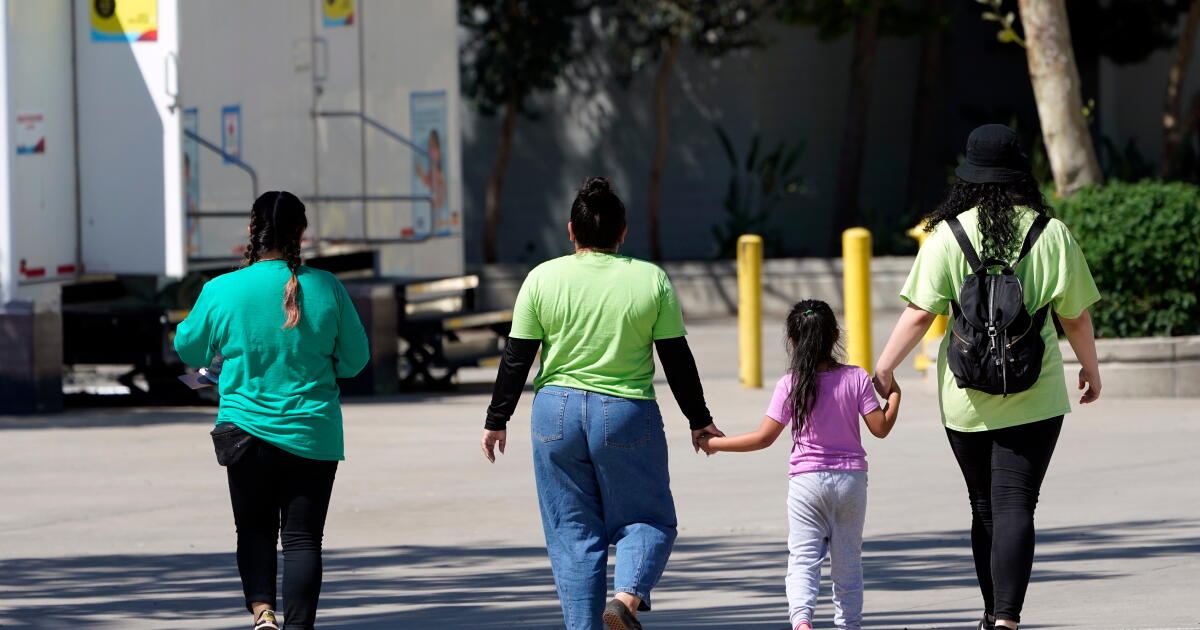
migrant child

Trump wages court battle to lift limits on detentions of migrant kids

For more than a quarter-century, a lawsuit settlement from a case brought in Los Angeles federal court has dictated conditions for children held in immigration detention.

But now, the long-standing settlement — which set minimum standards for housing, education and medical care for migrant kids in federal custody, while strictly limiting how long they can remain there — hangs in the balance in the 9th Circuit Court of Appeals after a challenge by the Trump administration.

At the same time, the federal judge in L.A. who presides over the agreement appears poised to appoint a powerful new enforcer to uphold it.

President Trump has long sought to scrap the Flores settlement, which dates back to the Clinton era. In recent months, the Trump administration has waged a legal battle to cancel the agreement, while also pleading with the district court not to order an independent monitor to boost its compliance.

“[Flores] is the only thing standing between them and indefinite detention of families,” said Leecia Welch, chief legal director at Children’s Rights, a plaintiff in the case.

Last month, Assistant Atty. Gen. Brett A. Shumate pressed the 9th Circuit court to give the administration “the thumbs-up or thumbs-down” on its bid to tear up the settlement and end what he called “judicial micromanagement” of federal immigration policy.

“The Flores consent decree is an agreement which goes well above the constitutional floor,” Shumate told the court during oral arguments in June. “We’re asking that [the Department of Homeland Security’s] compliance with the law be assessed based on the law, not a 30-year-old settlement agreement.”

The three-judge panel sharply questioned the Justice Department’s legal claims, saying little had changed since the government last petitioned the court to have the agreement dissolved in 2020 — a request that was rejected.

The judges also pressed Trump administration lawyers to respond to evidence from scores of declarations filed in district court since last summer, in which detainees describe struggling to sleep in freezing, brightly lit rooms, vomiting from eating spoiled food, and begging for diapers, baby formula and asthma inhalers.

“You’ve said a lot of the reason you’re doing this is to discourage families from coming in the first place, so you’re basically punishing children because their parents brought them here,” Judge Marsha S. Berzon said.

Berzon, a Clinton appointee who issued a fiery dissent last year in a case that challenged the administration’s use of armed troops in immigration enforcement operations, asked: “You’re saying there’s no constitutional problem there?”

“I understand the detention of children at the border is a controversial policy issue, but that’s a policy decision,” Shumate said.

Just a day earlier, Chief U.S. District Judge Dolly M. Gee scolded a pair of government attorneys from her bench in Los Angeles, signaling she would probably appoint a new special master to force compliance with the settlement agreement.

“We’re talking about 11 years of this,” Gee said during the June 1 status conference. “None of these issues are new to me. These are all issues on which I have issued orders. I am very displeased about the fact that my orders are being disregarded and are not being complied with, not in good faith.”

“Both sides seem to be operating in different planes of reality,” Gee said.

The disputed settlement emerged from a 1985 lawsuit over the fate of 15-year-old Jenny Flores, a Salvadoran refugee who was picked up by federal immigration enforcement and left to languish in detention in Pasadena. At the time, there was little awareness that children were among the tens of thousands of migrants fleeing civil war and state collapse in Central America — with virtually no U.S. government infrastructure to protect them.

“It was a surprise,” said Benjamin Roth, a professor at the University of South Carolina College of Social Work and an expert on the agreement. “There was no thought then that there were kids in this mix.”

The current court fight centers on an immigration detention center in Dilley, Texas, run by the private prison company CoreCivic, where the vast majority of children and families in immigration custody are held.

In court filings earlier this month, U.S. Immigration and Customs Enforcement said it has “maintained core Flores-related services” at Dilley and argued its length-of-stay numbers were skewed by a small number of families it was forced to keep because they are considered “national security risks.” U.S. Customs and Border Protection likewise boasted its July 1 report “shows our highest level of compliance to date.”

Immigrant rights advocates called those claims “a fiction.”

“We see the same sorts of problems and concerns and misery that we’ve been seeing for the last 15 months,” said Welch, the Children’s Rights attorney.

In dozens of declarations collected as part of the court record, detainees recounted broccoli full of worms, diapers doled out one at a time, and staff tearing up children’s drawings.

One mother said medical staff laughed off her 8-year-old’s broken arm. Another said she was denied treatment for hepatitis B, even after doctors told her she could develop liver cancer and pass the infection on to her unborn daughter.

Still others described unexplained rashes, outbreaks of diarrhea and infestations of lice, among a host of other maladies for which many said they were offered only Tylenol or allergy medication. Even Christmas brought misery in the form of an ICE agent dressed up as Santa, who shoved away children trying to hug him, according to the detainee declarations submitted to the court.

“What happened on Christmas Day can only be described as an atrocity,” one mother recalled. Children “dropped everything, ran up to him, begged for candy and wanted to take pictures. Some children even cried and begged him for their freedom. Santa himself acted very indifferent.”

The Department of Justice argued that immigrant kids could still sue over poor conditions if the Flores settlement is unwound. But experts say existing protections would collapse without the legal architecture of the consent decree to support them.

“[Under the settlement], the federal government has built out a very efficient system to provide temporary care for kids,” Roth said. “If Flores is dissolved, it’s not going to be easy to stand up this same set of programs.”

If the Trump administration loses before the 9th Circuit, the fight over Flores could soon escalate to the Supreme Court.

“I’d be shocked if the 9th Circuit rules for the government, and I’d be shocked if the Trump administration doesn’t appeal,” said Eric J. Segall, a law professor at Georgia State University and an expert on the high court.

But consent decrees are legally and politically complicated, and the treatment of migrant children further tangles the situation. Given the legal and political complexity, the Supreme Court could rule to keep the settlement in place, or decline to take the case at all, experts said.

“It’s more likely than not the court would stay away from this,” Segall said.

For now, both the district judge and the 9th Circuit panel appear fed up.

“I think my patience has come to an end,” Gee said during the recent hearing in her Los Angeles courtroom.

Source link

U.S. Senator warns of administration plan to hastily remove over 500 unaccompanied migrant children

A Democratic U.S. senator warns the Trump administration is getting ready to round up 500 immigrant children in a hasty effort to remove them from the country, bypassing legal protections. It would be their second attempt after a federal court intervened last year in an overnight plan to fly out hundreds of children on Labor Day weekend.

Sen. Ron Wyden of Oregon wrote in a letter Wednesday to U.S. Health Secretary Robert F. Kennedy Jr., which oversees the Office of Refugee Resettlement caring for unaccompanied migrant children, that he had “credible information” that the Trump administration had a list of more than 500 migrant children it was targeting for a fast-track removal process and that the department was racing to act in days. He warned that the administration was abdicating “core humanitarian and child welfare mandates” and demanded an immediate halt to any plans to remove the children.

Wyden, who is the ranking member and senior Democrat of the Senate Finance Committee, which has jurisdiction over ORR, did not detail how he came by his information. His office declined to provide further details. ORR falls under the Department of Health and Human Services.

An HHS spokesperson denied any such plans.

“The new information I obtained leads me to believe that the Department is laying the groundwork for another lawless deportation effort, this time on a greater scale, across more countries of origin,” Wyden wrote.

“You have been entrusted with the care and safety of the children placed within the ORR network. Proceeding with this plan knowingly endangers their lives and violates your duty to these vulnerable children.”

Wyden also issued an early warning last August ahead of what eventually became a chaotic weekend of efforts by the Trump administration to remove Guatemalan children in its care and send them home.

HHS spokesperson Emily Hilliard said in “there are no plans to target these children,” calling Wyden’s claims ”irresponsible fearmongering.”

“The Trump Administration is working to identify the parents or legal guardians of unaccompanied alien children in our care because ensuring every child is placed with a properly vetted sponsor is our top priority,” she said.

Over the Labor Day weekend, dozens of migrant children either staying in government-supervised shelters or with foster families were taken from their homes and bused to airfields in Texas bound for Guatemala. A federal judge woken up in the middle of the night eventually stopped the planes. Lawyers for the children — many who had fled violence at home to come to the U.S. — later described how traumatic the middle-of-the-night removal effort was for them.

The administration insisted it was reuniting the Guatemalan children — at the Central American nation’s request — with parents or guardians who sought their return. Lawyers for at least some of the children said that wasn’t true and argued that in any event, authorities still would have to follow a legal process that they did not.

Migrant children traveling alone are usually entrusted to U.S. government care, and there are various legal protections designed to protect them once they’re in the U.S. and navigating the immigration system.

The Trafficking Victims Protection Reauthorization Act of 2008 is one of the key pieces of legislation designed to protect them. With some limited exceptions, it requires that children be placed in the “least restrictive setting possible,” which generally means that they can be released to a sponsor such as a relative in the U.S. while their immigration proceedings play out.

The children can apply for a specially protected status if they can’t return to their home country because of abuse or neglect and they can also apply for asylum.

The Trump administration has made it increasingly difficult for those children to be released to sponsors though. The administration says that they are doing due diligence to make sure that sponsors are thoroughly vetted and that in the past, children were released into dangerous situations.

But advocates say that the result has been children lingering for months in government shelters.

This time, Wyden said the children at risk of being removed come from various countries, potentially including Guatemala, Honduras, El Salvador, and Afghanistan, and have been in U.S. custody — mainly in foster care — for at least 180 days. He said they were described as not having any “viable sponsor” who could come forward and take care of them in the U.S.

Not having an identified sponsor could mean the child’s parents are in their home countries, are deceased or are too afraid to claim their children after ICE started arresting some parents who are not in the country legally during their reunification efforts.

Gonzalez and Santana write for the Associated Press.

Source link