Weekly insights and analysis on the latest developments in military technology, strategy, and foreign policy.
The Pentagon is reportedly moving a Marine Expeditionary Unit and additional warships to the Middle East, as the war with Iran continues. The move, reported by The Wall Street Journal, will help respond to the Iranian campaign of attacks against shipping in the Strait of Hormuz. So far, Tehran has remained committed to its pledge of paralyzing oil tanker traffic through the strategic waterway.
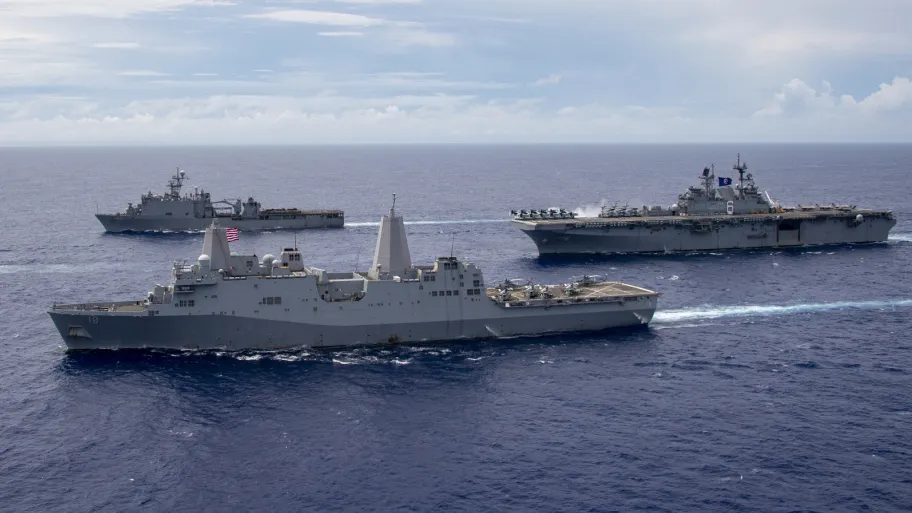
The WSJ reports that U.S. Secretary of Defense Pete Hegseth has approved a request from U.S. Central Command (CENTCOM) for an element of an Amphibious Ready Group and attached Marine Expeditionary Unit, citing three U.S. officials. An Amphibious Ready Group (ARG) typically includes an assault ship, two transport docks, and a support vessel that carries an embarked Marine Expeditionary Unit (MEU) of at least 2,200 Marines.
MEU on the move in the Pacific. (USN)
Two of those officials said that the ARG would be centered around the amphibious assault ship USS Tripoli, said to be now headed for the Middle East from its normal base in Japan.
Sailors aboard the USS Tripoli (LHA 7) conduct a live-fire exercise, March 12, 2026.
Routine live-fire training sharpens warfighting proficiency and ensures U.S. naval forces remain ready to operate across the Indo-Pacific. 🌏⚓
It’s possible other Amphibious Ready Groups could also deploy to the Middle East, if called upon.
The U.S. Navy at war | Carrier update:
– George H.W. Bush CSG completed workups and is deploying soon to join the war against Iran, per @LucasFoxNews – Gerald R. Ford CSG chopped into U.S. 5th Fleet/CENTCOM AOR (DVIDS) – Abraham Lincoln CSG conducting 24/7 combat ops (DOW/PAO) pic.twitter.com/nxWL4vOCVk
A Marine Expeditionary Unit (MEU) is a highly versatile, self-sustained, rapid-response force. Embarked aboard amphibious assault and landing ships, each MEU has fully integrated air, ground, and logistics components. Its four key elements are as follows:
Command Element: Serves as the headquarters for the entire unit and allows a single command to exercise control over all ground, aviation, and combat service support forces.
Ground Combat Element: Provides the MEU with its main combat punch. Built around a Marine infantry battalion, and reinforced with artillery, amphibious vehicles, engineers, and reconnaissance assets.
Aviation Combat Element: The ACE consists of a composite medium helicopter squadron containing transport helicopters of various models and capabilities, attack helicopters and jets, air defense teams, and all necessary ground support assets.
Logistics Combat Element: Providing the MEU with mission-essential support such as medical assistance, motor transport, supply, equipment maintenance, and landing.
A U.S. Marine Corps F-35B assigned to Marine Fighter Attack Squadron (VMFA) 121, 31st Marine Expeditionary Unit, takes off from the USS Tripoli in the U.S. 7th Fleet area of operations. U.S. Marine Corps photo by Lance Cpl. Victor Gurrola Lance Cpl. Victor Gurrola
A MEU would bring a wide range of capabilities to the fight. This can include additional aircraft to strike targets inland, including F-35Bs, and to execute sea control missions, going after Iranian small boats for instance. The latter can be done by embarked AH-1Z and UH-1Y helicopters, as well as F-35Bs. Then there is the assault component, with the ability to airlift Marines anywhere within the reach of its rotary wing component, which also includes MV-22s and CH-53s. The Aviation Combat Element can be tailored to the mission. This can include loading the deck with F-35s or putting a much higher priority on air assault capabilities. The USS Tripoli, which is aviation-focused and lacks a well deck, is specifically built for this kind of augmented air combat element, including being turned into a F-35 “Lightning Carrier.” You can read all about this here.
The MEU can also support beach landing and heavy surface logistical support. The Expeditionary Strike Group (ESG) that makes up the entire flotilla also includes surface combatant escorts that can lend their Aegis capabilities to the fight and launch Tomahawks on demand.
While the carrier strike groups get the most attention for their ability to hit hard from a distance, the MEU/ESG is truly America’s most versatile maritime capability.
In other news, in his latest update on the war on Iran, Secretary Hegseth claims that Iran’s new supreme leader, Mojtaba Khamenei, has been “wounded and likely disfigured” in the ongoing U.S.-Israeli attacks. The defense secretary also pushed back on claims that Iran has begun mining the Strait of Hormuz as it continues its campaign against international shipping in the strategic chokepoint.
In a press conference today, the defense secretary said, “We know the new so-called not-so-supreme leader is wounded and likely disfigured. He put out a statement yesterday — a weak one, actually — but there was no voice, and there was no video. It was a written statement.”
Iranian leadership has “gone underground” and Iran’d newly-appointed Supreme Leader Mojtaba Khamenei has been “wounded, and likely disfigured,” according to Defense Secretary Pete Hegseth. pic.twitter.com/zY5qveWUAv
As to why a written statement was issued, and Mojtaba Khamenei didn’t appear in person, Hegseth added: “I think you know why.”
Hegseth also promised that today will see the highest number of U.S. strikes so far against Iranian targets.
“Their production lines, their military plants, their defense innovation centers; defeated,” Hegseth claimed. “Iran’s leadership is in no better shape. Desperate and hiding, they’ve gone underground, cowering — that’s what rats do.”
Hegseth said the Iranian regime will only see the stars and stripes of the United States and Israel’s star of David, which he describes as “their worst nightmare.”
The Iranian regime has been the number one threat to peace and stability in the Middle East for years. U.S. forces continue to take decisive steps to neutralize Iran’s power projection capabilities. pic.twitter.com/JOT7rRGH7L
In the Strait of Hormuz, Hegseth said that the U.S. military is “dealing with” Iran’s attacks on shipping, and that this is not something it needs to be worried about.
Hegseth dismissed suggestions that Iran has mined the strait, through which around a fifth of the world’s oil passes.
“We’ve heard them talk about it just like you’ve reported recklessly and wildly about it. But … we have no clear evidence of that,” he explained.
Hegseth says there is “no clear evidence” Iran has placed mines in the Strait of Hormuz.
Asked when the Strait of Hormuz might become operational again, Hegseth said: “The only thing prohibiting traffic in the strait at the moment is Iran shooting at shipping.” He said that the United States “has a plan for every option” and that it will not allow the strait to remain “contested.”
Hegseth: “The only thing prohibiting transit in [Hormuz] right now is Iran shooting at shipping.”
According to a report in The New York Times, at least 16 oil tankers, cargo vessels, and other commercial ships have been attacked in the Persian Gulf since the war against Iran began nearly two weeks ago.
Iran has claimed responsibility for several of the attacks. Hegseth also criticized as “bad reporting” the suggestion that Iran could launch a drone attack on California.
“There’s a lot of things Iran has said it could do for a long time, including engaging their proxies and getting them involved in the fight, which they haven’t been able to do. So, we’re watching that very closely,” he said.
Citing multiple sources familiar with the matter, CNN reports that the Pentagon and National Security Council “significantly underestimated” Iran’s willingness to close the Strait of Hormuz in response to U.S. military strikes while Operation Epic Fury was being planned.
“Top Trump officials acknowledged to lawmakers during recent classified briefings that they did not plan for the possibility of Iran closing the strait in response to strikes.”https://t.co/dgNukmCUA9
BREAKING: The Trump administration planned for missile retaliation, proxy attacks, and cyber operations. It did not plan for Iran to weaponize the most important energy chokepoint on Earth.
The headline in the Hezbollah-linked Lebanese newspaper Al-Akhbar this morning reads: “Iran Activates the Hormuz Weapon. Going All the Way.”
הכותרת הבוקר של העיתון אל-אח’באר הלבנוני המזוהה עם חיזבאללה: “איראן מפעילה את נשק הורמוז. הולכים עד הסוף” pic.twitter.com/2xS9cuTTo7
— roi kais • روعي كايس • רועי קייס (@kaisos1987) March 13, 2026
SCOOP: President Trump told G7 leaders this week that Iran is “about to surrender.”
The Iranian regime has shown no signs of imminent surrender or collapse — and on Day 14 of the war, is moving to gain more leverage by choking off the Strait of Hormuz. https://t.co/qHzPkisGKe
In an interview with Fox News, U.S. President Donald Trump said that the U.S. military planned on hitting Iran “very hard” over the next week. A similar comment was posted on Trump’s Truth Social today, in which he said: “Watch what happens to these deranged scumbags today. They’ve been killing innocent people all over the world for 47 years, and now I, as the 47th President of the United States of America, am killing them,” he wrote. “What a great honor it is to do so!”
Gen. Dan Caine, the Chairman of the Joint Chiefs of Staff, today commented on the use of the new Precision Strike Missile (PrSM) short-range ballistic missile, which he confirmed saw its combat debut in the operation against Iran.
Caine said that the PrSM “reaching deep into enemy territory”. He said he spoke to one member of the crew of the system. “I asked him to walk me through a fire mission, not just what they do but what they feel,” he explained. “One of them just looked at me and said: ‘It’s awesome.’”
According to Caine, the U.S. military has hit 6,000 targets so far. In the process, Iran’s naval forces have been rendered “ineffective,” although Tehran still has the capability to harm “friendly forces” and commercial shipping.
More B52 Stratofortress long range bombers have arrived at RAF Fairford. Three landed this morning. There are now six on the ground. They join a fleet of 12 B1 Lancers. Two B1 bombers took off this morning. Supplies of JDAM bunker busting bombs continue to be moved around the… pic.twitter.com/XxwfWSRKQD
Air defenses in the United Arab Emirates intercepted 27 drones and seven ballistic missiles today, the UAE defense ministry said. Since the start of the conflict, UAE air defenses have shot down 285 ballistic missiles, 15 cruise missiles, and 1,567 drones heading toward their territory.
In Oman, two people were killed today after air defenses intercepted a drone over the Al Awahi industrial area, according to state media. The drone was one of two that were shot by air defences on Friday, but the second one did not cause any injuries.
The Israeli military has launched a new campaign across Iran, the Israel Defense Forces (IDF) said today.
The IDF said its most recent wave of strikes included targets in Tehran, Shiraz, and Ahvaz. The IDF had earlier issued evacuation warnings for parts of Tehran and Qazvin, northwest of the capital.
Iranian state TV today reported explosions heard across Tehran.
It appears that at least some of the strikes on the capital may have been deliberately timed to coincide with large-scale demonstrations against Israel and the United States, which have also involved some key regime figures.
Iran’s Foreign Minister Abbas Araghchi:
Today is Quds Day in Iran, and despite the brutal attacks by the Zionist regime and the United States, millions of Iranians have taken to the streets in Tehran and other cities, demonstrating their strong will and determination.
Strikes reported in Tehran near the “Al-Quds Day” march. Iranian officials Ali Larijani and police chief Ahmad-Reza Radan attend the march pic.twitter.com/eZOxK5Da5p
BREAKING: A large explosion struck a square filled with demonstrators in Iran’s capital, Tehran, Iranian state television reported. The cause of the blast was not immediately known. Israel warned it could strike in the area just before the blast. https://t.co/YBy6NTDrj8
Funerals of eight Basijis militiamen were being held in southeastern neighborhood of Khavaran in Tehran today when a Israeli/Us drone struck – Hamshahri newspaper pic.twitter.com/hnJQ8DuIEh
Speaking yesterday, Israeli Prime Minister Benjamin Netanyahu had reportedly said that one of the Israeli goals of the war is to create the conditions for regime change, rather than forcing it directly. Whether regime change is achieved depends on the Iranian people, Netanyahu reportedly asserted.
President Trump has also urged Iranians to take to the streets once the bombing stops, but has also acknowledged that it will be very difficult for them to overthrow the regime.
“I really think that’s a big hurdle to climb for people that don’t have weapons. I think it’s a very big hurdle… It’ll happen, but… maybe not immediately,” Trump told Fox News Radio.
Trump:
Iran’s regime will fall, “but maybe not immediately.”
Former U.S. Secretary of State Condoleezza Rice added her thoughts on the matter of regime change, noting that this was always very hard to achieve from the air, “and it is also very hard to shape the politics afterwards from the air.”
Former U.S. Secretary of State Condoleezza Rice:
It’s very hard to change a regime from the air, and it is also very hard to shape the politics afterwards from the air. pic.twitter.com/YSKPmUVOC9
Dubai has also been on the receiving end of Iranian attacks. There were reports of in Dubai, where videos posted to social media showed a large cloud of smoke over a central area of the financial hub. Authorities there confirmed a fire in an industrial area.
🚨🚨 دبي .. اندلاع النيران في أحد أبراج منطقة كريك هاربور عقب استهدافها بطائرة مسيّرة pic.twitter.com/sW9S6iEQ3E
Israel continues fighting on a second front in Iran, with the latest targets including the Zrarieh Bridge spanning the Litani River.
The IDF says it struck a bridge on the Litani River that was being used by Hezbollah as a “key crossing” to move from northern to southern Lebanon.
The Zrarieh Bridge was struck a short while ago.
According to the military, Hezbollah used the bridge “to move from the north to… pic.twitter.com/7Fq8nvrt0H
— Emanuel (Mannie) Fabian (@manniefabian) March 13, 2026
Israeli Minister of Defense Israel Katz vowed today that the Lebanese government “will pay increasing costs through damage to infrastructure and loss of territory” until Hezbollah is disarmed. “This is only the beginning,” Katz said, according to a report from Reuters.
🎯STRUCK: Hezbollah’s infrastructure across southern Lebanon:
📍Beirut: Assets of the “Al-Quard Al-Hassan”” Association and other significant financial assets of Hezbollah were struck. The recent strikes against the association have effectively and completely disrupted its… pic.twitter.com/g6BRa5LHjD
NATO air and missile defence assets have shot down another Iranian missile fired into Turkish airspace, Turkey’s defense ministry confirmed today. “All necessary measures are being taken decisively and without hesitation against any threat directed at our country’s territory and airspace,” the ministry said in a statement.
Turkey’s Defense Ministry says “a ballistic munition launched from Iran and entering Turkish airspace” was intercepted by NATO air defenses in the Eastern Mediterranean. The statement does not explicitly mention the reported incident near Incirlik Air Base last night. https://t.co/KxSV3uNEwq
The video below purports to show the Iranian ballistic missile over Incirlik Air Base in Turkey.
Another video showing what appears to be a ballistic missile, likely launched by Iran, in the sky tonight over NATO’s Incirlik Air Base, located near Adana, Turkey. pic.twitter.com/Tyb79Rg99Q
According to Jake Epstein of Business Insider, the Iranian ballistic missile was brought down by the Arleigh Burke class destroyer USS OscarAustin, using a Standard Missile-3 (SM-3) anti-missile interceptor. This is said to be the third time in the last two weeks that a U.S. Navy destroyer has used SM-3s to intercept an Iranian missile in Turkish airspace. SM-3 series interceptors are capable of engaging ballistic missiles outside of the Earth’s atmosphere during the mid-course portion of their flight.
New: A defense official tells me the USS Oscar Austin launched an SM-3 interceptor to shoot down the Iranian ballistic missile.
It’s a third time in the last two weeks that a US Navy destroyer in the Eastern Med has used SM-3s to intercept an Iranian missile in Turkish airspace. https://t.co/gHxjdyLirZ
French President Emmanuel Macron confirmed the first French military death of the war. He said that said a French soldier had been killed in an attack in Erbil in Iraq’s autonomous Kurdistan region. Several other soldiers were wounded, he said. French Army soldiers had been engaged in training with Iraqi partners during the drone attack in the region.
Je m’incline devant la mémoire de l’adjudant-chef Arnaud Frion, mort pour la France cette nuit, lors d’une attaque dans la région d’Erbil, en Irak. ⁰Belle figure de soldat et de chef, il incarnait les plus hautes vertus d’un combattant de l’armée de Terre.⁰Mes pensées vont à sa… pic.twitter.com/cBXnGpJbJf
— Chef d’état-major de l’armée de Terre (@CEMAT_FR) March 13, 2026
Yesterday, Reuters reported that at least six French soldiers were wounded in a drone attack targeting a joint Peshmerga-French base in the Makhmour area of Iraq.
Reports out of India suggest that New Delhi is set to repatriate the 183 crew members of the Iranian naval vessel IRIS Lavan as early as today. The sailors had been in the Indian port of Kochi since the Iranian amphibious vessel docked there on March 4 as tensions in the Middle East escalated.
India to repatriate 183 Iranian sailors from warship IRIS Lavan in Kochi. Repatriation can happen as early as today.
The United Kingdom Maritime Trade Operations (UKMTO) office has provided an update on an incident in which a cargo vessel was reported to have been hit by an unknown projectile in the Strait of Hormuz, which resulted in a fire onboard. The incident is said to have occurred 11 nautical miles north of Oman. The vessel had requested assistance, and the crew was previously said to be evacuating the vessel. While the fire onboard the vessel has been extinguished, as of today, at least some of the crew remain unlocated.
Footage has emerged showing the demise of the unique KC-747 aircraft formerly used by the Islamic Republic of Iran Air Force (IRIAF) during an attack on Mehrabad Air Base last week. The tanker version of the 747 was not flown anywhere else in the world, and Iran had just one flying example. You can read all about the aircraft in this past article.
An unnamed IDF official talking to the Israeli N12 news channel provided their assessment of the interdiction campaign against Iranian missile launchers.
“We destroyed between 160 and 190 launchers, disabled another 200, and around 150 remain active,” the official claimed, noting that the United States “didn’t believe we would succeed in the decapitation strike.”
A senior military official:
“The Americans didn’t believe we would succeed in the decapitation strike. We destroyed between 160–190 launchers, disabled another 200, and around 150 remain active. The missile crews are afraid to go out; there are desertions and refusals to…
Noteworthy, however, is an assessment from Bloomberg today, which states that the number of Iranian missile launchers has held steady after a week of unrelenting airstrikes, based on Israeli and Western estimates. “Finding the vehicles in such a large country, especially when some airspace is still dangerous for U.S. and Israeli aircraft, poses a huge challenge,” the article says.
There are rumors that the Iranian missile attack on Ali Al Salem Air Base last week may have destroyed three Kuwait Air Force Typhoon fighters that were based there. This remains unverified at this stage, although satellite evidence confirms that the facility was struck.
I’m hearing the attack on Ali Al Salem air base last week – 5/6 March – destroyed three Kuwait Air Force Typhoons. Those Iranian missiles appear to be very accurate. Doesn’t bode well for those without effective ballistic missile defences…
In a post on X, the House Select Committee on China railed against the Chinese AI firm MizarVision’s assistance to Iran.
The company owns no satellites, but “pulls imagery from multiple commercial providers, including VANTOR Technologies, Airbus Defence and Space, and China’s Jilin-1 satellite constellation, according to Military AI.
MizarVision’s AI software “scans vast volumes of satellite imagery, automatically identifying equipment ranging from aerial tankers like the KC-135 to missile defense systems like the Patriot,” the outlet noted.
Chinese AI firm @MizarVision is reportedly compiling satellite imagery from providers like @vantortech and @AirbusSpace to map U.S. military deployments across the Middle East.
Companies tied to the CCP are turning AI into a battlefield surveillance tool against America. The…
— Select Committee on China (@ChinaSelect) March 13, 2026
Vice President JD Vance told reporters it is unclear whether the new Supreme Leader of Iran was wounded in an attack by the U.S. or Israel.
NEWS: @VP tells us it’s not clear if the wounds that the new Supreme leader of Iran suffered are from a US strike, given much fire in this war, but it was likely from either Israel and US. “We know that he’s hurt. We don’t know exactly how bad, but we know that he’s hurt,” Vance… pic.twitter.com/5l9BwmYW1J
Earlier today, U.S. military officials said tonight would see the most intense bombardment of the war. Now the Israelis are making that claim.
An Israeli leading military journalist is saying that tonight is going to be a very intense night in #Iran in terms of airstrikes, adding “might be the most significant one since the beginning of the war”. He also says that the attack again Iran’s top intel leadership seems to… https://t.co/HSBIqt9aT7
Video emerged on social media showing massive attacks on Tehran.
Meanwhile, there is also video of Iranian ballistic missiles striking central Israel.
3:44 PM EST –
The Tripoli ARG, reportedly tapped to join Epic Fury, is speeding toward the Middle East from Asia, notes open-source investigator MT Anderson.
HIGH-SPEED SURGE: USS Tripoli ARG Sprints for the Middle East
OSINT Update (Mar 12 imagery): Following the announcement that the Tripoli Amphibious Ready Group is heading to the Middle East for Operation Epic Fury, visual evidence confirms she wastes no time.
In a YouTube video, the Economist offers some insights into how the war in Iran has widespread implications across the globe.
“The effective closure of the Strait of Hormuz—a slim waterway between Oman and Iran through which a large proportion of global oil and gas supply flows—has consequences for much of the world,” the publication noted. “The fall-out will not be felt evenly. Russia has a lot to gain from the escalating conflict.”
Is Russia the real winner from the war in Iran? | The Economist
A cyber attack by Iran-linked hackers “has paused the supply of essential medical equipment to UK hospitals,” TheIPaper reports. “Handala – a hacktivist group linked to Iranian intelligence – successfully breached the IT systems of a global medical technology firm supplying the NHS, pausing orders of mouth swabs and defibrillators to UK hospitals.”
NEW: A cyber attack by Iran-linked hackers has paused the supply of essential medical equipment to UK hospitals.
Handala – a hacktivist group linked to Iranian intelligence – successfully breached the IT systems of a global medical technology firm supplying the NHS, pausing…
— Richard Holmes 🕵🏻♂️ (@Richard_AHolmes) March 13, 2026
Despite proclamations from Hegseth to the contrary, the number of Iranian missile launchers has held steady after a week of unrelenting airstrikes, Bloomberg News reported, citing Israeli and western estimates. This highlights “the difficulty of finding small, mobile targets without having complete control of the skies,” the outlet explained.
3:00 PM EST—
CENTCOM has published this video showing B-2 Spirit bombers taking off for a raid on Iran. Flying global non-stop missions from their home base in Whiteman, Missouri, America’s stealth bombers have so far targeted Iran’s missile caves. These facilities are built deep under mountains and are primarily used for storage, but some of them actually have the ability to launch ballistic missiles through apertures in their ceilings.
B-2 stealth bombers takeoff to conduct a mission during Operation Epic Fury, delivering long-range fire to not only eliminate the threat from the Iranian regime today, but also eliminate their ability to rebuild in the future. pic.twitter.com/ebyUYNnOLo
The U.K. Ministry of Defence says that a British counter-drone unit shot down “multiple drones overnight” following recent strikes on coalition bases in Iraq. Meanwhile, U.K. Royal Air Force Typhoon fighters flew air defense operations over Bahrain for the first time, the MoD said in an update shared on X.
It added: “British Typhoon and F-35 jets are now flying in defence of British interests and allies across Qatar, Cyprus, UAE, Jordan, and Bahrain. U.K. defences in the eastern Mediterranean now include Typhoon and F-35 jets, air defense and counter-drone units, Wildcat and Merlin helicopters, and a further 400 air defense personnel are currently deployed to protect British lives and interests.”
2:30 PM EST—
Sri Lanka today repatriated the remains of 84 Iranians killed in the U.S. attack on the frigate IRIS Dena, sunk by a U.S. Navy submarine, local officials said.
The sailors were killed when the IRIS Dena was torpedoed on March 4 just off the coast of Sri Lanka, in an incident that you can read more about here.
An Airbus A340 chartered by Iran “left a short while ago carrying the remains of the sailors,” an airport official at Mattala International Airport in the island’s south told AFP earlier today.
The destination of the flight was not disclosed.
This is the Turkish Antalya A340, chartered by Iran to repatriate the remains of 84 sailors killed in a US submarine attack on March 4 just off Sri Lanka’s southern coast. The aircraft has landed at Mattala,- often dubbed Sri Lanka’s ‘ghost airport’ and the world’s emptiest. https://t.co/Yn6ryI9H18pic.twitter.com/n8Gy5SfTnf
Only 77 ships have so far crossed the Strait of Hormuz this month, as the war continues to disrupt one of the world’s most vital shipping routes. This data was provided today by Lloyd’s List Intelligence. Significantly, Lloyd’s said that most of these vessels belonged to the so-called ‘shadow fleet’ — ships used to evade Western sanctions and regulations, typically linked to Russia and Iran.
The 77 transits recorded so far this month compare with 1,229 passages in the same period last year, according to Lloyd’s List.
🚨 Shipping through the Strait of Hormuz has collapsed amid the Middle East war.
Just 77 ships have crossed so far in March, compared to 1,229 during the same period last year, according to Lloyd’s List Intelligence.
There are reports that India has cut a deal with Iran to allow their energy shipments to pass through the Strait.
Iran and India cut a deal: two LPG tankers get through the strait.
That countries are engaging in bilateral discussions with Iran points to the success of the Iranian strategy–as well as the ongoing failure of the US to resolve the security crisis in the strait.…
The Ford is still in the Red Sea and gaining destroyer escorts. It isn’t clear what the plan is for the carrier, but it could move through the tumultuous Bab el Mandeb Strait, which the Houthis again threatened, in order to be in a better striking position in the Arabian Sea. The ship suffered a fire in a laundry facility and is on its second deployment extension. How long it can stay on station remains a major question.
THE BUILDUP CONTINUES: 3rd Destroyer Joins the Ford
OSINT Update (Mar 12 imagery): Tracking the USS Gerald R. Ford (CVN-78) as she continues to hold off the coast of Al Wajh in the Northern Red Sea.
She has shifted her box slightly to ~100km offshore, but the critical tactical… pic.twitter.com/lR1p6qSbmI
Some commentary on the Marine deployment to the Middle East from TWZ‘s editor:
When you think of a Marine Expeditionary Unit in the context of this conflict, one target comes to mind: Kharg Island, where the majority of Iran’s oil exports flow. Untouched by the conflict yet, due to its strategic value and critical infrastructure. Seizing it would be a huge deal and would be a risky operation. Not just the seizing, but more so the staying. If Iran thought it was lost, they could bombard it with pretty much everything they have. Also, unlikely to push the MEU into the Persian Gulf. Would be an aerial operation, also not without risks.
There are also a number of islands in and around the Strait of Hormuz that could be used to help put up a screen against shipping attacks, etc. Also risky for obvious reasons.
There are also a number of islands in and around the Strait of Hormuz that could be used help put up a screen against shipping attacks etc. Also risky for obvious reasons. pic.twitter.com/0nolqdew9J
The USS Tripoli, right, pictured in February sending fuel to the USS Rafael Peralta in a replenishment-at-sea, is heading to the Middle East near Iran as U.S. military commanders have asked the Pentagon for additional options in the ongoing operation in Iran. Photo by Mass Communication Specialist 1st Class Ryre Arciaga/U.S. Navy
March 13 (UPI) — The USS Tripoli, and the 2,500 Marines on the amphibious assault ship, are headed to the Middle East to bolster U.S. military power there as the war in Iran enters its third week.
The Tripoli, along with Marines of the 31st Marine Expeditionary Group, had been operating in the Philippine Sea but is now headed west south of Taiwan through the Luzon Strait, USNI News reported.
Although the Tripoli had been with the USS San Diego and USS New Orleans in the Philippine Sea, it is not clear if the San Diego and the New Orleans are also being moved closer to Iran.
As Iran has closed the Strait of Hormuz to most traffic, and is targeting vessels that transit it, the move comes as U.S. Central Command asked the Pentagon for additional military options in the conflict, Axios reported.
The 31st MEU can conduct ground operations, which have not been announced but have not been ruled out, according to the Trump administration.
The deployment comes as President Donald Trump said he is considering sending U.S. Navy vessels to escort shipping vessels through the strait, the military is planning to take out anti-ship missiles that have been sent by Iran to the area.
CENTCOM is particularly focused on ensuring freedom of navigation in the straight, Joint Chiefs of Staff Chair Gen. Dan Caine told reporters on Friday, which “means going after Iran’s mine-laying capability and destroying their ability to attack commercial vessels.
Oil prices have surged over the last week after Iran shut down the strait, though Caine noted that some traffic is moving through it.
Defense Secretary Pete Hegseth also said Friday that the military is “dealing with” Iranian attacks on the strait, saying that “we have been dealing with it and don’t need to worry about it.”
Hegseth added that as the military campaign continues and Iran’s military capabilities weaken, the United States has also been taking out Iranian defense companies to prevent the ability to build more weapons.
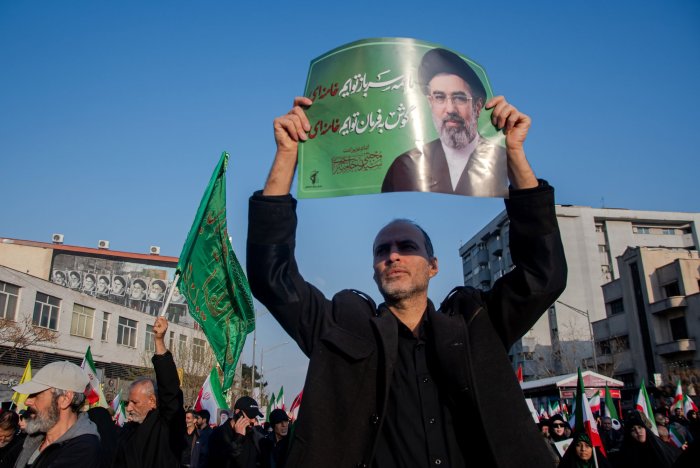
An Iranian man raises a portrait of new supreme leader Mojtaba Khamenei during a rally on Revolution Street in Tehran on March 9, 2026. Photo by Hossein Esmaeili/UPI | License Photo
SEVERAL cruises have been cancelled amid growing regional tensions in the Middle East, as some ships have been left ‘stuck’ in ports.
A number of cruise lines are cancelling European sailings following a number of ships getting stuck in ports in Dubai, Doha and Abu Dhabi amid conflict in the Middle East.
Sign up for the Travel newsletter
Thank you!
A number of cruises are being cancelled including European sailings due to the conflict in the Middle EastCredit: EPA
European cruises cancelled include two Celestyal Cruises sailings on March 20 and March 23 in the Aegean Sea.
This is because the Celestyal Discovery has not yet been able to leave Dubai as it needs to travel through The Strait of Hormuz which is currently closed due to the ongoing conflict in the Middle East.
Guests who were booked on the Greek sailings have been offered a full refund or can opt for cruise credit.
MSC Cruises has cancelled its three remaining wintercruises from Dubai that were due to set sail between March 14 and 28 as MSC Euribia remains docked in Dubai port.
Aroya Cruises has also cancelled all cruises for the remainder of the season.
As for TUI, two ships previously stuck in the Strait have resulted in cruises being cancelled up to March 16 for Mein Schiff 4 and March 12 for Mein Schiff 5.
While the final passengers are on their way home via flight, the ships remain in the area.
The main issue for cruise ships at the moment in regards to the conflict, is that since March 2 the Strait of Hormuz has been closed.
This means any ships, so not just cruise ships, are currently not travelling the Strait of Hormuz.
This impacts cruises mainly heading to Doha, Dubai and Abu Dhabi.
Normally, between 10 and 14 cruises travel through the Strait each week during the winter season (November to March).
A spokesperson for AROYA Cruises commented: “Due to ongoing regional operational considerations and in coordination with the relevant maritime and national authorities, AROYA Cruises will not proceed with the remaining sailings scheduled in the Arabian Gulf for the current season.
“All guests were safely disembarked in Dubai on March 7, with the safety, security, and wellbeing of our guests and crew guiding this process.
“We are supporting our guests as they arrange their onward travel and providing guidance and assistance throughout this process.
“The safety, security, and comfort of our guests and crew remain our highest priority and continue to guide every operational decision we make.”
TUI, MSC, Celestyal Cruises, Viking Cruises, Royal Caribbean and Avalon Waterways have been contacted for comment.
Some ships have been stuck in the Strait of Hormuz, which they must travel through to dock in DubaiCredit: Alamy
What does it mean for British cruise passengers?
The UK government is working to support Brits in all of the impacted areas including the United Arab Emirates.
Official guidance advises Brits who are due to head off on a cruise with stops at the impacted ports to check in with their cruse line to see if their sailing has been cancelled, postponed or rerouted.
For Brits heading on fly-cruises, you should also check with your airline to see if they are still operating your scheduled flight.
Lisa Minot, The Sun’s Head of Travel said: “Six cruise ships are stuck in ports in Dubai, Abu Dhabi and Doha, unable to sail to safer waters without entering the Strait of Hormutz.
“Assistance will be provided to all impacted guests, and cruisers on cancelled sailings will receive full refunds or a future cruise credit to reschedule.”
The Foreign Office has advised against travel to certain countries.
Mia O’Hare Senior Spare Time Reporter and Courtney Eales
09:31, 12 Mar 2026
There’s advice for anyone going to Egypt(Image: murat4art via Getty Images)
At the start of this month, the UK Government issued guidance advising British citizens in Bahrain, Israel, Kuwait, Lebanon, Palestine, Qatar and United Arab Emirates to register their whereabouts. The Foreign, Commonwealth and Development Office (FCDO) is then able to send them direct updates.
There are roughly 300,000 British nationals in the region, of which over 170,000 have registered their presence with the FCDO. The Foreign Office has been revising its travel guidance for Middle Eastern countries and those in the vicinity, as the ongoing conflict continues to cause significant disruption.
The Government stated it is in discussions with commercial operators and regional countries regarding the arrangement of additional flights, as regional airspace has now partially reopened.
One of the most recent updates from the UK Foreign Office relates to entry into Egypt from Jordan.
Guidance stated: “Ferry services operate between Aqaba, Jordan and Taba Heights and Nuweiba in Egypt. Contact ferry operators directly for schedules and availability. Please check travel advice for Jordan for the latest on exit requirements.
“If your stay in Sinai will exceed 15 days, or you are planning to travel in Egypt beyond the Sinai Peninsula, including to fly from mainland airports, for example Cairo or Hurghada, you will need an entry visa”, reports the Liverpool Echo.
The statement continued: “If entering at Taba Heights, this costs 35 US dollars. If entering at Nuweiba, this costs 30 US dollars. Visas can be purchased at the port terminals. Travellers should obtain USD in cash before travelling given payments are often required in cash.”
Currently, the Foreign Office advises against all but essential travel to certain regions of Egypt. Ignoring advice from the Foreign, Commonwealth and Development Office could invalidate your travel insurance.
There is an increased risk of regional tension which could result in travel disruption and other unforeseen consequences. The Foreign Office stated: “British nationals should take sensible precautions, considering their own individual circumstances.”
These precautions include:
Subscribing to FCDO Travel Advice email alerts.
Keeping an eye on local and international media for the latest updates.
Signing up to local information alerts/resources and following the instructions of the local authorities.
Avoiding areas surrounding security or military facilities.
The Foreign Office strongly advises against all travel within a 20km radius of the Egypt-Libya border, with the exception of the town of El Salloum, where it recommends only essential travel.
Active military operations targeting criminal activity are ongoing in this area.
It recommends against all travel to North Sinai Governate owing to ongoing criminal activity and terrorist attacks targeting police and security forces that have led to fatalities.
The complete list of areas the FCDO advises against travelling to can be found here.
US President Donald Trump on Tuesday threatened Iran with unprecedented military consequences if it had placed mines in the Strait of Hormuz and failed to remove them, Anadolu reports.
“If for any reason mines were placed, and they are not removed forthwith, the military consequences to Iran will be at a level never seen before,” Trump wrote on his social media platform Truth Social.
He added that removing the mines would be “a giant step in the right direction.”
Trump, however, also noted that US has “no reports of” Tehran putting out mines in the waterway.
The warning came after a CNN report that Iran has begun laying mines in the strait. Sources told the news outlet that only a few dozen had been placed so far, but Iran still had up to 90% of its small boats and mine-laying vessels intact, leaving it capable of deploying hundreds more.
The Strait of Hormuz is one of the world’s most critical energy chokepoints, with around 20 million barrels of oil passing through it daily. Iran’s IRGC had previously announced the closure of the strait to transit following the start of the US-Israeli attacks on Iran on Feb. 28, pushing oil prices above and raising fears of a prolonged global energy disruption.
The escalation in the Middle East flared since Israel and the US launched a joint attack on Iran on Feb. 28, and to date killing more than 1,200 people, including Ayatollah Ali Khamenei, who was the supreme leader. At least eight US service members have been killed since the beginning of the campaign.
South Korea said it remains capable of deterring threats from North Korea even if the United States redeploys some weapons stationed on the Korean peninsula to the Middle East amid the war involving Iran.
The comments by South Korean President Lee Jae Myung come after reports that key U.S. missile defence systems and military assets could be moved from Asia to support operations linked to the Iran conflict.
The potential redeployment has sparked concern among Asian allies that shifting military resources could weaken regional deterrence against China and North Korea at a time of heightened geopolitical tensions.
Seoul Says Deterrence Remains Strong
Speaking at a cabinet meeting, Lee acknowledged that reports about the relocation of U.S. military equipment had triggered controversy in South Korea.
He said that while Seoul had expressed opposition to the removal of certain weapons, it could not dictate U.S. military decisions.
However, Lee emphasised that South Korea’s own defence capabilities are strong enough to maintain deterrence against North Korea even if some American systems are temporarily relocated. He noted that South Korea’s defence spending and conventional military strength significantly exceed those of the North.
South Korea hosts about 28,500 U.S. troops as part of the long-standing alliance designed to deter aggression from nuclear-armed North Korea.
Missile Defence Systems May Be Redeployed
Officials have indicated that the U.S. and South Korean militaries are discussing the possible redeployment of Patriot missile defense system batteries to the Middle East.
South Korean media reported that some missile batteries may have already been shipped from Osan Air Base and could be redeployed to U.S. bases in Saudi Arabia and the United Arab Emirates.
There were also reports that parts of the Terminal High Altitude Area Defense (THAAD) system could be moved from South Korea to the Middle East.
While Patriot systems provide lower-tier defence against shorter-range missiles, THAAD systems are designed to intercept ballistic missiles at high altitude.
United States Forces Korea declined to comment on the possible relocation of equipment, citing operational security.
Analysts Warn of Miscalculation Risks
Military analysts say that although South Korea possesses strong military capabilities, the presence of U.S. forces and weapons in the country serves as a crucial signal of Washington’s commitment to the region.
According to Choi Gi-il, a military studies professor at Sangji University, the removal of some systems could carry strategic risks.
He warned that North Korea might interpret the redeployment as a weakening of allied defences and could attempt limited provocations to test the alliance’s response.
North Korean leader Kim Jong Un has recently signalled a more aggressive posture, pledging to expand the country’s nuclear arsenal and describing South Korea as its “most hostile enemy.”
Wider Regional Impact
The redeployment of U.S. assets reflects the broader strategic impact of the Iran conflict on global military posture.
Japan, which also hosts major U.S. bases, has seen two U.S. guided-missile destroyers stationed in Yokosuka deployed to the Arabian Sea to support operations linked to the Iran campaign.
The movements have raised concerns in Tokyo as well, with opposition politicians questioning whether U.S. forces stationed in Japan should be used for operations outside the region.
The developments highlight how the conflict in the Middle East is beginning to reshape global military deployments, drawing resources away from Asia and prompting questions about the balance of security commitments across different regions.
South Korean President Lee Jae Myung speaks during a Cabinet meeting at the presidential office Cheong Wa Dae in Seoul, South Korea, 10 February 2026. Photo by YONHAP / EPA
March 10 (Asia Today) — President Lee Jae-myung said Tuesday the government may prepare an early supplementary budget to cushion the economic impact of rising energy prices linked to the Middle East conflict.
Speaking at a Cabinet meeting in Seoul, Lee said additional fiscal measures could be necessary to support small businesses, struggling companies and vulnerable households if global energy shocks continue.
“To provide fiscal assistance and support for small business owners and vulnerable firms, we may inevitably need an early supplementary budget,” Lee said.
Lee also called for targeted support for lower-income households rather than a blanket reduction in fuel taxes as oil prices surge.
The president instructed officials to accelerate additional financial and fiscal measures, including a petroleum price cap system, adjustments to energy taxes and direct assistance to consumers.
“We must mobilize all national capabilities to minimize the impact of external shocks on people’s livelihoods, the economy and industry,” Lee said.
Deputy Prime Minister and Economy Minister Koo Yoon-cheol said the government could potentially finance the supplementary budget without issuing new government bonds.
He cited improving conditions in the semiconductor industry and increased fiscal resources linked to stronger activity in the stock market.
Lee also addressed concerns over reports that United States Forces Korea may remove some air defense assets from the country amid the regional conflict.
“If you ask whether this seriously undermines our deterrence strategy against North Korea, the answer is no,” Lee said.
He acknowledged that South Korea had expressed opposition to the partial withdrawal of air defense systems but noted that the United States may reposition some assets based on its broader military needs.
Foreign media have reported that systems such as the Terminal High Altitude Area Defense system and Patriot missile batteries could be redeployed.
Lee emphasized that South Korea’s defense spending remains among the highest in the world and said the country’s military readiness remains strong.
The armed wing of Hamas, Al-Qassam Brigades, released a video message on Wednesday afternoon showing an Israeli captive currently held in Gaza, the Palestinian Information Centre has reported. The footage shows Omri Miran lighting a candle on what he described as his “second birthday” in captivity.
“This is my second birthday here. I can’t say I’m celebrating; it’s just another day in captivity,” said Miran. “I made this cake for the occasion, but there is no joy. It’s been a year and a half. I miss my daughters and my wife terribly.”
He addressed the Israeli public directly, including his family and friends. “Conditions here are extremely tough. Thank you to everyone demonstrating to bring us home safely.”
The captive also urged Israelis to stage a mass protest outside Prime Minister Benjamin Netanyahu’s residence. “Bring my daughters so I can see them on TV. Do everything you can now to get us home. Netanyahu’s supporters don’t care about us, they’d rather see us dead.”
Screengrab from footage shows Israeli captive Omri Miran
He asked captives released in previous prisoner exchange deals to protest and speak to the media. “Let the people know how bad it is for us. We live in constant fear of bombings. A deal must be reached soon before we return home in coffins.
Miran urged demonstrators to appeal to US President Donald Trump to put pressure on Netanyahu: “Do not believe Netanyahu. Military pressure is only killing us. A deal — only a deal — will bring us home. Turn to Trump. He seems to be the only powerful person in the world who could push Netanyahu to agree to a deal.”
He also mentioned the worsening humanitarian situation: “The captors told me the crossings are closed; no food or supplies are coming in. As a result, we’re receiving even less food than before.”
In conclusion, the captive sent a pointed message to the Israeli leadership: “Netanyahu, Dermer, Smotrich, Ben Gvir — you are the reason for 7 October. Because of you, I am here. Because of you, we’re all here. You’re bringing the state to collapse.”
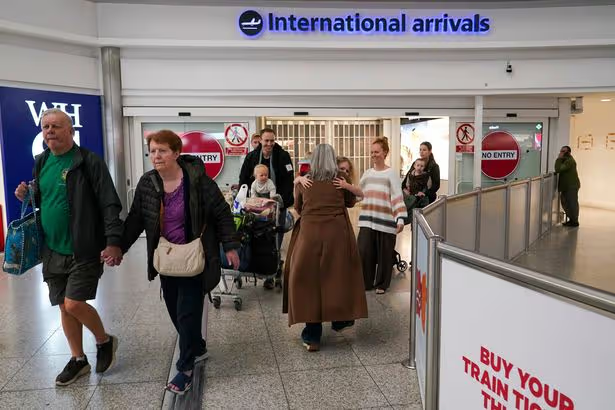
Thousands of Brits were left stranded following the outbreak of the Middle East conflict but now British Airways has announced it will suspend its daily rescue flights from Muscat
Itamar Greenberg laughed when asked if he thought he should be afraid. The 19-year-old Israeli antiwar activist had just described being spat on in the street and is the target of an online hate campaign.
“Yes!” he finally responded. “If I thought about it, I probably should be. I just don’t have time.”
Voices like Greenberg’s are rare in Israel at a time when public clamour for war is growing, and genocidal language already familiar to millions of Palestinians is reemerging, but with a different target – Iran.
Officially, 11 Israelis have been killed in Iranian strikes since the US and Israel launched their war on Iran on February 28. What the actual number might be, or how many of Iran’s ballistic missiles may have penetrated the country’s Iron Dome defence shield, is unknown.
Speaking at the site of an Iranian missile strike in West Jerusalem, shortly after the start of the US-Israeli attacks on Iran, Israeli Prime Minister Benjamin Netanyahu returned to the use of apocalyptic language that has characterised the genocide his country has conducted in Gaza. Comparing Iranians with the Jewish people’s biblical foe, Amalek, who the Jews had been divinely ordered to wipe from the face of the planet, Netanyahu told reporters: “In this week’s Torah portion, we read, “‘Remember what Amalek did to you.’ We remember, and we act.”
So far, Iran claims to have launched strikes across Israel, saying its missiles and drones hit military sites, symbolic infrastructure, and even Netanyahu’s office. Tehran has described the attacks as precise and strategic, rather than indiscriminate and part of a broader regional response. Iran also claims to have targeted locations such as Tel Aviv, Ben Gurion airport and Haifa.
However, Israeli officials have denied many of the specific claims. Netanyahu’s office dismissed Iranian assertions about hitting his office, or affecting his condition, as “fake news”, with stringent reporting restrictions on Iranian strikes within Israel making confirmation either way difficult.
What is clearer is that against the drumbeat of Iranian strikes, the fervour for war appears to be increasing among the public. A poll carried out last week by the Israel Democracy Institute (IDI) suggested overwhelming public support for the war, with 93 percent of Jewish-Israeli respondents expressing support for the strikes on Iran, and 74 percent expressing support for Netanyahu, the country’s historically divisive prime minister.
“No one’s talking about opposition to the war,” Greenberg said, describing an environment in which figures from across Israel’s media and political landscape – with the exception of the left-wing Hadash party and antiwar organisations such as Greenberg’s Mesarvot – had lined up behind the war. “It’s also getting increasingly violent,” he said.
“We held a protest on Tuesday, where the police were already waiting. They beat and arrested us. I was illegally strip-searched,” he said, describing it as efforts intended to humiliate him.
Greenberg is no stranger to such tactics. Six months ago, after being arrested for protesting the genocide in Gaza, prison guards had threatened to carve a Star of David on his face, a permanent reminder of what they thought his priorities should be.
It’s not just antiwar activists who have faced the brunt of the Israeli security establishment’s force.
“The atmosphere is very violent,“ lawmaker Ofer Cassif of the Hadash party told Al Jazeera. “When I leave the house, I’m more worried by the danger posed by a physical attack by fascists than I am by any missile,” he said.
Hadash and lawmakers like Cassif have been targeted by physical threats and attacks throughout the Gaza war. But criticism of the Netanyahu government’s handling of Israeli captives in Gaza meant that opposition to the Gaza war was – comparatively – more socially acceptable. When it comes to Iran, the current climate is toxic, Cassif said.
“We’re often accused of supporting the regime in Tehran,” Cassif explained of the attempts to delegitimise their opposition to the war.
“We’re unequivocally not. We want to see that regime go, but we’re not going to allow Netanyahu to say he’s doing this for the Iranian people. He isn’t. That’s not just rhetoric, that’s fact. The Israeli leadership was just as supportive of the shah as the US, and he was a murderous dictator no less than the current regime,” Cassif said, referring to Mohammad Reza Pahlavi, the leader of Iran before the Islamic revolution.
For now, analysts and observers in Israel describe a society that believes it is almost engaged in a holy war.
“They brought an antiwar activist onto one of the light news programmes,” political analyst Ori Goldberg said from near Tel Aviv, “and she was treated like you would a flat-earther. It’s as if it’s inconceivable that anyone would oppose this war.
“Israel has become a society with no middle ground, no capacity for conversation. It’s as if our entire existence is dependent on our ability to do anything we want. And if the world tries to stop that, then the world’s anti-Semitic, and we all burn.”
Ukrainian President Volodymyr Zelenskyy has said that Kyiv could provide defensive systems as well as assistance to civilians and American soldiers “deployed in certain countries” in the Middle East as the war in Iran continues.
He has reportedly proposed an exchange of Ukrainian defensive technology to combat Iranian drones in return for advanced US defensive systems to use in the war against Russia.
The US-Israel-Iran conflict, which started 10 days ago when the United States and Israel launched strikes on Iran and killed Iran’s supreme leader, Ayatollah Ali Khamenei, has continued to escalate. Iran has responded with strikes on Israel and US military assets and other infrastructure in Kuwait, Bahrain, Qatar, Saudi Arabia and the United Arab Emirates.
As Gulf and other Middle Eastern states continue to attempt to intercept incoming drones and missiles with US-supplied air defences, the US has asked Ukraine to contribute some of its own air-defence systems.
Here is what we know.
What has the US requested from Ukraine and why?
The US has asked for Ukraine’s help in defending Washington’s allies in the Middle East against Iranian missile attacks on infrastructure and US military assets, Ukraine’s president confirmed last week.
At the moment, the US is using air defence systems such as the Patriot, Terminal High Altitude Area Defense (THAAD) batteries and Airborne Warning and Control System (AWACS) aircraft, to intercept Iranian drones and missiles targeting its military assets in the region. The Patriot Advanced Capability-2 (PAC-2) and PAC-3 are advanced surface-to-air missile defence systems.
However, these types of systems are extremely expensive, costing millions of dollars for each interceptor missile fired, and there are concerns that supplies of US interceptor missiles could run low.
“We received a request from the United States for specific support in protection against ‘shaheds’ in the Middle East region,” Zelenskyy wrote in an X post on March 5.
Shahed drones, particularly the Shahed-136, are Iranian-designed “kamikaze” or loitering munitions which are very low cost compared to the interceptors being used by the US. Costing roughly $20,000-$35,000 each, these GPS-guided drones are about 3.5m (11.5 feet) long and fly autonomously to pre-programmed coordinates to strike fixed targets with explosive payloads. They blow up as they hit their targets.
Over the course of the Iran war, Shahed-136 drones have targeted Middle Eastern countries including Saudi Arabia, Bahrain, Qatar and the UAE where US military assets and troops are hosted. Experts estimate that Iran has thousands of these drones.
Iran has also been supplying Moscow with many thousands of Shahed drones during Russia’s war on Ukraine.
During the course of Russia’s four-year war on Ukraine, Ukraine’s domestic arms industry has been forced to innovate, building low-cost interceptor drones priced at roughly $1,000 to $2,000 to counter Russian attacks with imported Iranian Shahed-136s.
Kyiv is now mass-producing these low-cost interceptor drones.
“The role of Shahed-type drones in long-range attacks has become more prominent in Ukraine after Russia took Iranian technology, improved it, and built it in previously unimaginable numbers,” Keir Giles, a Eurasia expert for the UK-based think tank Chatham House, told Al Jazeera.
A man rides a motorcycle past a Shahed drone in Tehran’s Baharestan Square on September 27, 2025, as part of an exhibit to mark the ‘Sacred Defence Week’ commemorating the 1980-88 Iran-Iraq War [Atta Kenare/AFP]
What has Zelenskyy said?
Zelenskyy has posted several statements on social media confirming that he is ready to help Middle Eastern countries defend their territories by providing technical expertise.
“Ukrainians have been fighting against ‘shahed’ drones for years now, and everyone recognises that no other country in the world has this kind of experience. We are ready to help,” he wrote on X on March 5.
“I gave instructions to provide the necessary means and ensure the presence of Ukrainian specialists who can guarantee the required security.
“Ukraine helps partners who help ensure our security and protect the lives of our people.”
It is understood that Ukraine is in talks with several Middle Eastern countries about this.
On Monday, Zelenskyy said Ukraine has deployed interceptor drones and a team of specialists to help protect US military bases in Jordan.
Zelenskyy wrote on X that he has also spoken directly to Saudi Crown Prince Mohammed bin Salman (MBS) about “countering threats from the Iranian regime”.
He also said he had spoken with the leaders of Bahrain, Jordan, Kuwait, Qatar and the UAE.
Zelenskyy has repeatedly stressed that Ukraine must not weaken its own air defences. However, it is mass-producing this equipment now, and may well be able to afford to share.
“The fact that there are surplus capabilities ready to be sent to the US and the Middle East is unsurprising because Ukraine has led this innovation,” Giles said.
Zelenskyy has therefore proposed an exchange of air defence systems with the US ones being used in the Middle East.
“We ourselves are at war. And I said, completely frankly, that we have a shortage of what they have. They have missiles for the Patriots, but hundreds or thousands of ‘shaheds’ cannot be intercepted with Patriot missiles – it is too costly,” Zelenskyy said.
“Meanwhile, we have a shortage of PAC-2 and PAC-3 missiles. So, when it comes to technology or weapons exchange, I believe our country will be open to it.”
Zelenskyy may also have good political reasons for extending help, analysts say.
“The US has declined support for Ukraine on the ground that it had insufficient supply of air defence munitions, and now more of those Patriots have been fired in the Middle East in a few days, than have been supplied to Ukraine in four years,” Giles said.
“Zelenskyy will be aware that in providing this assistance, he is not only shaming the US, but also directly supporting potential friends and partners in the Middle East, who before now have been ambivalent to the situation in Ukraine,” Giles said.
Who else has sent defensive backup to the Gulf?
European countries including the United Kingdom, France, Spain, Portugal, Greece and Italy have pledged to provide defensive backup to Gulf nations over the past week. Additionally, Australia said it was deploying military assets to the region.
Wary of becoming directly involved in the US-Israeli war on Iran, European countries have nevertheless been drawn into the conflict by attacks on a British base on Cyprus in the Mediterranean and Iranian strikes on Western allies in Gulf countries that host US troops in military bases.
What will happen next?
Just as Ukraine is getting involved in the war, Russia might too, say experts.
“We should not be surprised if before long, as well as Russian technology in Iranian drones, we see Iran launching Shaheds manufactured in Russia,” Giles said.
He described Russia as a “primary beneficiary of current US actions,” pointing to how the surge in oil prices, the relaxation in US curbs on Russian energy exports to keep crude and gas prices under control, and the diversion of air defence munitions from Europe to the Middle East all helped Moscow. These, he said, “are all lifelines for Russia”.
President Volodymyr Zelensky has said Ukrainian drone experts will arrive in the Middle East this week to help Gulf states under attack from Iran.
In recent days, Iran has fired a number of Shahed drones across the Middle East – and some air defences in the region have struggled to cope.
Ukraine has spent the last four years inventing cheap but effective ways of defending their skies from similar Russian strikes, and now some countries have come knocking on their door to ask for help.
The BBC’s Diplomatic Correspondent, James Landale, is in Ukraine and has been to see the latest anti-drone technology the country has to offer.
In 1948, as the foundations of the Israeli state were being laid upon the ruins of hundreds of Palestinian villages, Albert Einstein wrote a letter to the American Friends of the Fighters for the Freedom of Israel (AFFFI), condemning the growing Zionist militancy within the settler Jewish community. “When a real and final catastrophe should befall us in Palestine the first responsible for it would be the British and the second responsible for it the terrorist organisations built up from our own ranks. I am not willing to see anybody associated with those misled and criminal people.”
Einstein — perhaps the most celebrated Jewish intellectual of the 20th century — refused to conflate his Jewish identity with the violence of Zionism. He turned down the offer to become Israel’s president, rejecting the notion that Jewish survival and self-determination should come at the cost of another people’s displacement and suffering. And yet, if Einstein were alive today, his words would likely be condemned under the current definitions of anti-Semitism adopted by many Western governments and institutions, including the controversial International Holocaust Remembrance Alliance (IHRA) definition, now endorsed by most Australian universities.
Under the IHRA definition, Einstein’s outspoken criticism of Israel — he called its founding actors “terrorists” and denounced their betrayal of Jewish ethics — would render him suspect. He would be accused not only of delegitimising Israel, but also of anti-Semitism. His moral clarity, once visionary, would today be vilified.
That is why we must untangle the threads of Zionism, colonialism and human rights.
Einstein’s resistance to Zionism was not about denying Jewish belonging or rights; it was about refusing to build those rights on ethno-nationalist violence. He understood what too many people fail to grasp today: that Zionism and Judaism are not synonymous.
Zionism is a political ideology rooted in European colonial logics, one that enforces Jewish supremacy in a land shared historically by Palestinian and other Levantine peoples. To criticise this ideology is not anti-Semitic; it is, rather, a necessary act of justice and a moral act of bearing witness. The religious symbolism that Israel uses is irrelevant in this respect. And yet, in today’s political climate, any critique of Israel — no matter how grounded it might be in international law, historical fact or humanitarian concern — is increasingly branded as anti-Semitism. This conflation shields from accountability a settler-colonial state, and it silences Palestinians and their allies from speaking out on the reality of their oppression. Billions in arms sales, stolen resources and apartheid infrastructure don’t just happen; they’re the reason that legitimate “criticism” gets rebranded as “hate”.
To understand Einstein’s critique, we must confront the truth about Zionism itself. While often framed as a movement for Jewish liberation, Zionism in practice has operated as a colonial project of erasure and domination. The Nakba was not a tragic consequence of war, it was a deliberate blueprint for dispossession and disappearance. Israeli historian Ilan Pappé has detailed how David Ben-Gurion, Israel’s first Prime Minister, approved “Plan Dalet” on 10 March, 1948. This included the mass expulsion and execution of Palestinians to create a Jewish-majority state. As Ben-Gurion himself declared chillingly: “Every attack has to end with occupation, destruction and expulsion.”
This is the basis of the Zionist state that we are told not to critique.
Einstein saw this unfolding and recoiled. In another 1948 open letter to the New York Times, he and other Jewish intellectuals described Israel’s newly formed political parties — like Herut (the precursor to Likud) — as “closely akin in… organisation, methods, political philosophy and social appeal to the Nazi and Fascist parties.”
Einstein’s words were not hyperbole, they were a warning. Having fled Nazi Germany, he had direct experience with the defining traits of Nazi fascism. “From Israel’s past actions,” he wrote, “we can judge what it may be expected to do in the future.”
Einstein warned about what many still refuse to see: a state established on principles of ethnic supremacy and expulsion could never transcend its foundation ethos. Israel’s creation in occupied Palestine is Zionism in practice; it cannot endure without employing repression until resistance is erased entirely. Hence, the Nakba wasn’t a one-off event in 1948; it evolved, funded by Washington, armed by Berlin and enabled by every government that trades Palestinian blood for political favours.
Zionism cannot be separated from the broader history of European settler-colonialism. As Patrick Wolfe explains, the ideology hijacked the rhetoric of Jewish liberation to mask its colonial reality of re-nativism, with the settlers recasting themselves as “indigenous” while painting resistance as terrorism.
The father of political Zionism, Theodor Herzl, stated in his manifesto-novel Altneuland, “To build anew, I must demolish before I construct.” To him, Palestine was not seen as a shared homeland, but as a house to be razed to the ground and rebuilt by and for Jews alone. His ideology was made possible by British imperial interests to divide and dominate post-Ottoman territories. Through ethnic partition and military alliances embellished under the 1917 Balfour Declaration to the ironic Zionist-Nazi 1933 Haavara Agreement, the Zionist project aligned perfectly with the West’s goal, as per the 1916 Sykes-Picot Agreement.
Zionism is a global power structure, not a monolithic ethnic identity.
Many Jews around the world — rabbis, scholars, students and Holocaust survivors and their descendants — continue Einstein’s legacy by saying “Not in our name”. They reject the co-option of Holocaust memory to justify genocide in Gaza. They refuse to be complicit in what the Torah forbids: the theft of land and the murder of innocents. They are not “self-hating Jews”. They are the inheritors of a prophetic tradition of justice. And they are being silenced.
Perhaps the most dangerous development today is, therefore, Israel’s insistence on linking its crimes to Jewish identity. It frames civilian massacres, apartheid policies and violations of international law as acts done in the name of all Jews and Judaism. By tying the Jewish people to the crimes of a state, Israel risks exposing Jews around the world to collective blame and retaliation.
Einstein warned against this. And if Einstein’s vision teaches us anything, it is this: Justice cannot be compromised for comfort and profit. Truth must outlast repression. And freedom must belong to all. In the end, no amount of Israel’s militarisation of terminology, propaganda or geopolitical alliances can suppress a people’s resistance forever or outlast global condemnation. The only question left is: how much more blood will be spilled before justice prevails?
The struggle for clarity today is not just academic, it is existential. Without the ability to distinguish anti-Semitism from anti-Zionism, we cannot build a future where Jews and Palestinians all live in dignity, safety and peace. Reclaiming the term “Semite” in its full meaning, encompassing both Jews and Arabs, is critical. Further isolation of Arabs from their Semitic identity has enabled the dehumanisation of Palestinians and the erasure of shared Jewish-Arab histories, especially the centuries of coexistence, the Jewish-Muslim golden ages in places like Baghdad, Granada/Andalusia, Istanbul, Damascus and Cairo.
Einstein stood up for the future for us to reclaim it.
The way forward must be rooted in truth, justice and accountability. That means unequivocally opposing anti-Semitism in all its forms, but refusing to allow the term to be manipulated as a shield for apartheid, ethnic cleansing and colonial domination. It means affirming that Jewish safety must never come at the price of Palestinian freedom, and that Palestinian resistance is not hatred; it is survival.
And if Einstein would be silenced today, who will speak tomorrow?
Lord of the Rings fans are spoilt for choice with 10 UK destinations that “transport” you to Middle Earth – without the cost and effort of a flight to New Zealand where the film adaptations were made
Jess Flaherty Senior News Reporter
07:07, 09 Mar 2026Updated 09:01, 09 Mar 2026
There’s plenty of scenic spots in the UK that bear a resemblance to the famous Middle Earth locations of The Lord of The Rings franchise (stock image)(Image: WLDavies via Getty Images)
Fans of The Lord of the Rings could be in for a treat, with 10 locations right here in the UK that “transport you to Middle Earth”.
The beloved trilogy, penned by JRR Tolkien, introduced countless fans to a fantastical world brimming with hobbits, elves, wizards and a host of other magical – and terrifying – creatures. Renowned filmmaker Peter Jackson famously brought the trilogy to life on the big screen, utilising his native New Zealand to recreate many of the iconic locations so vividly depicted in the best-selling book series.
If you don’t have the resources or the time to jet off halfway around the globe to immerse yourself in the world of The Lord of the Rings, there are plenty of picturesque spots right here in the UK that fit the bill.
Content creators Emily and Lucy, who have a passion for hiking and promoting local destinations, recently shared a carousel of images on Instagram showcasing 10 locations that bear a resemblance to Middle Earth.
In the caption accompanying their photos, they wrote: “Hiking through The Shire, Misty Mountains and Mordor just like Frodo and Sam – let’s transport you to Middle Earth right here in the UK.
“Just to be clear, this is our personal interpretation and imaginative comparison – not a documented statement about Tolkien’s real-life inspirations.”
Dragon’s Back
Middle Earth inspiration: The Shire
Emily and Lucy said: “The iconic landscape looks like sleeping Smaug the dragon from The Hobbit.”
This renowned trail, located in Powys, Wales, is famous for its winding shape which invites comparisons to mythical creatures.
It’s steep and challenging but provides stunning, panoramic views of the Welsh countryside.
Thor’s Cave
Middle Earth inspiration: Gollum’s Cave
The girls said: “Smeagol would love hiding away in this ancient cave high in the misty mountains with his Precious.”
This natural cavern is located in a steep limestone crag, in the scenic Peak District. It has an instantly recognisable arched entrance, and provides spectacular views across the valley.
Content cannot be displayed without consent
Yorkshire Moors
Middle Earth inspiration: Rohan
The hikers continued: “Picture the Rohirrim army led by King Theodon riding to battle across these wild moors.”
Atmospheric, brooding and expansive, the Yorkshire Moors are renowned for their beauty. In North Yorkshire, this tourist destination is home to one of Britain’s largest stretches of heather moorland.
Gordale Scar
Middle Earth inspiration: Helm’s Deep
Emily and Lucy said: “It’s rumoured that JRR Tolkien did actually visit and draw inspiration from this place for his fortress built within a gorge with a stream running through.”
This limestone ravine is situated near Malham in North Yorkshire.
Pooles Cavern
Middle Earth inspiration: Mines of Moria
The nature fans said: “What lurks in the deep? A balrog? An army of orcs? Probably just some natural limestone and a gift shop [to be honest].”
A historic landmark and celebrated tourist attraction “known as one of the finest caves in Derbyshire”.
Arthur’s Seat
Middle Earth inspiration: Mordor
They said: “Hard to imagine but this was once an active volcano – the perfect place to cast the One Ring into the fire!”
An incredibly famous landmark in Edinburgh, it’s the principal peak of a group of hills that draw countless tourists and locals alike.
Sherwood Forest
Middle Earth inspiration: Fangorn Forest
They explained: “This legendary place, once Robin Hood’s stomping ground, could also have been home to the giant Ents. The Major Oak pictured below is thought to be 1,100 years old!! Can you imagine it coming to life?”
This renowned, ancient woodland can be found in Nottinghamshire.
Lud’s Church
Middle Earth inspiration: Shelob’s Lair
The LOTR enthusiasts said: “This eerie cavern has been the setting for many a spooky folktale – so why not a giant spider waiting to lure you in?”
Located in Buxton, this atmospheric spot is a deep, moss-covered abyss steeped in history and myths.
Old East Buxton Lime Kiln
Middle Earth inspiration: Minas Tirith
The hikers conceded: “Okay, okay! It may not be as grand as Boromir’s home and capital city but with a little imagination, you could explore this abandoned kiln as the rightful King of Gondor.”
These Derbyshire-based industrial heritage structures can be discovered along the Peak District’s trail and make for a popular hiking spot. They were used for converting limestone into quicklime.
The Giant’s Causeway
Middle Earth inspiration: Mount Doom
Emily and Lucy added: “A little cheat as we’ve already covered Mordor but another tribute to a once active volcano but in Northern Ireland! When it erupted thousands of years ago, it formed these hexagonal pillars.”
This iconic and celebrated nature reserve is situated in Northern Ireland and holds designated World Heritage Site status. An extraordinary natural phenomenon, its 40,000 interlocking basalt columns create a fascinating spectacle.
Brent Crude oil was trading at about $93 Friday as prices continue to rise largely because of oil tanker disruption in the Strait of Hormuz. File Photo by Guillaume Horcajuelo/EPA
March 6 (UPI) — The military escalation in the Middle East has shaken global energy markets and put Latin America on alert. The rise in oil prices opens an uncertain scenario if the conflict drags on, but it also generates expectations among the region’s exporting countries.
In that context, Argentina is following the crisis with caution, but also with interest. A more expensive barrel of oil can translate into higher export revenues, which is important for an economy that seeks to increase foreign currency inflows and strengthen its fiscal accounts.
Attention is focused on Vaca Muerta, one of the world’s largest reserves of unconventional oil and gas. The field is in the Neuquén Basin in Argentine Patagonia, and has become the country’s main energy bet.
From there, companies and analysts are closely watching every signal coming from the Middle East. In the sector, a cautious attitude prevails, summed up in the logic of wait and see.
According to data from consulting firm Gas Energy Latin America, the price of a barrel rose from about $64 to nearly $76 after the escalation of the conflict. The jump of around $12 benefits countries that sell crude abroad. Brent Crude was trading at about $93 on Friday as prices continue to rise largely because of oil tanker disruption in the Strait of Hormuz.
Álvaro Ríos Roca, former hydrocarbons minister of Bolivia and director and founder of the firm, told UPI that many Latin American countries depend on selling raw materials such as oil, minerals or agricultural products.
He said these countries earn money mainly from those resources because they do not produce or export much science or technology.
For that reason, when the price of oil rises, countries that produce it earn more money and the state also receives more taxes. That money helps them maintain their public finances, which are often weak.
In this scenario, the analyst identified three clear beneficiaries: Brazil, Guyana and Argentina. All three export more oil than they import, so the price increase is directly reflected in their revenues.
Even so, Ríos Roca believes Argentina has an advantage within the region.
“Argentina has the best prospects in oil and gas. Its exports will continue growing because the international market is demanding more energy,” he said.
Part of that expectation is explained by energy projects already underway. One of them is a mid-scale liquefied natural gas initiative led by Pan American Energy that aims to begin exports in the second half of 2027.
In parallel, another larger project promoted by YPF plans to start large-scale sales between 2030 and 2031. Both projects aim to turn Argentina into a significant exporter of natural gas in the global market.
The situation is different in Brazil. The country exports large volumes of oil, but does not have the same capacity to export gas. Much of the gas it produces is reinjected into oil fields to maintain the pressure that allows crude extraction to continue. Another portion is used in the domestic market.
Argentina, by contrast, bases its production on a technique known as hydraulic fracturing, or fracking. This involves injecting water, sand and chemicals at high pressure to fracture deep rock and release oil and gas trapped underground. It is the same system that fueled the U.S. energy boom over the past decade.
For now, the analyst believes oil prices will continue to be shaped by developments in the Middle East conflict.
“I don’t think it will reach $100. On the other hand, if the crisis eases in the coming weeks, the price could stabilize near $70 per barrel,” Ríos Roca estimated.
Daniel Dreizzen, former secretary of energy planning of Argentina, agrees that rising prices benefit all producing countries.
“Export revenues could increase by about 20%, in line with the rise in oil,” he told UPI.
Deizzen also pointed to a key factor in Argentina’s case: The country’s refining capacity is practically at its limit. That means any additional oil produced will be destined for international markets.
“Argentina cannot refine much more. So the extra crude is exported,” he said.
That scenario also benefits oil companies, which sell the same product at a higher price. If the domestic market follows the so-called “export parity,” internal prices tend to align with international ones. That improves profitability and may encourage new investments in the energy sector.
While some countries gain from the new scenario, others face a more complex outlook. That is the case of Mexico.
According to Ríos Roca, Mexican production will continue declining due to a lack of investment. State-owned Petróleos Mexicanos, or Pemex, carries heavy debt with contractors and has little room to finance new exploration projects.
“Mexico had very strong production for decades, but it has been in decline for years. Even Venezuela now has better prospects,” he said. In Venezuela’s case, some analysts see a possible return of international investment, which could reactivate part of its energy industry.
In contrast, several Latin American countries would be on the losing side if high prices persist. Net energy importers such as Central American countries, as well as Bolivia, Paraguay, Uruguay and Chile, will have to pay more for the fuel they consume. The same applies to many Caribbean economies, where energy costs have a direct impact on inflation and growth.
Beyond the current situation, analysts agree on a global trend: demand for natural gas will continue growing.
“There is no decarbonization of the planet without natural gas,” Ríos Roca said. In that context, liquefied natural gas trade is expanding rapidly and opening opportunities for new exporters.
Argentina seeks to position itself in that market through LNG projects being developed around Vaca Muerta. The same trend could also emerge in Venezuela, where initiatives to export gas in the coming years are under evaluation.
However, the immediate direction of the energy market largely depends on what happens in the Middle East. Both analysts concurred that the key factor is not only the duration of the conflict, but also the damage that oil and transport facilities may suffer.
“Productive infrastructure is being destroyed amid the attacks,” Ríos Roca said. If those facilities are seriously damaged, the effects on the market could last much longer than the conflict itself. In that case, the impact on oil prices would be deeper and more prolonged.
The 7-foot Swiss center was injured Wednesday night in a 130-107 win against the Indiana Pacers. Niederhauser was diagnosed with a Lisfranc injury in his right foot and will require surgery, the team said. The injury involves damage to the ligaments or bones in the middle of the foot.
Niederhauser averaged 4.3 points and 2.9 rebounds in 41 games. After being selected 30th in last year’s NBA draft, he began the season in the G League, but after the Clippers traded Ivica Zubac last month, he was earning more minutes.
In his last five games, Niederhauser was shooting 52% from the field and averaging 8.2 points and 6.2 rebounds while playing 18 minutes a game.
Hezbollah has been attacking Israel as it pummels southern Lebanon and parts of Beirut.
Lebanon is once again drawn into a war many of its leaders say is not their fight.
Against the government’s warnings, Hezbollah has joined Iran in its conflict with Israel. The armed group says it has a right to respond as part of what it calls a resistance campaign.
Recommended Stories
list of 3 itemsend of list
However, this time, the Lebanese government has responded by deciding to ban Hezbollah’s military activities and demanding that it disarm. The group has not heeded that warning.
Now, as the war between the US, Israel and Iran widens to Lebanon, can Hezbollah’s involvement be of any real help to Tehran?
And what price will Lebanon pay as a result?
Presenter: James Bays
Guests:
Heiko Wimmen – Project director for Iraq, Syria and Lebanon at the International Crisis Group
Nimrod Novik – Member of the leadership of Commanders for Israel’s Security
Nabeel Khoury – Non-resident fellow at the Arab Center Washington DC
British Airways has warned all services from Oman up until March 7 are now fully booked as the scramble to return from the Middle East continues amid regional tensions
(Image: AFP via Getty Images)
British Airways has issued a warning that flights returning to the UK are ‘fully booked’ as the rush to get back from the Middle East intensifies.
In its most recent public statement, the UK’s flag carrier cautioned that all services departing from Oman through to 7 March are now completely full.
“Flights from Muscat on 5, 6 and 7 March are now fully booked. We will continue to review the situation and, if we are able to, we will add additional services,” a BA spokesperson stated at 2.14pm on Wednesday.
Oman is the nearest nation to major hubs, including Dubai and Abu Dhabi, with accessible airspace. Out of the 136 flights scheduled to depart from Oman today, just 14 have been axed so far. This stands in stark contrast to the UAE, Bahrain, Kuwait, Iraq and Lebanon, where most flights remain grounded.
The latest guidance from BA reads: “We remain unable to operate flights from Abu Dhabi, Amman, Bahrain, Doha, Dubai and Tel Aviv. We have scheduled further flights from Oman (Muscat) to London Heathrow departing on 6 and 7 March.
“Flights are for our customers with an existing booking who are in Oman or the UAE. If you wish to travel on one of these flights, please contact us via our dedicated phone line on +44 203 467 3854. Our teams will also be getting in touch with our customers.”
One BA flight bound for London Heathrow left Muscat after just a short delay this morning. Another is scheduled to leave at 2.30am local time tomorrow, and a third at the same time on Saturday.
Home Office minister Alex Norris has announced that a Government-chartered plane, which failed to depart from Muscat, is now scheduled to leave for the UK on Thursday.
However, he was unable to provide an exact departure time.
Mr Norris expressed confidence that the first Government rescue flight departing Oman amidst the escalating conflict in the Middle East would take off on Thursday, following an overnight delay. When questioned by LBC about the reason for the delay, he explained: “It didn’t take off because there are operational reasons… about getting passengers on board, and it wasn’t able to happen in the time that it had to happen. So that’s now going to go today instead.”
Earlier on BBC Breakfast, Mr Norris said: “We made sure we got them (the passengers) hotel rooms for the night as well, and we are facilitating and rebooking today’s flight. We hope that they do, and there’s multiple flights after it as well.”
In other news, Defence Secretary John Healey is en route to Cyprus in an attempt to defuse tensions with the island’s government following a drone strike on the British base RAF Akrotiri.
Mr Healey is expected to land in Cyprus later on Thursday. His visit follows the Cypriot high commissioner to Britain expressing his disappointment at the UK Government’s response to defending the island.
On Monday night, a hangar at RAF Akrotiri was struck by an Iranian-made Shahed drone, launched from Beirut in Lebanon, according to Cypriot officials. Two further drones detected on Monday were sh.
Shot down by British warplanes that took off from Akrotiri.
The UK has deployed air defence destroyer HMS Dragon to aid in the protection of Cyprus, although the Type 45 warship isn’t expected to set sail until next week.
Wildcat helicopters equipped with anti-drone capabilities have also been sent to the island and are anticipated to arrive this week.
In other developments in the conflict:
– Iran’s ambassador Seyed Ali Mousavi was summoned by the UK Government on Wednesday.
– A US submarine sank an Iranian warship in the Indian Ocean.
– Iran persisted in launching attacks at countries across the region, with Saudi Arabia and Kuwait targeted with missiles and drones.
– Western officials reported that the rate of Iranian missile strikes had declined, estimating that Tehran had several more days of capability to continue based on the current firing rate – although they warned that the decrease could also be a result of Iran trying to conserve its stockpiles.
– Turkey reported that a “ballistic munition” launched towards it from Iran was intercepted by Nato air defences.
– Economic uncertainty continued over the conflict in a region that plays a crucial role in international oil and gas supplies.
South Korea imposed a travel ban on all of Iran amid rising security concerns, its foreign ministry said Thursday. In this image, an Iranian flag stands amid the destruction in Enghelab Square following Wednesday’s attacks by the United States and Israel on Tehran. Photo by Nahal Farzaneh/UPI | License Photo
South Korea imposed a travel ban on all of Iran amid rising security concerns linked to the escalating conflict in the Middle East, the foreign ministry said Thursday.
A Level 3 travel alert, which advises nationals to leave the country, was upgraded to a travel ban effective at 6 p.m., the ministry said, amid escalating tensions in the Middle East following U.S. and Israeli strikes on Iran.
The ministry warned that Korean nationals who visit or stay in Iran without authorization may face punishment under relevant laws, advising those planning to travel to the region to cancel their trips and urging those currently there to evacuate.
The ministry said it issued the ban as “the worsening situation in the Middle East has raised serious concerns over the safety of Korean nationals visiting or staying in Iran.”
“The government will continue to closely monitor developments in the Middle East and take necessary measures to ensure the safety of Korean nationals,” it said.
The latest measures come as South Korea is continuing to evacuate its citizens from the Middle East after about 140 nationals were brought to safety in earlier operations, as U.S.-Israeli strikes on Iran escalate into a wider regional conflict.
The government is actively considering sending a chartered plane to the region, including the United Arab Emirates, where more than 2,000 South Korean short-term travelers remain stranded due to flight disruptions.
Copyright (c) Yonhap News Agency prohibits its content from being redistributed or reprinted without consent, and forbids the content from being learned and used by artificial intelligence systems.