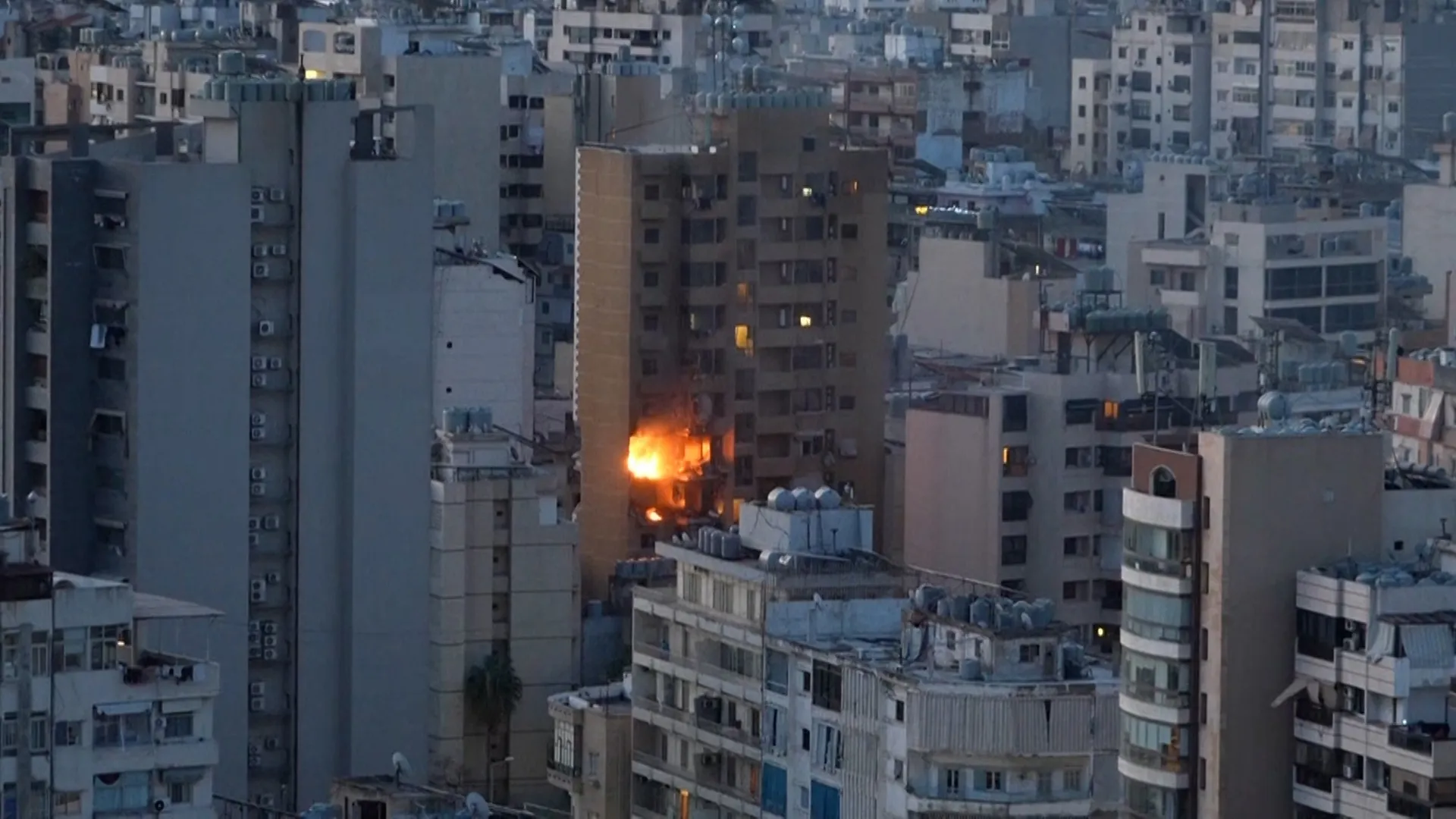
Video shared online shows the destruction caused to buildings and vehicles in Iran’s capital after a reported strike near Mehrabad international airport.
Mohammed bin Abdulaziz al-Khulaifi also says Qatar and Oman cannot act as mediators while under attack.
Published On 11 Mar 202611 Mar 2026
Share
Qatar’s minister of state for foreign affairs has called for a de-escalation in hostilities across the Middle East and urged Iran and the US to return to the negotiation table for a mediated solution.
Speaking to Al Jazeera in an exclusive interview, Mohammed bin Abdulaziz al-Khulaifi said that Iran’s attacks on its regional neighbours bring “benefit for no one”.
Recommended Stories
list of 4 itemsend of list
Iran has responded to a nearly two-week-long bombardment campaign from the United States and Israel by firing missiles and drones at its neighbours in the Gulf region and beyond, causing casualties, damaging critical infrastructure and severely disrupting the region’s energy-driven economy.
Al-Khulaifi said Qatar remains “extremely worried” about the wider range of attacks, including against civilian infrastructure.
“It’s unfortunate where we are standing right now,” the minister said.
“We also believe that there is no pathway to a sustainable and long-lasting solution other than returning to the negotiation table,” he told Al Jazeera.
Qatar condemns in the “strongest terms, the unjustified and outrageous attacks on the state of Qatar that directly impact its own sovereignty”, he said.
Doha will continue to take “every possible and legal measure to defend and practise its exercise of self-defence against this aggression”, he added.
Al-Khulaifi said the conflict demands a “global solution” to ensure that the Gulf’s energy supply chain keeps moving through the Strait of Hormuz, where global traffic has been severely disrupted by the conflict.
Ensuring freedom of movement through the waterway is “very critical,” he noted.
It is notable, Al-Khulaifi pointed out, that Iran has targeted countries such as Qatar and Oman, which had previously served as regional mediators and tried to “build bridges between Iran and the West”.
Neither country can play that role as long as the attacks continue, he said.
“We will not be able to fulfil that role under attack, and that’s something the Iranians need to understand.”
Qatari Prime Minister Mohammed bin Abdulrahman Al Thani tried to convey those points during a phone call with Tehran several days ago, the foreign minister said, when he urged Iran to cease attacks on its neighbours.
“The regional countries are not an enemy of Iran, and the Iranians are not understanding that idea,” Al-Khulaifi told Al Jazeera.
Doha also remains in contact with officials in the US and has encouraged US President Donald Trump to cease hostilities, he said.
“Our line of communication is always open with our colleagues in the United States, and we keep encouraging and supporting the pathway of peace and resolving conflicts through peaceful means.
“We really hope that the parties can find that pathway, end military operations, and return to the negotiation table.”
A group of Democrats in the United States Senate is demanding public hearings on the country’s war against Iran after receiving a series of classified briefings from officials in President Donald Trump’s administration.
Lawmakers say the White House has not clearly explained why the US entered the conflict, what its goals are, or how long it may last.
Republicans currently hold a narrow, 53-47 Senate majority, which gives them the power to control what legislation comes to the floor for debate.
Some Democrats have expressed frustration after the latest closed-door briefing. Trump has not ruled out sending US ground troops into Iran.
“I just came from a two-hour classified briefing on the war,” Senator Chris Murphy from the state of Connecticut said on Tuesday. “It confirmed to me that the strategy is totally incoherent.
“I think this is pretty simple: if the president did what the Constitution requires and came to Congress to seek authorisation for this war, he wouldn’t get it – because the American people would demand that their members of Congress vote no,” he added.
Here is what we know:
What has happened so far?
Since the US and Israel launched attacks on Iran on February 28, senior officials, including Secretary of State Marco Rubio and Defense Secretary Pete Hegseth, have held several closed-door meetings to brief Congress members on the military campaign and its progress.
Because the meetings are classified, lawmakers are restricted in what they can publicly disclose about the information they received.
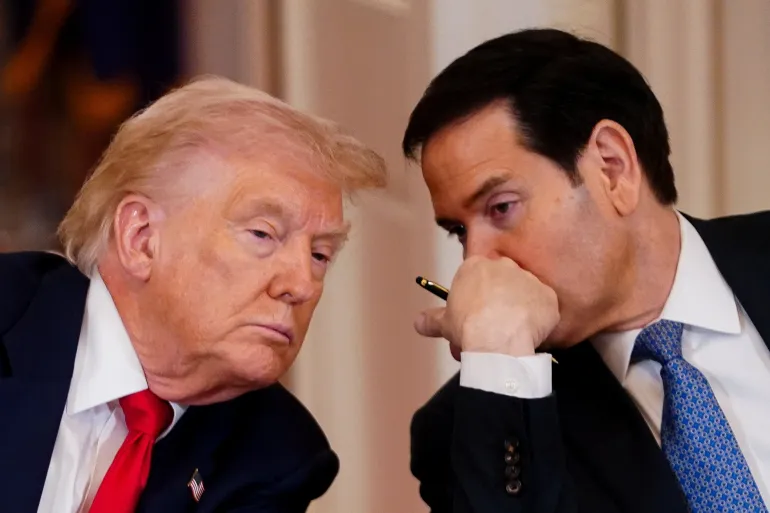
US President Donald Trump listens to Secretary of State Marco Rubio [File: Nathan Howard/Reuters]
What are Democrats saying?
Several Democratic senators have said they left the briefings frustrated, arguing that the administration had not provided clear answers about the war’s objectives, timeline or the long-term strategy guiding their approach to the conflict.
Earlier this week, six Democratic senators also called for an investigation into a strike on a girls’ school in Minab, in southern Iran. Reports indicate the attack, which investigators say involved US forces, killed at least 170 people, most of them children.
“There seems to be no endgame,” Democratic Senator Richard Blumenthal said. “The president, almost in a single breath, says it’s almost done, and at the same time, it’s just begun. So this is kind of contradictory.”
Senator Elizabeth Warren from Massachusetts raised concerns about the cost of war.
“The one part that seems clear is that while there is no money for 15 million Americans who lost their health care, there’s a billion dollars a day to spend on bombing Iran,” Warren said on Tuesday.
“The one thing Congress has the power to do is to stop actions like this through the power of the purse,” she added.
Others seem worried that a ground deployment could take place.
“We seem to be on a path toward deploying American troops on the ground in Iran to accomplish any of the potential objectives here,” Blumenthal, of Connecticut, told reporters after Tuesday’s classified briefing.
“The American people deserve to know much more than this administration has told them about the cost of the war, the danger to our sons and daughters in uniform and the potential for further escalation and widening of this war,” he added.
Democratic Senator Richard Blumenthal of Connecticut [File: Ben Curtis/AP]
What are Republicans saying?
Republicans, who have slim majorities in both houses of Congress, have almost unanimously backed Trump’s campaign against Iran, with only a handful expressing doubt about the war.
Some Republican leaders say the strikes are necessary to curb Iran’s military capabilities, missile programme and regional influence.
They have also argued that the operation is limited in scope and designed to weaken Iran’s ability to threaten US forces and allies in the region.
Republican Representative Brian Mast of Florida, chairman of the House Foreign Affairs Committee, last week publicly thanked Trump for taking action against Iran, saying the president is using his constitutional authority to defend the US against the “imminent threat” posed by Tehran.
But some Republican members of Congress have voiced concerns.
Representative Nancy Mace from South Carolina said she did “not want to send South Carolina’s sons and daughters into war with Iran”, in a post on X.
Rand Paul, a Republican senator from Kentucky, accused the Trump administration of changing its narrative and rationale for the war on a daily basis.
“We keep hearing new reasons for war with Iran—none convincing,” he wrote on X. “‘Free the oppressed’ sounds noble, but where does it end? We’ve been told for decades Iran is weeks from a nuke. War should be a last resort, not our first move. A war of choice is not my choice.”
Why does the debate matter?
The dispute has revived a long-running debate in Washington, DC, about the limits of presidential war powers.
Under the US Constitution, Congress has the authority to declare war, but modern presidents have frequently launched military operations without formal congressional approval, often citing national security or emergency threats.
The law allows the president to deploy US forces for up to 60 days without congressional authorisation, followed by a 30-day withdrawal period if Congress does not approve the action.
Some lawmakers and legal experts say the war on Iran highlights the need for stronger congressional oversight of military action.
“In the 1970s, we adopted something called the War Powers Resolution that gives the president limited ability to do this,” said David Schultz, a professor in the political science and legal departments at Hamline University.
“And so, either you could argue that what the president is doing violates the Constitution by… not [being] a formally declared war; or b, it exceeds his authority, either as commander-in-chief or under the War Powers Act,” he added.
“And therefore, you could argue that domestically, his actions are illegal and unconstitutional,” Schutlz said.
The Trump administration has argued that the February 28 strikes were justified as a response to an “imminent threat”, a rationale often used by presidents to justify military action without prior congressional approval.
However, US intelligence agencies had themselves said before the start of the war that they had no evidence of an imminent Iranian threat to the US or its facilities across the Middle East.
Footage from the ground in Erbil, Iraq shows several drones over the city’s airspace and the wrecking of a drone falling through the sky onto the city.
Footage from the ground in Erbil, Iraq shows several drones over the city’s airspace and the wrecking of a drone falling through the sky onto the city.