Foreign minister says regional powers have been ‘far more effective’ than European countries.
Published On 15 Feb 202615 Feb 2026
Share
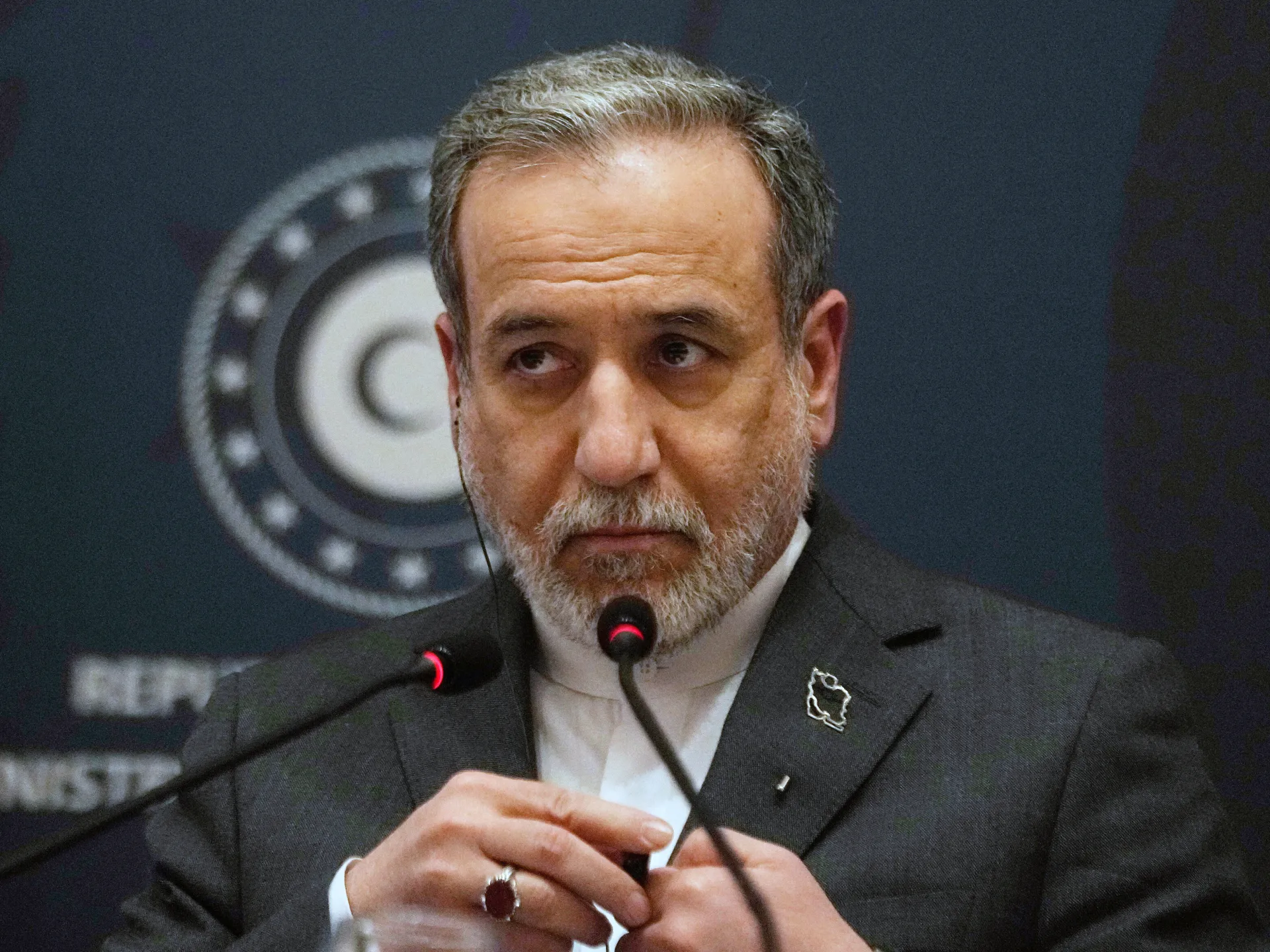
Iranian Foreign Minister Abbas Araghchi has derided the Munich Security Conference as a “circus”, accusing European powers of “paralysis and irrelevance” in efforts to revive nuclear negotiations with the United States.
Iranian officials were not invited to the annual security meeting in the German city.
Recommended Stories
list of 3 itemsend of list
“Sad to see the usually serious Munich Security Conference turned into the ‘Munich Circus’ when it comes to Iran,” Araghchi wrote on X on Sunday.
“The paralysis and irrelevance of the EU/E3 is displayed in the dynamics surrounding the current talks over Iran’s nuclear program. … Once a key interlocutor, Europe is now nowhere to be seen. Instead, our friends in the region [the Gulf] are far more effective and helpful than an empty-handed and peripheral E3.”
The E3 – which included France, the United Kingdom and Germany – were key players in the previous round of nuclear negotiations between world powers and Iran. That process culminated in 2015 with the Joint Comprehensive Plan of Action, a landmark agreement aimed at limiting the scope of Iran’s nuclear programme in exchange for sanctions relief.
The US under the first administration of President Donald Trump withdrew from the deal in 2018 and ramped up sanctions on Iran. Since then, the process has largely stalled. Still, the E3 maintained a role as a go-between with Tehran and Washington.
But since negotiations resumed last year, Gulf countries, such as Oman and Qatar, have taken the lead in facilitating talks between the US and Iran.
Araghchi made the remarks before leaving Tehran to lead a diplomatic and technical delegation to Geneva for a new round of nuclear talks with the US. The talks follow last week’s indirect negotiations in Oman, which is mediating the process, Iran’s Foreign Ministry said in a statement.
During his visit, Araghchi is expected to meet his Swiss and Omani counterparts, as well as the head of the International Atomic Energy Agency, Rafael Grossi, and other international officials.
Abas Aslani, a senior research fellow at the Center for Middle East Strategic Studies, said Araghchi’s comments “indicate a policy shift from the Iranian side that the E3 mechanism … is no longer a valid channel for resolution”.
“This nuclear mediation has moved from Europe to the region, and now the heavy lifting in diplomacy is done by regional players,” he said.
On Tuesday, Oman is to host talks between the US and Iran in Geneva after previous indirect negotiations in Muscat on February 6. Those talks were attended by US envoy Steve Witkoff and Trump’s son-in-law and adviser Jared Kushner.
US and Iranian officials previously held several rounds of talks in the Omani capital to discuss Iran’s nuclear programme last year. But that process was halted as Israel launched a 12-day war with Iran in June, which the US briefly joined by bombing three Iranian nuclear facilities.
The new rounds of negotiations come as tensions in the region remain high, with Trump moving more US military assets to the Middle East. On Friday, the US president said he was sending a second aircraft carrier to the region while openly talking about a change in Iran’s government.
Despite the new push for diplomacy, the two sides have maintained their positions. Iran has shown flexibility in discussing its nuclear programme, but the US wants to widen the talks to include Iran’s ballistic missiles and its support for regional armed groups – two issues that Tehran says are nonnegotiable.
The move, in coordination with the US, is the latest implementation of the ceasefire agreement with Kurdish-led forces.
Published On 15 Feb 202615 Feb 2026
Share
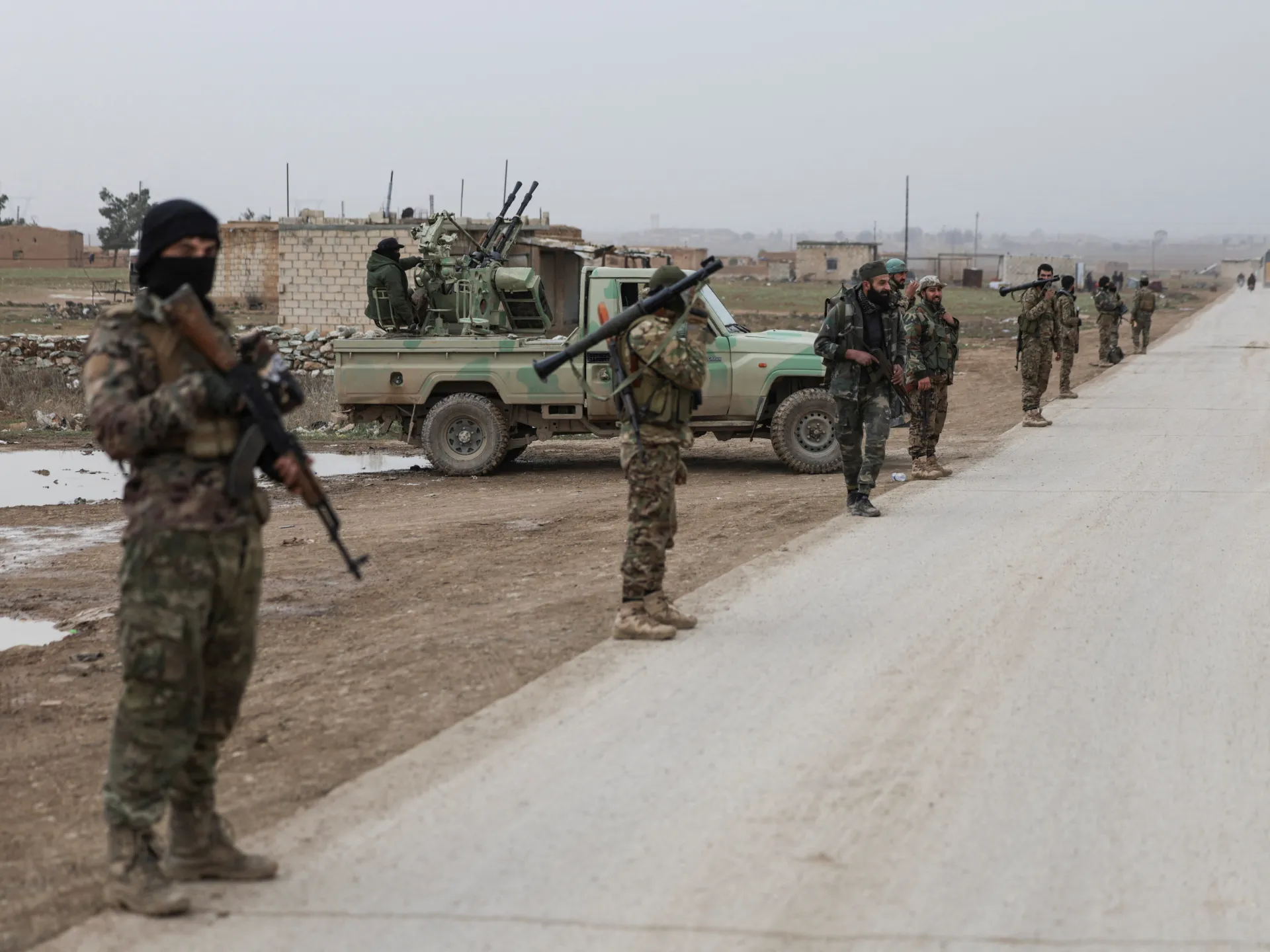
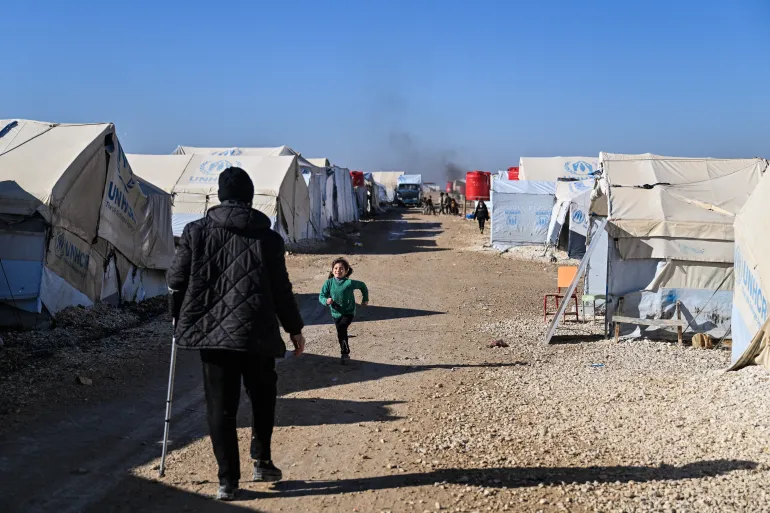
The Syrian army has taken over the al-Shaddadi military base in the northeast of the country following the withdrawal of United States troops, as part of a ceasefire arrangement with the Kurdish-led Syrian Democratic Forces (SDF).
Syria’s Ministry of Defence announced on Sunday that “forces of the Syrian Arab Army have taken over the al-Shaddadi military base in the Hasakah countryside following coordination with the American side”.
The US had been operating in al-Shadaddi since 2016, after Kurdish-led forces seized it from ISIL (ISIS). On Thursday, the Syrian army also took control of the US base of al-Tanf, near the border with Iraq and Jordan.
US Secretary of State Marco Rubio told reporters that the implementation of the ceasefire agreement was “headed in a positive direction”.
“There’s been some days that have been very concerning, but we like the trajectory,” he said. “We have to keep it on that trajectory. We’ve got good agreements in place. The key now is implementation, and we’ll be very involved in that regard.”
He noted that similar agreements needed to be reached with the Druze, Bedouin and Alawite communities in the country.
“We think that outcome, as difficult as it’s been, is far better than the Syria that would have been broken up into eight pieces, with all kinds of fighting going on, all kinds of mass migration, so we feel very positive about that.”
Reduced US presence
Reporting from Aleppo, Al Jazeera correspondent Heidi Pett said residents near al-Shaddadi said in recent days that they were hearing “explosions and seeing fires at the base as Americans destroy remaining material because they’ve been preparing to leave there for a number of weeks”.
“This is part of a broader change in US strategy in the region moving towards partnering directly with the Syrian government,” she said.
The US has been reducing its military footprint in Syria for months, going from 1,500 personnel in July to about 900 currently.
It has been consolidating its ground presence to Tower 22 in Jordan, although it continues to carry out air strikes on ISIL targets in Syria, with US Central Command (CENTCOM) announcing it had conducted 10 air strikes on 30 targets during the February 3-12 period, and killed or captured more than 50 people in two months.
CENTCOM’s commander Admiral Brad Cooper said in a statement that US forces would “remain poised to respond to any [ISIS] threats that arise”.
Tehran, Iran – Iran says it will continue efforts to get out of a blacklist of a prominent global watchdog on money laundering and “terrorism” financing despite “20 years of obstruction” from domestic opponents.
The statement by the Financial Intelligence Unit of Iran’s Ministry of Economic Affairs on Sunday came two days after the Paris-based Financial Action Task Force (FATF) renewed its years-long blacklisting of Iran, according to a report by the official IRNA news agency.
Recommended Stories
list of 4 itemsend of list
The FATF also ramped up measures aimed at isolating Iran from global financial markets with a particular focus on virtual asset service providers (VASPs) and cryptocurrencies.
It recommended member states and financial institutions around the world to:
Refuse to establish representative offices of Iranian financial institutions and VASPs or consider the noncompliance risks involved.
Prohibit financial institutions and VASPs from establishing offices in Iran.
On a risk basis, limit business relationships or financial transactions, including virtual asset transactions, with Iran or people inside the country.
Prohibit financial institutions and VASPs from establishing new correspondent banking relationships and require them to undertake a risk-based review of existing ties.
Even the flow of funds involving humanitarian assistance, food and health supplies as well as diplomatic operating costs and personal remittances are recommended to be handled “on a risk basis considering the “terrorist” financing or proliferation financing risks emanating from Iran”.
What does the FATF move mean?
Iran has been blacklisted by the FATF for years and is currently on the list in the company of just two other countries: North Korea and Myanmar.
Since October 2019, Iran has had “heightened measures” like supervisory examination and external audit requirements recommended against it and has been subject to “effective countermeasures” since February 2020.
This contributed to making access to international transactions increasingly difficult or impossible for Iranian banks and nationals and made the country more dependent on costlier shadowy third-party intermediaries for transactions.
The new countermeasures emphasise existing frameworks but also specifically cite virtual assets, signalling an increased focus.
The fact that the FATF also urges countries and global institutions to remain wary of risks of having any dealings with Iran may mean even more limited transaction opportunities for Iranian entities and nationals.
Small banks maintaining old correspondent relations with Iranian counterparts may also reconsider after being recommended to re-evaluate existing links.
The isolation has hobbled state-run or private income streams and contributed to the continuous depreciation of the Iranian rial over the years.
Links with Iran’s nuclear dilemmas
The FATF, formerly known by its French name, was established by the Group of Seven (G7) countries in 1989 to combat money laundering but later had its mandate expanded to countering financing of “terrorism” and weapons of mass destruction.
It has been formally raising concerns about Iran since the late 2000s, which is also when it started calling for countermeasures as international tensions grew over Iran’s nuclear programme and the country was sanctioned by the United Nations Security Council.
But a year after Iran signed a landmark 2015 nuclear deal with world powers that lifted the sanctions, the FATF also acknowledged a “high-level political commitment” from Iran and agreed to an action plan for the country to address its compliance requirements.
The centrist government of President Hassan Rouhani, who had clinched the deals, pressed ahead with ratifying several laws needed to fulfil the action plan despite opposition from hardliners who were firmly against the increased financial transparency and international supervision.
But United States President Donald Trump unilaterally reneged on the nuclear deal in 2018, imposing a “maximum pressure” campaign that has remained in effect until today. The move empowered the argument from the hardliners in Tehran, who succeeded in blocking the ratification of the rest of the FATF-linked legislation, leaving the issue dormant for years.
Washington has retained the sanctions over the years with some of the latest – including the blacklisting in January of two United Kingdom-based cryptocurrency exchanges – allegedly connected to Iran’s Islamic Revolutionary Guard Corps.
The UN Security Council sanctions were also reinstated against Iran in September when Western powers triggered the “snapback” mechanism of the nuclear accord. They include an arms embargo, asset freezes and travel bans as well as nuclear, missile and banking sanctions that are binding for all UN member states.
Support for ‘axis of resistance’
The Iranian hardliners railing against any progress on FATF-related legislation have presented two main concerns.
They assert that fully adhering to the watchdog’s guidelines would curb Tehran’s ability to back its “axis of resistance” of aligned armed groups in Lebanon, Iraq, Yemen and Palestine. The axis lost its base in Syria with the fall of President Bashar al-Assad in December 2024.
Hardliners have also suggested that Iran’s ability to circumvent US sanctions may be significantly compromised by disclosing all the information required by the FATF.
Iran has been selling most of its oil to China at hefty discounts, using a shadow fleet of ships that turn their transponders off to avoid detection in international waters. The country has also for years been forced to rely on a capillary network of currency exchanges and intermediaries, some of them based in neighbouring countries, such as Türkiye and the United Arab Emirates.
To assuage some of the domestic concerns, two FATF-related laws ratified by Iran in 2025 were passed with special “conditions” and reservations infused in the text.
One of the main conditions was that the ratified regulations must not “prejudice the legitimate right of peoples or groups under colonial domination and/or foreign occupation to fight against aggression and occupation and to exercise their right to self-determination” and “shall not be construed in any manner as recognition of the Zionist occupying regime”, a reference to Israel.
Iran also said it would not accept any referral to the International Court of Justice and asserted that its own Supreme National Security Council would determine which groups qualify as “terrorist” outfits.
Those conditions were rejected by the FATF, leading to the increased countermeasures.
The watchdog also said it expects Iran to identify and freeze “terrorist assets” in line with relevant UN Security Council resolutions. Some of Iran’s nuclear and military authorities are among individuals sanctioned by those resolutions.
Thousands of Western nationals joined the Israeli military amid its genocidal war in Gaza, raising questions over international legal accountability for foreign nationals implicated in alleged war crimes against Palestinians.
More than 50,000 soldiers in the Israeli military hold at least one other citizenship, with a majority of them holding US or European passports, information obtained by the Israeli NGO Hatzlacha through Israel’s Freedom of Information Law has revealed.
Recommended Stories
list of 4 itemsend of list
Since October 7, 2023, Israel’s genocidal war on Gaza has killed at least 72,061 people in military actions that have been dubbed war crimes and crimes against humanity by rights groups.
Rights organisations around the world have been trying to identify and prosecute foreign nationals, many of whom have posted videos of their abuse on social media, for their involvement in war crimes, particularly in Gaza.
So, what does the first such data reveal about the Israeli military? And what could be the legal implications for dual-national soldiers?
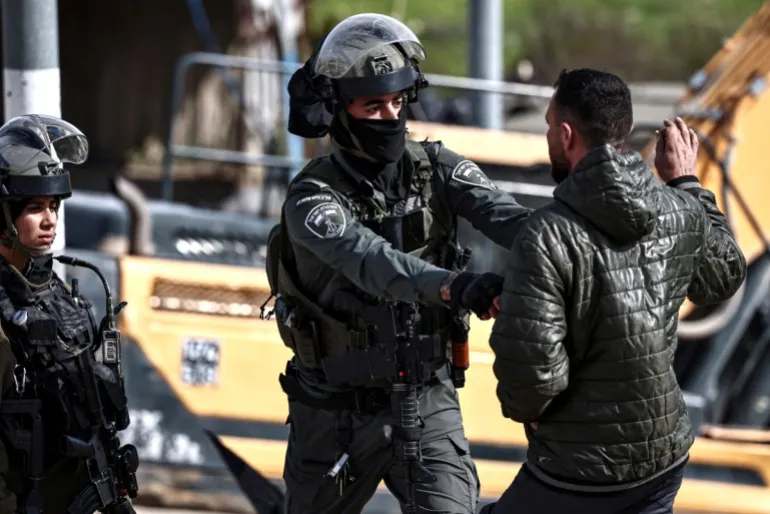
An Israeli soldier pushes a Palestinian man while military bulldozers demolish three Palestinian-owned houses in Shuqba village, west of Ramallah in the Israeli-occupied West Bank on January 21, 2026 [Zain Jaafar/AFP]
Which foreign nationals enlist most in the Israeli military?
At least 12,135 soldiers enlisted in the Israeli military hold United States passports, topping the list by a huge margin. That is in addition to 1,207 soldiers who possess another passport in addition to their US and Israeli ones.
The data – shared with Al Jazeera by Israeli lawyer Elad Man, who serves as the legal counsel for Hatzlacha – shows that 6,127 French nationals serve in the Israeli military.
The Israeli military, which shared such data for the first time, noted that soldiers holding multiple citizenships are counted more than once in the breakdown.
The numbers show service members enlisted in the military as of March 2025, 17 months into Israel’s devastating war in Gaza.
Russia stands at third, with 5,067 nationals serving in the Israeli military, followed by 3,901 Ukrainians and 1,668 Germans.
The data revealed that 1,686 soldiers in the military held dual British-Israeli citizenship, in addition to 383 other soldiers who held another passport in addition to their British and Israeli ones.
South Africa, which brought a case of genocide against Israel at the International Court of Justice (ICJ), also had 589 of its citizens serving in the Israeli military ranks.
Furthermore, 1,686 soldiers hold Brazilian citizenship, 609 Argentine, 505 Canadian, 112 Colombian, and 181 Mexican, in addition to their Israeli nationality.
Israel’s military comprises an estimated 169,000 active personnel and 465,000 reservists – of whom nearly eight percent hold dual or multiple citizenships.
Can dual nationals be tried for war crimes in Gaza?
Ilias Bantekas, a professor of transnational law at Hamad Bin Khalifa University in Qatar, told Al Jazeera that “war crimes incur criminal liability under international law, irrespective of what the law of nationality says”.
Otherwise, Nazi Germans, whose law allowed and obliged them to commit atrocities, would incur no liability, Bantekas added. “Dual nationality is immaterial to criminal liability,” he said.
However, the major issue in prosecuting the accused “is getting [them] on your territory and putting them before a court”, he noted.
Bantekas also added that there is no difference in the question of liability between native soldiers and those of dual nationalities.
Dual nationals, in fact, “may in addition be liable under laws that prevent military service in foreign conflicts or joining armies of other nations”, the professor said.
Prosecuting foreign nationals has been “pretty much the norm”, he noted.
“Think of Nazi Germans tried by Allied war crimes tribunals after World War II, Japanese officers tried by US military courts, and crimes committed during the Bosnian conflict where alleged offenders were tried by various courts in Europe,” Bantekas told Al Jazeera.
Last May, the United Kingdom’s Foreign Office said that allegations of war crimes should be submitted to the Metropolitan Police.
“The UK recognises the right of British dual nationals to serve in the legitimately recognised armed forces of the country of their other nationality,” it said. “Allegations of war crimes should be submitted to the Met Police for investigation.”
Israel has damaged or destroyed more than 80 percent of Gaza buildings [File: AFP]
Have foreign nationals been tried for Gaza war crimes?
Nationals with dual or multiple citizenships have not yet been arrested for committing war crimes in Gaza. But rights groups, including lawyers, are trying to get them prosecuted.
In the UK last April, the Gaza-based Palestinian Centre for Human Rights (PCHR) and the UK-based Public Interest Law Centre (PILC) filed a 240-page report to the Metropolitan Police.
Accusations against the 10 British individuals, whose names have not been publicly disclosed, include murder, forcible transfer of people, and attacks on humanitarian personnel, between October 2023 and May 2024.
In September last year, a case was filed in Germany against a 25-year-old soldier, born and raised in Munich, for participating in the killing of Palestinian civilians in Gaza, by PCHR, the European Center for Constitutional and Human Rights (ECCHR), Al-Haq, and the Al Mezan Center for Human Rights.
The sniper, with shootings documented near Gaza’s al-Quds and Nasser hospitals between November 2023 and March 2024, was a member of a unit known as “Refaim”, “ghost” in Hebrew.
Legal proceedings against members of the same unit are also under way in France, Italy, South Africa, and Belgium.
The Belgian public prosecutor’s office also opened a judicial investigation last October into a 21-year-old Belgian-Israeli citizen, a member of Refaim.
The mandatory military service law in Israel exempts dual nationals residing abroad, making the enlistment a voluntary act, an important distinction when such crimes are tried in foreign courts. Lawyers have reportedly noted that the voluntary nature of the soldiers’ service makes them more liable for alleged crimes.
Men carry a body bag as they bury one of 53 unidentified bodies at a cemetery in Deir el-Balah in the central Gaza Strip on February 13, 2026. Israel has returned many of the Palestinian bodies to Gaza with numbers instead of their names [File: AFP]
What does international law say about soldiers in foreign wars?
South Africa brought its case to the ICJ in December 2023, arguing that Israel’s war in Gaza violates the 1948 United Nations Convention on the Prevention and Punishment of the Crime of Genocide.
While a final ruling could take years, the ICJ issued provisional measures in January 2024 ordering Israel to take steps to prevent acts of genocide in Gaza and to allow unimpeded access for humanitarian aid. But Israel has continued curb the supply of aid into Gaza in violation of the ICJ interim order.
Under the 1948 Genocide Convention, countries that are party to the treaty have a binding obligation to prevent and punish genocide. Countries can investigate and prosecute individuals who may have committed or been complicit in this crime.
In March last year, the International Centre of Justice for Palestinians (ICJP) announced the “Global 195” campaign to hold Israeli and dual-national individuals accountable for war crimes and crimes against humanity in Gaza.
The coalition aims to work simultaneously within multiple jurisdictions to apply for private arrest warrants and initiate legal proceedings against those implicated, including the Israeli military members and the entire Israeli military and political command in its scope.
For countries that are parties to the Rome Statute of the International Criminal Court (ICC), there is an additional layer, where the ICC can assert its jurisdiction. Palestine has been a state party since 2015.
The State of Palestine is recognised as a sovereign nation by 157 of the 193 UN member states, representing 81 percent of the international community. Most recently, it has been recognised by France, Belgium, Canada, Australia, and the UK.
A foreign national, whose country considers Palestine a “friendly state”, would also be vulnerable to prosecution for participating in the Israeli military’s war crimes in Gaza.
A giant portrait of five-year-old Palestinian girl Hind Rajab, who was killed in Gaza in 2024, is unfurled on Barceloneta Beach on the second anniversary of her death and after a film about her killing received an Oscar nomination, in Barcelona, Spain on January 29, 2026 [Nacho Doce/Reuters]
How is the Hind Rajab Foundation tracking alleged war criminals?
The Hind Rajab Foundation – named to honour a five-year-old Palestinian girl whose killing by Israeli soldiers on January 29, 2024 became emblematic of Israel’s genocide in Gaza – has been amassing troves of data with identifiable information about Israeli soldiers.
The Belgium-based foundation is the force behind an international effort for accountability over war crimes in Gaza – and has since filed several cases, including a landmark challenge targeting 1,000 Israeli soldiers.
The foundation identified numerous individuals with dual citizenship, including 12 from France, 12 from the US, four from Canada, three from the UK, and two from the Netherlands, in the complaint.
The foundation has scoured TikTok, Instagram, and YouTube, where the Israeli soldiers boast about atrocities in Gaza, to collect information on the soldiers. It has been using those pieces of evidence to pursue the trail of the accused for war crimes.
“We are in possession of many more profiles of dual nationals beyond the 1,000 soldiers named in our complaint to the ICC. We will be pursuing legal action against all of them in the national courts of their respective countries,” the foundation had said in October 2024. “Impunity must end, everywhere.”
The Hind Rajab Foundation says it pursues criminal accountability for Israeli war criminals, from those who planned and ordered operations to those who executed them, including foreign nationals who have participated in or financed these crimes.
Its founder, Dyab Abou Jahjah, was also threatened by Israeli Minister of Diaspora Affairs Amichai Chikli, who told him to “watch your pager” in a post on X, an allusion to deadly attacks on Hezbollah members’ communication systems in September 2024. At least 12 people were killed and more than 3,000 people were wounded when thousands of pagers were detonated by Israeli operatives during those attacks.
In January last year, a complaint filed by the Hind Rajab Foundation led to a Brazilian judge ordering an investigation into an Israeli soldier vacationing in the country. The soldier had to flee, prompting the Israeli military to order all troops who participated in combat to conceal their identities.
“Criminal liability under international law cannot be dissolved by time bars. It extends forever, and no statute of limitations is applicable,” said Bantekas of Hamad Bin Khalifa University.
However, prosecuting Israeli military members “is practically difficult for two reasons”, he said, noting the difficulty of obtaining firsthand evidence and the wariness of national prosecutors who may fear political or other repercussions.
“If public opinion and political opinion in Europe shifts far more in favour of Palestine than it is now, then national prosecutions will feel more at ease to initiate prosecutions,” he told Al Jazeera.
Markets reopen in Dilling, South Kordofan’s second largest city. Yet residents face critical medical shortages and persistent aerial attacks.
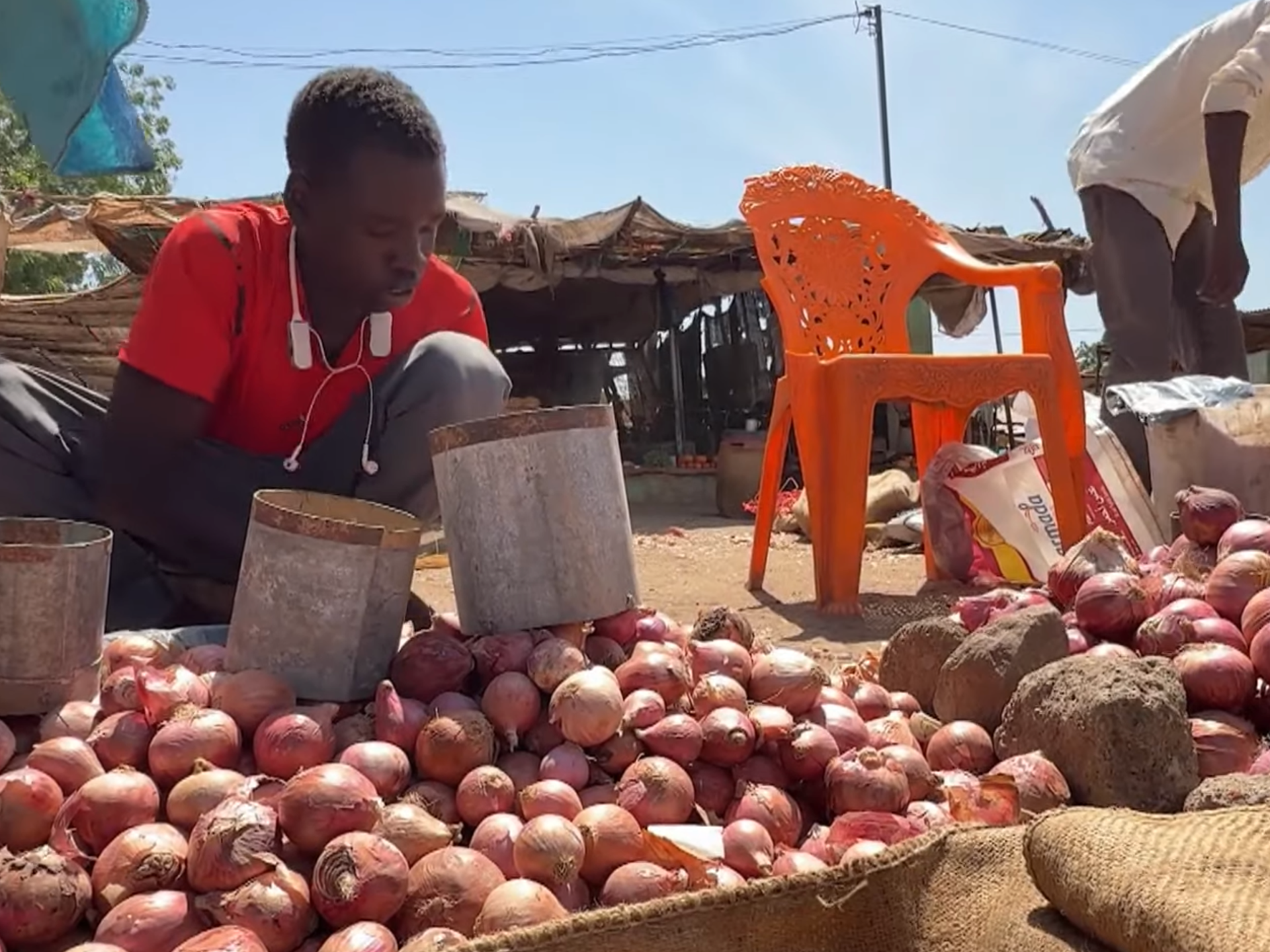
Life is cautiously returning to the streets of Dilling, the second largest city in South Kordofan state, after the Sudanese army broke a suffocating siege that had isolated the area for more than two years.
For months, the city had been encircled by the paramilitary Rapid Support Forces (RSF) and the Sudan People’s Liberation Movement-North (SPLM-N), cutting off vital supply lines and trapping civilians in a severe humanitarian crisis.
Recommended Stories
list of 4 itemsend of list
While the lifting of the blockade has allowed goods to flow again, local authorities and residents said the city remains under the threat of drone attacks.
Al Jazeera Arabic’s Hisham Uweit, reporting from Dilling, described a city “recovering slowly” from the economic strangulation.
“For over two years, heavy siege conditions were imposed on the city. Movement disappeared, goods vanished and livelihoods narrowed,” Uweit said.
“Now the eyes of buyers pick through the few available goods … as if the market itself is announcing its recovery at a leisurely pace, drawing determination from the patience of its residents.”
Markets return to life
The immediate impact of the army’s advance is visible in the local markets, which were largely shuttered during the blockade. Fresh produce, absent for months, has begun to reappear in stalls.
“The market and vegetables have all returned,” a local trader told Al Jazeera. “Before, the market didn’t exist. Now we have okra, potatoes, sweet potatoes, chillies and lemons. Everything is with us, and the market has returned to normal.”
However, the resumption of trade masks deep scars left by the isolation. The blockade devastated the local economy, stripping residents of their savings and leaving infrastructure in disrepair.
‘The price of isolation’
While food supplies are improving, Dilling’s health sector remains in critical condition. The city’s main hospital is struggling with a severe lack of equipment and essential medicines, a shortage that has had life-altering consequences for the most vulnerable.
Abdelrahman, a local resident suffering from diabetes, paid a heavy price for the siege. During the months of encirclement, insulin supplies ran dry. His condition deteriorated rapidly, ultimately leading to the amputation of both his legs.
“He had a medical appointment after a month, but the month closed off his check-ups,” a relative of Abdelrahman said. “He is suffering severely. He is missing his insulin. There is a shortage of food, and he is tired. His health has declined sharply.”
‘Chased like locusts’
Despite the Sudanese army asserting control over access routes, the security situation in Dilling remains precarious. Authorities said the city is subjected to almost daily drone strikes launched by the RSF and SPLM-N, targeting infrastructure and residential areas.
For Maryam, a mother displaced multiple times by the conflict, the breaking of the siege has not brought peace. She described the terror of the unmanned aerial vehicles that hover over their homes.
“Now the drones bombard and chase us. They chase us like locusts,” Maryam said. “When they come, we just run to hide. When they hover over us, they burn the thatch [roofs], start fires and force you to leave your home.”
She added that the constant threat of aerial bombardment makes normal life impossible: “If you are having a meal, like porridge, … the moment you see them, you leave it.”
Uweit said that while the lifting of the siege is a “glimmer of hope” and a first step towards recovery, the dual challenge of rebuilding a shattered health system and fending off persistent military attacks means Dilling’s ordeal is far from over.
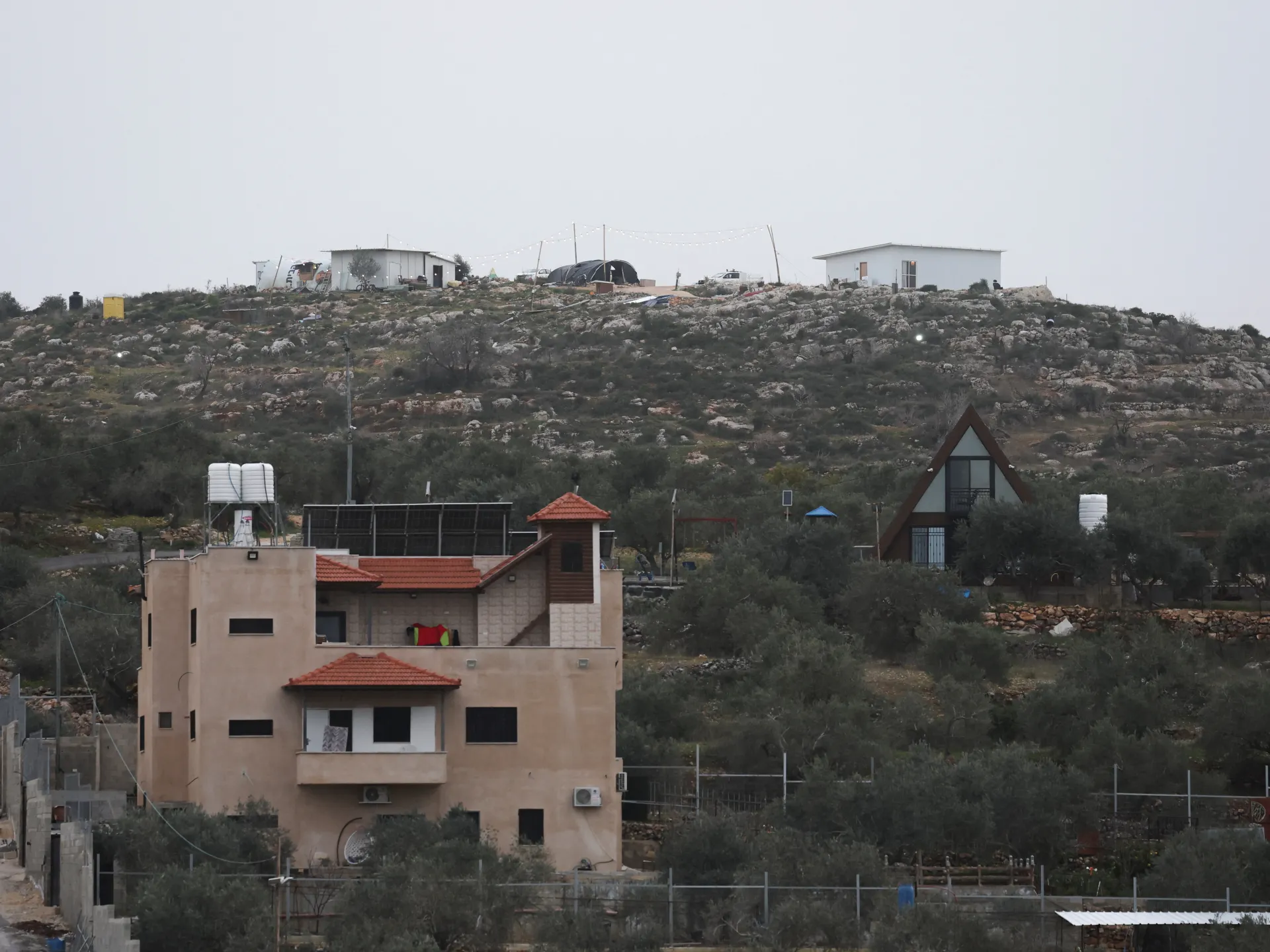
The Israeli government has approved a proposal to register large areas of the occupied West Bank as “state property,” for the first time since the Israeli occupation of the territory in 1967.
Israeli public broadcaster KAN on Sunday said the proposal was submitted by far-right Finance Minister Bezalel Smotrich, Justice Minister Yariv Levin, and Defence Minister Israel Katz.
“We are continuing the settlement revolution to control all our lands,” said Smotrich.
Most Palestinian land is not formally registered because it is a long, complicated process that Israel stopped in 1967. Registration of land establishes permanent ownership. International law states an occupying power cannot confiscate land in occupied territories.
The Palestinian Presidency slammed the Israeli government’s decision, calling it a “serious escalation” and saying the Israeli move effectively nullifies signed agreements and clearly contradicts resolutions of the United Nations Security Council, Wafa news agency reported.
Meanwhile, Israeli Defence Minister Katz described the move as an “essential security and governance measure designed to ensure control, enforcement, and full freedom of action for the State of Israel in the area”, the Jerusalem Post newspaper reported.
Last week, the Israeli Security Cabinet approved measures promoted by Smotrich and Katz that further facilitate the unlawful seizure of Palestinian land in the occupied West Bank.
Analysts describe it as a de facto annexation of the Palestinian territory, warning that it will profoundly reshape its civil and legal landscape by eliminating what the Israeli ministers called longstanding “legal obstacles” to the expansion of illegal settlements there.
Speaking from Ramallah, political analyst Xavier Abu Eid told Al Jazeera Israel is “packing annexation into some sort of a bureaucratic move”. He said the International Court of Justice in 2024 said the Israeli actions amount to annexation of the occupied West Bank.
“People should understand this is not just a step towards annexation, we are experiencing annexation as we speak today. What the Israeli government is doing is implanting their political programme – a policy that has already been presented,” he said.
Palestinian landowners are going to face more threats and intimidation from Israeli settlers supported by the Israeli government, he warned.
The dawn-to-dusk fast lasts anywhere from 11.5 to 15.5 hours, depending on where in the world you are.
Published On 15 Feb 202615 Feb 2026
Share
The Muslim holy month of Ramadan is set to begin on February 18 or 19, depending on the sighting of the crescent moon.
During the month, which lasts 29 or 30 days, Muslims observing the fast will refrain from eating and drinking from dawn to dusk, typically for a period of 12 to 15 hours, depending on their location.
Muslims believe Ramadan is the month when the first verses of the Quran were revealed to the Prophet Muhammad more than 1,400 years ago.
The fast entails abstinence from eating, drinking, smoking and sexual relations during daylight hours to achieve greater “taqwa”, or consciousness of God.
Why does Ramadan start on different dates every year?
Ramadan begins 10 to 12 days earlier each year. This is because the Islamic calendar is based on the lunar Hijri calendar, with months that are 29 or 30 days long.
For nearly 90 percent of the world’s population living in the Northern Hemisphere, the number of fasting hours will be a bit shorter this year and will continue to decrease until 2031, when Ramadan will encompass the winter solstice, the shortest day of the year.
For fasting Muslims living south of the equator, the number of fasting hours will be longer than last year.
Because the lunar year is shorter than the solar year by 11 days, Ramadan will be observed twice in the year 2030 – first beginning on January 5 and then starting on December 26.
(Al Jazeera)
Fasting hours around the world
The number of daylight hours varies across the world.
Since it is winter in the Northern Hemisphere, this Ramadan, people living there will have the shortest fasts, lasting about 12 to 13 hours on the first day, with the duration increasing throughout the month.
People in southern countries like Chile, New Zealand, and South Africa will have the longest fasts, lasting about 14 to 15 hours on the first day. However, the number of fasting hours will decrease throughout the month.
(Al Jazeera)
Fasting times around the world
The table below shows the number of fasting hours, suhoor and iftar times on the first and last days of Ramadan 2026. Use the arrows or search box to find your city.
Ramadan greetings in different languages
Muslim-majority nations have various greetings in their native languages for Ramadan.
“Ramadan Mubarak” and “Ramadan Kareem” are the most common greetings exchanged in this period, wishing the recipient a blessed or generous month, respectively.
Iraqi authorities confirm the transfer, saying detainees of 61 nationalities have arrived in the country.
Published On 15 Feb 202615 Feb 2026
Share
The United States has announced the completion of the transfer of more than 5,700 suspected ISIL (ISIS) detainees from Syria to Iraq.
“The 23-day transfer mission began on Jan 21 and resulted in US forces successfully transporting more than 5,700 adult male ISIS fighters from detention facilities in Syria to Iraqi custody,” the US Central Command (CENTCOM) said in a statement on X on Saturday.
Recommended Stories
list of 4 itemsend of list
The operation was completed after a night flight from northeastern Syria to Iraq took place on February 12, “to help ensure ISIS detainees remain secure in detention facilities”, CENTCOM added.
The US had previously announced it would transfer about 7,000 detainees.
The detainees from some 60 countries had for years been held in Syrian prisons run by Kurdish-led Syrian Democratic Forces (SDF) before the recapture of surrounding territory by the Syrian government prompted the US to step in.
ISIL swept across Syria and Iraq in 2014, committing massacres and forcing women and girls into sexual slavery.
Backed by US-led forces, Iraq proclaimed a victory over ISIL in the country in 2017, and the SDF ultimately defeated the armed group in Syria two years later.
The SDF went on to jail thousands of suspected fighters and detain tens of thousands of their relatives in camps.
Iraq’s National Centre for International Judicial Cooperation (NCIJC) said 5,704 ISIL detainees of 61 nationalities had arrived in Iraq. They include 3,543 Syrians, 467 Iraqis, and another 710 detainees from other Arab countries.
There are also more than 980 foreigners, including those from Europe, Asia, Australia and the US.
“We appreciate Iraq’s leadership and recognition that transferring the detainees is essential to regional security,” said CENTCOM head, Admiral Brad Cooper. “Job well done to the entire Joint Force team who executed this exceptionally challenging mission on the ground and in the air.”
Detainees at the al-Hol camp in Syria’s northeastern Hasakah province [File: Abdulmonam Eassa/Getty Images]
The NCIJC said Iraq’s judiciary will interrogate the detainees before taking legal action against them.
Last month, Syrian troops drove the SDF from swaths of northern Syria, prompting questions over the fate of the ISIL prisoners. Lingering doubts about security pushed the US to announce it would transfer them to Iraq to prevent “a breakout” that could threaten the region.
Iraq has issued calls for countries to repatriate their nationals among the ISIL detainees, though this appears unlikely.
For years, the SDF also called on foreign governments to take back their citizens, but this was done on a small scale and remained limited to women and children held in detention camps.
Most foreign families have left northeast Syria’s al-Hol camp, which is the largest camp holding relatives of ISIL fighters, since the departure of the SDF, which previously guarded it, humanitarian sources told the AFP news agency on Thursday.
Al Jazeera’s Assad Beig said the al-Hol camp, established in 2019 after ISIL was defeated in Syria, developed a “notorious reputation” over the years.
“Aid workers documented the killings and underground ISIL enforcement groups, while security officials warned it was a breeding ground for future armed groups,” he said.
Medical sources say Israeli forces killed five Palestinians in southern Khan Younis and four in northern al-Faluja.
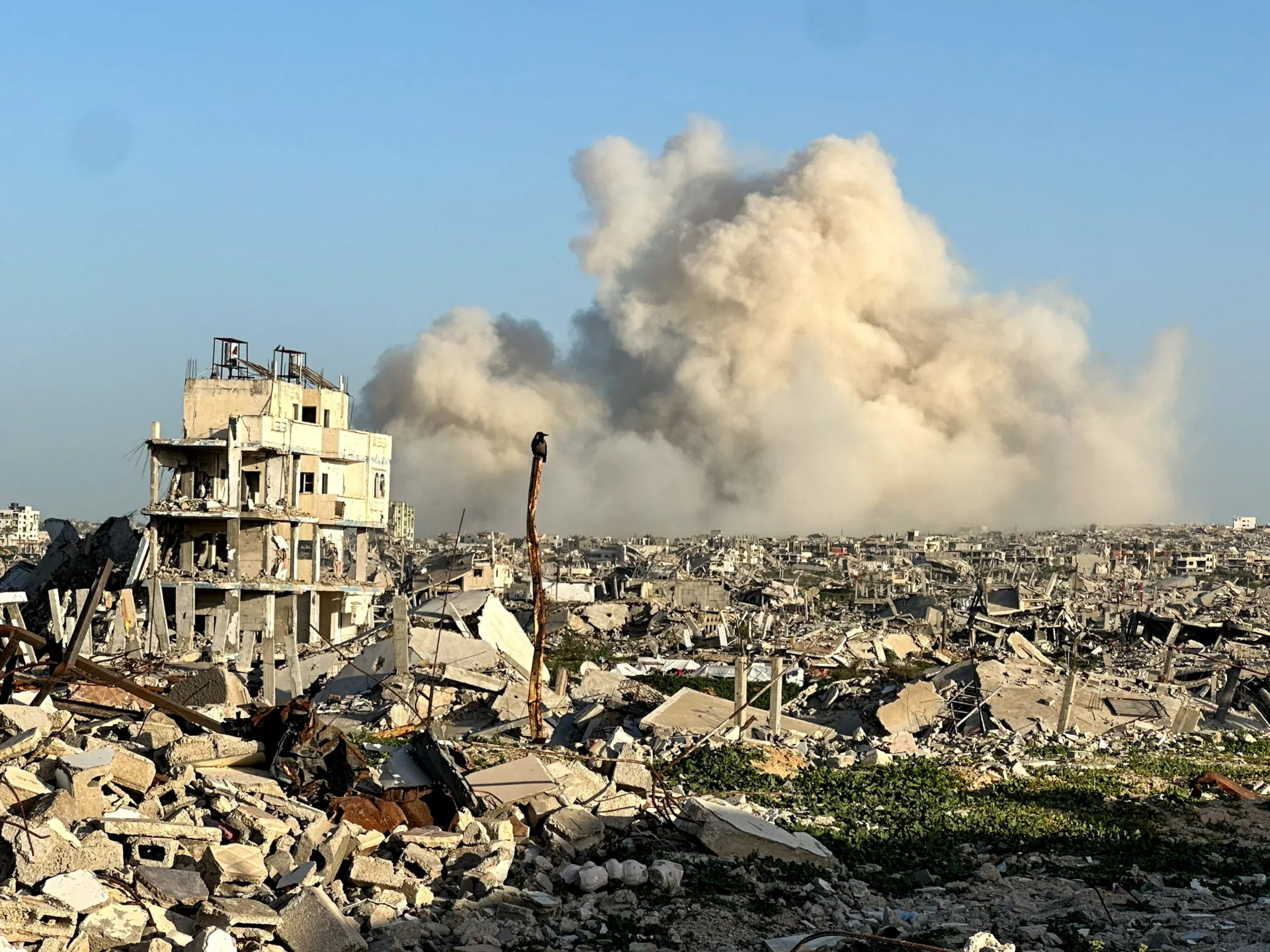
Israeli forces have killed at least nine Palestinians in new attacks across Gaza, in yet another violation of the United States-brokered “ceasefire” in October, according to medical sources.
The attacks on Sunday came as the Israeli military launched several attacks on southern Lebanon, targeting what it called warehouses used by the Hezbollah armed group.
Recommended Stories
list of 4 itemsend of list
In Gaza, a source at the Nasser Hospital told Al Jazeera Israeli forces killed at least five Palestinians in the southern city of Khan Younis.
The attack took place beyond the so-called “yellow line”, where Israeli troops are stationed in Gaza, the source added.
The other four Palestinians were killed when Israeli forces attacked a tent for displaced people in the al-Faluja area of northern Gaza, a source at al-Shifa Hospital said.
There was no immediate comment from Israel.
The Israeli military, however, said in a statement early on Sunday that it struck a building in an unspecified part of northern Gaza shortly after several armed fighters entered the structure.
At least two of the fighters were killed, it said.
The Israeli military also said it killed another person in Gaza on Sunday who allegedly crossed the yellow line and posed “an immediate threat” to its forces there.
It did not provide evidence for its claims.
In Lebanon, the Israeli military said it struck warehouses used by Hezbollah for storing weapons and launchers in the southern parts of the country.
The Israeli military and Hezbollah, which began attacks on northern Israel in solidarity with Palestinians in Gaza in 2023, agreed to a ceasefire in November 2024.
There was no immediate comment from Lebanon on Sunday’s attacks.
According to authorities in Gaza and Lebanon, the Israeli military continues to launch near-daily attacks despite agreeing to halt the fighting.
In Gaza, Israel has violated the US-brokered “ceasefire” more than 1,500 times since it came into effect on October 10. At least 591 people have been killed and 1,590 wounded since then.
In addition to the near-daily killing of Palestinians, Israel also severely restricts quantities of food, medicine, medical supplies, shelter materials and prefabricated houses from entering Gaza, where some 2 million Palestinians – including 1.5 million displaced – live in catastrophic conditions.
Israel launched its genocidal war on Gaza on October 8, 2023, with support from the US, killing 72,032 people, wounding some 171,661, and destroying 90 percent of the territory’s infrastructure.
The United Nations estimates it could cost more than $70bn to rebuild Gaza.
In Lebanon, the Israeli military launched more than 10,000 air and ground attacks in the year since it agreed to halt hostilities, according to the UN.
The organisation’s rights office said in November last year that it verified at least 108 civilian casualties from Israeli attacks since the ceasefire, including at least 21 women and 16 children.
At least 11 Lebanese civilians were also abducted by Israeli forces during that time period, the office said.
Operation Hawkeye has killed and captured more than 50 ISIL fighters after hitting about 100 targets.
Published On 14 Feb 202614 Feb 2026
Share
United States forces have carried out a series of strikes against ISIL (ISIS) targets in Syria in retaliation for last year’s killing of two of its soldiers and an interpreter.
US Central Command (CENTCOM) said in a statement on Saturday that it attacked more than 30 ISIL targets in Syria between February 3 and 12, hitting the armed group’s infrastructure and weapons storage facilities with “precision munitions”.
Recommended Stories
list of 3 itemsend of list
CENTCOM said it launched the most recent attacks to “sustain relentless military pressure on remnants from the terrorist network”.
ISIL attacked US and Syrian forces near the historic city of Palmyra in December, killing Sergeant Edgar Brian Torres-Tovar, Sergeant William Nathaniel Howard, and Ayad Mansoor Sakat, identified as an American civilian interpreter.
Launched after the killings, Operation Hawkeye has killed and captured more than 50 fighters and hit about 100 ISIL infrastructure targets over the past two months, said CENTCOM.
The US military on Friday completed the transfer of thousands of ISIL detainees from Syria to Iraq, where they are expected to stand trial.
The prisoners were sent to Iraq at the request of Baghdad in a move welcomed by the US-led coalition that had for years fought against the armed group.
In other developments, the Syrian Ministry of Defence confirmed that government forces took control of the al-Tanf military base in the east of the country, which was run for years by US troops fighting ISIL.
The US-led coalition worked alongside the Kurdish-led Syrian Democratic Forces (SDF) in the battle that led to ISIL’s territorial defeat in Syria in 2019.
However, Washington has now drawn close to Syria’s new authorities, recently saying that the purpose of its alliance with the SDF was largely over.
The US withdrawal from al-Tanf comes as Damascus seeks to extend its control over all of Syria.
Doctors Without Borders, known by its French initials MSF, has suspended some operations at a Nasser Hospital in Gaza after its staff and patients saw “armed men, some masked” posing “serious security threats” inside the building.
The Geneva-based medical charity reported on its website that non-essential work at the hospital in Khan Younis was halted on January 20 due to concerns with the “management of the structure, the safeguarding of its neutrality, and security breaches”.
Recommended Stories
list of 4 itemsend of list
“MSF teams have reported a pattern of unacceptable acts, including the presence of armed men, intimidation, arbitrary arrests of patients, and a recent situation of suspicion of movement of weapons”, said the site’s “frequently asked questions” section, last updated on February 11.
“Hospitals must remain neutral, civilian spaces, free from military presence or activity to ensure the safe and impartial delivery of medical care”, it said, adding that the charity expressed concern to the “relevant” authorities.
Under the suspension, MSF will continue supporting critical services, such as inpatient and surgical departments, but will end support to the paediatrics and maternity wards, including the neonatal intensive care unit, and will no longer offer a range of outpatient consultations and other services.
The organisation was not able to indicate the armed men’s affiliation, but said its concerns were heightened by previous, deliberate Israeli attacks on health facilities.
Israel has decimated the enclave’s health infrastructure and continues to hold captive 95 Palestinian doctors and medical workers, including 80 from Gaza.
Zaher al-Waheidi, the head of the records department at Gaza’s Ministry of Health, said that MSF’s suspension will have a significant impact as hundreds of patients are admitted to the maternity and burn wards daily. He said the ministry would take over maternity patient care.
Gaza’s Ministry of Interior said in a statement that it is committed to preventing any armed presence inside hospitals, and that legal action will be taken against violators. It suggested that armed members of certain families recently entered hospitals, but did not identify those involved.
Israeli ban on aid organisations
MSF’s announcement comes after Israel recently ordered the charity and dozens of other international organisations to stop their work in Gaza and the Israeli-occupied West Bank if they did not meet new rules, including sharing details about their staff.
Two weeks ago, MSF – which provides international staff for six hospitals, and operates two field hospitals and eight primary health centres, clinics and medical points – said it would not submit a staff list to Israel after failing to receive assurances for their safety.
Israel has repeatedly attacked hospitals and healthcare workers throughout its genocidal war on Gaza.
In other developments on Saturday, Israel’s military said its troops “eliminated” a person in northern Gaza, alleging that the unidentified individual crossed the “yellow line“. The demarcation divides Gaza into an eastern area under Israeli military control and a western area where Palestinians face fewer movement restrictions but are under constant threat of air strikes and forced displacement.
Palestinian President Mahmoud Abbas slammed Israel for violating the US-brokered “ceasefire”, during which Israel has killed nearly 600 Palestinians since October 10.
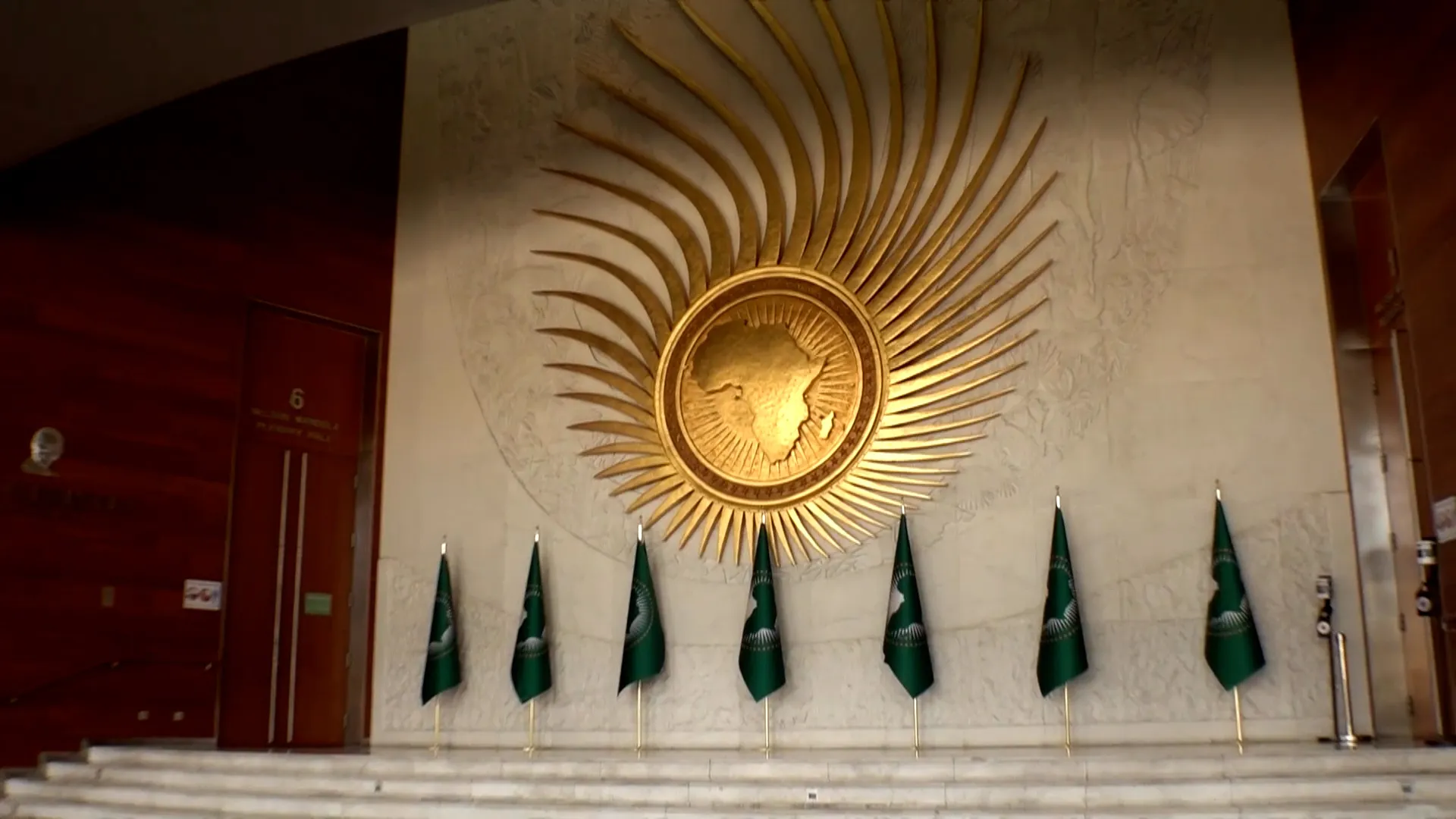
In a speech by Prime Minister Mohammed Mustafa at an African Union summit in Ethiopia, he called on Israel to remove all “obstacles” to implementing phase two of the “truce” deal, including the work of a technocratic committee that will oversee the daily governance of Gaza.
More than 72,000 Palestinians have been killed and 171,000 wounded in attacks in Israel’s genocidal war on Gaza since October 2023.
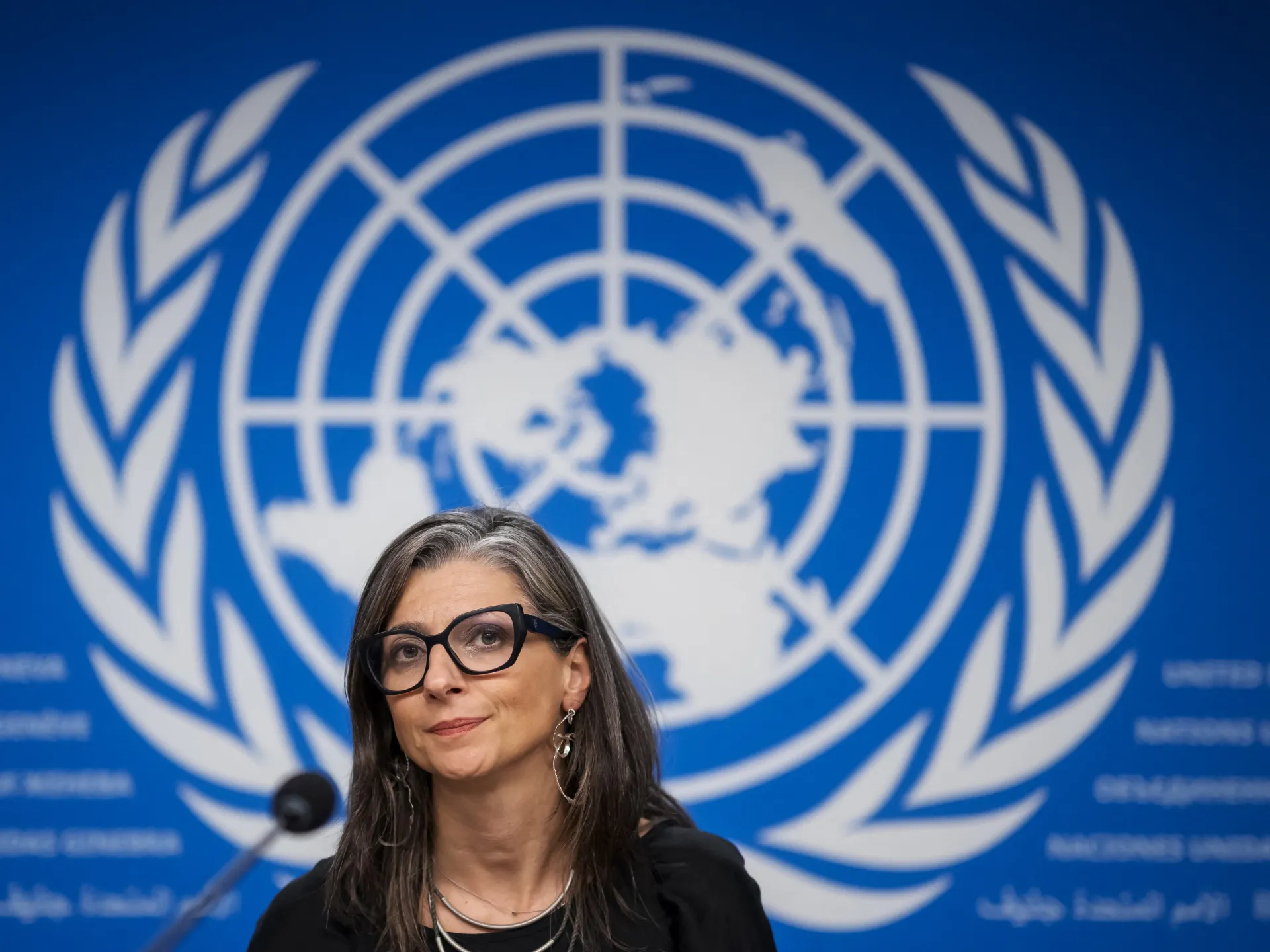
France and Germany call for UN special rapporteur for occupied Palestinian territory, Francesca Albanese, to step down over her critical comments.
More than 100 prominent artists – including musicians, actors and writers – have signed an open letter in support of the United Nations special rapporteur for occupied Palestinian territory who faces international calls to step down.
In a letter from the group Artists for Palestine on Saturday, the signatories offered “full support to Francesca Albanese, a defender of human rights and, therefore, also of the Palestinian people’s right to exist”.
Recommended Stories
list of 4 itemsend of list
“There are infinitely more of us in every corner of the Earth who want force no longer to be the law. Who know what the word ‘law’ truly means,” the letter said.
Among the supporters were actors Mark Ruffalo and Javier Bardem, Nobel Prize-winning author Annie Ernaux and British musician Annie Lennox.
At last week’s Al Jazeera Forum, Albanese, an outspoken critic of Israel’s genocidal war on Gaza, said “we as humanity have a common enemy”, but a fake video that was later debunked had her accusing Israel of being the “common enemy”.
She later explained in a social media post she was referencing “the system that has enabled the genocide in Palestine” as the “common enemy”.
‘Crush any criticism of Israel’
Still, European countries, including France and Germany, continue to call for her removal.
On Tuesday, a group of French lawmakers sent a letter to Foreign Minister Jean-Noel Barrot condemning Albanese’s remarks as “anti-Semitic”. A day later, Barrot called on her to step down, saying France “unreservedly condemns the outrageous and reprehensible remarks”.
On Thursday, German Foreign Minister Johann Wadephul called her position “untenable”.
Frank Barat, an author and film producer, said French President Emmanuel Macron and Barrot have repeatedly said they support international law “while the facts show the complete opposite”.
Albanese has highlighted for the past two years that under international law, “states have a duty to act to prevent genocide, and they’ve been failing completely” in Gaza, Barat told Al Jazeera.
“Because Francesca has been highlighting this hypocrisy, she’s been targeted by most Western governments. The political agenda of these governments is to crush any criticism of Israel. We’ve seen it in the streets of Europe. We’ve seen it in the streets of the US,” he added.
People who have spoken out against Israel’s war on Palestine are “criminalised while the perpetrators of genocide continue to be let go“, Barat said.
Marta Hurtado, a spokesperson for the Office of the UN High Commissioner for Human Rights, said at a news briefing on Friday that her colleagues are “very worried” about the backlash against Albanese.
“We are concerned that UN officials, independent experts and judicial officials are increasingly subjected to personal attacks, threats and misinformation that distracts from the serious human rights issues,” Hurtado said.
Nearly 600 Palestinians have been killed by Israel in Gaza since an October 10 “ceasefire” alone. At least 72,000 Palestinians have been killed and 171,000 wounded in Israel’s war since October 2023
Tehran, Iran – Iran and the United States are presenting clashing views before expected talks as diaspora Iranians rally across the world to demand action after thousands were killed during last month’s nationwide protests.
Amid reports that a second round of mediated talks may take place over the coming days, Washington has maintained it wants to limit Iran’s missile programme and end all its nuclear enrichment. Iran has consistently rejected both demands, saying it could dilute highly enriched uranium – all said to be buried under rubble after being bombed by the US in June – in exchange for the lifting of sanctions.
Recommended Stories
list of 4 itemsend of list
US President Donald Trump said at the White House on Friday that he is sending a second aircraft carrier to the Middle East, adding that “regime change” in Iran would be the “best thing that could happen”.
Speaking at a conference in Tehran on Saturday aimed at attracting regional investment for railroad projects, Iranian President Masoud Pezeshkian thanked the leaders of Azerbaijan, Turkiye, Qatar, Oman, Saudi Arabia and others for mediating to prevent a US military attack.
“All of these countries are working so that we can resolve our own problems with peace and calm, and we are able to do this. We do not need a custodian,” Pezeshkian said, warning that a war would impact the entire Middle East.
Major rallies in US, Europe
A large number of Iranians abroad who are opposed to the theocratic establishment governing Iran since a 1979 revolution participated in rallies across the world on Saturday to demand an end to religious rule.
Reza Pahlavi, son of Iran’s US-backed shah who was deposed in the revolution, called on Iranians living abroad to be part of a “global day of action” aimed at “taking Iran back” from the Islamic Republic. He also addressed the Munich Security Conference in Germany and met with leaders such as Ukrainian President Volodymyr Zelenskyy and senior US Senator Lindsey Graham.
The three main cities designated for the protests were Munich, Los Angeles and Toronto. Iranians also marched in cities in Australia, including Sydney and Melbourne.
A similar rally last month in Toronto saw more than150,000 people in attendance and no adverse incidents, according to city police. About 100,000 people registered early to attend the Munich rally on Saturday.
The rallies are some of the largest ever held by the Iranian diaspora and the biggest since demonstrations in solidarity with the deadly 2022-2023 nationwide protests in Iran, triggered by the death in police custody of Mahsa Amini, 22, for allegedly wearing the mandatory hijab for women improperly.
The latest protests were held days after the Iranian establishment organised demonstrations and burned the flags of Israel and the US to mark the 47th anniversary of the 1979 revolution.
“They killed my innocent girl for a few strands of hair and nobody was held accountable, but now they record women with bare heads and so-called unconventional attire in their official ceremonies and nobody yells that Islam is in danger,” Amini’s father wrote in an Instagram story after state television interviewed a pro-establishment woman without a hijab.
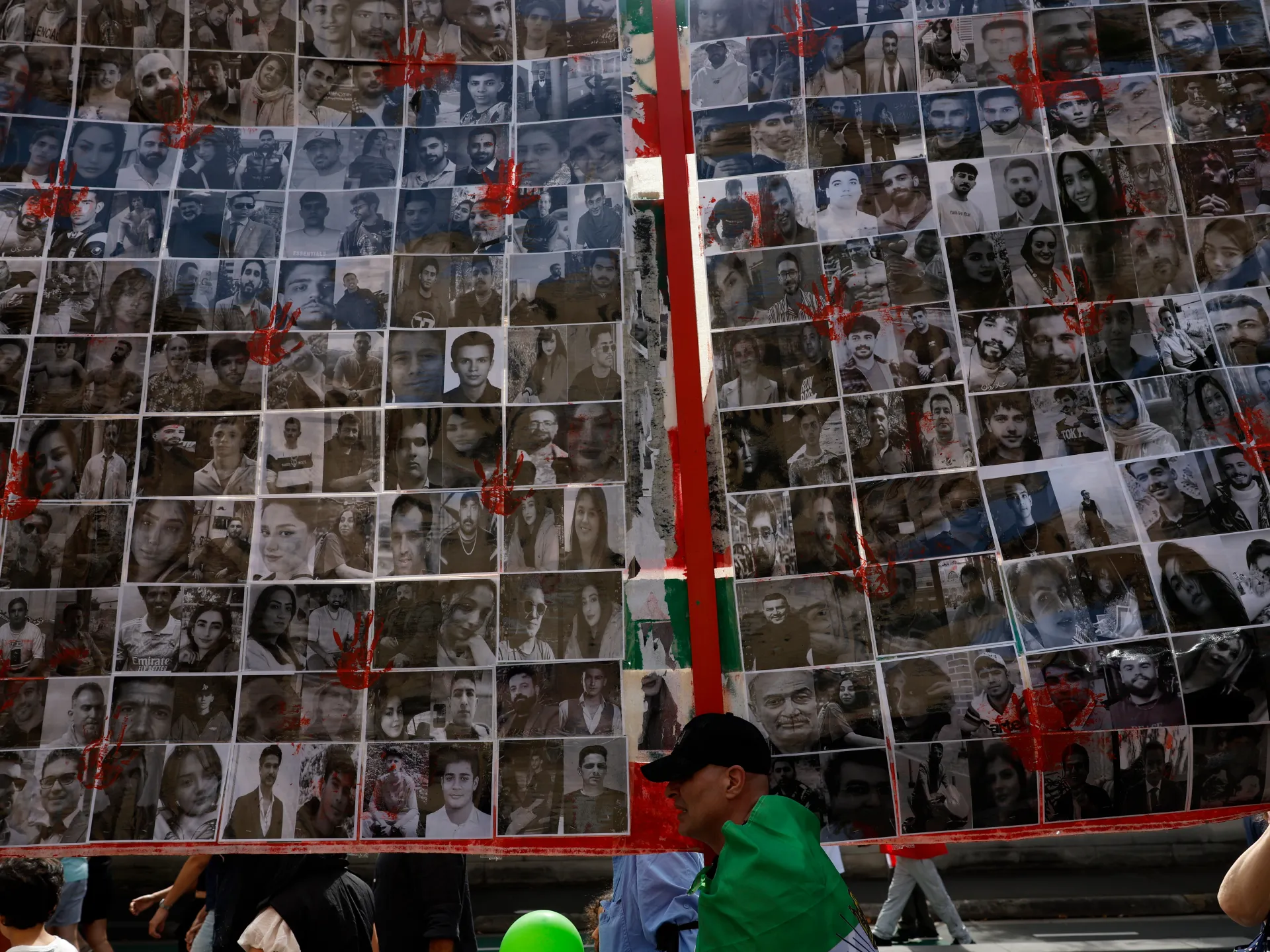
Since the killing of thousands of protesters last month, mostly carried out on the nights of January 8-9, similar rallies have been held to raise awareness in dozens of cities across the globe, including The Hague, Zurich, Rome, Budapest and Tokyo.
The United Nations and international human rights organisations said they documented widespread use of lethal force by state forces against peaceful protesters. But the Iranian government rejected all their allegations, claiming “terrorists” and “rioters” armed and funded by the US and Israel were behind the killings across Iran.
Families united in grief, strength
From Kuhchenar county in southern Iran’s Fars province to central Arak and Mashhad in the northeast, families continue to release footage online to commemorate their loved ones killed during the demonstrations.
Behesht-e Zahra, a cemetery in Tehran, was crowded on Friday as people gathered in solidarity with multiple families holding mourning ceremonies to mark “chehelom”, or 40 days since the killing of their loved ones.
Bereaved relatives somberly clapped, played music and showed the “victory” sign in an attempt to express pride, strength and defiance despite their losses.
Among those remembered were Ayda Heydari, 21, a medical student, and Zahra “Raha” Behloulipour, who attended Tehran University. Both were shot and killed with multiple live rounds in separate incidents.
The state-run Mehr news agency reported Heydari was “a victim of Mossad agents in recent riots” and released a short clip of an interview with her family. Heydari’s mother said her daughter was not a “munafiq”, a term the Islamic Republic uses to describe dissidents.
Mohammad-Hossein Omid, head of Tehran University, last week told the semiofficial ISNA news agency that “most” of the people taking part in the nationwide demonstrations were “protesters not terrorists”.
Concerns for prisoners
The Iranian judiciary confirmed on Saturday that a number of senior reformist politicians arrested last week for criticising the establishment were released on bail while others remained behind bars to face previous charges.
Vahid Shalchi, a deputy science minister, cited judiciary officials as saying “a considerable” number of arrested students will be released soon but did not say how many are being held.
Tens of thousands of people have been arrested during and after the protests, and human rights organisations said some are in immediate danger of being executed – allegations the Iranian judiciary has rejected.
Amnesty International said 18-year-old wrestling champion Saleh Mohammadi has been sentenced to public execution in Qom after being forced to make confessions about being involved in the death of a security agent.
Mai Sato – UN special rapporteur on Iran, who previously said more than 20,000 civilians may have been killed during the demonstrations – said three other people face execution and “What is happening now is not new.”
“The same patterns documented in those individual cases are being replicated on a mass scale after the nationwide protests,” she said.
A specific casualty toll from the demonstrations is unknown as information remains extremely limited because of ongoing heavy internet filtering.
Homeland Security Secretary Kristi Noem has determined it is safe for Yemenis to return to their country, despite ongoing conflict.
Published On 14 Feb 202614 Feb 2026
Share
The United States government has ended the Temporary Protected Status (TPS) designation for Yemen, ordering the more than 1,000 Yemeni refugees and asylum seekers living in the country to leave within 60 days or face arrest and deportation.
The action on Friday came as part of US President Donald Trump’s broad immigration crackdown, which is impacting those who fled perilous lives in war-torn countries.
Recommended Stories
list of 4 itemsend of list
It will terminate TPS for roughly 1,400 Yemeni nationals who have had access to the legal status since September 2015 because of armed conflict in their country, Secretary of Homeland Security Kristi Noem announced on Friday.
“After reviewing conditions in the country and consulting with appropriate US government agencies, I determined that Yemen no longer meets the law’s requirements to be designated for Temporary Protected Status,” Noem said in a statement.
“Allowing TPS Yemen beneficiaries to remain temporarily in the United States is contrary to our national interest,” she said, describing the revocation as an act of “putting America first.”
Contrary to Noem’s determination, Yemen continues to be riven by years-long conflict in one of the world’s poorest nations.
The State Department currently advises against travel to Yemen, citing “terrorism, unrest, crime, health risks, kidnapping, and landmines”.
TPS allows narrow groups of people in the US to live and work in the country if they’re deemed to be in danger if they return to their home nations, because of war, natural disaster or other extraordinary circumstances.
While the protections are technically temporary, historically, presidents have continued to renew TPS statuses for refugees and asylum seekers rather than revoking them and rendering them undocumented.
The TPS for Yemen was last extended in 2024 and was set to expire on March 3 of this year.
Yemeni beneficiaries with no other lawful basis for remaining in the US have 60 days to voluntarily depart the country or face arrest, the statement said, offering a complimentary plane ticket and a $2,600 “exit bonus” for those who “self-deport”.
Since coming to office last year, Trump has ended the status for Venezuelans, Hondurans, Haitians, Nicaraguans, Somalis, Ukrainians and thousands of others.
The Trump administration has also expanded its travel restrictions since returning to power, imposing a total ban on citizens of 19 countries from entering the US, primarily targeting Muslim-majority and African nations, including Yemen, Somalia and South Sudan.
Citizens from a further 29 countries, including Nigeria and Senegal, are subject to partial bans.
Jury chair Wim Wenders said filmmakers ‘have to stay out of politics’ when asked about German support for Israel’s genocidal war in Gaza.
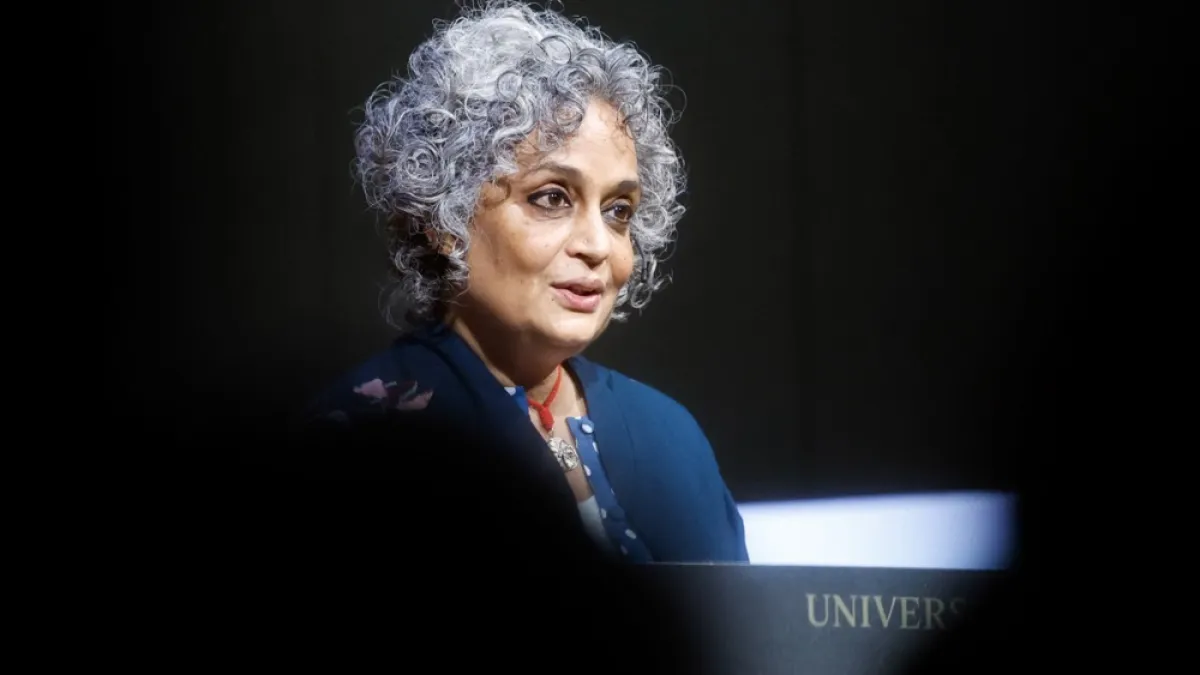
Indian author Arundhati Roy has announced that she is withdrawing from the Berlin International Film Festival after what she described as “unconscionable statements” by its jury members about Israel’s genocidal war on Gaza.
Writing in India’s The Wire newspaper, Roy said she found recent remarks from members of the Berlinale jury, including its chair, acclaimed director Wim Wenders, that “art should not be political” to be “jaw-dropping”.
Recommended Stories
list of 4 itemsend of list
“It is a way of shutting down a conversation about a crime against humanity even as it unfolds before us in real time,” wrote Roy, the author of novels and nonfiction, including The God of Small Things.
“I am shocked and disgusted,” Roy wrote, adding that she believed “artists, writers and filmmakers should be doing everything in their power to stop” the war in Gaza.
“Let me say this clearly: what has happened in Gaza, what continues to happen, is a genocide of the Palestinian people by the State of Israel,” she wrote.
The war is “supported and funded by the governments of the United States and Germany, as well as several other countries in Europe, which makes them complicit in the crime,” she added.
During a panel to launch the festival on Thursday, a journalist asked the jury members for their views on the German government’s “support of the genocide in Gaza” and the “selective treatment of human rights” issues.
German filmmaker Wim Wenders, who is the chair of the festival’s seven-member jury, responded, saying that filmmakers “have to stay out of politics”.
“If we made movies that are dedicatedly political, we enter the field of politics. But we are the counterweight to politics. We are the opposite of politics. We have to do the work of people and not the work of politicians,” Wenders said.
Polish film producer Ewa Puszczynska, another jury member, said she thought it was “a bit unfair” to pose this question, saying that filmmakers “cannot be responsible” for whether governments support Israel or Palestine.
“There are many other wars where genocide is committed and we do not talk about that,” Puszczynska added.
Roy had been due to participate in the festival, which runs from February 12 to 22, after her 1989 film, In Which Annie Gives It Those Ones, was selected to be screened in the Classics section.
Germany, which is one of the biggest exporters of weapons to Israel, after the US, has introduced harsh measures to prevent people from speaking out in solidarity with Palestinians.
In 2024, more than 500 international artists, filmmakers, writers and culture workers called on creatives to stop working with German-funded cultural institutions over what they described as “McCarthyist policies that suppress freedom of expression, specifically expressions of solidarity with Palestine”.
“Cultural institutions are surveilling social media, petitions, open letters and public statements for expressions of solidarity with Palestine in order to weed out cultural workers who do not echo Germany’s unequivocal support of Israel,” organisers of the initiative said.
Trump says he believes negotiations with Iran will be ‘successful’ as he confirms USS Gerald R Ford deployment.
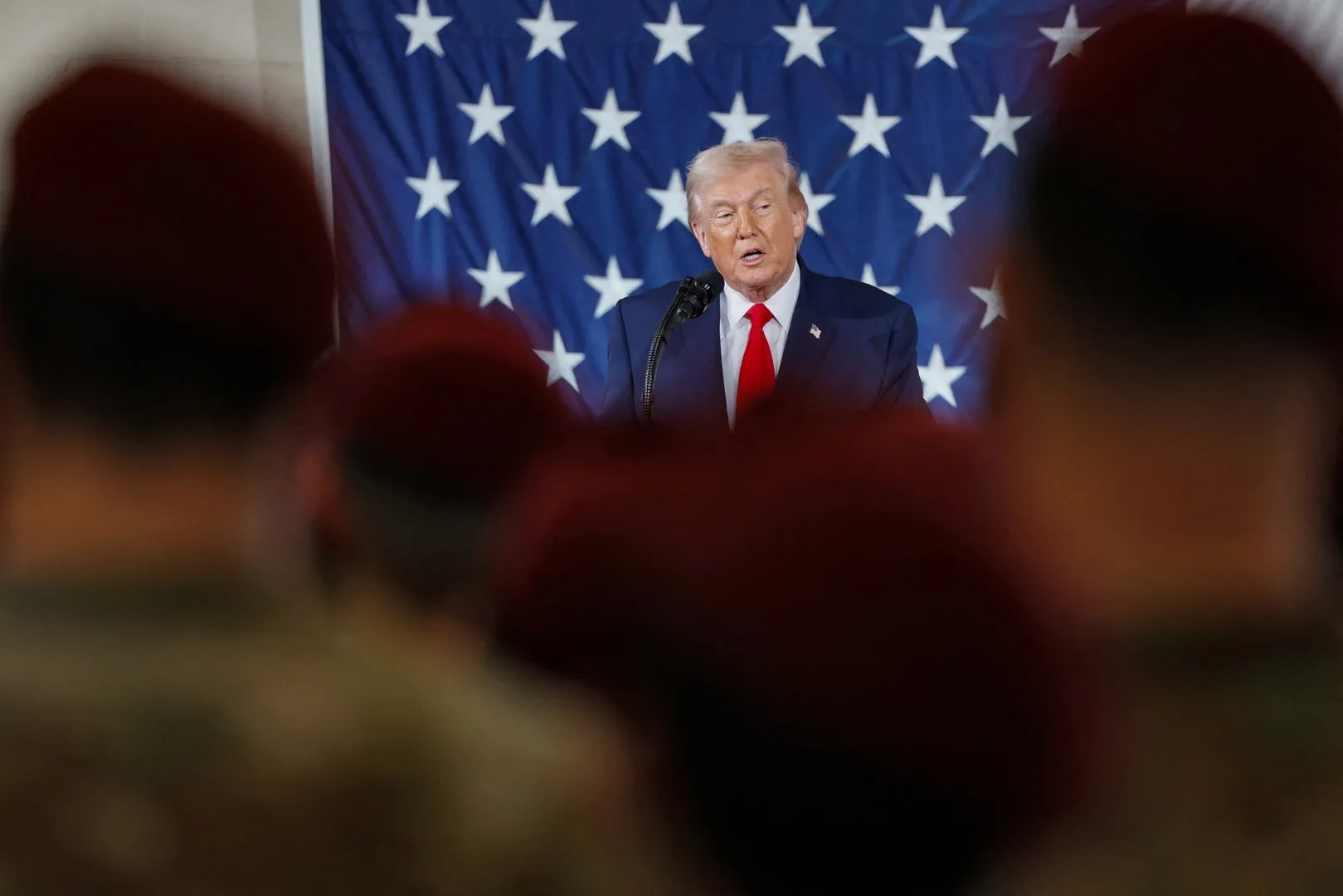
President Donald Trump says that he is sending a second aircraft carrier to the Middle East as the United States increases pressure on Iran over its nuclear and ballistic missile programmes.
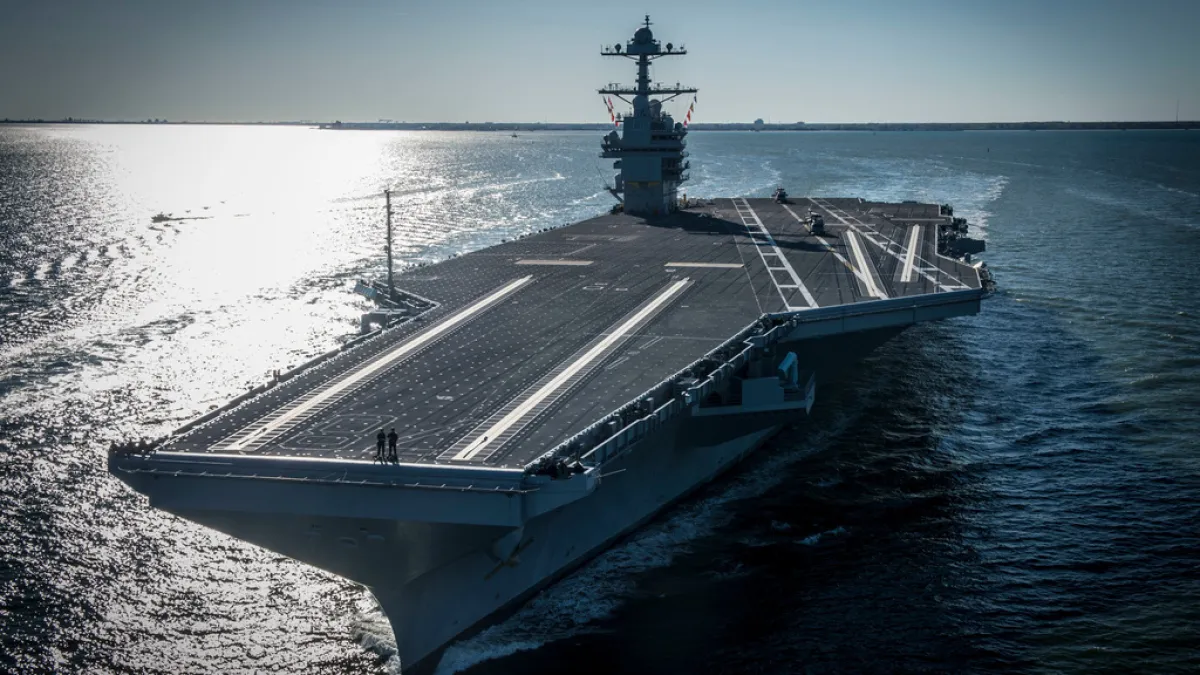
Speaking at the White House on Friday, Trump confirmed that the USS Gerald R Ford would be leaving the Caribbean for the Middle East “very soon” as tensions remain high following indirect talks in Oman last week.
Recommended Stories
list of 3 itemsend of list
“If we need it, we’ll have it ready, a very big force,” said Trump, adding that he believed negotiations would be “successful” while warning it would be a “bad day for Iran” if the country failed to make a deal.
Later, Trump said a change of government in Iran would be the “best thing that could happen”.
“For 47 years, they’ve been talking and talking and talking. In the meantime, we’ve lost a lot of lives,” he said, in an apparent reference to Tehran’s crackdown on recent antigovernment protests that left thousands dead.
The imminent departure of the Gerald R Ford is part of an ongoing buildup of military hardware in the region, with the Abraham Lincoln carrier, several guided-missile destroyers, fighter jets and surveillance aircraft sent in recent weeks.
Trump’s comments come days after he met Israeli Prime Minister Benjamin Netanyahu in Washington, with the latter saying a “good deal” was expected while voicing reservations if any agreement did not also curb Iran’s ballistic missile programme. Tehran has publicly rejected US pressure to discuss the missiles.
Netanyahu has repeatedly called for further military action since Israel’s 12-day war against Iran in June, which the US briefly joined by attacking three Iranian nuclear sites, in a military operation dubbed “Midnight Hammer”.
Trump at the time said the US attacks had “totally obliterated” the nuclear facilities.
The indirect US-Iran talks were the first to be held since the June conflict, which halted previous rounds of negotiations between Tehran and Washington over potentially replacing the Joint Comprehensive Plan of Action (JCPOA), which Trump ditched during his first term in office.
Risk of escalation
The JCPOA, a deal reached between Iran, the US and several European powers, saw Tehran curtail its nuclear programme in exchange for sanctions relief.
Following Trump’s unilateral withdrawal in 2018, Tehran subsequently began enriching uranium beyond the limits set out in the agreement, though it has repeatedly denied Western claims it is seeking a nuclear weapon.
Upon taking office for a second time in January, Trump initially sought a new nuclear deal with Iran, but soon adopted a zero-enrichment policy long dismissed by Iranian negotiators as a non-starter.
As the latest attempts at negotiations continue, United Nations nuclear watchdog chief Rafael Grossi has had trouble getting Iran to agree on inspections of sites targeted in the 12-day war.
Grossi, who heads the International Atomic Energy Agency, told the Munich Security Conference that inspectors had returned to Iran after the 12-day war but had not been able to visit any of the sites targeted.
Grossi said dialogue with Iran since the inspectors’ return last year had been “imperfect and complicated and extremely difficult, but it’s there”.
The US president’s comments on Friday confirm his earlier indication that he was considering sending the Gerald R Ford, which has a nuclear reactor on board and can hold more than 75 military aircraft, to the region.
Gulf Arab nations have warned any attack could escalate into another regional conflict in a region still reeling from Israel’s genocidal war on Gaza.
US President Donald Trump says a second aircraft carrier strike group will deploy to the Middle East, increasing pressure on Iran as negotiations over its nuclear programme continue.
Heads of state are arriving in Addis Ababa for the 2026 African Union Summit, with a water-focused theme centred on climate change. Conflicts in Sudan, South Sudan, DR Congo and the Sahel loom, while Israel’s recognition of Somaliland adds pressure over borders.
Latest attacks come amid a widely condemned Israeli push to cement control over the occupied Palestinian territory.
Published On 13 Feb 202613 Feb 2026
Share
Dozens of Palestinians have been injured as Israeli settlers carried out a wave of attacks across the occupied West Bank, destroying olive trees and vandalising property.
At least 54 Palestinians were wounded on Friday morning as settlers attacked several towns and villages under the protection of the Israeli military.
Recommended Stories
list of 3 itemsend of list
Settlers assaulted Palestinian farmers on their lands near Talfit, a village south of Nablus in the northern West Bank, and Israeli troops fired tear gas and live ammunition at residents who tried to repel the settler attack.
Images from the village showed homes with broken windows and vehicles with smashed windshields as a result of the attack.
Elsewhere in the West Bank, Israeli settlers also destroyed about 300 Palestinian olive trees near the Ramallah-area town of Turmus Aya, the Wafa news agency reported, citing local sources.
Palestinians across the West Bank have faced an intensified surge in Israeli military and settler violence in the shadow of Israel’s genocidal war against Palestinians in Gaza.
A shattered window in the village of Talfit after the settler attack, February 13, 2026 [AFP]
At least 1,054 Palestinians were killed in the West Bank by Israeli troops and settlers between October 7, 2023, and February 5 of this year, according to the latest United Nations figures.
Israel has also forcibly displaced tens of thousands of Palestinians from their homes across the West Bank, refusing to allow them to return in what Human Rights Watch says amounts to war crimes and a crime against humanity.
The Israeli government drew international condemnation this week after it approved plans to extend its authority over more of the West Bank – a move that observers denounced as de facto annexation, in violation of international law.
“If these decisions are implemented, they will undoubtedly accelerate the dispossession of Palestinians and their forcible transfer, and lead to the creation of more illegal Israeli settlements,” UN human rights chief Volker Turk said on Wednesday.
“We are witnessing rapid steps to change permanently the demography of the occupied Palestinian territory, stripping its people of their lands and forcing them to leave,” Turk said in a statement.
“This is supported by rhetoric and actions by senior Israeli officials, and violates Israel’s obligation as an occupying power to preserve the existing legal order and social fabric. These decisions must be overturned.”
DP World appoints new chairman and group CEO following departure of Sultan Ahmed bin Sulayem over ties to sex offender.
Published On 13 Feb 202613 Feb 2026
Share
United Arab Emirates-based logistics giant DP World has appointed a new chairman and CEO, after coming under pressure over former company chief Sultan Ahmed bin Sulayem’s ties to the late sex offender Jeffrey Epstein
The UAE government’s Dubai Media Office said Friday that Essa Kazim had been appointed chairman and Yuvraj Narayan as group CEO of DP World, one of the world’s largest logistics companies, which claims to handle about 10 percent of global trade.
Recommended Stories
list of 4 itemsend of list
The roles were previously held by bin Sulayem, one of Dubai’s most powerful and well-connected people, who has led DP World – which operates more than 60 ports and terminals worldwide – for more than four decades.
Sulayem’s lengthy tenure at the helm of the logistics giant came to an end in a firestorm of controversy over his links with the disgraced financier, after recently declassified documents showed the pair had exchanged messages for years before and after Epstein pleaded guilty in 2008 to soliciting a minor for prostitution.
Salacious exchanges
The friendly exchanges between the two include discussions about deals and also mention bin Sulayem visiting Epstein’s private island while sharing contacts in business and politics.
The two men also shared salacious comments about women, with bin Sulayem’s email address featuring a correspondence in which Epstein remarked, “I loved the torture video.”
Bin Sulayem’s name was blacked out in documents released by the Department of Justice, but on Tuesday, Democratic Representative Ro Khanna identified him in the House of Representatives, along with five others whose names had been redacted, saying the government had shielded their names “for no apparent reason”.
Since Khanna’s speech to Congress, the Justice Department partially unredacted some of the files he pointed to.
Partners suspend ties
While the files referenced by Khanna did not appear to implicate bin Sulayem or the other men in any specific crimes, the revelation of bin Sulayem’s years-long friendship with Epstein prompted the United Kingdom development investment agency, British International Investment, and Canada’s second-largest pension fund, La Caisse, to announce they had paused future ventures with DP World in response.
La Caisse, which in 2022 invested $2.5bn in Jebel Ali Port, the Jebel Ali Free Zone and the National Industries Park, three of DP World’s flagship assets in the UAE, said on Tuesday that it would not carry out further investments until it shed light on bin Sulayem’s links to Epstein and took “necessary actions”.
On Friday, British International Investment welcomed DP World’s appointment of a new chief executive and said it would resume investment alongside the company.
“We welcome today’s decision by DP World and look forward to continuing our partnership to advance the development of key African trading ports to unlock the continent’s global trading potential,” a spokesperson for the agency said.
Epstein was convicted of procuring a minor for prostitution in 2008, spending about a year in prison before his release.
His contacts with a network of wealthy and influential figures continued in the wake of his conviction until an investigation into the wealthy financier was reopened in 2019.
Epstein died in prison that year while facing charges of sex trafficking underage girls.
Explosions are reported in eastern Gaza City, while at least 54 Palestinians are wounded in attacks by Israeli settlers across the occupied West Bank today.