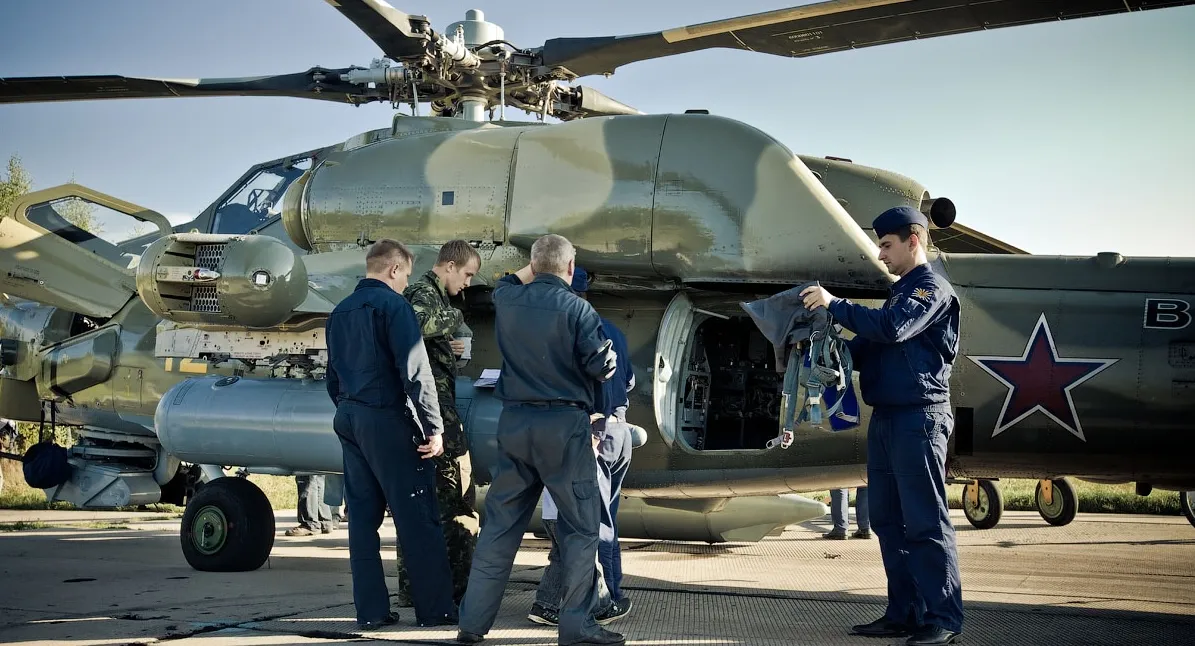
Mi28

Russia’s Mi-28 Havoc Attack Helicopter Has Tiny Crew Compartment To Pick Up Downed Pilots

As well as being a key component of Russia’s attack helicopter force in the war in Ukraine, the Mi-28 Havoc has been in the news recently on account of its apparent delivery to Iran. Meanwhile, one lesser-known aspect of the Mi-28 is its ability to transport two or three passengers in a cramped fuselage compartment, a feature that is seen clearly in a recently published video of the rotorcraft.

The footage in question originates with the state-owned Russia Television and Radio channel and shows a Russian Aerospace Forces Mi-28NM — the latest domestic version of the gunship — undergoing pre-flight checks at a forward airstrip somewhere in the Ukrainian conflict zone. The video reportedly dates from this month.

At the start of the video, a technician is seen handling hoses that run into the helicopter’s port-side rear fuselage via an open door. Typically, such hoses are attached to dehumidifier units, which then blow warm, dry air through the aircraft to keep everything dry. This is especially important for sensitive avionics in cold weather, as on this snowy airfield. Once the helicopter is fully powered up, it should keep itself warm enough for moisture not to be a problem.

Perhaps the best available view of the Mi-28 rear-fuselage compartment, with the access door open. via X

What’s most interesting, however, is that the open door provides a rare look into this rear-fuselage compartment, which has the capacity to carry two or three people, or an equivalent load of cargo. Of course, this is in addition to the Mi-28’s two crew seated in tandem in the cockpit — the weapon system operator/navigator forward and the pilot to the rear.

The fuselage compartment, unique among in-service attack helicopters, was part of the Mi-28’s design when it was first schemed back in the second half of the 1970s. The Soviet Union had ordered Mil to design a new-generation combat helicopter, equivalent to the U.S. AH-64 Apache, but this feature was all its own.

The Mi-28’s configuration was broadly similar to the AH-64, but marked a significant move away from the philosophy enshrined in the previous Mi-24 Hind. As we have discussed in the past, the Mi-24 had been built around a passenger/cargo cabin — with space for a squad of infantry — although, as it was developed, it expanded its anti-armor capabilities, too.

A walkaround video of a privately owned Mi-24 in the United States. The passenger/cargo cabin is seen in detail from around the 11:30 mark:

Hind MI-24 Helicopter Walkaround Tour


In contrast, the Mi-28 was a tank-killer first and foremost, with no cabin, and better overall performance. However, there was internal space for a much smaller compartment and one that would be very useful for retrieving downed pilots from the battle area, especially for grabbing a pilot who went down within the same flight. Bearing in mind the expected aircraft losses on Europe’s Central Front — especially among low-flying helicopters — this made a lot of sense.

Other tasks could have included moving mechanics and tools to conduct limited repairs of other helicopters in an emergency. Potentially, it could even have been used for inserting and picking up infiltrators or saboteurs.

Having the option of using the Mi-28 as a kind of ad-hoc, or non-traditional combat search and rescue (CSAR) asset would also mean that the aircraft could operate on its own and on the fly if other air or ground assets were not available. Traditionally, CSAR helicopters have to operate with an armed escort. It’s unknown whether the passenger cabin has been used at all in the war in Ukraine, but the limited space, presence of avionics equipment, and complete lack of windows mean it’s only really suited to emergencies. For more typical CSAR missions in the Ukrainian theater, Mi-8 Hips and Mi-24s are typically used, with an escort of Mi-28 or Ka-52 Hokum attack helicopters.

A close-up view of the Mi-28 rear-fuselage compartment reveals how cramped it is, including the presence of avionics equipment. via X

As for other attack helicopter types attempting personnel recovery, the best-known incident is likely that involving two British Army Apache gunships in Afghanistan in January 2007. During that dramatic mission, four Royal Marines strapped themselves to the outside of two Apaches for an attempted combat rescue. Ultimately, they were only able to recover the body of their fallen comrade, Lance Cpl. Ford, who had already been killed.

The Italian Army, too, has explored the concept of using its A129 Mangusta attack helicopters for personnel rescue, strapping a pair of soldiers to the main landing gear struts. Meanwhile, the U.S. Army Special Operations Command operates MH-6M Little Birds with side-mounted planks to externally airlift special operators. A more elaborate modular system, used to transport small numbers of personnel, was schemed for the Bell 360 Invictus armed scout helicopter, as you can read about here.

A diagram depicting four individuals sitting on a modular seating system fitted in the weapons bay of a 360 Invictus helicopter. USPTO

It’s also worth pointing out another planned ‘survival’ feature of the Mi-28, namely its crew-escape system. Unlike the Ka-52, the Mi-28 doesn’t have ejection seats. Instead, the Zvezda/Tomilino Pamir-K crew seats have belts that tighten automatically when high-g loads are encountered. As originally envisaged, the crew escape system would work as follows: During any kind of catastrophic failure at altitude, the cockpit doors would be blown off, the stub wings would be jettisoned together with their loads, and an inflatable door-sill sleeve would be filled with air. This was to protect the crew from the protruding main landing gear and cannon and help them clear the helicopter, after which they would return to the ground by parachute. In theory, at least.

Ka-52 alligator and its unique K-37-800M ejection seats. Before the rocket in the ejection seat deploys, the rotor blades are blown away by explosive charges in the rotor disc and the canopy is jettisoned. pic.twitter.com/BzPP9SNXMZ

— Владимир З. (@VladZinen) December 11, 2020

In practice, it seems the crew escape system never reached operational status on the Mi-28, likely due to the very limited window in which it would be of practical use.

According to the Oryx open-source tracking group, Russia has lost 19 Mi-28s since launching its full-scale invasion of Ukraine four years ago. This figure could be higher because Oryx only tabulates losses it can confirm visually. Russia began the conflict with a force of around 110 Mi-28s of all versions.

⚡️Video of the destruction of the Mi-28 of the 🇷🇺Russian Air Force using an 🇺🇦FPV drone. The first recorded case pic.twitter.com/LWosDeX2Ah

— 🪖MilitaryNewsUA🇺🇦 (@front_ukrainian) August 7, 2024

The Mi-28 has had a notably protracted history since it was first flown in prototype form in 1982. The original Havoc was abandoned by the early 1990s, and Mil pressed ahead with the radar-equipped, night-capable Mi-28N version. Deliveries of production Mi-28N helicopters to Russia began in 2008, and export versions have since been sold to Algeria, Iraq, Uganda, and, apparently, now also Iran.

For Russia, the basic version remains the Mi-28N, which also undertook combat operations in Syria starting in 2016.

Less common is the Mi-28UB (only 24 of which were produced), which received a mast-mounted radar, lacking on the Mi-28N, and dual controls. As for the latest Mi-28NM version — as seen in the video above — this also has the mast-mounted radar and other changes, including new missiles. As well as having been ordered in quantity for Russia, there are also plans to bring older Mi-28N aircraft up to Mi-28NM standard.

Video of the radar-equipped Mi-28UB during a live-fire exercise in the Krasnodar region, March 2020:

Russian Mi-28UB live fire exercise


For all the changes that the Mi-28 has undergone since it first appeared, its highly compact passenger compartment remains one of its most unusual features.

Contact the author: thomas@thewarzone.com
Thomas is a defense writer and editor with over 20 years of experience covering military aerospace topics and conflicts. He’s written a number of books, edited many more, and has contributed to many of the world’s leading aviation publications. Before joining The War Zone in 2020, he was the editor of AirForces Monthly.


Source link

Evidence Of Mi-28 Havoc Attack Helicopters Delivered To Iran Grows

Video has emerged that is said to show a Russian-made Mi-28NE Havoc attack helicopter flying over the Iranian capital Tehran. Last week, pictures had also appeared online that looked to show at least one Mi-28NE in Iran. The arrival of Havocs in Iran might also point to the delivery of weapons and other materiel from Russia, or plans to do so soon, amid a new spike in geopolitical friction between the Middle Eastern country and the United States.

TWZ has not been able to independently confirm where and when the footage in question, seen in the social media post above, was taken. However, the pictures that began circulating online last week look to have taken at a hangar belonging to Iran’s Pars Aerospace Services Company (PASC). Situated at Mehrabad International Airport in Tehran, PASC is tied to Iran’s powerful Islamic Revolutionary Guard Corps (IRGC) and is subject to sanctions in the United States and other Western countries.

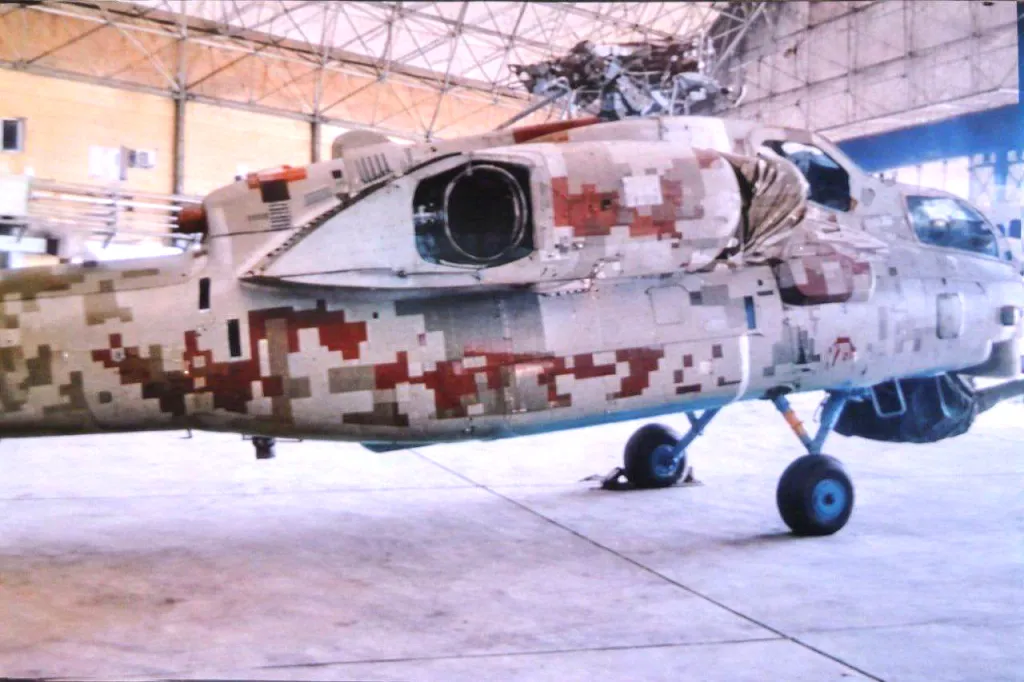
One of the pictures that began circulating online last week said to show an Mi-28 in Iran. via X

🇷🇺🇮🇷 It is believed that Iran has received the first batch of Mil Mi-28NE attack helicopters ordered in Russia.

Photos of a Mil Mi-28 helicopter in digital desert camo stationed in a hangar have emerged on social media.

The arrival of the first Havocs in Iran was also… pic.twitter.com/SgZxwy9ivP

— Status-6 (War & Military News) (@Archer83Able) January 28, 2026

Geo-Location of the warehouse where the recently delivered to Iran Mil-28 helicopter photo is taken.
Pars Aerospace Services Company in Tehran.
35.69899, 51.29459 pic.twitter.com/VV7ruGVPWj

— Mehdi H. (@mhmiranusa) January 28, 2026

In addition, on January 3, Iranian journalist Mohamad Taheri wrote “Inshallah you have a good military service,” according to a machine translation of a Persian-language post on X, which included a stock picture of an Mi-28 wearing a two-tone desert camouflage scheme. Taheri has been associated with Iran’s quasi-official Tasnim News Agency. Tasnim was among the first to report on a possible Iranian acquisition of Havocs, as well as Su-35 Flanker fighters and Yak-130 jet trainers, all the way back in 2023. The Yak-130s appeared in Iran that same year. There had been talk of a batch of Su-35s originally built for Egypt, but that were never delivered, being sent instead to the Iranians. However, at least some of those jets appeared instead in Algeria last year.

The two-seat Mi-28 traces back to before the fall of the Soviet Union, with the original variant making its first flight in the 1980s. The project was shelved in the 1990s and then subsequently revived. The first version to enter actual operational service was the Mi-28N in the late 2000s. Russia subsequently introduced an NE export version, different subvariants of which have been delivered to foreign customers in the past. A further upgraded NM variant for the Russian military was also developed in the 2010s, but has been slow to enter operational service. You can read more about the Mi-28 family in this past TWZ feature.

An example of the latest Mi-2NM variant. Russian Ministry of Defense
Mi-28NEs in Iraqi service. The nose of an Mi-24 Hind gunship is also seen at right. Iraqi Army

Mi-28s are armed with a 30mm automatic cannon in a turret under the nose and can carry various munitions, including anti-tank guided missiles and unguided rockets, on four pylons, two on each of a pair of stub wings on either side of the fuselage. The default sensor suite on the Mi-28N includes a mast radar and a turreted infrared video camera under the nose.

The exact configuration of any Mi-28s for Iran, and how many the country may have ordered in total, is unclear. The recently emerged video is too low quality to see any fine details, though it does appear to be fitted with a mast-mounted radar that has been lacking on certain other export versions of the Havoc. The still pictures show a partially disassembled helicopter, which also makes it very difficult to assess the overall configuration. The images do not offer a clear view of the nose, either, where various sensors, as well as the turreted main gun, are located.

Russian Helicopters, the main helicopter conglomerate in Russia today, also notably unveiled a further improved NE variation in 2018 that was said to incorporate lessons learned from the conflict in Syria. This included a directional infrared countermeasure system to provided add defense against incoming heat-seeking missiles, as well as other survivability improvements. It had new engine air filters, a particularly desirable feature for operations in desert environments, and a digital camouflage scheme, as well. The Mi-28 seen in the pictures that emerged last week looks to have the air filters, though they are covered by tarps, and has a digital paint job.

An image reportedly depicting an Mi-28NE attack helicopter recently delivered from Russia to Iran, featuring digital desert camouflage and lacking specialized screen-exhaust devices (SEDs), also known as infrared signature suppressors. https://t.co/e6AZK0g7OW pic.twitter.com/Etc5eo4RPo

— H. Memarian (@HEMemarian) January 28, 2026

New Mi-28s in any configuration would be a notable addition to the Iranian arsenal. The main attack helicopter in service in Iran today is the AH-1J International Cobra, which the country first acquired during the reign of the Shah. The Islamic Republic has made some upgrades to its AH-1 fleet since the 1970s, with the resulting helicopters variously referred to as Toufans or Panha 2091s. However, at their core, these are American-made helicopters that are increasingly difficult for the current regime in Tehran to sustain. The Havoc is more survivable overall and can carry a greater weapons load, as well.

IR Iran unveils Toufan 2 helicopter (upgraded Cobra)


If Iran’s Mi-28s feature the infrared sensor turret and the mast-mounted radar, the helicopters could offer an even greater boost in capability, even at night or in poor weather. That, in turn, could be valuable for responding to any kind of foreign ground incursion in the future, or to internal threats to the regime. At the same time, when an Iranian Havoc fleet might reach a level of real operational capability, and how well the country is able to sustain the helicopters going forward, remains to be seen. Moscow’s own demands in relation to the war in Ukraine have created additional challenges for foreign operators of Russian-made helicopters and other materiel.

As noted, the appearance of Mi-28s in Iran could also reflect larger deliveries of weapons and other materiel from Russia, or the potential for that to occur in the near future. In January, online flight tracking data showed at least five flights by Il-76 airlifters from Russia to Iran, which could have been carrying Havocs or other cargo. Those aircraft could also have been bringing cargo back to Russia from Iran, or carrying payloads both ways. Ties between Moscow and Tehran have grown, in general, in recent years, as Russia has found itself increasingly isolated globally over the ongoing conflict in Ukraine. There has been much talk of Iran receiving exchanges in kind for its support to the Russian war effort.

Flight-tracking data from Flightradar24 shows at least five Russian Il-76 cargo aircraft flying to Tehran in the past 48 hours, pointing to a spike in undeclared Russian deliveries to Iran. pic.twitter.com/jLP8bz45iA

— Open Source Intel (@Osint613) January 1, 2026

In addition, since the end of the 12 Day War with Israel, Iran has been looking to bolster various ends of its depleted arsenal. There have been reports that Iran has also been seeking new air defense systems from China, another country the regime in Tehran has been working to expand its ties with. China reportedly continues to be an important source of materials to support Iranian missile programs, as well.

The Mi-28 imagery has come amid the backdrop of a new surge in geopolitical friction with the United States. Just today, American authorities announced that an F-35 Joint Strike Fighter flying from the aircraft carrier USS Abraham Lincoln in the Arabian Sea shot down an Iranian drone that had “aggressively approached” the ship. U.S. officials also accused the IRGC of harassing a U.S.-flagged merchant vessel transiting the Strait of Hormuz.

All of this follows a major build-up of U.S. military forces in the region for weeks now, together with a steady stream of reports that U.S. President Donald Trump is considering new strikes on Iran, at least in part in retaliation for that country’s violent crackdown on nationwide protests last month. Trump has also expressed interest in finding a negotiated arrangement of some kind with Tehran, with reports that American and Iranian officials could meet as early as Friday in Turkey.

Speaking earlier on Fox News, White House Press Secretary Karoline Leavitt confirms the shoot down of an Iranian drone that was “acting aggressively” towards the USS Abraham Lincoln (CVN-72) today over the Arabian Sea, though states that President Trump remains committed to… pic.twitter.com/sVPzPjZIy8

— OSINTdefender (@sentdefender) February 3, 2026

When it comes to Mi-28s for Iran, evidence is growing that at least one of the helicopters has now been delivered, and more details may now continue to emerge.

Contact the author: joe@twz.com

Joseph has been a member of The War Zone team since early 2017. Prior to that, he was an Associate Editor at War Is Boring, and his byline has appeared in other publications, including Small Arms Review, Small Arms Defense Journal, Reuters, We Are the Mighty, and Task & Purpose.


Source link