mexico city

Best restaurants to try in Mexico City, according to an expert

Yes, you should visit Mexico City. Don’t overthink it and don’t delay. Despite excessive tourism and rising gentrification fears, the seething capital of Mexico — 25 million souls strong — remains a top-tier international destination for any committed food lover. And the intensity of its dining scene seems to be only growing.

Sure, a wave of privileged remote workers oozing dollars and euros may have dampened the vibe for Mexico City natives, leading to protests. The post-pandemic issues of housing displacement and rising costs for locals are serious challenges that political leaders must address. Yet time and again, on every visit, the resiliency and passion that original defeños have for their gastronomical paradise proves to be boundless.

Use these handy dining guides for all of your summer travel, near and far.

I have traveled to Mexico City regularly since 2002 and lived there for nearly a decade. I won’t feel slighted if you prefer the dining advice of current residents, or from any of the numerous local dining guides online. But one thing about me, I have an aversion to hype, and tend to avoid the city’s contemporaneous food magnets where the ratio of foreigners to locals is too out of whack. (No, the Michelin-starred taqueria was never extraordinarily better than any others in its bracket.) Where my native friends go, I go.

Here are highlights of my top, top, top recommendations from my L.A. Times restaurant guides on Mexico City, plus a few more favorites. My goal here is to distill down your options for a concentrated, food-centric visit, from nostalgic jewels beloved by hardscrabble chilangos to the celebrated shrines of high-end chefs reaping the bounties of the Valley of Mexico.

Source link

$75 caviar-topped tots. Beer that costs a day’s pay. Here’s the World Cup menu — and prices

World Cup tickets are expensive. Flights to North America are expensive. Hotel rooms in many places are expensive.

Then there’s the price of beer.

There are some fun — and yes, sometimes pricey — food and drink offerings at the venues playing host to the World Cup. A $75 caviar-topped tray of tater tots and a $40 empanada weighing in at 5 pounds for the daring or for sharing in Miami. Ribeye tacos for $8 in Guadalajara, Mexico. Something called a Twinkie cheeseburger that has nothing to do with dessert for $22 in Los Angeles.

Prices, in many cases, aren’t all that different from what U.S. fans would experience on NFL Sundays or college football Saturdays. But some international fans aren’t used to such pricing and are calling foul, especially over beer prices that can top $20.

“It’s unfair. It’s not right. It’s wrong,” said Thomas Schüller, an engineer from Germany in Toronto to watch his national team play over the weekend, as he held a beer that cost him 24.25 Canadian dollars (about $17). “It’s three times the cost of what I pay in my country.”

But is that stopping him?

“Well, no,” Schüller acknowledged.

Beer prices become a mild pint of discord

There is clearly some sticker shock among international visitors to this World Cup, especially when it comes to the concession prices. In Europe, it’s not uncommon for beers to be perhaps around 4 or 5 euros (about $5-6).

There’s also no shortage of intrigue on the menu at the concession stands at stadiums across the U.S., Canada and Mexico.

“Never seen anything like it,” said Janine Arbetter, a fan from Austria, as she waited for a hot dog, chips and soda combo in Miami last week. The pre-tip price: $19.35, which included a discount for using Visa. “It’s a lot of food for a little snack.”

Some Argentina fans happily showed off their $34 lobster rolls from a match in Kansas City on social media, but in Toronto, the brisket sandwich with chips and a bottle of soda for nearly 40 Canadian dollars ($28) had some online commenters lamenting it as “robbery.”

“It’s OK, more or less, for the World Cup,” German fan Daniel Feldmann said of the food prices while watching a match in Vancouver last week.

Concession offerings vary from stadium to stadium

FIFA, the sport’s governing body and the tournament organizer, has very specific rules on just about everything related to the World Cup — and there are guidelines that concessionaires have to follow as well. But prices can vary by market, as do the food and drink offerings. And that means the experience in one city might look, or taste, nothing like what’s offered in another.

The “Fancy AF Tots” for $75 at Miami Stadium aren’t really tots at all — it’s three deep-fried hash brown patties, with caviar, creme fraiche and chives. (For those who just want the caviar, it’ll be $70.) Southern California’s Twinkie cheeseburger is in fact a burger topped with a Texas Twinkie — a bacon-wrapped jalapeño stuffed with brisket and cream cheese.

But there’s also a slew of choices specific to a local market; for example, Vancouver offers short rib poutine along with a maple bacon smokie (smoked sausage topped with bacon onion jam that features Canadian maple syrup).

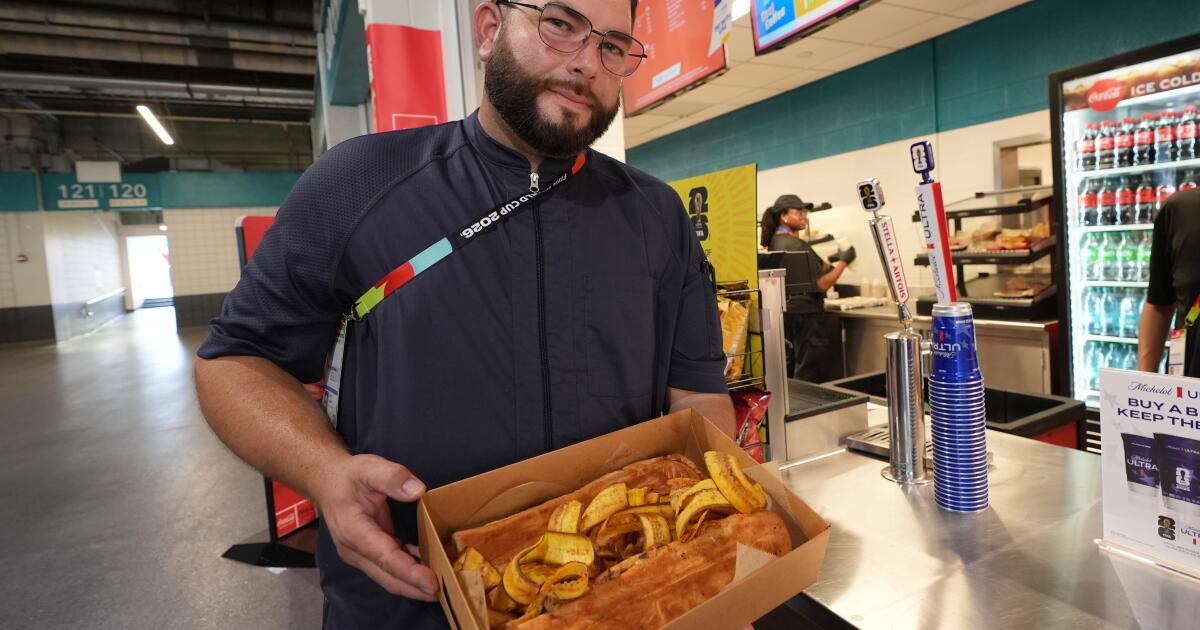
And in Miami, the signature offerings include pan con lechon (a Cuban-style sandwich with pork, infused with citrus mojo sauce and served on a toasted full Cuban loaf) and Empanada Mundial (the five-pound, handmade, chicken-and-cheese-stuffed dish named after the World Cup).

Both Vancouver and Miami have Sodexo Live as a food and beverage provider, and the typical game-day menus in both stadiums were revised a bit to accommodate a soccer crowd.

“We want it to feel like Miami when you’re here,” said Zach Williams, Sodexo Live’s vice president of operations at Miami Stadium. “Everything we do around the Miami Stadium, we want to make sure everybody understands that when they come here, they’re getting a Miami experience.”

Atlanta Stadium keeps prices low

In Mexico City, a beer could cost a day’s pay — literally. The daily minimum wage in Mexico City is just 315.04 pesos (roughly $18). Some beers at Mexico City Stadium were selling for between 299 and 310 pesos — about twice as much as fans would ordinarily pay in the same stadium when the World Cup isn’t in town.

But in Atlanta, where Falcons owner and stadium operator Arthur Blank promised the low concession prices he’s championed for many years would hold for the World Cup, pizza slices were $3, 32-ounce sodas were $4, a cheeseburger was $5, chicken tenders with fries were $6 and beers could be had for as little as $8.

Jonathan Arango, a 33-year-old from Greenville, S.C., was at a match in Atlanta with his wife, daughter and father.

“In total for what we got — three orders of tacos, a slice of pizza, two waters and a Coke — we spent like $50,” Arango said. “Compared to what we’ve paid at other events … it’s nice after you paid a lot for a ticket.”

And Schüller pointed out that even though the tournament does come around every four years, it still feels like a once-in-a-lifetime experience.

“The entire football world is having fun,” Schüller said, “so cheers to that.”

Reynolds writes for the Associated Press.

Source link

LIV Golf CEO confirms Saudi funding commitment is only through 2026

LIV Golf appears to be dying on the vine but doesn’t want to say so.

Amid several reports that the Saudi-backed Public Investment Fund will cease its abundant funding of LIV Golf after the 2026 season, officials with the four-year-old PGA Tour competitor chose to focus on the fact that the show will go on — at least through August.

During a broadcast interview from the LIV tournament in Mexico City, LIV Chief Executive Scott O’Neil would not say if the league has a funding commitment from the Public Investment Fund, or PIF, beyond this year.

O’Neil responded to a question about golfer Sergio Garcia saying this week that LIV Golf Chairman Yasir Al-Rumayyan “told us at the beginning of the year that he is behind us, that they have a project of many years.”

“It’s just not the way the world works,” O’Neil said. “We have commitments to have this … the reality is you’re funded through the season and then you work like crazy as a business to create a business and a business plan to keep us going.

“But that’s not different from any other private equity-funded business in the history of mankind.”

The interview was pulled from the internet shortly after it was posted.

PIF announced a new five-year strategy Wednesday that will reduce international investments from 30% to 18-20% of the portfolio and place greater emphasis on Saudi domestic initiatives to promote sports. LIV Golf does not fit into that category and was not mentioned.

“PIF will continue to support Saudi Vision 2030 objectives by delivering competitive domestic ecosystems,” Al-Rumayyan said in the announcement. “The 2026-2030 strategy is a natural next step in PIF’s growth journey.”

PIF approved more than $250 million in additional funding for LIV Golf this year, hiking the total investment to more than $5.3 billion since the league was launched four years ago. Documented losses are more than $1 billion from 2022 to 2024, according to Forbes.

LIV Golf executives were rushed from various corners of the planet to a meeting this week in New York where the future of the operation was discussed in private and decisions were made.

A few flew in from Mexico City, where this week’s tournament began Thursday at the Club de Golf Chapultepec. It is one of the highest-altitude golf courses in North America, and LIV golfers took deep breaths before answering press questions about reports that the organization was on the verge of collapse.

“For me, it didn’t make sense to think about it or waste time thinking about,” superstar golfer Jon Rahm said after shooting a first-round 65. “Since everything happened so suddenly and so quickly, I wasn’t very worried about it because normally, before the rumors start, we already know something — there’s always someone within the league who knows something.”

Communication at the tournament was spotty. A power outage at the course Tuesday caused interviews to be canceled, and streaming of the first round Thursday was down for about two hours because of what were described as technical difficulties.

Yet nothing could stop the speculation and growing unease about the future of LIV Golf. Money continues to hemorrhage, as does the roster of big-name golfers.

LIV Golf purses each week are $30 million — 50% more than PGA Tour purses. Enormous signing bonuses were doled out to secure the services of superstar golfers Phil Mickelson, Dustin Johnson, Cameron Smith, Bryson DeChambeau and Rahm. All received bonuses of at least $100 million to defect from the PGA Tour, and Rahm, a relative latecomer to LIV Golf, received a reported $300- to $500-million bonus.

Yet original LIV Golf members Brooks Koepka and Patrick Reed recently returned to the PGA Tour. Others are bound to follow.

Former PGA standout Greg Norman was the LIV Golf chief executive until resigning in August, citing exhaustion. His comments upon exiting might have foreshadowed the current difficulties.

“I knew there were going to be a lot of headwinds,” he told the Australian Golf Digest. “I didn’t anticipate the magnitude of those headwinds because … as time went by, those headwinds were created by misperceptions.”

Norman was replaced by O’Neil, whose internal message to the LIV staff Wednesday attempted to quiet concerns about PIF pulling the plug. He urged the golfers to focus on the season that is already underway.

“We are heading into the heart of our 2026 schedule with the full energy of an organization that is bigger, louder and more influential than ever before,” O’Neil wrote in the message obtained by Sports Illustrated. “The life of a startup movement is often defined by these moments of pressure. We signed up for this because we believe in disrupting the status quo.

“We have faced headwinds since the jump, and we’ve answered every time with resilience and grace. Now we answer by doing what we do best: putting on the most compelling show in sports.”

One of those headwinds is that “a compelling show” can be a relative term. LIV Golf has been popular in golf-starved locales such as Australia and South Africa, but TV ratings are low everywhere and interest in events held in the United States is tepid.

PIF — worth an estimated $1.15 trillion — launched LIV Golf as part of a strategy to transform Saudi Arabia into a global sports hub, using its vast oil revenue to drive economic diversification, create jobs and boost tourism. Initiatives include massive investments in soccer, tennis and esports in addition to golf.

The PGA Tour countered by increasing prize money and creating a series of limited-field “signature events” for top players. Rory McIlroy and Tiger Woods are among the sport’s top stars to steadfastly remain loyal to the PGA Tour, with Woods turning down an offer from LIV Golf of $800 million in 2022.

Mexico City is the sixth stop in the LIV Golf 14-tournament season that concludes in August. The Individual Championship finale is scheduled for Indianapolis from Aug 20–23.

Source link