England faces Mexico on hostile turf with World Cup glory at stake
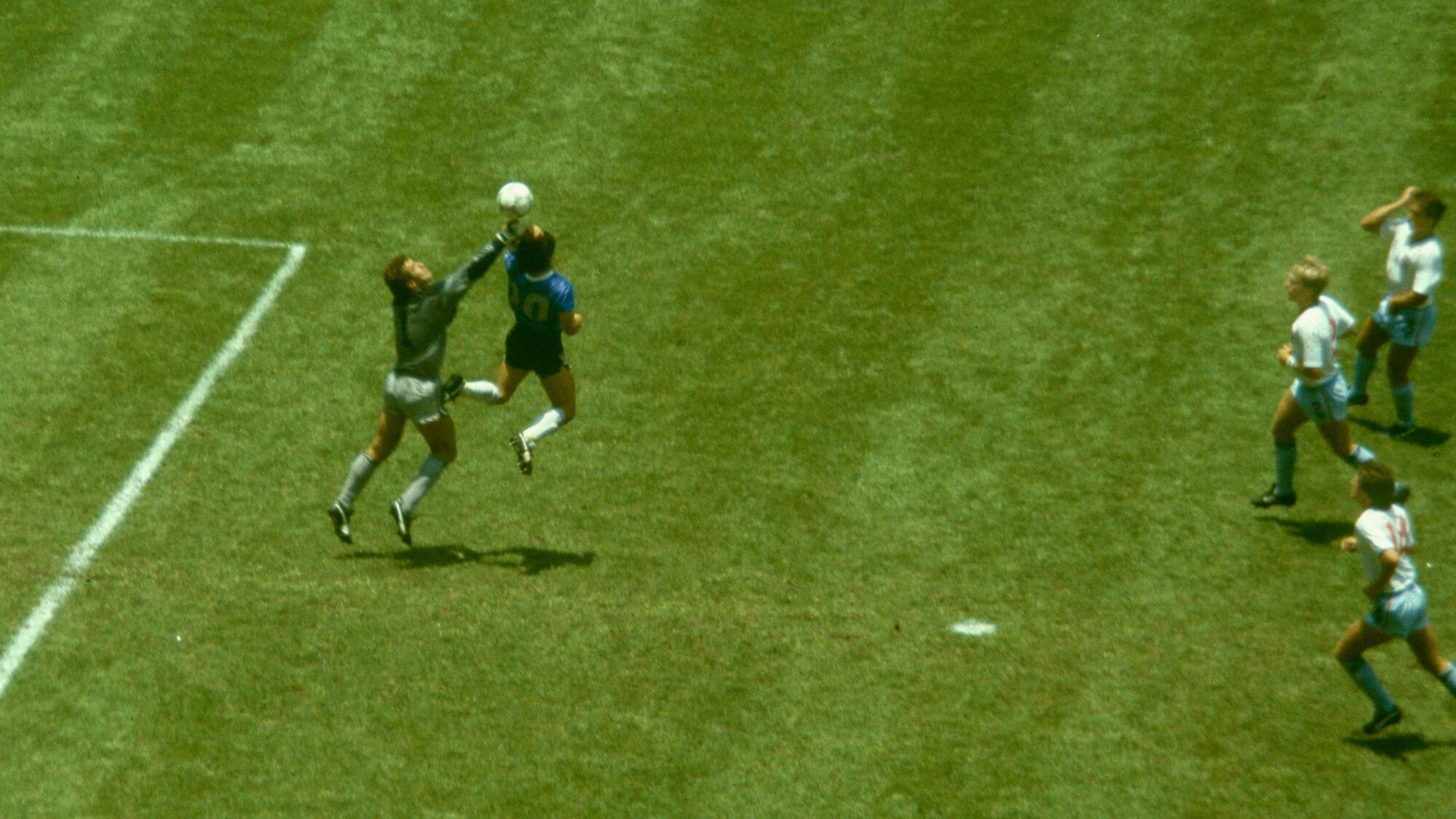
England famously found itself on the wrong side of World Cup history at Azteca Stadium, surrendering Diego Maradona’s iconic “Hand of God” goal and another strike known as the tournament’s “most beautiful goal.”
Maradona and eventual champion Argentina eliminated England 2-1 in the quarterfinals of the 1986 World Cup, leaving the Brits to stew over their link to a soccer legend.
England will return to Azteca Stadium on Sunday to take on World Cup co-host Mexico in a round-of-16 match kicking off at 5 p.m. PDT and airing on Fox and Telemundo.
England coach Thomas Tuchel said during interviews before their departure for Mexico that this will be a way to “make amends” with the stadium that hosted a goal Maradona punched in with his fist, and “karma will come back for us.”

Argentina’s Diego Maradona punches the ball past England goalkeeper Peter Shilton to score his “Hand of God” goal during a 1986 World Cup match at Azteca Stadium.
(Getty Images / Getty Images)
“It’s one of the most beautiful, most exciting matchups you can have — playing Mexico at the Azteca,” Tuchel said during a news conference after defeating the Democratic Republic of the Congo in the round of 32.
But the road to Azteca Stadium hasn’t been easy for England.
England enters this matchup after a hard-fought victory over Congo. The African team took the lead and had chances to extend it, but ultimately paid dearly for squandering those opportunities. Top England scorer Harry Kane stepped up with two decisive goals that helped his team advance. It was England’s first World Cup victory after trailing 1-0 since the 1966 final, which the English team won as a tournament host.
The English have to contend with not only the ghost of Maradona’s two goals, but also the altitude in Mexico City, which is about 7,350 feet above sea level.
Mexico has lost only two of 89 matches at Azteca Stadium, winning 70 and tying 17. The last time it lost an official match there was a 2-1 defeat to Honduras in a 2013 World Cup qualifier.
“There will be many obstacles — the altitude will be a major disadvantage because we can’t acclimate to it,” Tuchel said. “Let’s hope that when we face difficulties along the way, we’ll find the answers.”

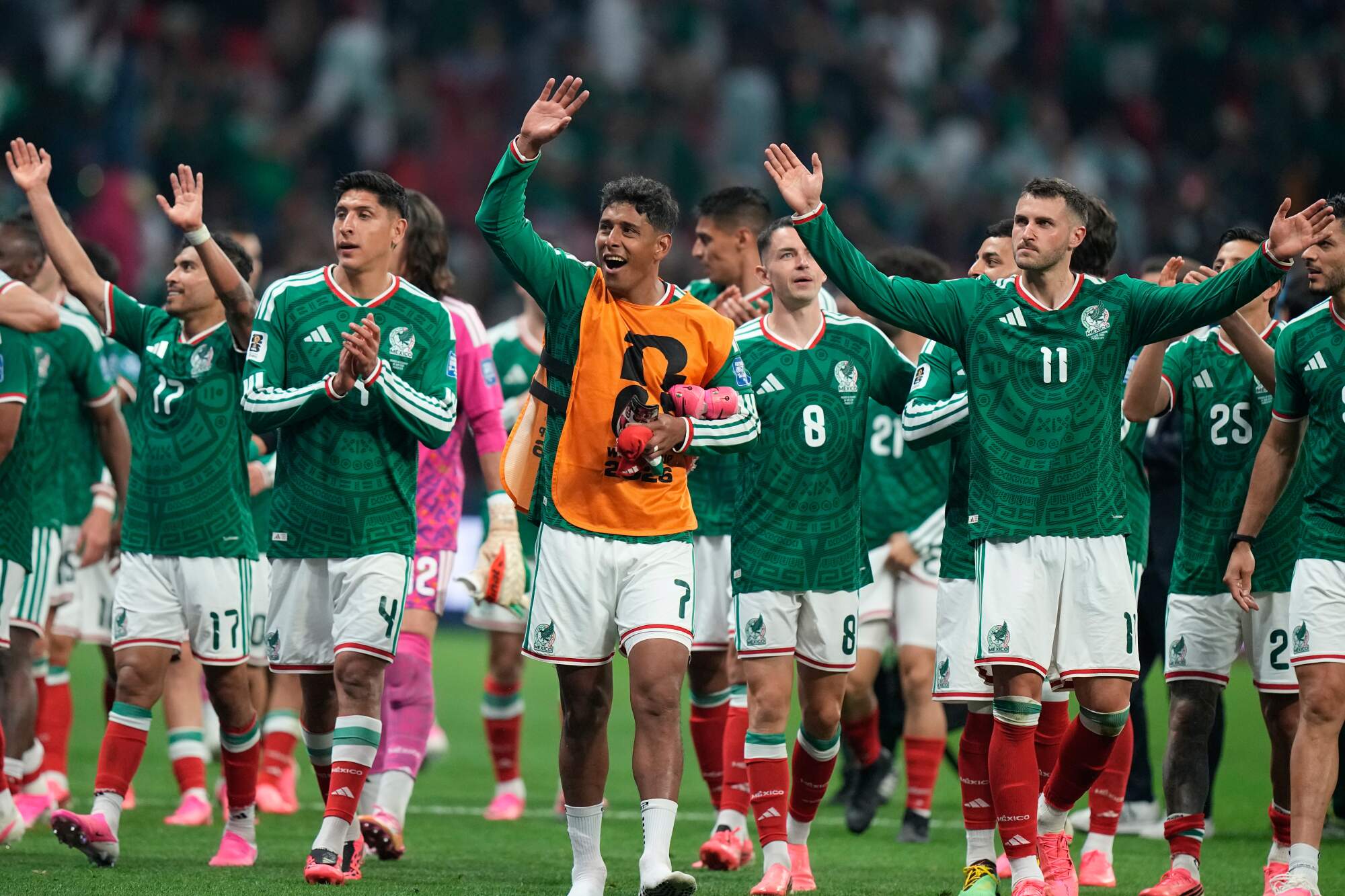
Mexico players celebrate after the team’s World Cup win over Ecuador at Azteca Stadium on Tuesday.
(Luke Hales/Getty Images)
Tuchel noted his team got accustomed to heat and humidity while training in the United States.
“At the end of the day, it’s a soccer game,” said England’s Marcus Rashford, who also plays for Manchester United. “We’ve all been playing soccer since we were kids, and we’ve played in different environments and under different conditions — some more difficult than others, some in terrible places. But it’s up to us to find a way to win and to work as a team.”
England expects to face an intense atmosphere, with the majority of more than 80,000 fans backing Mexico.
“It’s one of the great stadiums in soccer. Playing there is a blessing. Mexico is probably the favorite. They’re at home, playing on their home turf; it will be a big challenge for us, but we’ll be ready,” England’s Marc Guehi told the BBC.
The match also will pose a significant challenge for the Mexican team, which has not conceded a goal during the World Cup but will face an English side that excels in aerial play, with lethal scorers like Kane and Jude Bellingham. Mexico’s defensive performance has been credited to the direction of Rafa Márquez, a former Barcelona player who is one of Mexico’s assistant coaches.
“They’re high-caliber players who can make a difference at any moment, and we have to take advantage of playing at home and maintain our current level of play because no one has given us anything for free,” said veteran backup goalkeeper Guillermo Ochoa, another key voice supporting Mexico’s defensive effort.
Less than 72 hours before the game, FIFA explored moving the evening kickoff to noon local time — a change that would have completely disrupted the sporting, logistical and emotional planning of both teams.
FIFA first weighed the unprecedented change reportedly because of the threat of thunderstorms. The Athletic and media outlets covering both teams later reported security concerns after the death of four Mexico fans during round-of-32 postgame celebrations triggered the potential change, but both team pushed back, and Mexico’s security officials assured FIFA they could keep fans safe. FIFA relented and did not change the start time.

Mexico’s Álvaro Fidalgo celebrates after scoring against Czechia during a World Cup match at Azteca Stadium on June 24.
(Silvia Izquierdo / Ap Photo/silvia Izquierdo)
“No one wants a celebration — such an important moment, a once-in-a-lifetime moment — to turn into a sad occasion because of certain things. We don’t want anyone to lose a loved one,” Mexico midfielder Álvaro Fidalgo said.
Contrary to what many experts expected, Mexico has breezed through the group stage and the second round at home. Coach Javier Aguirre has eased some of the pressure on himself by leading the team to its fifth World Cup match — a feat Mexico had not achieved in eight consecutive World Cups. Two of those failed attempts came under Aguirre’s leadership: in 2002, when Mexico lost to the United States, and in 2010, when it lost to Argentina — both in the round of 16.
“We’ll try to keep this momentum going at home,” Aguirre said. “We’ll try to play a complete game.”
With the support of its fans and a sense of hope that grows with every game, the Mexican team will seek to match its best performances from 1986 and 1970 — World Cups it hosted, though with fewer participating teams.

Mexico’s Raúl Jiménez celebrates after scoring against South Africa during a World Cup match at Azteca Stadium on June 11.
(Carl Recine / Getty Images)
“We have to let them know that we’re just as good,” said Raúl Jiménez, Mexico’s leading scorer. “That we can compete on equal terms, we can play a good game, and we have the support of the fans. It doesn’t matter which goalkeeper is in front of us — if we put it in the corner, no goalkeeper can stop it.”
Advancing past England would mark the first time Mexico defeated a past champion in a knockout round, and it also would be the first time the team strung together two knockout-round victories in a World Cup, after beating Ecuador in the round of 32.
Mexico defeated past champions France and Germany in 2010 and 2018, respectively, but those wins came in the group stage.
“It’s a match everyone always dreams of. Being in the round of 16 at the Azteca — not just saying it, but even thinking about it — is incredible,” Fidalgo said. “We have to rise to the occasion.”