How and where to view the Perseid meteor shower near Los Angeles
I am not someone who regularly goes out on a weekday.
But when I heard just how ideal the viewing conditions will be for the upcoming Perseid meteor shower, I texted multiple friends, inviting them on a late-night adventure into the woods. That’s exactly my kind of party.
The Perseid meteor shower, which can produce up to 100 meteors an hour in its most active period, is expected to peak from the evening of Aug. 12 into the early morning of Aug. 13. Last year during the shower’s peak, the moon was 84% full.
That’s part of what makes this year special. The night sky will be at its darkest during the Perseids peak because we’ll have the new moon, the lunar phase when our moon’s illuminated side faces the sun.

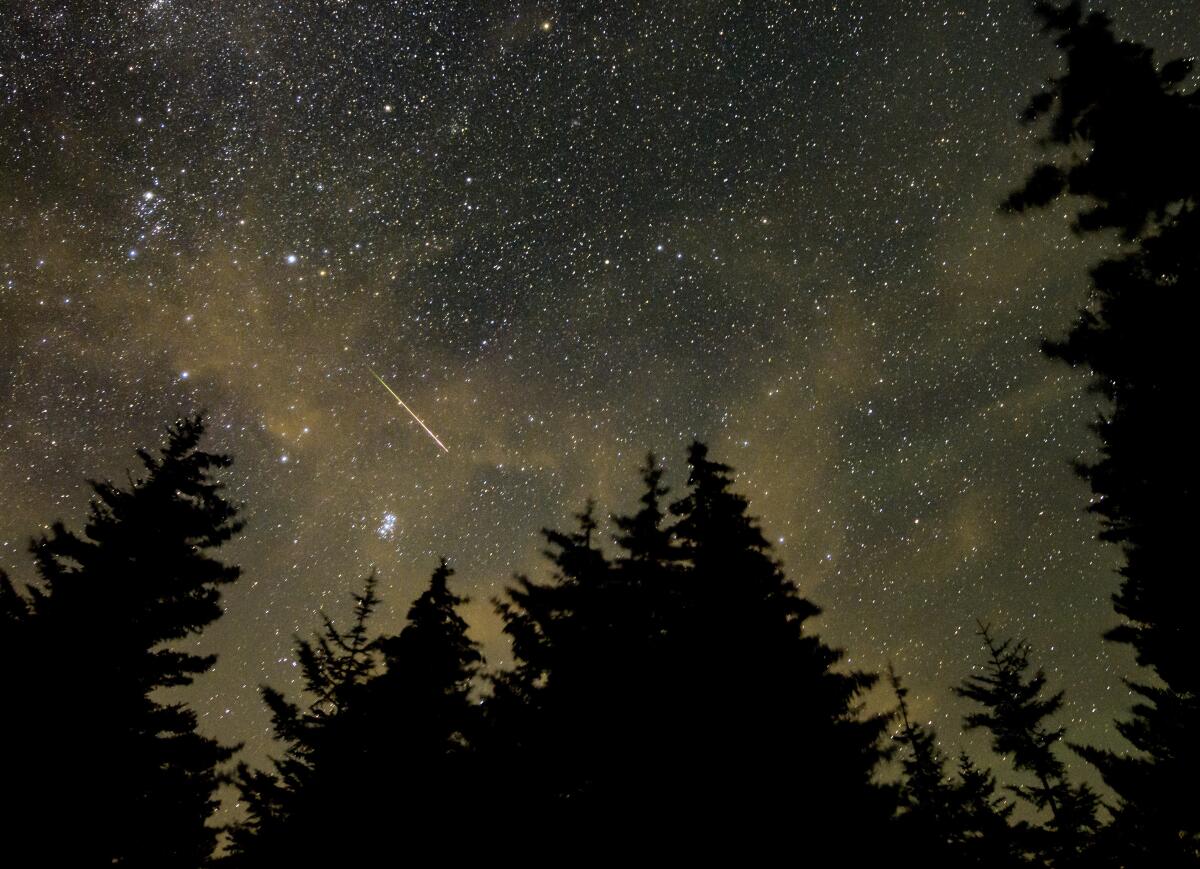
In this 30-second camera exposure, a meteor streaks across the sky during the annual Perseid meteor shower in West Virginia in 2021.
(Bill Ingalls / Associated Press)
In this edition of The Wild, our weekly outdoors newsletter, I will explain not only where near L.A. you can drive, hike or camp for the best viewing of this meteor shower, but also, thanks to a conversation with an astrophotography expert, how you can get better photos regardless of whether you’re using your cellphone or dedicated camera.
First, though, let’s talk about what exactly a meteor shower is and why they occur.
🌑 Tips for viewing the Perseid meteor shower 🌃
I spoke to Bruce Betts, chief scientist at the Pasadena-based Planetary Society, a member-financed group focused on advancing space science.
Betts explained that Earth gets hit every night by an estimated 100 tons of material, equivalent to about 13 Randy’s Donuts signs blasting into the planet (which is a fun visual). This means there are meteors every night, around 10 an hour in a place with no light pollution.
A meteor shower occurs when Earth is moving through a debris field left by a comet. But nothing hitting Earth is thankfully as large as a 25-foot-high fiberglass doughnut.
“It’s mostly small-sized stuff — sand-sized, pebble-sized, dust-sized,” Betts said. “It’s going to burn up hundreds of thousands of feet up in the atmosphere. When you see it fizzle out, it’s way up there typically.”
I cannot be the only person who, learning this information, felt surprised that tiny specks of space dust can produce such dazzling experiences for us earthlings. But these particles are moving incredibly fast — tens of thousands of miles per hour — and as they move through our atmosphere, they’re heating up and vaporizing.
In the case of the Perseid meteor shower, you’re watching debris left behind by the comet Swift-Tuttle as it neared perihelion, its closest approach to the sun.
Earth orbits through that debris field every August. The Perseid meteor shower is named as such because as you’re watching, it appears as if the meteors are emanating from a point in the constellation of Perseus called the radiant point.

Meteors streak across the sky, seen above the Temple of Zeus during the Perseid meteor shower near Cavdarhisar, Turkey, in 2025.
(Emrah Gurel / Associated Press)
🌃 Getting the best Perseid-viewing experience 💫
To see the most meteors during the Perseids, you have to get to a point where you’re looking through less atmosphere, which around L.A. includes smog, smoke, clouds and, of course, light.
“The real problem is light pollution,” Betts said. “And that is, lights on the surface that are then reflecting off particles and stuff, a technical term, in the atmosphere. If you can get above that stuff, you start seeing better.”
Betts compared it to being in a bright room where there’s a dim light on. You won’t notice the dim light until you turn the rest of the lights off, and suddenly, that dim light is the brightest thing in the room.
During the Perseids peak, you don’t have to escape the light pollution of L.A. to see meteors. From outside your home, you will probably still see the largest blasts of light between 9 and 11 p.m. This is best for anyone who must be at their workplace at 8 a.m. for a meeting that could have been an email.
For the rest of us, let’s dive into where the best spots near L.A. are.

The 2023 Perseid meteor shower, as seen from Sequoia National Forest.
(Preston Dyches / NASA)
🏔️ Where to view the Perseids near L.A. 🌠
Below you’ll find my recommendations for spots that should provide good opportunities for viewing the Perseids. Please take good care when driving mountain or unfamiliar roads, and make sure someone outside your party knows where you’re headed and when you’ll be back. A meteor shower is still viewable when stranded with a flat tire, but far less fun!
- Mt. Wilson Observatory: Located about an hour northeast of downtown L.A. in the San Gabriel Mountains, the observatory has a large paved parking lot at about 5,650 feet elevation that features nice views of the surrounding area. The only caveat is that the main gate usually closes at 5 p.m. in the summer, so you’ll need to park inside before then.
- The Vetter Mountain Lookout: The lookout, at about 5,900 feet elevation, is reachable via a 5-mile round-trip hike and offers stunning panoramic views of the San Gabriel Mountains. The trailhead is about an hour drive northeast of downtown.
- Chilao Campground: Also about an hour drive from downtown, this large first-come, first-served campground sits at 5,300 feet and offers great views of the night sky. Nearby Mt. Hillyer, which can be reached via a 6.4-mile round-trip hike from near the Chilao Visitor Center, could also be a nice spot to observe the meteor shower.
- Crystal Lake Recreation Area and Campground: Crystal Lake is a 120-site first-come, first-served campground north of Azusa (about 1½- to two-hour drive northeast from downtown). At 5,539-feet elevation, it’s a great spot to camp and take in the shooting stars.
- Mt. Pacifico Campground: This is a rustic 10-site campground that sits at 7,100-feet elevation and is deep in the San Gabriel Mountains. It’s about a 1½-hour drive from downtown L.A. and involves taking narrow mountain roads. High-clearance vehicles are required to make the final mile into the campground.
- Musch Trail Camp: Musch Trail Camp is a small but charming campground in the Santa Monica Mountains. Located in Topanga State Park, it has picnic tables and a small restroom with flush toilets and sinks. It’s around a 45-minute drive mostly west from downtown.
- Leo Carrillo State Park: Along with its hiking trails and campground, the park in Malibu features 1.5 miles of beach, where you can watch the sunset before the sky darkens enough to see the meteor shower.
- Red Rock Canyon State Park: A two-hour drive from downtown L.A., this park has colorful desert cliffs and a 50-site campground with great views of the night sky.
- Joshua Tree National Park: I mean, duh.
- McGill Campground/Chula Vista Walk-In Campground: A two-hour drive from L.A., either of these campgrounds in Los Padres National Forest will provide you with a memorable experience, as the area is known for its stargazing. McGill is mostly by reservation while Chula Vista is a walk-in spot with first-come, first-served sites. If not prepared to camp, you can also watch nearby from the Mt. Pinos parking lot, but it’ll likely be quite crowded during the Perseids, as it is the closest darkest spot to L.A.
Or, you could try a spot where you can safely and legally drive and/or hike into that you recall being fairly dark at night. There are online tools that can help you find your own spot, including light pollution maps.
Regardless of where you go, please remember to practice the Leave No Trace principles, including packing out any trash you bring, not taking anything from the forest that you didn’t bring and not playing loud music, as it not only bothers hikers but also the animals who live in our natural areas.

A Perseid meteor appears at the top left of the frame in this 25-second exposure, as seen from White Tank Campground in Joshua Tree National Park in 2024.
(Raul Roa / Los Angeles Times)
📸 How to photograph the Perseid meteor shower 🤩
Many of us have tried and failed to take photos of the night sky. I spoke to accomplished astrophotographer Jeremy Evans, a delegate for Dark Sky International who affirmed that it’s no easy task to capture the beauty of celestial bodies.
“Carl Sagan said astronomy can be a humbling and character-building experience because it is a little overwhelming to look up at that vastness of the sky and either explore it, photograph it [or] study it, [regardless of] whether through a telescope, camera or naked eye,” Evans said.
Here’s what Evans, who has photographed the Perseids for the past 20 years, recommends (after you’ve found the darkest area possible to view the shower).
1. Point your camera to the southwest
Perseus, the constellation that the upcoming meteor shower is named after, will rise in the northeast between 9 and 10 p.m., depending on your latitude.
Photographing a meteor shower can feel like a game of Whac-A-Mole, Evans said. Instead of trying to chase meteors across the sky all night, set your camera to face the southwest for the Perseids.
“Most of the [Perseids] meteors, based on my experience, fly from northeast to southwest, so I like to have my camera pointing toward the southwest, and catch those meteors flying overhead and into my frame,” Evans said. “The good thing about that is, when they start burning up and giving you that trail of ionized gases, they’re usually flying over the southwest at that point. You can point your camera to the northeast, but you might not get the fire balls and the tails.”
2. Adjust your camera’s settings
- If using a dedicated camera (as opposed to a phone camera), turn off image stabilization. Otherwise, you might be plagued with blurry images all night.
- Choose a wide lens. Evans generally recommends using a wide lens with a focal length between 14 and 24 mm. “You can use a fish eye,” Evans said. “However, a fish eye will show most of the night sky, but then the meteors are going to appear a lot smaller.”
- Determine your shutter speed. Some astrophotographers use the “500 rule,” an equation that helps them figure out the ideal shutter speed. It’s essentially dividing your camera lens’ focal length into 500 to get your shutter speed. For Evans, that’s often 500 divided by 24, which he rounds down to equal a 20-second exposure. (If your shutter speed is too slow, the stars can come out blurry)
- Turn off the flash.
- Turn off your camera’s auto focus. You will need to manually adjust your lens, as your camera most likely won’t be able to automatically focus on the starry sky. (More on that below.)
- Turn on shutter delay. If you don’t have an external remote, turn on the setting that allows for a multi-second delay after you press the button. This allows your camera to stabilize after you press the shutter. Wiggling camera = bad pics.
3. Set up your tripod.
Evans said a tripod is arguably your most important piece of equipment, and it’s worth investing in if you’re wanting to regularly practice astrophotography. Cheap tripods are often flimsy and can fall over and wiggle from a light breeze.
That said, I’ve taken good images of the stars by propping my DSLR up using soup cans on a metal bear box while out camping. I’ve also used boulders, including during a recent trip to capture the aurora. Really, whatever you’re using just needs to be as solid and unmoving as your least favorite relative’s political beliefs.
4. Use this trick to focus your camera.
Evans recommends pointing your camera at a bright object at least a quarter mile away, like a street light or other fixed object. You could also use a bright star or, if setting up early enough, Venus. Regardless, use this distant object to manually focus your lens.
If your DSLR has a “Live View” option, you can magnify the bright object using that feature, making it even easier to focus on the object. When you zoom back out, the object should be a fine point of light.
“And then be careful not to bump your lens,” Evans said.
5. Pack enough battery power.
Evans recommends bringing at least two batteries for your DSLR if you don’t own an external power source for your camera.
If your battery is more than 2 years old, it’s likely lost a significant amount of its capacity, Evans said. In that case, you’ll want to ideally pack a third battery, depending on how long you plan to stay out.
“When you’re taking a series of photographs in the day, you’re using a shutter speed of 1/500 of a second on average, and then when you go from 1/500 of a second to keeping that shutter open for 20 seconds, you’re using a lot more power,” Evans said, meaning a battery that usually lasts for several days might only provide enough battery to shoot night photography for, at most, a few hours.
🌠🌑🌃
Betts and Evans told me that they hope that people going out to view the Perseids results in more people not only enjoying the night sky but also wanting to protect it, namely from light pollution. I hope so too.
And I hope wherever you go, you witness the beauty of shooting stars burning in the night sky. It’ll be arguably the most fun you can have on a Wednesday night in August.

3 things to do

A great blue heron.
(Lois A. Sheppard)
1. Wander the wetlands in Seal Beach
The Los Cerritos Wetlands Land Trust will host a guided nature walk from 8 to 10 a.m. Saturday in Seal Beach. Guests will learn about the Los Cerritos Wetlands, looking for herons and other birds who frequent the area. Close-toed shoes are required. Register at eventbrite.com.
2. Care for oaks near Calabasas
The Resource Conservation District of the Santa Monica Mountains needs volunteers from 9 a.m. to noon Saturday in Topanga State Park to tend to fire-damaged oak trees. Participants will water, weed and mulch oak trees, and plant acorns to replace trees that have died. Attendees should wear durable shoes and bring drinking water. Register at eventbrite.com.
3. Cycle along Slauson in South L.A.
T.R.U.S.T. South LA, People for Mobility Justice and Metro will host a community bike ride along the Slauson rail-to-rail bike path from 6 to 9 p.m. Tuesday. The group will meet in front of Augustus F. Hawkins Nature Park. At registration, guests can request a voucher for a Metro bike if unable to bring their own. Register at docs.google.com.

The must-read

Jackie, an internet-famous bald eagle, sits on an egg in her nest shared with partner Shadow in Big Bear.
(Friends of Big Bear Valley)
As of Monday, Jackie, the beloved Big Bear eagle, appears to be improving. In mid-July, Jackie was rescued by L.A. County’s San Dimas Raptor Rescue team and transported to Ojai Raptor Center for emergency care. Fans of Jackie, one half of the avian power couple whom thousands of people regularly view via live webcams near their nest, have since anxiously waited for news. “She is eating on her own, her energy and alertness have noticeably improved, and she has become much more feisty during feedings,” the Ojai Raptor Center posted on social media.
Happy adventuring,

P.S.
Cool new feature alert! Times digital subscribers can now save trails highlighted in our hiking guides directly to their profiles on latimes.com. This allows subscribers to create their own curated lists of not only hiking trails but also restaurants, music venues and more. For example, you could save whale-watching sites, trails and beaches you wanted to check out, and then use the map function to see which spots are close to each other. And if you’re feeling especially spunky, you could throw some restaurants into the mix. I am personally excited to play around with this new feature because the No. 1 thing I like to do after a hike is eat, and our food writers are always finding great spots. Have fun out there!
For more insider tips on Southern California’s beaches, trails and parks, check out past editions of The Wild. And to view this newsletter in your browser, click here.