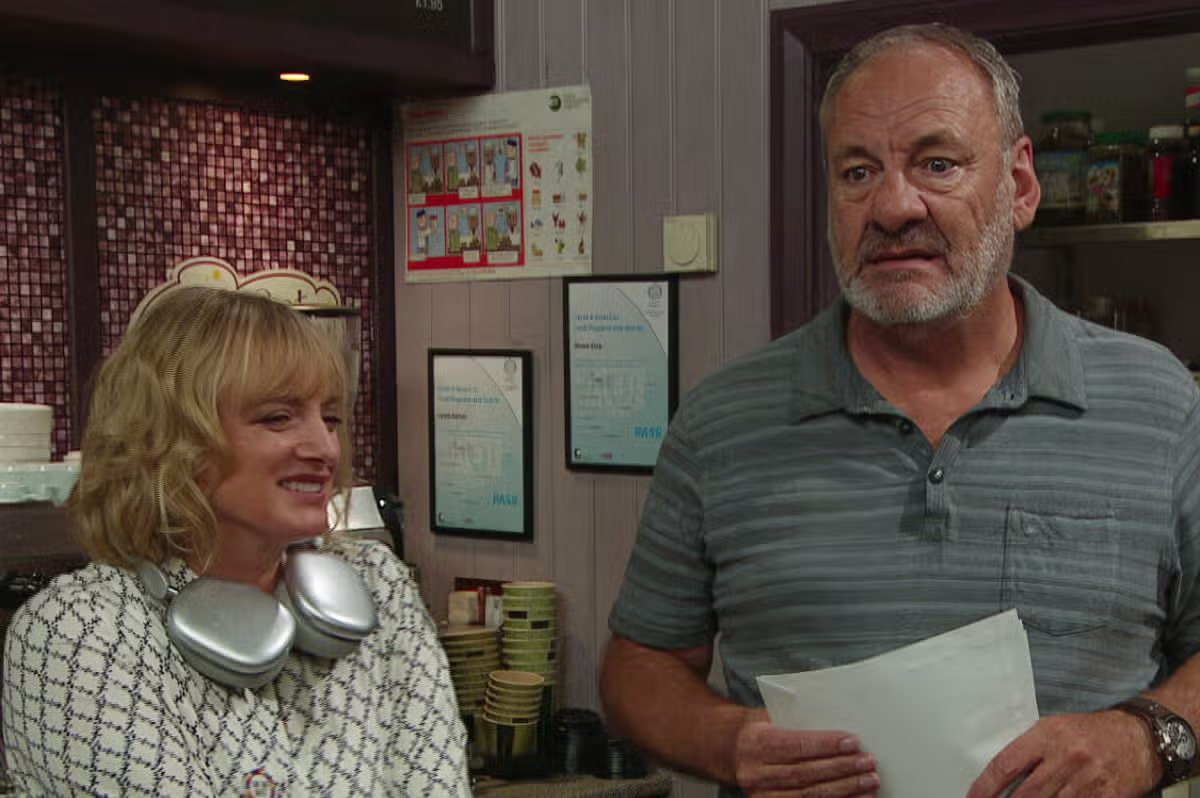
Emmerdale’s latest episode revealed that Jimmy King had secret voice messages hidden on his laptop, sent to his ex Sadie King before his death and found by his wife Nicola
Emmerdale’s latest episode revealed that Jimmy King had secret voice messages hidden on his laptop(Image: ITV)
Jimmy King’s secret voice messages to Sadie King left his widow Nicola King distraught on Emmerdale on Friday.
But the truth behind the messages could be bad news for Sadie, who’s hiding some secrets of her own. Sadie returned after Jimmy’s death in a car crash recently, and she claimed to Nicola she was in a three-year relationship with Jimmy behind Nicola’s back.
Of course viewers soon found out that Sadie had faked images of her and Jimmy together, and she was trying to get her hands on his money. That said, voice messages found on Jimmy’s laptop appeared to confirm he had been in contact with Sadie right before his death.
As Nicola found out from her son Carl that the messages were on the laptop, she decided to listen. She heard her late husband’s voice, talking to Sadie.
As Jimmy spoke, he asked Sadie whether she was comfy and in a hotel, leaving Nicola fearing they were meeting up just like Sadie had claimed. He then told her he had “the money”.
While this confirmed that Jimmy was giving Sadie money, it’s what he said next that sparked confusion over the reasons. The message also suggested Nicola’s fears that Jimmy was cheating might be nothing to worry about.
Nicola had stopped listening hen he mentioned the money, and she got upset and ran off. But a the earphones dropped, the audio kept playing.
It’s then that Jimmy vowed this would be the one and only time he gave her any money. He said he loved his wife to pieces and she would rightly “kill him” if she found out what he was doing with Sadie.
Jimmy appeared to rule out any other meetings, and his words almost suggested he was doing her a favour. So, clearly he wasn’t planning to run off with Sadie or leave the family behind, like Sadie had implied at some stage.
The true reasons for him seeing Sadie and giving her money has not been explained. But surely this voice note could dispute Sadie’s claims about what Jimmy was up to, and prove Sadie is hiding something.
So will Nicola or someone else hear the rest of the voice message, and confront Sadie? We know there may have been more than one message, as Carl had found messages. plural.
So, is there even more to find out from these that will expose the truth?
ITV’s new drama The Blame starring Michelle Keegan and Douglas Booth tackles misogyny that can be found in the UK police force
Michelle Keegan stars as Di Emma Craine in ITV’s The Blame(Image: ITV)
Deeply offensive messages sent by serving police officers in a group chat are the basis of a storyline featured in ITV‘s gripping new drama starring Michelle Keegan.
Six-part series The Blame, based on the 2023 book of the same name by Charlotte Langley, starts off when the body of a young woman is found in a small town where DI Crane (Michelle Keegan) and DI Radley (Douglas Booth) work.
The duo team up to uncover what happened to a teenage figure skater, Sophie Madsen, and discover “a tangled web of lies, institutional cover-ups and a moral compromise”.
The show tackles misogyny that can be found in the UK police force, and the official synopsis confirms that Keegan’s DI Crane “must navigate both a murder investigation and the treacherous politics inside her own team”.
It also depicts actual text messages from the real-life Metropolitan Police group chat scandals, in which multiple investigations exposed deep-rooted and systemic racism, homophobia, and sexism, dismissed as “banter”, poisoning the country’s top police force.
Speaking about The Blame at ITV Showcase 2026 earlier this year, actor Douglas Booth explained: “There was a Panorama about the Charing Cross WhatsApp messages and texts that are completely sickening, and that was a bit of a basis and model for this group chat to let this toxic behavior spread and rot the department.”
He added: “Every single character in this show is trying to be a good person and nearly all of them are touched by some sort of institutional failure and hold some form of moral injury.”
An official investigation was launched by the Independent Office for Police Conduct, which exposed the highly damaging revelations involving officers based at London’s Charing Cross Police Station who shared deeply offensive, racist, misogynistic, and homophobic messages on WhatsApp and Facebook.
First exposed globally in a landmark February 2022 report by the Independent Office for Police Conduct (IOPC), the scandal triggered widespread public outrage and directly contributed to the resignation of Metropolitan Police Commissioner Dame Cressida Dick.
The IOPC’s Operation Hotton uncovered a toxic culture within the station’s impact team between 2016 and 2018, which officers routinely dismissed as “banter”.
The watchdog noted a pervasive culture of bullying where good officers were too intimidated to challenge or report their peers. The initial 2022 report led to multiple fast-track misconduct hearings, resulting in several officers being sacked, forced to resign, or barred from policing.
Secret filming aired during BBC’s Panorama Undercover in the Police revealed evidence of racism, misogyny and officers revelling in the use of force at Charing Cross.
Assistant Commissioner Matt Twist said at the time: “Enquiries were immediately launched by our Directorate of Professional Standards into allegations of criminality and misconduct by officers and staff based at Charing Cross Police Station.The behaviour as reported is disgraceful and rapid steps to secure evidence and protect the public have also been taken.
“In addition, we are scrutinising more widely the leadership and culture within these teams, led by Professional Standards and senior leaders, to root out any further failings. The leadership of these teams failed to create the right culture that identified warning signs or generated confidence in junior colleagues to report. This is one of the reasons we are taking such assertive exceptional action.
“The Met’s leadership has been very clear that it will not tolerate behaviour that fails to meet the organisation’s standards of professionalism and integrity.”
The Blame airs Sunday, September 20 on ITV1 at 9pm
Europe has long been the primary target for US President Donald Trump’s tirades against traditional allies. However, Asia got a taste of this treatment last month when he cut short, at very short notice, the annual “Ulchi Freedom Shield” US military drills with South Korea.
Seoul is still angry at this development, especially given Trump’s later confirmation that he would also try to arrange a meeting with North Korea’s supreme leader, Kim Jong Un, in coming months. Signs of this frustration included President Lee Jae Myung’s call to speed up the development of new nuclear-powered submarines and his push to regain presidential wartime operational control of South Korean forces from the US, insisting that enhanced domestic military capabilities were needed in parallel with the alliance with Washington.
As remarkable as Trump’s decision was, it only confirmed the degree to which US partnerships with traditional allies have changed during his presidencies, as Washington demands wider concessions in return for US collaboration. These White House expectations include not only huge investments in the US, but also support in a conflict with Iran that has failed to unseat the regime in Tehran, while causing the largest global energy shock in a generation.
Certainly, some agree that Trump has legitimate concerns about South Korea. However, the manner in which he expressed his disagreement, in such a publicly humiliating way, is self-defeating. The US president said he told his South Korean counterpart that “we have 39,000 soldiers over there, guarding you from Kim Jong Un, your next-door neighbor, and you’re not going to help us on a very easy military operation in Iran? That’s strange.”
As ever, Trump’s statement requires a fact check. Currently, Seoul is scheduled this year to pay Washington about $1.19 billion of the estimated $5.5 billion-$6 billion it costs to station approximately 28,500 US troops in South Korea.
Even though that $1.19 billion sum represents a significant increase, Trump claimed that during his first term, Seoul pledged to pay much more: $3 billion. He further contends that the Biden administration failed to follow up on this pledge.
Trump’s decision to end the latest US-South Korea military exercises on Aug. 21 rather than Aug. 27, as scheduled, was embarrassing enough for Seoul. To also confirm that he planned to try to arrange another meeting with Kim was rubbing salt in the wounds.
His tirade has set back recent and extensive efforts by his team to reassure Asian allies about the US commitment to the region. At a recent meeting of Association of Southeast Asian Nations foreign ministers in the Philippines, for instance, Secretary of State Marco Rubio pledged about $2.5 billion of strategic investments in Southeast Asia. During a speech at Singapore’s Shangri-La conference in May, US Secretary of Defense Pete Hegseth emphasized the importance of the region to Washington.
White House expectations include not only huge investments in the US, but also support in a conflict with Iran.
Andrew Hammond
Asian allies also query the utility of reengaging with Kim, after Trump’s first three meetings with him, between 2017 and 2021, failed to deliver any diplomatic breakthroughs.
White House expectations include not only huge investments in the US, but also support in a conflict with Iran.
Andrew Hammond
The prospects appear slim for any sustained de-escalation of tensions in the world’s last Cold War-era frontier in the form of the prize of a verifiable, comprehensive denuclearization of North Korea. Pyongyang’s weapons program has only grown in size and sophistication since Trump’s first term. This potentially widens the negotiating divide between the two sides.
The central challenge in making any meaningful diplomatic process with Kim is, as it was during Trump’s first term, the differing US and Korean interpretations of what exactly would constitute “denuclearization” of the peninsula.
To Trump, this appears to mean unilateral North Korean disarmament. For Kim, it appears to be more about potentially lengthy negotiations in which Pyongyang should be treated as an equal to the US, providing him with the further potential for propaganda victories. In this context, Kim will continue to be wary of commitments on specific time frames, and will want to win further concessions from Trump before agreeing to any reduction in nuclear capabilities, let alone committing to full denuclearization.
As was the case during Trump’s first term, it is far from clear what, if any, sequencing is possible to move the process forward. After the last meeting between Trump and Kim, North Korea disputed the US assertion that the reason the talks collapsed was because Kim demanded a full roll-back of sanctions. Pyongyang said it asked only for partial sanctions relief, and that an offer had been made to permanently halt nuclear and long-range rocket testing.
One reason Pyongyang’s position will not shift far or fast is that it was Kim, not Trump, who emerged as the bigger beneficiary of their previous engagements. The North Korean leader made few concrete concessions while Trump called off US-South Korea military exercises, and held out the prospect of an easing of sanctions on Pyongyang if it did “something meaningful” on denuclearization.
Taking all of this together, the damage to US alliances in Asia from last month’s decisions therefore goes far beyond South Korea and might outlast Trump’s second term. The paradox is that the White House had spent much time in recent months reassuring allies of enduring US support for the region, efforts that have now been badly set back.
• Andrew Hammond is an associate at LSE IDEAS at the London School of Economics.