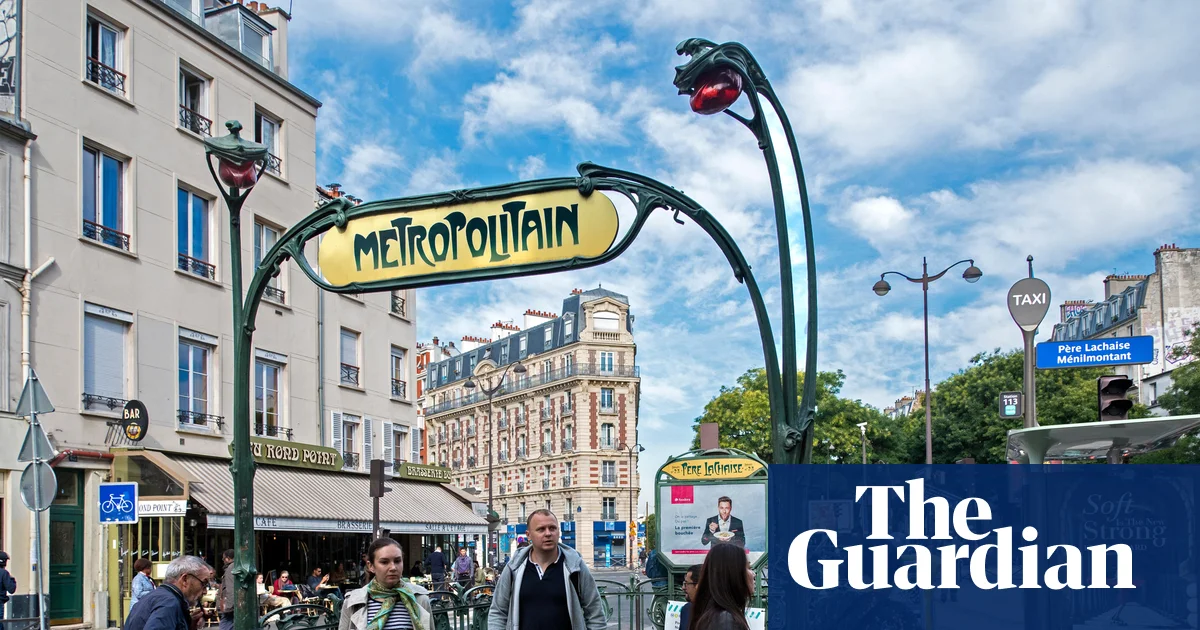
Zoning in on Ménilmontant, Paris: ‘bohemian, arty and off the tourist trail’ | Paris holidays
Why go now
On a hill that rises up between Belleville’s Chinatown and Père-Lachaise cemetery, Ménilmontant was once a rural hamlet with vines and farms, before becoming more industrial in the 19th century. The quartier boasts a united, colourful community whose working-class Parisian roots have long been integrated with a strong north African diaspora. Bohemian, arty and socially committed, it remains off the tourist trail with no notable museums or monuments; it’s just a genuinely Parisian neighbourhood. The locals were bemused to learn that Time Out made Ménilmontant one of its World’s Coolest Neighbourhoods for 2025, though tourists who do venture here to discover a glimpse of a fast-disappearing Paris are sure of a warm welcome.
Where to eat and drink
Eating out in Ménilmontant is inexpensive, hearty, multi-ethnic and vegetarian-friendly. My favourite discovery is La Cantine des Hommes Libres, a retro bistrot where the dish of the day costs €11.50 for blanquette de veau, boeuf bourguignon or Algerian specialities such as tikourbabine, while the couscous is the best I have ever tasted. A happy hour glass of organic wine costs just €2. The owner, Monsieur Abdelkrim, created the Cantine 20 years ago, “to bring the culture of Algeria to Paris, initially through our cuisine, serving traditional dishes from our bleds (rural villages) that were unknown to French people. Over the years, the bistrot has became an unofficial cultural centre to discover the music, art and poetry of our Berbère people.”
Crates of colourful vegetables are stacked outside the popular diner Chez les Deux Amis Brocante, where the ever-smiling chef, Beyaz Balta, oversees a cosmopolitan kitchen brigade who create a raft of vegetarian meze, crispy dürum, spicy köfte and sticky-sweet baklava. She arrived in 2007 as a Kurdish refugee. “I could not have been made more welcome when I came to Ménilmontant, and am proud today that nearly all our customers are locals,” she says. Further up the hill, Rue Sorbier opens up into a semi-square lined with cafes, wine stores, bakeries and épiceries. On the corner, L’Entrepot’s serves classic brasserie fare – steak frites, confit de canard – and oozes Parisian charm with its flea-market decor, marble-topped bar and quirky chandeliers, unchanged from the days when Ménilmontant was home to Maurice Chevalier and Edith Piaf.
For a slice of local life, the best bars to check out include the historic La Pétanque, with its sunny terrace that looks out over the church, and, on the corner of bustling Boulevard de Ménilmontant, L’Express de Paris, which is packed from early morning coffee and croissants until after-midnight cocktails and artisan brews. The graffiti-covered Demain c’est Loin is a funky hangout for tapas, a lethal rum punch and a free jukebox; while, to catch a match during the World Cup, head for Chez Hubert, a lively sports and music bar.
Cultural experiences
Head straight to the neighbourhood’s cultural hub, Rue Boyer, beginning with Galerie Ménil’8, an extensive exhibition space run by and for the Artistes de Ménilmontant association, which also organises an annual Open Door festival of more than 60 venues in the last week of September. When I pass by, the gallery is showcasing an art collective, Cul-de-Sac, with an avant garde mix of experimental photography, sculpture and video. La Maroquinerie is housed in an old leather goods factory, hosting concerts and club nights, while the historic La Bellevilloise symbolises Ménilmontant’s commitment to transform its heritage industrial sites into socially engaged artistic venues. Once an immense self-help workers’ co-operative, founded in 1877, this cultural fortress today bears the provocative slogan: “Liberté, Équité, Utopie”. A glance at a typical month’s programming spans film screenings, queer disco, a French swing party, a jazz brunch, wine tasting and cabaret, and a night of pulsating Colombian cumbia. The roof terrace of its Halle aux Oliviers restaurant is ideal for a sunset cocktail looking out over Paris.
This is just the tip of the iceberg for the live music scene, as musician Thomas Ménard says: “Things have certainly changed since I came to live here 38 years ago, with bars like Scenobar, Les Apaches and Lou Pascalou providing a stage for local indie bands, slam poets and DJs. Hipsters will never take over here as there is too much social housing, such as the tower block where I live, which ensures the popular, multi-ethnic roots of Ménilmontant’s culture and community will never disappear.”
Where to shop
Foodies will love the chaotic street market on Boulevard de Belleville every Tuesday and Friday morning, perfect to pick up cheese and charcuterie, while the boutiques Rue des Narcisses and Vintage 77 are packed with retro fashion and decor bargains. DJs and fans of vinyl should check out the record shop Cracki, which also runs its own independent music label, while just next door, Dilia La Cave specialises in natural wines.
Don’t miss
The monumental Église Notre-Dame de la Croix de Ménilmontant is one of the largest churches in Paris and is a proud point of reference for the local community. Its forecourt is transformed into an open-air venue for concerts and movie screenings during the Festival des Canotiers in June, and then the Festival Septembre Indien. Take a neighbourhood stroll from the church by heading up steep Rue de Ménilmontant to a staircase on the left that plunges down to a walkway along La Petite Ceinture, an abandoned railway line that has been left for rewilding and vegetable allotments. Further up Rue de Ménilmontant, turn into Rue de l’Ermitage for a flashback to life in the 19th century – the labyrinth of shady cobbled lanes and lush gardens forming Villa de l’Ermitage and Cité Leroy are still lined with utopian worker’s cottages.
Stay
Ménilmontant is so far off the tourist radar that accommodation options remain limited. Your best bet is a spacious apartment in the self check-in Le Bellevue (from €100), located on the corner of the vibrant Rue Boyer.