Iceland has rejected the government’s proposal to hold accession talks with the European Union, public broadcaster RUV has reported, with only a small number of votes left to be counted.
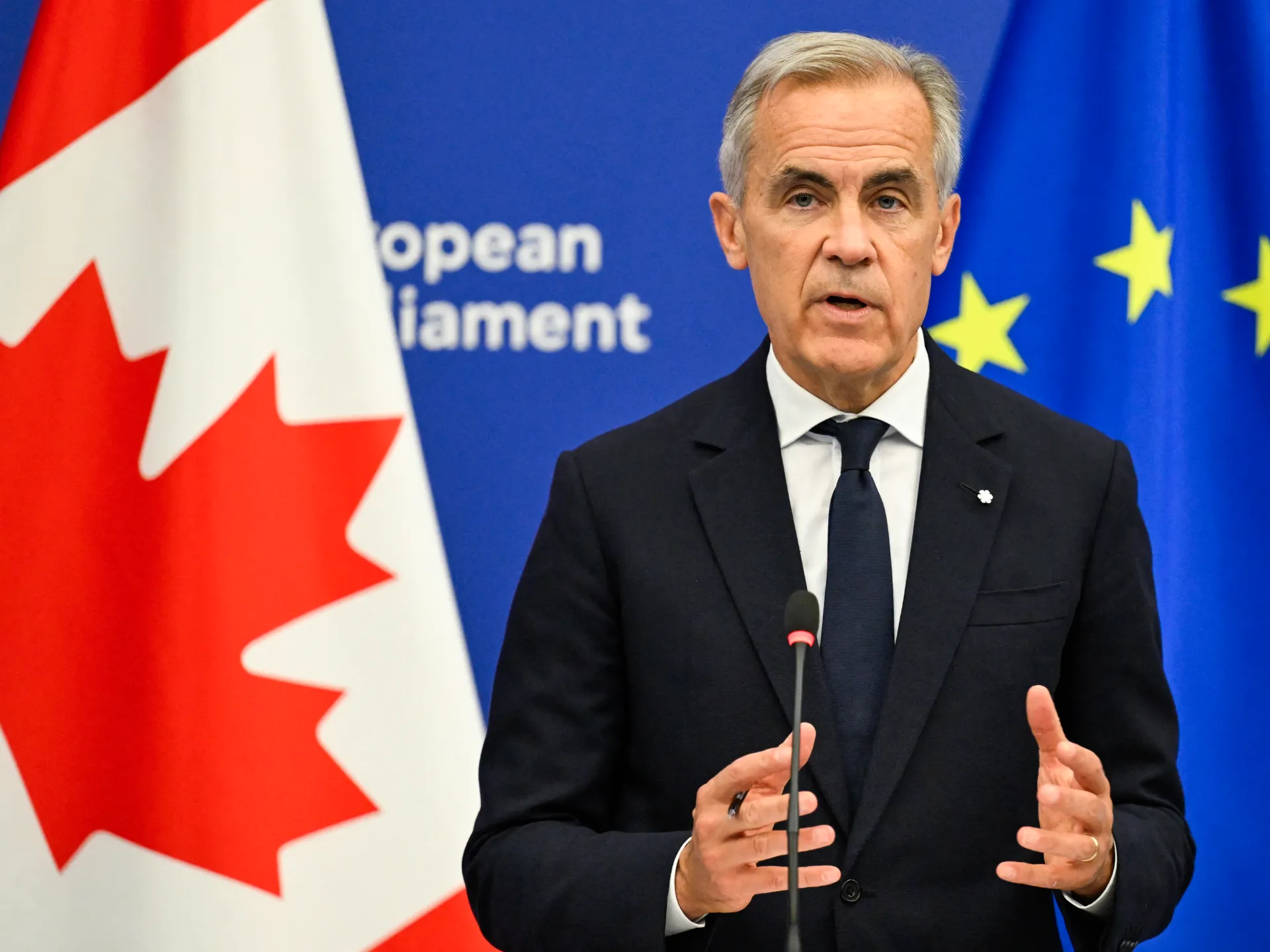
With the trade war with the US heating back up, Canada’s Prime minister Mark Carney has delivered another pledge to deepen his country’s economic and security partnership with the EU.
ADVERTISEMENT
ADVERTISEMENT
His statement came after trade talks between Ottawa and Washington collapsed last week, with Canada accusing the US of interfering in its sovereignty by demanding French-language concessions.
In retaliation, US President Donald Trump said on Truth Social that on 1 January 2027, tariffs on cars and trucks will be increased to 50%.
“WE DON’T NEED CANADA, THEY NEED US!” he wrote. “They do 95% of their business with the US, with us, the exact opposite!”
Canada announced later that, as of 8 September, it would enact tariffs ranging from 15% to 50% on over 700 American imports, worth about $20 billion (€17.2 billion).
Since Trump’s return to power in 2025 and his repeated attacks on US-Canada trade relations, Ottawa has been turning several times towards the EU, seeking a stable relationship with a “like-minded” partner.
“This fall we will begin intense discussions with the European Union, the world’s second-largest economy, to build a much stronger and deeper economic and security partnership,” Carney said on Monday.
The Canadian Prime minister has confirmed, according to Politico, that he will attend the State of the EU speech in Strasbourg on 16 September after European Commission President Ursula von der Leyen invited him before the trade war with the US broke out.
Since the start of the second Trump administration, Brussels and Ottawa have shared a common objective: diversifying their trade relations away from Washington. But since the EU and Canada are already bound by a trade agreement, how far could a deeper relationship go?
The truth is that both sides have their limits.
Intertwined Canadian and US markets
From critical raw materials to energy and defence, the last months have seen multiple areas of interest come to the fore, and they will likely set the agenda at the Canada-EU summit this fall.
Canada is planning to offer the EU better access to its critical raw materials. Brussels is desperate to move away from China, which holds the monopoly on the production and processing of rare earths. With strong domestic supplies of lithium, graphite and nickel, Ottawa has a lot to offer to integrate the EU into its metal value chain.
Canada might also make offers on energy, which it currently supplies principally to the US.
“We should be talking about a more viable Canada-EU corridor for energy, and not just in respect of oil and gas, but also of nuclear,” Mark Camilleri, President of the Canada-EU Trade and Investment Association, told Euronews. “The EU’s energy needs are increasing, and its energy supply is still very dependent on imports.”
On defence, Canada is already part of SAFE, the €150 billion defence instrument that supports EU member states that wish to invest in defence industrial production through common procurement. But defence cooperation is already set to go further, with Canada selecting German-Norwegian TKMS to build a new fleet of 12 submarines. Deepening the relationship on Arctic security could be another area of collaboration.
Canadian business, meanwhile, is increasingly interested in the European market, but the diversification will not come overnight. Geography, after all, matters.
“The Canadian economy is very much oriented and integrated to the US and North American economy,” Camilleri added. “We are not looking to untangle the relationship, despite the very distressing political issues taking place.”
The Europeans will also put limits on integration with Canada. The trade agreement struck in 2016 is proof enough that the EU market is not easy to access: the deal has not yet been ratified by all EU member states, and has only been provisionally applied since 2017.
Faint EU membership hopes
Geography matters not only for the Canadians, but also for the EU.
Article 49 of the Treaty on European Union opens membership to “any European State”. Morocco was not considered European enough in the past to become a member, so how could Canada, located much further away, be considered a “European state”?
Guntram Wolff, senior fellow at the Brussels-based think tank Bruegel, points out that there is a new openness in Brussels, and that a strategic alignment “could go far”, even if probably it has to fall short of full membership.
Liberalising trade further than what the current agreement involves could be an option. But how far could the integration of the Canadian market into the EU go?
“One can go to the point where Norway is, which is a single market membership,” Wolff told Euronews. “Whether that is where Canada wants to go and whether that’s where all the European countries want to go, we will see in the coming weeks.”
Norway, Iceland and Liechtenstein are members with EU member states of what is called the “European Economic Area”, membership of which involves the implementation of the EU’s four freedoms – free movement of goods, persons, services and capital. These freedoms form the basis of the single market.
But an EU official told Euronews that this option was not on the table yet, and remains a theoretical debate for now.
Iceland will hold a referendum on August 29 on whether to reopen negotiations over joining the European Union, in a closely contested vote that could reshape the country’s economic and strategic direction.
The referendum, however, is not a vote on EU membership itself. Icelanders will only decide whether their government should begin accession negotiations with Brussels.
If voters approve the proposal, negotiations could last two or more years before Iceland holds a second referendum, potentially in 2028, on whether to actually join the bloc.
With opinion polls showing a near-dead heat between supporters and opponents, the vote has become an important test of Iceland’s relationship with Europe at a time of economic uncertainty and growing geopolitical competition in the Arctic.
Stay ahead of the geopolitical week.
MD Briefing delivers expert analysis across five global fronts — the Indo-Pacific, energy, geoeconomics, European security, and the Middle East — every Monday morning. Free.
Is Iceland Voting to Join the EU?
No.
The August 29 referendum only asks whether Iceland should begin negotiations with the European Union.
A “yes” vote would open a potentially lengthy accession process. Iceland would then negotiate the terms of membership with Brussels before citizens have another opportunity to accept or reject the final agreement.
That means the upcoming referendum is essentially a decision about whether to explore EU membership, rather than a final decision to join.
Prime Minister Kristrun Frostadottir’s government has nevertheless presented the vote as a potentially decisive moment.
What Happens If Iceland Votes No?
The government has described the referendum as a “now or never” opportunity.
Frostadottir has warned that rejecting negotiations would effectively put the EU question aside.
This makes the vote particularly important because Iceland has already attempted the accession process once.
Reykjavik applied to join the EU in 2009, but negotiations were abandoned in 2013 after a Eurosceptic government came to power.
A second rejection could therefore close the issue again for the foreseeable future.
Why Does Iceland Want to Reconsider EU Membership?
Economic concerns are among the strongest arguments for reopening negotiations.
Iceland has faced high living costs and economic volatility, while the country’s relatively small economy remains vulnerable to external shocks.
Supporters argue that closer integration with the EU could provide greater economic stability and strengthen Iceland’s position when dealing with larger trading partners.
EU membership could also eventually allow Iceland to adopt the euro, replacing the Icelandic krona.
Supporters say the euro could reduce currency volatility, help address inflation and potentially lower interest rates.
The country’s strategic environment has also changed since Iceland abandoned its previous accession negotiations.
The war in Ukraine and growing competition in the Arctic have encouraged Iceland to reconsider how closely it should align with European institutions.
What Would Iceland Gain From Joining the EU?
EU membership would provide Iceland with access to the bloc’s customs union and its wider internal market.
The customs union eliminates internal tariffs between member states while applying common external tariffs to goods entering the bloc.
Iceland would also gain a formal role in EU decision-making.
Its representatives would participate in institutions including the European Parliament, European Commission and European Council.
For supporters, this is important because Iceland would move from being closely connected to the EU economically to having a direct role in shaping policies that affect it.
The argument is particularly relevant for a small country dealing with much larger economic powers.
Why Do Icelanders Oppose EU Membership?
Opponents argue that membership would transfer too much political authority from Reykjavik to Brussels.
They also question whether joining the EU would substantially improve Iceland’s security.
The most sensitive issue, however, is fisheries.
Why Are Fisheries Central to the Debate?
Fishing is one of the pillars of Iceland’s economy and a major part of the country’s national identity.
Opponents fear that joining the EU would subject Iceland to the bloc’s Common Fisheries Policy and potentially weaken its control over fishing resources.
They worry that common European resource-management rules could eventually increase access for foreign vessels to Icelandic waters.
For a country surrounded by some of the world’s most important fishing grounds, that is not simply an economic concern. It is also a question of national sovereignty.
The fisheries debate therefore gives the opposition one of its strongest arguments against membership.
Why Does Iceland Want to Keep the Krona?
Iceland’s currency is another major dividing line.
Supporters of the euro argue that replacing the krona could reduce exchange-rate volatility and improve economic stability.
Opponents see the krona differently.
They argue that an independent currency provides Iceland with an important economic adjustment mechanism.
During a downturn, the krona can weaken against major currencies, potentially helping Iceland’s economy adjust. During periods of stronger growth, it can appreciate.
Giving up that flexibility in favour of the euro, opponents argue, could leave Iceland with fewer tools to respond to economic shocks.
Who Supports EU Membership?
The country’s centre-left government coalition has backed putting the issue to a referendum.
Vidreisn, Iceland’s most explicitly pro-EU political party, pushed for the vote.
Prime Minister Frostadottir’s Social Democrats also support EU membership, although they have taken a more cautious approach to campaigning.
The coalition’s third party, the People’s Party, opposes membership.
The political divide therefore does not fit neatly along government versus opposition lines.
Who Opposes EU Membership?
The opposition Independence Party, led by Gudrun Hafsteinsdottir, is campaigning against reopening accession talks.
Its argument centres on sovereignty, fisheries and economic independence.
Opponents believe Iceland can maintain its existing relationship with Europe without accepting the political obligations of EU membership.
The close polling suggests neither side has yet secured a decisive advantage.
Why Is the Arctic Important to the Vote?
The referendum is taking place against a backdrop of growing geopolitical competition in the Arctic.
Iceland occupies a strategically important position between North America and Europe.
It sits along the Greenland-Iceland-United Kingdom gap, commonly known as the GIUK gap, a critical North Atlantic maritime corridor.
The area has long been important for monitoring Russian naval movements between the Arctic and the North Atlantic.
Iceland is also a NATO member despite having no standing army of its own.
That makes its strategic location particularly important to the security architecture of the North Atlantic.
What Would Iceland Mean for the EU?
For the European Union, Iceland’s potential membership would have significance beyond economics.
It would expand the EU’s presence in the Arctic at a time when the region is becoming increasingly important to major powers.
Russia, the United States and other countries are paying greater attention to Arctic shipping routes, natural resources and military positioning.
Iceland could therefore give the EU a stronger institutional and geopolitical foothold in the North Atlantic and Arctic region.
Its accession could also be relatively straightforward compared with some other countries seeking EU membership.
Unlike Ukraine and several Western Balkan states, Iceland already has close economic and institutional links with Europe and would require fewer major reforms to align with EU rules.
Could Iceland Join the EU Quickly?
Potentially, but the process would still take years.
A “yes” vote would only begin negotiations.
Iceland would then have to negotiate the terms of membership before citizens could vote again on the final agreement.
The second referendum could potentially take place in 2028.
This means that even if Icelanders vote in favour of talks on August 29, actual EU membership would remain uncertain.
The referendum is therefore the beginning of a political process rather than its conclusion.
Analysis: Why Does Iceland’s EU Vote Matter?
Iceland’s referendum is ultimately about more than whether a small North Atlantic country should join a political and economic bloc.
It reflects a wider debate over sovereignty, economic resilience and strategic alignment in an increasingly contested Arctic.
For supporters, EU membership offers economic stability, greater influence over European decisions and closer integration with a bloc that could provide Iceland with additional leverage against larger powers.
For opponents, the same process represents a potential loss of national control over fisheries, monetary policy and important economic decisions.
The strategic dimension is becoming increasingly difficult to ignore.
Iceland’s location makes it disproportionately important to North Atlantic security despite its small population and lack of a conventional military. As competition involving Russia, the United States and European countries intensifies in the Arctic, Iceland’s relationship with the EU could acquire greater geopolitical significance.
The vote also highlights a fundamental dilemma facing smaller states: whether greater integration with a larger political bloc provides more security and economic strength than the sovereignty it requires them to surrender.
The August referendum will not answer that question definitively.
It will determine whether Icelanders are willing to begin the conversation.
If voters choose “yes,” Iceland could move toward its most significant geopolitical realignment in more than a decade. If they choose “no,” the country may once again put EU membership aside and preserve its distinctive position outside the bloc while remaining closely connected to Europe.