Meet

EU trade chief to meet G7 counterparts as pressure mounts over US tariff threats

Published on Updated

EU Trade Commissioner Maroš Šefčovič is set to meet G7 trade ministers on Monday after United States President Donald Trump upped the pressure on trading partners with a 15% across-the-board tariffs on imports entering the American market.


ADVERTISEMENT


ADVERTISEMENT

Trump’s move came after a US Supreme Court ruling last week struck down several global duties he had imposed from the White House last year, overturning a central part of his trade policy.

Brussels is now demanding legal clarity. The EU is bound to Washington by a trade pact clinched in July 2025 by Commission President Ursula von der Leyen and Trump, setting tariffs on EU exports at 15% while committing the bloc to slash its own duties to zero.

“Full clarity on what these new developments mean for the EU-US trade relationship is the absolute minimum that is required in order for us the EU to make a clear-eyed assessment and decide on next steps,” Commission deputy spokesperson Olof Gill said on Monday.

Key Parliament vote expected

Šefčovič’s G7 talks come ahead of a closed-door meeting of EU ambassadors to assess the fallout from the latest developments in the US.

Some member states, including France, are prepared to deploy the bloc’s Anti-Coercion Instrument – the so-called “trade bazooka” that allows restrictions on public procurement, licenses and intellectual property rights if necessary to push back against external pressure.

Attention is now shifting to the European Parliament, which was set to vote Tuesday on implementing the EU-US agreement by cutting tariffs on US goods, as included in the deal. Instead, MEPs are meeting on Monday afternoon to decide on the future enforcement of the agreement.

The Parliament has led resistance to the US administration, arguing the deal signed in Scotland last summer was unbalanced.

German MEP Bernd Lange, who chairs the Parliament’s Committee on International Trade, said on Sunday that he will urge negotiators to suspend the agreement. But Zeljana Zovko, lead negotiator for the EPP – the Parliament’s largest group – struck a cooler tone, telling Euronews that MEPs “keep calm and do our [their] part.”

“No need to add any more fuel to an already existing fire,” she said.

Source link

2026 Winter Olympics ice hockey: Canada and USA to meet in charged final

USA meanwhile have stars of their own, but don’t have the attacking gifts of the Canadians.

“The Tkachuk brothers [Brady and Matthew], and Jack Eichel, that attacking line has worked well together,” Bennett said.

“What they have not had is much scoring from captain Auston Matthews, he has not yet taken any of the games by the horns. They are OK, but not more than that.”

However, the Americans have the best defenceman at the Games in Quinn Hughes, who scored the crucial winner against Sweden.

“He might be the best three-on-three player in the world,” said Bennett. “He loves to keep possession, and is always looking to make an exciting play.”

It sets up a mouth-watering finale of an Olympic ice hockey competition which has benefitted hugely from the return of National Hockey League (NHL) players for the first time since 2014.

The attendance of players from the top North American league was in doubt for a time over concerns about the ice quality at the unfinished Milano Santagiulia Ice Hockey Arena, but they have been a major boon for the Games.

“This is the highest level of hockey we have ever seen at an Olympics,” said Bennett. “The NHL players have made it a different world.

“At the last two Olympics, games have been good but have missed the quality in the final third, the big moments. Players didn’t have the skillset to break a game, so saw a lot of tight, dull games

“Some of what the players have been doing here has been mind-blowing. One of the goals scored for Canada, McDavid saucered this pass from the back door [behind the goal], it lands as McKinnon is shooting, on the half-volley. That’s when you recognise it.

“I have been getting phone calls from people in the hockey world, all they have been saying is, this is so good. There have been periods where Kent [Simpson, BBC co-commentator] and I have just been sat watching, smiling, laughing.”

Canada have won gold in three of the five Olympics when NHL players have featured and will fancy their chances in a game on Sunday which could be as fascinating in the stands as it is on the ice.

It is highly likely that Canadian prime minister Mark Carney will be in Milan for the game.

Not only is Canada as a country hockey-mad, but so is Carney – when working as governor of the Bank of England, he would play for a recreational team in Haringey, north London.

The big question is whether his American counterpart will also be in Italy.

Source link

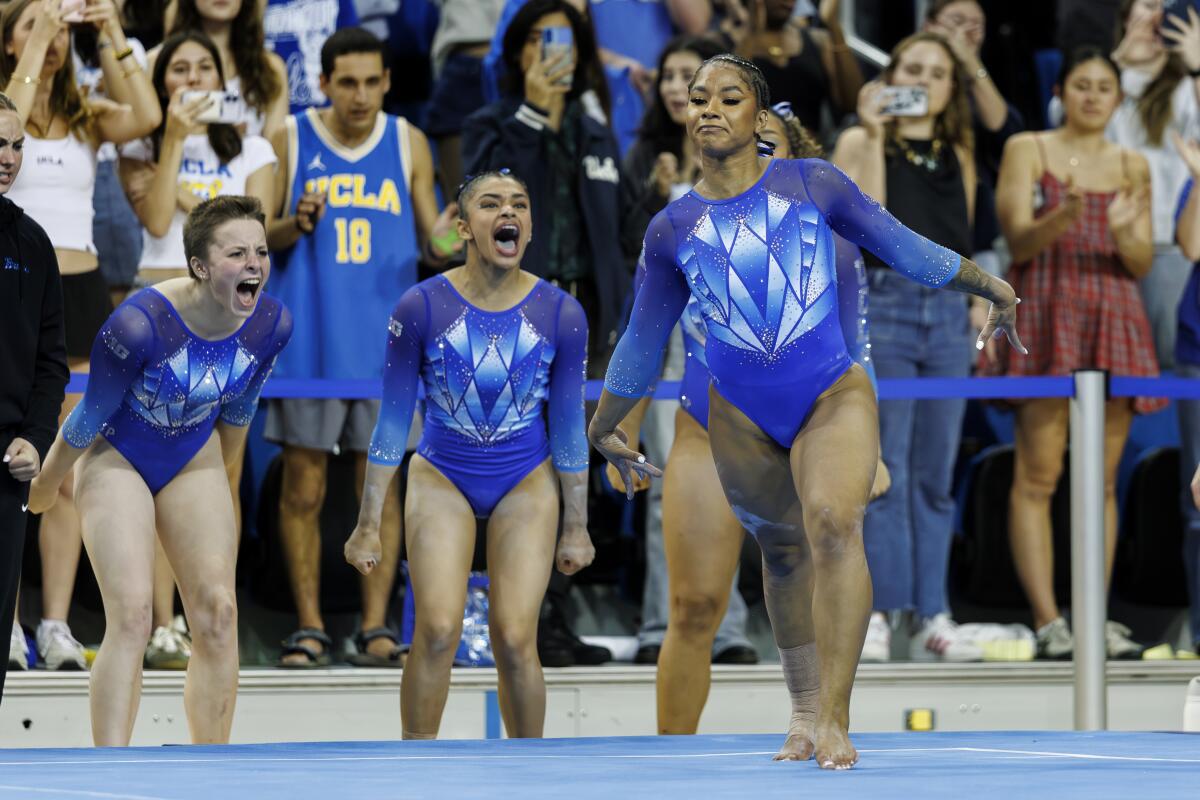
Jordan Chiles extends perfect 10 streak, UCLA beats Michigan

UCLA senior Jordan Chiles remains unstoppable on the floor exercise.

A week after reviving her Prince routine to honor fans during a meet at Minnesota, Chiles seamlessly transitioned back at Pauley Pavilion to her energetic routine set to a medley of hits by icons Janet Jackson, Whitney Houston, Stevie Wonder and Tina Turner. The result was a crowd-pleasing perfect 10, firing up the Valentine’s Day home crowd and helping seal No. 4 UCLA’s 197.725-196.975 win over No. 9 Michigan.

It was Chiles’ fourth straight 10 on floor and fifth perfect score this season.

The Bruins (9-2, 5-0 Big Ten) entered the meet averaging a team score of 197.404 and remained consistent, delivering modest improvement that has proven hard for Big Ten opponents to beat.

UCLA opened the competition on the vault.

Tiana Sumanasekera tied a career-best with a 9.9. Katelyn Rosen scored a 9.875, Chiles a 9.825, Ashlee Sullivan a 9.850, Riley Jenkins a 9.775 and Madisyn Anyimi a 9.750.

The Wolverines (5-3, 2-3) led 49.325 to 49.225 after the first rotation.

The Bruins pulled ahead on the bars, taking a 98.725-98.250 lead.

Nola Matthews, Chiles and Sullivan all scored 9.925 marks, while Sumanasekera posted a 9.90 and Ciena Alipio and Sydney Barros both scored 9.850.

UCLA maintained a 148.075-147.725 lead after the beam rotation.

Alipio and Barros scored a 9.9, while Chiles scored a 9.875, Rosen a 9.850, Jordis Eichman a 9.825 and Sumanasekera a 9.775.

The Bruins closed with their showstoppers on the floor exercise.

Chiles notched her 10; Alipio scored a 9.950; Barros, Rosen and Sumanasekera earned 9.900 marks; and Sullivan scored a 9.875.

UCLA competes at unranked Illinois on Feb. 22 before returning home for a Big Fours meet on Feb. 27 against Ohio State, Iowa and Maryland — all ranked in the top 25.

Source link

Nations League draw: England to face Spain and Croatia, Wales meet holders Portugal

League A

Group A1: France, Italy, Belgium, Turkey

Group A2: Germany, Netherlands, Serbia, Greece

Group A3: Spain, Croatia, England, Czech Republic

Group A4: Portugal, Denmark, Norway, Wales

League B

Group B1: Scotland, Switzerland, Slovenia, North Macedonia

Group B2: Hungary, Ukraine, Georgia, Northern Ireland

Group B3: Israel, Austria, Republic of Ireland, Kosovo

Group B4: Poland, Bosnia-Herzegovina, Romania, Sweden

League C

Group C1: Albania, Finland, Belarus, San Marino

Group C2: Montenegro, Armenia, Cyprus, Gibraltar/Latvia*

Group C3: Kazakhstan, Slovakia, Faroe Islands, Moldova

Group C4: Iceland, Bulgaria, Estonia, Luxembourg/Malta*

League D

Group D1: Gibraltar/Latvia, Luxembourg/Malta, Andorra

Group D2: Lithuania, Azerbaijan, Liechtenstein

*Gibraltar and Latvia, and Luxembourg and Malta, will contest play-offs in March to determine who will play in Leagues C and D.

Source link

Bangladesh’s Jamaat leader Shafiqur Rahman: The man everyone wants to meet | Bangladesh Election 2026

Dhaka, Bangladesh – On Wednesday evening in Dhaka, Shafiqur Rahman, the emir (chief) of the Bangladesh Jamaat-e-Islami, unveiled an ambitious election manifesto. A key promise: If his party wins the country’s February 12 election, it would lay the ground for Bangladesh to quadruple its gross domestic product (GDP) to $2 trillion by 2040.

Addressing politicians and diplomats, the 67-year-old Rahman pledged investment in technology-driven agriculture, manufacturing, information technology, education and healthcare, alongside higher foreign investment and increased public spending.

Recommended Stories

list of 4 itemsend of list

Economists in Dhaka have cast doubt on whether sweeping promises can be financed, describing the manifesto as heavy on slogans but short on detail. But for Jamaat’s leadership, the manifesto is less about fiscal arithmetic than signalling intent, say analysts.

For years, critics have tried to portray Jamaat, Bangladesh’s largest Islamist party, as driven too much by religious doctrine to be able to govern a young, diverse, forward-looking population. The manifesto, by contrast, presents a party long excluded from power as a credible alternative – and as a force that sees no contradiction between its religious foundations and the modern future that Bangladeshis aspire to.

His audience was telling too.

Until recently, Bangladesh’s business elites and foreign diplomats either kept their distance from Jamaat or engaged with it discreetly. Now, they are doing so openly.

Over the past few months, European, Western, and even Indian diplomats have sought meetings with Rahman, a figure who, until not long ago, was seen by many internationally as almost politically untouchable.

For a leader whose party has been banned twice, including by ousted Prime Minister Sheikh Hasina’s administration, the coming election is raising a question few would have dared to ask even a year ago: Could Shafiqur Rahman become Bangladesh’s next prime minister?

Shafiqur  Rahman, Ameer (President) Jamaat-e-Islami, poses for a photograph after an interview with Reuters, in Dhaka, Bangladesh, December 31, 2025. REUTERS/Kazi Salahuddin
Rahman poses for a photograph after an interview with Reuters news agency in Dhaka, on December 31, 2025 [Kazi Salahuddin/Reuters]

‘I will fight for the people’

The shift in how Jamaat and its leader are being viewed is at least partly to do with a political vacuum that has opened up in Bangladesh.

The July 2024 uprising that ousted Sheikh Hasina did more than end her long rule. It upended the country’s political order, hollowing out the familiar duopoly that for decades defined Bangladeshi politics – the rivalry between Hasina’s Awami League and the Bangladesh Nationalist Party (BNP).

With the Awami League effectively barred from the political field and the BNP the only big party left standing, a vacuum emerged. Many initially assumed it would be filled by the student-led National Citizen Party (NCP). Instead, Jamaat – long pushed to the margins – moved to occupy the space.

As Bangladesh heads towards a high-stakes election in less than two weeks, Jamaat has now emerged as one of the country’s two most prominent political forces. Some pre-election polls now place it in direct competition with the BNP.

At the centre of that transformation is Rahman, according to Ahsanul Mahboob Zubair, Jamaat’s assistant secretary-general and a longtime associate of the party chief.

Zubair, who worked closely with Rahman when he led Jamaat in the country’s Sylhet region, said the resurgence is the result of years of grassroots social work and political survival under repression.

Rahman, a soft-spoken former government doctor, took over as Jamaat’s chief in 2019, at a time when the party was banned under Hasina. In December 2022, he was arrested in the middle of the night on charges of supporting militancy and was released only after 15 months when he secured bail.

In March 2025, months after the student-led protest had overthrown Hasina and an interim government under Nobel laureate Muhammad Yunus had taken office, Rahman’s name was dropped from the list of accused in the case.

Since then, his carefully calibrated, emotional public appearances have drawn wide attention.

At a massive rally in Dhaka last July, Rahman collapsed twice on stage due to heat-related illness but returned to finish his speech, defying doctors’ advice.

“As long as Allah grants me life, I will fight for the people,” he told the crowd, barely sitting on the stage, supported by the doctors. “If Jamaat is elected, we will be servants, not owners. No minister will take plots or tax-free cars. There will be no extortion, no corruption. I want to tell the youth clearly – we are with you.”

Bangladesh Jamaat-e-Islami leader Shafiqur Rahman waves a their party flag during an election campaign in Dhaka, Bangladesh, Jan. 22, 2026. (AP Photo/Mahmud Hossain Opu)
Rahman waves his party flag during an election campaign in Dhaka, January 22, 2026 [Mahmud Hossain Opu/AP Photo]

Reinventing Jamaat’s image

Supporters describe Shafiqur Rahman as approachable and morally grounded – a leader who prefers disaster zones to drawing rooms, and projects calm in a country exhausted by confrontation.

Now in his third term as chief, Rahman commands firm authority inside the party.

“He is a good and pious man. Everyone in the party trusts him,” said Lokman Hossain, a Jamaat supporter in Dhaka. He said that over the past year and a half, the party has reached far more people than before, with Rahman’s appeal beyond Jamaat’s traditional base playing a central role.

Rahman’s challenge, however, is no longer purely electoral – it is reputational.

As new supporters drift towards Jamaat, he is attempting to reframe how the party is seen: less as an Islamic force defined by doctrine and history, and more as a vehicle for clean governance, discipline and change.

Whether this reinvention is substantive or merely cosmetic will define both Rahman’s leadership and Jamaat’s future, say analysts.

Any attempt to recast Jamaat’s public image, however, runs up against the unresolved legacy of 1971. For decades, the party’s role during Bangladesh’s war of independence – when it sided with Pakistan – and the subsequent trials and executions of several senior leaders have shaped perceptions of Jamaat at home and abroad.

Rahman has approached that history with caution. He has avoided detailed admissions but has recently acknowledged what he calls Jamaat’s “past mistakes”, asking forgiveness if the party caused harm.

The language marks a subtle shift from outright denial, while stopping short of naming specific actions or responsibilities. Supporters say this reflects political realism rather than evasion – an attempt to move the party beyond its dark chapter. Critics, by contrast, see the ambiguity as deliberate, arguing it softens Jamaat’s image without confronting the substance of its past.

“He knows what those mistakes were,” said Saleh Uddin Ahmed, a United States-based Bangladeshi academic and political analyst. “But stating them explicitly would destabilise his leadership inside the party.”

Ahmed nonetheless considers Rahman more moderate than Jamaat’s previous leaders, noting his relative willingness to discuss unresolved historical questions and address issues such as women’s rights – topics the party long avoided. “This opening up is also happening because of increased public and media scrutiny,” Ahmed said. “People are asking questions now, and Jamaat has to respond.”

Jamaat’s effort to reach voters beyond its traditional base and reassure foreign audiences, while retaining the loyalty of its conservative supporters, has created a persistent tension – one that has often resulted in dual messaging.

That balancing act has been evident in public statements by senior leaders. Abdullah Md Taher, one of Rahman’s closest aides, in an interview with Al Jazeera, said Jamaat is a moderate party, adding that it would not impose or strictly adhere to Islamic law.

The party has also, for the first time in its history, nominated a Hindu candidate.

Yet when addressing conservative supporters, the party continues to emphasise its Islamic identity, with some backers encouraging votes for Jamaat as an act of religious merit – a practice the rival BNP has criticised as the misuse of religious sentiment.

The strategy appears to have helped Jamaat re-enter political conversations that were once closed to it. At the same time, it has sharpened doubts about how far Rahman is willing – or able – to go in reinterpreting the party’s past and ideology as he courts a broader electorate.

Those limits are most visible in Jamaat’s stance on women and leadership. They came into sharp focus during his Al Jazeera interview in which Shafiqur Rahman said it was not possible for a woman to hold the party’s top position – a remark that reignited longstanding criticism of Jamaat’s gender politics, despite its attempts to project a more inclusive image.

“Allah has made everyone with a distinct nature. A man cannot bear a child or breastfeed,” Rahman said. “There are physical limitations that cannot be denied. When a mother gives birth, how will she carry out these responsibilities? It is not possible.”

Critics argue that the stance exposes the limits of Jamaat’s claims of moderation.

Mubashar Hasan, an adjunct researcher at the Humanitarian and Development Research Initiative at Western Sydney University in Australia and author of Narratives of Bangladesh, also questioned Jamaat’s internal culture, noting that even female leaders who publicly endorse such views operate within a male-dominated hierarchy. He was referring to the party’s large number of female supporters and members, including women within its Majlis-e-Shura, the highest decision-making body. “It reflects a structure where women follow what men say in that party,” he said.

The criticism carries particular weight given the movement that helped reopen political space for Jamaat itself. The July 2024 uprising against Hasina, analysts note, saw extensive participation by women, often at the front lines of protest. “Women were part of that movement as much as men, if not more,” Hasan said. “Undermining them now gives Jamaat a deeply problematic outlook.”

Political historians argue this is not a new contradiction but a longstanding one. Since contesting elections under its own symbol in 1986, Jamaat has never fielded a woman candidate for a general parliamentary seat, relying instead on reserved quotas.

“This isn’t a temporary position or a tactical lapse,” said political historian and author Mohiuddin Ahmad.“It reflects the party’s ideological structure, and that structure has not fundamentally changed.”

Head of Bangladesh's interim government Muhammad Yunus, center, with Bangladesh Jamaat-e-Islami party leader Ameer Shafiqur Rahman, inaugurate the July Uprising Memorial Museum, once the official residence of Bangladesh's ousted Prime Minister Sheikh Hasina, in Dhaka, Bangladesh, Tuesday, Jan. 20, 2026. (AP Photo/Mahmud Hossain Opu)
Rahman (left) with the head of Bangladesh’s interim government, Muhammad Yunus, at the inauguration of a museum to commemorate the student uprising that overthrew Hasina, on January 20, 2026 [Mahmud Hossain Opu/AP Photo]

The ‘grandfather’ expanding Jamaat’s reach

Yet among Jamaat supporters – particularly younger ones – the issue is often filtered through loyalty to Rahman himself rather than doctrine.

During his recent nationwide campaign, young supporters can frequently be heard calling Shafiqur Rahman “dadu” – grandfather. White-bearded, soft-spoken and visibly attentive to supporters, Rahman fits the image.

“He connects with young people through his words,” said Abdullah Al Maruf, a Gen Z law student from Chattogram and a Jamaat supporter. “There is something about his recent work that feels like the relationship between a grandfather and his grandchildren. Where BNP leaders often belittle young people, Shafiqur speaks to them with respect.”

Maruf added that Rahman’s appeal extends beyond Jamaat’s traditional base. “Outside the usual Jamaat circle, he is more popular than previous Jamaat leaders,” he said.

Zubair, Jamaat’s assistant secretary-general, described the party’s outreach beyond traditional voters – such as the decision to nominate a Hindu candidate – not as a tactical move but one rooted in Jamaat’s constitutional framework rather than political expediency.

“Our constitution allows any Bangladeshi, regardless of religion, to be part of the party if they support our political, economic and social policies,” he said. “Supporting our religious doctrine is not a requirement for political participation.”

Jamaat leaders argue the move reflects a broader effort to shift the party’s public image – from one defined primarily by theology to one centred on governance and accountability. “We are emphasising corruption-free politics, discipline and public service,” Zubair said. “People have seen our leaders stand with them during floods, during COVID, and during the July uprising. That is why support is growing.”

Krishna Nandi, the party’s Hindu candidate from the city of Khulna, agrees. “When families fall into poverty, Jamaat-linked welfare networks step in without asking about religion or political loyalty. This culture of service explains why many citizens see Jamaat not as a party of slogans but as a party of discipline, structure and responsibility,” Nandi wrote for Al Jazeera.

The Jamaat’s outreach has also extended well beyond domestic audiences. Zubair said the party’s leadership has held meetings with Indian diplomats in Dhaka who paid a courtesy visit to Shafiqur when he was ill. Jamaat figures were invited to India’s 77th Republic Day reception at the Indian High Commission last month – an unprecedented step.

European and Western diplomats, he added, have also sought engagements with Rahman in recent months. That shift has been mirrored in Washington. In a leaked audio recording reported by The Washington Post, a US diplomat was quoted as saying American officials wanted to “be friends” with the Jamaat, asking journalists whether members of the party’s influential student wing might be willing to appear in their programmes.

As Jamaat’s international engagement expands – and as it emerges as a serious electoral force alongside frontrunner BNP – many general supporters express confidence in Rahman’s leadership.

“He is a patriot,” said Abul Kalam, a voter in Rahman’s Dhaka constituency. “Whether as prime minister or opposition leader, he will lead us well.”

What lies next for the party is unclear. But analysts say that irrespective of the outcome of the elections, Rahman’s stature within Jamaat – and beyond, in Bangladesh – appears resolute.

“Shafiqur Rahman is an experienced politician and is frequently in the headlines,” Ahmad, the political historian, said. “His political thinking is not yet fully clear, but his grip over the party is evident.”

Source link

Board of Peace invited to meet in Washington, D.C., on Feb. 19

Feb. 7 (UPI) — The first meeting of the newly formed Board of Peace is planned in the nation’s capital on Feb. 19 after 26 member nations received invitations from U.S. officials on Friday.

The United States created the Board of Peace during the World Economic Forum last month in Davos, Switzerland, which is focused on promoting global peace.

Its first meeting would be on Feb. 19 at the White House, and four nations so far, plus the United States, plan to send representatives, Axios reported.

The date is problematic for some member states because it coincides with the state of the Muslim holiday of Ramadan, which starts on Feb. 17 and runs through March 19.

The Board of Peace was formed to ensure a lasting cease-fire and peace in Gaza, which has been enduring violence between Hamas and Israeli forces as each accuses the other of cease-fire violations that led to retaliatory attacks.

Gaza mediators in Turkey, Egypt and Qatar have weighed disarming Hamas, but the Israel Defense Forces on Tuesday reported finding 110 mortar rounds, rockets and other military hardware wrapped in UNRWA blankets and hidden among humanitarian aid supplies in southern Gaza.

The IDF on Friday struck a residential building in Khan Yunis it said held a Hamas arms depot.

Before launching the strike, IDF officials warned civilians to leave and did not strike it until after determining all non-combatants had left.

Such incidents are among those that the Board of Peace is tasked with preventing while moving forward with the next phase of a peace agreement signed last year that is designed to permanently end the violence and fighting in Gaza and much of the Middle East.

Some have criticized the Board of Peace’s creation, saying it undercuts the United Nations and its mission of trying to ensure global peace.

President Donald Trump and others have said the United Nations is ineffective and has become more of a political organization instead of a peacemaker.

Attorney General Pam Bondi speaks during a press conference at the Department of Justice Headquarters on Friday. Justice Department officials have announced that the FBI has arrested Zubayr al-Bakoush, a suspect in the 2012 attack on the U.S. Embassy in Benghazi, Libya, that killed four Americans. Photo by Bonnie Cash/UPI | License Photo

Source link

UCLA gymnastics loves putting on a show during floor exercise

p]:text-cms-story-body-color-text clearfix”>

During home meets, the moment the UCLA women’s gymnastics team transitions to the mat for floor exercise, the crowd is hyped. The arena announcer further pumps up the audience. During each Bruin’s routine, their teammates are locked in on the edge of the mat cheering while mimicking key moves.

“The floor really is a show,” UCLA coach Janelle McDonald said. “It’s a performance. [Gymnasts] can use their own personality out there to perform for the crowd, put their own stamp on it, so to speak, more so than other events.”

Each routine displays the identity of each performer. Each jump, performed with personality, draws the crowd in. Anytime the gymnastics are dialed in and made to look easy, the crowd can focus on the performance. It is an incredible event to finish a meet at home, McDonald said.

“The team’s been putting in a lot of work because we know that that can be a really strong event for us and so it was great to see it all come together last weekend,” she said.

UCLA earned a 49.700 on the floor during its meet against Washington this past week, the highest team total in the event during the NCAA gymnastics season.

“I just think the energy that we all bring in our floor routines and how different they are really stands out for UCLA gymnastics,” Tiana Sumanesekera said. “Yes, the best show in L.A., and I think we really bring that to the table.

Sumanasekera earned a season-best of 9.925 on her routine during the meet against Washington. She attributes the team’s success to assistant coach BJ Das’ choreography.

“We’re so good at captivating the audience in the sense that we bring our own style throughout our routines,” she said. “I think every single one of our routines, BJ did an incredible and phenomenal job of individualizing them.”

UCLA competes at Minnesota on Saturday at a sold out arena.

“It really is just a show and that’s what we want to put on,” McDonald said.

Source link

Epstein’s help sought in bid to meet Chuck Schumer, files reveal | Business and Economy News

Email exchange shows Epstein sought to arrange meeting between top Democrat and US Virgin Islands representative.

An associate of the United States Virgin Islands’ sole representative in the US Congress asked Jeffrey Epstein for help to arrange a meeting between the politician and Senate Minority Leader Chuck Schumer, according to documents released by the US Justice Department.

The outreach to Epstein was made on behalf of Stacey Plaskett, the islands’ delegate to the House of Representatives, as the politician sought to lobby Schumer for relief after two hurricanes ripped through the Caribbean in 2017, according to the documents.

Recommended Stories

list of 4 itemsend of list

“We have to help Stacey get a meeting with Schumer. Any thoughts?” Erika Kellerhals, a tax lawyer in the US Virgin Islands, wrote to Epstein in an email on January 24, 2018.

“[S]hould not be a problem need to know the reason and subject,” Epstein wrote back a few hours later.

“She has been unable to confirm a meeting with him. He is driving the disaster relief bill and has only been talking about Puerto Rico and not the [Virgin Islands]. She’s concerned we will be ignored,” Kellerhals told Epstein in response.

After his exchange with Kellerhals, Epstein sent an email to Kathy Ruemmler, a former chief counsel to US President Barack Obama, asking for help in setting up a meeting with Schumer.

“schumer is driving the puerto rico . virgin islands relief=bill. the VI congressional rep Stacey plaskett , h=s not been able to get a meeting. confirmed with him. ca= you help?” Epstein wrote to Ruemmler, who is now the chief lawyer to Goldman Sachs.

“I do not have any relations=ip with him, but let me see whether I can get to his COS,” Ruemmler said in response, referring to his chief of staff.

The emails are among some 3.5 million pages of files released last week that relate to US authorities’ investigations into Epstein, who died by suicide in 2019 while awaiting trial on sex trafficking charges.

It is not clear if a meeting between Schumer and Plaskett went ahead, though Congress ultimately approved emergency funds for the US Virgin Islands as part of a two-year budget package passed in February 2018.

There is no public record of Schumer meeting or directly communicating with Epstein.

Schumer, Plaskett and Kellerhals did not respond to requests for comment. Ruemmler could not be reached for comment.

The email exchange with Epstein, which has not been previously reported, is the latest among numerous examples of how the disgraced financier continued to exert influence at the highest levels of politics and business long after his 2008 conviction for soliciting prostitution with a minor.

Plaskett’s ties to Epstein have been a source of controversy for years.

Plaskett narrowly escaped censure by the House of Representatives last year over revelations that Epstein had coached her over text during a Congressional hearing in February 2019.

Shortly after Epstein was arrested for a second time in July 2019, Plaskett announced that she would donate a sum to charity equivalent to several campaign donations she had received from Epstein and his associates.

While Plaskett is a non-voting member of Congress, the Democrat participates in floor debates and sits on several influential committees, including the House Permanent Select Committee on Intelligence.

Plaskett has previously denied enabling Epstein, calling him a “demon” and saying she was “disgusted by his deviant behavior”.

Source link

Six Nations 2026: Meet Scotland’s rising star Gregor Brown

We are inching towards a sliding doors moment in the life of Gregor Brown.

The day is surely fast approaching when Brown is no longer quizzed about being Blair Kinghorn’s cousin and when the Scotland full-back is instead asked what it is like being related to the Glasgow forward.

It is not exactly clear which position Brown is going to play for Scotland in the Six Nations, or indeed, if he starts or is on the bench, but there is one certainty – he is going to be pivotal to the team’s hopes.

The 24-year-old is only really 18 months into his time as a top-level player – a whirlwind of progress that he calls “insane” – but his impact has been enormous.

He has played Test matches with four, five, six and seven on his back. He has started against France at lock and against New Zealand and Argentina at blindside flanker.

He was Jonny Gray’s understudy in the Six Nations last season and by the summer had played some minutes for the British and Irish Lions in Australia.

“If I went back 18 months and you told me that I would have done all this, I would have laughed at you. Like, no way. It’s just been absolutely mental,” he says.

True, but Brown is a pivotal figure now for Townsend, a guy who gives the coach some questions to answer.

Townsend’s natural inclination for Rome on Saturday might be a second row of Grant Gilchrist and Scott Cummings. That would leave Brown either starting at six or, more likely, on the bench covering lock and blindside.

Source link

Trump and Colombia’s president to meet at White House after months of tension and insults

President Trump is scheduled to host one of his most vocal regional critics, Colombian President Gustavo Petro, at the White House in a high-stakes meeting analysts suggest could redefine the immediate future of bilateral relations.

Petro has called Trump an “accomplice to genocide” in the Gaza Strip, while the U.S. president called him a “drug lord,” an exchange of insults that escalated with U.S. sanctions against Petro, threats of reciprocal tariffs, the withdrawal of financial aid to Colombia and even the suggestion of a military attack.

Tensions eased in early January when Trump accepted a call from Petro, saying it was a “great honor to speak with the president of Colombia,” who called him to “explain the drug situation and other disagreements.”

The two leaders are expected to meet Tuesday to address strategies for curbing drug trafficking and boosting bilateral trade, while potentially discussing joint operations against Colombian rebel groups fueled by the cocaine trade.

“There’s a lot of space here for mutual cooperation and shared success,” said Elizabeth Dickinson, a Colombia expert at the International Crisis Group.

Combating drug trafficking

Decades of security cooperation once made Colombia the primary U.S. ally in the region, but that relationship has recently faced unprecedented strain.

The two countries have opposing views on how to address the problem of illicit drugs. While the U.S. remains anchored in aggressive eradication and supply-side control, Petro advocates for interdiction, demand reduction and providing economic alternatives for small-scale coca farmers.

In 2025, the U.S. signaled its dissatisfaction with Petro’s anti-drug policy by adding Colombia to a list of nations failing to cooperate in the drug war for the first time in three decades.

Since then, Petro has focused on highlighting the record seizures and claiming that his government has managed to halt the growth of coca leaf crops. However, Colombia’s coca crop has reached historic highs, as the government shifts away from eradication. According to United Nations research, potential cocaine production has surged by at least 65% during the Petro administration, to more than 3,000 tons per year.

The Venezuela factor

The sudden detente between Petro and Trump followed a period of extreme volatility.

Tensions peaked after the Jan. 3 U.S. raid in Caracas that captured then-President Nicolás Maduro and his wife, Cilia Flores. Petro denounced the operation as an act of “aggression” and a “kidnapping,” blasting the U.S. for what he called an “abhorrent” violation of Latin American sovereignty and a “spectacle of death” comparable to Nazi Germany’s 1937 carpet bombing of Guernica, Spain.

Despite recently calling for Maduro’s return to face Venezuelan justice, Petro’s tone softened significantly during a subsequent hourlong call with Trump, paving the way for their upcoming summit.

Gimena Sánchez-Garzoli, director for the Andes region at the Washington Office on Latin America, a think tank, believes that Trump accepted Petro’s call partly to quell questions about the operation in Venezuela and the growing concern over warnings issued to countries like Colombia.

She also said she considers it likely that both presidents will agree on actions against drug trafficking and a joint fight against the National Liberation Army guerrilla group, which is most active on the border with Venezuela.

‘A quiet, effective cooperation’

Signaling a thaw in relations just days before the White House summit, the Colombian Foreign Ministry announced on Thursday that repatriation flights for deportees from the U.S. have officially resumed.

Images released by the ministry showed citizens arriving at El Dorado airport — a stark contrast to the diplomatic crisis a year ago. At that time, Petro triggered a near trade war by refusing U.S. military deportation flights over “dignity” concerns, only relenting after Trump threatened 50% tariffs and visa cancellations.

“A good outcome [of the meeting] would be that the relationship is cordial, pragmatic, and that the two countries can get back to what they have been doing for years, which is a quiet, effective cooperation on shared security threats,” Dickinson said.

“The less noise there is around the relationship the better.”

Suárez and Rueda write for the Associated Press.

Source link

Meet the 17 Scots in Team GB for Winter Olympics

Men: Bruce Mouat, Grant Hardie, Bobby Lammie, Hammy McMillan, Kyle Waddell (alternate)

Women: Rebecca Morrison, Sophie Jackson, Jennifer Dodds, Sophie Sinclair, Fay Henderson (alternate)

Mixed: Mouat and Dodds

In Beijing four years ago, curling was the only sport to return to Britain with medals. Eve Muirhead’s rink took women’s gold and Mouat’s men claimed silver.

Muirhead is no longer playing – instead, she will lead the overall GB team as chef du mission – but her Bejing team-mate Dodds is.

“Jen and the kids” is how the women’s rink this time label themselves and, while their inexperience means they are not among the favourites, they could find themselves in contention for a podium place if things go their way.

Edinburgh duo Dodds and Mouat will be fancied in the mixed, though, having lost the bronze-medal match last time.

And Mouat’s rink are the team to beat in the men’s event. For them, anything less than gold would be a disappointment.

Source link

Lula, Trump discuss ‘Board of Peace’, agree to meet in Washington: Brazil | Donald Trump News

Brazil’s President Lula criticises US actions in Venezuela, calling the capture of Maduro an unacceptable line against regional stability.

‍Brazilian ‍President Luiz Inacio Lula da Silva has held a ⁠phone call ​with his US ‍counterpart Donald Trump and agreed ‍to ⁠visit Washington soon, the Brazilian government said in a statement.

The two leaders on Monday discussed several issues during the 50-minute call, including the situation in Venezuela, Trump’s proposed “Board of Peace” for Gaza, and the fight against organised crime.

“Lula and Trump ​exchanged ‌views on the situation in Venezuela, and the ‌Brazilian president stressed ‌the importance of ⁠preserving peace and stability in the region,” ‌the statement said.

Regarding Venezuela, the Brazilian president stressed the importance of “preserving peace and stability in the region”, the statement said.

Lula has criticised the ‍US abduction of ⁠Venezuelan President Nicolas Maduro, who was deposed earlier this month and taken to New York to face drug-trafficking charges. The Brazilian president had condemned the move as crossing “an unacceptable line”.

Lula emphasised to Trump on Monday the need to work for the welfare of ​the Venezuelan people.

The Brazilian government’s statement did not say whether Lula accepted Trump’s ‍invitation to join the initiative.

Board of Peace

Lula also ‌requested that Trump’s new proposal for a Board of Peace “be limited to the issue of Gaza and include a seat for Palestine”, as global powers worry the initiative launched last ‌Thursday could assume a wider role and rival the United Nations.

Lula also urged the “comprehensive reform of the United Nations, including the expansion of the permanent members of the Security Council”.

On Friday, Lula, 80, accused Trump, 79, of trying to create “a new UN where only he is the owner”, with his proposed “Board of Peace” following the October 10 ceasefire in the Israel-Palestine war.

Although originally intended to oversee Gaza’s rebuilding, the board’s charter does not appear to limit its role to the Palestinian territory and seems to aim to rival the United Nations.

Traditional US allies, including France and Britain, have also expressed doubts.

‘Unacceptable line’

Lula and Trump have been in contact several times since their first official meeting in October, which ushered in improved ties after months of animosity between Washington and Brasilia.

As a result, Trump’s administration has exempted key Brazilian exports from 40 percent tariffs that had been imposed on Brazil, and lifted sanctions on a top Brazilian judge.

Earlier this month, Lula said the US attack on Venezuela to abduct President Maduro crossed “an unacceptable line”.

The presidency said the visit would take place after Lula’s trips to India and South Korea in February, and that a date would be set “soon”.

The veteran leftist Lula has held phone calls in recent days with Russian President Vladimir Putin and Chinese President Xi Jinping.

Source link

Australian Open 2026: Meet Iva Jovic the ‘future number one’ facing Aryna Sabalenka in last eight

Ranked 27th in the world, Jovic is playing her first Grand Slam as a seeded player.

Just 12 months ago, she was 191st in the rankings.

She won a first WTA Tour-level title at Guadalajara in Mexico during a breakthrough 2025 season, while she also won her first WTA 125 title at the Ilkley Open.

And she started 2026 on the front foot – reaching the semi-finals in Auckland before a run to the Hobart International final, where she lost to Italy’s Elisabetta Cocciaretto.

“She is like a shining light, she’s burst on to the scene, she’s risen up so quickly but she brings a sense of purpose every single time she hits the ball, and you just watch the intensity of the footwork and there’s purpose behind every single ball she’s hitting,” former British number one Annabel Croft told BBC Radio 5 Live.

Jovic has won 11 matches already this year – more than anyone else on the WTA Tour.

“This is such great news for women’s tennis and I’m so excited every time she steps on the court because she brings so much sunshine and so much light, a beautiful energy,” former world number five Daniela Hantuchova added.

“She is the ultimate professional, super disciplined and committed and her technique is unbelievable.”

Source link