meddling

Why is Israel being accused of meddling in Colombia presidential election? | Elections News

Colombia’s outgoing leftist president, Gustavo Petro, has alleged electoral fraud after preliminary results from a presidential run-off saw his handpicked candidate lose by a small margin.

In a barrage of posts on the social media site X on Monday, Petro alleged that the opposition bought votes and Israel and the United States interfered to help opposition far-right candidate Abelardo de la Espriella win.

Recommended Stories

list of 4 itemsend of list

Petro has refused to recognise the results and has called for an investigation by the judiciary.

The president, who was barred by the constitution from running for a second term, was Colombia’s first leftist president, putting him at odds with the US.

His administration is praised for reforms that boosted social spending, raised the minimum wage and redistributed land to poorer families. Petro also cut ties with Israel over Israel’s genocidal war on Gaza and distanced himself from US President Donald Trump’s administration.

However, critics said his refusal to accept the election results risks inflaming political tensions – and violence. Here’s what we know:

cOLOMBIA
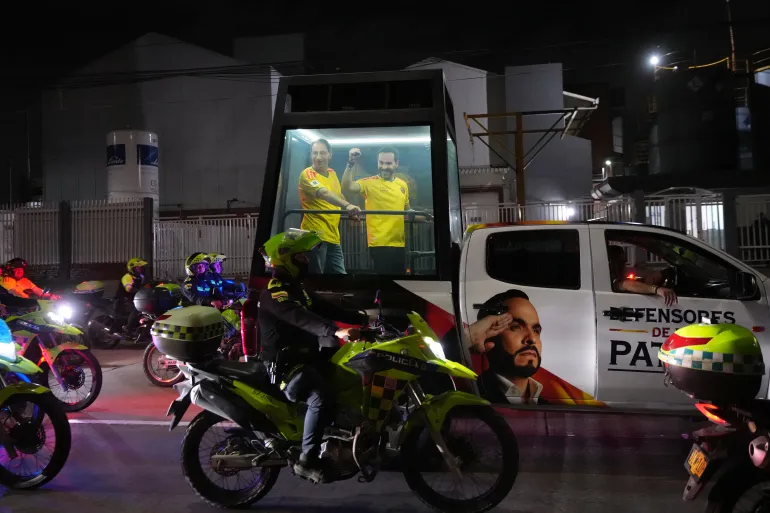
Presidential candidate Abelardo de la Espriella of the opposition Defenders of the Motherland movement and his vice presidential running mate, Jose Manuel Restrepo, ride inside a bulletproof enclosure towards a victory rally in Barranquilla on June 21, 2026 [Rodrigo Abd/AP]

What are the election results?

The first round of the presidential election was held on May 31. Neither of the two leading candidates – Abelardo de la Espriella of the right-wing Defenders of the Homeland movement and Senator Ivan Cepeda of the ruling Historic Pact – secured at least 50 percent of the vote, leading to a run-off on Sunday.

De la Espriella narrowly won with 49.66 percent over Cepeda’s 48.7 percent, according to preliminary results released on Monday by the National Registry, which manages vote numbers.

The razor-thin difference amounts to less than 1 percent of the vote and represents one of Colombia’s closest elections.

Trump-backed de la Espriella, 47, is to take office on August 7. The criminal lawyer is a multimillionaire who campaigned on tougher security and anti-leftist policies. He also has US citizenship.

De la Espriella’s win is part of a recent trend of Latin American countries electing far-right, populist leaders who are pro-Trump. Argentina’s Javier Milei, Honduras’s Nasry “Tito” Asfura, El Salvador’s Nayib Bukele and Costa Rica’s Laura Fernandez Delgado all have close ties to the Trump administration.

Why is Petro alleging fraud?

Petro took to X to denounce in a series of posts what he said was voter fraud committed with the help of Israel and Prime Minister Benjamin Netanyahu.

Petro said there was evidence of manipulation of Form E-14, the official, handwritten tally of sheets filled out by poll workers at each voting station.

The form is a physical record of the vote count and is meant to prevent electoral fraud. It is filled out by hand, and digital scans are also uploaded to the National Registry’s portal for public auditing. If found to have errors, parties may request a recount.

Petro alleged that foreign actors accessed the National Registry’s website and rewrote voting data on some E-14 forms.

“Today we have evidence of a change in IP addresses of several servers of the national registry,” he posted.

“This means that the software was compromised and others wrote data for polling stations and voting posts. The only entity in the world capable of doing that is the state of Israel,” Petro added without providing evidence of Israel’s alleged involvement.

Petro said his party had requested a “technical audit” of the voting software before the elections and asked authorities to retrieve the digital footprints of all digitally transmitted documents to avoid modification. He claimed those requests were ignored.

The outgoing president shared videos of what he alleged captured the “premeditated” modification of E-14 forms. He also claimed the manipulation was done “from the offices of the Bautista brothers”.

Colombia
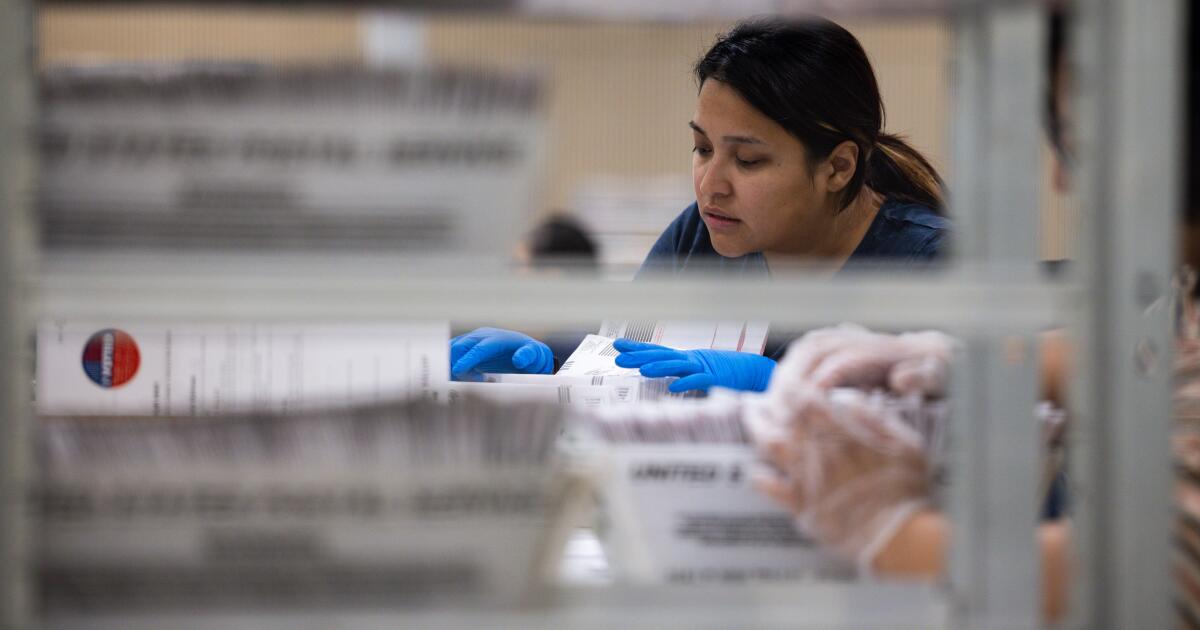
Electoral workers, observers and party delegates attend the official vote count the day after the presidential run-off in Bogota on June 22, 2026 [Fernando Vergara/AP]

Who are the Bautista brothers?

Petro was referring to Thomas Greg & Sons, an influential private logistics and security printing firm that runs Colombia’s electoral infrastructure. Until recently, it also printed Colombian passports.

It is run by brothers Fernando and Camilo Bautista Palacio. The duo was convicted of bank fraud in the US in the 1980s.

Thomas Greg & Sons, which was founded by their father, Gregorio, has been contracted by the National Registry for more than a decade to manage election logistics, preliminary vote counting and vote-tallying software.

Petro in April accused the Bautista brothers of negotiating a deal with de la Espriella that would see them secure the presidency for the far-right candidate in return for clinching passport printing contracts once more.

At the time, de la Espriella refuted the claims, and his lawyers threatened Petro with a lawsuit.

What are authorities saying?

Attorney General Gregorio Eljach has dismissed the allegations and told reporters there is “no evidence of fraud” with more than 99 percent of the votes counted.

De la Espriella, meanwhile, has so far not responded directly to Petro.

Is de la Espriella linked with Israel?

Yes, de la Espriella has consistently voiced support for Israel and campaigned in Colombia’s Jewish community, making pro-Israel promises and saying his government would “defend Judeo-Christian principles”.

He pledged to reverse Petro’s 2024 decision to cut ties with Israel and has promised to relocate the Colombian embassy to Jerusalem.

Netanyahu congratulated de la Espriella on Monday, saying: “I look forward to working with you to strengthen the bond between Israel and Colombia.”

How has the US reacted?

In his posts, Petro also blamed Trump for interfering in the elections by publicly endorsing a candidate and thus swaying voters.

Trump endorsed de la Espriella on his Truth Social platform weeks before the run-off.

Trump and US Secretary of State Marco Rubio also congratulated de la Espriella on his preliminary win, and Trump took credit for the far-right candidate’s victory.

“He was in 10th place. I endorsed him, and he won the election. He called me last night and thanked me for the endorsement,” Trump told reporters at the White House on Monday.

Rubio wrote on X: “The Trump administration looks forward to working closely with your incoming administration to advance regional security cooperation, end illegal immigration to the United States, and strengthen our economic ties.”

Petro has invited Trump to make a statement on the electoral fraud allegations.

“I formally invite President Donald Trump to speak,” Petro wrote, adding that the US president bears responsibility for “having supported a candidate and not the freedom of the Colombian people”.

What is the US-Colombian relationship like?

Although both countries have close trade ties, diplomatic relations have often been strained over drug trafficking policies and relations with Israel, among other issues.

But relations essentially collapsed under the Trump and Petro administrations.

Petro in January last year refused to allow US migrant deportation planes to land in his country and said on X that the US “cannot treat Colombian migrants like criminals”.

In October, the US sanctioned Petro, his family and key officials in his government based on unproven allegations of involvement in the drug trade.

In January this year, the US military abducted leftist Venezuelan President Nicolas Maduro from his Caracas home after the Trump administration accused him of “narcoterrorism”.

Source link

Many Californians feared federal meddling in elections before Trump’s latest baseless attacks, poll finds

Even before President Trump’s latest wave of unfounded claims of election fraud in California, a significant share of voters in the state expressed concerns about federal interference in the electoral process, according to a new poll.

Trump on Monday claimed on his social media site that the race for Los Angeles mayor was a “Rigged Election,” an allegation that came after Democrat Nithya Raman overtook Republican Spencer Pratt for second place in the ongoing primary election vote count.

Raman’s lead had prompted Rep. Abe Hamadeh, an Arizona Republican, to call for the election to be federalized, or run by the federal government rather than the state, a message Trump reposted.

Earlier Sunday, Trump had alleged during an interview with NBC News that California elections officials “were cheating.” That came after a debunked social media conspiracy theory claiming that a lag in an update of electronic voting data by the Associated Press showed Pratt was being cheated. On Monday, House Speaker Mike Johnson said the elections process in the L.A. mayoral race “stinks to high heaven.”

The ongoing attacks by Trump and his supporters continue to erode confidence in the nation’s elections, especially among Republicans, threatening a pillar of American democracy, said political scientist Eric Schickler, co-director of the Institute of Governmental Studies at UC Berkeley.

“The president … wants to use those claims to make changes in the election process that could make it harder for people to vote, and that certainly is a threat to our democratic institutions,” Schickler said.

“One thing we’ve learned in recent years is that we just cannot take the voting process for granted, cannot take for granted that both sides will accept as legitimate the outcome, and can’t take for granted the idea that there won’t be efforts to essentially manipulate the vote counting process,” he added.

A new poll released Friday by the institute found that 41% of California voters were “not confident” that this year’s elections would be free of federal interference. Although 48% had confidence that there would be not meddling, the concerns expressed were still significant, Schickler said.

More telling was the partisan divide among voters when asked whether they have confidence that local officials would conduct fair and secure elections and that the vote count would be accurate. Among Democratic registered voters, 79% said they trusted elections officials to provide an accurate vote count. Among Republicans, 55% said they were not confident that would occur.

California voters who don’t belong to either party said by a 2-1 margin that they had confidence in the vote count, the poll showed.

“The positive is that local officials are still widely trusted by Democrats, no-party-preference voters, and at least a share of Republicans, though a lot fewer than I think in the past, and a lot fewer than you know we would want for a really healthy democracy,” Schickler said.

That growing mistrust among certain parts of the electorate comes after years of baseless claims by Trump that the 2020 election was stolen from him, as well as Republican-led efforts to restrict the use of mail-in ballots and impose new requirements for voters to show identification and proof of citizenship.

Recent rulings by the conservative-leaning Supreme Court also have rolled back federal protections under the Voting Rights Act. In April, the court sharply limited a part of those protections that had forced states to draw voting districts to help elect Black or Latino representatives to Congress, as well as state and local boards.

Trump and his allies have used California’s slow vote-counting process to allege cheating. The day after the June 2 primary, Trump claimed without evidence that Democrats were trying to “steal” the gubernatorial and L.A. mayoral primaries. The next day, he alleged that California Democrats had “found” mail-in ballots and were “rigging the election” with them.

Secretary of State Shirley Weber and other officials have said California’s voting system prioritizes voter accessibility and security over speedy results. The state has more than 23 million registered voters, and ballots go through numerous verification steps, including verifying signatures on mail-in ballots.

“Over 97% of our folks actually vote by mail. They want to keep that system. That system demands more contact, more touching of the ballot, more verification of the individuals who are voting. All of those things take time,” Weber said during a recent interview with ABC10 in Sacramento.

Gov. Gavin Newsom’s office called Trump’s claims during the recent “Meet the Press” interview the “most severe case of California Derangement Syndrome we’ve ever seen.”

Newsom is considering a 2028 run for president and has consistently warned that Trump may try to interfere in both the 2026 and 2028 elections.

The Berkeley poll found that California voters overall — 74% — want candidates running for president in 2028 to prioritize defending democracy and making voting more accessible. Among Democratic voters, 95% said that was important; among Republicans, 41%.

Funding for the poll was provided to IGS by the Evelyn and Walter Haas, Jr. Fund, a private foundation based in San Francisco that aims to increase civic participation and improve the state’s democratic processes.

The poll of 8,578 registered California voters was conducted between May 19 and 25 online in English and Spanish and has a margin of error of about 2 percentage points in either direction.

Times staff writers Alene Tchekmedyian and Kevin Rector contributed to this report.

Source link