Mecca

Turkiye says Mecca defence pact not aimed at Iran | News

The pact includes an Article 5-style mutual-defence clause, but questions remain over how it would operate in practice and how Tehran will respond.

Turkish leaders have insisted that the new trilateral defence pact with Saudi Arabia and Pakistan is not directed at Iran.

Turkiye’s Foreign Minister Hakan Fidan said on Saturday that the pact does not identify Iran, or any other country, as a common threat.

Recommended Stories

list of 4 itemsend of list

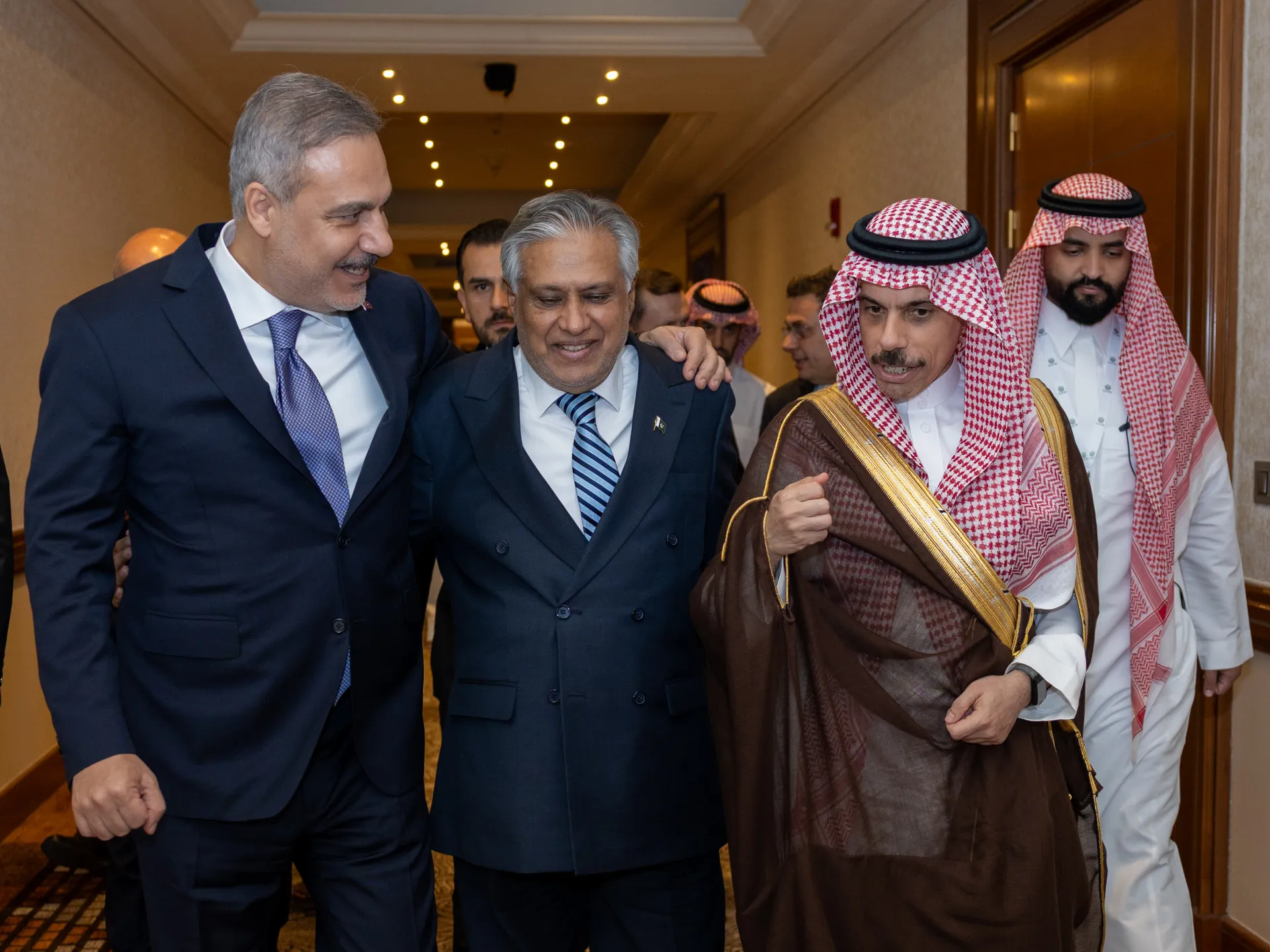
The Mecca Joint Defence Agreement was signed on Friday by Turkish President Recep Tayyip Erdogan, Saudi Crown Prince Mohammed bin Salman and Pakistani Prime Minister Shehbaz Sharif, stating that an armed attack on one of the three countries would be considered an attack on them all.

“There is no common threat that we have put in writing,” Fidan told Turkey’s state-run Anadolu agency, adding that countries that do not attack the signatories would not be considered targets.

An Article 5-style commitment

Fidan described the pact as “technically” similar to NATO’s Article 5 collective-defence clause, under which an attack on one member is treated as an attack on all.

But the response would depend on the circumstances.

A country under attack would have to request assistance and specify what kind of support it needed, Fidan said. That could range from intelligence and logistics to ammunition or the deployment of military units.

The alliance will also establish political and military committees, bringing together foreign and defence ministers and military chiefs, as well as a secretariat in Saudi Arabia.

Fidan said the three countries would work on joint training, intelligence sharing, logistics, threat assessments and military interoperability.

DAMASCUS, SYRIA - APRIL 5: (----EDITORIAL USE ONLY - MANDATORY CREDIT - 'TURKISH FOREIGN MINISTRY' / HANDOUT' - NO MARKETING NO ADVERTISING CAMPAIGNS - DISTRIBUTED AS A SERVICE TO CLIENTS----) Turkish Foreign Minister Hakan Fidan meets with Syrian Foreign Minister Asaad Hassan al-Shaibani (not seen) and Ukrainian Foreign Minister Andrii Sybiha (not seen) in Damascus, Syria, on April 5, 2026. ( Turkish Foreign Ministry - Anadolu Agency )
Turkish Foreign Minister Hakan Fidan [File: Turkish Foreign Ministry/Anadolu]

Defence-industry cooperation is also expected to be a notable part of the pact. Fidan said it was one of the main issues discussed by the three leaders in Mecca, including how the countries could benefit from each other’s military technologies.

The Turkish minister said preparations for the agreement had been under way for nearly two years and eight months, suggesting it was not drawn up simply in response to the current tensions involving Iran.

Iran pushes back

Despite Ankara’s assurances, some Iranian officials have questioned the agreement and warned Saudi Arabia against relying on its new partners for security.

Mahmoud Nabavian, a member of Iran’s parliamentary National Security and Foreign Policy Commission, said Saudi leaders should understand that cooperation with Turkiye and Pakistan would not guarantee their security.

Another commission member, Ebrahim Rezaei, similarly dismissed the pact as a “paper agreement”.

Iranian Foreign Minister Abbas Araghchi did not directly mention the agreement in a message on X on Friday, but he called on regional states to rely on themselves and pursue what he described as “true brotherhood”.

At the same time, he stressed the strength and readiness of Iran’s armed forces.


Egypt could join next

Fidan portrayed the agreement as part of a broader effort to give regional countries greater responsibility for their own security.

“External hegemons coming into the region do not solve the problems; they make them more acute,” he told Anadolu.

He described Turkiye, Saudi Arabia and Pakistan as the “core countries” of the initiative and made clear that Ankara wants the arrangement to expand.

“Under our president’s vision, we should not remain limited to three countries,” Fidan said. “We should grow and, if necessary, bring all countries under this umbrella.”

Several countries have already expressed interest, according to Fidan, who said he expected Egypt, which he described as a “natural partner”, to join once outstanding technical issues were resolved.

epa13053663 Egyptian Foreign Minister Badr Abdelatty (R) welcomes Turkish Foreign Minister Hakan Fidan (L) before a quadrilateral meeting at Tahrir Palace in Cairo, Egypt, 21 June 2026. EPA/MOHAMED HOSSAM
Egyptian Foreign Minister Badr Abdelatty, right, welcomes Turkish Foreign Minister Hakan Fidan, left, to Egypt on June 21, 2026 [Mohamed Hossam/EPA]

For now, many of the practical details remain to be worked out, including how the three militaries would coordinate in a crisis.

But the planned committees, permanent secretariat and focus on interoperability and defence-industry cooperation suggest the pact is intended to develop beyond a simple mutual defence declaration.

Source link

What are the challenges facing the Mecca agreement? | Military News

Saudi Arabia turns to Turkiye and Pakistan for defence ties, raising questions overreliance on the US.

Saudi Arabia, Pakistan and Turkiye have signed a joint defence pact.

It is an alliance that analysts say highlights Riyadh’s desire to diversify its defence partnerships, expanding to Ankara and Islamabad.

Recommended Stories

list of 3 itemsend of list

The pact was announced at a time of increased regional tension.

Yemen’s Saudi-backed government has launched a military operation against the Iran-aligned Houthis following a series of attacks, while Iran and the US have yet to reach a final deal to end the war.

The trilateral Mecca pact raises questions about the effectiveness of the decades-long US military presence in the Gulf. Does this alliance offer a viable alternative to the security umbrella promised by Washington?

Presenter: Anna Burns-Francis

Guests:

Abdulaziz Alghashian – Senior non-resident fellow at the Gulf International Forum

David Des Roches – Professor at the Thayer Marshall Institute

Zaid M Belbagi – Managing partner at Hardcastle Advisory

Source link

What could the Mecca defence pact mean for the US role in the Middle East? | US-Israel war on Iran News

A new mutual defence pact between Saudi Arabia, Turkiye and Pakistan has raised questions about the shifting geopolitical landscape of the Middle East, where fallout from the US-Israel war on Iran has prompted some countries to seek new arrangements to safeguard their security.

The pact, termed the Mecca Joint Defence Agreement, was signed in the Saudi city of Mecca on Friday.

Recommended Stories

list of 3 itemsend of list

“The agreement is intended to strengthen collective deterrence against any act of aggression, and stipulates that any armed attack against any one of the three states shall be regarded as an attack against them all,” a statement from the meeting reads.

“It further provides for the enhancement of all aspects of defence cooperation among the three states.”

While it is not yet clear what such an agreement might look like in practice, analysts say the pact points to growing questions about the durability of US security guarantees.

“Regional states have harbored growing doubts about the reliability of the US security partnership for more than a decade,” Kristian Coates Ulrichsen, a Middle East fellow at Rice University’s Baker Institute for Public Policy, told Al Jazeera over email.

“Both the decision to begin military operations against Iran and the subsequent conduct of the war and the on-off attempts to resolve it have only intensified those concerns and accelerated efforts to diversify security and defence relations.”

But, Ulrichsen added, building new defence pacts is likely not intended “to replace or supplant the US, but to provide additional strategic and policy options”.

Uncertainty over US role

While the administration of US President Donald Trump has yet to weigh in on the pact, analysts say the agreement is an effort by the three countries to reorient themselves after the turmoil of the Iran war.

“This is one of the first major geopolitical signs that the regional order is being reshaped by the US-Israeli war on Iran,” Sina Toossi, an analyst at the Center for International Policy, told Al Jazeera.

“The significance is less about a formal military alliance than about what it says regarding how regional states are reassessing security.”

Toossi pointed to the long-running alliance between the US and Saudi Arabia. For decades, the two countries have enjoyed a strong relationship, hinged on shared security interests. But the pact could be a sign that Saudi Arabia is looking to expand its security alliances.

“Rather than relying primarily on Washington, Saudi Arabia appears to be broadening its security partnerships and laying the groundwork for more intra-regional security arrangements,” Toossi explained. “That is arguably the most important takeaway.”

Media reports have also indicated that US partners in the Middle East were frustrated that the Trump administration had launched February’s war against Iran with little apparent thought to the impact on allies in the region.

Iranian forces have launched waves of missile and drone strikes against US military facilities in the Middle East, causing bystander casualties. Iran has also targeted civilian infrastructure, including energy and desalination plants.

Tehran’s decision to close the Strait of Hormuz, a key conduit for the region’s energy exports, has also imposed a steep cost on local economies.

Despite heavy strikes by the US and Israel, Iran has largely maintained its ability to restrict traffic through the strait, and Washington has struggled to provide partners with sufficient air defence munitions, many of which went to Israel.

‘Normative deterrence’

Under the circumstances created by the war, the longstanding reliance on Washington for security in the region has become more strained.

“It’s a fluid, tabula rasa era in the Middle East,” Brett McGurk, a key architect of Middle East policy under former US President Joe Biden, wrote in a social media post.

But analysts note that Friday’s security pact is best understood as an effort to supplement regional security cooperation with other countries and deter Iran.

“These countries are all US partners, and they recognise that there is no framework that can replace the United States,” Yasmine Farouk, an analyst at the International Crisis Group, told Al Jazeera.

Farouk added that it would also be a mistake to see the pact as a step towards greater confrontation with Iran.

She noted that all three countries involved have generally called for mediation and de-escalation since the US and Israel first launched their attacks on Iran in late February.

“What these countries have in common is that they are not seeking regional escalation,” she said, underscoring that the importance of the agreement might be something closer to “normative deterrence”.

Iran, she explained, has emerged from the war hardened and more confident in its ability to use force to advance its goals.

“There is a long-term perspective here on strategic cooperation, not just a deterrent effect.”

Source link

When Paris is hotter than Mecca: How Europe’s heatwave compares globally | Climate Crisis News

Paris and other European cities are experiencing temperatures above 40C (104F), reaching levels normally seen across the Middle East.

A blistering heatwave has gripped much of Europe, prompting the highest-level red alerts in parts of the United Kingdom, France, Spain and Italy.

Authorities have warned of health risks, wildfires and travel disruptions as extreme temperatures persist.

Recommended Stories

list of 3 itemsend of list

With temperatures approaching record highs, officials have taken emergency measures, including a localised alcohol ban in parts of France under red alert, nationwide heat warnings in Germany and the cancellation of a World Cup fan zone screening in Madrid, where temperatures hit 39C (102F).

Why is it so hot in Europe?

A persistent area of high pressure, known as a heat dome, has trapped hot air over Western Europe, bringing clear skies, weak winds and prolonged sunshine. Hot air moving north from North Africa has added to the extreme temperatures.

interactive- Heat dome-june24-2026-1782302509
(Al Jazeera)

Unusually warm seas around the UK, Ireland, France and the western Mediterranean have also helped keep coastal areas hot, especially at night. Coastal waters around Spain have reached record warm levels, according to Spain’s port authority.

In the worst-affected areas – western France, England and Wales – daily average temperatures have soared more than 12C above the 1991-2020 baseline, according to Copernicus data.

interactive-Europe is hotter than usual -june24-2026 copy-1782302382
(Al Jazeera)

Scientists say the early-season heatwave is part of a broader warming trend. Europe is the world’s fastest-warming continent, with temperatures rising by approximately 0.56C per decade since the mid-1990s, more than double the global average.

Climate change is making heatwaves more frequent, more intense and likely to occur earlier and later in the year.

How hot are European cities today?

To contextualise the temperatures Europe is dealing with, Al Jazeera looked at the maximum temperatures in five European capitals on June 24 and compared them with cities across the Middle East, North Africa and Asia, where high temperatures are more typically experienced.

Europe is particularly vulnerable – much of its housing and infrastructure was not built for prolonged extreme heat, and only about 20 percent of European homes have air conditioning.

The graphic below shows how European cities’ maximum temperatures today compare with some other cities around the world:

interactive-How hot are European cities today-june24-2026 -1782302387
(Al Jazeera)

How is temperature measured?

The temperature you see on the news or the weather app on your phone relies on a network of weather stations positioned around the globe.

To ensure accurate readings, weather stations typically use specialist platinum resistance thermometers placed inside shaded instruments known as a Stevenson screen.

Measurements are taken at a standard height of 1.25-2 metres (4-6.5 feet) above the ground. This provides a reading that reflects the air temperature that people actually feel.

INTERACTIVE How temperature is measured-1782301089
(Al Jazeera)

There are two well-known scales used to measure temperature: Celsius and Fahrenheit.

Only a few countries, including the United States, use Fahrenheit as their official scale. Most of the world uses the Celsius scale, named after Swedish astronomer Anders Celsius, who invented the 0-100 degree freezing and boiling point scale, although originally inverted, in 1742.

Why does the temperature feel hotter than the forecast says?

Air temperature alone often doesn’t match how hot it feels to your body. That is why forecasts report a “feels like” temperature, which adjusts air temperature based on factors like humidity, wind speed and sun exposure.

INTERACTIVE Why does the temperature feel hotter than the forecast says-1782301086
(Al Jazeera)

Humidity

Humidity measures how much water vapour is in the air. This moisture slows the evaporation of sweat, so your body can’t cool itself as effectively.

Wind speed

In hot weather, a light breeze can help evaporate sweat, making it feel cooler.

Sun exposure

Even if the thermometer reads the same, direct sunlight adds extra warmth, which is why shaded areas feel cooler.

Source link