WASHINGTON — The Trump administration has imposed sweeping new sanctions on the International Criminal Court as part of its campaign to dismantle the tribunal over investigations into the United States and its allies, including Israel.
Secretary of State Marco Rubio announced the sanctions Friday, after the Nobel Peace Prize was awarded to South African jurist Navi Pillay, a former judge at the ICC and other international courts whose selection was condemned by Israel. President Trump has coveted that prize for himself.
“We will ban transactions with this rogue court, cutting off their resources and crippling its ability to operate against us,” Rubio said in a video address posted to social media. “The United States and the American people are not subject to the jurisdiction of this fake ICC.”
The sanctions cut the court off from U.S.-based financial services, technology companies and even using U.S. dollars. They set a six-month timeline for U.S. companies and individuals that have business with the court to wind that business down.
U.S. Secretary of State Marco Rubio speaks at the Pnyx hill, where ancient Athenians held democratic assemblies, with the ancient Parthenon temple atop the Acropolis in the background, in Athens,Wednesday, Oct. 7, 2026.
(Mark Schiefelbein / Associated Press)
The ICC denounced the step as an attack on the rule of law and the foundations of international order, themes that Rubio had appeared to embrace only two days ago in a speech in front of the Acropolis in Athens.
“It is an attempt to obstruct the course of justice and to prevent the court from doing what it was created to do,” the court said in a statement. “It is an assault on the rule of law and on the very foundations of the international legal order which strikes at the simple principle that no one stands above the law.”
ICC President Tomoko Akane, a citizen of U.S. ally Japan, said the court would “continue to fully discharge its mandate, with independence and impartiality, acting only on the basis of the law and the evidence, for the sake of the countless victims of grave crimes.”
She also appealed to other ICC members for support. “This is not just about defending a single institution, but about safeguarding the international order grounded upon the rule of law.”
Rights groups also denounced the sanctions.
“This existential attack must fail,” said Erika Guevara Rosas, an Amnesty International senior director. “States must take concrete action to resist the imposition of these measures and actively protect the Court.”
A view of the International Criminal Court in The Hague, Netherlands, on August 22, 2026.
(Karolina Janik/NurPhoto via Associated Press)
The court’s host country of the Netherlands has been preparing for weeks for the move. One possible measure to mitigate sanctions is the EU “blocking statute,” which could be used to protect European court staff by preventing European companies from complying with the U.S. measures. Dutch Foreign Minister Tom Berendsen has called the blocking statute the “nuclear option” in countering possible sanctions, but said the Netherlands has been in talks with the European Commission to ensure that if it is necessary it can be quickly enacted.
In a joint statement, Canada, Denmark, Germany, France, Italy, Japan, the Netherlands and the United Kingdom expressed strong disagreement with the U.S. sanctions.
“We will continue to work together to support the court’s vital work, uphold the rules-based international system, and advance accountability,” the statement said.
“If put into effect, these sanctions will have a significant impact on the court’s work, its dedicated staff and their families. They work every day to bring those accused of the most serious international crimes to justice and to support their victims.”
Rubio said U.S. allies should join in the U.S. actions. “If they do not, the United States will continue its campaign to dismantle the ICC, piece by piece, until Americans are threatened no longer,” he said.
A number of countries have withdrawn from the court this year, including Venezuela and Chad. The South Pacific island nation of Naoero was the most recent to announce it would quit.
Lee and Quell write for the Associated Press. Quell reported from The Hague, Netherlands. AP writer Mike Corder contributed to this report from The Hague.
The ballot initiative was spearheaded by the United Firefighters of Los Angeles City Local 112, the union representing rank-and-file firefighters, which has long argued that the department is underfunded.
The president of the union has said that the tax would be the most important thing for the LAFD “really ever.”
“The most important thing for the citizens of L.A. is our response times; this ballot measure would help us get more firefighters, more paramedics, more fire stations and more apparatus, which would let us respond faster to citizens of L.A.,” said Doug Coates, the president of UFLAC.
“In the Palisades, this measure would have let us respond quicker, knock it down faster, protect more homes … We would have saved more homes if we had had more firefighters, period,” he said.
The sales tax would represent the biggest investment in the city’s fire department since 2000, when voters approved Proposition F, a ballot measure that authorized the issuance of a $532-million bond — more than half of which was allocated to build 19 neighborhood fire stations and a helicopter maintenance facility.
The initiative also has received support from Mayor Karen Bass as well as Councilmember Traci Park, who represents Pacific Palisades.
SACRAMENTO — What’s so wrong about requiring every Californian to show a government ID before they’re allowed to vote? That’s what Proposition 39 backers ask. And it’s a fair question.
Here are some valid answers:
It would make California’s already notoriously slow vote count even more pokey.
It would be an added hassle for citizens attempting to exercise their voting right.
It would cost taxpayers a bundle, perhaps hundreds of millions of dollars each year.
It’s another solution by politicians to a problem that really doesn’t exist.
Practically everyone, regardless of political affiliation, must understand by now that there simply is no evidence of widespread — significant, meaningful — voter cheating in California or anywhere else in America. This despite conspiracy-theorists’ fruitless searching and President Trump’s lies about “rigged” elections.
It’s my belief that the main reason Republicans placed Proposition 39 on the California ballot was to boost GOP voter turnout in the Nov. 3 election. And recent independent polling shows that the measure does appeal strongly to Republicans — but not Democrats, who are united in opposition.
The proposition appears to be headed for defeat, largely because Democratic voters in this deep blue state equate it with the discredited president. Trump has turned into poison for Republican candidates in competitive races and any cause that reminds people of him.
You’re reading the L.A. Times Politics newsletter
Expert columnists cover the insights, legislation, players and politics you need to know.
By continuing, you agree to our Terms of Service, which include arbitration and a class action waiver. You agree that we and our third-party vendors may collect and use your information, including through cookies, pixels and similar technologies, for the purposes set forth in our Privacy Policy such as personalizing your experience and ads.
That’s why the Proposition 39 campaign last week released a new major TV ad that essentially asks voters to ignore the president.
This is how conservative consultant Jon Fleischman summarized the ad’s message to Democrats in his blog: “You can hate Trump and still back Voter ID.”
Require voters to show some government-issued identification each time they vote in person, such as a driver’s license or passport. Don’t have one? The state would issue a free ID card to any voter who asked.
Californians who cast mail ballots — more than 80% of voters — would be required to write the last four digits of a government ID number on the return envelope. The number would be determined when initially registering to vote.
The measure also would impose some basically noncontroversial mandates that make sense separately. It would require election officials to maintain accurate voter registration files, weeding out people who have moved or died and verifying citizenship. But counties already do that pretty well.
The contrived bogeyman for election fraud scaremongers is the undocumented immigrant community. But these people, living on the edge and hiding from the government, aren’t going to risk deportation by trying to vote in an election they couldn’t care less about. And political candidates aren’t going to waste their time and money on them. Their targets are the large numbers of apathetic legal voters who sit out elections.
Currently, Californians must provide identification when registering and swear under penalty of perjury — a felony — that they are U.S. citizens. And they must record their signatures when registering and scribble it on the back of the ballot envelope when voting by mail.
Requiring me to add a four-digit number on the back of my “absentee” ballot envelope means I’d have to register all over again to record the PIN. And then remember it every election. A pointless pain.
Assemblyman Carl DeMaio (R-San Diego), a conservative firebrand, instigated and authored Proposition 39. “I do believe that voter fraud is a real problem. Absolutely,” he told me.
But he said the proposition has two main goals: 1, to clean up voter files and make sure ballots are properly validated and counted. 2, to increase public confidence in the voting process. “We have a perception problem,” he says. “Voters have low trust” in the election system.
Republicans mistrust a lot; Democrats not so much.
A California poll released last week by the UC Berkeley Institute of Governmental Studies showed that 84% of Republican voters had a “major concern” about voter fraud. Only 21% of Democrats did.
Can anyone doubt who’s driving the Republicans’ anxiety? The bellicose president. “Mail-in voting means mail-in cheating,” Trump has reiterated. “It’s terrible what’s going on.”
This from the hypocrite who mails in his ballots.
Fortunately, Proposition 39’s crafters left mail ballots pretty much alone, except for requiring a nuisance PIN on the ballot envelope.
That “absolutely” will slow down vote counting, says Assemblywoman Gail Pellerin (D-Santa Cruz), who heads the Assembly Elections Committee and was the longtime chief elections official of Santa Cruz County. Under Proposition 39, officials not only would need to check voters’ signatures against those on file, but also their PINs.
And voting in person would drag while people dug for an ID and an official checked it, Pellerin says. Some people are bound to be denied their voting right by mistake, she asserts.
Tony Quinn, formerly a GOP redistricting consultant and a longtime political analyst, points out that a disproportionately high portion of in-person voters are Republicans. Proposition 39 is “imposing a burden on them,” he says. “I don’t think the authors realize who’s voting in person these days. They sense illegal aliens.”
The UC institute poll showed Proposition 39 being supported by 39% of likely voters and opposed by 52%. It was backed by 92% of Republicans, but Democrats were 80% against. And they outnumber Republicans by nearly 2-to-1 in California.
The proposition also trailed in a poll by the Public Policy Institute of California: 43% yes, 55% no.
In the PPIC poll, Republicans said 39 was by far the most interesting proposition on the ballot.
Trump’s influence? Among the paltry 27% of voters who approve of his job performance, 88% support Proposition 39. But of the 72% who disapprove of the president, 73% oppose the measure.
Trump is toxic.
Proposition 39 is more government regulation for no good reason.
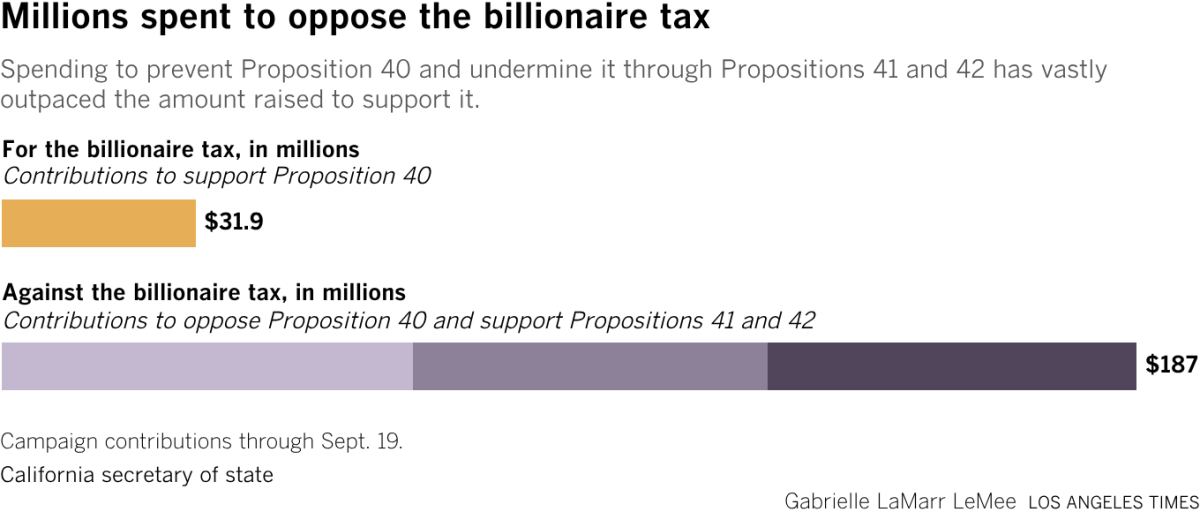
Opponents of the billionaire tax on the November ballot have vastly outraised the proposal’s supporters, with the anti-Proposition 40 effort and the backers of two other ballot measures crafted to nullify it raising $187 million compared to the $32 million raised by boosters of the wealth tax, according to campaign finance documents filed with the state.
The reports, filed Thursday, account for donations through Sept. 19 and do not include several million dollars that have poured into campaign coffers in recent days. The numbers are expected to vastly increase before the Nov. 3 election.
The bulk of the money raised by the proponents of Proposition 40, which would enact a one-time 5% tax on California billionaires’ assets, appears to have been spent on gathering signatures to qualify the measure for the November ballot. The campaign had only $207,000 in the bank, according to the latest campaign finance reports.
A leader of the union that crafted the proposal accused wealthy Californians who are spending heavily against the measure of lying to voters. The measure is designed to offset $100 billion in impending federal healthcare funding cuts expected to impacts millions of Californians.
“The billionaires take and take — tax break after tax break — and now they’re spending that money to deceive voters and avoid paying their fair share,” said Suzanne Jimenez, the chief of staff of the Service Employees International Union-United Healthcare Workers West. “Voters want their money back from the billionaires and want local emergency rooms to stay open. California does not need more tax breaks for billionaires. California needs emergency rooms for patients, hospitals that stay open, and healthcare people can access and afford.”
Opponents of the billionaire tax argue that it would do more harm than good.
“The more Californians learn, the more they see Proposition 40 for what it is — a harmful tax scheme that permanently damages the state’s budget and economy with zero accountability or safeguards to ensure funding actually improves care or lowers costs for patients,” said California Medical Assn. President Dr. René Bravo, the leader of one of the groups opposing the billionaire tax.
Proposition 41 would nullify the billionaire tax if, in the event that both measures are approved, it receives more “yes” votes. Proposition 41 would prohibit any new state tax from being excluded from a voter-approved cap that restricts how much tax revenue the state can spend each year.
“Californians deserve better results for their hard-earned tax dollars,” said Molly Weedn, a spokesperson for the Proposition 41 campaign.
Proposition 42 would prohibit new taxes on personal property, intellectual property, retirement accounts and other assets, and would limit situations in which a ballot measure or state lawmakers can impose or raise taxes retroactively — both of which are essential parts of Proposition 40. If both measures pass and Proposition 42 receives more “yes” votes, it would nullify the wealth tax.
The proposed billionaire tax has divided California Democrats, with Gov. Gavin Newsom opposing it while the state Democratic party supports it.
In recent polling, a majority of likely voters did not support any of the three proposals.
While 45% of likely voters supported the billionaire tax, 42% opposed it, according to a poll released Friday by UC Berkeley’s Institute of Governmental Studies and co-sponsored by the Los Angeles Times. Voters also are torn about the two ballot measures designed to nullify it.
The other measure receiving great attention, Proposition 39, which would require voters to show government-issued ID to cast ballots, faces a similar financial disparity. Opponents to the measure have raised $39.3 million compared to $15.6 million garnered by supporters.
Fifty-two percent of likely California voters oppose the voter ID proposal, while 39% support it and 9% are undecided, according to the Berkeley poll.
In the race to replace Newsom, Democratic former Biden cabinet member Xavier Becerra has raised $35.8 million, while his GOP rival, conservative strategist and television commentator Steve Hilton, has raised $22.3 million.
Becerra remains the front-runner in the governor’s race, which is not surprising since Democratic voters outnumber Republicans nearly 2 to 1. In last week’s Berkeley poll, the Democrat had the support of 58% of likely voters, while 33% backed the Republican.
Gov. Gavin Newsom has signed a package of bills that he says are intended to build on California’s record of protecting reproductive rights and expanding access to care.
One of the measures, sponsored by Assemblymember Catherine Stefani (D-San Francisco), increases access to medication abortion by making it available on community college campuses.
Another bill, sponsored by Assemblymember Jacqui Irwin (D-Thousand Oaks), focuses on military veterans, aiming to address a gap in their healthcare after the Trump administration largely banned the U.S. Department of Veterans Affairs from providing abortion services. The measure enables California veterans to access abortion and contraception services through a state program.
“Freedom means being able to make deeply personal decisions without elected officials inserting themselves in pursuit of a political agenda,” Newsom said. “California is protecting that freedom and showing the nation, particularly under increasingly severe attacks by the Trump administration, what is possible when we put patients and people first — not politics.”
The governor announced the signing of the bills on Sunday, saying they will strengthen reproductive healthcare in the state.
One of the bills, introduced by Stefani, expands the ability of certified nurse-midwives to provide care for pregnant and postpartum patients by specifying that supervision by a physician is not required when providing certain services.
The legislation also included a bill sponsored by Assemblymember Celeste Rodriguez (D-San Fernando) that aims to expand access to breast pumps and services for nursing mothers through Medi-Cal.
Gov. Gavin Newsom has vetoed a bill aimed at deprioritizing commercial logging in a unique state forest system, arguing the measure would jeopardize the ability to test best management practices.
At issue are the state’s 14 demonstration forests — managed by the California Department of Forestry and Fire Protection, or Cal Fire — which are billed as “living laboratories” for forest management practices. Under existing law, they’re directed to produce as much timber as can be sustained over time, while considering factors like recreation and wildlife.
Assembly Bill 2494 would have eliminated what’s often characterized as a logging mandate in favor of prioritizing values such as carbon storage, wildfire resilience and biodiversity conservation. It also would have directed state officials to seek agreements with Native American tribes to integrate their traditional knowledge into managing the land.
In Newsom’s veto message, he said the forests “produce cutting-edge strategies that inform forest management on public and private lands across California,” which is key for fighting climate change and improving wildfire resilience.
“By narrowing the management of these forests to a limited set of public benefits, this bill risks the state’s ability to fully demonstrate the best science-based practices,” he wrote Friday. “At a time when California is racing to keep pace with a rapidly changing climate, we cannot afford to lose the flexibility needed to safeguard our forests for future generations.”
The move deals a blow to a grassroots coalition that included tribes, environmentalists and mountain bikers, some of whom have fought for decades to rein in logging at Jackson Demonstration State Forest in Mendocino County. In recent years, activists have staged protests and tree sits, harkening back to the “timber wars” of the 1980s and ‘90s.
The bill grew in part out of discussions with constituents who wanted to see the forest run differently, according to its author, Assemblymember Chris Rogers (D-Santa Rosa).
Rogers, who represents the North Coast, called Newsom’s veto message “nonsensical” and said it didn’t reflect the language of the bill.
“Current law says that the guiding principle for the management of the forests is maximum sustained production of high-quality wood products,” he told The Times. “That’s much more narrow as a directive on how to manage those lands than by expanding it to include biodiversity, carbon sequestration, research, recreation.”
Polly Girvin, who pushed for changes at Jackson along with her late partner and tribal leader Priscilla Hunter, said the fight will continue under California’s next governor. She wants to see Native Americans take an even stronger leadership role going forward, pointing to rights afforded to them by state law.
“Our local tribal voice is not pro-logging; it’s really to keep the world in balance, to honor the cries of the ancestors, to try to save the trees from commercial logging,” said Girvin, a retired attorney focused on Native American law.
Leaders in Mendocino and Humboldt counties backed the measure. Humboldt County Supervisor Steve Madrone saw it as codifying practices that could help rebuild trust in the community, which he said Cal Fire had lost.
“It was not going to restrict it from being able to do all kinds of things,” he said. “Frankly, it was going to be better than just letting them kind of focus on board feet.”
Cal Fire’s Kevin Conway, who oversees the state’s demonstration forests, said he could not comment on the measure.
The bill was opposed by the Rural County Representatives of California, an advocacy group representing 40 counties, along with many in the timber and agriculture industries.
Staci Heaton, senior policy advocate for RCRC, echoed Newsom’s concerns that the legislation would have limited what could be done in the forests to achieve resilience, such as the ability to harvest trees of different sizes and types. She said they also had concerns about the funding structure and what she described as vague definitions in the bill, which could invite litigation.
“We appreciate the governor signaling that we’re going to continue to use sound forest management in California,” Heaton said.
Asked about the disagreement among some counties, she said there tends to be “more of a split in what people think good forest management looks like” when it comes to coastal redwood forests.
“We maintain that a lot of our forests really aren’t healthy in their current condition, and there’s too many straws in the ground, and there does need to be, in some areas, more aggressive management,” she said.
SACRAMENTO — The California Primary Care Assn. and five clinics filed a civil lawsuit in federal court Friday accusing SEIU-United Healthcare Workers West and its president, Dave Regan, of racketeering and using ballot initiatives to “shake down” community health centers.
The association alleges that Regan and his union orchestrated a “multi-year campaign of coercion, threats, and economic pressure” to “extort” what the lawsuit describes as “valuable property rights” and “labor-organizing terms” from CPCA and the health centers the association represents in California, according to a copy of the complaint obtained by The Times.
The suit says Regan pushed Proposition 44, which if approved by voters in November will restrict spending at nonprofit community health clinics, as political leverage against the industry. Regan then offered to call off the measure if CPCA agreed to support the union’s efforts to unionize 25,000 industry workers, the lawsuit states.
In the complaint, CPCA estimates that 25,000 new union members would generate $2.37 million in monthly revenue from dues paid to UHW.
“This is about Dave Regan and UHW in particular adopting a strategy to create harmful legislation and harmful ballot initiatives to force people to the table to negotiate favorable agreements that will benefit them financially and then when those agreements don’t go through, they allow these initiatives to go through to create punishment for the organizations that can’t come to terms, and then they keep coming back, over and over and over again,” said Brandon Thornock, chief executive of plaintiff Shasta Community Health, echoing claims in the lawsuit.
“It’s a complete waste of resources and it’s amoral.”
A spokesperson for UHW did not immediately respond to a request for comment on the lawsuit. In an interview in July, Regan denied asking the clinics to support his unionization efforts in exchange for dropping Proposition 44.
“We wanted to construct a relationship with the clinic association that prioritized appropriate funding of the community clinics in California, including restoring the healthcare cuts that were introduced by the ‘One Big [Beautiful] Bill,’” Regan said previously. “It was a strategic relationship where we’re working in a mutually cooperative way to properly fund the healthcare system to respect workers, and they were not interested in that.”
Regan is a powerful figure in California politics who has a history of using the ballot box to try to force the healthcare industry to unionize. The union leader has come under scrutiny this year over claims about his extreme political tactics, intimidating behavior toward and threats against women, and an allegation of assault more than 15 years ago, all of which he denies.
Regan is also the architect of California’s billionaire tax, a proposal on the November ballot to apply a one-time 5% tax on the net worth of billionaires that has splintered labor and divided Democrats.
The CPCA lawsuit, in the federal court in the Eastern District of California, alleges that Regan’s political tactics are not designed to win initiatives, “but to subjugate and terrify.”
The union, the lawsuit states, has filed dozens of punitive ballot measures in California “targeting hospitals and dialysis providers with the implied threat or directly stated purpose of coercing health care providers into acquiescing to their union organizing or bargaining demands.” UHW has spent over $216 million, the suit says, on measures to “harm patients, destroy services, and drive providers out of business.” The vast majority of the UHW-backed measures have been withdrawn, usually after the industry agrees to concessions, the suit states.
“No other singular entity or individual has engaged in such widespread corruption of California’s initiative process,” the suit states.
Proposition 44 requires that community clinics spend 90% of revenue on patient services, which Regan has said ensures that money is aligned with the mission of the health centers.
CPCA and health centers say restricting the funding would dramatically reduce money for other essential services and leave some clinics at risk of closing their doors.
The CPCA lawsuit alleges that Regan’s demands on Proposition 44 were sent in an email in January from a legislative staff member on behalf of the union. The offer, presented as a joint submission from UHW and two union affiliates, included a requirement that community health centers “hold elections for at least 5,000 employees in each of five years the agreement would be in effect, resulting in elections for 25,000 employees over the five-year period.”
The complaint says the email also disclosed that UHW said it would drop the initiative if CPCA agreed to the terms.
“The e-mail unambiguously shows that UHW and the Union Affiliates — bullied and instructed by Regan — agreed and intended to participate in an endeavor to abuse the ballot initiative process to extract valuable labor concessions from CPCA and CHCs, in violation of federal and state law,” the complaint states.
Negotiations to withdraw the measure fell apart on June 24, the day before the deadline to rescind initiatives from the statewide ballot.
The lawsuit alleges that the union offered a new deal that same day.
“UHW would withdraw the Clinic Penalty Initiative if, in exchange, CPCA reversed its opposition to UHW’s billionaires’ wealth tax initiative and took the funds it raised to oppose the Clinic Penalty Initiative and instead used that money to assist UHW in passing its wealth tax,” the lawsuit alleges. “The next morning, Regan, through an intermediary, offered the same ‘deal.’ CPCA refused to entertain such discussions.”
The lawsuit states that California’s community health centers served 6.7 million people in 2025 and 67% are enrolled in Medi-Cal, state subsidized healthcare coverage for low-income Californians. In many rural areas, health centers are sometimes the only source of primary care.
Thornock said Shasta Community Health has patients who travel more than an hour to get care and provides a program that transports them to health facilities. Under Proposition 44, the program would not be considered patient services.
“It was designed to create for us what becomes an existential crisis in many cases,” he said.
The CPCA lawsuit states that Regan and the union began seeking to extort unionization from nonprofit hospitals through ballot measures in 2011 and used the same strategy to try to grow their membership among dialysis center workers beginning in 2017. In early 2022, they began targeting CPCA and health centers through legislation, the lawsuit stated.
The suit also alleges that Regan and UHW are in violation of a California law that prohibits a proponent of a ballot initiative from seeking, soliciting, bargaining for, or obtaining any money or a thing of value from any person or entity for abandoning or preventing an initiative from moving forward.
A week before the lawsuit became public, The Times reported that independent investigators hired by SEIU found in a report that Regan had tried to “extort” an SEIU state council endorsement of the billionaire tax from other California union leaders. An outside law firm that investigated internal charges against Regan found that he suggested to David Huerta, then president of SEIU California, that the state council could be investigated for “governance issues” if the council did not endorse the billionaire tax on the November ballot. The state council later voted to remain neutral on the measure.
The law firm’s investigation, which was paid for by Service Employees International Union, substantiated an allegation that Regan threatened Tia Orr, executive director of SEIU California, over the council’s position on the ballot measure. The SEIU probe found an allegation that Regan also assaulted one of Orr’s predecessors in the job, Courtni Pugh, in 2009, to be credible.
A second investigation conducted by an outside law firm hired by SEIU California found sufficient evidence to substantiate a complaint that Regan bullied Jessica Bartholow, the council’s government relations director.
In interviews with investigators hired by the union and with The Times, Regan admitted to swearing at a staff member for SEIU California and adamantly denied bullying, threatening and assaulting women or seeking to force the state council to back his measure.
Regan remains in his job and alleges that he’s being unfairly targeted over his advocacy for the billionaire tax. SEIU, the national umbrella organization that represents local SEIU affiliates, has not taken any disciplinary action against him while an internal administrative review process moves forward.
Sources involved in negotiations over the billionaire tax said Regan also asked for concessions to grow his union in exchange for rescinding the measure from the ballot this year, which The Times previously reported.
Regan’s list of demands included union contracts with two private hospitals and a health clinic, an organizing neutrality agreement with healthcare clinics statewide, recognition of his union from dialysis clinics and for billionaires to remove measures they launched in response to his tax, according to two sources familiar with the talks who were granted anonymity to share details of the discussions.
The union leader called the allegation “categorically false” and denied that he asked for concessions for his union in exchange for removing the billionaire tax from the ballot.
SACRAMENTO — SEIU United Healthcare Workers West President Dave Regan allegedly tried to “extort” an SEIU state council endorsement of the billionaire tax ballot measure from other California union leaders, according to an investigation commissioned by Service Employees International Union.
The investigation and a second inquiry conducted on behalf of SEIU California found that Regan allegedly threatened and intimidated women who worked for the state council, and in one instance, physically assaulted a former executive director of the labor organization.
Regan, in an interview with The Times, denied the allegations that he attempted to extort from union officials. He also denied assaulting the executive director and said he did not threaten female labor leaders. He repeated a counterclaim he made to the union: The allegations against him are retaliation for his advocacy for Proposition 40, the proposed wealth tax that will be on the Nov. 3 ballot.
“They are internally contradictory, they are fundamentally biased, and maybe most importantly, they are politically motivated,” Regan said about the probes.
The law firm hired by the national union investigated Regan’s claim of retaliation but found the allegation could not be substantiated.
David Huerta, the president of SEIU United Service Workers West, and three other labor leaders filed a rare formal union charge against Regan in February.
The national union of SEIU has ultimate authority to resolve charges filed under its constitution and hired the New York labor law firm Cohen, Weiss and Simon to independently investigate the claims. The firm interviewed 18 current and former SEIU leaders and others in the California labor movement over nearly three months, according to its report.
The law firm’s report, reviewed by The Times, supported Huerta’s claim that on Dec. 3 Regan suggested the state council could be investigated for “governance issues” if the council did not endorse the billionaire tax on the November ballot. Huerta was then president of SEIU California.
“During the investigation, Huerta reported that he left the conversation with Regan feeling ‘extorted’ and believing that Regan might report unspecified governance concerns to the U.S. Department of Labor, which is known to be unfriendly to labor unions under the Trump administration, if state council did not support the billionaire tax,” the report said.
The law firm’s investigation substantiated an allegation that on the same day, Regan threatened Tia Orr, executive director of SEIU California, over the council’s position on the ballot measure. The SEIU probe found an allegation that Regan also assaulted one of Orr’s predecessors in the job, Courtni Pugh, in 2009, to be credible.
“SEIU California leaders filed charges against Dave Regan alleging a pattern of bullying, threats, abuse, harassment, physical violence and attempted extortion,” Christopher Calhoun, a spokesperson for SEIU California, said in a statement. “Initial investigations pertaining to these charges substantiated most of SEIU California leaders’ allegations.”
State union officials have temporarily banned Regan from the offices of SEIU California, a council of union leaders that coordinates political operations for all SEIU-affliated unions in the state, to protect female employees, according to the state council’s report.
Democratic National Committee delegate Courtni Pugh speaks at the California Democratic Party breakfast in Chicago on Aug. 20, 2024.
(Myung J. Chun / Los Angeles Times)
“Sufficient evidence was also found to substantiate that Regan has engaged in a pattern of subjecting former and current SEIU California female directors to intimidating and threatening physical behavior and verbal abuse,” the report commissioned by the state council said.
Leaders and workers within the labor movement describe Regan’s alleged behavior as an open secret at SEIU, which represents more than 2 million members nationwide and is the largest union in California.
The law firm hired by SEIU submitted its investigation report on July 28. Regan remains in his job as an administrative process moves forward with hearings. Regan will get a chance to make his case before SEIU determines any appropriate disciplinary action.
SEIU President April Verrett has the power to temporarily suspend Regan as the process plays out.
“SEIU is deeply committed to the safety and well-being of all people, including our members, staff, and the public, and takes these matters seriously,” said Dan O’Sullivan, a spokesperson for SEIU. “As soon as these concerns were raised, we initiated a deliberate and thorough process and retained independent, outside investigators to look into these allegations. Our process is active and ongoing, and the next steps include appointing a hearing officer and holding an evidentiary hearing through which all parties will be afforded due process.”
At a California Federation of Labor event on Dec. 3, Regan told Orr that “state council better endorse this measure by Jan. 1 or I’m coming for you,” she told investigators in both probes.
Regan rode to the airport with Orr and sat next to her on the plane “as part of a continued effort to intimidate her into providing state council’s support for the billionaire tax,” Orr told the investigators. As they left, Regan tapped his watch to suggest her time was running out, the report stated.
Regan told investigators that he learned last year that Orr was working behind the scenes to undermine his billionaire tax proposal. If approved by voters, the measure will retroactively apply a one-time 5% tax on the net worth of billionaires who were residing in California as of Jan. 1, 2026.
Regan denied that he threatened Orr, calling the claims “completely fabricated.”
“And again, the source of that is somebody who is not in favor of Proposition 40, and somebody who has not been leading the state council with practices of good governance,” Regan said in an interview.
Regan also denied intimidating Orr to investigators hired by the national union, but offered a different perspective on the SEIU California executive director. He said he traveled with Orr as a friend that day, had previously supported her professionally and offered her a job, according to the report.
The law firm said Orr believed that Regan was a “bully” who mistreated women of color and made it difficult for them to do their jobs at SEIU and had even “fought someone” when he didn’t “get his way.” Regan denied those allegations, including that he mistreated women of color.
“Orr therefore took Regan’s statement that he was ‘coming for’ her as a threat to her job security and her physical safety. She contemporaneously shared this fear with a colleague. Moreover, her response to Regan’s statement is reasonable because three interviewees — both current and former employees of state council — corroborated that Regan has verbally berated and at times physically intimidated or assaulted former state council executive directors,” the report stated.
The investigation commissioned by the national union concluded that UHW then launched a “fishing expedition” into the state council’s finances under Orr’s leadership, but did not substantiate a claim that Regan defamed her to allies of the labor movement.
The SEIU investigators also wrote that the claim that Regan assaulted Pugh was substantiated.
Pugh told investigators that Regan kicked open her office door and “jacked” her against the wall, according to the investigative report. While she was “pinned,” Regan pressed his finger into her chest and screamed that she was a “dumb ass,” the report said.
When he left her office, Pugh fell to the ground and began to hyperventilate, according to the report. Two colleagues found her, helped her breathe into a paper bag and walked her home, the report said.
Regan denied the allegation.
“It is a complete fabrication and a fiction made by somebody who has all of the incentive possible to critique or trash or criticize UHW generally, and me specifically, and no, there was no mention of it for 17 years,” he said.
The report also concluded that Regan recently threatened to sue SEIU Local 221 President Crystal Irving in an attempt to silence her from warning others about the alleged assault against Pugh.
Regan said the national union’s investigation was “fundamentally flawed” because it stated that Pugh “had nothing to gain from sharing her story” with Irving. Pugh, now a political consultant, has worked against the billionaire tax ballot measure, something Regan said gave her a reason to lie about him.
Pugh called Regan’s response “offensive to the women” who she said objected to his behavior. She said she detailed the alleged incident at the time to board members who oversaw her work and SEIU leadership. The encounter, she said, was well-known.
“I told my colleagues and organization leaders when it occurred,” Pugh said in a statement. “I was asked to participate in the later investigation because so many people had heard about the 2009 incident over the years. I chose to participate in the investigation because I saw that his behavior had continued and in hopes that no one else would have to endure this kind of treatment from him.”
Regan, in his interview with The Times, also denied the allegation that he attempted to force the state council to support the billionaire tax.
David Huerta, president of SEIU-USWW, speaks during a Memorial Day action in Los Angeles on May 21.
(Kayla Bartkowski / Los Angeles Times)
“Huerta then asked Regan if it was his intention to initiate an investigation,” according to the report. “Regan replied, ‘I don’t have to; there are others who would.’ In that conversation, Regan demanded a full endorsement of the billionaire’s tax initiative measure by the state council by Jan. 1.”
Regan told investigators he raised governance issues with Huerta and could not remember if he demanded the council’s support for the billionaire tax during the conversation, though he said he had been seeking the endorsement for months, according to the national union’s report.
“The investigation found that Regan likely suggested he would cause the DOL to investigate state council,” the report said. “According to Regan, he did discuss with Huerta that an investigation was possible.”
The executive board of SEIU California later voted in July to remain neutral on Proposition 40, marking a blow to Regan’s efforts to overcome an onslaught of opposition from California Gov. Gavin Newsom, billionaires and liberal groups concerned that the measure could backfire and reduce state tax revenue collected from the ultra wealthy.
Regan filed a counterclaim with SEIU in April, alleging that the state council initiated the complaint and launched its own investigation into him as a retaliatory “character assassination” for his advocacy for the billionaire tax, something the SEIU report said was not substantiated.
The investigative report submitted to the national union raised questions about Regan’s tactics to earn support for his causes.
Investigators said their probe “revealed that Regan has been associated with similar extreme efforts to secure political endorsements in the recent past.”
The firm reported that it reviewed text and email messages in which a representative for Regan offered to drop part of his counterclaim “in exchange for the state council’s endorsement of Tom Steyer for governor.”
“In an email response to that offer, a State Council representative stated they have ‘no interest in a behind-the-scenes trade involving dropping internal charges of misconduct in exchange for the making of a political endorsement.’”
The person working with Regan who sent the offer denied to the law firm that the conversation constituted extortion.
“This denial is not credible,” the firm wrote in the report. “The Regan Offeror stated that they were ‘extremely careful’ with their language when conveying Regan’s offer, as they were aware that what they said could be misconstrued as extortion. That the Regan Offeror took such care suggests that the offer was likely extortion.”
Regan also denied the claim, which he called a “complete fabrication.”
A second investigation by the Los Angeles law firm Barboza & Associates, which was hired by SEIU California, found sufficient evidence to substantiate a complaint that Regan bullied Jessica Bartholow, the council’s government relations director.
Bartholow reported to her superiors at SEIU California that Regan stood uncomfortably close and hovered over her at the bar at a fundraiser for the state Senate leader in San Diego in March as tensions flared over the billionaire tax. He then screamed an expletive at her in front of a crowd of lawmakers and lobbyists when she walked away from him, according to the state council’s report.
“Bartholow was scared and her heart was pounding,” investigators wrote in the report for the state council that was reviewed by The Times. “Bartholow had heard that Regan could be violent, and she did not know what he was going to do.”
Regan told investigators and The Times that he swore at Bartholow but denied that he physically intimidated her. Regan said he was upset with her over an allegation that she previously threw “four staff members of UHW out of the state council office.” The report commissioned by the state council discredited his claim and said “Bartholow did not throw UHW staff out of the SEIU California office or treat them rudely or disrespectfully.”
Lawyers hired by the state council said Regan intimidated another woman within the union during their investigation.
The state council investigation included an allegation that Regan physically and verbally intimidated Susan Li, an assistant director of external organizing for SEIU Local 721, on April 30 after a meeting with the Assembly Speaker’s Office and the California Primary Care Assn. Regan was allegedly upset with David Green, president of SEIU Local 721 who had just left for the airport, and began randomly screaming at Li, according to the investigative report on the probe commissioned by the state council.
Regan described the encounter as a conversation and said he did not scream at Li.
The state report said Regan “attacks female staff members instead of taking his concerns to the individuals who had the authority to make decisions.”
“Time and again, Regan unleashed his hostility toward the women who worked for SEIU California, and one from Local 721, in a physically intimidating and verbally abusive manner,” the report concludes.
Regan vigorously denied this assertion.
The state council report said Regan often berated Pugh when she worked at SEIU.
“Every week it was, ‘What the f— were you doing in this meeting? Why did you say that? You dumb ass bitch,’” the SEIU state report said. “Every time Regan called Pugh, she put him on speaker phone so everyone could hear him call her a f—up and tell her to f— off. Not one person said anything.”
Pugh told investigators hired by the national union that Regan continued to belittle her in meetings until she eventually resigned from the state council. She said she believed he formed a coalition to force her out of her job and that she would have been fired if she had not stepped down.
Terry Brennand, director of pensions, revenue and budget at SEIU California, told investigators that he and Mary Gutierrez, now deceased, heard Pugh sobbing in her office after Regan allegedly assaulted her.
“Brennand believed Pugh was in shock and traumatized,” the state SEIU report stated. “Pugh seemed frozen, terrified and not quite clear-headed. It was not the usual Pugh, who was direct, thoughtful and expressive. She was shaking and clearly traumatized.”
Three current and former SEIU California executive directors, all women of color, told Brennand that Regan had bullied them, the report said.
“That’s his forte,” Brennand said to investigators. “That’s his wheelhouse.”
Regan denied that he has a problem with women, or women of color.
“It is 100% false,” he said.
Lorena Gonzalez, president of California Labor Federation, said Regan’s union is overwhelmingly composed of women and women of color, who just reelected him to a position he’s held for 16 years.
“Ultimately they have the ability to make this determination of whether he’s an appropriate leader, which they just made again,” she said. “I think what’s most important is that we have to keep our eyes on the fact that Medi-Cal is being cut and we have no solution but the billionaire’s tax to fill that cut.”
Times staff writer Kevin Rector contributed to this report.
SACRAMENTO — Labor leader Dave Regan claimedFriday that he was the victim of a “smear” campaign orchestrated in part by wealthy Californians and said he has been falsely accused of attempting to “extort” an endorsement of the billionaire tax ballot measure and of physically assaulting a female union leader.
Investigations commissioned by the Service Employees International Union and SEIU California, and conducted by outside law firms, determined the allegations against Regan were credible, along with reports that he threatened and intimidated other female labor leaders. Regan, who is president of SEIU-United Healthcare Workers West, vehemently denied the allegations, which were first reported by The Times Friday morning.
During a video news conference hours after the allegations were published, Regan claimed the probes were launched by opponents of Proposition 40 — the billionaire tax measure he helped place on the Nov. 3 ballot — as well as members of the SEIU California labor council with whom he had clashed in the past.
Regan, joined by other SEIU-United Healthcare Workers West union leaders and members, also criticized Gov. Gavin Newsom for opposing the proposed one-time 5% tax on billionaires’ assets.
Newsom is “trying to curry favor with the richest people in the state to fund [his] presidential campaign,” Regan said. “That is shameful behavior.”
Newsom and other opponents of the measure, including Democratic gubernatorial candidate Xavier Becerra, Planned Parenthood Affiliates of California and the California Teachers Assn., have expressed concern that Proposition 40 could push many of the state’s biggest taxpayers to relocate and destabilize state finances.
“The Governor supports a national tax on billionaires and is proud to stand with teachers, firefighters, reproductive health clinics, and others in opposing this poorly written state measure that will harm California,” said Newsom’s spokesperson Izzy Gardon.
Regan also criticized The Times’ reporting on the allegations, and an editorial opposing Proposition 40. He alleged that Dr. Patrick Soon-Shiong, the Times’ owner, influenced coverage about the measure because he is a billionaire.
“We stand by our reporting,” said a Times spokesperson.
David Huerta, president of SEIU-United Service Workers West, and three other labor leaders filed a rare formal union charge against Regan in February. The SEIU investigation report, which was reviewed by The Times, supported Huerta’s claim that in December, Regan suggested the state council could be investigated for “governance issues” if the council did not endorse the proposed billionaire tax. Huerta was then president of SEIU California, which along with their national arm, did not endorse Proposition 40.
In July, the executive board for SEIU California voted to take a neutral position on the proposed wealth tax.
The investigation and a second inquiry conducted on behalf of SEIU California substantiated allegations that Regan threatened and intimidated women who worked for the state council. The investigation also determined an allegation that Regan physically assaulted a former executive director of the state labor organization, Courtni Pugh, in 2009, was credible.
Regan called the allegation that he assaulted Pugh a “complete fabrication.” Regan and other SEIU-United Healthcare Workers West members downplayed Pugh’s allegations against him because of her political consulting firm’s role opposing Proposition 40.
Pugh called his remarks “offensive” to the women who participated in the independent investigation.
“My testimony and the testimony of the other women were substantiated by investigators,” she said. “His claims were not.”
Regan remains in his job as the SEIU administrative process moves forward with hearings. Regan will get a chance to make his case before SEIU determines any appropriate disciplinary action.
Times Staff Writer Phil Willon contributed to this report.