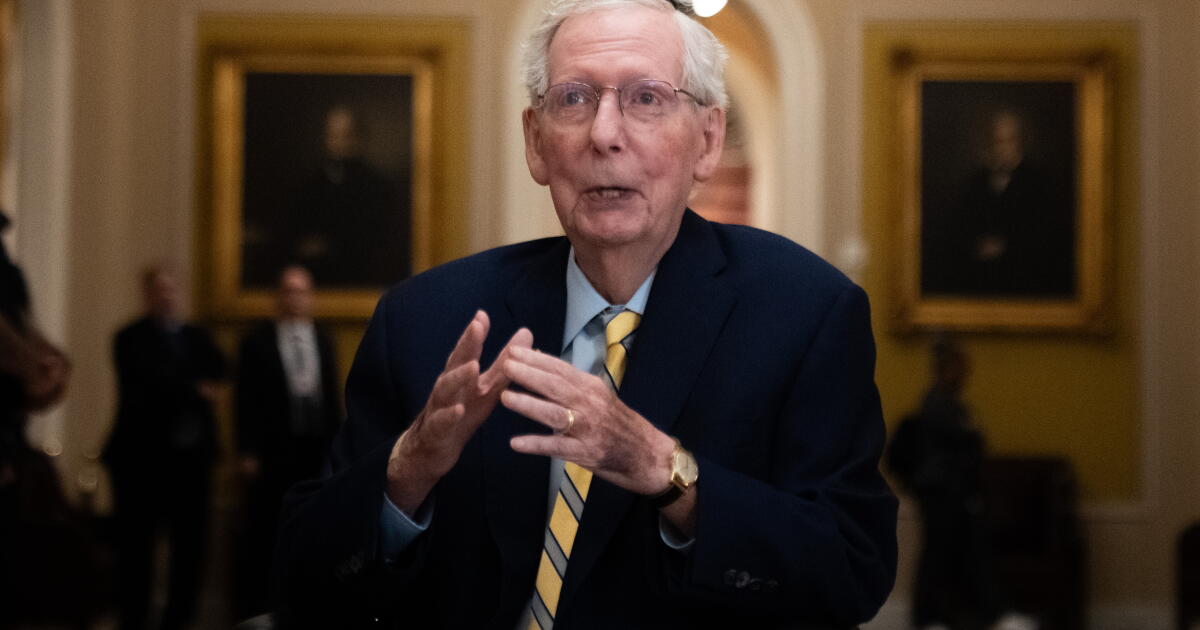
McConnell

What happens if Mitch McConnell is unable to finish his US Senate term? | Politics News

It was a Capitol Hill mystery. For nearly a month, United States Senator Mitch McConnell was not seen or heard from in public.

Little was known about the 84-year-old’s condition, other than that he was hospitalised on June 14. Conspiracy theories began to bubble online. One prominent right-wing influencer, Laura Loomer, even spread rumours that the Republican leader was brain-dead.

Recommended Stories

list of 3 itemsend of list

But after weeks of silence, McConnell confirmed on Sunday that he was on the mend after suffering a fall.

Still, the Kentucky Republican has increasingly appeared frail on Capitol Hill, freezing in front of cameras and walking unsteadily when not in a wheelchair.

Members of Congress are typically on the older side. The average age for a US senator is around 65.

McConnell’s poor health — and the sudden passing of his Senate colleague Lindsey Graham, 71, on Sunday — have reignited the question: What would happen if McConnell were unable to serve the remainder of his term?

The answer is the subject of intense scrutiny, as Republicans seek to preserve their majority in the Senate.

Who is Mitch McConnell?

A seven-term senator from Kentucky, McConnell is the longest-serving party leader in the history of the Senate.

He first entered the Senate in 1985, and in 2007, he became the head of the Republican Party in the chamber, a position he held until 2025.

He continues to serve as a senator, though he is not seeking re-election in November’s midterm elections. His term ends in January.

What is wrong with McConnell’s health?

On Sunday, McConnell said in a statement that a fall on June 14 rendered him “briefly unconscious” and landed him in the hospital. The senator also said he had dealt with a mild case of pneumonia.

But McConnell has long struggled with health and mobility challenges. As a toddler, he survived a severe bout of polio, though it left one of his legs partially paralysed.

McConnell indicated his condition was improving, but that he would not return to the Senate yet.

“With signs of continued progress, I’ve been able to move from hospital care to a rehabilitation center where I’ll keep regaining my strength,” he wrote.

His statement was accompanied by a smiling photo of the senator in a hospital bed, with what appeared to be a copy of Sunday’s Washington Post newspaper.

U.S. Senator Mitch McConnell (R-KY) sits with his wife, former United States secretary of labor Elaine Chao, while holding what appears to be the July 12 sports section of the Washington Post in a photograph released by his office in Washington, D.C., U.S. July 12, 2026. Office of Senator Mitch McConnell/Handout via REUTERS. THIS IMAGE HAS BEEN SUPPLIED BY A THIRD PARTY TPX IMAGES OF THE DAY
Senator Mitch McConnell released this photo of himself and his wife, Elaine Chao, on July 12, amid questions about his health [Handout: Office of Senator Mitch McConnell via Reuters]

Has McConnell been hospitalised before?

This is not the first time the senior senator’s health has been a source of concern in recent years.

As recently as February, the veteran lawmaker was hospitalised for flu-like symptoms.

Also, in 2019, McConnell tripped and fell in his Louisville home, fracturing his shoulder.

According to reporting from the Louisville Courier Journal, he also collapsed three times in 2023, suffering a concussion and a broken rib that ultimately led to him using a wheelchair.

It was during that period that McConnell had several instances where he inexplicably appeared to freeze while speaking in public, prompting questions about his fitness to serve.

Why does his presence in the Senate matter?

Republicans have a controlling majority in the Senate — but only by a few seats.

With McConnell absent, the number of Republicans available to vote shrinks from 53 to 52 in the 100-seat Senate.

That could influence the outcome of divisive bills, when every Republican vote matters.

McConnell’s absence has already helped Democrats pass a resolution against President Donald Trump’s war on Iran, with four Republicans crossing party lines to vote for it.

McConnell also sits on the all-important Senate Appropriations Committee, which helps decide discretionary government spending.

The US government has a looming funding deadline on September 30, and McConnell’s continued hospitalisation could muddle efforts to pass funding measures.

FILE - Sen. Mitch McConnell, R-Ky., right, walks through the Capitol, Jan. 15, 2026, in Washington. (AP Photo/Allison Robbert, File)
Senator Mitch McConnell leans on a colleague’s arm as he walks through the US Capitol on January 15 [Allison Robbert/AP Photo]

What does McConnell’s absence reveal about Republican Party unity?

The Republican majority in the Senate has weakened over time, according to Stephen Voss, a political science professor at the University of Kentucky.

Moderates like Susan Collins and Lisa Murkowski — alongside wild cards like Rand Paul — have shown willingness in the past to join with Democrats during critical votes.

But that small proportion of “swing” Republicans has grown during the midterm primary season.

A number of lame-duck Republicans have lost their re-election bids to party rivals, backed by President Trump. That makes them more willing to buck their party leadership from time to time.

“McConnell’s absence could become inconvenient depending on what sort of policy battles we see in coming months,” said Voss.

What has been the reaction to McConnell’s absence?

News of McConnell’s hospitalisation sent alarm rippling through the US political sphere.

Republican leaders attempted to reassure the public that the senator would soon return to his post. But as the weeks stretched on, questions about McConnell’s condition mounted.

Ultimately, on July 8, Kentucky Governor Andy Beshear sent a letter to McConnell’s office, requesting an update on the senator’s health status.

Beshear has since called McConnell’s written statement on Sunday a “step in the right direction”, but he continues to push for more transparency, suggesting the Republican senator release a video update instead.

Some critics have called on McConnell to step down altogether, questioning his fitness for office. They include Democrat Charles Booker, who is running to succeed McConnell in the midterm elections.

Tres Watson, a Republican strategist and host of the Kentucky Politics Weekly podcast, sees no reason to doubt McConnell’s ability to serve, despite the recent health scares.

“I’ve been around the senator several times in the last year. His brain is functioning fine, his wit is there, his intellect is there, but the body is failing him, and he made the understandable decision not to run for another term,” Watson said.

Kentucky Governor Andy Beshear has pressed Mitch McConnell for a health update
Kentucky Governor Andy Beshear has pressed Mitch McConnell for a health update [File: Charlie Neibergall/AP Photo]

What happens if Mitch McConnell is unable to serve the rest of his term?

If McConnell were to vacate his senate seat before his term ends, it may be tempting for Democrats to think Beshear, the Democratic governor of Kentucky, could appoint someone from his own party.

That’s not the case, however, because of a recent change in state law. Kentucky is now one of four US states where the governor does not have authority to fill Senate vacancies.

In 2024, Kentucky’s Republican-controlled legislature passed a law requiring Senate vacancies to be filled by a special election, which must be called by the governor.

But experts say holding a special election this year would be fraught with challenges, one of which is timing.

The new law says the governor must give 63 days’ notice before the special election. Senate hopefuls would have to file their candidacy no later than 56 days prior to the vote.

Even if McConnell’s Senate seat were vacated immediately, the earliest a special election could occur is September.

But experts say that cobbling together a special election would not make sense, since November’s midterm elections are barely three and a half months away. McConnell’s Senate seat is up for grabs in that race.

“Setting up the process would take time, so we wouldn’t get a senator in office very quickly, even if this process kicked off soon,” said Voss, the political science professor. “The probability that we’d get a replacement ahead of time is pretty low.”

Watson, the Republican strategist, agrees. He questions the efficiency of rushing to hold a special election, when the midterms are on November 3.

“We’re getting pretty close to Election Day,” Watson said. “They’re not going to put the commonwealth through the expense of having another special election just so someone could be a US senator for effectively one month.”

Representative Andy Barr is running as the Republican nominee to succeed Mitch McConnell in November’s midterm elections
Representative Andy Barr is running as the Republican nominee to succeed Mitch McConnell in November’s midterm elections [File: Jon Cherry/AP Photo]

Could there be challenges to filling McConnell’s seat?

Yes, a significant challenge could be litigation. Kentucky’s 2024 law is largely untested, and it would almost certainly attract legal challenges.

“I think there’s a decent chance the issue could end up in the courts,” said Joshua Douglas, a University of Kentucky law professor who teaches election law.

Douglas believes there may be a contradiction between the new law and parts of the Kentucky Constitution.

“The 17th Amendment says the legislature may authorise the governor to appoint a temporary replacement, Section 152 of the Kentucky Constitution says the governor appoints one, and the Kentucky legislature now says there must be a special election after the new law,” Douglas said.

Voss explained that the legal challenges could delay any special election to fill McConnell’s seat.

“This is the sort of thing that lawyers know how to tie up in litigation,” Voss said. “There would be people involved who know how to slow walk the process.”

14-month-old Justice Booker looks on as her father, Kentucky Democratic candidate for Senate Charles Booker casts his early vote in the midterm election in Louisville, Ky., Thursday, Nov. 3, 2022. (AP Photo/Timothy D. Easley)
Kentucky Democrat Charles Booker is racing against Republican Andy Barr in November for Mitch McConnell’s open Senate seat [File: Timothy D Easley/AP Photo]

Why can’t the governor pick McConnell’s replacement?

The 2024 law stripped the governor’s authority to select a temporary replacement for a US Senate seat.

Governor Beshear vetoed the bill, but the state legislature, which has a Republican supermajority, overrode his opposition.

The measure is part of a broader strategy of Republican lawmakers to shift powers away from the governor since Beshear’s election in 2019.

“We’ve seen an overall attempt by the Kentucky General Assembly to shift power from the executive to the legislative branch,” Voss said.

But the 2024 law was not the legislature’s first attempt at limiting the governor’s ability to fill Senate vacancies.

Initially, in 2021, Republican lawmakers passed a bill that required the governor to choose a temporary replacement from a list of three provided by the executive committee of the former senator’s party. After filling the vacancy, a special election would be held.

According to Watson, Republicans passed a new version because they were concerned about legal challenges to the 2021 law.

Republicans in the state argue that the 2024 update is more democratic and aligns with the process for filling other vacancies.

Beshear is the only Democrat to hold a statewide office in Kentucky. The state has not elected a Democrat to the US Senate since 1992.

Who is running to replace McConnell in the midterms?

In the general election, Democrat Charles Booker, a former state legislator, is running against Republican Representative Andy Barr to succeed McConnell.

Source link

After Lindsey Graham’s death, questions linger about aging politicians and health transparency

The sudden death of Sen. Lindsey Graham, a top ally of President Trump and one of Washington’s best-known politicians, is renewing focus on the country’s aging lawmakers.

Graham, a South Carolina Republican who had turned 71 just two days before dying on Saturday, was far younger than many of his Senate colleagues and appeared to have been in good health. He suffered a tear in his aorta, according to a preliminary report from the medical examiner.

It was the second time in less than a month that emergency personnel were dispatched to the home of a U.S. senator. In early June, Mitch McConnell of Kentucky, the former Republican Senate leader, was hospitalized for undisclosed reasons.

After weeks of increasingly dire speculation about his health, he finally revealed on Sunday that he had fallen and suffered from mild pneumonia. He released a photo, complete with a copy of the day’s newspaper.

Graham’s death and McConnell’s hospitalization have come amid an ongoing reckoning about the nation’s aging leaders, two years after the disastrous presidential debate that sparked widespread panic among Democrats about then-81-year-old President Biden’s capacities and accusations of a cover-up.

Some politicians have continued to obscure details about their health challenges, asking for privacy despite their public positions, and fueling conspiracy theories.

“I think we need some transparency,” Sen. John Cornyn (R-Texas) said Monday. “I wish Sen. McConnell and his team would have done that earlier. I think it would have resolved a lot of questions.”

McConnell is admitted to a hospital

McConnell, who at 84 is only the third-oldest member of the Senate, was admitted to the hospital on June 14 with barely any explanation. Aides said he was “receiving excellent care” but offered no details about his condition.

The dearth of information fueled a wave of speculation about his prognosis, with Laura Loomer, a Trump ally and conspiracy theorist, claiming on social media that a “high level source close to the White House” had told her he was “officially brain dead.”

But McConnell, who will retire from Congress at the end of January after serving as the longest-ever Senate leader, said in a statement that he is on the mend. He said a fall had led to his hospitalization and that he was “briefly unconscious” and treated for mild pneumonia.

“You all know how folks of my generation often hesitate to share the vulnerability that comes with growing older,” he said. “Even in the public eye, I feel that same instinct — I can’t help it.”

That wasn’t enough to put speculation to rest. On social media, many refused to believe the veracity of a photo his office released that included the front page of the sports section of the Washington Post.

Conspiracy theories about McConnell’s health are “a symptom of our times,” said Sen. Rand Paul, a Republican who is also from McConnell’s home state of Kentucky. Paul said people should “give him a break.”

“People think they have a right to know everyone’s medical problems,” he said, “but I don’t know, where does it begin and where does it end?”

Trump’s medical reports offer limited details

The oldest person ever elected president, at age 78, has long offered only the rosiest picture of his health.

“Everything checked out PERFECTLY,” he boasted after his last physical in May, adding that he took yet another cognitive test aimed at detecting early dementia and has “aced them all.”

His past medical reports have been criticized for offering limited detail and including statistics that some health professionals have viewed with skepticism.

When he first ran for president in 2016, Trump declined to release his health records, breaking with longtime precedent. He instead offered a four-paragraph note from his doctor declaring that he would be “the healthiest individual ever elected to the presidency.” Rep. Ronny Jackson (R-Texas), White House doctor during Trump’s first term, later drew headlines when he extolled the president’s “incredibly good genes.”

When he was infected with COVID-19 in the midst of his 2020 reelection campaign, Trump’s doctors and aides withheld key details of his treatment and tried to downplay the severity of his illness.

And after an attempted assassination at a Pennsylvania rally, Trump aides kept the public in the dark for days, declining to discuss the extent of his injuries or release medical records after assuring he was “fine.”

Kean Jr. goes absent for months

The obfuscation extends beyond the septuagenarian and octogenarian set. New Jersey Republican Rep. Tom Kean Jr. spent four months missing without explanation before he finally disclosed late last month that he had been in treatment for depression.

He said in a brief floor speech after his return that he had remained silent about his condition because he is a “private person by nature.”

He won an uncontested primary during his absence, despite missing more than 100 votes in the House, and is running for reelection.

The approach stood in contrast to Sen. John Fetterman, a Pennsylvania Democrat, who disclosed his hospitalization for clinical depression the day after he was admitted to Walter Reed National Military Medical Center for treatment. He also suffered a stroke while running for office.

Biden’s stumbles doom his reelection effort

Biden’s halting gait, frail appearance and frequent verbal stumbles eventually doomed his 2024 reelection campaign. After a debate in which he frequently lost his train of thought, he chose to withdraw from the race, sparking an unprecedented swap at the top of the Democratic ticket that ultimately paved the way for Trump’s return to office.

Many others have refused to retire. California Sen. Dianne Feinstein, a Democrat, died in office in 2023 at the age of 90, after years of declining health, including a bout of shingles. Though she returned to the Senate after her illness, she appeared frail and confused at times. It was later revealed that her office had failed to disclose in real time that she had contracted encephalitis while recovering.

Longtime Republican Rep. Kay Granger of Texas spent the final months of her more than two decades in Congress, when she was in her early 80s, suffering from what her office called “unforeseen health challenges” that made travel to Washington difficult.

Eleanor Holmes Norton, 89, the longtime House delegate for the District of Columbia, announced earlier this year that she would not run for reelection amid questions about her competency.

Colvin writes for the Associated Press. AP writers Mary Clare Jalonick and Lisa Mascaro in Washington contributed to this report.

Source link

McConnell says a fall led to his hospitalization

Sen. Mitch McConnell on Sunday revealed for the first time that a fall led to his hospitalization, breaking the silence about his condition after weeks of speculation about the Kentucky Republican’s health.

McConnell, 84, said in a statement that he has undergone a battery of tests as doctors try to determine what led to his fall. He explained the long silence about his condition by saying that “folks of my generation often hesitate to share the vulnerability that comes with growing older.”

“Even in the public eye, I feel that same instinct — I can’t help it,” he said.

McConnell said he is now in a rehabilitation center and will not be returning to the Senate “quite yet.” He said he continues to work with his staff on Senate business in the meantime.

The statement included a smiling picture of the senator with his wife, Elaine Chao, a tacit response to speculation online that McConnell had died or was incapacitated.

It comes following his hospitalization on June 14. McConnell’s office for weeks provided little information, saying only that he was “receiving excellent care” and recovering.

As his hospital stay grew longer, speculation about his condition became so intense that Kentucky Gov. Andy Beshear, a Democrat, took the extraordinary step of asking that McConnell update the public about his health in a “transparent manner.”

Source link

Kentucky Gov. Andy Beshear asks Sen. Mitch McConnell to give a public update on his condition

Kentucky Gov. Andy Beshear is directly asking Sen. Mitch McConnell, the state’s most powerful figure in Congress, to disclose more about his condition after three weeks of silence from the 84-year-old since he was hospitalized in Washington.

The letter released Wednesday from Beshear, a Democrat who is considered a potential presidential candidate in 2028, to the former Senate Republican leader says “Kentuckians have grown increasingly concerned about the current state of your health and well-being, and ability to hold office.”

McConnell, whose physical condition has visibly declined in recent years, was hospitalized June 14. He has not released a public statement, photos or videos since. Aides have disclosed nothing specific about his condition, other than to say last week that McConnell “continues to improve, and is working closely with his staff on Kentucky and Senate matters while the Senate is out of session.”

That lack of detail has fueled rampant speculation about his prognosis and whether he will return to the Senate when it reconvenes next week. The firestorm was enough that Republican Senate leaders made public statements Tuesday saying they had talked to McConnell and that he was alert and discussing current events.

McConnell is retiring at the end of his term in January, and the campaign to elect his successor already is underway. Kentucky’s Senate succession law, which Republican legislators have twice changed during Beshear’s tenure, does not give the governor a role in picking a temporary successor should McConnell’s seat become vacant before his term ends.

Under the latest change in 2024, Beshear would call a special election if the seat became vacant. The winner of that election could take office after the result is certified. The general election winner would be sworn in as part of the new Congress in January. But there are unresolved questions about the timing of a special election under the untested law, and the seat could remain vacant until January.

Beshear ended the letter by wishing McConnell “a safe and speedy recovery.”

A look at what an absence from the Senate or a vacancy could mean.

What happens if McConnell isn’t able to return?

There is not much, if anything, that Beshear, Kentucky lawmakers or the Senate could do if McConnell remains in office but is unable to perform his duties between now and when the current Congress expires in January.

Senate rules do not allow proxy voting. But there have been extended Senate absences before, and the chamber has continued its business with however many senators are in attendance. Republicans currently hold a 53-47 advantage. Without McConnell, that means a maximum of 52 Republican votes are available.

McConnell had been among the senators blocking war powers resolutions that seek to limit President Trump’s military options in Iran. Without him, the administration has less of a buffer. On the other hand, McConnell had already been among the Republicans refusing to support Trump’s sweeping elections law overhaul.

Why wouldn’t Beshear have a say in filling any vacancy?

The 17th Amendment to the U.S. Constitution calls for Senate vacancies to be filled by popular elections. But it allows state legislatures to empower governors to appoint an interim senator to serve through those campaigns. Most states have taken this option, according to the Congressional Research Service.

Kentucky law allowed interim appointments until 2021, when McConnell and other state GOP leaders persuaded the Republican-run Legislature to make a change. They did not want Beshear to shift the partisan balance in Washington if he got the opportunity. They called for a committee of the previous senator’s state party to select three people from whom the governor could choose an interim senator. In this case, that would mean Beshear picking which Republican would fill a vacancy. Several states have this system.

Kentucky lawmakers changed the law again in 2024 to require a special election. The only role for the governor is to call that election.

Beshear vetoed the 2021 and 2024 changes, but Republican lawmakers overrode him.

How would a special election work?

The 2024 law says Beshear “shall” issue a proclamation for a special vote but it does not say when he should make that proclamation or what the election date must be. Separate laws require certain minimum windows between a proclamation and the election date, but not necessarily a maximum window.

Some officials have argued that any vacancy after Aug. 3 would mean a special election concurrent with the general. They have even speculated that at some point, it would be impractical to have a special election at all given the regular election already taking place.

The Kentucky secretary of state’s office declined to speculate on a hypothetical time frame.

If a special election was needed, the simplest option would be to hold it at the same time as the regular general election.

For the full Senate term that begins in 2027, Republicans nominated U.S. Rep. Andy Barr, and the Democratic nominee is former state lawmaker Charles Booker. Concurrent elections would be separate, requiring new nominations by the parties, though they could choose Barr and Booker. Regardless, in this scenario, voters would be electing the immediate replacement and the full-term lawmaker on the same Election Day.

Multiple vacant House seats have been filled that way with little national attention.

Yes. The 2024 law has never been tested. If a vacancy occurred, there could be different interests between parties and even among Republicans about special election timing and whether to hold one at all. That could create any number of legal questions and disputes that have to be settled by the courts.

Beshear’s office did not immediately respond to an inquiry about how he interprets the law.

Barrow writes for the Associated Press.

Source link

McConnell speaks to Republican leaders as speculation swirls about his health

The Senate’s top two Republicans have spoken individually to Kentucky Sen. Mitch McConnell, according to aides, as the former GOP leader remains in the hospital more than three weeks after being admitted for undisclosed health issues.

Aides to McConnell have declined to release any information about his condition, fueling speculation about his prognosis and whether he will be healthy enough to be at the Capitol when the Senate returns to Washington next week after a two-week recess. McConnell, 84, is retiring at the end of his term next January.

A spokesperson for Senate Majority Leader John Thune (R-S.D.) said he had spoken with McConnell by phone on Monday and that the two had a “lengthy and substantive conversation that covered a variety of topics, including national security.” As leader, Thune is generally kept up to date on illnesses and absences in his conference as he has to navigate vote counts and his narrow 53-47 majority.

Wyoming Sen. John Barrasso, the No. 2 Senate Republican, had a 20-minute conversation with McConnell on Tuesday, according to a spokeswoman. The two discussed Senate races ahead of the midterm elections, the Supreme Court and other topics, the statement said.

“Senator McConnell was fully engaged and is eager to get back to the Senate,” said Barrasso spokeswoman Kate Noyes.

Another McConnell ally, Republican strategist Scott Jennings, posted on X that he had also talked to McConnell for 20 minutes on Tuesday, and that “he’s still recovering in the hospital.” Jennings said they spoke about politics, foreign policy “and even a little bit of Senate history.”

Few details released as McConnell remains in the hospital

McConnell was admitted to the hospital June 14, according to a statement from his office that only said he was “receiving excellent care.”

A statement a week later said he would not be voting that week. And a new statement Thursday said he ”appreciates the outpouring of support he’s receiving while he continues his recovery in the hospital.”

“The Senator continues to improve, and is working closely with his staff on Kentucky and Senate matters while the Senate is out of session,” the statement said.

A spokesman for McConnell released the same statement again Tuesday with no new updates.

McConnell has a history of health troubles

The senator’s unspecified health issues come after several hospitalizations in recent years.

While he was still Republican leader, McConnell was hospitalized with a concussion in March 2023 and missed several weeks of work after falling in a Washington hotel. He froze up twice during news conferences after he returned, staring vacantly ahead before colleagues and staff — including Barrasso, who is a doctor — came to his assistance.

A year later, he fell and sprained his wrist while walking out of a GOP luncheon.

McConnell had polio in his early childhood and he has long acknowledged some difficulty as an adult in walking and climbing stairs. He also tripped and fell in 2019 at his home in Kentucky and underwent surgery for a fractured shoulder.

The Kentucky senator was first elected to the Senate in 1984 and was the Republican leader from 2007 until last year, serving as both majority and minority leader during that period. He has remained active as a rank-and-file senator, showing up for work when the chamber is in session, often using a wheelchair to get around.

Jalonick writes for the Associated Press.

Source link

Former Senate leader Mitch McConnell hospitalized, but few details are known

Republican Sen. Mitch McConnell of Kentucky was admitted to a hospital Sunday, his spokesperson said, but there was no immediate information about why he was there or his prognosis.

McConnell, 84, was the longest-serving Senate leader in history before stepping aside from that role while finishing his final term, which ends in January.

“Senator McConnell was admitted to the hospital this morning. He is receiving excellent care,” spokesperson David Popp said in a statement without elaboration. It was not immediately clear whether McConnell was in Washington, Kentucky or elsewhere.

McConnell’s health has been a subject of scrutiny for years.

He fell and sprained his wrist while walking out of a GOP luncheon in December 2024. He was hospitalized with a concussion in March 2023 and missed several weeks of work after falling in a Washington hotel. After he returned, he twice froze up during news conferences that summer, staring vacantly ahead before colleagues and staff came to his assistance.

McConnell had polio in his early childhood, and he has long acknowledged some difficulty as an adult in walking and climbing stairs. In addition to his 2023 fall, he tripped and fell in 2019 at his home in Kentucky. He had surgery for a fractured shoulder.

McConnell was first elected to the Senate in 1984 and was the Republican leader from 2007 until 2025, serving as both majority and minority leader during that period.

He remains active in the Senate, showing up for work when the chamber is in session, and recently chairing public hearings and grilling officials from his perch as chair of the Senate appropriations subcommittee on defense. He has intermittently used a wheelchair to navigate the Capitol and is routinely accompanied by his security detail, as a former congressional leader.

Source link