mayors

In L.A. mayor’s race, everyone is campaigning on change — even the incumbent

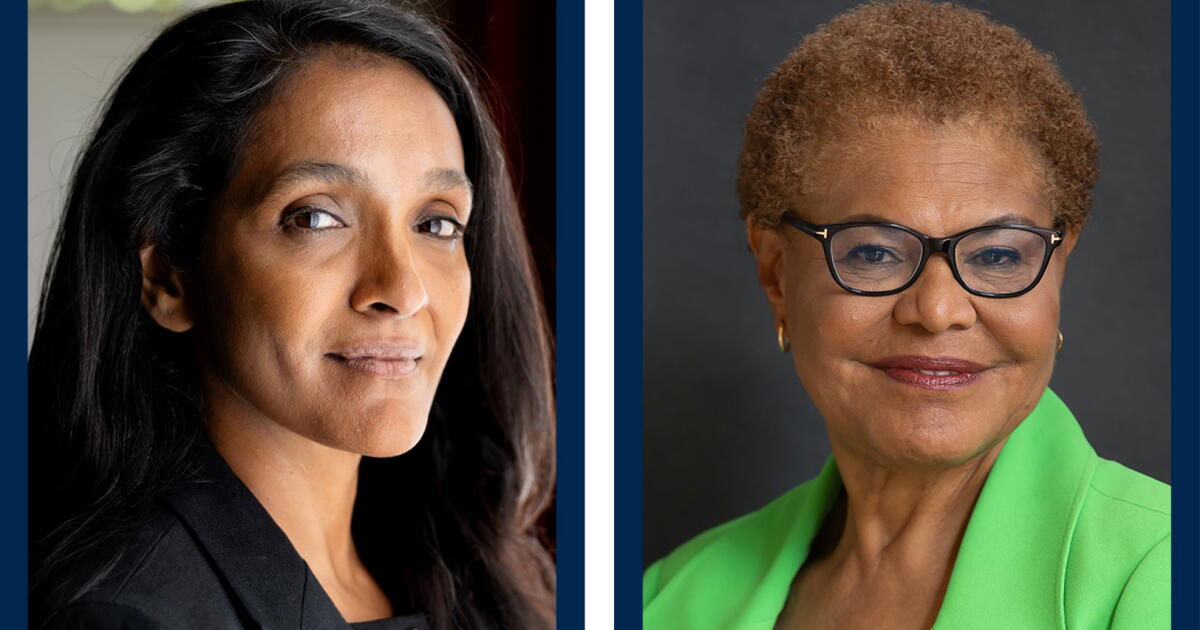
Mayor Karen Bass has had a lengthy political career, spending six years in the state Legislature, 12 years in Congress and the last three in the top elected office at Los Angeles City Hall.

Now, facing the toughest reelection battle of her career, Bass is marketing herself in a way that might surprise some Angelenos: She’s running as a champion of change.

And she’s not alone.

City Councilmember Nithya Raman, who has represented a Hollywood Hills district since 2020, says her last-minute decision to enter the race was fueled by “a sense of urgency that things needed to change.”

Three other major candidates, all political newcomers, argue that an outsider is needed to shake up the status quo.

“We can no longer keep our city together with duct tape and slurry,” said Rae Huang, a leftist community organizer, at a recent candidate forum on housing and transportation.

The race to embrace the mantle of change in the June 2 primary election comes at a moment of political peril for Bass, a veteran Democrat who has racked up high disapproval numbers in several voter surveys.

In recent months, Bass has revamped her messaging, saying she’s been tackling problems that have “been around for multiple decades,” such as homelessness, sluggish police hiring and trash-strewn streets.

Last week, speaking to the Pacific Palisades Democratic Club, Bass said she wants another four years to finish that work. She also implied that, in her zeal to fix the city’s problems, she quietly pushed out a dozen high-level bureaucrats, including those who dealt with trash pickup and police recruitment.

“Let me just tell you that in three years and three months, it is difficult to change what has been a practice for over four decades,” Bass told the group. “I am very clear that there needs to be massive change, and I’ve done a lot of change.”

Raman has portrayed herself as someone who shook up the system while in office, securing a 4% cap on rent increases for more than 600,000 apartments and opposing initiatives she viewed as “disastrous” for the city’s budget. She said the city is falling short on an array of issues, including traffic deaths and housing affordability.

“So much of what’s happening in L.A., our inability to address our biggest crises — our housing crisis, our homelessness crisis, but also essential services like lights and potholes — so much of this has resulted from a lack of clear urgency in decision-making at City Hall,” said Raman, the first L.A. council member to win office with the backing of the Democratic Socialists of America.

Those types of arguments have elicited salty responses from Huang, tech entrepreneur Adam Miller and conservative reality TV personality Spencer Pratt.

Miller, who described himself as a lifelong Democrat, pointed out that Raman runs the powerful five-member council committee on housing and homelessness. He argued that both she and Bass have failed on those issues, as well as on public safety and much needed infrastructure repairs.

“These are the people who have been running the government,” said Miller, who made a fortune developing education software. “So I don’t understand how they could describe themselves as change-makers. They’re the ones who have been the problem.”

Pratt offered a similar take on social media, calling Raman and Bass “two peas in a pod,” while portraying himself as a change agent.

“I’m a wrecking ball to the status quo,” he said in one post.

Neither Pratt nor his representative responded to an interview request.

In one recent high-profile poll, about 56% of respondents said they had an unfavorable view of Bass. In another, about 40% of those surveyed said they had not yet made up their minds about who should lead the city.

“It’s clear that there are concerns among voters about the direction of the city — and the state, quite frankly,” said Pomona College politics professor Sara Sadhwani, referring to the race for governor. “In both instances, there are lackluster candidates, and so we see voters being very much undecided in both of these incredibly consequential races.”

The election season got underway a little more than a year after the Palisades fire, which destroyed thousands of homes and left 12 people dead.

Bass, who was out of the country when the fire broke out, was unsteady in her early public appearances and, since then, has faced sharp criticism over the pace of the rebuilding. She has defended her record on the recovery, saying she cut red tape and suspended city permit fees, while also pressing the Trump administration to crack down on insurance companies that fail to compensate wildfire survivors.

The back-and-forth over change and the status quo broke to the surface during last month’s housing forum in downtown L.A.

At one point, Raman voiced alarm over the city’s elevated “people mover” being built at Los Angeles International Airport, saying it is so far behind schedule that it won’t be ready before the World Cup, which starts in June.

Raman said that as mayor, she would ensure that such projects are finished on time — and replace airport leadership if it fails to happen.

“Nithya, you’ve been on City Council for six years, though,” Huang shot back. “Why have you not moved this forward?”

(At five years and four months, Raman’s tenure is slightly less than that.)

Raman countered that, as a council member, she only has control over certain issues.

“So much of what’s going wrong in Los Angeles requires the mayor to get involved,” she said.

Bass did not attend the forum, traveling instead to New Orleans for a reelection fundraiser. Pratt also skipped. In their absence, the three remaining candidates pounded on a wide array of municipal ills, including broken sidewalks, high rents and sluggish housing production.

Raman, at that event and elsewhere, has sought to differentiate herself from Bass, and City Hall more broadly, by highlighting her dissenting votes.

In 2023, Raman opposed a package of police pay increases negotiated by Bass, saying they were too expensive and would deprive other city departments of funding. Last year, she voted against a $2.6-billion upgrade of the Convention Center, citing similar long-term cost concerns.

Bass, for her part, said she’s been shifting the direction of the city in critical ways. Previous city leaders were too hesitant to build temporary housing for homeless people, she said, leaving them to languish on sidewalks while waiting for government-funded apartments to be built.

After taking office in 2022, Bass declared a local emergency on homelessness and launched her Inside Safe initiative, which has put thousands of people into hotels and motels. Raman signed off on the emergency and the funding for Inside Safe but now says the program is too expensive.

The mayor said she also pushed for changes in LAPD hiring, not just by making officers’ salaries more competitive, but by hacking away at a slow and bureaucratic recruitment process. Speaking to the Palisades Democrats, Bass said she got that done, in part, by changing the leadership and staff at the city’s personnel department.

Bass told the group she’s preparing to launch an initiative to clean up the city’s streets — and that she made a personnel move in that regard as well.

“In terms of cleanliness, I’ve had to change the leadership of the Department of Sanitation, because I couldn’t get the job done,” she said.

Sadhwani, the Pomona College professor, said she doubts that voters will view Bass as a reform candidate. Raman, she argued, is also part of the establishment.

“They cannot run from the fact that they have been in power,” she said.

Source link

Under L.A. mayor’s $300-million homeless program, 40% have returned to the street

It was a risky move and Jonathan Torres knew it, but he did it anyway. He let an out-of-town guest stay with him in his room.

Torres, 40, had been living at the Highland Park Motel as part of Inside Safe, Mayor Karen Bass’ flagship program to combat homelessness. He and his neighbors, many of them from a downtown encampment, were told that visitors were not allowed.

Still, Torres kept having people over. After the third violation, he said, the facility kicked him out.

Jonathan Torres spent about two years living in a city-leased motel in Highland Park.

Jonathan Torres spent about two years in a city-leased motel in Highland Park. He told The Times he was kicked out of the facility in December.

(Myung J. Chun / Los Angeles Times)

“It’s nobody’s fault but my own, but I just feel it’s unfair,” said Torres, who now lives in a tent in Chinatown. “In the real world, you’re allowed to have people come over. You have visitors. That’s part of keeping your sanity, you know?”

Los Angeles has spent more than $300 million on Inside Safe since Bass launched the program in December 2022, clearing scores of homeless encampments and moving about 5,800 people into interim housing — mostly hotels and motels. The goal was to get each of those people into permanent housing, typically taxpayer-funded apartments.

But even as the mayor’s initiative brings more people indoors, a growing number are winding up back on the street.

About This Story

The Times’ reporting on Mayor Karen Bass’ Inside Safe program was undertaken as part of the USC Annenberg Center for Health Journalism’s 2025 Data Fellowship.

The longer the program exists, the greater the share of participants who have returned to “unsheltered” homelessness, according to monthly dashboards which were posted by the Los Angeles Homeless Services Authority, or LAHSA, and analyzed by The Times.

Jeremiah Flores packs up his belongings for interim housing through the Inside Safe Program in North Hollywood.

Jeremiah Flores, center, packs up his belongings during an Inside Safe operation in North Hollywood last month.

In 2023, at the program’s one-year mark, nearly 20% had returned to the street, according to numbers posted by LAHSA at the time.

Halfway into Bass’ four-year term, the figure had climbed above 30%.

In December, as the program finished its third year, about 40% of the people who had gone indoors — 2,300 of the 5,800 — were back on the street, according to LAHSA’s dashboard. That includes people who were kicked out of their housing or disappeared from the system altogether.

The growing exodus reflects the challenges Bass faces while trying to help some of the city’s neediest residents, many of whom struggle with mental health conditions, substance use issues or major physical ailments.

Los Angeles sanitation workers clean a homeless encampment along Hollywood Boulevard in 2024.

Workers with Mayor Karen Bass’ Inside Safe program clean up a homeless encampment along Hollywood Boulevard in 2024.

(Brian van der Brug / Los Angeles Times)

Bass, asked about the worrisome trend, said she believes that Inside Safe participants need more services to address those issues. She also said she suspects that the longer people stay, the more likely they are to violate the rules and face expulsion.

The goal of Inside Safe is to find permanent homes within 90 days, with a maximum stay of six months, according to the written agreement issued by the city to each participant.

At this point, the average stay is 362 days — just shy of a year, according to recent LAHSA figures.

Bass did not offer any definitive conclusions, saying the city now has outside researchers assessing the problem.

“It’s critically important that we look at the people who left, why they left [and] what do we need to do strengthen the interim housing that we have,” she said. “I have my opinions about it, but the opinions have to be based in science.”

Bass has staked much of her reelection campaign on her handling of the homelessness crisis, which she made a top priority as soon as she took office. She credits Inside Safe with producing a 17.5% drop in “unsheltered homelessness” — people living outdoors or in their vehicles — over a two-year span. That number fell from about 33,000 to nearly 27,000, according to the most recent homeless count.

Los Angeles Mayor Karen Bass prepares to leave a large homeless encampment in Van Nuys.

Los Angeles Mayor Karen Bass prepares to leave a homeless encampment along the San Diego (405) Freeway in Van Nuys targeted by Inside Safe in July. “The homeless should never be living in these conditions,” she said.

By clearing encampments, Inside Safe also benefits the surrounding community, making sidewalks more accessible and reducing the number of encampment fires, Bass said.

UCLA Law School professor emeritus Gary Blasi, an expert on homelessness, said the program has become too expensive to justify the results — and is in need of “a thorough re-engineering.”

Blasi said there were never enough vouchers and low-cost apartments to provide permanent housing to Inside Safe participants in a timely way. As a result, the city has been paying for them to live in expensive motel rooms for long stretches, he said.

“Once they started having people in interim housing for nine months or a year, that should have rang some alarm bells, because that’s just not sustainable,” he said.

July 2025 image of an officer walking through a large homeless encampment in Van Nuys.

Last summer, the Inside Safe program cleared away a large homeless encampment next to the San Diego Freeway in Van Nuys. Some residents went to the Budget Inn in North Hills.

Inside Safe participants also face a wide array of rules. They are barred from leaving the premises for three consecutive days without prior approval. Alcohol and illegal drugs are prohibited in their rooms, which are inspected multiple times a day.

Participants also are frequently barred from bringing in outside food, to keep from attracting roaches, mice and other pests.

“The rules are dumb. They treat houseless people like children. They don’t give people agency,” said Paisley Mares, who lives in an RV in the San Fernando Valley and has several friends who took part in the program.

Executives with the nonprofit groups that run the Inside Safe facilities said the restrictions are needed to protect residents, keeping them on track to find permanent housing.

Violence, threats of violence and property damage are prohibited, and can result in immediate removal from the program. The ban on guests is designed to prevent people from being physically attacked, sexually assaulted or engaging in high-risk behavior, such as drug use, behind closed doors, those nonprofit leaders said.

“We are bringing people indoors, mostly from encampments, where drugs are often the trade of the street. There is also often physical violence. That’s the way people survive on the streets,” said John Maceri, chief executive officer of the nonprofit the People Concern, which runs two Inside Safe motels in Hollywood. “All of those behaviors don’t stop when people come into an Inside Safe setting.”

Executives at the People Concern estimate that 50% to 65% of the shelter clients they work with — not just for Inside Safe, but other homeless housing programs — have serious issues with drugs or alcohol. The number with serious mental health issues, particularly trauma, is also “very high,” they said.

Inside Safe providers acknowledged that motel rooms can be a huge adjustment, leaving people feeling lonely and isolated. They said they work closely with participants to improve their behavior — and turn to expulsion only as a last resort.

“My goal is never to exit anyone to the streets,” said Joseph Bradford III, chief executive officer of BARE Truth, which runs two Inside Safe motels on the Eastside. “I want to keep people inside until they find permanent housing.”

By now, Inside Safe operations are a well-oiled machine. Sanitation trucks roll up to encampments. Traffic officers cordon off the sidewalk with yellow tape. Encampment residents lug their bags onto a bus and head to their destinations.

Robert Martinez, 40, moved to a Budget Inn in North Hills last summer from an encampment near the 405 Freeway. He had been homeless for about five years and jobless even longer, he said.

Martinez, who used to work at a water filtration company, said the Inside Safe motel was better than the street. Still, he chafed at the rules. He wanted his children to visit, which was not permitted.

In November, after learning that a beloved uncle had died, Martinez left the motel for several days — and didn’t “want to be around anybody.”

When he returned, he said, program staffers informed him he’d been away more than 72 hours and would have to leave.

“I had 30 minutes to get my stuff,” said Martinez, who has been living on a sidewalk in Van Nuys.

Erica Y. Pena, left and Jose Monteon are pictured at a homeless encampment in Van Nuys.

Erica Y. Pena, left, and Jose Monteon at a homeless encampment in Van Nuys. Monteon told The Times he spent about two months in an Inside Safe motel last year.

(David Butow / For The Times)

Jose Monteon, 29, moved into the same motel as part of the same Inside Safe operation. He said he was kicked out two months later, after program managers accused him of fighting and making threats.

Monteon, who has spent some nights sleeping his car, denied getting physical. But he admitted expressing frustration over the theft of his bicycle and other possessions.

“Yes, I said some s—. But I never said it to a specific person,” he said. “I said ‘Whoever I find out is taking my s—, I’m going to stab their b— ass.’”

Monteon corrected himself. “My bad — poke. I didn’t say stab, I said poke.”

Ken Craft, whose nonprofit supervises the Budget Inn, declined to discuss specific cases. But he said his staff gives Inside Safe participants three chances — unless they have engaged in threats or violence — and tries to find another place for them to go.

“We’re trying to end homelessness, not have people recycle back to homelessness,” he said.

Even with its challenges, Inside Safe has been gradually moving a greater percentage of its residents into permanent housing, where they are no longer governed by such a wide array of rules.

In December, about one out of every four people who participated in Inside Safe since its inception was in permanent housing, according to that month’s LAHSA dashboard. Two years earlier, that figure was about 15%.

Once the program’s hotels, motels and other temporary lodging are factored in, about 55% were in some form of housing.

Bass said those facilities are a vast improvement over the street, providing bathrooms, heating, air conditioning, hot showers, three meals a day and doors that lock. The program is one of several reasons why Los Angeles County officials reported a double-digit reduction in the homeless mortality rate in 2024, she said.

“The value of the interim housing, number one, is to save lives,” Bass said.

Torres, the Inside Safe participant now in a tent in Chinatown, experienced the difference. He entered the program with a history of gastrointestinal issues and abdominal surgeries.

Jonathan Torres walks his dog in Highland Park in November. At the time, he was living in an Inside Safe motel.

Jonathan Torres walks his dog in November. At the time, he was living in an Inside Safe motel in Highland Park.

(Myung J. Chun / Los Angeles Times)

“The whole time I had my housing, not once did I get sick or have to be hospitalized,” said Torres, who grew up in Redlands and Baldwin Park.

Torres said he was in the program for nearly two years. The longer he stayed, the more frustrated he grew over the wait for permanent housing.

In November, Torres told The Times he had received a notice stating that he had violated the motel’s prohibition on guests and was in danger of being expelled.

By then, he was worried about his health and his dog Waku, a Belgian Malinois/Akita mix. (The program allows “emotional support” animals.)

First To Serve, the nonprofit that supervises the hotel, did not respond to inquiries from The Times.

Even after the written notice, Torres struggled to comply with the rules. He said he allowed a woman from out of state to stay in his room for more than a week during last year’s rains.

The day after Christmas, he was back on the street.

In February, his dog was struck and killed by a car. Days later, sanitation workers cleared the encampment where he’d been living. Soon afterward, he was in the hospital, receiving treatment for a blockage in his bowels.

He eventually returned to Chinatown, setting up another tent. He’s been using meth, saying it helps with his medical issues.

For now, Torres has found some of the companionship he craved. In recent days, he’s been sharing his tent with his new girlfriend.

Source link

In L.A. mayor’s race, controversial poll shows Nithya Raman ahead of Karen Bass

City Councilmember Nithya Raman came out ahead of incumbent Karen Bass in a new poll on the Los Angeles mayor’s race, though the poll’s director cautioned that it did not give the whole picture.

Raman had a commanding lead in a field of five major candidates, with 33% of voters supporting her, while Bass trailed at 17%, according to the poll by the Loyola Marymount University Center for the Study of Los Angeles.

Leftist Rae Huang came in just behind Bass at nearly 17%, while tech executive Adam Miller had 13% and conservative reality TV star Spencer Pratt had 12%.

Other polls have shown Bass in first place.

She was at 20% in an Emerson College Polling/Inside California Politics poll, with Raman at just over 9%. In a UC Berkeley Institute of Governmental Studies poll, co-sponsored by The Times, Bass was at 25% and Raman at 17%.

In the Loyola Marymount poll, unlike the other polls, respondents were given brief descriptions of the candidates, including their occupations and political priorities.

Raman was labeled a “progressive LA City Councilmember focused on housing affordability, homelessness and systemic reform,” while Bass was “incumbent mayor of Los Angeles, veteran legislator, focused on homelessness.”

One of Raman’s challenges, as a councilmember representing Los Feliz and Silver Lake as well as parts of the San Fernando Valley, is to spread her name recognition citywide, with the June 2 primary election about two months away. She entered the race to challenge Bass, her one-time ally, at the last minute, hours before the early February filing deadline.

The Loyola Marymount poll of 370 registered Los Angeles voters was conducted from Feb. 11 to March 16. It did not include a choice for “undecided,” while the other two polls showed that significant percentages of voters hadn’t made up their minds.

“This poll shows if only positive descriptors are used and context is provided, Raman is ahead,” said Fernando Guerra, director of Loyola Marymount’s Center for the Study of Los Angeles, who directed the poll.

Guerra said he believes Bass is the front-runner, taking the previous polls into account.

Bass’ campaign took issue with the Loyola Marymount poll.

“In 2022, this same LMU poll had Karen Bass at 16% — she ended up winning the primary with 43%. The only thing more ridiculous than this poll is Spencer Pratt’s performance on The Hills,” said Alex Stack, a spokesperson for the Bass campaign, referencing Pratt’s reality show.

Raman’s campaign did not immediately respond to a request for comment. In a post on X citing the poll, Raman wrote, “OUR CAMPAIGN IS SURGING … Angelenos are ready for a city that actually works.”

Paul Mitchell, vice president of the bipartisan voter data firm Political Data Inc., said the poll’s sample size was too small to draw conclusions and that the poll was less reliable because it was conducted over the course of more than a month.

He also noted that with many of the candidates relatively unknown, including the descriptors could have a major effect.

“I’m sure Nithya Raman doesn’t have citywide name recognition, but that description is really great,” Mitchell said.

Guerra said he didn’t include an “undecided” option because he wanted to “force” respondents to give an answer, similar to when they actually vote.

In the Emerson poll, more than 50% of voters were undecided on who to support for mayor. The Berkeley IGS poll showed about a quarter of voters were undecided.

In LMU’s mayoral poll from 2022, released in early March of that year, 42% of respondents chose “undecided/someone else” for mayor.

After Bass, who had 16% support, then-City Councilmember Kevin de Léon was second at 12% in the 2022 poll. Rick Caruso, the billionaire developer, who ended up making the runoff election against Bass, received 6% support.

In that year’s June primary, Bass got 43% of the vote, Caruso nearly 36% and De Léon about 8%.

This year’s LMU poll also asked L.A. voters what kind of candidate they would prefer for mayor.

Nearly 50% said they prefer a Democratic Socialist, while 25% said they want a moderate Democrat, 19% said a conservative and just 8% said an establishment Democrat.

“Los Angeles is much more progressive than its elected leadership. This poll captures that,” Guerra said.

Some disagreed.

Mike Trujillo, a consultant for moderate Democrats who is not representing anyone in the mayoral race, said polling he has done across the city shows that the Democratic Socialists of America’s popularity is much lower.

Raman is a dues-paying member of the Los Angeles chapter of DSA, which endorsed her in her two successful City Council campaigns.

“If you believe this poll, I have bridges to sell you on 1st Street, 6th Street, and Alameda Street — and there’s no bridge on Alameda,” he said. “The poll was basically A to Z in Nithya Raman’s contact list.”

This year’s LMU poll also asked L.A. County voters about the governor’s race. Former U.S. Rep. Katie Porter led at about 16%, followed by Republican Steve Hilton at 13% and billionaire Tom Steyer at 12%.

The Berkeley IGS poll showed two Republicans — Riverside County Sheriff Chad Bianco and Hilton — leading the crowded field of gubernatorial candidates by slim margins among voters statewide, with Democratic support split among multiple candidates in a left-leaning state.

Source link

Most L.A. voters undecided about mayor’s race, with support for Bass at 20%, poll finds

A majority of Los Angeles voters are undecided about the race for mayor, with support for incumbent Karen Bass at 20%, according to a new poll.

The poll by Emerson College Polling/Inside California Politics found that about 51% of Angelenos have not made up their minds about who should lead the city for the next four years.

Spencer Pratt, a conservative reality TV star, came in second to Bass, at just over 10%. City Councilmember Nithya Raman, a former Bass ally who shook up the field with her last-minute entry, polled at slightly more than 9%. Tech entrepreneur Adam Miller was supported by just over 4% of those polled, with leftist candidate Rae Huang at about 3%.

Although Bass had the most support among the candidates in the June 2 primary election, the poll showed that nearly half of Angelenos are unhappy with her performance. She was weakened politically by her handling of the devastating Palisades fire but has touted reductions in homicides and homelessness.

About 25% of those polled said they approve of the job Bass is doing as mayor, while about 47% disapprove. About 28% said they have no opinion or felt neutral.

The poll, based on interviews with 350 likely voters March 7-9, revealed just how up for grabs the mayoral election is, with less than three months before the primary.

“This is a wide open race,” said Zev Yaroslavsky, a former city council member and L.A. County supervisor who runs the Los Angeles Initiative at the UCLA Luskin School of Public Affairs. “The general narrative [of the poll] is that the mayor is not popular for somebody going into reelection, but the majority of people have not made up their mind whether they’ll come back to her or go to someone else.”

Los Angeles Councilmember Nithya Raman meets with reporters after filing paperwork to run for mayor.

City Councilmember Nithya Raman meets with reporters after filing paperwork to run for mayor of Los Angeles.

(Christina House / Los Angeles Times)

Bass campaign spokesperson Doug Herman did not respond directly to the poll. But he said in a statement that the mayor “took on the challenge to change Los Angeles after decades of decline from long ignored issues; resulting in first ever back to back drops in homelessness, 60 year lows in homicides and an unprecedented 40,000 affordable housing units accelerated.”

Pratt said through a campaign spokesperson, “The Emerson poll confirms what we’ve been seeing on the ground — this is a two-person race for Mayor of Los Angeles between me and Karen Bass. Angelenos are frustrated with the direction of the city and it’s reflected in her low approval numbers. Our campaign is gaining real momentum as more voters look for new leadership focused on results and accountability. This race is just getting started.”

Raman’s campaign, however, said she’s the one gaining momentum.

“It’s clear that voters want change, and we’re gaining momentum for our campaign to make L.A. more affordable and to govern with urgency and accountability,” the campaign said in a statement.

The field of candidates did not take shape until the week of the February filing deadline. Billionaire developer Rick Caruso and L.A. County Supervisor Lindsey Horvath both flirted with a run before deciding against it, and former L.A. schoolsSupt. Austin Beutner dropped out after the death of his 22-year-old daughter. With no other major candidate opposing Bass, Raman filed her paperwork with hours to spare.

With petitions still being verified, 13 mayoral candidates have qualified for the June ballot. If no one gets 50% of the vote in the primary, the top two finishers will head to a runoff in November.

“This race could shift dramatically come June,” Spencer Kimball, executive director of Emerson College Polling, said in a statement.

Kimball cited the large percentage of undecided voters of all stripes — 67% of independents, 49% of Democrats and 37% of Republicans are undecided. Pratt is a Republican, and the other major candidates are Democrats in a heavily blue city.

Pacific Palisades resident Spencer Pratt, who lost his home in the Palisades fire, stands with supporters.

Pacific Palisades resident Spencer Pratt, who lost his home in the Palisades fire, stands with supporters after announcing his run for Los Angeles mayor on the one-year anniversary of the Palisades fire in the Palisades Village on Jan. 7, 2026.

(Genaro Molina / Los Angeles Times)

The poll is not the first to show negative views of Bass.

Last year, after the Palisades fire, a poll of L.A. County residents by the UCLA Luskin School of Public Affairs found that 37% held favorable views of the mayor, while 49% held unfavorable views.

The Emerson poll also featured questions on issues such as public safety and homelessness.

More than 82% of Angelenos in the poll said they feel very safe or somewhat safe in their communities, while about 17% said they feel not too safe or not safe at all.

On homelessness, the view was grimmer. Only 15% of Angelenos polled said that homelessness is getting better, while more than 55% said it is getting worse. Almost 30% feel it is staying the same.

Los Angeles has seen significant reductions in street homelessness for the last two years, after years of steady increases.

Bass has attributed the declines to her signature Inside Safe program, which clears encampments and places homeless people in short term housing.

“There is no doubt that Inside Safe, by bringing thousands of people inside and reducing street homelessness by 17.5 percent, has saved lives and helped drive this decline,” Bass said in a statement Tuesday.

The Emerson poll also asked California residents about the governor’s race. Rep. Eric Swalwell (D-Dublin) had the most support at slightly more than 17%, followed by Republicans Steve Hilton at just over 13% and Chad Bianco at more than 11%. Billionaire Tom Steyer came in at about 11%.

Nearly a quarter of California voters were undecided, according to the poll.

Paul Mitchell, a political data expert, called the Emerson poll flawed. Not enough Angelenos were polled, and the sample skewed too heavily toward young people, when older residents are more likely to vote, he said.

Mitchell called the poll an “amuse-bouche.”

“This tells all of the candidates [they] should be doing a poll,” he said.

Source link