matt mahan

Commentary: 90 minutes, 6 gubernatorial candidates, zero big moments — but some differences that matter

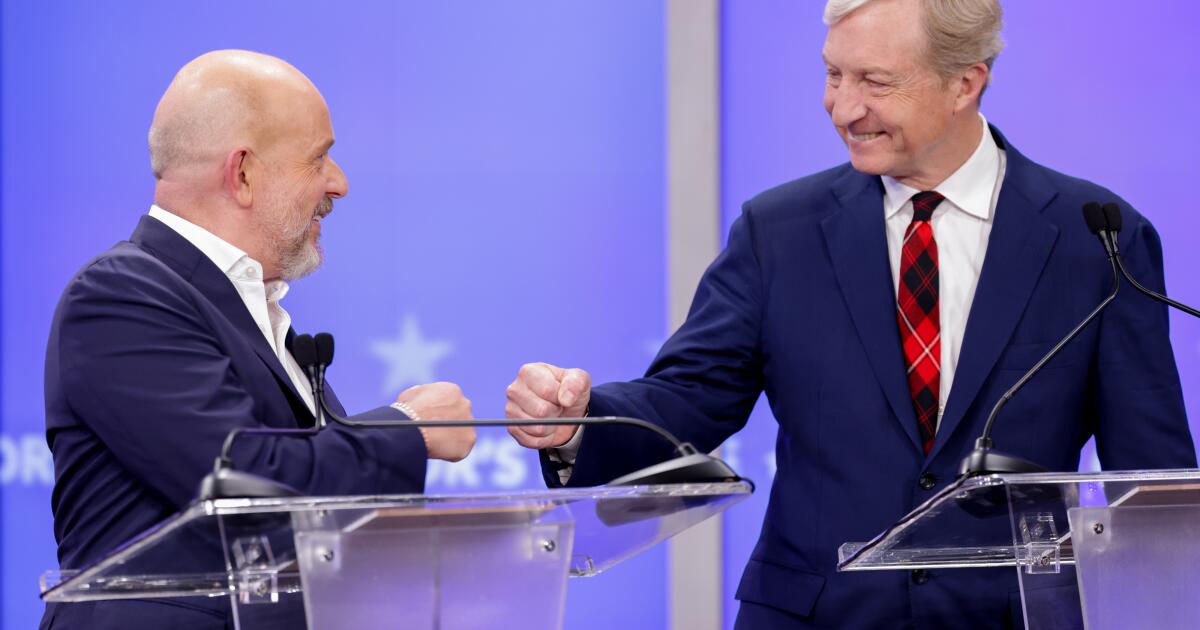
Two of our esteemed gubernatorial candidates, the cowboy and the dilettante, apparently could not find ties for the first debate Wednesday night, showing up with dress shirts casually unbuttoned.

Mr. Middleground sported a scruffy sorta-beard, apparently unable to pay for a razor in the midst of California’s affordability crisis. It’s a trademark look that always makes me think if this doesn’t work out, he’ll opt to live on a boat in some not-too-expensive slip by the Bay.

The billionaire wore Nikes instead of dress shoes, a sartorial nod perhaps to his bid to be the outsider-fighter. Or maybe his feet just hurt.

The last two contenders were remarkably unremarkable.

Why start with fashion? Honestly, it might be the most interesting, and telling, bit of insight that came from this first (of three) chances for our next governor to let us know who they are and what they’re made of. If the debate showed us anything, it’s that none of these candidates are hiding follow-me charisma or an excitement-inducing political vision for our collective future.

Yes, there were a few decent jabs here and there about Tom Steyer’s money, Katie Porter’s temper, Matt Mahan’s tech ties and Chad Bianco’s far-right world view. But even those were predictable.

Still, in between the yawns, there were a couple of answers worth noting, ones that might actually give us insight into how the Democratic candidates differ (Despite all the hype, it seems increasingly unlikely that two Republicans will come out of the primary, and even more unlikely that in a Democratic vs. Republican race, the Democrat would lose in blue California.)

I’ll start with a surprising place where I agreed with Steve Hilton, the Republican endorsed by President Trump.

The candidates were asked if they would support a ban on social media for kids under age 16. This is a quickly accelerating idea not beloved by tech companies. Australia and Indonesia already have bans in place. Other countries, including France and Portugal, have them in the works. Florida banned children under 14 from opening social media accounts on their own last year.

And a Los Angeles jury last month dealt a blow to Meta and YouTube when it found the platforms had damaged the mental health of a young woman with their addictive features.

Hilton took the ban question a step further, saying it “misses the point.” He has long argued that it isn’t just social media that is the problem, but having kids staring at a digital device for hours a day instead of interacting in the real world. It was one of the most genuine answers of the night.

“We’ve got to get to the heart of the problem, and that’s the devices and the screens,” he said. “I think that every parent in their heart knows that it’s wrong.”

While Steyer and Xavier Becerra, the former California attorney general, both said they would support such a ban, the remaining three candidates hedged or said they would not. Porter said no to a ban under age 16, but said she “might consider a different ban,” without being specific.

Mahan, who is backed by significant tech money, and Bianco both said they believed requiring parental consent was the way to go (though Mahan said he would ban devices in schools).

As Becerra pointed out, “kids have died as a result of their use of social media,” so it’s a place where policy matters. And if a candidate doesn’t see government’s role in controlling the dangers of social media, what will happen with artificial intelligence?

The candidates also had differences in how they would handle homelessness and the related crisis of housing affordability, though the devil was often buried in the details.

At least for Democrats. For Bianco, the difference was stark.

“We are not dealing with homeless. So stop calling it homeless,” he snapped at the moderators. “It has nothing to do with homes. This is drug- and alcohol-induced psychosis, mental illness.”

Of course, this is wrong. Last year, the UC San Francisco Benioff Homelessness and Housing Initiative released the results of the state’s most comprehensive survey of homeless people. It found that for most people living on our streets, “the cost of housing had simply become unsustainable.” It also found an increasing percentage of those folks were older — almost half were over the age of 50 — and had become homeless after a hardship such as an illness or a job loss.

“It’s also families who are fleeing intimate partner and domestic violence,” Porter said. “It’s people who are double and tripled up. It’s people who are living in their cars on our college campuses. Homelessness comes in a lot of different forms.”

Most of the Democratic candidates seemed to understand this and embraced the increasingly popular idea of putting more money into helping people stay housed after a hardship, instead of trying to get them housed after they lose their place.

“How can I help you keep your home?” Becerra said. “Because it costs me so much more money to pick you off the streets, provide you with the assistance in the shelter, than it does to keep you in the home.”

But the issue of homelessness is also where daylight emerged between the candidates. Steyer said he and his wife had helped finance low-barrier homes, not just shelter spaces, where people do not need to be addiction-free and where they can bring pets — two issues that are common hindrances for moving folks off sidewalks voluntarily.

Mahan, the mayor of San José, who often touts his city’s success at moving people indoors, agreed that emergency and interim housing was critical, but also voiced support for forcing folks to accept help. Last year, San José passed an ordinance he backed that some say criminalizes homelessness — a person can be cited twice for refusing shelter, and a third refusal within 18 months can lead to an arrest.

“When shelter was available, we required that people come indoors,” Mahan said, adding, “We have to be able to mandate treatment.”

It’s a controversial position, but also one that is increasingly popular. Gov. Gavin Newsom has backed mandated treatment, in a lighter form, with his CARE Court (which is technically voluntarily). And the movement to require people to accept a shelter space or face arrest is growing on the right and even the Democratic-middle.

But there is a fine and dangerous line with mandated treatment and shelter requirements that is often pushed further and further to the side in favor of the clean, safe streets argument. Whenever we start locking folks up — whether it’s in mental wards or immigration detention centers or jails — we should be careful that expediency isn’t trumping ethics.

Of course, the debate would not be complete without the Democratic candidates’ position on our president, speaking of ethics.

Steyer was gleeful that Trump has come after him on social media, a point of pride that he is a relevant figure in the fight against MAGA. He also said he would abolish Immigration and Customs Enforcement if he could, which he can’t.

Becerra highlighted his many lawsuits as California’s attorney general during Trump’s first term, and pledged to keep fighting. Porter leaned into her time in Congress and her efforts to help Democrats in other races win.

Mahan took a different route, pledging to fight when necessary, but adding, “We need a partnership, and we need to find common ground with this administration on certain issues.”

Newsom learned the hard way that common ground is what Trump says it is, and shifts without warning or reason.

So what’s the takeaway from all this?

Boring dad; feisty mom; rich do-gooder; striving newcomer; MAGA one; MAGA two.

None of them hit it out of the park, but no one struck out. Maybe next time.

Source link

Democrats excluded from USC governor debate urge rivals to boycott

Four Democrats running for governor called on their fellow candidates to boycott an upcoming debate at USC, reiterating concerns that the criteria used to determine who was invited to participate resulted in every prominent candidate of color being excluded from the forum.

“We ask each and every candidate who is in this race to recognize that if we can’t have a fair process for a debate, then we should all not participate,” said Xavier Becerra, the former U.S. Health and Human Services secretary. “We call on them to withdraw from this biased forum.”

Becerra’s call was echoed by former Los Angeles Mayor Antonio Villaraigosa, state Supt. of Public Instruction Tony Thurmond and former state Controller Betty Yee during a Friday afternoon news conference.

The candidate’s request comes a week after some of them raised concerns about the criteria for Tuesday’s debate, arguing that it was engineered to allow the inclusion of San José Mayor Matt Mahan, who entered the race in late January and quickly raised millions of dollars from Silicon Valley executives.

“The rules initially were polling and money. Matt Mahan is [polling] lower than some of us, period,” Villaraigosa said, adding that the debate organizers “then added time in the race,” which resulted in Mahan’s invitation.

Mahan’s campaign did not respond to a request for comment on Friday, but when Becerra raised such concerns last week, Mahan said the former Biden administration official ought to be included in the debate.

The matter is further complicated by Mahan supporters who have notable ties to the university.

Mike Murphy, a co-director of the USC center hosting the debate, has been voluntarily advising an independent expenditure committee backing Mahan. The veteran GOP strategist said last week that he had nothing to do with organizing the debate and that he has asked for unpaid leave at the university through the June 2 primary if he takes a paid role in the campaign.

USC has also received tens of millions of dollars in donations from billionaire real estate developer Rick Caruso and his wife. Caruso, a USC alumnus who served as a trustee for years, is also a Mahan supporter.

A representative for Caruso did not respond to a request for comment.

The debate, hosted by the USC Dornsife Center for the Political Future, KABC-TV Los Angeles and Univision, is scheduled to take place on campus at 5 p.m. Tuesday — less than two months before ballots begin arriving in voters’ mailboxes. The forum will be streamed and broadcast on ABC and Univision affiliates across the state.

USC and the television stations put out a joint statement Friday morning, prior to the candidates’ news conference, justifying the criteria used to determine who was invited to participate and saying none of the debate partners had any influence on the methodology.

“We want to be clear that we categorically, unequivocally deny any allegations that the debate criteria was in any way biased in favor or against any candidate and want to clarify the facts,” they said in a statement, adding that Christian Grose, a USC political science professor, was asked to develop “data-driven” benchmarks to determine which candidates were invited.

“The methodology was based on well-established metrics consistent with formulas widely used to set debate participation nationwide — a combination of polling and fundraising — and developed without regard to any particular candidate.”

After the Democratic candidates called for their competitors to not participate, USC and KABC declined to comment further. Univision did not respond to a request for comment.

Grose defended the methodology he crafted as “objective” in an interview Friday, and said he met with Becerra as well as the staff of other candidates to explain it.

“The idea that it was biased or designed to create some sort of outcome to disfavor the candidates who spoke at the press conference is just not correct,” Grose said, adding that attacks on the methodology have a “chilling effect” on universities and media outlets who sponsor debates.

“I’m not worried about the optics,” he said. “The optics are we are having a debate at USC to inform voters and educate students.”

Jarred Cuellar, a political science assistant professor at Cal Poly Pomona, described Grose’s methodology as “thoughtful” and “empirically grounded,” and characterized the concerns raised by candidates not included in the debate as unfounded and not credible.

“The formula is methodologically sound and represents a clear improvement over how debate participation has often been determined,” he said. “Rather than relying on a single metric such as polling, it takes a multidimensional approach to evaluating candidate viability. That approach better reflects how political scientists measure complex phenomena like electoral competitiveness.”

But the controversy has caused consternation among USC professors past and present.

“It seems like an unforced error that is casting the entire event in a bad light,” said a current USC professor who closely follows politics but is not involved in the debate, and who asked for anonymity to speak candidly. “It’s super important that if the debate happens, it happens correctly.”

Darry Sragow, a veteran Democratic strategist who taught election and environmental law at USC for 19 years, said that while he believes the large field of Democratic candidates needs to be winnowed, that’s not the job of a university or media outlets.

“Every one of these eight [Democratic candidates] is capable of running the state of California,” he said. “ It would certainly be my advice to USC and to Univision and to ABC to allow all the candidates to take part, or to cancel the debate.”

The four Democratic candidates not invited to the debate argued that voters are just starting to pay attention to the thus-far sleepy race and that diverse candidates should be represented.

“We are a minority-majority state, and the idea that the four candidates of color are not going to be on the stage to bring those perspectives, to really speak to those communities, is really not doing right by the voters,” Yee said.

Becerra said some of the candidates had requested to speak with top university leadership, including President Beong-Soo Kim. In other conversations, he said university officials raised the possibility of “either canceling this debate or incorporating more of the candidates in it. Evidently they could not agree to do that. … I think they recognize that there were problems with the way this debate had been organized.”

Becerra said he reviewed the formula and has “never seen” debate criteria like it before during his decades of serving in elected office.

“Your fundraising numbers are divided by the number of days you’ve been out there campaigning in front of voters,” he said. “So you could have raised millions of dollars, but if you’ve been in longer than someone else who just raised millions of dollars very quickly, you get penalized.”

Campaigns for the invited candidates — Democrats Rep. Eric Swalwell of Dublin, former Orange County Rep. Katie Porter, climate activist Tom Steyer and Mahan; as well as Republicans Chad Bianco, the sheriff of Riverside County, and former Fox News host Steve Hilton — did not respond to requests for comment on the call to boycott the debate.

Source link

Villaraigosa’s dreams for a political comeback meet reality — again

Former L.A. mayor and current candidate for governor Antonio Villaraigosa wants voters to know that he navigated billion-dollar budgets, cracked down on violent crime and championed the expansion of bus and rail lines.

The onetime state Assembly speaker argues he’s the only Democratic candidate with the experience to do the complicated job of running California.

But Villaraigosa left City Hall in 2013 — eons ago in the world of politics. President Obama was still in office, singer Robin Thicke’s “Blurred Lines” was atop the charts and Apple Watches weren’t yet a thing.

Because of his distance from elected office, combined with a decent but overshadowed fundraising effort, Villaraigosa lacks a high-profile platform to attract attention in today’s fractured media universe, an essential ingredient he needs to remind voters about his experience and accomplishments as mayor and a state lawmaker.

Out going Los Angeles mayor Antonio Villaraigosa gets his photo taken with students

Antonio Villaraigosa gets his photo taken with students from Hazeltine Avenue Elementary School while visiting Placita Olvera in 2013.

(Irfan Khan / Los Angeles Times)

Recent polls show Villaraigosa, 73, wallowing at the bottom of the field, though none of the major Democratic candidates have an overwhelming edge.

Villaraigosa also ran for governor in 2018, coming in third in the primary election behind Democratic rival Gavin Newsom, who went on to win and is now serving his second term, and little-known Republican businessman John Cox.

Political strategist Mike Madrid, who worked for Villaraigosa on that campaign, said the former mayor’s absence from politics in recent years is a major liability in this race.

“He’s a dogged, determined candidate,” Madrid said. “But there are pretty stiff headwinds.”

Villaraigosa got a boost last week when the State Building and Construction Trades Council of California pledged $1 million to an outside committee supporting him.

His allies argue voters aren’t paying attention to the governor’s race because eyes are on President Trump, immigration raids and the Iran war.

But the new funding is a pittance compared to some of his rivals. Billionaire Tom Steyer is tapping tens of millions of his own money to pump out ads. Tech companies and billionaire Rick Caruso are supporting Matt Mahan, the mayor of San José, with millions.

Another contender, Rep. Eric Swalwell (D-Dublin), has the power of incumbency. Swalwell launched his campaign on “Jimmy Kimmel Live!” and is a regular on cable news shows, while former Orange County Rep. Katie Porter, who is also running, recently served in Congress and campaigned for the U.S. Senate two years ago.

With the June primary looming, Villaraigosa’s campaign risks sputtering out.

Angeleno Celine Mares holds a copy of Newsweek featuring newly elected Los Angeles Mayor Antonio Villaraigosa

Angeleno Celine Mares holds a copy of Newsweek featuring newly elected Los Angeles Mayor Antonio Villaraigosa as he is sworn into office on the steps of City Hall July 1, 2005.

(David McNew / Getty Images)

Leaving a Compton church earlier this month, he reacted to Mahan’s support from technology companies, and the billionaire money in the race.

“When you have overwhelming sums of money influencing elections, there’s a great deal of concern for those of us who care about our democracy,” said Villaraigosa. “As much as they say it’s about free speech, it actually drowns out speech.”

(During his 2018 bid for governor, though, Villaraigosa was a major beneficiary of Californians using their wealth to wield political influence. Charter school backers, including Netflix co-founder Reed Hastings and philanthropist Eli Broad, spent around $23 million on efforts to boost his campaign. )

Earlier in the morning, he rallied runners at a 10K road race in L.A.’s Chinatown, lighting firecrackers, posing for photos and looking as energetic as when he was mayor and would dart into the street to personally fill potholes.

Villaraigosa flitted around the racers’ VIP tent, spotted a bowl of fortune cookies and made a beeline. “You have an active mind and a keen imagination,” he read aloud.

“Antonio V.!” a middle-aged man called out as the former mayor passed.

Minutes later, Villaraigosa swapped his black and white Veja sneakers and jeans for dress shoes and a suit for the church service in Compton, at which an overwhelmingly Black audience gave him a warm reception.

Building a coalition of Black and Latino voters helped him win the 2005 L.A. mayor’s race in a dramatic upset of then-Mayor Jim Hahn, and brought wide attention to the one-time high school dropout, who was raised by a single mother on Los Angeles’ eastside.

Newsweek magazine featured Villaraigosa on its cover with the headline, “Latino Power: L.A.’s New Mayor and How Hispanics will change American Politics.”

But national acclaim can be fleeting. Today, voters aren’t as interested in identity-based politics, said Fernando Guerra, a professor of political science at Loyola Marymount University who has known Villaraigosa for decades.

Guerra said Villaraigosa is struggling to differentiate himself in the race because his pitch to voters is not unlike the moderate path taken by Mahan. Another contender, former Health and Human Services Secretary Xavier Becerra, overlaps with Villaraigosa when it comes to biographical details: Both are from the L.A. area, Latino and relatively close in age.

“What’s made it so difficult is that [Villaraigosa said], ‘Here’s my path,’” said Guerra. “Well, guess what, there are one to two more candidates who are also on that path.”

Strategist Madrid questioned whether voters even want to hear about a candidate’s experience at a time when anti-Trump messages rally Californians. “They want a fighter,” he said.

Since leaving the mayor’s office, Villaraigosa has enjoyed success in the lucrative private sector. He purchased a $3.3 million home in the L.A. neighborhood of Beverly Hills Post Office in 2020. . A recent campaign filing shows he’s spent the last few years advising companies including the health company AltaMed, financial lender Change Company and crypto currency exchange Coinbase Global.

Mayor Antonio Villaraigosa holds news conference at the front steps of Department of Water and Power.

Then mayor Antonio Villaraigosa holds a news conference at the Department of Water and Power on Hope Street July 22, 2005, urging all of Los Angeles to conserve energy in an effort to ensure Southern California avoids blackouts.

(Ken Hively / Los Angeles Times)

He also worked for a few years for consulting firm Actum and briefly advised the Newsom administration on infrastructure projects.

“It’s not that I didn’t like the public sector,” said Villaraigosa, explaining his decision to run again. As he talked about his desire to serve, he cast a gauzy image of the aughts in Los Angeles, taking credit for the downtown resurgence, skyline full of construction cranes and fewer homeless people on the streets during that period.

“Most people look back on those years and say they were some of the best years we’ve had in the last 25 — at least,” said Villaraigosa.

Stuart Waldman, president of the business group Valley Industry and Commerce Assn., argues Villaraigosa’s experience in the private sector and distance from elected office is a good thing.

“Look at what the economy was like, look at what the city was like” under Villaraigosa, said Waldman. “That’s what he’s going to be judged on.”

Villaraigosa started his career working for labor and civil rights groups before entering politics. Elected to the state Assembly in 1994, he pushed legislation that banned assault weapons and created healthcare coverage for children. His outgoing personality established him as a coveted fundraiser for Democrats in Sacramento and paved the way for him to be chosen as Assembly speaker.

As L.A. mayor, he brought down gang crime through a program that used former gang members to broker truces. Voters backed his ballot measure to expand L.A.’s transit system through new sales tax money in the middle of the Great Recession. He drove down pension costs after a bruising battle with city unions. At the same time, he established himself as a national leader on climate issues and education.

His reputation took a hit after an affair with a television reporter led to the breakup of his marriage.

The media scene that covered Villaraigosa back then is vastly diminished, with young people now getting news from TikTok videos, message boards or Instagram posts.

Weighing in on recent TV news layoffs in Los Angeles, Villaraigosa called himself “lucky” that there were plenty of newspaper and television reporters covering him as mayor, recalling that he’d get a dozen cameras to his press conferences.

Asked to compare his 2018 campaign for governor with this one, he said, “I didn’t have to reintroduce myself last time in quite the way I’ve had to this time.”

Villaraigosa spent a significant time in Mexico in recent years to see his now ex-wife Patricia Govea, a clothing designer. “She was in Mexico 80% of the time, the last six years. So I` went to Mexico a lot.” The pair’s divorce was finalized last year.

During a debate in front of Jewish voters on L.A.’s westside last month, Villaraigosa appeared to seize on the fact that he was the sole Angeleno on the stage, introducing himself by saying, “It’s good to be home.”

He told the crowd about his work as president of the American Civil Liberties Union of Southern California and criticized UCLA — his alma matter — for its handling of incidents targeting Jewish students on its campus.

It remains to be seen if he’ll have a hometown advantage. In the 2018 race for governor, Newsom won more votes than Villaraigosa in Los Angeles County. While Villaraigosa did well in Latino communities in central L.A. and on the Eastside, Newsom captured more votes in wealthier, whiter areas.

But at the Compton church, a security guard approached Villaraigosa and told him she’d worked on his 2005 campaign, while others promised to vote for him.

“I know he has a track record,” said Valerie Bland, a 63-year-old former port worker from Long Beach, as she watched Villaraigosa work the pews. “I haven’t even looked at anyone else.”

Former Assembly speaker Fabian Núñez, a longtime friend of Villaraigosa and managing partner at Actum, hopes voters dig into Villaraigosa’s record.

“We have short-term memories in this country,” said Núñez.

Source link