marvel

Why audiences packed theaters for ‘The Odyssey’

It took an ancient Greek epic to ignite a fire at the box office last weekend, as Christopher Nolan’s adaptation of “The Odyssey” became one of the biggest movie events of the year.

The film, led by Matt Damon as Odysseus, hauled in $123.5 million in the U.S. and Canada on its way to a global total of nearly $264 million — the biggest-ever global opening for one of Nolan’s films.

In many ways, “The Odyssey” is a throwback to old-school Hollywood filmmaking, with Nolan’s use of practical effects and numerous on-location shoots. It’s also a sign that audiences will still pack theaters for the right kind of movie.

The Universal Pictures film also outperformed studio expectations of a $117-million domestic premiere and set a record for the highest-grossing opening weekend for a live-action or R-rated film this year.

“Audiences always want to be thoroughly immersed in the theatrical experience and engulfed by the story and the production, and Christopher Nolan’s ‘The Odyssey’ is a perfect example of that,” Jim Orr, Universal’s president of domestic distribution, said Sunday. “When you have a very substantial opening, and you have those kinds of audience scores, it only points to what should be a remarkable run throughout the summer and into the fall.”

That’s good news for the summer box office, which lately has seen a bit of ebb and flow.

“The Odyssey” now ranks as the third-largest domestic opening of the year, trailing only kid-friendly films such as Walt Disney Co. and Pixar’s “Toy Story 5” and Universal, Illumination and Nintendo’s “The Super Mario Galaxy Movie.” Though family-friendly films have become power players for theaters, the two most recent flicks — Disney’s live-action “Moana” and Universal and Illumination’s “Minions & Monsters” saw softer openings.

After the big weekend for “The Odyssey,” the summer box office is up 7.3% compared with the lackluster 2025 season, according to entertainment data firm Rentrak. More encouraging, the year-to-date domestic box office is now 10.4% higher than for the same period last year.

That’s been helped not only by big blockbusters such as “The Odyssey,” which had a production budget of $200 million to $250 million, but also by the success of smaller-budget films such as A24’s “Backrooms” and Focus Features’ “Obsession.”

The common denominator is the draw of directors who have cultivated strong fan bases. “Obsession” director Curry Barker, 26, and 21-year-old Kane Parsons, who helmed “Backrooms,” have been building their reputation on YouTube among Gen Z audiences, and that loyalty is starting to count for something at the box office.

Nolan, of course, is one of the masters of building a faithful following over more than two decades. Fans started grabbing Imax 70 millimeter tickets for “The Odyssey” when they first went on sale a year ago, and the film ended up driving record presales for the Canadian entertainment tech company, which operates out of Playa Vista.

The film has notched a 95% on aggregator Rotten Tomatoes and an A CinemaScore rating.

“His films have tapped into the cultural zeitgeist,” said Shawn Robbins, director of movie analytics at Fandango and founder of the website Box Office Theory. “That’s what keeps bringing people back. They know they’re going to get a different experience; there’s always going to be a watercooler conversation around his movies, and they’re part of the cultural fabric.”

For “The Odyssey,” part of that conversation was Nolan’s old-school movie magic, including the puppetry, animatronics and robotics he used in scenes with the Cyclops, as well as the real Viking ship that the actors learned to sail.

The film also has driven interest in 70mm screenings from film buffs and casual moviegoers.

Ahead of the premiere of “The Odyssey,” Allen Michaan, owner of Oakland’s Grand Lake Theater, knew the weekend would be very busy for his four-screen movie palace. He is showing the film both in standard digital format and on 70mm film.

You’re reading the Wide Shot

Samantha Masunaga delivers the latest news, analysis and insights on everything from streaming wars to production — and what it all means for the future.

Michaan has made 70mm showings a priority since 1982, when the projector was installed for the release of Steven Spielberg’s “E.T. the Extra-Terrestrial.” He said the theater played that movie for 45 weeks that year. Due to the demand at the time, he installed two more 70mm projectors, making three of his four screens capable of the old-fashioned format.

Demand for the 70mm showings of “The Odyssey” has significantly outperformed their digital screenings, he said.

“We’re thrilled to get any 70mm print because it’s a gift from the filmmaker and the studio,” Michaan said.

Enhanced format screenings for “The Odyssey” made up 53% of the domestic weekend box office, with Imax film and digital revenue accounting for nearly 24%.

Imax 70mm accounted for about 4% of that total, with Imax digital making up the rest. Non-Imax 70mm film screening revenue totaled 3%, while 35mm showings made up 0.3%.

The nearly three-hour epic also marked the first feature film shot entirely on Imax cameras, a feat that required extensive collaboration between Nolan and Imax.

Nolan first told Imax Corp. Chief Executive Rich Gelfond in early 2024 that he was considering making an entire film with Imax cameras and laid out what he’d need for that to happen, including a quieter and lighter camera, a way to make film reloads easier and getting enough trained projectionists.

“It took a fair amount of time and investment” to figure out those challenges, Gelfond said. But by August 2024, the Imax team put together a series of tests to show cinematographer Hoyte van Hoytema. Two months later, Nolan saw the tests and was impressed.

“As filmmakers and studios integrate Imax, we become an increasingly important part of the ecosystem,” Gelfond said. “When a film is released in Imax or shot in Imax, I think it’s a signal to audiences that it’s somewhat special, and the filmmaker is really leaning in in a unique way.”

Times staff writer Cerys Davies contributed to this report.

Stuff We Wrote

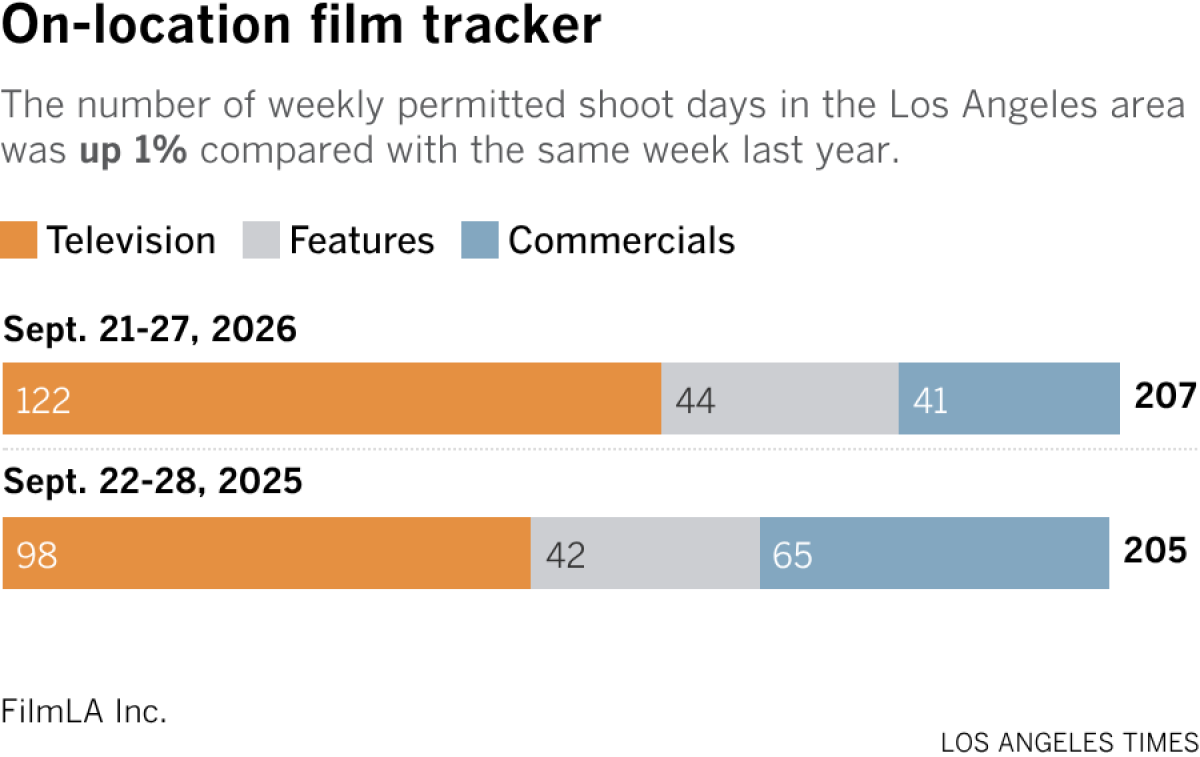
Film shoots

Number of the week

fifty-one billion dollars

Streaming giant Netflix narrowed its 2026 revenue forecast to $51 billion to $51.4 billion from its previous, larger range of $50.7 billion to $51.7 billion in its last Thursday’s second-quarter earnings report, renewing concerns among investors and equity analysts about the Los Gatos-based company’s future growth.

On the Friday morning after the earnings call, Netflix stock slid 13% to $65.08 a share, marking a new 52-week low. Shares eventually closed that day at $68.95.

As my colleague Wendy Lee has reported, investors are growing nervous that in recent months, Netflix’s share of TV viewing time in the U.S. has been decreasing, while YouTube’s share has increased, according to Nielsen data. Investors are concerned that if consumers are watching Netflix less, they’ll cancel their subscriptions, and that will put pressure on the company’s ability to raise prices in the U.S.

Netflix has said its engagement rates are healthy.

What I’m watching

I love a good teen mystery show, especially when it has a bit of a “Veronica Mars” vibe, so I binged Paramount+’s “School Spirits” last weekend.

Where Veronica Mars was solving realistic crimes around her local beach city, “School Spirits” tries to dig into why so many teens have died at (and haunt) a Wisconsin high school. At times, they’re hitting at a lot of different themes and storylines, but I loved the colorful ensemble of ghost characters from different decades, and Jennifer Tilly makes for an incredible villain.

Source link

Our predictions for the summer box office

It’s been about a month into the all-important summer box office season, and already, there is a noticeable boost in optimism.

I wrote last week about how the massive debut of Walt Disney Co. and Pixar’s “Toy Story 5” was a promising sign; many analysts and movie theater operators believe the summer’s theatrical revenue could finally reach pre-pandemic levels.

The cinema business has been propelled by the likes of Paramount Pictures and Miramax‘s “Scary Movie,” Universal Pictures’ “Disclosure Day” and, of course, A24’s “Backrooms” and Focus Features’ “Obsession.”

With more potential blockbusters on the way, my colleagues David Viramontes, audience editor for arts and entertainment, and Cerys Davies, who covers the business of the entertainment industry, joined me to give our best predictions for how this summer will shape up.

What will be the biggest movie of the summer?

Masunaga: After seeing how family movies — specifically, PG-rated films — were the winners of the last two years, I think we’ll be seeing “Toy Story 5” emerge at the top. The movie has already brought in more than $585 million worldwide less than two weeks after it opened, and if its billion-dollar-grossing predecessors are any indication, this franchise may still have a long life at the box office.

Viramontes: After the R-rated, three-hour drama “Oppenheimer” made nearly $1 billion at the worldwide box office in 2023, it would be professional malpractice not to pick Christopher Nolan’s “The Odyssey” as the biggest movie of the summer — and possibly the year. 70-millimeter IMAX screenings were sold out a year in advance and premium format tickets are still hard to come by in Los Angeles. Not to mention tentpole movies like this attract repeat viewings and even encourage viewers to seek out screenings in every format. And we haven’t even talked about how the film boasts one of the most stacked casts in recent history.

Davies: In an effort to play it safe, I’m going to pick a family movie and bet on “Toy Story 5.” Think about the dog days of summer — when the air gets heavy, a sense of inexplicable boredom takes over and it’s almost too hot to do anything. Deep down, you know the only reprieve is sitting in the comfort of your local theater chain’s air conditioning. But, at this point, you already saw “The Odyssey” with all your friends at the earliest available IMAX showing. What else will scratch that box office itch? I’m willing to bet it’ll be none other than the familiar faces of Woody, Jessie and Buzz Lightyear, as they fend off technology in their home.

You’re reading the Wide Shot

Samantha Masunaga delivers the latest news, analysis and insights on everything from streaming wars to production — and what it all means for the future.

Which movie’s marketing campaign will be the talk of the summer?

Masunaga: The marketing for “The Odyssey” has been less overt than that of other summer releases, giant Trojan horse in Venice Beach notwithstanding. But a film helmed by Nolan and starring a plethora of A-list actors basically markets itself. After all, both official trailers for the film have garnered more than 30 million views on YouTube.

Viramontes: I’m prepared for Spider-Man to be everywhere. From buses and billboards to talk shows and TikTok, the movie will reach full saturation. While “Brand New Day’s” marketing campaign hasn’t reached fever pitch just yet, I’m prepared to be inundated with activations, posters and commercials for the four-quadrant fave that’s poised to be one of Marvel’s biggest successes in years.

Davies: A massive orange monster named Irene with dozens of eyeballs has nearly engulfed the historic Carney’s restaurant on Sunset. A giant inflatable “Rich” minion, sporting a goatee and a blinged out chain, popped up on Fairfax. And minions have taken over Wendy’s frosty machines with a new banana flavor. At this point, Universal and Illumination could put a minion on every Los Angeles street corner, and I wouldn’t grow tired of them. (The ominous, goggle-wearing eye overlooking the 101 freeway just isn’t enough.)

What will be the biggest wild card of the summer?

Masunaga: The biopic “Young Washington” could make waves. Distributed by Provo, Utah-based Angel Studios, the movie has the backing of the studio’s 2 million Angel Guild members, who determine its slate and get other perks, including free movie tickets. That support proved crucial for 2023’s “Sound of Freedom,” which ended up grossing more than $250 million worldwide, and could end up being a factor here, too.

Viramontes: “The End of Oak Street” has been teasing a dinosaur adventure in trailers, but can the mystery box movie starring Anne Hathaway and Ewan McGregor attract audiences? There’s also potential counter programming to blockbuster hopefuls dotted throughout the summer with “Teenage Sex and Death at Camp Miasma.” But I’m putting my money on “Evil Dead Burn.” Horror movies put butts in seats, and this summer doesn’t have many other straight-down-the-middle scares in store for audiences.

Davies: There’s an Anthony Bourdain biopic called “Tony” hitting theaters in August. These days, it feels like Hollywood will make a biopic about just anyone, but something about seeing Dominic Sessa channel the chef’s undying passion for food and effortless swag on screen seems irresistible. Plus today’s audiences love stories about intense kitchens (“The Bear”) and debatable biopics (“Michael”) — let’s see what happens when the two marry.

Both Warner Bros.-owned DC Studios’ “Supergirl” and Sony Pictures‘ “Spider-Man: Brand New Day” are part of this summer’s lineup. Will we see a turnaround from the recent superhero fatigue at the box office?

Masunaga: This past weekend marked a disappointing debut for “Supergirl,” which brought in just $37.1 million in the U.S. and Canada and about $62.6 million worldwide on a reported budget of $170 million. Box office analysts had been expecting a domestic opening of about $47 million to $50 million. On the other hand, pre-sales for “Spider-Man: Brand New Day” have been extremely strong. Not every superhero movie prints money anymore, so even with a potentially big haul for “Spider-Man,” I don’t know that it’ll signify a complete turnaround for the genre as a whole.

Viramontes: If there’s any superhero with enough pull to rescue the genre from fatigue after “Supergirl’s” poor performance, it’s your friendly neighborhood box office king Spider-Man.

Davies: Tom Holland’s Spider-Man definitely has the potential to cure superhero fatigue, at least for a few months. But as soon as the internet’s favorite couple, Zendaya and Holland, stop walking red carpets and doing press together, audiences are likely to put superhero movies on the back burner once again.

Analysts and theater owners have predicted that this summer’s box office will reach pre-pandemic levels. Will that momentum continue for the rest of the year?

Masunaga: Yes. The lineup of movies this year is more plentiful and varied than in years past, and with massive blockbusters slated for the holiday season, I think it’s very possible we could see a year-end domestic box office total of $9 billion or more.

Viramontes: Yes. We’ll have an action horror in September with “Resident Evil,” Zach Cregger’s follow-up to “Weapons.” In October, Tom Cruise’s long-awaited “Digger” might hit pay dirt. Following that in November is the new “Hunger Games” movie, “Sunrise on the Reaping.” And I don’t even have to mention “Avengers: Doomsday” and “Dune: Part Three,” the juggernauts waiting for us in December, do I?

Davies: Given the overall excitement from audiences of all ages and the variety this summer’s box office has to offer, this season will definitely be the one to do it. When Christopher Nolan, Spider-Man, the minions and the toys from “Toy Story” join forces, there’s no stopping them.

“The Pitt” and its economic effect on California

As film and TV production has fled the Golden State in search of cheaper locales, HBO Max medical drama “The Pitt” stands out as a major contributor to California’s economy.

My colleague Meg James wrote about the economic impact of the show, which films almost entirely on the Warner Bros. lot in Burbank and has provided jobs for about 1,000 people. The show’s first season alone contributed $125 million to California’s gross domestic product, according to an estimate from Oxford Economics.

“We’re old men who didn’t want to go away from our homes any longer,” series star Noah Wyle, who also serves as an executive producer and writer on the show, said, half-joking. “We’ve all been plying our trades out of state, chasing tax credits and being away from our families for a really long time.”

Stuff We Wrote

Film shoots

Number of the week

seventy million dollars

Disney and Pixar’s “Toy Story 5” continued its dominance this weekend, pulling in $70 million in the U.S. and Canada to stay on top at the box office.

The animated film has now grossed more than $585 million worldwide in less than two weeks. The haul for “Toy Story 5” helped push Disney past the $3-billion mark at the global box office, making it the first studio so far this year to hit that milestone.

What I’m watching

I feel like I’m always catching up on shows, and this week was no exception. I’m just now starting Season 2 of Netflix’s “A Man on the Inside,” which continues the hilarious exploits of retired engineering professor-turned-private-investigator Charles, played by Ted Danson. As a fan of “The Good Place,” I’ve loved the similar humor of this latest Michael Schur show.

Source link

‘Toy Story 5’ could be the start of a big summer box office

It’s been more than 30 years, but Andy’s toys are proving irreplaceable at the box office.

Walt Disney Co. and Pixar’s “Toy Story 5” opened to a massive $160 million in the U.S. and Canada last weekend, marking the biggest domestic box office debut so far this year. Internationally, the film brought in $152 million for a worldwide total of $312 million.

With those numbers, “Toy Story 5” broke several franchise records for opening weekend totals. As my colleague Cerys Davies and I wrote last week, it’s a sign of the long-running juggernaut’s firm grip on audiences amid a sea of Hollywood sequels, reboots and spinoffs.

You’re reading the Wide Shot

Samantha Masunaga delivers the latest news, analysis and insights on everything from streaming wars to production — and what it all means for the future.

“‘Toy Story’ has been breaking ground since it first hit the screen more than 30 years ago,” Disney Entertainment Studios Chairman Alan Bergman said in a statement. “It’s wonderful to see ‘Toy Story 5’ continuing that tradition and connecting with audiences around the world to deliver the biggest opening for the franchise and the biggest of this year as well.”

For theater owners, “Toy Story” may have seemed like a surefire bet. After all, the franchise has grossed more than $3 billion in worldwide box-office revenue, and its third and fourth installments each made more than $1 billion globally.

The big opening weekend for “Toy Story 5” has no doubt brightened the outlook for many theater operators as the all-important summer movie season gets underway.

Already, last weekend’s box-office totals were a whopping 80% improvement compared with a year ago, when Universal Pictures’ live-action “How to Train Your Dragon” was in its second weekend in theaters. But more importantly, the domestic box office is now up 14% to $4.46 billion compared with the same time a year ago, according to data from Rentrak.

This summer’s lineup of films, including “Toy Story 5,” will play an important role in terms of whether 2026 will truly be the year that the theatrical business turns the corner from the COVID-19 pandemic and the dual Hollywood strikes of 2023.

In one promising sign, summer box-office revenue so far is up 15.2% to about $1.84 billion compared with the same May to mid-June period in 2025. (That summer ultimately ended in a dismal finish of $3.67 billion.) Compared with pre-pandemic 2019, this year’s summer box office to date is down just 1.9%.

Studio executives and theater owners have told me they feel good about this summer and are optimistic about the overall outlook for 2026.

It’s easy to see why. The deck is stacked, with upcoming titles such as Universal and Illumination’s “Minions & Monsters,” Disney’s live-action “Moana,” Christopher Nolan’s “The Odyssey” and Sony Pictures’ “Spider-Man: Brand New Day.”

In a propitious sign, presales for “The Odyssey” and “Spider-Man” have already shown massive demand. Overall, there’s just more and varied movies in theaters now, which expands the pool of potential moviegoers, theater owners have said.

Take A24’s “Backrooms” or Focus Features’ “Obsession,” for instance. The two original and digital-native films shocked the industry by keeping a weeks-long grip on the box office, largely by attracting Gen Z audiences who were familiar with the 20-something directors from their followings on YouTube.

Beyond these two, as well as Steven Spielberg’s “Disclosure Day,” many of this summer’s films continue established franchises.

Although not all spinoffs have performed this year — including Disney and Lucasfilm’s “Star Wars: The Mandalorian and Grogu,” which saw ticket sales drop sharply after its late May opening — “Toy Story” has remained a consistent force in theaters over the decades.

Disney and Pixar executives credit the films’ focus on character relationships, particularly that of Tom Hanks’ Woody and Tim Allen’s Buzz Lightyear. And as the franchise spanned years, its appeal became generational.

“Having parents now that say, ‘I grew up with ‘Toy Story,’ and now I’m showing my kids,’ has been really gratifying,” Pixar Chief Creative Officer Pete Docter told me by phone a week before the movie’s opening.

“Toy Story” is now the most-watched franchise on the Disney+ streaming service, with more than 2 billion hours streamed. And its beloved characters have spawned 19 theme park rides, four themed lands, two hotels and roughly $1 billion a year in global retail sales.

That has no doubt kept the franchise front and center for both adults and children, as well as fueling interest in future stories.

Stuff We Wrote

Film shoots

Number of the week

six million

The FIFA World Cup has been a major boost for broadcasters, as an average of 6 million viewers tuned in to Fox and cable network FS1 for the first 16 group stage matches, an increase of 128% compared with the last World Cup in 2022, according to Nielsen data released last week.

On Spanish language network Telemundo, which is owned by Comcast, the first 12 group stage matches drew an average of 7.5 million viewers, up 234% from four years ago. (The Telemundo telecasts are also streamed on Peacock.)

I was in the Bay Area last week on vacation and didn’t watch many of the games, but I did catch my colleague Clara Harter’s great read about the mutual love and respect between fans of Mexico and South Korea and how that has played out in Los Angeles.

What I’m watching

Since I was out of town last week, I didn’t watch a ton of TV. But I did make time to watch the series finale of “The Way Home,” a quirky time-travel drama on Hallmark that I’ve followed for all four seasons.

I’m a big fan of time-travel stories (The “Back to the Future” trilogy is one of my favorites), so the usual past-future questions, plus the complicated family dynamics anchored by matriarch Andie MacDowell, made this a must-watch for me. The series finale was a satisfying ending, though there are definitely some loose strings that deserve further exploration.

Source link

Amazon’s AI boss on the primacy of humans in a changing Hollywood

At the AI on the Lot media conference last week in Culver City, speakers laid out a view of artificial intelligence that was very much complementary to human workers.

Artificial intelligence is a tool that must be wielded by humans, several said. The idea was to help skilled artists and production specialists do their jobs and experiment, others said.

Of course, to many in Hollywood, AI is not that simple.

Guardrails on its usage emerged as a central issue in the 2023 writers’ and actors’ strikes, and additional rules were added in the recent Screen Actors Guild-American Federation of Television and Radio Artists and Writers Guild of America contracts. There are still big questions about AI’s effect on jobs in the entertainment business, as well as copyright and ethical concerns.

Whether it’s good or bad or some combination of both, AI, in some form, is probably here to stay.

So, eight months ago Amazon MGM Studios opened an AI Studios division to start work on Project Nara, an AI production toolkit built on Amazon’s AWS cloud computing platform that could be used by teams of filmmakers. Project Nara is still in beta mode, and the company set up a GenAI Creators’ Fund to give filmmakers interested in using the toolkit financial support, while also giving the studio feedback.

The beta testers got eight weeks to produce an animated short and, out of those, the company greenlighted three animated series.

Shortly after the conference, filmmaker Jorge Gutierrez, whose stop-motion-style “Punky Duck” was chosen as one of the greenlighted series, pulled out after an online backlash over his use of AI.

You’re reading the Wide Shot

Samantha Masunaga delivers the latest news, analysis and insights on everything from streaming wars to production — and what it all means for the future.

“We respect Jorge’s decision, as well as his incredible talent, his voice and the world he created with ‘Punky Duck,’” an Amazon MGM Studios spokesperson said in a statement. “We continue to be excited about the innovative work moving forward at our studio and the GenAI Creators’ Fund.”

Before the flap over “Punky Duck,” I spoke with Albert Cheng, head of Amazon MGM Studios’ AI Studios, about the goal of the division, what’s next for AI and his belief that humans are at the center of creativity. The conversation has been edited for length and clarity.

Why was AI Studios formed?

AI Studios was started last fall because we wanted to learn how to leverage AI technology to build tools that would help enhance or redefine the workflows for film and TV production.

When you look at the horizon of what it takes to drive continued engagement of a global streaming service like Prime Video, we need more original programs. So if you can figure out how we take the same amount of money that we spend and be able to make more shows, that’s ultimately what we want, and we think AI is going to be a help to drive that.

With AI, now we’re looking at how does technology change the way we actually create our cinematic storytelling? It could mean that with AI, we will hear from a lot more voices. If we can actually get the biggest costs down, we will be able to have more voices, be able to take more risks and creative risks most of all.

There’s always concern about what does AI mean for jobs. We believe that it actually creates more jobs and different types of jobs. In fact, people with experience, plus the tools, become even more valuable in terms of their ability to produce excellent quality work. So it’s always about the human behind it.

You mentioned that some of these production crews had more than 100 people, but crews in the past would have been much larger. How do you respond to concerns about that?

You may have smaller crews, but we’ll do more of them [productions], and more in a short period of time. When you actually have smaller productions and you do more of them, you’re increasing your throughput. Your turnover rate of the available jobs is much faster, so your job totals are actually going to be bigger.

You spoke about the idea of AI filmmaking bringing jobs back to L.A. and expanding California’s production incentive eligibility to include AI-assisted filmmaking. Can you elaborate on that?

When you look at AI production, it can be done on a soundstage. We don’t need to go to London, we don’t need to go to other places.

We do have technology companies in California that are driving this, we have people here in the city that have experience, if given the AI tools, can produce great work. So, how can we not incentivize more companies to use our soundstages and finally make productions and make more of them?

Have you or anyone else at Amazon spoken with government officials about this idea of expanding the incentive criteria?

We’ve been talking to a number of bodies about whether it’s possible. The question is, who’s going to take the ball?

How much can you decrease a show’s production budget by using AI?

I think we can get a show to half the cost, [or] to almost a fifth of the cost.

What was the thinking behind the GenAI Creators’ Fund?

We wanted to provide a support and invest in creators who wanted to try it, and then also give us feedback.

We also wanted to show that storytelling is the thing that drives the content. It’s not the technology; the technology just enabled them to make it.

What is the biggest misconception of AI use in production?

There’s a narrative that AI can do so many things by itself, that you don’t need people. That’s absolutely not true. It’s just a technology, it can’t make decisions.

In order for something actually quality to be made, a person actually needs to be behind that, and that’s been proven over and over again. People are still responsible for the output.

Stuff We Wrote

Film shoots

Number of the week

eighty-one point four million dollars

Internet culture drove the box office over weekend, with A24’s “Backrooms” hauling in $81.4 million in the U.S. and Canada.

The $10-million horror flick, which stars Chiwetel Ejiofor as a furniture store owner who finds a mysterious portal in his basement, was directed by 20-year-old YouTuber Kane Parsons and is based on his online series of the same name. Worldwide, the film made nearly $118 million in its debut weekend.

Focus Features’ “Obsession” also had a big weekend with a 10% jump in domestic box-office revenue in its third outing. The horror movie, which had a production budget of less than $1 million, was directed by Curry Barker, who also built his reputation on YouTube.

Together, the two films highlight the growing power of YouTube — and online culture as a whole — on the big screen. They beat out franchise film “Star Wars: The Mandalorian and Grogu,” which dropped 69% from its debut last weekend to rank third at the box office.

What I’m watching

I’m just one episode away from finishing this season of “Bridgerton” on Netflix. While I liked that the show dived into the social class dynamics behind Benedict and Sophie’s romance, I have to say that I loved the secondary focus on Violet Bridgerton and Lord Anderson finding a second chance at love.

Source link

Seth Rogen on comedy, money and all those awards

It’s been a big year for Seth Rogen’s Point Grey Pictures.

The 15-year-old production company founded by Rogen, his childhood friend and longtime collaborator Evan Goldberg and producer James Weaver is coming off a huge awards season for its comedy, “The Studio.”

The Apple TV series, which simultaneously pokes fun at the institutions of Hollywood while also peeling back some of the industry’s mystery, is now the most-awarded new comedy in TV history.

“The Studio” has won 13 Emmys, a BAFTA TV award in the international category, two Golden Globes and three Critics Choice awards. It’s currently filming its second season, with most details still under wraps.

I spoke with Rogen, Goldberg and Weaver about the success of the show, which primarily films on the Warner Bros. lot, and what’s next for Point Grey.

On all those awards?

“We’ve never, literally, won any awards before this, so I by no means expected this,” Rogen said, with a chuckle. “I hoped people would creatively recognize that we were really swinging for the fences, but awards were not really something that I was thinking that much about.”

In the show, the Canadian actor and comedian plays beleaguered movie studio head Matt Remick, who must balance the art of filmmaking with the economics of the business. In a nod to Hollywood’s pull toward intellectual property, one storyline focuses on the studio embarking on a movie about the Kool-Aid Man, which Rogen’s character only reluctantly agrees to pursue.

It’s not all about the money

“To me, what is interesting, and what people don’t seem to think about Hollywood, is that the people involved in it actually care about movies, even the ones who make bad ones, even the ones who make choices that stop good ones from being made,” Rogen said. “If you really just wanted to make money, there are much easier ways to make money where you don’t have to deal with people like me.”

He also noted that there’s a role for movies such as the fictional Kool-Aid flick.

“You could argue it’s the Kool-Aids of the world that keep theaters open,” Rogen said. “It’s our fake Kool-Aid movie that allows smaller movies to exist and allows theaters to take risks on smaller movies.”

Remembering comedy

“The Studio” also stemmed from a desire to make a pure comedy, despite the tough time comedies have had recently in the marketplace.

“We just all agreed that we wanted to make something that was just funny,” Goldberg told me. “It just felt like the world stopped making those, and we just wanted to make something that when you tuned in, was just absolutely hilarious.”

A serious L.A. business

Los Angeles-based Point Grey, which has 15 employees, is named for the Canadian school where Rogen and Goldberg met (the first project they wrote together, which became 2007’s “Superbad,” was based on their experiences there). Despite their comedic reputations, the more serious-sounding company name was deliberate so it could be used with any kind of project.

In fact, the company got its start with the Joseph Gordon-Levitt-led dramedy “50/50” about a 20-something who learns he has cancer. Over the years, Point Grey’s projects have spanned genres, including supernatural series “Preacher,” 2016’s “Sausage Party,” the satirical superhero show “The Boys” and biographical mini-series “Pam and Tommy.”

A Point Grey project is “genuinely original” and “daring,” said Weaver, Rogen’s former assistant who now serves as president of the company, which has a first-look film deal with Universal Pictures and a first-look TV deal with Lionsgate. He declined to discuss financials but said the company is profitable.

“We’ve managed to be really productive in terms of the amount of things that we’ve made, and we try to be smart about how we run our financials,” Weaver said. “The company is doing quite well.”

Point Grey is in production on “Teenage Mutant Ninja Turtles: Mutant Mayhem”; just wrapped a romantic comedy for Amazon MGM Studios starring Cameron Diaz and Stephen Merchant; and recently screened an animated film at Cannes called “Tangles” that’s based on a graphic novel about Alzheimer’s.

The production company may eventually expand into video games (“We love video games,” Goldberg told me), and plan to continue to navigate the changes in Hollywood, which is reeling from a continued drought in local production that my colleague Stacy Perman and I wrote about recently.

“Personally, I feel like people are very fatalistic about the trajectory of the industry, but it’s not like the industry is going down, the industry is just changing,” Goldberg said. “We just are very flexible and embrace the change, and hopefully in doing so, we don’t get left behind.”

Stuff We Wrote

Number of the week

one thousand eight hundred and ten

After 1,810 episodes as the host of “The Late Show,” Stephen Colbert signed off for the final time Thursday.

CBS has said it canceled Colbert because the show was losing $40 million a year as viewers have increasingly migrated away from late-night viewing in the streaming era.

But many in the TV business are skeptical of the claim and believe Skydance wanted to silence Colbert, a frequent Trump critic, to pave the way for its deal last year to acquire parent network Paramount. (The Federal Communications Commission’s approval of the transaction came days after the show’s cancellation was announced.)

My colleague, Stephen Battaglio, has written about what the future of late-night TV talk shows will now look like.

What I’m watching

I watched the “Survivor 50” finale Wednesday with some friends, despite only watching two episodes this season (or ever). It was fun seeing the drama unfold, though I was, like everyone else, shocked at that “last twist” of Jeff Probst accidentally spoiling who lost in the final fire-making challenge.

Source link

Weird Britain: 10 glorious oddities to visit and marvel at | United Kingdom holidays

One thing unites the British more than anything else. It stands there in plain sight but is rarely spoken about. We may try to hide it; we may not admit it to ourselves; but under the surface, deep down, in the nicest possible way, we are all a little odd. Not in a sinister way, just eccentric, weird, unpredictable and downright wonderful. As a nation we have an artistic and creative zest and boffin-like inventiveness. In fields of innovation, we led the tech world with some of our brave and crazy inventions. Even our landscapes are damn weird, with some of the oldest, most mysterious and diverse geological oddities in Europe, and plentiful legends too. I spent years exploring the enchanting strangeness of Britain, discovering follies, eccentric public art, strange buildings, mysterious ruins and eerie landscapes for my Weird Guide, which features about 300 of these curiosities. Here are some of my favourites.

The Yoxman, Suffolk

In a field not far from the A12 in Yoxford, Suffolk, stands the Yoxman, an artwork of colossal proportions. At 8m (26ft) high and made from bronze, it took creator Laurence Edwards and his team four years to make. The figure is a personal tribute to Suffolk, the artist describing it as a visitor from the past, both from the land and of the land. The result, finished in 2021, is astounding – a fully grown adult barely makes it to the top of his shin, as the Yoxman dwarfs even some of the surrounding trees. From Yoxford village, take the path opposite the shop and follow it through the grounds of the hall to the statue.

Little Italy, Gwynedd

Little Italy is not open to the public but is visible from a footpath. Photograph: Dave Hamilton/Wild Things Publishing

The late Mark Bourne, a chicken farmer, was obsessed by Italy, visiting as often as he could, filling notebooks with sketches of buildings and architecture. When he returned to his remote cottage on the Corris hillside in Gwynedd, Wales, he and his wife aimed to recreate what he had seen in their garden. Both worked on the creation, named Little Italy, well into their 80s, with models of everything from the Leaning Tower of Pisa to Florence’s Duomo. Although Bourne’s old garden is strictly off-limits to passersby, the surrounding wall is relatively low and the buildings are large enough to see from the path. From the Corris Institute, turn left up the hill along the lane then follow a footpath on the right after the youth hostel for about 100m.

Mannakin, Lincolnshire

Dave Hamilton joins the mannakins. Photograph: Dave Hamilton/Wild Things Publishing

Mannakin Hall near Grantham feels like an eerie plastic graveyard. Situated down a narrow Lincolnshire lane, it was set up by Roz Edwards in 2008 when she realised that most mannequins were discarded after no more than five years of service, and began to acquire those destined for landfill. Once repaired or cleaned up, they are hired out and at any given time there are about 15,000 mannequins on site; most are unclothed, but some are dressed up in Halloween costumes or strange outfits. As a working business, Mannakin Hall isn’t open to the public on a walk-in basis but you can prebook and visit as a group, attend one of the regular open days or even stay overnight in your camper van!

White Scar, Yorkshire Dales

The grykes (gaps) between the rocks provide a habitat for rare plants. Photograph: Martin Priestley/Alamy

On the west side of the Ingleborough summit in North Yorkshire, just south of the ancient Roman road, lies one of the country’s most remarkable areas of limestone pavement, known as White Scar. This extraordinary landscape formed during and after the last ice age, as massive glaciers scraped away the surface. Millennia of weathering broke down the soft alkaline stone, revealing intricate miniature canyons, or grykes. These deep fissures have become like terrariums, providing a habitat for rare plants that are normally at home in dark woodlands.

Library, Isle of Arran

The Library was built using trees blown down in a storm. Photograph: Arran Brough/Wild Things Publishing

The woodland Library near Levencorroch on the Isle of Arran, Scotland, is a unique tourist attraction, a cabin with an interior resembling a 3D giant visitors’ book. Built by the woodland’s owner, Albert Holmes, using trees blown down in a storm, the cabin is covered with drawings, poems, messages, words of wisdom and notes from all over the world. Ranging from playful to profound, the papers, which are now about 25 layers deep, are stuck in every conceivable space, including the ceiling. It feels like entering something from a Michel Gondry film, or a strange nest left by a literary woodland creature. Pick up a map at the Eas Mor Ecology cafe, east of Levencorroch, and follow a steep gravel path to the waterfall and on to the library. It’s a 25-minute walk.

Sultan the Pit Pony, Mid-Glamorgan

The earth sculpture was built in the late 1990s. Photograph: Tom Goudsmit/Wild Things Publishing

Measuring close to 200 metres from his nose to the end of his tail, Sultan the Pit Pony sits on the site of the old Penallta colliery north of Caerphilly. Mike Petts used 60,000 tons of coal shale rock to create the sculpture, which he built in the late 1990s to honour the thousands of ponies put to work in British mines throughout the Industrial Revolution. It’s close to Parc Penallta Ponds, with its wonderful wildlife and walking trails.

Painshill Follies, Surrey

The grotto dates from the 18th century. Photograph: T P Holland/Wild Things Publishing

Inspired by the culture, paintings and architecture he experienced during his grand tour of Europe, aristocrat Charles Hamilton began transforming his country estate – Painshill in Cobham, Surrey – into something between a work of art and a garden in 1738. Alongside a temple, gothic tower and lake, he created one of the most spectacular follies in the country, employing grotto builder Joseph Lane to construct a semi-naturalistic cavern with sparkling stalactites made of minerals such as feldspar and quartz. The park fell into ruin in the 1940s, but the local authority acquired it in the late 1970s and though much has been restored, work continues. The crystal grotto was completed in 2013, with builders making every effort to make it look like the original, using paintings of the grotto.

Rock-cut tombs, Lancashire

The tombs are just outside an eighth-century chapel. Photograph: Stephen Gidzey/Wild Things Publishing

There is a local legend that, after being shipwrecked, Saint Patrick was washed ashore and set up a chapel at Heysham, Lancashire, sometime in the fifth century. Considering Saint Patrick was also supposed to have been shipwrecked on Ynys Môn (Anglesey), there may be some doubt about this story! Regardless, during the eighth century a chapel was built in honour of the saint. The remains of this chapel still stand, along with eight rock-cut tombs in one group of six and another of two.

Blackchurch Rock, Devon

The rocks are a walk away from Clovelly village. Photograph: Mark Wordy/Wild Things Publishing

Around 320 million years ago, the great continent of Gondwana collided with Laurasia (present-day Europe, Russia, North America and parts of Asia). The force of the impact was so great that it pushed up the rocks of Blackchurch Rock near Clovelly, Devon, into its present formation (we know the date thanks to fossils found in the stone, including Goniatites). Over time, tidal seas shaped Blackchurch further, carving out the great arch. It’s a 30-minute walk north west along the coast path from Clovelly village.

The Tilted Globe, Highlands

The sculpture at Knockan Crag is made from local moine schists, a type of metamorphic rock. Photograph: Media World Images/Alamy

Joe Smith, creator of The Tilted Globe at Knockan Crag in Assynt, north of Ullapool, first learned how to dry stone in 1961, at the tender age of 11. By the time he was 19, dry-stone walling had become his means of earning a living. Over time, he stopped seeing walls as only functional and instead recognised how the stacking of stones could be beautiful, appreciating their potential for creating artworks. He has collaborated with Andy Goldsworthy on a number of projects around the world, including Slate, Hole, Wall at the Royal Botanic Gardens, Edinburgh. The Tilted Globe is an independent work made from moine schist local to Knockan Crag. The area is of geological importance, as the ancient rock has been moved through tectonic action about 43 miles (70km) west to remain above the line of the younger rocks. It’s a short walk on marked trails from the turf-roofed hexagonal visitor centre.

This is an edited extract from Weird Guide by Dave Hamilton, published by Wild Things Publishing (£18.99). To support the Guardian, order your copy from guardianbookshop.com. Delivery charges may apply. Follow @davewildish

This article was amended on 21 May 2026 to remove an incorrect reference to Sultan the Pit Pony being the largest earth sculpture in the UK.


Source link

Why fans obsess over the idea of a third park at Disneyland

Last week, news organizations and Disney bloggers learned that the Mouse House had filed building permits with the city of Anaheim related to a parking structure at Disneyland Resort.

That immediately sparked rumors about a third park — a long-held dream of Walt Disney Co. fans who want to see more rides, themed areas and Mickey-related shopping destinations.

But that will remain a dream — at least for the foreseeable future.

Anaheim city officials confirmed as much in an internal email about one of the news articles, noting to City Council members and the mayor that the permits were, in fact, for minor parking lot improvements within the existing Toy Story parking structure off Harbor Boulevard.

You’re reading the Wide Shot

Samantha Masunaga delivers the latest news, analysis and insights on everything from streaming wars to production — and what it all means for the future.

The email, which was reviewed by The Times, said the improvements were not related to an already-approved expansion of Disneyland Resort, or “what could ultimately be developed on the property in the future.”

A Disneyland spokesperson told me the permits are related to painting and striping at the Toy Story parking structure. So much for a third theme park.

It’s not the first time there’s been a hullabaloo about an additional park at Disneyland Resort.

In the early 1990s, there were serious talks about a Disneyland expansion called Westcot Center, a West Coast version of Walt Disney World’s Epcot in Florida. The plan at one point was to include three hotels, a public plaza and a number of retail, dining and entertainment options all around a central lake. At one point, both Anaheim and Long Beach were vying to be chosen as the site.

But that all collapsed in the mid-’90s amid financial concerns. Disney later built California Adventure, and briefly teased the idea of a third theme park complex with both a water park and amusement park that could complement the two-park resort. But that but never came to fruition.

The idea came up yet again about 10 years ago at an annual shareholders meeting in San Francisco, when former Chief Executive Bob Iger batted down speculation about a third park.

“We have plans at Disneyland for an expansion that we have not announced but those plans at the present do not include a third gate,” he said at the time.

More on that expansion later, but the truth is Disney simply doesn’t have enough land in Anaheim to build out a third theme park. I spoke with Len Testa, president of theme park travel site TouringPlans.com, who laid out the issues for me.

A third park would probably need a minimum of 80 to 120 acres of land to accommodate big new rides, as well as necessary behind-the-scenes facilities like employee break rooms and other back-of-the-house infrastructure.

“They’re landlocked,” he said. “And to acquire that land now in any way that would keep the campus centralized and avoid the logistics of a far-flung transportation network, that would be prohibitively expensive.”

That’s not to say that Disneyland Resort isn’t expanding on the land it does have.

Two years ago, Anaheim approved expansion plans for a project known as DisneylandForward, which will allow the company to build new attractions alongside shops, restaurants and hotels.

Development plans include a bigger Avengers campus with two new rides, as well as a “Coco” ride and “Avatar”-themed area in California Adventure, as well as a new parking structure.

Although it’s not a park, adding new lands and rides is “mission critical” for Disneyland Resort, Testa told me. After all, to drive attendance, you need to regularly open new attractions.

And these new rides can’t just be any old rides — they have to be “epic, mammoth blockbusters” that no one’s seen before, which takes time, space and money, he said.

Disneyland Paris is a good example. The European tourism resort saw a notable boost in attendance after it opened a World of “Frozen”-themed land in March.

“When you have that type of expansion and you can fill the park, you feel very, very good about that,” Disney Chief Financial Officer Hugh Johnston said last week at the MoffettNathanson media, internet and communications conference. “When we leverage our [intellectual property] and take that IP and build big new attractions, not little things … it’s these big new things that actually tend to just really bring in the consumers.”

That’s also key when you consider Disney’s growing competition from Universal Studios, which recently opened Epic Universe in Orlando and siphoned off some attendance from Walt Disney World.

And while the company’s TV and film business is vital, its theme parks still throw off most of the cash — new Disney CEO Josh D’Amaro recently called the parks the “physical centerpiece of the company.” And of course, they retain a deep link to Disney’s heritage.

As Walt himself noted, Disneyland is a “living” entity that would “never be finished.”

Stuff We Wrote

Film shoots

Number of the week

twenty-six point one million dollars

Lionsgate’s musical biopic “Michael” retook the top spot at the box office last weekend with a haul of $26.1 million in the U.S. and Canada.

The film, which chronicles the early career of singer Michael Jackson, has had remarkable staying power atop the charts since it debuted in late April. The film’s weekend revenue was down only 31% in North America compared with the previous weekend.

Overall, “Michael” has now made an estimated $703.9 million in worldwide box office revenue, with $421.1 million coming from international markets.

What I’m watching

Now that WNBA season is in full swing, I’ve been watching my L.A. Sparks and caught the game against the Toronto Tempo on Sunday. It was a rough game, but here’s hoping the Sparks can start turning things around, and quickly.

Source link

Can the new tax credits bring animation back to California?

Last year, studios and Hollywood labor unions lobbied hard to ensure animated movies and shows could compete for California’s expanded film and television tax credit program.

The payoff came last week, when three animated movies were among the nearly 40 film projects that received a production incentive in the latest round of awards, the California Film Commission announced Thursday.

Walt Disney Co.-owned 20th Century Studios received $21.9 million for “The Simpsons Movie 2,” Disney Entertainment Television got $3.5 million for “Phineas and Ferb” and DreamWorks Animation was awarded $24.7 million in credit allocation for a yet-untitled animated film.

The three are the first animated feature films to receive tax credits from the state of California. (Last month, two animated shows — a spin-off of “Rick and Morty” and “Stewie,” which branches off from the “Family Guy” cartoon — also received tax credits.)

I spoke with DreamWorks Animation Chief Operating Officer Randy Lake about the award, which he called a “potential game changer” for the Glendale-based studio known for the “Shrek” and “Kung Fu Panda” franchises.

You’re reading the Wide Shot

Samantha Masunaga delivers the latest news, analysis and insights on everything from streaming wars to production — and what it all means for the future.

“Unlike live-action, our projects are years long,” he said. “You’re talking about not just a job for six or nine months on set. It’s literally three or four years that these projects can take. It’s long-term employment.”

Like most of Hollywood, the animation industry has suffered from the effects of the 2023 dual writers’ and actors’ strikes, as well as the retrenchment in studio spending after the initial rush to invest in content for streaming services.

And like much of U.S. film and TV work — particularly in California — the animation business has been deeply affected by the increasingly rich tax credits offered by other countries.

Over the last 15 years, countries including Canada and Ireland have slowly built up animation hubs, aided by their local talent and lucrative production incentives specific to animation and visual effects.

For instance, visual effects and computer animation unit Sony Pictures Imageworks, which Lake ran for years, relocated its Culver City headquarters to Vancouver more than a decade ago.

DreamWorks, too, has outsourced work to partner studios, particularly in Vancouver and Montreal, as costs in the U.S. have increased and studios face pressure to rein in their production expenses while theatrical box-office revenue has become less reliable.

Just three years ago, DreamWorks cut about 70 jobs across its corporate functions, feature films, TV and technology departments. In 2024, Disney-owned computer animation studio Pixar laid off about 175 employees as it pulled back on its production of streaming series.

But with the recent tax credit allocation, DreamWorks will hire about 100 people in California for its upcoming untitled film. Those jobs would probably would have been outsourced to a third-party studio, Lake said. Keeping all of the jobs on that film in California helps improve collaboration among the teams and foster more creativity, he said. Today, DreamWorks has about 1,000 employees.

To understand why the new incentives are meaningful, consider that a DreamWorks Animation movie similar to the one that received the credit will typically have a crew of about 400 to 500 people.

That film is a big feature, though Lake declined to share details since the project hasn’t been announced.

Both the Animation Guild and studios have pointed to the incentive as a way to bring back animation jobs to the Golden State.

“Studios have been chasing animation tax credits in other states and countries for years, so it’s incredibly rewarding to see them use California’s for the very first time,” Marissa Bernstel, a trustee on the union’s executive board and member of the task force that helped lobby for the expanded production incentives, said in a statement last week. “The results feel very real, and I’m excited to see what future employment opportunities the incentive inspires.”

Lake said DreamWorks hopes to take advantage of the state incentives for all of its full-budget films.

“We’ll be applying for the next window,” he said, adding that he hoped they will be successful so “we’ll be able to have more and more of our films be fully produced in state. That’s the goal.”

Stuff We Wrote

Film shoots

Number of the week

two hundred and seventeen million dollars

Lionsgate’s “Michael” had a massive opening weekend with just over $217 million in global box-office revenue. In the U.S. and Canada, the Michael Jackson biopic hauled in about $97 million, far surpassing studio expectations.

The film, which stars Jackson’s nephew, Jaafar Jackson, as the late singer, chronicles the pop star’s rise from his early days in the Jackson 5 through the growth of his solo career. The movie ends in 1988 while Jackson is on tour for his hit album “Bad.”

The premiere for “Michael” marks the biggest domestic opening for any biopic, musical or otherwise. The 2015 movie “Straight Outta Compton” previously held the record for highest opening weekend total for a musical biopic, with $60 million in the U.S. and Canada, followed by the Queen biopic “Bohemian Rhapsody” in 2018, which had a $51.1-million domestic opening.

Critics’ reviews of “Michael,” however, were largely negative. Many noted the plot sidesteps the child sexual abuse allegations against Jackson and said the film presents a more one-dimensional view of the singer.

An earlier cut of the film did end in 1993 and addressed the allegations, but that ending had to be scrapped due to a clause in a legal settlement with an accuser that stipulated he could never be pictured or mentioned in a dramatization of Jackson’s life. Jackson and his estate have denied that the pop star abused children.

What I’m watching

I finally finished the Hulu series “Paradise” this last week, which kept me guessing about literally everything all the way until the end. I’m interested in seeing where this genre-morphing show goes next season.

Source link