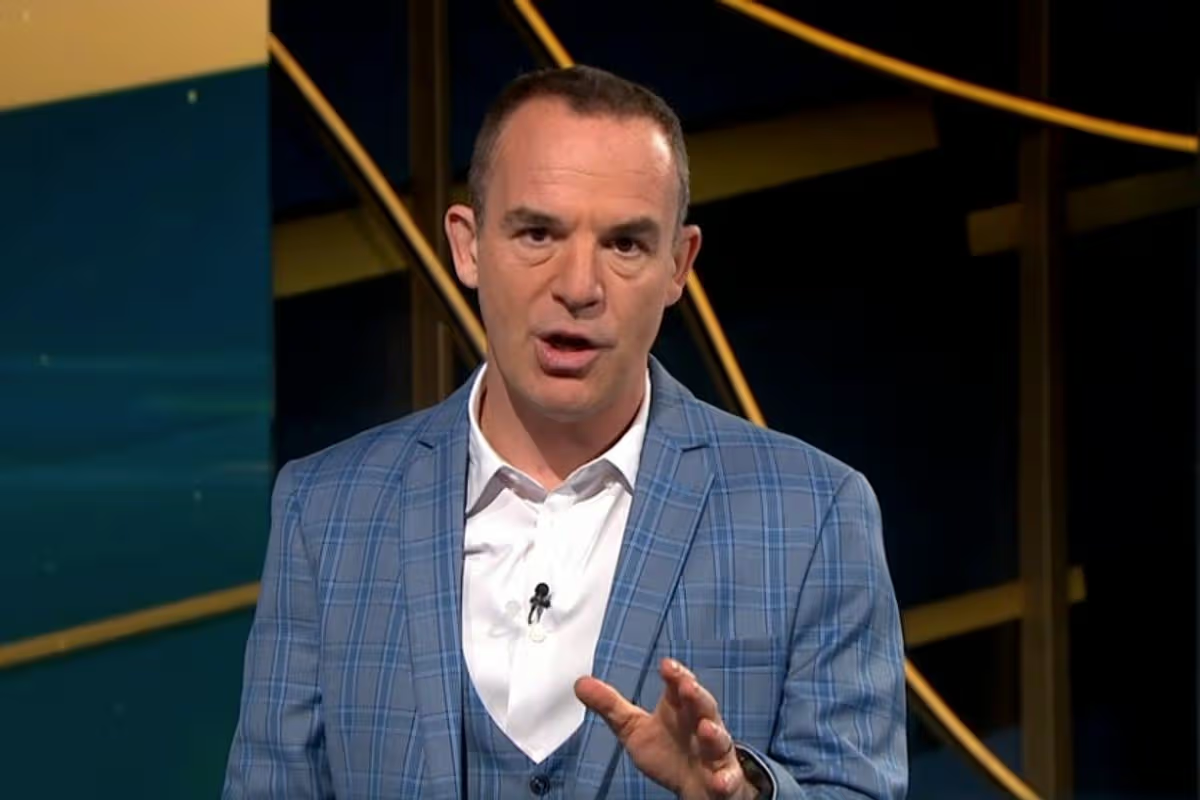
Martin Lewis Money Show

MSE Martin Lewis urges holidaymakers follow rule ‘right now’

The MSE team and Martin Lewis said to do this quickly

If you’re planning a holiday this year, there’s one crucial item on your checklist that should be ticked off first before you begin planning where to go and what to wear.

The Money Saving Expert (MSE) News team and Martin Lewis have emphasised the importance of securing travel insurance as soon as possible after booking a holiday. Many people tend to leave it until the last minute, but as Martin Lewis recently explained on The Martin Lewis Money Show Live, without insurance, you may not be able to recoup your costs if something prevents you from travelling, potentially losing thousands.

According to MSE, during the show, Martin Lewis said: “Travel insurance is not just to cover you while you’re away. It’s also very important to cover you in case something happens before you go that stops you going.

“I have a rule: you should get your travel insurance ASAB – as soon as you book. ASAB.”

The financial expert added: “Right now, many people have already booked. If you don’t have your travel insurance and if your holiday’s booked, do it right now.

“The reason I do this is every year, someone asks me a question something like, ‘I’ve been diagnosed with cancer. We can’t go on the holiday. They’re saying we can’t have our money back. What do I do?’ And I’m impotent.

“Because the answer is, you get on your travel insurance. And they say, ‘Well, I haven’t got my travel insurance yet’. Do not get your travel insurance the day before you go. You get your travel insurance ASAB.”

Speaking to his co-host Jeanette Kwakye, who is also a former Olympic sprinter, she revealed that a viewer had contacted the programme regarding a difficult predicament they were facing.

Jeanette shared their message, reading: “I booked a holiday for Christmas last year, but I was then medically advised not to fly. The holiday was already paid for and I hadn’t taken out any travel insurance. I’m now being told I’ve lost all the money for the holiday. Is there anything that can be done?”

READ MORE: Travel expert Simon Calder issues Spain airport strike updateREAD MORE: Simon Calder predicts Easter ‘disruption’ with millions set to travel

Martin said: “Please don’t be the person this summer who asks me that question. If you’re going to get travel insurance, ASAB.

“The answer [to whether something can be done] is no. I mean, look, very simply, just think about it for a second. If you bought a tennis racket and you broke your arm, you can’t say to them, I want a refund because my arm’s broken.

“The tennis racket still works. The flights still work, the hotel still works. It’s not them that’s got the problem. It’s you. That’s the logic. That’s what you have insurance for.”

Foreign Office and travel insurance

While you can take out travel insurance, it is worth noting that it could be invalidated, even if you take it out when you book. For example, if you are planning on heading to Dubai, the Foreign Office has said on its GOV.UK website: “Your travel insurance could be invalidated if you travel against advice from the Foreign, Commonwealth & Development Office (FCDO).”

At present, it states: “FCDO advises against all but essential travel to United Arab Emirates.”

For detailed information and advice on Foreign travel insurance, visit the GOV.UK website online here. It also advises: “You should buy your travel insurance as soon as possible after booking your trip. Read the small print and familiarise yourself with any exclusion clauses for the policy.”

Alongside insurance, it is recommended that you review FCDO travel advice and register for alerts for your destination. GOV.UK confirms: “If you travel to a destination where FCDO advises against all but essential travel or all travel, your insurance may be invalidated.”
Source link

Martin Lewis issues alert to anyone with more than £11,000 in savings

Martin Lewis has explained the personal savings allowance and when basic rate taxpayers with over £22,000 in savings could pay tax on interest earned

Martin Lewis has issued a tax alert for savers, with a particular warning for those holding more than £11,000 or £22,000 in savings, depending on their tax bracket. On his ITV programme this week, Mr Lewis provided savers with guidance on structuring their savings to prevent unnecessary tax charges on interest.

He began by explaining the personal allowance, which permits anyone to earn £12,570 before any tax is levied. This threshold has remained frozen since 2021, and last November Chancellor Rachel Reeves controversially extended this freeze until 2031.

The freeze has faced criticism for creating ‘fiscal drag’, meaning more of the lowest earners in the country now pay tax as inflation and wage rises leave them with less disposable income whilst facing higher taxation.

On this he said: “The first one, the personal allowance, £12,570 a year that you can earn from any source, earnings, rent, savings, interest without paying tax on. Most people get that unless you start earning over £100,000 when it’s taken away.”

Starting Rate for Savings Tax.

Mr Lewis said: “The next one not that many people know about is called the starting rate for savings. This is another £5,000 of savings. savings interest you can earn a year on top of the personal allowance. And this is designed for people who have low work earnings but high interest on savings. Often people who are retired. And here’s how it works.

“For every pound of earnings you earn above this allowance, you lose a pound on your starting savings rate. So imagine you earn £13,570. You’re a £1,000 above that. You can now only have £4,000 of tax-free interest in your savings due to the starting savings rate. And by the time you earn from work £17,570, this is gone. So it’s only for people on low work earnings and high interest on savings.”

Content cannot be displayed without consent

He previously outlined that those in the ‘perfect circumstance’ would receive £12,570 from earned income. Mr Lewis explained the individual would then gain £5,000 through the starting savings allowance, plus £1,000 from the personal savings allowance on top ‘because they all go on top of each other’.

He added: “You could earn £18,570 a year tax-free with £12,570 of it coming from work or other sources, and another £6,000 of it coming from savings. I hope that makes sense. The main two for most people are the personal allowance and the personal savings allowance, but for those on lower incomes, it’s worth reading the starting savings allowance guide that’s our money saving expert just so you really understand it.”

Personal savings allowance

Mr Lewis described this as the ‘big one’ and said: “Next, we get the big one that many of you will know about, the personal savings allowance. And this is on top of those two. This is the fact that a basic rate taxpayer, 20% taxpayer, can earn £1,000 a year of interest in any form of savings at all without paying tax on it. Now, the top savings accounts at the moment pay about 4.5 per cent. So, you need about 22,000, just a little over £22,000 in the top savings account before you earned £1,000 interest.

“So, if you got less than that, you’re not going to be paying tax on your savings interest because it’s tax free. High rate tax because it’s within your personal savings allowance. High rate taxpayers pay £500 a year of interest they can make each year tax free. It’s about £11,000 saved at the top rate.

“If you’re an additional rate taxpayer earning over £125,000, you don’t get one of these. So, you got your personal allowance, your starting rate for savings, and on top of that up to another £1,000 in your personal savings allowance.”

For the 2025/26 tax year, the UK Personal Allowance stays at £12,570, with a 20% basic rate (up to £50,270), 40% higher rate (£50,271-£125,140), and 45% additional rate (over £125,140) applying to England, Wales, and Northern Ireland.

ISAs

Mr Lewis stated that this week’s show was focused on ISAs, explaining: “You can put up to £20,000 a tax year in, as you know. And crucially, the interest earned in a cash ISA does not count towards the personal allowance, does not count towards the starting rate of savings does not count towards the personal savings allowance. It is totally separate from that. So, anything you earn in there is not taxable. I should note premium bonds work roughly the same way, but it’s not an annual allowance. It’s a maximum £50,000 you can put in in total. Those are the main ways that you can save without paying tax on them.”

Source link