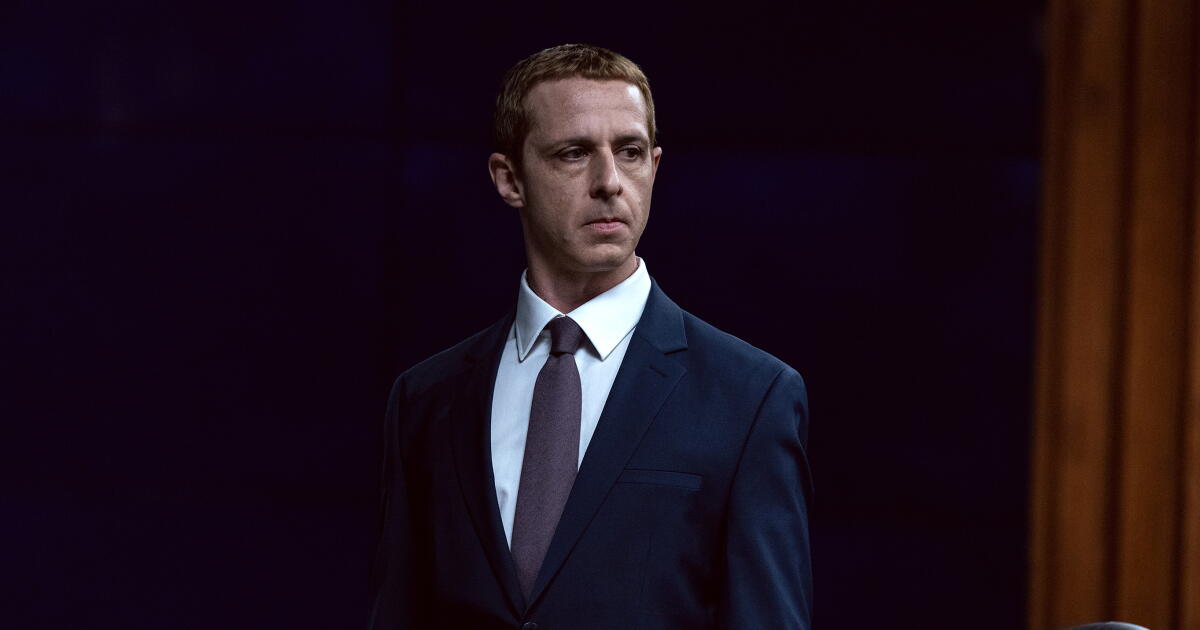
mark zuckerberg

These Californians spent 0.07% of their billions to oppose Prop. 40

About 260 California billionaires would be subject to Proposition 40’s one-time 5% wealth tax according to the Forbes Real-Time billionaires list. Just 30 of those billionaires or their spouses, or 1 in 8, spent money opposing Proposition 40, the billionaire tax, according to a Times analysis of recent campaign filings.

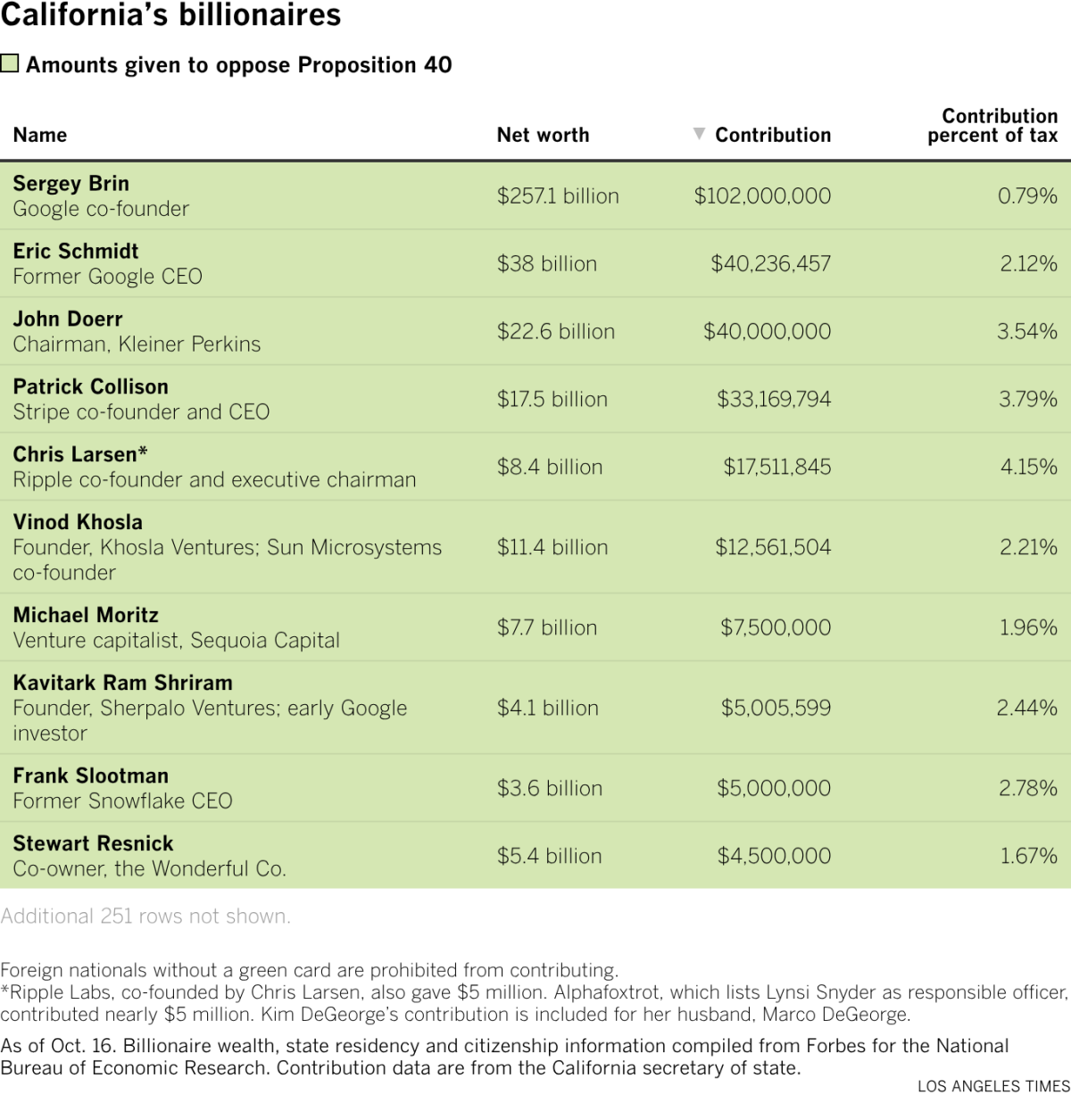
Billionaires have individually contributed $293 million to oppose the tax measure and to support Proposition 41 and 42, which would nullify the billionaire tax if either receives more votes, according to a Times analysis. Sergey Brin, co-founder of Google, has given $102 million, more than a third of all billionaire money against the measure. But this is less than 1% of his estimated tax bill.

Several billionaires also contributed to the political action committee of the California Business Roundtable, which is spending to oppose Proposition 40 and support Proposition 43. Peter Thiel gave $3 million, Eric Schmidt gave nearly $2.6 million, Marco DeGeorge’s wife, Kim, gave $1.9 million, Chris Larsen gave $750,000 and Douglas Leone and his wife gave $500,000.

Proposition 40 would apply the tax to billionaires who were California residents on Jan. 1, 2026, and the taxable amount would be based on their net worth on Dec. 31. The tax is payable over five years.

Altogether, these individuals would owe at least $107 billion in taxes, according to an analysis by economists Jasper Boll, Emmanuel Saez and Gabriel Zucman. Their research was published in the National Bureau of Economic Research in August. Saez and Zucman are also architects of the tax proposal.

This amount is 5% of their combined estimated wealth by Forbes as of Oct. 16 and factors in a certain amount of tax avoidance and evasion. Spread across all 39 million Californians, the $107 billion would be roughly $2,700 per person. The Public Policy Institute of California estimates that the median household net worth in California was $303,000 in 2023.

The four richest Californians — Sergey Brin, Jensen Huang, Larry Page and Mark Zuckerberg — would owe 40% of the estimated taxes to be collected from the billionaire tax, according to a Times analysis. Their wealth largely comes from ownership of stock in extremely high-value technology companies.

Their net worth would increase 5% in about four months if their stock investments continues to grow as they have since December.

California billionaire wealth grew nearly threefold from 2022 to 2026, according to Times analysis of Forbes data collected by Boll and his colleagues, and much of that growth was not taxed. Billionaires’ taxable income is small compared with their wealth, because most of that wealth is invested in public stocks, and gains aren’t taxed until the stock is sold.

Page and Brin disclosed no taxable income in three of the years since 2019. Many others had similarly no publicly disclosed income. For that reason, Boll and his colleagues estimate that the Proposition 40 one-time tax would raise more than $100 billion, “with comparatively minor impacts on income tax revenue” from some billionaires leaving the state.

Based on Meta’s filings, the economists estimated that Zuckerberg’s taxable income was about $947 million in 2025, just 0.4% of his net worth.

Over the summer, Zuckerberg shared with Meta advisors his plans to relocate outside California to avoid the possibility of a significant reduction in his control over the company as a result of selling enough stock to fund a 5% tax. The advisors determined that Zuckerberg’s leadership presence at Meta headquarters was essential to the company’s success. On Wednesday, Meta announced the creation of new, nonvoting Class C common stock, which will allow Zuckerberg to sell the amount he needs to pay his potential tax bill while maintaining his voting power in exchange for his commitment to remain in the state for eight years.

Researchers at the Hoover Institution estimate the revenue to the state to be closer to $40 billion based on reports of billionaires’ residential purchases outside the state before and after Jan. 1 and their estimate of unannounced residency moves.

Chris Hoene, executive director at the California Budget and Policy Center, a nonpartisan group, said the residency question hinges on the amount of time spent living in the state. “Purchasing property in another location does not mean that they have changed their residency,” he said.

Ultimately, the state’s Franchise Tax Board, responsible for administering the tax, will have to assess residency. Hoene says this task is “easier for them to do than people realize.” The board will also calculate the amount of wealth subject to the tax using publicly available stock information and private assessments of personal property, such as artwork and jewelry. Real property, pensions and retirement accounts would be excluded.

Opponents of Proposition 40 are concerned that the threat of wealth taxes will lead to billionaires continuing to leave the state, resulting in a long-term decrease in state income tax revenue. Forbes recently reported that Brin registered to vote in Nevada last year. Peter Thiel disclosed Dec. 31 that he opened a new office in Miami; Florida has no wealth tax or income tax. But in July, he purchased a $130-million mansion in Bel-Air.

“The reality is the income tax loss can never get anywhere near the scale of what the wealth tax gain would be,” Hoene said.

Ninety percent of that gain would be spent on healthcare services to fill a gap in Medi-Cal from losses in federal funding that the measure’s authors estimate would total $190 billion over the next 10 years. Medi-Cal provides healthcare coverage for one-third of low-income Californians, according to the Legislative Analyst’s Office.

Gov. Gavin Newsom opposes a California-only tax and has instead called for a national wealth tax. Democrat Xavier Becerra and Republican Steve Hilton, who are running to replace Newsom, have spoken out against the tax. Other opponents include the California Teachers Assn., the California Medical Assn., and Planned Parenthood Affiliates of California. Supporters include Service Employees International Union, U.S. Sen. Bernie Sanders (I-Vt.), the California Democratic Party and the California Federation of Labor Unions AFL-CIO.

Times staff writer Queenie Wong contributed to this report.
Source link

‘The Social Reckoning’ review: Sorkin’s follow-up is awkward

Aaron Sorkin’s “The Social Reckoning,” a sequel to 2010’s David Fincher-directed “The Social Network,” is hitting theaters as part of a surge of tech geek takedowns that includes documentaries on Elon Musk and Theranos’ Elizabeth Holmes, as well as Luca Guadagnino’s upcoming comedy “Artificial” about OpenAI’s Sam Altman.

Still, its timing couldn’t be worse.

Cursory and hollow, it recounts the true story of Wall Street Journal reporter Jeff Horwitz (Jeremy Allen White) and Facebook whistleblower Frances Haugen (Mikey Madison), a disenchanted data engineer on the company’s civic integrity team, who paired up for a 17-part investigative series that provided proof of what people already sensed: Facebook boosted misinformation and rage-bait to juice user engagement at the cost of our country’s mental health.

The script ends shortly after Haugen testified before Congress in October 2021, noting that the carpet in her waiting room had recently been swapped out because of bloodstains from the Jan. 6 Capitol attack. The film rewinds to that day, too, and attempts to squeeze drama from slow-motion reenactments of the rioters, which Alexandre Desplat scores to an overbearing military dirge as Mark Zuckerberg (Jeremy Strong) and his good little Facebook soldiers mull over whether to take down the U.S. president’s incendiary posts.

Back in our own reality, Zuckerberg and the president just had lunch last week. At this point, we’re all so psychically drained that the only response we can muster to this vacant period piece is: So what?

Sorkin has my sympathies. The future moves faster than a film in development. And he fundamentally gets the peril we’ve put ourselves in by entrusting Zuckerberg, who is, at minimum, an ethically askew man. After all, Sorkin’s own screenplay for “The Social Network” remains a prescient masterpiece.

But the movie’s problems go beyond arriving simultaneously too slowly and too soon for Zuckerberg’s endgame, where his emptying social media empire has him gambling his fortunes (and ours) on AI. Expanding his scope from Harvard to the planet, Sorkin now aims to show that we’re all trapped in Zuckerberg’s insensitive mind view. Cold computer speak has infected everyone like a virus. When Madison’s Frances goes on a blind date, her online match says he appreciates that the internet makes it simpler for singles to pair up “within their own vector.” The buddy-buddy Winkelvoss twins’ version of the app might actually have been better for the world.

Meanwhile, Zuckerberg, who mostly stays on the sidelines of the movie, is now a mighty billionaire and, as Strong plays him, a dour, lifeless dork. Gone are the beer bashes, the thrill of invention and any hint that Zuckerberg lusted for something — women, attention, clout — other than a quarterly earnings report. This Zuckerberg is no longer made of flesh and blood but ones and zeros. Pity Strong couldn’t play the CEO after his bro-y 2024 mutation into MMA-fighting Marky Mark. At least that guy is amusingly ridiculous. Trapped in this stiffer, earlier incarnation, the only acting Strong is able to do is poke his head straight up from his shoulders until he resembles a retractable pen.

Worse, all the other characters in the film talk just like him: charmless, frigid and quick to cut each other off with snippy corrections. I could forgive that if it was just Facebook’s employees: Madison’s quavering, exasperated Frances, the co-worker (Anna Lambe) who insists she and Frances are merely colleagues, not friends, even after their company frittered away the meaning of the word, and a media relations executive (a smooth Billy Magnussen) who gets the scariest line, coolly insisting that “we’re post-government around here.” After all, these are the folks who saw “The Social Network” and still wanted to work for Zuckerberg.

But the opposition is steeped in that same monotone rudeness. Sorkin must have adored that earlier film’s opening scene where Rooney Mara insults a clueless Jesse Eisenberg because he’s written three-dozen takes on it. At Sorkin’s version of the Wall Street Journal, everyone up and down the masthead — editors, writers, even interns — insults each other with such relish that someone should be written up by HR. The fast-and-furious dialogue hits its nadir when Madison’s Frances slips Jeff important documents that he can’t even read because she nonsensically starts chattering about the looming coronavirus.

Here’s where you say that this is just how Sorkin writes characters. And here’s where I counter that a movie about how algorithms destroy humanity has to have some credible humans in it, if only to illustrate its own point.

Instead, Sorkin’s protagonist-bots come with bolted-on personality quirks. White’s journalist is a Luddite who would rather be late to his own job interview than use Google Maps. He comes across as so clueless that the audience can barely credit him for his reporting work winning an eventual Pulitzer — he’s just soulful eyes and a cellphone ringtone that tinkles old show tunes.

Madison, 15 years the junior of the real Frances, is too young to convince us that her character truly believes she can turn Facebook into a digital utopia. An ultra-online 20-something, she was a front row witness to Gamergate, yet somehow she’s shocked to overhear about middle-school girls getting bullied on Instagram. Her character wears legwarmers and knit wristlets to the office as protection against the air conditioning, which also serves to emphasize her company’s interpersonal chill.

Yet, bizarrely, the script makes Frances dress like a sex worker whenever she sneaks to Jeff’s hotel to slip him some corporate secrets. It’s a disguise, she explains, although the gag is so forced that it’s just as easy to believe the literal-minded girl is taking her Deep Throat identity too seriously. Or perhaps Sorkin just wanted to remind audiences that this awkward creature is the same actor who won the Oscar stripping off in “Anora.”

A few moments do work, like an opening showdown between a drunk blond (a nasty-great Portia Doubleday) and two cops that gets live-streamed to the web, and Zuckerberg’s congressional coaching sessions with his crisis team, played by Wunmi Mosaku and the comedian Bill Burr. From what we learn of Burr’s Charlie Garrigan, an insider who sold his Facebook stock too fast and then wrote a negative New York Times editorial against the company, he seems to be inspired by early co-founder Christopher Hughes, which would made him the only other callback character from “The Social Network.” But Sorkin has changed his name and upped his age, so as fun and ferocious as Burr is, we also spend his scenes feeling a little confused.

Do we learn anything new about Facebook itself? No. Still, I appreciated how dismissive Frances gets when asked to confirm small scandals that she finds too piddly to care about, like Jeff’s suspicion that Zuckerberg is goosing his posts so that positive comments outrank negative ones 32 to 1. That’s just obvious, her posture says. Facebook is over two decades old and he still hasn’t made many friends.

‘The Social Reckoning’

Rated: R, for language

Running time: 1 hour, 53 minutes

Playing: Opens Friday, Oct. 9 in wide release

Source link