POP star Pixie Lott has morphed into Hollywood golden girl Marilyn Monroe for a new West End role.
Taking the titular part in Who Killed Marilyn? Pixie has wowed early audiences with how uncannily she embodies the pin up, in a play about her life and death.
Pixie Lott has morphed into Hollywood golden girl Marilyn Monroe for a new West End roleCredit: SplashActress Marilyn Monroe in Gentlemen Prefer BlondesCredit: Getty
Images from the show see Pixie, 35, showcasing Marilyn’s iconic look, complete with platinum blonde wig and a slick of bright red lipstick.
The star slipped into a white satin dress (based on the gown Marilyn wore in The Seven Year Itch in 1955) and kissed a hunky co-star in scenes from the show, which debuted on Saturday and has been lauded by theatregoers.
Sign up for the Showbiz newsletter
Thank you!
The West End run is a deep-dive into the woman behind the legend, inviting audiences to “experience the mystery, the glamour and the raw emotion of Who Killed Marilyn?” following decades of conspiracy.
The starlet was discovered dead in Los Angeles on August 5, 1962, aged just 36.
Taking the titular part in Who Killed Marilyn? Pixie has wowed early audiences with how uncannily she embodies the pin up, in a play about her life and deathCredit: SplashImages from the show see Pixie, 35, showcasing Marilyn’s iconic look, complete with platinum blonde wig and a slick of bright red lipstickCredit: SplashThe West End run is a deep-dive into the woman behind the legend, inviting audiences to “experience the mystery, the glamour and the raw emotion of Who Killed Marilyn?” following decades of conspiracyCredit: SplashHistory has been rife with theories about the star’s demise, thanks to her links with former US President John F Kennedy, his brother Robert, and rumours of a mob cover upCredit: Instagram/@pixielott
The actress’ death was officially ruled a probable suicide from a barbiturate overdose, but playwright Sharleen Cooper Cohen and director Philip Wm. McKinley have told theatregoers to “get ready to question everything you thought you knew…”
History has been rife with theories about the star’s demise, thanks to her links with former US President John F Kennedy, his brother Robert, and rumours of a mob cover up.
The synopsis reads: “Who Killed Marilyn? dares to challenge the most enduring myth surrounding one of the twentieth century’s most iconic women.
“Drawing on decades of documented evidence, conspiracy and cover-up, the production presents a vivid and provocative re-examination of the life and death of Marilyn Monroe, placing her at the centre of a web of power, politics and desire that reached the highest levels of American government and organised crime.
“Who Killed Marilyn? restores Marilyn Monroe to her rightful place, not as a victim, but as a woman of extraordinary intelligence, wit and force, whose story has never been fully told. Until now.”
Pixie – who is married to model Olicer Cheshire and has two sons – recently said of the role: “I have always loved Marilyn, she is such a fascinating, timeless legend, and bringing her complex story to life on this beautiful stage and being her every night is an absolute dream come true for me.”
During a trip to the beautiful desert city of Palm Springs in California, home to Golden Age Hollywood stars, I found myself with a Guinness World Record after a jolly great time
12:24, 08 Jun 2026Updated 12:26, 08 Jun 2026
I found myself with a Guinness World Record after a trip to Greater Palm Springs(Image: Getty Images)
If someone told me earlier this year I’d have a Guinness World Record to my name, I would have thought they were joking. But here I am, with the notorious title following a trip to the United States.
You’re probably wondering what on earth I did to secure a Guinness World Record, and no, it wasn’t some ludicrous challenge. Instead, all I needed was a blond wig, red lipstick, and a white dress.
I was in the beautiful desert resort city of Greater Palm Springs, known for its Hollywood glamour, mid-century modern architecture and natural hot springs, when this all took place. The Southern California oasis, nestled in the Coachella Valley, was once home to Golden Age Hollywood stars, including Frank Sinatra and Elvis Presley, but I was there for Marilyn Monroe.
The iconic American actress and model became a global sensation during the 1950s and early 1960s, and was often known for her persona as the ‘blonde bombshell’. She tragically died at the tender age of 36 in 1962, but spent much of her adult life in Palm Springs and is known to have spent time in a trendy bungalow known as the Marilyn Monroe Doll House, which I passed by during my trip, still with its signature pink letter box on the front yard.
This year, on 1 June, marked what would have been Marilyn Monroe’s 100th birthday, and to mark the occasion, Greater Palm Springs hosted a celebration and mega event to secure a new Guinness World Record. And I was lucky enough to be there and take part.
The idea was to gather as many Marilyn Monroe lookalikes as possible in one place for a Guinness World Record attempt. The previous record was 254 in 2020, so there were high hopes that Palm Springs, the home of Hollywood, would surpass it.
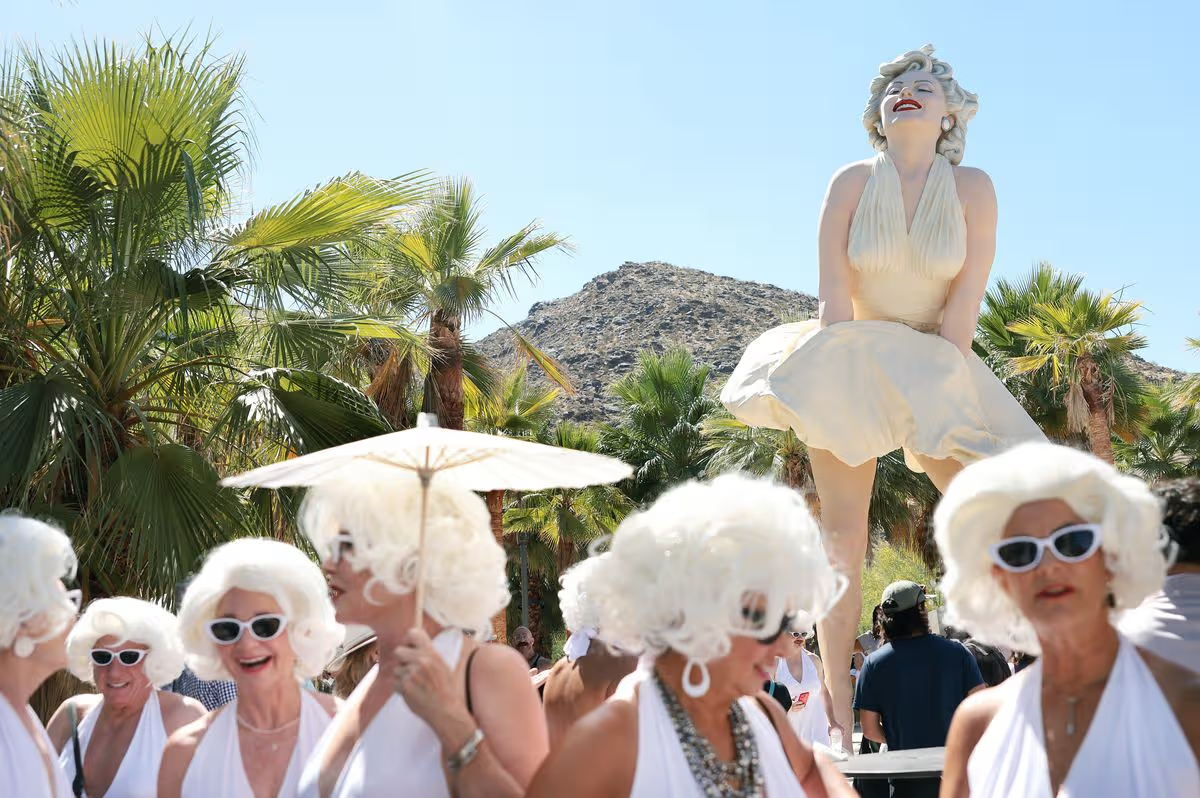
I had no idea what to expect, but after signing up for the event and securing my iconic Marilyn Monroe outfit of a styled blond wig, white dress and red lipstick, I was ready to take part. So on Saturday, 30 May, the day before her birthday, I dressed up as the glamorous star and joined my fellow doppelgangers around the Forever Marilyn statue in Downtown Palm Springs, to secure a Guinness World Record.
Remarkably, there were a whopping 1,037 Marilyn Monroe lookalikes in attendance, and it was incredible to be around so many people celebrating the icon. Everyone went all out with their outfits, accessorising with pearls, diamonds, sparkly heels, fans and feather boas.
To secure the Guinness World Record, all attendees had to be dressed in the same iconic white halter dress, platinum wig and red lipstick, and everyone absolutely was. So after gathering in our hundreds, singing happy birthday to Marilyn Monroe, and being thoroughly counted, we successfully obtained a new Guinness World Record.
“People are on a high that they get to participate in this”, Palm Springs mayor Ron deHarte told me. “It’s not unusual to have something flashy going on in Palm Springs, but this is something different.”
The Pride organisation was connected to the event, as Ron noted, “Marilyn Monroe had a voice, and she used it.” And I could feel the celebrations, the love, kindness, acceptance, and overall pride of this city as I put on my best Marilyn Monroe impersonation and joined the joyful, spirited community of Palm Springs for a Guinness World Record.
It was certainly an honour to take part in such an event, and one I won’t forget in a hurry. After all, there are only 1,037 of us across the globe who can say we broke a record by dressing up as Marilyn Monroe in the desert.
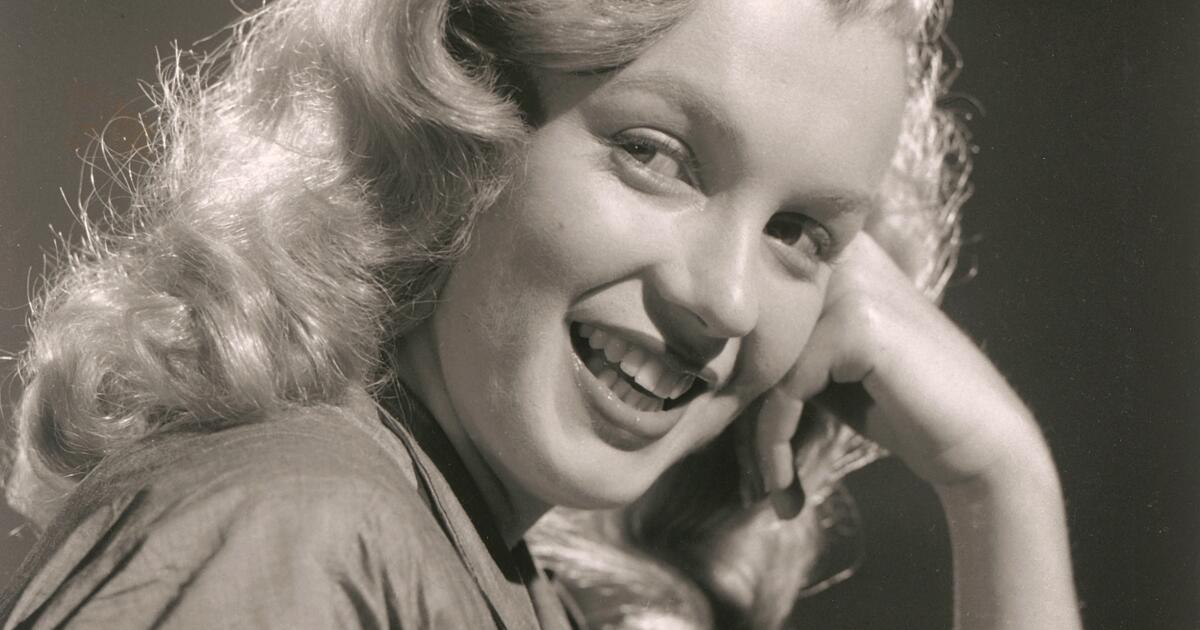
It was the summer of 1949 when a 22-year-old, newly hired Milwaukee photojournalist was assigned to take portraits of an unknown 23-year-old actor passing through town on a publicity tour. John Ahlhauser spent 30 minutes capturing seven photos of the up-and-coming starlet. One was published in the Milwaukee Journal Sentinel and Ahlhauser took the other six home.
That unknown actor was Marilyn Monroe (although her legal name was still Norma Jeane Mortenson).
To celebrate Monroe’s 100th birthday on June 1, five photos from the shoot are being auctioned off through proxy bidding until Tuesday morning, when the live auction will occur. The photos were shot as part of a promotion for Monroe’s brief role in the Marx brothers’ final feature together, “Love Happy.” According to Ahlhauser’s daughter, Mame O’Meara, these pictures represent an unguarded and unedited version of the celebrity.
“When we took it to ‘Antiques Roadshow’ — which it did not get on at that moment — they said these are before she got her nose job, before she went platinum, and that she had developed a look in her eye in January of 1950 that really kept you out of her personal space,” O’Meara said. “They describe these seven little pictures as windows into her soul.”
The Milwaukee Journal Sentinel ran one photo in 1949 and a second image was used in Gloria Steinem’s 1988 book, “Marilyn: Norma Jeane.” In 2011, all of Ahlhauser’s work was placed in a trust, including his photos of Monroe.
Monroe’s estate was controlled by Anna Strasberg, the second wife of Monroe’s acting coach and close friend, Lee Strasberg, since his death in 1982. O’Meara explained that the family waited to release Ahlahauser’s photos of Monroe because of the “contention” over Anna Strasberg’s ownership of Monroe’s image. Strasberg died in 2024.
“Strasberg was fighting in court for all of the images of Marilyn, and we put these in a trust and actually worked to keep them quiet at that time,” O’Meara explained.
When Ahlhauser died in March 2016, O’Meara and her five siblings inherited hundreds of their father’s yellow Kodak photo boxes. Inside the boxes were his photos of Monroe, organized with the “sleeve dated and with the assignment on the outside.”
“I wanted to touch absolutely everything in the boxes,” O’Meara said. “[My siblings] were both gracious, and none of them wanted to, and so I have had the privilege the last six years of going through every print he ever made, and I’m just working on the negatives now.”
However, O’Meara and her siblings aren’t entirely ready to let go of Monroe yet. While they’ll be auctioning off five of the photos, they’re planning to keep two.
“We’re selling these five, and people can take the copyright and put them on coffee mugs, or make an AI movie, or whatever they want to do with them,” O’Meara said, laughing. “We’ll just keep the two really nice ones that he was so proud of. We’ll keep those in his collection, and we can sell prints if we feel like it.”
While Ahlhauser’s photo of Monroe may become his most iconic image, the session didn’t feel like a particularly notable event in his career. It wasn’t as impactful as when he photographed the 1968 Democratic National Convention in Chicago or civil rights marches in 1960s Mississippi. But for O’Meara, that’s where the beauty of these photos lies.
“They are both really nobodies; they’re both people doing a job,” O’Meara said. “And yet, when I look at those pictures, I think they both had to really allow themselves to let the camera find the vulnerability, and that to me is the art in it.”
There she stands, in that iconic hot pink gown, arms thrown open wide as if to both offer herself to the world and embrace what the world offers — love, applause, admiration and diamonds, which are, as she sang from the body-hugging confines of that pink silk in “Gentlemen Prefer Blondes,” a girl’s best friend.
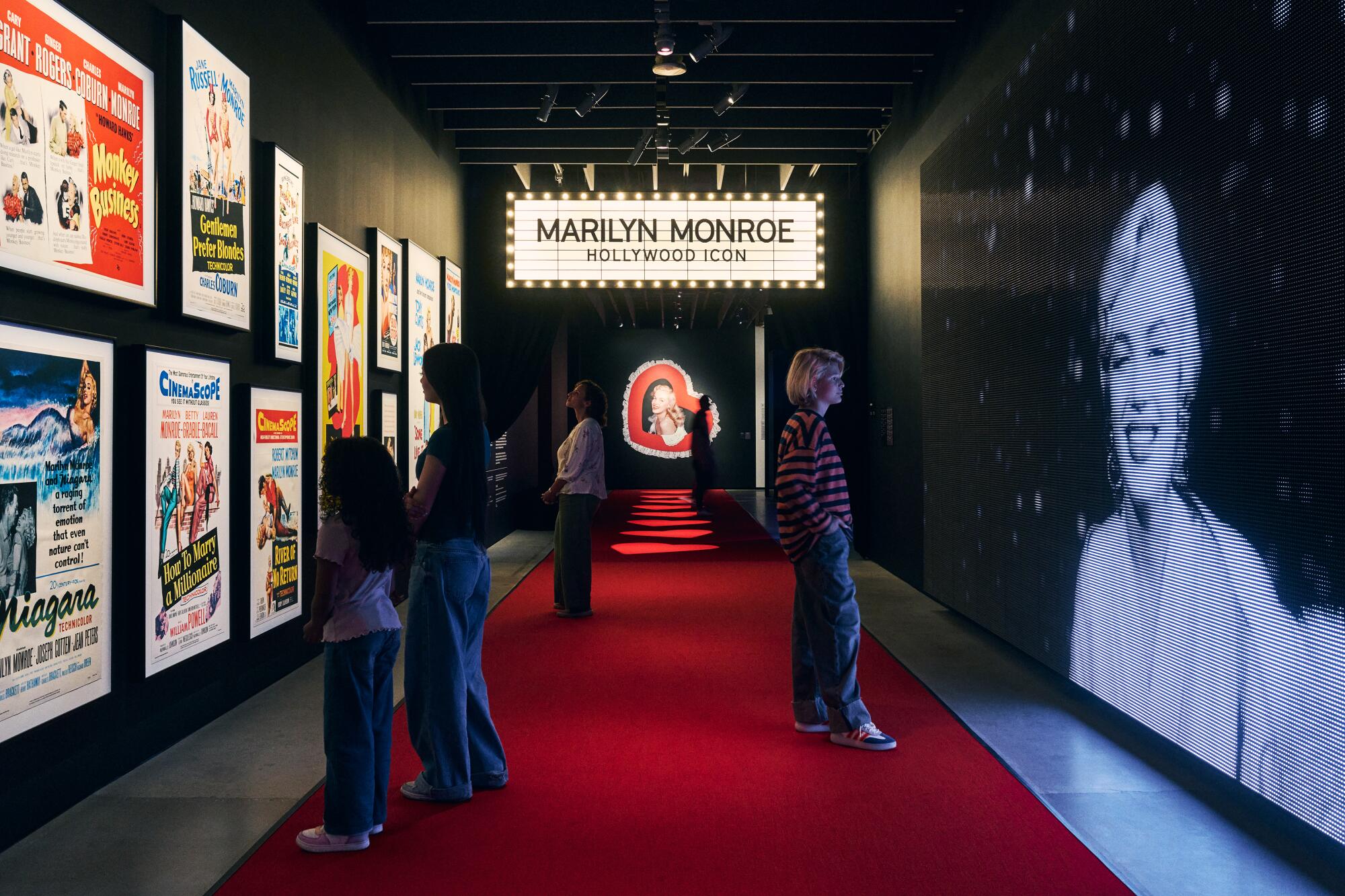
It isn’t her, of course, though it is the dress, designed by William Travilla and now a part of the new “Marilyn Monroe: Hollywood Icon” installation at the Academy Museum of Motion Pictures. Opening Sunday, it is just one of many exhibitions and events timed to celebrate the 100th anniversary of Monroe’s birth.
More than 60 years after her death, Monroe still glows brightly in the Hollywood firmament. Her career only lasted 17 years, but during that time she dazzled so brightly that her image, and all that has been projected onto it, remains burned into our collective line of vision, an unfading afterimage of a bursting star.
As the Academy Museum’s exhibit underlines, Marilyn Monroe was a pioneer in many ways.
(Emily Shur / Academy Museum Foundation)
Her death — at 36 by way of overdose — did much to cement her legacy, generating international headlines and then a multitude of conspiracy theories, many of them involving powerful men, including members of the equally mythic Kennedy family.
Tragedy and mystery are powerful binding agents, but they do not quite explain the tower of books that have been, and continue to be, written about her (including several out this year) or the many films made about her life or the art she has inspired, from Andy Warhol’s iconic silkscreen “Marilyn Diptych” (done a year after her death) to Seward Johnson’s massive statue “Forever Marilyn,” which, after some controversy, made its forever home in Palm Springs five years ago.
Marilyn Monroe’s personal items on display include parts of her makeup regimen.
(Emily Shur / Academy Museum Foundation)
As the Academy Museum’s exhibit underlines, Monroe was a pioneer in many ways. In the repressive ‘50s, she was sex positive and spoke openly about psychotherapy and the vagaries of fame. She often defied studio heads, was one of the first actresses to start her own production company and demanded approval of her many photo sessions.
She had multiple marriages, problems with drugs and alcohol and a reputation for being difficult on set, but she was unafraid to both call out the press and banter with them.
Still, she is not seen by the masses as a pioneer, a term that brings to mind scientists and suffragettes. No, Monroe remains a mesmerizing, radiant symbol — of beauty, glamour, sensuality, a life force so rare that it could not be expected to survive long in a world full of envy and petty demands.
In putting together “Marilyn Monroe: Hollywood Icon,” associate curator Sophia Serrano spoke with many devoted fans, including those whose collections helped build the exhibit, and they all said the same thing.
More than 60 years after her death, Marilyn Monroe still glows brightly in the Hollywood firmament.
(Emily Shur / Academy Museum Foundation)
“Even though she had a tragic ending,” Serrano said, “people would say she is a symbol of resilience. Her story is like a movie — an orphan who makes it big, then loses it all. They see her as battling the studio, wanting to get more nuanced roles and not getting the roles she wanted. … A lot of people latch onto her because she gives them hope.”
In many ways, Monroe is, and was, a piece of art herself, onto which we could project our own longings and adulation. But that art, Serrano says, was created by Monroe, with equal parts natural magnetism and a canny, rigorous sense of her own strengths.
In 1952, when she was a rising star, a journalist realized a nude pin-up being used in calendars and posters was Monroe; she had posed for what is now known as the “Golden Dream” series five years before. Monroe was filming 20th Century Fox’s “Gentlemen Prefer Blondes” at the time and studio head Darryl Zanuck pressured her to deny that the photos were of her.
Monroe did the exact opposite, shrugging it off in an interview, in which she said, “I was broke and I needed the money. … I’m not ashamed of it; I’ve done nothing wrong.”
“Marilyn Monroe: Hollywood Icon” opens Sunday at the Academy Museum.
(Emily Shur / Academy Museum Foundation)
Monroe’s unique, and, to a certain extent, self-constructed combination of vulnerability — the wide eyes, the half-open mouth, the child-like voice — and essential grit is what fuels her continued cultural resonance and what forms the guiding principal for the Academy Museum’s exhibit.
An exhibit on the life and legacy of Marilyn Monroe could fill an entire museum so for purposes of this exhibit, Serrano and her team chose objects that were relevant to her life. This being the Academy Museum, much of it focuses on her career in film. Costumes from her various movies (including the original exhibition copy of the famous white dress from “The Seven Year Itch”) occupy a big portion, in part, Serrano says, because Monroe was so often involved in their design.
“She was so smart, looking at these costumes,” Serrano says. “She was obviously Fox’s star for Cinemascope — she’s how they marketed the new technology and she didn’t like how certain silhouettes looked so she would not wear A-lines in Cinemascope because she thought the effect was unflattering. She really paid attention to how things worked and then knew how to control and edit and manage.”
Costumes from Marilyn Monroe’s various movies.
(Emily Shur / Academy Museum Foundation)
The pink gown from “Gentlemen Prefer Blondes” has its own story. Monroe’s character was originally to appear in bejeweled hot pants (also on display), but when the Golden Dream “scandal” broke, Zanuck demanded that she wear something less revealing.
Many personal items are on display as well, including the shoes she wore to her wedding to Joe DiMaggio, a rare apology from gossip columnist Hedda Hopper, marked-up scripts and parts of her makeup regimen (including a face-slimming mask she wore after being told she had a double chin). The love-hate relationship she had with the press is well represented by newspaper clippings and newsreels.
Marilyn Monroe’s famous white dress from “The Seven Year Itch.”
(Emily Shur / Academy Museum Foundation)
A whole room is devoted to scenes from her more famous films and an entire long wall to countless photographs. “She understood the camera better than anyone,” Serrano says, echoing observations made by photographers and actors who worked with her, including Laurence Olivier, who famously did not get along with Monroe during the filming of “The Prince and the Showgirl.”
Her reputation as being difficult on certain sets is also documented in a rather infuriating series of telegrams between director Billy Wilder complaining to her then-husband, playwright Arthur Miller, and Miller responding in defense of his wife.
It is a well-crafted glimpse at Monroe as a totality, including pieces from her Brentwood home and some of her own clothing, which Serrano says was far simpler than the gowns and suits she was photographed in. “Her persona was carefully constructed. She knew how to give just enough, to create the illusion of something.”
A whole room is devoted to scenes from her more famous films and an entire long wall to countless photographs.
(Emily Shur / Academy Museum Foundation)
And maybe that is the reason why Monroe continues to fascinate. Yes, she owned her beauty and sexuality with a boldness that stands out even now. Her relationship with the camera remains unparalleled — when she is in frame, it is almost impossible to look away. Her hip-swaying walk remains iconic and also, perhaps, revealing. It was achieved by putting one foot directly in front of the other, much like a tight-rope walker.
Which in many ways Monroe was, treading the line, invisible to the rest of us, between innocence and worldliness, between vulnerability and power.
The tension between the human need for both love and self-determination powers both art and madness, but never was it so tangibly brought to life than by Marilyn Monroe. Art and artist, creation and creator, she left behind a now-century-old mystery we’re still trying to unravel.
Marilyn and Her Books: The Literary Life of Marilyn Monroe
By Gail Crowther Gallery Books: 304 pages, $30
If you buy books linked on our site, The Times may earn a commission from Bookshop.org, whose fees support independent bookstores.
In 1951, not long after her breakthrough appearances in “All About Eve” and “The Asphalt Jungle,” Marilyn Monroe went to college: She enrolled in a pair of 10-week classes at UCLA’s adult-extension program, both covering literature. Looky-loos peeked through the windows. Some likely assumed a publicity stunt. But Monroe’s passion for books was sincere. An orphan who bounced around upward of a dozen foster homes and orphanages regretted that she’d never graduated high school, she moved often in her life but always made sure her books came wherever she went.
Gail Crowther’s “Marilyn and Her Books” is the story of that library, though more precisely it’s about what we’ve projected upon Monroe when we’re asked to consider that she had one. Our prevailing cultural reflex, then and now, is skepticism larded with misogyny. A famous 1955 photo of her sitting in a Long Island playground reading James Joyce’s “Ulysses” — one of 50 known photos of her reading — is routinely scoffed at whenever it’s posted online. (Crowther gathers up a sampling of misogynistic comments.)
But Crowther’s sleuthing determines that Joyce’s novel was a regular companion of hers, and she was particularly enchanted with Molly Bloom’s closing soliloquy. As an actor who had to be exceedingly smart to play dumb blondes, she used the shoot to make “a profound statement about her social positioning.”
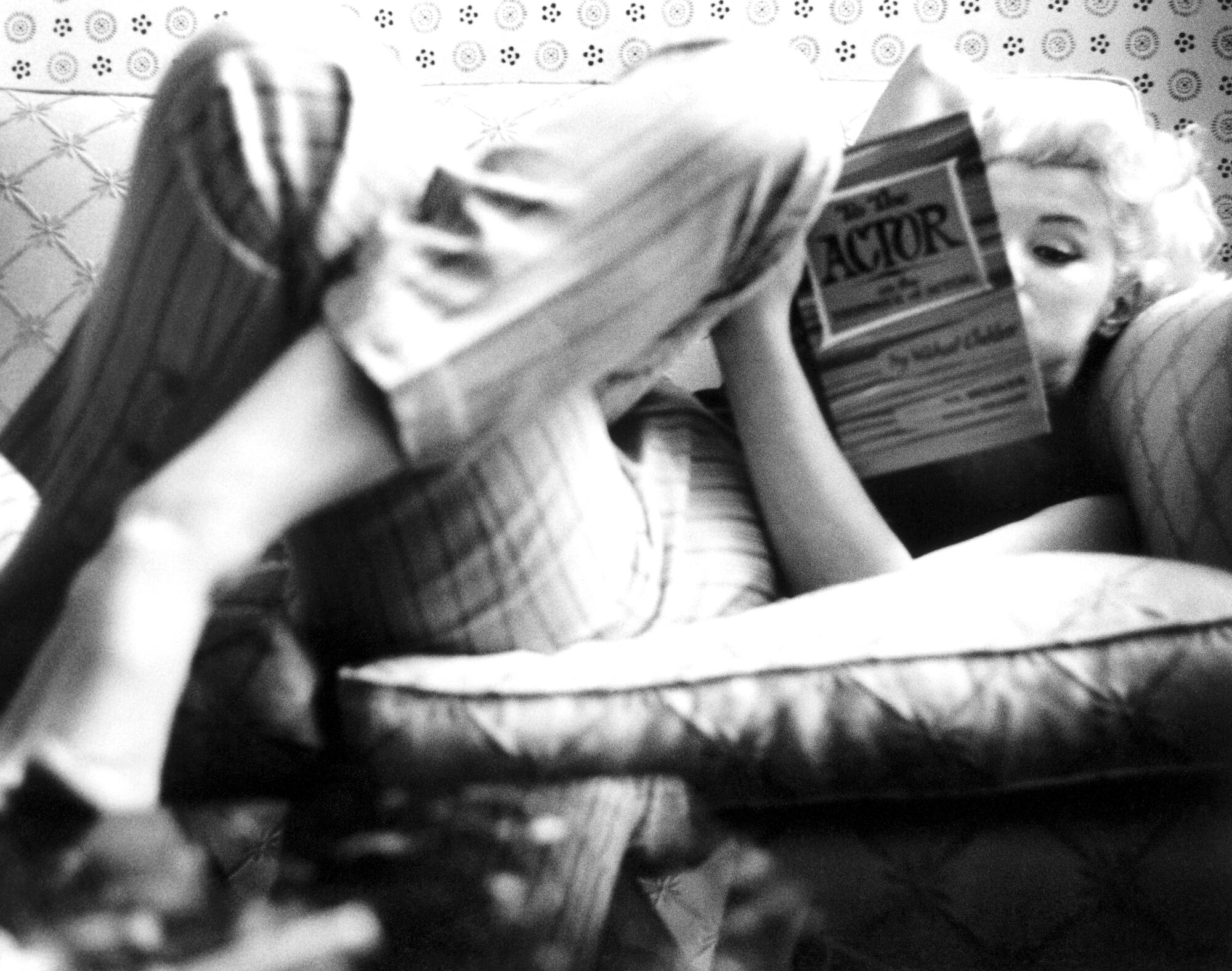
Marilyn Monroe reads the book “To the Actor: On the Technique of Acting” by Michael Chekhov in a quiet moment at the Ambassador Hotel in New York.
(Ed Feingersh / Michael Ochs Archives / Getty Images)
Writing about Monroe’s reading habits demands a lot of speculation on the part of Crowther, who’s written engaging books on Dorothy Parker, Sylvia Plath and Anne Sexton. We know a lot about the star’s library — when she died in 1962, she owned more than 400 books, diligently cataloged and auctioned in 1999. There’s documented marginalia and scribblings that suggest a serious reader, and anecdotes about her reciting poems at parties, reading Proust on set, and expounding on Whitman, Dostoevsky and Tolstoy. She had strong opinions about Hemingway: “Those big tough guys are so sick, they aren’t even all that tough. … They always want to kill something to prove themselves.”
And Crowther literally has the receipts from Los Angeles and Beverly Hills stores like the Pickwick Book Shop, Martindale’s Book Store and Hunter’s Books, where she purchased titles that were practical (“How to Live With a Cat”), relatable (“Sister Carrie”) and weighty (a three-volume life of Sigmund Freud).
Her third husband, playwright Arthur Miller, suggests the purchases were largely a pose: In his memoir, he wrote that aside from some short stories and Colette’s “Cheri” she likely never read anything start to finish. It would be nice to know more, but as Crowther pointedly observes multiple times, journalists never thought to ask her about her reading. When the subject of literature came up, Monroe seemed compelled to play to ditzy expectations. After telling interviewers she wanted to play Grushenka in an adaptation of “The Brothers Karamazov,” they asked her if she could spell the character’s name. She demurred.
A clearer historical record might have blunted the sexist comments that have stalked her, and given Crowther an opportunity to do less guesswork. “Marilyn and Her Books” is scaffolded with 15 chapters, each dedicated to a question that usually can’t be answered in full: “Did Marilyn read all her books?” (probably not, who does?), “Did Marilyn suffer from imposter syndrome?” (probably, who doesn’t?). Some questions feel like attempts to pad the pages (“Are there any surprising omissions from Marilyn’s personal library?” “How did Marilyn’s reading compare to that of her contemporaries?”). The elegiac opening and closing chapters, in which Crowther imagines visiting Monroe’s home and scanning her shelves, also add to the feeling that too much is being extrapolated out of not enough information.
Curiously, the book also dwells little on Monroe’s own literary ambitions. Crowther shares a few scraps of despairing, Plathian verse, but almost entirely neglects her unfinished posthumous memoir, published in 1974 as “My Story.” Its relative shapelessness, along with its use of a ghostwriter, doesn’t bolster her literary credentials, but its existence points to Monroe’s ambition to have them.
And there’s plenty to say about the literary work that Monroe herself has inspired, including Joyce Carol Oates’ 2000 masterpiece, “Blonde,” or Sharon Olds’ poem “The Death of Marilyn Monroe,” in which a man who carted away her body is shocked into the reality of “a woman breathing, just an ordinary woman breathing.” Writers have afforded Monroe the grace and status in death that she was rarely afforded in life.
But the core question that drives the book, the subject of a central chapter, is valuable: “Why is Marilyn Monroe’s reading ability doubted?” Among other things, Crowther argues, Monroe suffered from a “poisonous cocktail of patriarchy, industry decisions, cultural stereotypes, social expectations, Marilyn’s unwitting complicity,” and more. Crowther keeps her focus narrowly on Monroe, but it doesn’t require a substantial mental leap to see how Monroe is just one example of a cover-model-worthy woman artist being told she’s a try-hard for demonstrating intelligence. (To pick just one example, the pop star Dua Lipa’s book club has a demonstrated high-literary bent, selecting Tommy Orange, Olga Tokarczuk and Percival Everett, which got her mocked as “an alien spaceship touching down in a medieval peasant village.”)
“Marilyn’s reading formed a concerted effort to overcome any inadequacies she perceived in herself,” Crowther writes. That, too, made her a lot like anybody who goes to books to satisfy gaps in our knowledge. We can do that in private, to avoid embarrassment. For Monroe, though, the effort was always public and always suspect — the culture was attuned to see any book in her hand as a prop. For most people, reading is an escape route. For Monroe it only led to one more cul-de-sac.