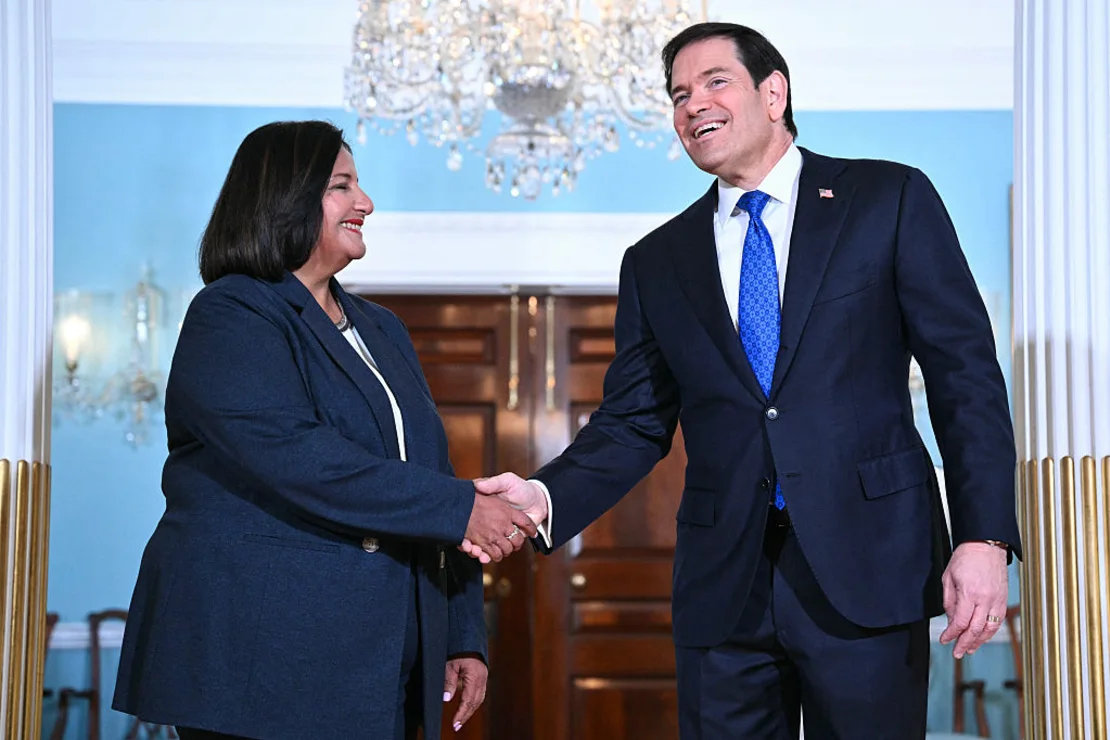
Marco Rubio

U.S. sanctions ICC officials amid crackdown on global tribunal

Aug. 18 (UPI) — The United States on Tuesday sanctioned two senior officials of the International Criminal Court, as the Trump administration cracks down on the global tribunal it calls a threat to U.S. sovereignty.

Secretary of State Marco Rubio and the rest of the Trump administration has aggressively targeted the court over arrest warrants it issued in November 2024 for Prime Minister Benjamin Netanyahu of Israel and his former defense minister, Yoav Gallant, on allegations of war crimes committed during the war in Gaza.

Though not a member of the court, the United States has rejected the warrants, even under the former Biden administration, and has been critical of its jurisdiction over U.S. citizens and potential for politicization. Under the administration of President Donald Trump, Washington has used its powers to target the court with punitive measures.

On Tuesday, Rubio unveiled sanctions against ICC President Tomoko Akane and ICC Senior Trial Lawyer Abdoulaye Seye on accusations that they were “directly engaged in efforts by the ICC to investigate, arrest, detain or prosecute officials whose government has not consented to ICC jurisdiction.”

“The ICC has repeatedly attempted to assert authority over nationals of the United States and other countries that have not consented to its jurisdiction or ratified the Rome Statute,” he said in a statement, referring to the international treaty that established the court in 2002 to try individuals accused of genocide, war crimes, crimes against humanity and the crime of aggression.

“This sets a dangerous precedent.”

UPI has contacted the Hague-based court for comment.

The sanctions, which freeze all property of those designated, come under an authority given to the secretary of state by an executive order Trump signed in the presence of Netanyahu at the White House in February 2025, during his third week back in office.

Last month, Rubio announced the launch of a whole-of-government campaign to dismantle the threat the Trump administration alleges it poises to the United States. Along with increased sanctions and visa revocations of ICC personnel, the campaign includes encouraging other countries to exit the court and increased scrutiny of countries that receive U.S. assistance but do not criticize the ICC, as well as nations under the so-called U.S. security umbrella are also being urged to reject the ICC’s authority to prosecute U.S. officials and service members.

“The ICC has become a kangaroo court that cloaks its abuse of power in language of international law while undermining the very principles of justice,” said Netanyahu, whom the ICC has accused of using starvation as a weapon of war and crimes against humanity, including murder and persecution.

“I commend Secretary of State Marco Rubio for leading the Trump administration’s determined efforts against the ICC’s illegitimate overreach, and for making clear that the corrupt officials who lead the ICC will face consequences,” he added in the statement.

The court described Trump’s executive order in February as an unprecedented attack that undermines its ability to administer justice and a threat to international law that protects millions of victims.

Following the announcement Tuesday, the Netherlands came to the court’s defense while international human rights organizations chastised the United States.

“International courts and tribunals must be able to freely carry out their mandates,” Foreign Affairs Minister Tom Berendsen of the Kingdom of the Netherlands, said in a statement, saying he has invited Akane to discuss the country’s support.

“We fully support the court and its staff,” he said.

Margaret Satterthwaite, the United Nations special rapporteur on the independence of judges and lawyers, said she was “alarmed” by the sanctions being imposed on judicial operators for doing their jobs.

“Sanctioning independent judges and lawyers for their work to end impunity and ensure justice for the most grave crimes is a shocking betrayal of the Nuremberg promise and a violation of the human rights guarantee of fair trial and access to justice,” she said in a statement.

Erika Guevara Rosas, senior director for research, advocacy, policy and campaigns at Amnesty International, rebuked the punitive action as a “reprehensible assault” on the international justice system that was part of an intimidation campaign meant to obstruct its work.

“These sanctions are not about sovereignty. They are about shielding powerful actors from accountability and punishing those tasked with investigating and prosecuting the gravest crimes under international law,” she said.

Kenneth Roth, senior fellow at Yale University and former executive director of Human Rights Watch, said in a statement that Trump was sanctioning the court “so that American and Israeli officials can commit war crimes (and worse) with impunity.”

“No one should accept this utter lawlessness,” he said.

Last week, HRW and three other human rights groups sued the Trump administration over sanctioning judges and prosecutors of the ICC.

President Donald Trump hosts lifeguard Ryder Williams in the Oval Office of the White House on Monday. Photo by Samuel Corum/UPI | License Photo

Source link

Treasury Department repeals reporting rule for businesses

U.S. Secretary of the Treasury Scott Bessent (R) is shown with Secretary of State Marco Rubio during a meeting in July in the Oval Office of the White House in Washington, D.C. The Treasury Department has repealed a business reported rule that was connected to the Corporate Transparency Act. Photo by Graeme Sloan/UPI | License Photo

Aug. 12 (UPI) — The U.S. Treasury Department has officially repealed a rule that required U.S. companies and individuals to report “beneficial ownership information” to the department.

The Financial Crimes Enforcement Network bureau of the Treasury Department — which is meant to safeguard the U.S. financial system from illegal activity, work against money laundering and terrorism financing and help with national security — issued a final rule Tuesday that permanently removes the requirement. The reporting rule existed in connection with the Corporate Transparency Act.

The network, called FinCEN, also announced that it would delete all previously reported information from its databases.

Treasury Secretary Scott Bessent called it “a victory for common sense” and said that it eliminates a “burdensome reporting requirement.” An interim final rule has been in place since March 2025.

This final rule also exempts U.S. citizens with FinCEN identification from having to update or correct their information and eliminates a requirement for foreign businesses to report U.S. citizens who helped them register to do business in the United States.

As defined by FinCEN, a beneficial owner is one who directly or indirectly owns at least 25% of a company or exercises substantial interest over the company.

Sen. Elizabeth Warren, D-Mass., issued a statement Tuesday saying the repeal guts the Corporate Transparency Act and is a “gift to cartels, criminals and U.S. adversaries that exploit shell companies to move millions through our financial system.”

“The Trump administration has dismissed law enforcement warnings, ignored the role that shell companies play in crimes ranging from drug trafficking to fraud to sanctions evasion and gutted a statue that Secretary Rubio once championed as ‘the most significant anti-corruption and money-laundering law in decades,” Warren said.

Secretary of State Marco Rubio posted that statement about the act on social media in December 2020.

Congress passed the Corporate Transparency Act in 2021. The reporting requirement went into effect in 2024.

Members of the National Guard patrol near the Washington Monument on Tuesday. Photo by Bonnie Cash/UPI | License Photo

Source link

Trumps confirms secret plane switch amid Iranian assassination threat

Aug. 12 (UPI) — President Donald Trump confirmed he was smuggled off Air Force One and secretly boarded onto a different aircraft before departing the NATO Summit in Turkey for a flight to a British air base in July, amid a possible threat on his life.

Speaking to reporters at Joint Base Andrews in Maryland on Tuesday night, Trump said the decision to make the switch in Ankara was made by the “Secret Service and the military.”

“I go by Secret Service and the military. They wanted me to go in a different flight, different plane. I just have to do what they say,” he said.

NBC News said it had confirmation of reports that after apparently boarding Air Force One as normal, Trump was moved, secreted in a catering truck, to an unmarked VIP transport aircraft for the first leg of the July 8 flight back to the United States, via RAF Mildenhall.

Secretary of State Marco Rubio and Treasury Secretary Scott Bessent remained on board and the press corps accompanying Trump and most White House staffers flew the leg on Air Force One unaware that Trump was not present, but Trump dismissed questions over whether leaving them aboard the decoy aircraft may have placed them in harm’s way.

“I think actually the plane that I flew on was at greater risk. I think it was at greater risk because that would be the plane I think that they would be more likely to go for,” said Trump, without saying why that might be the case.

Trump said he didn’t delve too much into the threat but he said he was “not surprised” he had been targeted, saying it was an occupational hazard for any president who was getting results.

“Any consequential president has a lot of threats,” he said.

NBC said it had been told by a U.S. official the switch was due to credible intelligence of an Iranian threat to kill Trump, possibly using a shoulder-fired missile launcher to attack Air Force One as it departed Ankara.

Other reports said U.S. intelligence had information of a person with a shoulder-fired missile launcher seen near where the summit was being held.

“As the president has said recently, there are many enemies of America who have their sights on him, and we use every tool at our disposal to address those threats,” the White House said in a statement to ABC News.

Trump said at the time he would take the original Air Force One and not the new one provided by Qatar because he was sending it to Mildenhall for U.S. service members to tour.

However, the sequence of events was that Trump boarded Air Force One in view of the cameras in Ankara, clandestinely switched to the C-32 carrying Defense Secretary Pete Hegseth for the flight to Britain. Once on the ground at Mildenhall, the maneuver was reversed and Trump emerged from Air Force One as if he’d been aboard the whole time.

Administration officials, even Hegseth, reportedly were unaware of the ruse until afterward.

Trump subsequently switched onto the new Qatari-gifted “Air Force One” for the rest of the flight back to Washington.

President Donald Trump hosts Olympic and Paralympic medal-winning athletes during a reception for Team USA in the East Room of the White House on Thursday. The reception honored the team’s medal achievements during this year’s Winter Games, where American athletes earned 57 total medals, including 25 gold. Photo by Aaron Schwartz/UPI | License Photo

Source link

Chad announces withdrawal from International Criminal Court

An exterior view of the International Criminal Court (ICC) in The Hague, The Netherlands, on March 11, 2025. Chad on Monday announced its formal withdrawal from The Hague. File Photo Robin Utrecht/EPA-EFE

July 28 (UPI) — Chad has announced it is withdrawing from the International Criminal Court, days after a U.S. official urged the central African nation to consider doing so and amid a concerted U.S. campaign seeking to dismantle the court.

In an official communique made public Monday, Chad’s Ministry of Foreign Affairs said it notified United Nations Secretary-General Antonio Guterres of its decision to withdraw from the Rome Statute, the treaty establishing the court, following what it described as an “in-depth examination” of its operations.

The ministry said the court’s effectiveness “has remained limited and uneven in light of the expectations that led to its creation,” alleging an anti-African bias and noting that its first nine investigations concerned situations in Africa. The ICC currently lists 17 situations under investigation.

Chad also highlighted that six of the seven people in the court’s custody are being prosecuted in connection with situations in Africa.

“Taken together, these objective factors explain the perception, widely shared among numerous states and their populations, that the court’s judicial activity has remained durably concentrated on the Global South in general and on the African continent in particular, which have consistently been victims of a form of political instrumentalization of the ICC,” the ministry said.

It called on the African Union and member stats to reconsider the future of what it called an “apparently biased system” and to strengthen the African judicial mechanisms instead.

The decision, which is to take effect in one year, comes amid an intensified U.S. campaign against the ICC following the court’s issuance of arrest warrants for Israeli Prime Minister Benjamin Netanyahu and former Defense Minister Yoav Gallant over alleged war crimes and crimes against humanity in Gaza.

Earlier this month, U.S. Secretary of State Marco Rubio announced a campaign seeking to “dismantle the threat posed by the International Criminal Court to U.S. sovereignty.”

The United States is not a member of the ICC, and although the Trump administration has taken a more aggressive stance toward the court, the United States has long rejected the cour’s assertion of jurisdiction of U.S. nationals without Washington’s consent.

Four days before Chad announced its decision to withdraw from the ICC, Foreign Minister Abdoulaye Sabre Fadoul spoke with U.S. Under Assistant Secretary of State for African Affairs Frank Garcia Jr..

A statement from Chad said the call was made at the request of the United States. During the call, Garcia expressed the United States’ concerns about the ICC’s operation and requested that Chad review its membership, which Fadoul said Chad would.

“The United States welcomes Chad’s decision to withdraw from the ICC and join the growing number of nations reclaiming their sovereignty from this flawed institution,” the State Department’s Bureau of African Affairs said in a statement.

“The United States will never surrender its sovereignty to an unaccountable global tribunal, and we are launching a comprehensive, whole-of-government campaign to end the ICC’s illegitimate overreach. We call on all other ICC members to withdraw from the Rome Statute.”

The announcement comes days after Venezuela announced it was withdrawing from the ICC.

Burkina Faso, Mali and Niger all announced their withdrawals from the court in June 2026.

Source link

U.S. monitors Catholic Church distribution of aid in Cuba

Workers load a cargo plane with humanitarian aid destined for Cuba at the 7 Air/World Freight Service Warehouse in the Miami International Airport in Florida on Tuesday. The United States launched the first humanitarian aid flight from Miami to Havana, delivering food and hygiene supplies as part of U.S. Secretary of State Marco Rubio’s $100 million assistance initiative for the Cuban people. Photo by Cristobal Herrera-Ulashkevich/EPA

July 23 (UPI) — The head of the U.S. mission in Cuba met with the Cáritas Cuba director Wednesday as the Catholic charity began distributing humanitarian aid sent by President Donald Trump‘s administration to vulnerable families in western Cuba, the U.S. Embassy in Havana said.

The meeting between Mike Hammer and Carmen María Nodal Martínez came a day after the first shipment from a $100 million humanitarian assistance package arrived in Havana. it was announced in May by Secretary of State Marco Rubio.

The shipment includes prepackaged food and hygiene kits for about 700 families, the U.S. State Department said. Catholic Relief Services is distributing the aid in coordination with the Catholic Church and Cáritas Cuba.

The U.S. Embassy said Hammer and Nodal reviewed the distribution process through Catholic parishes and planned visits to volunteers and beneficiaries as the humanitarian program expands across the island.

The first deliveries began in the municipalities of Bejucal, in Mayabeque province, and Alquízar, in Artemisa province, targeting families previously identified by local communities as the most vulnerable.

Cáritas Cuba confirmed that volunteers from parish communities started to deliver the food and hygiene kits on Wednesday. The organization said the assistance is being distributed according to humanitarian vulnerability criteria, with an emphasis on transparency throughout the distribution process.

According to the State Department, the packages contain rice, beans, pasta, canned tuna and sardines, cooking oil, sugar and salt, along with soap, detergent, toothbrushes, sanitary pads, water purification tablets, solar lamps and other household supplies intended to meet a family’s basic needs for about 10 days.

Washington has said it is using Catholic Relief Services, Cáritas Cuba and the Catholic Church to ensure the aid reaches recipients directly without being diverted by the Cuban government. State Department officials said they will closely monitor the distribution process to prevent the assistance from being misappropriated.

Cuba authorized the shipment’s entry, but government officials criticized Washington for providing humanitarian assistance while maintaining sanctions and what Havana describes as a de facto oil embargo that has worsened the island’s economic crisis.

Cuba’s Ministry of Foreign Trade and Foreign Investment acknowledged receiving the shipment, while reiterating that U.S. restrictions continue to affect the country’s economy.

Several Democratic members of the U.S. House of Representatives who recently visited Cuba have also called on Washington to lift the restrictions, arguing they amount to collective punishment.

Rubio and other U.S. officials have rejected that criticism, arguing that Cuba’s ruling elite and the military-run conglomerate GAESA have diverted the country’s resources and prioritized scarce fuel supplies for the government and its security apparatus rather than the general population.


Source link

Rubio meets with Philippines president, discusses South China Sea

1 of 3 | Philippine President Ferdinand Marcos Jr., right, meets Wednesday with U.S. Secretary of State Marco Rubio, second from right, during a courtesy visit inside Malakanang Presidential Palace in Manila. Rubio was in Manila to attend meetings of the Association of Southeast Asia Nations. Photo courtesy U.S. State Department | License Photo

July 22 (UPI) — U.S. Secretary of State Marco Rubio, in Manila on Wednesday for a meeting of the Association of Southeast Asia Nations, met with Philippines President Ferdinand Marcos Jr. and his counterpart in China, Foreign Minister Wang Yi.

Meanwhile, police clashed with protesters outside who criticized the United States’ involvement in area conflicts and blamed the Trump administration for fueling tension in the region. Some protestors held up signs that said, “U.S. out of everywhere!” and “War criminals not welcome! Ban Rubio! Ban Trump!”

Rubio spokesman Tommy Pigott said the secretary of state met with Marco “to reaffirm our ironclad alliance and our shared commitment to a free and open Indo-Pacific.”

The two men confirmed that “there is no legal basis for China’s expansive maritime claims in the South China Sea” and discussed other matters, Pigott said.

Tensions between the Philippines and China have been high lately over the disputed South China Sea. On Monday, the Philippine military accused Chinese coast guard personnel of striking and injuring a Philippine sailor. China said the Philippine officers instigated the conflict.

China claims most of the South China Sea, including areas that hold the exclusive economic zones of other countries including the Philippines.

In person at the ASEAN conference, Rubio behaved politely toward his Chinese counterpart, saying he appreciated China withholding support for Iran and opposing a toll in the Strait of Hormuz. He also said the countries were taking steps to establish boards of investment and trade.

He did not mention recent claims by U.S. President Donald Trump that China interfered in the 2020 U.S. presidential election.

“Look, these are the two most powerful countries in the world,” Rubio told reporters Wednesday. “It would frankly be reckless and irresponsible for the U.S. and China not to have a relationship.”

Chinese President Xi Jinping is expected to visit the United States in September.

In contrast to his remarks Wednesday, Rubio’s words in an opinion column that the U.S. State Department placed in Philippine newspapers this week were somewhat less measured when it came to the conflict over the South China Sea.

“If those waters fall under the control of a power willing to use commerce as a geopolitical weapon, both the United States and the ASEAN states would face dire new threats to their sovereignty, security and economic futures,” he wrote.

Source link

Rubio: US to Be ‘Very Engaged’ in Venezuela Political Dialogue

The Trump administration has exerted significant influence over Venezuelan affairs in recent months. (Kevin Dietsch)

Mérida, July 21, 2026 (venezuelanalysis.com) – The Trump administration has vowed to play an active role in upcoming negotiations between the Venezuelan government and a US-backed opposition faction.

The government-aligned National Assembly and a group of opposition lawmakers from the 2015–2020 legislature recently announced a joint working agenda scheduled to begin August 1, with explicit support from the US State Department.

Secretary of State Marco Rubio addressed the initiative during a press briefing on July 19, calling it “a very powerful offer.” 

“We’ll see where it goes, but we think that that agreement was broadly met in Venezuela as very good news, and obviously something we’re going to be very engaged in,” he told reporters.

Rubio emphasized that the upcoming talks are “a forum to begin the transition process, which is what the people of Venezuela need”. In the same way, the State Department, via a July 16 official statement, had pledged to back efforts “toward a peaceful and democratic electoral transition.”

Since the January 3 US military strikes and kidnapping of Venezuelan President Nicolás Maduro, Rubio and other Trump officials have insisted on a “three-phase plan” that ends with a political transition.

The latest dialogue initiative emerged following a June 18 meeting between National Assembly President Jorge Rodríguez and Dinorah Figuera, who leads an opposition-majority legislature whose term ran from 2015-2020.

The defunct parliament retained US recognition as the Caribbean nation’s legitimate authority after the conclusion of its term in 2021, and has retained control over Venezuelan state assets frozen abroad.

According to statements from both sides, the working agenda prioritizes strengthening democratic institutions, reforming the electoral system, and restoring guarantees for political participation.

Figuera welcomed Rubio’s latest comments and argued that “active participation” from the Trump administration will be “essential to generate concrete progress.”

“We will invite all democratic sectors to participate and bring proposals toward a peaceful and democratic electoral transition,” she wrote on X. For their part, government officials, including Acting President Delcy Rodríguez, have not offered further comment on the talks since last week’s announcement.

In recent days, Figuera addressed criticism of her role in the negotiations, rejecting accusations that she was acting outside the opposition’s institutional framework.

The former lawmaker has faced scrutiny from other opposition sectors, particularly following her June 18 return to Caracas with US backing. Her meetings with Rodríguez and subsequent travel to Washington occurred weeks after far-right leader María Corina Machado had announced at a Panama gathering her intention to head negotiations with the government over future electoral processes.

On July 16, Machado met with high-ranking opposition figures from the Democratic Unitary Platform (PUD) coalition to assess the new dialogue initiative. The meeting was reported as a venue to “gather information” regarding the announced negotiations and “define a public position.” However, neither Machado nor the PUD have taken a stance on the upcoming talks.

Rubio’s influence over Venezuela was highlighted in a recent New York Times article that detailed the Trump administration’s involvement in the country’s day-to-day affairs. The report highlighted that US officials have sought to engage with institutional actors they consider manageable, including the 2015 National Assembly faction, as part of a strategy to reduce volatility in bilateral relations.

However, according to the Times, the approach has generated tensions within the opposition camp given the recent protagonism assumed by far-right Machado.

Caracas and Washington fast-tracked a diplomatic rapprochement following the January 3 attacks, with embassies reopening in both capitals. The Trump administration has seized control of Venezuelan oil export revenues and exerted influence over recent pro-business energy and mining reforms.

The US has also undertaken a significant military deployment in the country following the June 24 double earthquake, with US forces running logistical operations out of the Simón Bolívar International Airport and La Guaira port.

Edited by Ricardo Vaz in Caracas.

Source link

Cuban dissident says exile to United States came at a cost

The facade of Terminal 3 at Jose Marti International Airport in Havana is shown on Saturday. Cuban artist and dissident Luis Manuel Otero Alcantara departed for the United States after being granted humanitarian parole following a five-year prison sentence on the island, Photo by Ernesto Mastrascusa/EPA

July 20 (UPI) — Cuban artist and dissident Luis Manuel Otero Alcántara said he cannot return home after arriving in exile in the United States this weekend.

Meanwhile, Secretary of State Marco Rubio renewed his call Monday for the Cuban government to release more than 700 political prisoners amid rising tensions between Washington and Havana.

Otero Alcántara, 38, arrived in Miami on Saturday after spending five years imprisoned in Cuba on charges of desecrating national symbols, contempt and public disorder.

His arrival was confirmed by Rubio, who said the artist had been imprisoned for challenging the Cuban government.

In his first public remarks since arriving in the United States, the founder of the San Isidro Movement said prison changed the way he sees people, but acknowledged that exile carries a high personal cost.

“Five years later, I am more human. Prison is a place where you can look into the eyes of people who, even after committing the worst crimes, are still human beings,” he said in videos published by Caraota Digital.

However, he said that being forced to leave Cuba does not represent true freedom.

“I have been expelled from Cuba. This is not right. … I can’t see my son. I can’t return to my home. It’s just not right,” he said.

Otero Alcántara gained international prominence via a collective of artists and intellectuals that called for greater freedom of expression in Cuba and that, according to Amnesty International, has been the target of constant persecution by Cuban authorities.

He was arrested while attempting to join the anti-government protests of July 11, 2021, and was sentenced to five years in prison a year later.

After confirming Otero Alcántara’s arrival in the United States, Rubio said on X that the artist’s imprisonment was the result of challenging “the Marxist tyranny of the Cuban regime,” and he demanded the immediate release of “the more than 700 political prisoners unjustly detained” on the island.

Rubio said President Donald Trump‘s administration will continue to support those seeking greater political freedoms in Cuba.

Source link

ICE deports pardoned child rapist 20 years after removal order

Tou Lue Vang being deported from the United States by Immigration and Customs Enforcement after Secretary of State Marco Rubio canceled the convicted child rapist’s legal status to remain in the country. Photo by Department of Homeland Security

July 10 (UPI) — Immigration and Customs Enforcement on Friday deported a man who was convicted of repeatedly sexually assaulting a child and ordered removed from the country in 2006.

Tou Lue Vang, who legally entered the United States in 1994, was convicted in 2006 of first-degree criminal sexual conduct for repeatedly sexually assaulting a 10-year-old girl over the course of two years.

Vang was ordered to be deported to Laos in October 2006 but because of that country’s limits on how many deportees it accepts he, like many ethnic Laotians and Hmong, was permitted to stay, The New York Times reported.

Having been in the country legally ever since, Vang applied for a pardon during the Trump administration’s immigration crackdown last year to prevent himself from being deported — which was granted in June.

“ICE deported Tou Vang, an illegal alien convicted child rapist,” Lauren Bis, acting assistant secretary of homeland security, said in a press release.

“This monster repeatedly sexually assaulted a 10-year-old girl,” Bis said.

Vang was convicted repeatedly sexually assaulting the girl between 2002 and 2004, and justified his actions as being “a cultural thing … to marry and have sex with girls as young as 12,” and also suggested that the girl was just as guilty as he was of a crime, ICE said last week.

The Times reported that Vang has not been charged with serious crimes since his conviction and supervised release while awaiting his 2006 deportation.

ICE arrested Vang in December 2025, with plans to deport him, based on his prior conviction, but a Minnesota judge ordered that he be released from custody in February 2026.

Vang’s pardon request, which the Minnesota Clemency Review Commission granted on June 10, could prevent him from being deported, the federal government and legal experts have said.

The State Department said Friday that it had terminated Vang’s legal status in the United States and deported him immediately.

“Americans should never have to live in fear that foreign sex predators — shielded from deportation by their own elected officials — could endanger them or their children,” Secretary of State Marco Rubio said in a statement.

“That’s why I terminated his legal status in the United States,” Rubio said. “Vang has now been removed from our country and will never pose a threat to any American ever again.”

Olympic canoeist David Hearn departs the Moultrie Courthouse after pleading not guilty to damaging the Lincoln Memorial Reflecting Pool on Thursday. Hearn was indicted on July 2 on one count of destruction of property of more than $1,000 for allegedly damaging the Reflecting Pool, carrying a maximum penalty of 10 years in prison if convicted. Photo by Bonnie Cash/UPI | License Photo

Source link

NATO summit begins with focus on U.S. commitment, Ukraine defense

July 7 (UPI) — Leaders of the Western world’s premier military alliance will gather in Ankara on Tuesday for the start of this year’s NATO summit, with support for Ukraine and questions over U.S. President Donald Trump‘s commitment to the pact expected to dominate the two-day meeting.

The summit in Turkey’s capital is formally focused on reviewing progress made since last year, when the leaders of NATO’s 32 members agreed to raise their annual defense-related spending from the previous 2% target to 5% of gross domestic product by 2035 amid growing global security concerns.

Major new policy pronouncements are not expected, though several large arms deals are. The focus of the two-day summit will be on progress toward that defense-investment plan and how allies intend to spend the money to increase weapons production, cooperation and joint procurement.

Attention will also be on Trump and the U.S. commitment to NATO after his administration announced earlier this year that it would withdraw some American troops from Germany.

Long a demand of Trump’s, the increase in defense spending has done little to curb the American president’s long-held criticism of the alliance, which has intensified since NATO allies offered limited support for the U.S. war against Iran.

Trump departed Maryland’s Joint Base Andrews aboard Air Force One for Turkey a little after 9:40 EDT Monday, with State Secretary Marco Rubio, Treasury Secretary Scott Bessent, Defense Secretary Pete Hegseth and a number of aides with him.

Trump is expected to meet with Zelensky during the summit.

The two spoke Saturday, according to the Ukrainian leader, who said he called the U.S. president to congratulate him on the United States’ Independence Day.

“We are grateful to the United States for all the assistance we have received — from Javelins and Patriots to political support — and we deeply value that America stands by us in defending our independence,” he said online, adding that they had discussed the situation in the Ukraine-Russia war.

“We have agreed to continue these discussions during the NATO Summit in Ankara,” he said.

On the eve of the Fourth of July, Trump also spoke with Russian President Vladimir Putin for nearly 90 minutes, according to the Kremlin, which said in a statement that they discussed “the Ukrainian settlement, including in light of Donald Trump’s upcoming participation in the NATO Summit.”

The Kremlin said Putin framed the current situation of the war as Russia “steadily advancing” despite Ukraine making recent gains and expanding its long-range attacks.

However, Russia has been targeting Kyiv with massive attacks leading up to the summit. Zelensky has been calling on allies for additional long-range weaponry, or the ability to produce the arms themselves, arguing that if Ukraine can batter Moscow how the Kremlin has been hitting Kyiv, an end to the war could be rapidly secured.

“We have proven to all our partners both the need, and more importantly, the possibility of providing greater protection of lives,” Zelensky said in a Monday statement.

“It is simply nonsensical that, in today’s world, production has still not been scaled up to the level that is actually needed to protect people from ballistic terror. We have long made the case that we are capable of producing such defensive weapons ourselves. If Ukraine were granted U.S. licenses to produce Patriots, our own production would be sufficient both to protect Ukraine and to help partners in need.”

The U.S.-based Institute for the Study of War said Monday night that Russian forces were likely timing these large-scale strikes to send a political message ahead of the summit.

News anchors are seen outside the Supreme Court of the United States as the court releases their final opinions before summer recess on Tuesday. The court upheld birthright citizenship and also state laws banning transgender women and girls from playing on school athletic teams. Photo by Bonnie Cash/UPI | License Photo

Source link

Vessel struck transiting Hormuz; U.N. pauses evacuation operation

June 25 (UPI) — A cargo vessel in the Strait of Hormuz was attacked Thursday, prompting officials to halt the evacuation of sailors stranded in the chokepoint by the war.

It was unclear who attacked the cargo ship. According to the British navy’s United Kingdom Maritime Trade Operations office, the vessel was struck on its starboard side by an unknown projectile at about 5:40 p.m. local time. It was about 7 1/2 nautical miles southeast of Dahit, Oman, when it was attacked, it said.

The vessel’s bridge sustained damage, but no casualties or environmental impact were reported.

Following the attack, the United Nations’ International Maritime Organization paused its evacuation operation in the Strait of Hormuz.

“I have decided to temporarily pause its implementation in order to reconfirm that the necessary safety guarantees continue to be in place for the ships on our evacuation list and all those in the region,” IMO Secretary-General Arsenio Dominguez said in a statement.

The war, which began Feb. 28, left some 11,000 sailors stranded in and around the Strait of Hormuz, a vital energy shipping route. The IMO announced the evacuation operation Tuesday, after the United States and Iran agreed to a Memorandum of Understanding that seeks to pave a path to ending the war.

Under the U.N. plan, a number of vessels have already been evacuated.

The vessel struck Thursday was not transiting the Hormuz under the IMO’s evacuation framework, the U.N. agency said.

Though it unclear who was responsible for the attack, the Iran’s U.S.-sanctioned Persian Gulf Strait Authority, newly created by Tehran to oversee and manage the strait, issued an advisory Thursday, stating it is not responsible for the protection of vessels transiting “outside designated routes.”

“Any consequences arising from unauthorized routing shall be the sole responsibility of the vessel owner, charterer and master,” it said.

Control of the strait has been a focus of ongoing U.S. efforts to end the war.

Iran effectively closed the strait after being attacked Feb. 28, causing energy prices to surge and threatened nations with worsening energy crises.

Since then, Iran has attempted to maintain control of the strait and has sought to impose fees on ships that transit it.

The United States is seeking to secure free maritime travel through the strait as part of the MOU. U.S. Secretary of State Marco Rubio is currently in the Middle East trying to sell the MOU to allied nations.

However, the Institute for the Study of War said in a report Thursday night that Iran’s alleged attacks and threats directed at vessels in the strait “advance its objective of establishing control over the waterway” as well as “undermine international efforts to guarantee safe passage through the Strait of Hormuz.”

“Iran is using military threats and economic incentives to try to convince Gulf states to support its efforts to control the strait, but the Gulf states appear to be resisting Iranian pressure at present,” it said.

Source link

U.S. sanctions five Cuban entities, Castro family member

June 24 (UPI) — The United States has sanctioned five Cuban state companies and the wife of Raul Castro‘s son, as the Trump administration continues to apply economic pressure on the Caribbean nation.

Three of the companies blacklisted by the State Department on Tuesday are associated with Grupo de Administracion Empresarial, which the United States initially sanctioned during the first Trump administration on accusations of being a Cuban military-controlled umbrella enterprise with interests sprawling throughout the island nation’s economy.

The two other entities hit are accused of operating in Cuba’s mining sector with foreign investment from Australia as well as working in collaboration with Russia.

Annalie Lilliam Rueda Cadero was sanctioned for being the wife of Alejandro Castro Espin, the son of Raul Castro, Cuba’s former head of state. Alejandro Castro was sanctioned by the Trump administration earlier this month.

Secretary of State Marco Rubio said in a social media statement that he was sanctioning GAESA network entities for diverting Cuba’s money and assets and the two other companies for exploiting its mineral and metal reserves.

“The situation in Cuba is devolving as the island’s corrupt, brutal and anti-American Communist regime continues to prioritize its own total control over the freedom, opportunity and basic well-being of the Cuban people,” he said.

Sanctions generally freeze U.S.-based property or interests in property under the control of those designated while threatening foreign businesses with secondary sanctions for doing business with them.

The United States has long imposed a blockade and sanctions on Cuba, but the economic punitive measures have starkly increased during the second Trump administration, exasperating the power and energy shortages in the country, causing blackouts. The supply shortages have forced more than 100,000 people, including 11,000 children, to wait for surgeries, according to the United Nations.

Tuesday’s designations come under an executive order Trump signed in May permitting the sanctioning of those operating in Cuba’s energy, defense, mining and financial services sectors, as well as those complicit in human rights abuses or corruption related to Cuba working or for providing services to the Havana government.

Trump has been increasing the political and economic pressure on Cuba since ousting Venezuela’s authoritarian leader in January, declaring a national emergency with respect to the island nation early this year.

Since signing the sanctions-related executive order in May, he has used it at least five times to designate Cuba-related entities and individuals.

Cuba’s foreign minister, Bruno Rodriguez, accused the Trump administration on Tuesday of increasing its sanctions regime against Havana, because Havana continues to prove it is “stronger, more capable and efficient than it expected.”

He accused the Trump administration of collectively punishing the Cuban people.

Ernesto Soberon, Cuba’s United Nations ambassador, accused the United States of lying about employing sanctions due to human rights abuses by Havana.

“No government, no person with even a shred of common sense — and certainly not the people of #Cuba, who are suffering the humanitarian impact of the U.S. economic war — can believe that the tightening of the blockade, the energy siege and the newly announced sanctions are intended to support the Cuban people,” he said on social media.

“Anyone who has doubts should ask the parents of the more than 12,000 children currently awaiting surgery in Cuba as a result of the U.S. government’s genocidal policy.”

Source link

Trump signs Iran agreement while in France

1 of 2 | President Donald Trump attends a press conference at the Hotel Royal during the G7 summit in Evian-les-Bains, France, on Wednesday. Photo by Yoan Valat/EPA

June 17 (UPI) — U.S President Donald Trump signed an agreement with Iran at the Palace of Versailles on Wednesday night while in France for the G7 Summit,

The United States sent an image of the signed agreement to the Iranians, officials said. Dan Scavino, White House deputy chief of staff, later posted a video of the signing on social media.

Earlier, the United States government released the text of the agreement, several days after the agreement was reached. The agreement was expected to be signed Friday in Switzerland.

It includes 14 points, including “the immediate and permanent termination of military operation on all fronts” — including Lebanon, where Israel continued to carry out strikes as of earlier Wednesday — provisions for reopening the Strait of Hormuz and measures for easing financial restrictions on Iran. It also offers expectations for addressing Iran’s nuclear program in future talks. CNN reported the text of the agreement, which was read out loud by an official.

Earlier Wednesday at a press conference in France, Trump had said that if Iran doesn’t abide by the memorandum of understanding, the United States may bomb the country.

The press conference lasted more than an hour, with Secretary of State Marco Rubio and Commerce Secretary Howard Lutnick standing behind him.

Trump made the remark in his opening statement.

“If they don’t honor that, we’ll probably go back to bombing them until they honor it, you know?” he said. “It’s amazing what bombs can do.”

The president called the MOU the “Trump deal,” and said that the deal says Iran will never have a nuclear weapon, and the Strait of Hormuz will reopen.

He also said that if an agreement hadn’t been reached with Iran, the United States could have continued the war.

“If we didn’t do this deal, we could have dropped more bombs for another three weeks, two weeks, four weeks, two years,” Trump said.

The president also defended releasing Iranian frozen assets.

“We have taken a lot of their money,” Trump said. “We have taken their money; it’s not our money, it’s their money, and we froze it at a certain point in time. I guess we’re going to have to give it back.

“As far as sanctions are concerned, at some point, you know, we have sanctions, which will never let them rebuild. They would have no money. They would be in poverty.”

Trump has said the United States won’t give any money to Iran, but he defended allowing Iran access to its own frozen funds.

“We’re not doing anything; we’re not putting up money, only if they’re doing things right. If they’re doing things right, if people want to invest, they can invest, but they had this $300 million fund. It’s only $300 million fund; it’s only if they’re doing things right,” CNN reported Trump said.

A reporter asked if the president would hold anyone in the administration responsible for the bombing of an elementary school for girls in Iran in late February, and he replied that it was under investigation. The strike killed more than 170 people, mostly children.

Trump responded that it was a “strange question” and said, “You’re talking about a long time ago.”

“But nobody did that on purpose,” Trump said. “I guess you’d have to say about them, what about the thousands of soldiers that they blew up when they opened their car door? What about the thousands of people that were killed by Iran? No, mistakes are made, war is nasty, but I know it’s under investigation.”

Trump also offered a rare criticism of Israel, saying it could do better in its conflict with Lebanon.

“I think they could do better with respect to Hezbollah. I am not saying they should not protect themselves. I am saying when two drones are shot into the desert and dropped harmlessly, you do not have to knock down buildings in Beirut,” Trump said.

“They could behave better and, frankly, they could do a better job.”

“On that, I don’t think they’re doing well, and I feel very bad for Lebanon,” he said. “Lebanon’s been, you know, it was a great culture. It was a great, they had the professors, the doctors, the lawyers, it was an incredible culture, maybe the highest in the Middle East for years and years, centuries. And for the last 50 [to] 60 years, they have been just trashed. They have been, they have been living in hell.”

Source link

Cuba implements economic reforms amid new U.S. sanctions

Cuban President Miguel Diaz-Canel (C) attends an event in support of former Cuban President Raul Castro in Havana on May 22 after the U.S. Department of Justice unsealed two days earlier a federal criminal indictment charging the 94-year-old Castro, along with five other co-defendants, for his alleged role in the February 1996 shoot-down of two unarmed U.S. civilian aircraft operated by a Cuban exile relief group. Photo by Ernesto Mastrascusa/EPA

June 12 (UPI) — Cuba’s government on Friday announced a broad package of economic reforms aimed at restructuring key aspects of the country’s economic model, just hours after the United States imposed a full financial blockade on state oil company Unión Cuba-Petróleo, or CUPET.

Speaking on state television, Cuban President Miguel Díaz-Canel defended the shift toward decentralization, saying that “these are times when change is necessary.”

The measures are part of the government’s 2026 Economic and Social Program, a roadmap inspired by the economic models of China and Vietnam. Havana says the plan is intended to address the island’s deep economic crisis, high inflation and widespread shortages of goods and services.

The reforms came only hours after U.S. Secretary of State Marco Rubio announced on X sanctions against CUPET, freezing all of the company’s assets under U.S. jurisdiction and prohibiting commercial transactions with it.

Rubio said that “Cuba’s communist elites have turned energy into a tool of social control and profit,” accusing the government of hoarding fuel supplies for its own benefit and using them to repress the Cuban people.

“President Donald Trump wants a new future for the Cuban people with greater freedom and opportunity,” Rubio wrote.

The secretary of state said the sanctions were justified because CUPET operates assets that were allegedly confiscated from U.S. owners decades ago. Washington also warned that foreign companies continuing to do business with the state oil company could face secondary sanctions.

Cuba announced the measures two days after the Miami Herald reported on a proposed commercial agreement between Florida-based Vanguard Energy and Cuban agencies to deliver 250,000 barrels of gasoline and diesel fuel intended exclusively for Cuba’s private sector, small and medium-sized enterprises and humanitarian organizations.

The arrangement included a five-year lease of state-owned storage tanks operated by CUPET. Under the proposal, Vanguard would retain ownership of the fuel to prevent it from being diverted to the Cuban government and would operate outside the island’s banking system.

However, within hours of the agreement becoming public, the U.S. State Department halted the shipment, saying the company did not possess a specific license authorizing the transaction and reaffirming that the Trump administration’s sanctions against Cuba remain fully in force.

Despite the tightening U.S. restrictions, Díaz-Canel rejected suggestions that the reforms were a response to pressure from Washington, describing them as a necessary internal restructuring effort.

The economic plan centers on decentralization and greater openness to investment. Municipal governments and state-owned companies will receive expanded authority over imports, exports and foreign currency management in an effort to reduce bureaucratic obstacles.

The government also plans to ease restrictions on private small and medium-sized businesses, open financial investment opportunities for Cubans living abroad and allow foreign companies to lease agricultural land to boost food production.

To support the reforms, Havana plans a significant reduction of the central bureaucracy, cutting the number of government ministries to 20 from 27 through mergers and eliminations.

Díaz-Canel said Cuba must move toward “new models and new actors” capable of making use of existing infrastructure, acknowledging that sectors such as tourism have been hurt by U.S. sanctions.

“We cannot focus only on the large international hotel chains when many of them, because of pressure from the United States government, have left the country,” he said. “We are developing real estate and tourism projects with new models and other actors that have not traditionally participated in these sectors.”

On energy policy, Díaz-Canel said Cuba would continue shifting toward solar power and renewable energy sources.

“We are going to eliminate, as much as possible, the restrictions that exist on vehicle imports,” he said. “We will continue prioritizing, through tariffs and pricing policies, the importation of electric vehicles powered by solar energy.”

Recent U.S. measures against Cuba have significantly tightened the decades-old embargo through Executive Order 14404 and additional restrictions targeting the energy sector, including CUPET. The sanctions also affect senior government officials, their relatives and military-linked entities.

Washington says the measures are intended to cut off revenue to the Cuban government, encourage political change and punish human rights abuses.

Cuban authorities argue that the restrictions have worsened an already severe economic crisis marked by chronic shortages and power outages that have lasted more than 48 hours in some parts of the island.

International organizations, including the United Nations, have warned about the humanitarian impact on the civilian population.

Source link

U.S. sanctions Cuban leader Miguel Díaz-Canel, military, Castro kin

Cuban President Miguel Diaz-Canel was slapped with sanctions by the United States on Thursday as Washington continued to ratchet up pressure of the island nation’s communist government. File Photo by Ley Royero/EPA-EFE

June 4 (UPI) — The United States on Thursday leveled sanctions against Cuban Miguel Díaz-Canel, members of former President Raul Castro‘s family, the Cuban military and other organizations as it continued a crackdown on the country’s communist government.

Secretary of State Marco Rubio announced the measures against Diaz-Canel the others in a statement, asserting they are being targeted because they “fund the [Cuban] regime and its efforts to mobilize its radical revolutionary movements in the United States and around the world.”

The Cuban president, Rubio said, poses a threat to U.S. national security, while the Ministry of the Revolutionary Armed Forces of Cuba, with its “many majority holdings and subsidiaries,” is also now “considered blocked.”

Other organizations newly added to the sanctions list are the Cuban Institute of Friendship with the Peoples, or ICAP, Amistur Cuba S.A., Committees for the Defense of the Revolution and Minera La Victoria S.A.

The individuals sanctioned include Alejandro Castro Espin, the former head of the Cuban intelligence services and the son of Raul Castro, and Raul Alejandro Castro Calis, Castro Espin’s son.

“For decades, Cuba has been the world capital for radical left-wing terrorism,” Rubio asserted. “The regime in Havana has recruited, trained and backed violent Marxist and ‘third-worldist’ movements across our hemisphere and beyond.

“Today, we are targeting the network that enables and funds Cuba’s subversive and radical operations.”

In a stated response, Diaz-Canel said the latest sanctions are “illegitimate” and are “aimed at reinforcing the blockade measures and the scenario of conflict between Cuba and the United States.

“This political blindness is added to the coercive measures applied in recent weeks against our country, designed to harm the Cuban people,” he added. “The aggressiveness and perversity of the Yankee government will clash with our determination to confront the worst scenarios and resist the imperialist onslaught.”

The newly issued sanctions are the latest in a series of moves designed to ratchet up pressure on the Cuban government.

The Trump administration has set a Friday deadline for foreign companies to sever ties with GAESA, the business conglomerate run by Cuba’s Armed Forces, sparking a mass exodus of tourism-related businesses from the island nation.

Meanwhile, Cuba is struggling with the effects of a January 2026 executive order issued by U.S. President Donald Trump imposing a fuel blockade against the nation on national security grounds.

The move has resulted in shortages of electricity, fuel, medicine and medical supplies across Cuba, according to the U.N. Office for the Coordination of Humanitarian Affairs and the World Health Organization, which says emergency care, blood banks, laboratories, immunization programs and maternal and child health services have all been “severely disrupted.”

Source link

Marco Rubio: Iran must reopen Strait of Hormuz, discuss nuclear program

June 2 (UPI) — Secretary of State Marco Rubio told the Senate on Tuesday morning that Iran must reopen the Strait of Hormuz and commit to future talks on its nuclear program before the United States will make concessions.

He testified before the Senate Foreign Relations Committee before a scheduled afternoon meeting with a House panel on State Department spending. Both sessions were planned so that Rubio could defend the department’s nearly $36 million budget request for the 2027 fiscal year.

Rubio is also President Donald Trump‘s national security adviser.

The Washington Post reported that Rubio’s testimony with lawmakers has been mostly friendly. He served in the Senate for 14 years and in the House for 8, representing Florida.

Lawmakers from both sides of the aisle have expressed frustration with the cost and potential political fallout from the war with Iran.

“This war and the administration’s decision to blockade has now held the entire world economy, and the U.S. economy, hostage to the ability to negotiate an agreement with Iran,” said Sen. Chris Murphy, D-Conn, The Post reported.

The Strait of Hormuz, which has been closed by Iran since late February, must reopen, Rubio stressed. The strait is a critical waterway for shipping of much of the world’s oil, gas and fertilizer. The closure has caused gas prices to rise, causing anxiety as Republicans fear losing House and Senate seats in November.

Rubio said Trump demands that Iran enter into negotiating “severe and long-term limitations” on its nuclear program, including disposing of enriched uranium, and those talks could take months.

But he said he’s optimistic that Iran is more willing to negotiate on nukes.

“They have agreed to negotiate aspects of their nuclear program that just a month ago, just a year ago, they were refusing to even mention,” The Guardian reported Rubio said. He warned that it’s “not a guarantee that ultimately it will lead to a deal that’s acceptable,” and Iran’s leadership instability has made the negotiations more difficult.

Rubio said Iran had intended to use its conventional weapons capabilities as a “shield” to protect its nuclear program, The Guardian reported.

“What they tried to do is, they were going to try to build a conventional shield and hide behind that conventional shield,” he said, explaining why Trump wanted to start the war.

He also admitted, after questioning by Sen. Ted Cruz, R-Texas, that another sticking point for Trump was that Iran stop supporting terrorist proxy groups. He said Trump is not willing to ease sanctions just for opening the strait.

Rubio said that Iranian Ayatollah Mojtaba Khamenei is believed to be alive.

“I would imagine, given what’s happened to multiple leaders in that system, being very public is probably not something that’s recommended for them internally,” he said. “But that said, I think there are indications out there that he is increasingly engaging at some level, although all of his communications have been in writing and through intermediaries.”

Along with Iran, lawmakers were expected to ask Rubio about the president’s comments about Cuba and Taiwan.

Secretary of State Marco Rubio and President Donald Trump participate in a Cabinet meeting in the Cabinet Room of the White House on Wednesday. Photo by Samuel Corum/UPI | License Photo

Source link