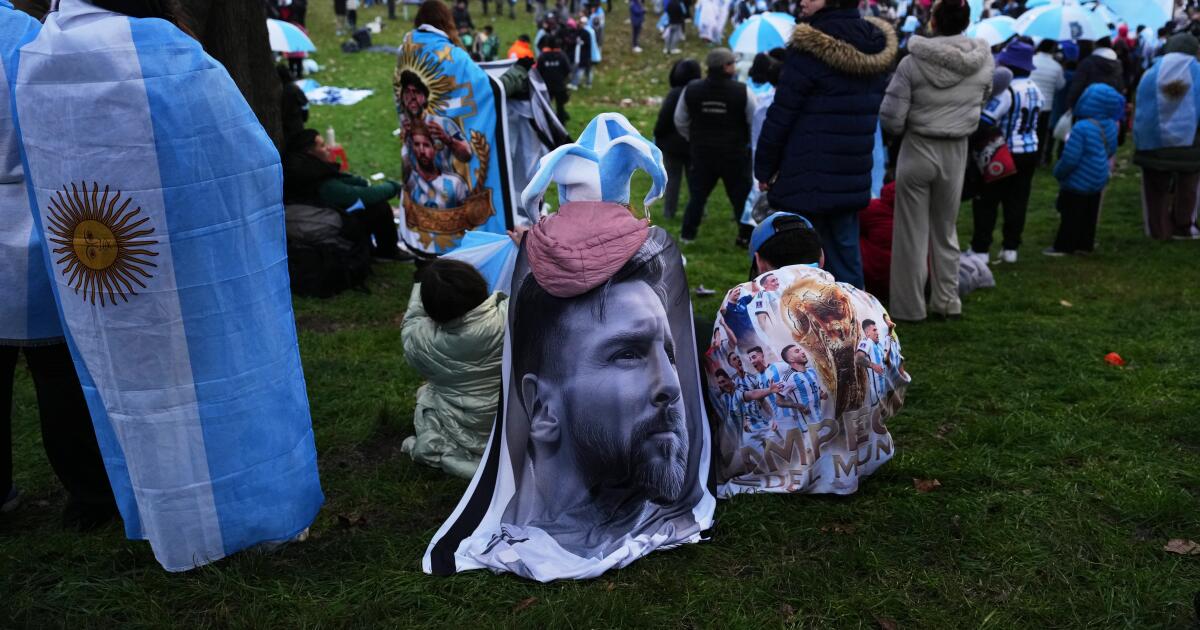
Messi’s private jet landed near his hometown of Rosario from Fort Lauderdale, Fla., at 6:27 a.m. Although many fans were waiting with signs and flags, he did not make a public appearance.
“The pain is immense, and this wound will take time to heal,” he posted on his Instagram account. “I cherish all the good moments, memories that will last forever — and the support of an entire nation which, combined with this group’s hard work and effort, propelled us once again into the ranks of the world’s best.”
Supporters only caught a brief glimpse of the SUV that met Messi on the tarmac to transport him and his family to the private neighborhood of Funes, roughly 185 miles north of Buenos Aires.
The Argentina captain reportedly traveled with his wife, Antonela Roccuzzo, and their three children, all of whom had accompanied him throughout the tournament in North America. Waiting for him in Rosario was his 68-year-old father, Jorge, whose ongoing medical treatment for an undisclosed illness had been revealed by the family during the World Cup.
Fans had gathered at the airport as early as 3:30 a.m. hoping to catch a sight of the star. Among them were two young girls in La Albiceleste jerseys holding welcome signs, one of which read: “Messi: You’re a legend. Thank you for bringing joy to our hearts. A whole country loves you!”
Messi is expected to rejoin Inter Miami in late July or early August for the ongoing MLS season.
Fifteen members of Argentina’s 26-player World Cup roster, led by head coach Lionel Scaloni, landed at Buenos Aires’ Ezeiza Airport on Monday on a chartered flight.
The squad’s arrival followed Sunday’s 1–0 extra-time loss to Spain in the World Cup final in East Rutherford, N.J., decided by a Ferran Torres goal.
“It is hard to fully appreciate our achievement right now, but this group reached two consecutive World Cup finals. Thank you all from the bottom of my heart for every greeting and message,” Messi added. “I also want to congratulate Spain on winning the championship.”
The match marked Messi’s third World Cup final appearance, following 2014 and 2022. He ended the tournament as the runner-up for the Golden Boot with eight goals, two behind France’s Kylian Mbappé.
Mbappé tops the all-time World Cup goal-scoring chart with 22, one more than Messi.
MEXICO CITY — Argentina may be the last Latin American team standing in the World Cup, but don’t expect many fans in Mexico to be cheering for La Albiceleste — the lads sporting the classic white and blue stripes.
“There’s no way I want the Argentines to win,” said Roberto García, 55, who owns a clothing shop in the Mexican capital. “How can one sympathize with a team that has such a supremacist, racist discourse?”
The Argentine squad — reigning world champions led by seemingly ageless superstar Lionel Messi — faces off Wednesday in a semifinal match against England. Argentina is seeking its fourth World Cup, which would put it in a second-place tie for global titles with Germany and Italy, trailing only Brazil and its five cups.
But Argentina’s performance in the 2026 World Cup has again put the spotlight on a contentious fact of life in world soccer: The current of disdain that the Argentine side has long inspired among a certain segment of Latin American fans, especially those in Mexico.
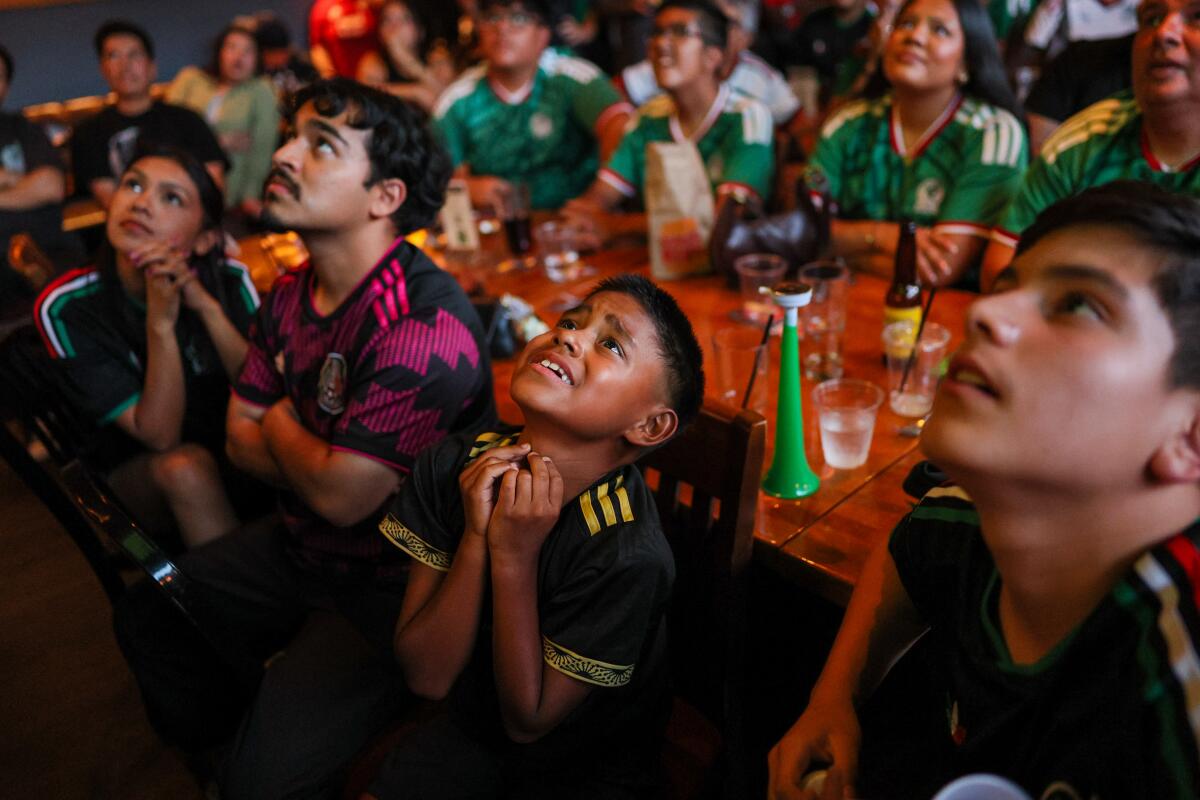
Reynaldo Flores Jr., 10, center, reacts during the final minutes of a round of 16 knockout match between Mexico and England during a World Cup watch party at Chapter One in Santa Ana on July 5.
(Ronaldo Bolaños / Los Angeles Times)
A combination of factors are to blame: Mexico’s repeated World Cup losses to Argentina, a series of questionable refereeing decisions seeming to favor Argentina, Messi’s massive media presence and ongoing discourse on social media — where legitimate analysis coexists with passionate opinions and misinformation.
Deeper cultural resentments are also a factor. Many in the region have long complained that Argentines, many of whom have predominantly European ancestry, think they’re better than the rest of Latin America.
Critics say that Eurocentric superiority complex was on display this summer when Argentine journalist Eduardo Feinmann declared on air, after Mexico was eliminated in a close match with England: “I detest Mexicans, I detest them with my soul. … The envy they feel for us, not only in football but in everything.”
Feinmann’s comments sparked such widespread ire that Mexican President Claudia Sheinbaum weighed in, calling his remarks “appalling.”
Later, Feinmann said his words were not directed at the Mexican people — while musing that Sheinbaum had bigger things to worry about, like combating narco-trafficking, violence and corruption.
The World Cup by its nature stokes nationalism, and the deployment of stereotypes and even outright racism has long been a feature of the tournament. Last week, for example, a former Spanish prime minister, Mariano Rajoy, sparked outrage when he said that the French national soccer team, which includes members with African immigrant backgrounds, “does not have any French players.”
At two Argentina matches during this year’s tournament, fans from the country were recorded hurling racist slurs at an African American streamer. Online critics were quick to dredge up comments by a former Argentinian leader as proof of the country’s bias. “The Mexicans came from the Indians, the Brazilians came from the jungle, but we Argentines came from the ships … from Europe,” former Argentine President Alberto Fernández said in 2021.
A boy wearing an Argentina jersey waves American flags as fireworks explode during the annual Independence Day Celebration in the predominantly Latino community of Lynwood on July 3.
(Mario Tama / Getty Images)
Many Argentines say they, too, are appalled by such comments. “We reject it completely,” said actress Karenina Ivankovic, 37. “But you’ll find rude people everywhere.”
She moved from her native Argentina to Mexico City 13 years ago, and said she is shocked by the wave of “xenophobia” directed at her countrymen during this year’s tournament.
People have sent her nasty messages online, and strangers have stopped her on the street to tell her they hope Argentina loses. And she said several Argentine friends were physically attacked at a festival in Mexico City organized by FIFA, soccer’s world governing body.
People love Argentine music, Ivankovic said. They love Argentine beef.
“But during the World Cup,” she said, “they hate us.”
She thinks that may in part be because of how serious Argentines take their fútbol.
“Argentina lives in crisis,” she said. “Economic crisis, political crisis. Soccer is something that unites us. We say there’s no better hug than after Argentina has scored a goal.”
But at the end of the day, she said, people need to relax and remember that what’s at stake is just a tournament trophy.
“It’s become very political and personal,” she said. “But it’s just a game.”
Even some fans in Mexico express remorse about the wave of anti-Argentine sentiment — much of which has been playing out, sometimes crudely, online.
“It’s too bad that all this hate directed at the Argentines doesn’t allow us to appreciate that they have the best player in the world, Messi,” said Carlos Romero Díaz, 37, a car salesman here who was rooting for the South Americans. “Yes, Argentina generates a lot of anger, but at the end of the day, they score goals and win games.”
While Mexico has never won a World Cup, Mexico City’s iconic Estadio Azteca has been the site of some of Argentina’s greatest soccer triumphs, notably its championship in the stirring 1986 World Cup.
Argentina player Diego Maradona outjumps England goalkeeper Peter Shilton to score with his “Hand of God” goal as England defenders Kenny Sansom (top), Gary Stevens (center) and Terry Fenwick look on during the 1986 FIFA World Cup at Estadio Azteca in Mexico City.
(Getty Images)
A quarterfinal match between Argentina and England featured two of soccer legend Diego Maradona’s greatest hits: the so-called “Goal of the Century,” by all accounts a masterpiece strike; and Maradona’s infamous “Hand of God” goal, an illegal hand-goal that was allowed to stand because no referee saw the infraction.
But Mexico’s losses to Argentina have left a strong mark too. No other team has eliminated Mexico as many times in a World Cup.
After Argentina defeated Mexico 2-0 during group play in the 2022 World Cup, a video from inside the Argentine locker room began circulating, showing Messi — who scored one of the goals — taking off a soccer boot while a Mexican jersey lay on the floor.
Mexican boxer Saúl “Canelo” Álvarez interpreted the scene as the Argentine captain deliberately kicking the jersey and accused him of disrespecting Mexico — an allegation that Messi denied.
Years later, Messi acknowledged that the incident had altered the perception some Mexican fans had of him.
“I’ve always felt very loved by the people of Mexico. I’ve never disrespected anyone,” he said during an interview with “Simplemente Fútbol.”
Although Mexico is at the center of much of the debate, critical sentiment toward Argentina has taken hold among fans from other Latin American countries.
Social media has been flooded with posts from users in Colombia, Chile, Uruguay, Ecuador and Peru questioning refereeing decisions or expressing disapproval of Argentina, while messages mocking rival teams also proliferated from Argentine accounts.
As Argentina continues its quest for another World Cup title, the debate over whether it has simply been the best team in the tournament or also the one most favored by circumstances will continue to dominate soccer conversation in Latin America.
Staff writers Linthicum and El Reda reported from Mexico City and McDonnell from Boston. Special correspondent Sánchez Vidal reported from Mexico City and special correspondent Andrés D’Alessandro from Buenos Aires.
StubHub is getting a red card from some World Cup fans
Two World Cup customers are suing the New York-based ticket-selling company, alleging “false and misleading” advertising that left them without tickets or a refund for the World Cup games they paid to attend.
In federal court in New York last week, two Californians — Julia Reeker Moghal and Reuben Renteria — sued StubHub seeking monetary damages and a ban on the company selling World Cup tickets. The lawsuit aims to become a class action and comes after weeks of fierce criticism and complaints from customers regarding the company’s practices.
Throughout the World Cup, videos have emerged on Instagram and TikTok of StubHub customers describing their nightmare experiences with the ticket-selling platform.
Some said they had purchased tickets to World Cup games as early as November of last year, booked flights and hotels and arranged travel plans, then StubHub notified them days to weeks before the match of a refund for their tickets, which they never requested.
There were similar complaints about last-minute cancellations from people who bought Coachella tickets on StubHub.
In the lawsuit, Moghal said she had purchased three tickets for nearly $2,000 for the June 18 match between Switzerland and Bosnia-Herzegovina at SoFi Stadium in Inglewood, which were then canceled by StubHub. Moghal said she was contacted by StubHub and told her tickets would remain canceled, then was later told the tickets would be available one hour before the game.
When the match began, Moghal said she was at SoFi Stadium, but the tickets never came.
Renteria said he paid around $2,300 for the June 18 Mexico versus South Korea match in Guadalajara, Mexico, but they were canceled
“Devoted soccer fans have traveled from around the world to attend World Cup matches — and they reasonably relied on StubHub to provide the tickets they paid for as well as on StubHub’s warranty,” Blake Hunter Yagman, the attorney representing the two, said in a statement. “Instead of rewarding their business, StubHub sold them World Cup tickets that they either could not provide or on speculation, only to be stranded, in many cases, at the stadium gates without any recourse.”
According to StubHub’s website, its Fan Protect Guarantee states the platform will deliver valid tickets or refund in the event of a ticket issue, and that it will “go out of our way to find replacement tickets” of a comparable value. The lawsuit alleges the replacement tickets many fans were given by StubHub were worse than their original tickets.
FIFA, the World Cup organizer, states in its terms and conditions that the FIFA Marketplace, its own ticket-selling platform, is the only authorized platform for World Cup tickets, and that only tickets purchased through it are guaranteed by FIFA to be valid.
Despite the risk of purchasing through a third-party platform such as StubHub, many fans opted to do so to avoid the 30% FIFA resale tax, believing that the Fan Protect Guarantee would safeguard their order.
Since World Cup tickets began selling on FIFA Marketplace last September, fans have expressed disappointment in the expensive price tag. FIFA utilized a dynamic pricing system for the sale, and as sales phases progressed leading up to the games, the cost of tickets increased tremendously. In March, the extreme cost of tickets prompted 69 members of Congress to write a letter to FIFA urging them to lower their prices.
Tickets for the upcoming Friday match between Spain and Belgium in Los Angeles are selling on StubHub for over $1,300.
StubHub said in various statements to the news and in legal proceedings that ticket cancellations were a result of transfer problems and issues with FIFA’s ticketing infrastructure.
StubHub did not respond to requests for comment.
A FIFA spokesperson responded to this accusation in a statement, saying, “FIFA has no visibility over, or control of, secondary market ticket transactions carried out on third-party platforms. The transactions facilitated on these platforms occur entirely independently of FIFA’s official ticketing platform. With reference to the reliability of the services available to fans on FIFA’s official ticket platform, FIFA rejects any suggestion that the functional issues being experienced by users of third-party platforms with respect to FIFA World Cup 2026 tickets are the result of FIFA’s ticketing infrastructure.”