Manchester Airport

Couple left £973 out of pocket after confusing rule blocks them from dream holiday

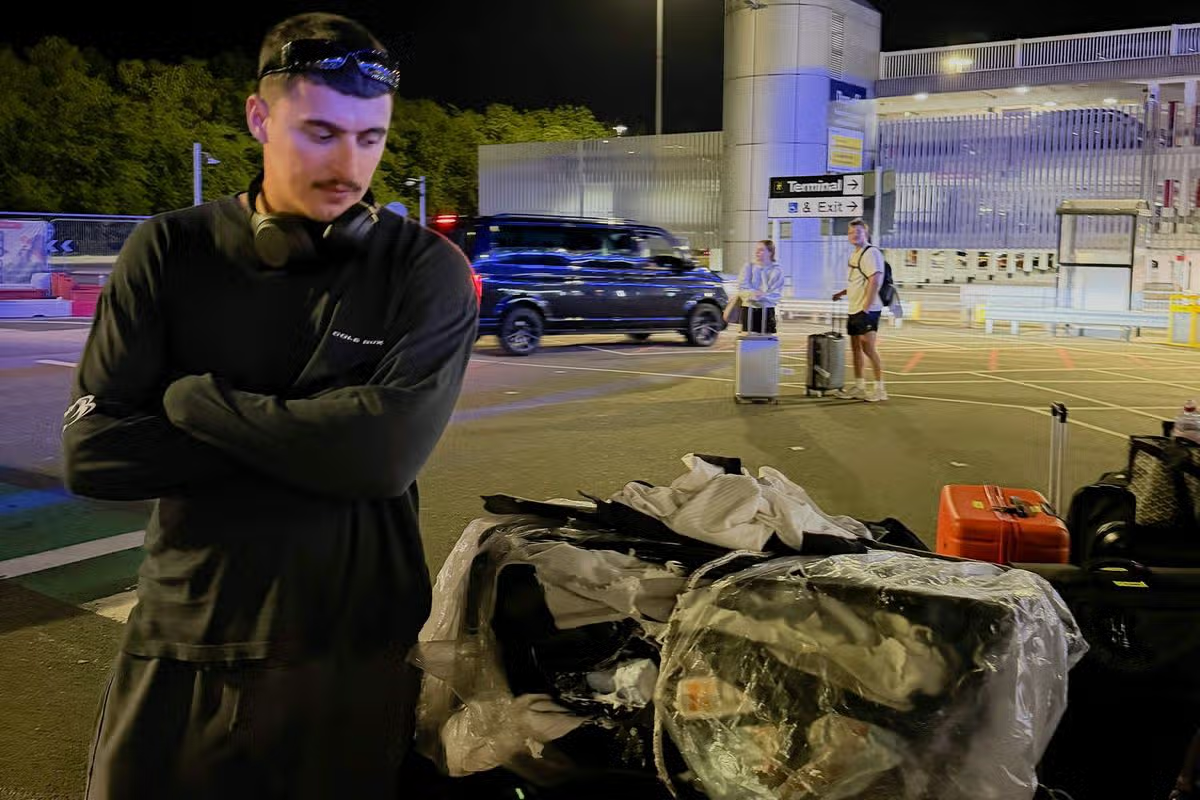
Peter Wiles and his wife Rogelyn Caresosa had been planning to go on a holiday to Cappadocia in Turkey, but their holiday ended at Manchester Airport where Turkish Airlines stopped them from boarding

A man was left ‘questioning his sanity’ after he and his wife missed a Turkish Airlines flight.

Peter Wiles and Rogelyn Caresosa had been looking forward to a romantic getaway in Cappadocia, a region of Turkey famous for its colourful hot air balloons and multi-level subterranean cities carved out of soft volcanic ash stone over thousands of years.

The couple married in 2024, paving the way for Rogelyn to move to the UK on a spouse visa and live with her factory worker husband. Having saved up the cash for the May 2025 getaway, Peter splashed out £973.30 for flights from Manchester Airport.

Both Peter and Rogelyn were distraught when their dream getaway ended at the airport.

“My wife was devastated, we had to get a taxi home as it was late on a Sunday and the trains had finished,” Peter told the Mirror. “This whole debacle has honestly had me questioning my sanity at times!”

Peter had booked and paid for two Turkish Airlines return flights to Turkey for himself and his Filipino wife, as part of a single booking in his name, using his Tesco Bank credit card.

They encountered a small difficulty in booking. Because Rogelyn holds a UK spouse visa, her old Biometric Residence Permit (BRP) card had technically expired at the end of 2024 under the UK’s switch to digital eVisas, although her actual immigration status remains valid until 2027.

Before applying for Turkey’s eVisa, Rogelyn called the Turkish Consulate, which advised her to use her BRP number rather than her UK “share code” as the “additional visa number” on the form.

However, once at Manchester Airport, a Turkish Airlines gate agent rejected this, insisting the share code should have been used instead. This is despite the eVisa printout they presented, which stated that “eVisas of other countries are NOT accepted as supporting documents.”

Ultimately, Rogelyn was denied boarding and so the couple were left at the airport, their plane leaving without them.

Peter has now been left fighting to get his money back, attempting to claim it back via his bank and Turkish Airlines. So far, he has been unsuccessful. He claims that Turkish Airlines refused to give a clear written explanation for the refusal, at various points citing a vague “issue” with the visa, then claiming the couple were a “no show”.

Following a request from Peter, Tesco Bank raised a chargeback, which the airline contested twice, before Tesco Bank ultimately dropped it. The bank accepted the airline’s “flight operated as scheduled” explanation, despite that not addressing why boarding was denied.

Peter would go on to report the incident to the Ombudsman, but she ruled against him on technical grounds: no valid Debtor-Creditor-Supplier agreement existed for the wife’s ticket because she, not Peter, was the one denied boarding.

The lengthy and frustrating process has left Peter doubting himself. “I’ve developed a complex about being misunderstood and feel I have to explain everything in detail,” he added.

A Tesco Bank spokesperson said: “We were sorry to hear about the experience Mr Wiles had when attempting to travel with his wife. After careful consideration, we concluded that his case didn’t meet the criteria for a successful Section 75 claim. He referred his claim to the Financial Ombudsman Service, which upheld our decision.”

Turkish Airlines did not respond to a request for comment.

Source link

‘Ryanair charged me £75 extra for suitcase I’ve used more than 30 times’

A Ryanair passenger has hit out at the airline after she was forced to pay a £75 oversized bag fee for a suitcase she claims to have used ‘more than 30 times’ over the last seven years

A Ryanair passenger claims she was forced to pay a £75 fee at the airport terminal for a bag she has travelled fine with ‘more than 30 times’. The flyer, named Laura, shared her frustration on X after the unexpected luggage charge.

Laura, who had been flying through Manchester Airport, posted: “Hey @Ryanair I want a refund for the £75 that the absolute jobsworth at Manchester Airport this afternoon took from me for an ‘oversized’ bag i’ve used and never had an issue with on this exact journey maybe 30+ times over the last seven years.” She included a photograph showing the bag apparently fitting into the 40 x 30 x 20 cm slot which is permitted.

In a follow-up to her initial post, she explained: “I asked a staff member, ‘have the measurements changed recently?’ and they said no, but that the enforcement was more stringent.”

One person responded: “This happened to me last year! Baring in mind I’ve just come back from a holiday 2 weeks before and had no problems.

“Their argument was that it was sticking out (being too wide). It wasn’t at all and is the same as yours is in the picture. Poor behaviour.”

Another user chimed in: “You’re so right, they’re trying to get money as much as they can, I had to buy a new bag as the one I’ve been using for the last 14 years is ‘too big’ and they also made me pay. They want to take money as much as possible.”

A third also added: “I hate that but there is no winning. The only way I found is to ask for the measure and have them measure it, if it checks out then it’s fine if not, then it’s on you.”

Not everyone was sympathetic, however, with some siding with Ryanair over the bag’s size. One user wrote: “The depth of your suitcase goes over the line that clearly says too big. What makes you think you are entitled to this over the other millions of passengers who don’t do this?”.

Another commented: “Looks like you owe Ryanair £2,250 for those 30 flights. Double it if they were returns.”

While one user simply stated: “It’s oversized.”

Several others urged Laura to switch airlines if she was unhappy with Ryanair’s policies.

She responded, however: “Unfortunately they’re the only airline operating on that route.”

A representative for Ryanair said: “This passenger booked a Regular Fare for this flight from Manchester to Göteborg Landvetter (Aug 4), which allowed them to carry a small personal bag and 10kg cabin bag measuring up to 55 x 40 x 20 cm onboard.

“As this passenger’s cabin bag exceeded the permitted size, she was correctly required to pay a standard gate baggage fee by the gate agent at Manchester Airport.”

What are Ryanair’s baggage fees?

Ryanair’s baggage fees vary dynamically depending on the route, date of travel, and when you purchase the allowance. Buying baggage online during your initial flight booking is always the cheapest option.

Cabin and hand luggage fees

Every passenger is allowed one small personal item for free (e.g., laptop bag, small backpack) that must fit under the seat in front of you (max 40 x 20 x 25 cm).

Priority and 2 cabin bags: Allows you to bring the free small bag plus a 10kg overhead cabin bag (max 55 x 40 x 20 cm).

  • When booking flight: €/£6 to €/£36
  • Added post-booking / at airport

Gate baggage fee: If your non-priority cabin bag is oversized at the gate, it will be placed in the hold for a fee of €/£50 to €/£69.99.

Checked baggage fees

  • 10kg checked bag – €/£9.49 – €/£44.99 during initial booking, €/£23.99 – €/£44.99 post-booking/at airport
  • 20kg checked bag – €/£18.99 – €/£59.99 during initial booking, €/£39.99 – €/£59.99 post-booking/at airport
  • 23kg checked bag – €/£29.99 – €/£80.99 during initial booking, €/£54.00 – €/£97.00 post-booking/at airport

Source link

UK airport drop off fees up by a third – full list of most expensive

The cost to drop friends and family off at the airport this summer has increased by a third at most airports across the UK – with some short stays costing a whopping £10

Dropping off family and friends at the airport this summer will cost you even more as new research has found that fees have increased by a third over the last year.

It was found that 16 out of 20 airports analysed had increased or introduced so-called “kiss and fly” fees since last summer, according to the RAC.

Some airports are now charging as much as £10 just to stop outside the terminal for a few minutes.

The most costly airports are still Gatwick and Stansted, with terminal drop-offs costing £10 at both.

The bigger shock comes as the only major airport that offered free terminal drop-offs, London City, now has one of the costliest fees charged on a per-minute basis.

Drivers dropping off relatives at London City are now charged £8 for five minutes, making it the highest charge per minute among airports included in the research.

The next most expensive drop off zones are outside of England’s capital.

One is in Scotland, as Edinburgh charges £8.50 for up to 10 minutes. Bristol also charges the same fees.

The RAC noted the average cost of airport drop-off fees has increased by around a third over the past year, despite many of the world’s busiest airports continuing to offer free terminal drop-offs.

The organisation highlighted that none of the busiest airports in the European Union charge drivers for dropping passengers off outside terminals.

In some of the world’s busiest hubs, including Dubai, these fees also do not exist.

Most UK airports do have alternative options that are free, however these are usually located in mid or long-stay car parks, with passengers needing to catch a shuttle bus to the terminal.

RAC senior policy officer Rod Dennis said: “It’s disappointing to see so many airports charging so much for what many regard as a simple act of kindness in dropping off family and friends.

“Having a captive audience should be no excuse for these farewell fees, especially when they’re completely at odds with how major airports around the world operate.

“Of course, airports need to manage the limited space they have carefully, but if free, convenient drop-off zones work at many other international airports, then why not here?”

Mr Dennis also warned drivers to take extra care when using airports with “park now, pay later” systems without barriers.

He said: “Those that drop off but miss the signage or forget to pay soon afterwards can face a parking charge notice as high as £100 – a fee that feels distinctly disproportionate to the contravention.”

There were only four airports in the study that had not increased their costs. Liverpool John Lennon, East Midlands, Belfast City and Southampton.

Most expensive airport drop-off charges:

  • £10: Gatwick and Stansted
  • £8.50: Bristol and Edinburgh
  • £8: Bournemouth, Leeds Bradford and London City
  • £7: Aberdeen, Birmingham, Glasgow, Heathrow, Luton and Southampton
  • £6: Liverpool John Lennon and Newcastle
  • £5.50: Manchester
  • £5: Belfast International and East Midlands
  • £4.50: Cardiff
  • £4: Belfast City

Source link

Viral kids’ toys could be confiscated at UK airport security – warning to parents

Airports have warned that kids could be forced to leave the items behind

Parents are being told to leave certain children’s toys at home. If kids bring them to the airport, they may be taken from them at security. There is a high chance that items like NeeDoh cubes and other popular ‘squishy’ toys could be flagged and confiscated.

Even at airports using advanced scanners, gel-filled toys look highly unusual on security screens. This frequently triggers a manual bag check, causing travel delays, and some staff will not take the risk with these items going any further into the airport.

Travel specialist Kate Donnelly (@Thedonnelllyedit) said: “From my own personal experience, [squishy toys] do tend to come under closer scrutiny when passing through airport security. My top tip for parents this summer, pack these items in your whole luggage.

“There is a high chance that if you put these in your hand luggage, they will get confiscated. There are absolutely no markings on them to let you know exactly how much liquid is contained within them, and therefore, they are very easily removed.

“This means that you have upset children and you will have to pay out for a whole new load of toys when you get to your destination.” She suggested that the best thing to do is to pack toys safely in your main suitcase that gets checked into the hold, as this allows more liquids than hand luggage does, helping you avoid delays and reduce the risk of them being confiscated.

Content cannot be displayed without consent

Posting online, Luton Airport confirms that any squishy toys, including NeeDoh cubes, that contain a gel or liquid must comply with the strict liquid rule when packed in hand luggage. The airport said: “As the quantity of gel contained within these items cannot be accurately verified during the screening process, they are not permitted through security in hand luggage.”

Manchester Airport also said: “Things like squishy toys contain liquid – this includes NeeDohs, which use malt syrup. Smaller versions of the toy are under 100mls, but larger versions are not.

“The problem is that, as they don’t have measurements printed on them, security staff have to estimate their size. Our advice is that all but very small squishy toys should be placed in hold baggage.”

As a result, kids could be forced to bin their favourite toys before going on holiday. The issue is that there is often no way to verify exactly how much ‘liquid’ is inside one of these objects.

Not all UK airports follow the same rules about liquids in 2026 due to a staggered rollout of new high-tech 3D CT security scanners that allow the 100ml rule to be relaxed. Different locations are at different stages of upgrading, with a pause currently in effect this summer to avoid disruption over peak travel times.

Below is a list of what airports are following the new (2000ml) rules. At the airports accepting two litres in hand luggage, the scanners also mean people do not need to empty their bags, as scanners are powerful enough to detect these items, as well as electronics:

  • Belfast City
  • Belfast International
  • Birmingham
  • Bristol
  • Edinburgh
  • London Gatwick
  • London Heathrow (All terminals)
  • Teesside International

These airports are still following the original (100ml) rule:

  • Aberdeen
  • Bournemouth
  • Cardiff
  • East Midlands
  • Glasgow International
  • Glasgow Prestwick
  • Inverness
  • Isle of Man
  • Leeds Bradford
  • Liverpool
  • London City
  • London Luton
  • London Stansted
  • Manchester
  • Newcastle
  • Norwich
  • Southampton

Source link

Parents warned over NeeDohs as they ’cause chaos’ at UK airports

Families are being delayed at security and some items are being confiscated

Parents have warned holidaymakers about a viral toy as it is causing chaos at airport security this summer. Stress relief toys called NeeDohs and squishy shaped dumplings are popular among children, but they are causing problems at airport security.

The squishy toys contain liquid which parents say is being detected on scanners at airport security and have caused travellers delays as they wait to get their bags checked. Emma Barnes was travelling to Barcelona from Birmingham airport on May 29 with her ten-year-old twins when their cases were pulled aside by security.

The part-time teacher, from Chester in Cheshire said: “I didn’t know it was a thing until it happened to us. We had five or six squishies in total spread across random pockets in our bags. I didn’t think twice, I thought it was just a squishy toy the kids had and especially on a short hall flight when they don’t have a television, they need something.

“It caused us so much stress. It is stressful anyway at airport security and when the first case got pulled and I thought ‘oh no what is it’.”

Emma explained security officials went through their bags until they found one of her children’s NeeDoh squishies. She said: “The first case got pulled and they took the squishy out and said we can’t tell what the component is inside of it and they had to drug test it.

“My daughter then said to me ‘I put two in the other cases as well’. The queue behind us was getting massive and I was dying inside. The security was really nice, they scanned and swabbed them and gave them back to us.

“I wanted to help warn other parents travelling this summer as everyone’s kids have squishy toys. We could see the airport staff thinking ‘this is going to be a bad summer ahead’.”

Emma said next time she will treat the squishies. Other parents said online “my son’s got taken off him” and that “Play-Doh has the same issue”.

Leanne, from Derbyshire, had a similar experience at East Midlands airport earlier this year. Her seven-year-old daughter put a NeeDoh in a bag without telling her mum. “Thankfully we were allowed to keep it,” she said. “I have heard that some airports dispose of them.

“My little girl is in the special educational needs (SEN) pathway so they help her regulate emotions when she’s stressed, so she was so worried it would be taken from her. The security lady said they flag up all the time. It was not a nice experience but I do understand why it happened when we knew what our daughter had done.

“It has never been flagged until now. It is becoming a bigger and bigger thing – the scanners aren’t liking them at all.”

A spokesperson for Manchester Airport said: “Things like squishy toys contain liquid – this includes NeeDohs which use malt syrup. Smaller versions of the toy are under 100mls but larger versions are not. The problem is that as they don’t have measurements printed on them security staff have to estimate their size.

“Our advice is that all but very small squishy toys should be placed in hold baggage.”

A Birmingham Airport spokesperson added: “These items are not a security prohibited item, but as with any item carried as cabin baggage, they are required to clear security screening”.

Gatwick Airport said the toys are not prohibited but like all items, are subject to security screening. Government officials have also issued concerns about the toys, including Aberdeen City Council in Scotland who put out a warning on July 13 about potentially dangerous versions of the popular squishy toys, with more than 1,000 being seized from local shops in a month.

Hillingdon Council trading standards officers seized 500,000 squishy dumpling toys in two months at Heathrow airport which were coming into the UK to potentially be sold. Officials fear businesses are selling dangerous counterfeit versions and urge people to check where they are buying the toys from.

Hillingdon Council said: “Heathrow Airport is a gateway for goods entering the UK, and we’re proud to play a leading role in protecting consumers. As part of this work, our Trading Standards officers have been carrying out targeted checks on “squishy” toys at Heathrow. In the past two months, the council has seized 500,000 squishy toys. Many are similar in design and lack proper labelling and traceability information.

“The main issue is the absence of clear details of a responsible UK-based business and the correct UKCA or CE safety markings, making it hard to verify compliance and take action.”

Source link

Every UK airport with 2000ml liquid limit ‘rule’ in place this summer

People should check their specific airport before travelling this summer

Airports in the UK have slightly different rules that could catch some travellers out this summer if they do not check them before packing. Certain airports have been upgraded to help relax a major security rule, while others have yet to make any changes.

The 100ml liquid-limit security rule means passengers can only bring liquids in containers of 100ml or less in hand luggage. The rule was put in place back in 2006 when police foiled a major terrorist plot, which prevented a group that planned to smuggle liquid explosives on board a flight leaving London that was bound for North America.

At the time, standard airport security X-ray machines were designed to detect metal weapons (such as guns and knives) and solid explosives, with no way to distinguish between a simple bottle of water and volatile liquids. For years, the rule has remained in place for the vast majority of airports.

But in 2022, the Government confirmed plans to relax the rules. As technology has advanced, some airports are relaxing the rules in 2026.

Certain UK airports featuring new 3D security scanners now allow passengers to carry liquids, gels, and aerosols in individual containers that can hold up to two litres (2000ml). These airports allow you to leave liquids in your hand luggage without needing clear plastic bags.

Content cannot be displayed without consent

As of July 15, 2026, the following airports have fully upgraded their systems to include new scanners that officially allow passengers to carry liquids in containers up to two litres in their hand luggage:

  • London Heathrow (All Terminals)
  • London Gatwick
  • Birmingham
  • Bristol
  • Edinburgh
  • Belfast International
  • Belfast City
  • Teesside International

Even at these hubs, reusable metal, insulated, or double-walled vacuum bottles must be empty when passing through security. You can refill them once you are inside the departure lounge.

Every other UK airport has yet to follow suit with the change, and still follows the commonly known limit of 100ml. But even with the same cap on liquids, certain airports have different ways of letting items through security.

For example. certain airports remain the same as last summer, where passengers need to use 100ml containers and place them in a clear, resealable plastic bag for scanning. These airports include:

  • London Stansted
  • London Luton
  • Glasgow International
  • East Midlands
  • Liverpool John Lennon
  • Cardiff

But, certain airports have relaxed the rules slightly. Although the strict limit on the amount of liquids is still in place, passengers can keep their liquids and electronics inside their bags for processing at these airports:

  • London City
  • Manchester
  • Newcastle
  • Leeds Bradford
  • Aberdeen
  • Southend

Why aren’t all airports changing at once?

The UK Government’s original goal was a blanket lifting of the 100ml rule, but issues arose, meaning the change had to be implemented gradually. To prevent massive security bottlenecks during the peak summer rush, the Department of Transport has largely frozen rule changes at airports that haven’t yet reached 100% compliance.

Major remaining hubs, such as Stansted, Luton, and Manchester, are continually updating their lanes behind the scenes. Gradual transitions to the “in-bag” rules are expected to resume late autumn/winter 2026 as travel volume drops.

People have been reminded to think before they start maxxing out their luggage limit, as their return journey could be what catches them out. Even if you fly out of a 2L-friendly airport like Heathrow, most international destinations still enforce the strict 100ml rule, so if you buy full-sized toiletries in the UK, you may have to check them into hold luggage on the way back or throw any leftovers away before coming home.

Source link

Packing innocent 35p item in bags or suitcases could see you stopped at airport

It might seem harmless at first glance, but it could lead to unnecessary delays

Packing for a holiday can feel like navigating a minefield, with a long list of rules on what can and can’t go in your luggage. While some banned items are obvious, others seem completely innocent at first glance – yet bringing them to the airport could still result in officials delaying your journey.

There is one everyday item that is allowed by all major airlines, including Ryanair, Jet2, TUI, easyJet and British Airways, but could still attract attention during security screening if officers are unable to identify it clearly on the scanner. To avoid unnecessary delays or having to unpack your luggage at the checkpoint, travellers are advised to pack toiletries in a way that makes them easy to inspect.

A simple bar of soap – buyable at Sainsbury’s for 35p, for example – might seem like one of the most harmless items you could take on holiday. However, it is not the soap itself that can cause concern – it is the way a solid item may appear when passing through security scanners.

Airport security staff do not routinely search luggage simply because it contains a bar of soap. However, dense items can sometimes make X-ray images harder to interpret, particularly when they are packed alongside electronics, cables or other bulky belongings. If officers cannot clearly identify an item, they may carry out additional checks before allowing passengers through.

The government information website GOV.UK says: “Airport security staff will not let anything through that they consider dangerous – even if it’s normally allowed in hand luggage.” While soap clearly is not dangerous, if a bar of soap raises an alert on the scanner, they are legally required to stop the passenger and inspect it.

The US Transport Security Agency (TSA), for instance, says passengers are often asked to separate dense items because they can “clutter bags and obstruct clear images on the X-ray machine.” When a solid block of soap, cheese, or other dense organic material blocks the scanner’s view or mimics a threat signature, protocol requires a physical bag search or chemical swab testing to clear the item.

According to GOV.UK, solid bars of soap are permitted in both hand luggage and checked baggage. Security officers can still manually inspect any item they are unable to identify clearly during the screening process, regardless of whether it is allowed.

To reduce the chances of your bag being opened, experts recommend keeping dense items easy to access and, if requested, placing them in a separate tray during screening. Avoid storing them inside thick metal tins or rigid plastic cases alongside items such as power banks, charging cables and other electronics, as this can make X-ray images harder to interpret.

It’s also important not to confuse solid soap with liquid toiletries. While bars of soap are exempt from liquid restrictions, liquid soaps, shower gels and similar products carried in hand luggage must normally be in containers holding no more than 100ml, unless you’re travelling through an airport that has introduced next-generation security scanners permitting larger liquids.

The rules apply regardless of which airline you’re flying with, as baggage screening is carried out by the airport rather than carriers such as Ryanair, Jet2, TUI, easyJet or British Airways. A manual inspection is simply a precaution and does not mean you’ve broken any rules or packed a prohibited item.

Taking a few moments to think about how you pack everyday toiletries could help make your journey through security a little smoother. Although a 35p bar of soap is perfectly legal to travel with, storing it sensibly could help avoid unnecessary delays before your holiday even begins.

Source link

Fly through airport security using ‘psychology’ trick for faster service

An airport has revealed an easy trick for a shorter wait at airport security

Holidaymakers can cut down the time they spend waiting at airport security using a little-known trick. The travel hack was shared by Manchester Airport, and it could be perfect for families ahead of the busy summer holidays.

According to Manchester Airport, there’s an easy way to reduce your queue time if you’re allowed to choose which lane to wait in. Posting tips for passengers online, the travel hub shared an ‘Ultimate Airport Guide’ on its website. There are various tips, covering everything from the best shoes to wear and how to decorate suitcases for maximum visibility.

In the ‘at the airport’ section of the guide, there’s a hack that could help passengers fly through security using ‘reverse psychology.’ Manchester Airport said: “If given the choice of security lanes, pick the left. Most passengers are right handed and will subconsciously prefer the right, making the left a little quieter.”

The airport added that customers can also pay to upgrade to FastTrack for a faster experience. “For just a few pounds, you can purchase FastTrack tickets to use the priority lane and avoid the queues before Security on your way out and Passport Control on your way in.” Many airports offer a similar experience, allowing passengers to pay to use FastTrack.

Elsewhere, London Stansted Airport offers the same security advice for passengers. The airport retierates: “If given the choice of security lanes, pick the left.”

The tip could be especially helpful when many passengers are travelling at the same time, such as during the school summer holidays. However, it’s worth noting that passengers don’t always get to choose their lane.

Nonetheless, they can help speed up the process by avoiding accessories that are difficult to remove. This makes the process faster for everyone.

Offering advice online, London Stansted Airport said: “To prepare your outfit for security, wear shoes that you can take off and put on easily. Avoid fiddley belts or fastenings in your clothes and excess jewellery. Try and keep your pockets empty of non-essentials.”

Despite this, passengers might still want to pack a few layers for later in their journey. The airport recommends packing items such as jumpers, which are easy to take on and off when the temperature changes.

The travel advice said: “Temperatures aboard flights can vary so wearing a few removable layers is advised. An extra jumper can always be used as a pillow if nothing else.”

Source link

New July 8 UK airport rule will affect British families – ‘get through quicker’

Travel could be about to get faster for some families this summer at dozens of UK airports

Families are being reminded that a major change to a key rule across more than a dozen UK airports will come into effect this summer. From next week, on July 8, a security rule will be eased for certain primary school-age children.

Back in May, the UK Government announced that up to 1.5 million more children would soon be able to use UK eGates, helping to speed up the process for them and their families during the summer holidays. Children aged eight and nine, who are at least 120cm (3ft 11in) tall and travelling with an adult, will become eligible under the new measures that come into force on Wednesday, July 8.

Officials say the change to the age threshold will be a welcome relief for families returning home from their holidays with young children in tow. The government claims that passing through an eGate typically takes just a matter of minutes.

With greater numbers of passengers making use of eGates, waiting times at passport control are also anticipated to fall. Prior to 8 July, eGates were generally available to those aged 10 and above, though children under 17 were required to (and must still be) accompanied by an adult, reports the Express.

Passengers are eligible to use an eGate if they have a biometric symbol on the front cover of their passport and are either:

  • a British citizen
  • a national of an EU country, Australia, Canada, Iceland, Japan, Liechtenstein, New Zealand, Norway, Singapore, South Korea, Switzerland or the USA
  • a member of the Registered Traveller Service
Content cannot be displayed without consent

Minister for Migration and Citizenship, Mike Tapp said: “Travel with young children can be stressful for parents. By expanding eGate access, more families can experience a swifter and smoother journey home – freeing up precious time this summer holiday season. We are delivering continued improvement to the passenger experience, while keeping our borders safe and secure.”

Border Force Director General, Phil Douglas said: “eGates are an essential part of keeping our border secure. Expanding access for families will deliver safe, smooth journeys whilst freeing up highly-skilled officers to focus on intercepting those who pose a threat to the UK.”

Karen Dee, Chief executive of AirportsUK, the trade body for UK airports, said: “This is a welcome development as it will give more families the ability to take advantage of this technology, speeding up the border process and reducing waiting times for many. Airports work very hard with border authorities to ensure the UK’s front door is both secure and welcoming, with those coming home and visiting enjoying a smooth experience.”

The UK first introduced ePassport gates at airports in 2008, with the very first gate going live at Manchester Airport. Initially, the automated gates were limited to UK, EU, and Swiss citizens but have since expanded to include eligible travellers from dozens of countries, including the US, Canada, Australia, and New Zealand.

Full list of UK airports with eGates (as of July 2026):

  1. London Heathrow
  2. London Gatwick
  3. London Stansted
  4. London Luton
  5. London City
  6. Manchester
  7. Birmingham
  8. Edinburgh
  9. Glasgow
  10. Bristol
  11. Newcastle
  12. Cardiff
  13. East Midlands
  14. Southampton
  15. Southend

Source link

Which UK airports still have the 100ml restrictions in place – full list

We’ve all got used to packing tiny shampoos and shower gels into our hand luggage when we fly, but new technology means some major airports are scrapping the 100ml rule making going through security so much easier

It’s hard to believe that the airline liquid rules have been in place for nearly two decades. Since a terror plot was foiled in 2006, air passengers in the UK have been limited to taking containers of under 100ml on planes, and made to keep them in a clear, resealable 20cm x 20cm plastic bag.

Over the years, technology has improved, meaning restrictions have slowly been eased. In many airports, you no longer need to use a clear plastic bag for your liquids and can simply leave them in your hand luggage. However, in the majority of airports, the 100ml rule still stands all these years later.

A small number of airports have now scrapped the 100ml rule – allowing Brits to fly out with liquids in containers of up to two litres in volume. This means most standard-sized bottles of water, creams, gels, sprays, and aerosols can be taken through as hand luggage.

Whatever the allowed liquid size at your departure airport, holidaymakers should make sure they avoid using metal or double-walled bottles, such as a Thermos flask, when they carry liquids on board, as the scanners cannot penetrate the insulated layers.

Another thing travellers should keep in mind is that the rules at their return airport might be different. The vast majority of European airports still enforce the 100ml rule. So while you may be able to take a big bottle of suncream in your hand luggage going out, you may need to put it in your checked luggage coming back.

The GOV.UK website has a list of items considered liquids. Many travellers still get caught out by the 100ml rule as they don’t realise items such as semi-liquid foods such as soup, jam, honey, or syrups need to be within the restricted size.

Nut butters and soft cheeses also come under the category of liquids. In the USA, the Transportation Security Administration (TSA) use a rule that: if you can spill it, spread it, spray it, pump it, or pour it, it counts as a liquid. While this isn’t an official rule in the UK, it’s a good way to determine whether an item you’re taking onboard is going to need to follow liquid size rules.

Liquid rules at airports can be updated with little notice, so always check your departure airport’s official website before you fly.

Full list of airports still enforcing the 100ml rule

  • Manchester Airport (MAN)
  • London Stansted (STN)
  • London Luton (LTN)
  • Glasgow Airport (GLA)
  • Glasgow Prestwick Airport (PIK)
  • Liverpool John Lennon Airport (LPL)
  • Newcastle International Airport (NCL)
  • Leeds Bradford Airport (LBA)
  • East Midlands Airport (EMA)
  • London City Airport (LCY)
  • Aberdeen International Airport (ABZ)
  • Jersey Airport (JER)
  • Cardiff International Airport (CWL)
  • Southampton Airport (SOU)
  • Inverness Airport (INV)
  • Cornwall Airport Newquay (NQY)

Full list of airports that have scrapped 100ml rule

  • London Heathrow (LHR)
  • London Gatwick (LGW)
  • Edinburgh Airport (EDI)
  • Birmingham Airport (BHX)
  • Bristol Airport (BRS)
  • Belfast International Airport (BFS)
  • George Best Belfast City Airport (BHD)
  • Bournemouth Airport (BOH)

Have a story you want to share? Email us at webtravel@reachplc.com

Source link

UK airport most likely to delay your holiday this summer – not London

Data experts have analysed UK airport punctuality figures for the first half of 2025, ranking airports by the lowest number of flights recorded as on time

Plenty of us will be filling up our suitcases this summer ahead of a well-deserved holiday. Whether you’re a spontaneous booker or someone who organises trips months in advance, there’s always a thrill about heading to an airport.

Yet, not every journey runs as seamlessly as we’d hope. Data specialists at SEO Backlinks examined UK airport punctuality statistics for the first six months of 2025 and ranked airports according to the lowest proportion of flights departing on schedule.

The results serve as a useful reminder to factor in potential disruption when preparing to leave home.

Daniel Weston, spokesperson for SEO Backlinks, said: “Flight time and ticket price are usually the first things people compare, but punctuality can make a huge difference to the start of a holiday.

“If you are booking a tight connection, travelling with children or paying for airport parking by the hour, a lower on-time score can quickly become expensive and stressful.

“Passengers should check the latest airport and airline status before leaving home, keep screenshots of disruption notices, and know when they may be entitled to support or compensation if a delay is within the airline’s control.”

So which UK airport suffers the worst delays?

Manchester Airport is where British travellers are most likely to experience a departure that doesn’t stick to the timetable.

The airport ranked bottom of the table, with merely 71.5% of flights departing on time. That indicates 28.5%, or roughly one in four passengers, failed to leave within the punctuality standard.

Birmingham International came in as the second worst performer, with Stansted and Bournemouth joint third, both recording just 73.5% of flights departing on schedule.

While London airports didn’t monopolise the bottom 10, both Stansted and Gatwick featured in the rankings, highlighting that the problem isn’t confined to regional airports alone.

The top 10 UK airports most likely to delay your holiday are:

  • Manchester, 71.5% of flights on time, 28.5% not recorded as on time
  • Birmingham International, 72.5% of flights on time, 27.5% not recorded as on time
  • Stansted, 73.5% of flights on time, 26.5% not recorded as on time
  • Bournemouth, 73.5% of flights on time, 26.5% not recorded as on time
  • Bristol, 74.5% of flights on time, 25.5% not recorded as on time
  • Teesside, 75% of flights on time, 25% not recorded as on time
  • Newcastle, 75.5% of flights on time, 24.5% not recorded as on time
  • Gatwick, 75.5% of flights on time, 24.5% not recorded as on time
  • Jersey, 75.5% of flights on time, 24.5% not recorded as on time
  • Exeter, 76% of flights on time, 24% not recorded as on time

A Manchester Airport spokesperson told the Express: “This analysis of the Civil Aviation Authority’s data is misleading as it ignores important context – context which is directly referenced by the CAA in the notes accompanying the research and in the research itself. Punctuality is affected by factors that are outside of an airport’s control.

The two most significant factors contributing to delays in the last year have been industrial action affecting air traffic control in Europe, and the weather. These were exacerbated by airspace restrictions above conflict zones meaning airports with significant long-haul networks, like Manchester, were more significantly affected than others.

“As an industry we are working collectively to achieve the best possible on-time departure rates, while protecting flight schedules and avoiding the need for cancellations.”

Source link

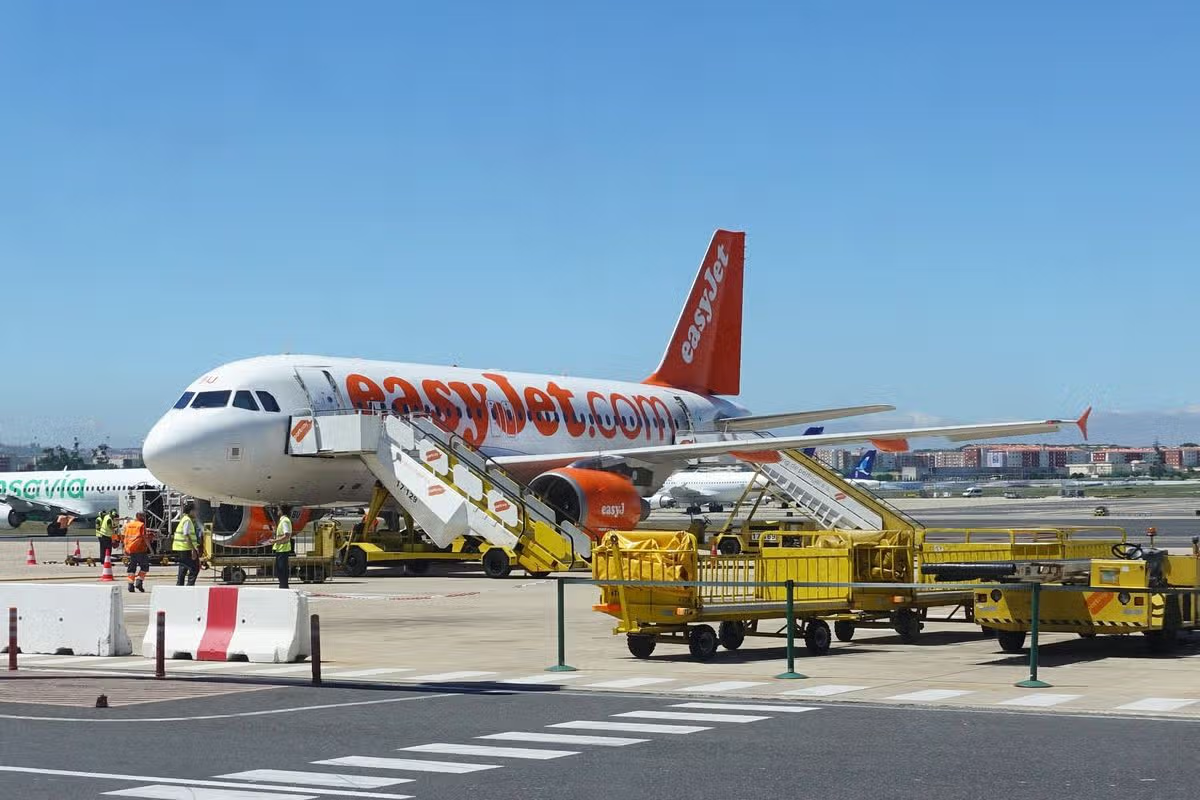
EasyJet update for UK travellers as 13 new routes to launch from 10 airports

EasyJet has announced 13 new routes, including new city breaks for UK tourists

EasyJet has today revealed 13 brand-new UK routes set to launch this winter. Among them are flights and package holidays to a never-before-served destination in Germany.

This festive season, EasyJet will launch flights and packages to Nuremberg. Services will be departing from Manchester from 2 November on Mondays and Fridays, London Gatwick from 19 November on Thursdays and Sundays and London Luton from 23 November on Mondays, Wednesdays, and Fridays.

Nuremberg is home to one of Europe’s oldest and most celebrated Christmas markets. The iconic Christkindlesmarkt, which dates back to the 16th century, draws visitors from across the globe to soak up the festive atmosphere of one of Germany’s most beloved seasonal destinations.

EasyJet will also be expanding its offering from its London airports, with fresh routes launching to Morocco, France and Egypt. Flights from London Luton to Rabat get under way on 5 November, followed by London Southend to Lyon from 3 December, running on Thursdays and Sundays.

Completing the new additions, flights from London Southend to Sharm El Sheikh will kick off on 4 January, departing on Mondays and Fridays. The airline is also expanding its connections to Hungary, with fresh flights and package holidays to Budapest taking off from three UK airports.

Services from Bristol and Belfast International will commence on 17 November, operating on Tuesdays and Saturdays, while flights from Liverpool will get under way on 19 November, running twice weekly on Thursdays and Sundays – perfect for a festive weekend getaway.

In Scotland, a brand new service from Edinburgh to Tromsø in Norway will launch on 30 November, operating twice weekly on Mondays and Thursdays and providing passengers with the only direct route to the ‘Gateway to the Arctic’. Meanwhile, in time for the festive period, flights from Glasgow to Krakow in Poland will commence on 13 November, with departures twice weekly on Mondays and Fridays.

EasyJet will enhance its Manchester network with a fresh service to Vienna in Austria, launching on 19 November with departures up to twice a week on Mondays and Fridays. Additionally, EasyJet is introducing its first international route from the Isle of Man, with a new weekly service to Geneva starting on 19 December, operating on Saturdays. The route will offer the only direct link between the Isle of Man and Switzerland.

The new routes take the airline’s total number of winter services introduced over the past fortnight to 26. Last week’s announcement featured a new direct service from Manchester to Sphinx Airport, alongside the carrier’s first ever international route from Cornwall Airport Newquay to Geneva. The airline says that package holidays can be booked through EasyJet holidays on all new routes with the exception of Luton to Rabat. All packages include flights and hotel, plus 23kg luggage and transfers on beach destinations such as Sharm El Sheikh, they say.

Holidaymakers can reserve their winter getaway with a deposit of £60 per person and until 1 July 2026, can save money on new bookings using the code FOOTBALL26.

Kevin Doyle, EasyJet’s UK Country Manager, said: “We’re thrilled to be announcing a further 13 new routes this winter, bringing the number of new routes on sale over the past two weeks to a total of 26. A real statement of our commitment to giving customers across the UK more choice from their local airport.. From winter sun escapes to magical Christmas market breaks, there’s never been a better time to book a flight or package holiday with EasyJet. We look forward to welcoming even more customers on board for their winter holidays.”

EasyJet and EasyJet Holidays say they have introduced their Book with Confidence Promise to reassure customers on their travel plans. The airline says that the pledge guarantees that flight and package prices will not increase in price once booked and confirms that EasyJet intends to operate a full schedule across its network, despite competitors cutting routes, as EasyJet prepares to fly over 50 million passengers this summer.

Full list of new EasyJet routes and dates

  • London Gatwick to Nuremberg – 19 November
  • London Luton to Nuremberg – 23 November
  • London Luton to Rabat – 5 November
  • London Southend to Lyon – 3 December
  • London Southend to Sharm El Sheikh – 4 January
  • Bristol to Budapest – 17 November
  • Liverpool to Budapest – 19 November
  • Manchester to Nuremberg – 2 November
  • Manchester to Vienna – 19 November
  • Edinburgh to Tromso – 30 November
  • Glasgow to Krakow – 13 November
  • Belfast to Budapest – 17 November
  • Isle of Man to Geneva – 19 December

Source link

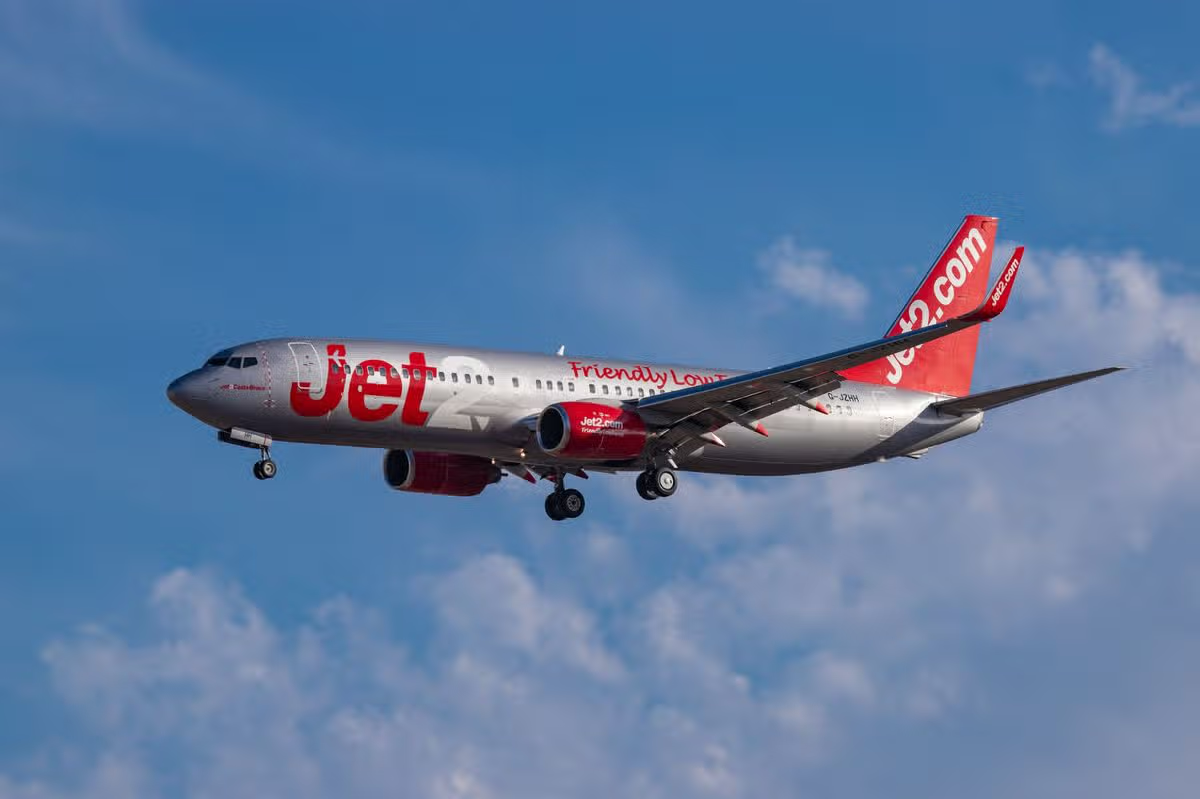
Jet2 clarifies luggage allowance rules that apply to all customers

There are several Jet2 rules to note when planning your trip

Jet2 has clarified its baggage allowances after an enquiry from a holidaymaker. The customer asked for help as they got ready for their summer getaway.

The person contacted the provider over social media on June 23. The traveller had booked their journey through Jet2holidays, and was due to jet off the following week.

They posed a question about their luggage entitlement. The customer wrote: “We have 3 x 22kg baggage allowance. Assume we are good to check in just two bags provided weight doesn’t exceed allowance?”

They went on to ask if they could check in one suitcase weighing 23kg and another at 25kg while remaining within their total allocation. Jet2 replied to set out the options available to the customer.

Combining your baggage allowance

The airline confirmed: “You can pool your luggage into two suitcases as opposed to three, as long as this doesn’t exceed your combined allowance of 66kg, and that no single article of luggage exceeds 32kg. I hope this helps.”

State Pensioners to face major tax change

According to Jet2’s official guidance: “Any baggage that exceeds your total weight allowance will be carried subject to availability and at our discretion. You’ll also need to pay an excess baggage fee, which is £12 per kg. Please note that no single item of baggage can weigh more than 32kg.”

You can add extra luggage when you book or through the Manage My Booking facility. Simply enter your booking reference, surname and departure date, then navigate to ‘Add Holiday Essentials’.

Query over 10kg allowance

Jet2 was also recently asked another question about its baggage weight rules after a passenger reported receiving contradictory information. The person had a booking for two adults and a six-month-old infant.

They explained: “Told we get two extra carry ons such as a buggy and travel cot that will be checked into the hold at the gate.”

They said they had two 22kg checked bags and that on a prior Jet2 holiday they had been told they qualified for “an extra 10kg for the baby”. According to Jet2’s official website guidance for bookings with children, passengers receive “an extra 10kg allowance for infants” plus “up to two items per child or infant free of charge”.

The passenger asked whether the additional 10kg could be combined with one of the 22kg cases, creating a 32kg allowance. They described receiving mixed messages on their last Jet2 journey. The customer recalled: “On the way out with you we were told it’s fine to have a 32kg case (22kg + the 10kg).

“On the way back we were told the 10kg should be a separate small checked case. Please can you clarify which it is and what the rules are because on our last holiday with you we were told different things.”

Setting the record straight, Jet2 responded to the passenger: “The additional 10kg is applied to one adult’s baggage, allowing for a total of one bag at 32kg and one bag at 22kg.”

Source link

Furious passenger pays £150 for extra legroom on flight before realising major downside

A couple who were flying out of Manchester Airport were furious after realising a major downside to spending £150 each on seats with extra legroom – with the couple vowing ‘never again’

A passenger on a plane was furious after paying £150 for extra legroom on a flight, before realising one major downside. Being comfortable when travelling is one of the most important things for passengers.

Depending on where you are travelling to, you could be on a plane for up to 19 hours, so being somewhat comfortable is important if you’re planning to sleep while onboard. There are a number of ways people can ensure comfort on a flight including upgrading seats to extra legroom or buying a first-class ticket for the duration of the flight.

Upgrades, however, do come at a cost which can be thousands of pounds on top of the initial flight price – which can already be pricy enough.

But if you’re travelling on a smaller plane, the only upgrade available can be a seat with extra legroom, also known as exit row seats.

Sitting in this row means that you must both be physically and mentally able, and willing, to help cabin crew open the heavy exit door and assist them in the event of an evacuation.

One couple, from Manchester and Yorkshire, flew out of Manchester Airport and decided to upgrade to seats with extra legroom for £150 each.

They were initially happy with their seats, until the flight took of and the seatbelt signs were turned off, and they instantly realised the downside to paying extra money for their flight.

The couple said: “You pay £150 for extra legroom seats just to have people queuing for the toilet right in front of you. The British people see a queue and love to join it. There was a free toilet approx 10 rows back but here they are.”

Content cannot be displayed without consent

They shared a video on TikTok showing the situation, where a crowd of people were seen standing waiting for the toilet right in front of them.

The couple were unable to extend their legs and were forced to be sat the same as anyone else on the flight due to the amount of people in front of them.

Other people commented on the video to explain how they had also learned the hard way after purchasing seats with extra legroom.

One person said: “This always happens and exactly why I’d never choose those seats! Plus the smell.”

The couple replied: “Literally never again! we had the ones in the middle on the way to Mexico which weren’t as bad, but these seats were the worst!!”

Another person said: “I just leave my feet out and they have to move around them. I’ve never been stood on …yet.”

A third person said: “I did this when I had a cast on my leg and some pensioner stepped over my leg and tripped then had the cheek to look at me like it was my fault.”

Source link

Jet2 starts £48 flights to idyllic island that most Brits don’t know about

The island of 32,000 is not one on the British holidaymakers’ Greek trail, at least not when compared to the likes of Crete, Cyprus or Mykonos

Jet2 has just begun flying to a beautiful Greek island home to rugged mountains, cobblestone alleys and fresh waterfalls.

In May 2026, the budget airline launched a new flight route from the UK to Samos, becoming only the second airline to offer direct flights to the island, after TUI.

From May to the end of October, Jet2 will be flying twice weekly from Manchester Airport, London Stansted and Birmingham to Samos, with fares from £48.

The island of 32,000 is not one on the British holidaymakers’ Greek trail, at least not when compared to the likes of Crete, Cyprus or Mykonos. But there are plenty of reasons why a visit to Samos is a great idea.

Do you have a travel story to share? Email webtravel@reachplc.com

Content cannot be displayed without consent

For one, it’s a place of serious historical pedigree, home as it is to two UNESCO World Heritage Sites of Pythagoreion and Heraion, and as the supposed birthplace of the Greek goddess Hera.

Zeus’s sister/wife is far from the only famous child Samos has to shout about. It is also the birthplace of the Greek philosopher and mathematician Pythagoras, the philosophers Melissus of Samos and Epicurus, and the astronomer Aristarchus of Samos, the first known person to suggest that the Earth revolves around the Sun.

Samos is one of the greenest Greek islands, and its nature is genuinely impressive. It is quite different from the more barren, sun-bleached look of many other Aegean islands.

Forests and mountains are a big part of that. Much of the island is covered in dense pine and cypress forests, and Mount Kerkis dominates the western end, rising to around 1,434 metres. It’s one of the highest peaks in the Aegean and is popular with serious hikers. The summit trail takes about 5–6 hours round trip.

Rivers and waterfalls are unusual for a Greek island, yet Samos has several. The most famous is the Potami waterfall near Karlovasi in the west, where a river flows through a gorge shaded by plane trees into a series of cascading pools you can swim in. It’s one of the most scenic spots on the island.

Beaches range from busy, sandy coves to wild, pebbly stretches backed by cliffs. Psili Ammos in the east has fine golden sand, while spots like Mikro Seitani and Megalo Seitani on the northwest coast are only reachable on foot or by boat.

Antasia Nalmpanti is the general manager of Casa Cook Samos, a hotel on the island with rooms from €243.

She told the Mirror: “Samos is one of those rare Greek islands that still feels genuinely undiscovered – and that’s a big part of what makes it so special. Unlike many Mediterranean destinations, it hasn’t been shaped by mass tourism; the pace is slower, the landscape is wilder, and the locals are incredibly welcoming.

“Our hotel, Casa Cook Samos, was designed to mirror exactly that spirit – inspired by the architecture of a traditional Samian village, nestled between lush hillsides and the Aegean, with private beach access and a restaurant that genuinely tastes of the island. Guests arrive looking for something real and unspoiled. Samos delivers that, every single time.

“At Casa Cook Samos, our goal is also to bring people together and revive the spirit of parea – the Greek tradition of sharing moments, stories, food, and connection, just as people once gathered around the village square. Guests can experience this feeling at our Parea Bar, where conversations flow naturally, and during our Samian Dinner, where a local yiayia joins us to prepare traditional dishes and share the island’s culinary heritage. It’s these authentic moments of togetherness that make a stay on Samos truly memorable.“

Source link

The UK’s dirtiest airport named – and it’s not London or Manchester

An analysis of Google Reviews has shown which UK airports have the most cleanliness complaints — and the top spot may surprise you.

Airports are set to be busier than ever over the coming months as numbers of Brits prepare for their summer getaways. With greater numbers passing through the terminal, airports can become rather grubby in no time.

However, a fresh study has examined which UK airports have received the highest number of complaints regarding cleanliness. Private Tours England analysed Google Reviews of 50 UK airports and tallied how frequently travellers mentioned the word “dirty” in their feedback.

The rankings are determined by the proportion of total reviews featuring the term.

Remarkably, Leeds Bradford Airport came out as the dirtiest in the UK. In total, 2.46% of all its reviews include the word when describing their time at the terminal.

Leeds Bradford Airport operates flights to numerous destinations including Austria, Hungary, Romania, Iceland, Ireland, Spain, France, the Netherlands and Italy.

The airport itself holds a 3.2 Google rating, with one reviewer noting: “The airport is currently being renovated.

“However, there are very few seats, toilets are super dirty, and the WiFi does not function whatsoever.”

A second commented: “To say it’s been refurbished, it’s cheap, IKEA plastic plants everywhere and dirty and unclean. The public lounge is bad enough, but the Avro Lounge is an absolute disgrace.”

Another wrote: “Avoid this grubby, dirty little airport if you can. Completely unfit for purpose.”

Coming in second place was Manchester Airport, with 1.45% of reviews making reference to cleanliness issues. Belfast International Airport took third spot at 1.42%.

Followed by London Stansted in fourth place at 1.18%, with Birmingham Airport rounding off the top five at 1.13%.

Top 10 dirtiest airports in the UK:

1. Leeds Bradford Airport – 2.46%

2. Manchester Airport – 1.45%

3. Belfast International Airport – 1.42%

4. London Stansted – 1.18%

5. Birmingham Airport – 1.13%

6. Edinburgh Airport – 1.05%

7. London Luton Airport – 0.96%

8. Newcastle Airport – 0.84%

9. Bristol Airport – 0.80%

10. East Midlands Airport – 0.73%

Leeds Bradford Airport has been approached for a response.

Source link

Ryanair 2026 flight cuts: 19 airports affected including Manchester and Stansted

The low-cost airline is reducing the number of flights at 19 airports across Europe, including in the UK, and passengers have been warned to check their itineraries and alternative routes

Ryanair has slashed flights at 19 airports across Europe, including in the UK, ahead of its summer timetable.

Due to the changes, passengers have been urged to verify their itineraries and explore alternative routes.

Destinations affected by the reductions include Berlin, Manchester, Krakow and Malaga.

The decision comes as the budget carrier attempts to streamline its operations and tackle seasonal overcapacity, according to Travel and Tour World.

Travellers departing from or arriving at the airports facing reductions must verify their schedules to confirm their booking remains valid.

Full list of airports facing cuts:

United Kingdom

  • London Stansted
  • Manchester

Ireland

Germany

  • Berlin Brandenburg
  • Cologne Bonn
  • Hamburg

Italy

Portugal

Belgium

France

Poland

Hungary

Romania

Bulgaria

Spain

The budget carrier has implemented the reductions to optimise its strategic network, ease economic pressures and manage rising costs.

The widespread cancellations form part of the airline’s efforts to safeguard profitability as the fuel crisis continues to fuel inflation worries.

The cuts come after Brits heading to Europe were caught in hours-long airport queues, with some passengers reportedly missing flights as new border checks continue to cause disruption across the EU.

The delays come following the rollout of the EU’s Entry/Exit System (EES), which officially launched on October 12, 2025. Under the new system, non-EU travellers including Brits are required to register fingerprints and have their photograph taken when entering or leaving the Schengen area.

Source link