Dinorah Figuera has a signature with limited value
“Venezuela cannot stand another communiqué” has become something of a political meme, but it captures the central problem with the process beginning on August 1. Washington has assembled a negotiation between an interim president whose continued rule it chose to preserve and an opposition counterpart it helped revive, hoping to combine Delcy Rodríguez’s control of the state with the residual democratic legitimacy of the 2015 National Assembly. The question is not merely whether they can reach an agreement. It is whether two actors whose authority is partial, externally enabled and detached from the country’s current popular leadership can legitimize a transition roadmap whose broad contours appear to have already been decided in Washington—and whether anything they sign can survive without María Corina Machado’s endorsement.
Everyone involved acknowledges that the mechanism was promoted by the United States. What nobody has explained clearly is what kind of mechanism it actually is. Is this a negotiation between two autonomous Venezuelan parties? Is it a broader national dialogue? Or is it an implementation process for a transition whose direction Donald Trump and Marco Rubio have already chosen?
The distinction matters because both sides are selling versions of the process that exaggerate their freedom to negotiate. The opposition presents it as the beginning of a democratic transition. Primero Justicia has listed substantial objectives: a new electoral authority and calendar, the restoration of political parties, an end to political disqualifications, the liberation of political prisoners, the dismantling of the repressive apparatus, freedom of expression and an independent Supreme Court.
Chavismo presents the same process as a necessary concession to preserve peace, obtain sanctions relief and protect the revolution. In its telling, sitting down with the opposition is not surrender but adaptation. “Dialogue does not mean capitulation,” Diosdado Cabello has insisted.
Neither story is entirely realistic.
The opposition may negotiate how political life is reopened and how future elections are organized. Still, it does not appear free to reopen Washington’s decision that stabilization and institutional reconstruction will precede an electoral transfer. Trump accepted Delcy’s continued presidency and has publicly argued that Venezuela is not yet prepared for another election, so the opposition is unlikely to be permitted to demand the immediate transfer of power it once said had already been decided by the 2024 presidential election.
Delcy’s room for maneuver is also limited. She cannot seriously defend all the old red lines of chavismo: no foreign supervision, no negotiated reform of state institutions, no conditions on sanctions relief and no binding electoral horizon. The existence of an American-sponsored process involving the 2015 Assembly already violates much of the sovereignty theater through which the revolution previously justified itself.
Her real prohibitions are more practical. She cannot accept a settlement that fractures the military, dismantles the governing coalition, exposes its leadership without guarantees, or leaves chavismo incapable of competing in the order that follows. This is regime learning: not preserving the revolution exactly as it existed, but reducing the meaning of survival till it becomes achievable. If chavismo retains its organization, protects much of its elite and remains a viable electoral force, it can describe retreat as continuity.
The opposition is conducting a retreat of its own. It once insisted that the sovereignty expressed in 2024 had already resolved who should govern Venezuela. It is now negotiating the conditions under which Venezuelans may be allowed to decide that question again.
The two sides are not choosing freely between victory and defeat. They are negotiating the distance between two defeats and deciding which concessions each can successfully rename as victory.
Washington’s role goes well beyond providing the room and the refreshments. Delcy Rodríguez is interim president because the United States chose continuity under Maduro’s vice president over an immediate transfer of power to the leadership produced by the 2024 election. Venezuelan institutions administered the oath, but American recognition made that continuity politically viable.
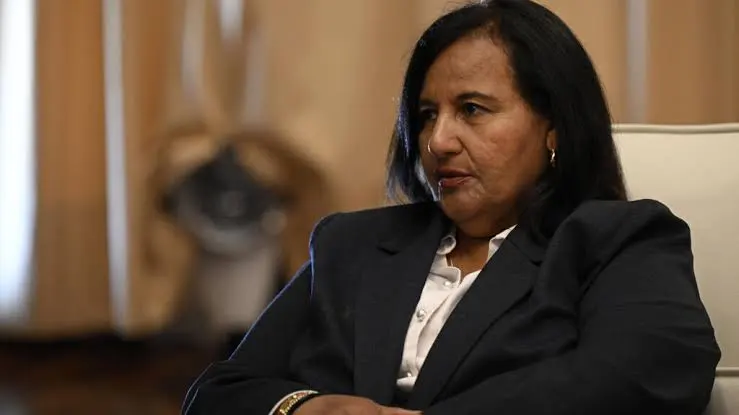
Dinorah Figuera’s return to relevance followed an equally American route. She did not reemerge because a renewed domestic constituency demanded her leadership or because the forces behind the 2024 campaign selected her as their representative. One of her first consequential official appearances after years of political obscurity was a meeting with Michael Kozak at the State Department. She later returned to Venezuela at Washington’s invitation and became Jorge Rodríguez’s counterpart.
Washington helped produce both sides of the table. It accepted Delcy as the administrator of the interim order and activated Dinorah as the institutional representative needed to negotiate with it.
That does not make either woman a simple American puppet. Delcy controls the state machinery required to implement or sabotage any agreement. Dinorah can withhold the opposition stamp Washington needs to sell Trump’s latest South American peace project. But both operate inside a structure whose outer limits appear to have been drawn elsewhere.
The revival of the 2015 National Assembly is understandable. Delcy possesses effective authority but lacks democratic legitimacy. Her government can implement reforms and enforce agreements. What it cannot provide by itself is a convincing democratic chain of authorization.
The 2015 Assembly offers the missing signature. It remains, at least internationally, Venezuela’s last legitimately constituted national institution. Its participation can make institutional appointments, economic agreements and the broader reopening of the country look less like arrangements reached exclusively between Washington and the surviving chavista elite. That matters to governments, creditors and corporations seeking reassurance that future democratic authorities will not repudiate everything agreed during the interim.
But legal usefulness is not political legitimacy.
The Assembly elected in 2015 was a broad and plural legislature supported by millions of Venezuelans. The body negotiating today is a diminished delegated commission represented by only part of the coalition that originally composed it. Its leaders possess little independent national recognition, and the institution itself is deeply unpopular.
Its problem is not merely that it cannot enforce its decisions. For years, it often declined to act at all. It preserved itself as a constitutional necessity while withdrawing from political life, avoiding renewal and becoming increasingly detached from the society it claimed to represent. It remained alive enough to retain recognition and administer assets, but too frozen to lead.
It has now thawed itself back into relevance because Washington needs its pedigree.
Democratic legitimacy cannot simply be placed in constitutional cryogenic storage and reheated intact. The 2015 Assembly survived by refusing to die. It did not spend those years proving that it knew what to do next.
Primero Justicia has tried to bridge that gap by claiming that the delegated commission represents the sovereignty expressed in the 2024 election. But the commission was not elected in 2024, was not selected by the leadership of that campaign and does not represent the full coalition that supported it. The same communiqué reaffirms the leadership of María Corina Machado and Edmundo González while welcoming their willingness to observe a process they have publicly refused to buy into sight unseen.
The contradiction is striking. The people said to embody the country’s current democratic mandate are assigned the role of observers while an older institutional remnant claims to negotiate in their name.
Yet María Corina is not simply outside the process. She may be formally locked out of the negotiating room, but continues to have a relationship with both Trump and Rubio, based at least on her perceived importance. Dinorah has procedural access to the table. María Corina retains strategic access to the people who arranged it.
That may be intentional. Keeping Machado outside allows the delegated commission to absorb the least attractive compromises over sequencing, guarantees and appointments. It preserves her political capital for the moment when the settlement requires popular endorsement. If the process succeeds, she can validate its results without defending every concession. If it fails, she can truthfully say that she neither designed nor controlled it.
But Washington may be delusional if it believes Dinorah Figuera and Jorge Rodríguez can emerge from a closed room, announce an agreement and expect Venezuelan society to accept it without Machado’s endorsement. Their signatures may produce legal validity. Washington may provide international recognition. Foreign corporations may decide that the arrangement offers enough reassurance to begin investing.
Neither Dinorah nor Jorge can manufacture a national constituency.
The mechanism is an attempt to assemble a legitimacy that none of its participants possesses alone. Delcy supplies control of the state. The 2015 Assembly supplies constitutional pedigree. Washington supplies leverage and guarantees. María Corina supplies contemporary popular legitimacy. The problem is that the last component remains outside the formal process and has not promised to endorse whatever it produces.
August 1 does not need to resolve Venezuela’s political crisis. It does need to establish whether this mechanism can produce anything beyond the language of its communiqués. Its credibility will not come from another declaration of democratic intentions, but from evidence that someone can compel chavismo to share power with forces outside its orbit. The first test is not simply whether the parties promise another election. As chavismo reminds us at every opportunity, Venezuela has held plenty of those. The real test is whether the country can move credibly beyond replacing red chavismo with a poorly disguised blue version of the same political order.
The first meaningful agreement should not merely tell Venezuelans when they might vote. It should begin dismantling the police state we somehow cannot escape, even under American tutelage. Without the freedom to speak, organize, report and return without fear, another election would merely place a democratic label over the same machinery of control.
The organizers must also explain what they are asking the country to trust. If this is a negotiation, they should say what remains negotiable. If it is a dialogue, they should identify who participates and what authority the table possesses. If it is an implementation mechanism, Washington should disclose the roadmap being implemented. And if it is genuinely a transition, someone must eventually announce the date on which the interim order ends.
Venezuela cannot stand another communiqué because communiqués allow everyone to declare intentions without assuming ownership. Dinorah Figuera and Jorge Rodríguez may be able to sign an agreement. Washington may guarantee it. María Corina Machado may eventually persuade Venezuelans to give it a chance.
But only results can turn it into a transition.
Hope may be vigilant. Legitimacy is less patient.