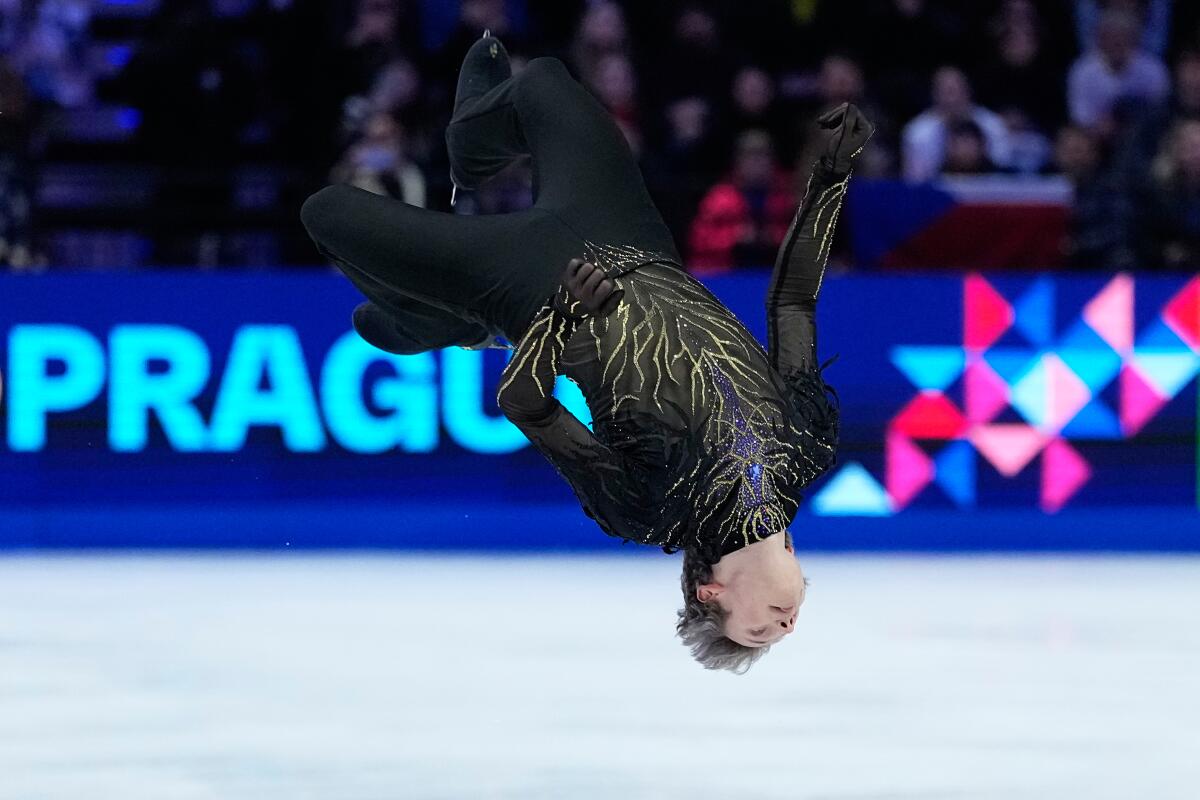
Malinin

Ilia Malinin’s collapse: Olympics are a different kind of pressure

When she skated, Tara Lipinski was always nervous. But it was different before the free skate of the 1998 Olympics. The teenager cried that morning. She called her parents after the six-minute warmup and said she couldn’t do it. Her legs were physically shaking in her beginning pose. She didn’t know what to do.

“When you go to the Olympics, there’s no training for that,” said Lipinski, now an analyst for NBC. “You don’t know what it’s going to feel like ‘til you’re actually feeling it.”

The awe-inspiring dream that often starts as a child can quickly turn into a nightmare for athletes who get blinded by the bright Olympic spotlight. While Lipinski realized her dream, becoming Olympic champion in Nagano, she knows the suffocating feeling of competing under the Olympic rings.

She knows the stress that devoured Ilia Malinin on Friday in Milan.

Malinin’s meltdown from favorite to eighth place underscored the unpredictability of the Olympic stage. The 21-year-old dubbed “the Quad God” was supposed to unleash the first quadruple axel in Olympic history. The four-and-a-half twisting jump he successfully executed when he was 17 has been the talk of the Olympic cycle.

Battling nerves and the conditioning needed for a long Olympic competition, he didn’t use it during the team competition or his individual short program. The free skate would be the last opportunity. It felt like the perfect coronation for the soon-to-be Olympic champion.

Then he bailed midair.

“I think that, for me, I would be like, ‘Oh, man, I just missed what everyone was waiting for,’” Lipinski said. “You go through that minute of being rattled and you have to come back to [the program]. … The next jump [he] wasn’t able to completely reset and shake it off. And then once that next mistake happened — and for Ilia, who doesn’t make mistakes — I think that was probably very difficult for him.”

The standing-room-only crowd gasped when Malinin gave up on the quad axel. Fans grew more uneasy when he fell two jumps later. They tried to urge him on as the mistakes piled up. Instead of joyful encouragement, the clapping felt like desperation in the arena.

Ilia Malinin falls during his free skate at the Milan-Cortina Games on Friday.

Ilia Malinin falls during his free skate at the Milan-Cortina Games on Friday.

(Robert Gauthier / Los Angeles Times)

Eight years ago, when Nathan Chen bent under the Olympic pressure in Pyeongchang, the crowd’s gasps each time he stumbled through his short program only made one of the hardest moments of his career even more difficult.

“That just hurts you to your gut,” Chen said in a video for Yahoo Sports. “You get up and mentally you have to refresh … but also the energy just changes in the arena. You can tell there’s tension now.”

Chen, then 18 years old in his Olympic debut, bounced back in a fearless free skate that moved him into fifth overall. He became almost unbeatable for the next Olympic cycle. At the Beijing Games, he set the world record for the short program, exorcised the demons from 2018 and became the United States’ first Olympic gold medalist in men’s singles in 12 years.

Malinin was a contender to be at those Games four years ago. He finished second in the 2022 U.S. championships, but was left off the Olympic team in a controversial decision. Then just 17, he was only in his first full season of senior competition.

But Malinin was already poised to be the future of the sport. Simply going to the Games as an understudy to Chen’s leading role would have been valuable experience.

Instead, U.S. Figure Skating selected third-place finisher Vincent Zhou and fourth-place Jason Brown.

Sitting with his coaches while waiting for his score Friday, a frustrated Malinin said if he had been sent to Beijing, he “wouldn’t have skated like that.”

“It’s not easy,” he said as cameras zoomed into his face.

He shrugged. He reset.

“It’s done,” he said.

“I think if I went to ’22 then I would have had more experience and know how to handle this Olympic environment,” a composed Malinin said in the mixed zone interview area. “But also, I don’t know what the next stages of my life would look like if I went there. So now all I can do is just regroup from this and really just take in the information that happened and just figure out how to manage in the future.”

Malinin has said he wants to skate for three Olympic cycles. The first attempt ended in shattering disappointment. That could only make the comeback sweeter.

“He will dominate the sport for years to come,” Lipinski said. “This was a huge, obviously, heartbreak for him, but we will see him rise again.”


Source link

Disaster strikes Ilia Malinin in most shocking moment of Winter Olympics

Welcome to the Olympic Edition of the Sports Report, an L.A. Times newsletter published every morning during the Winter Olympics. To sign up to receive it via email (it’s free), go here and select The Sports Report. If you’ve already signed up for the Sports Report, you will receive the Olympics edition as well.

Welcome to your daily review and preview of this year’s Milan-Cortina Olympics. My name is John Cherwa and I’m your tour director for the Games as we learn how thin the line is between greatness and failure.

In the most shocking moment of the Games so far, U.S. figure skater Ilia Malinin had the gold at his doorstep but instead had a dreadful performance, falling twice and giving the gold to Mikhail Shaidorov of Kazakhstan. The feeling in the arena was that there with no way Malinin could lose with his big lead after the short program. Then his main competitor, Yuma Yagiyama of Japan, had a subpar skate just before Malinin took the ice as the last skater of the night.

But Malinin missed his first combo and could never regain his composure in what was likely his worst performance in a major competition in quite some time. He finished eighth but at age 21, we could see him in a future Olympics. It was Malinin’s first loss since Nov. 2023.

In honor of Valentine’s Day, we thought we should look at some of the athlete couples at the Games. We compiled the list from People, so we take no responsibility for last-minute fights or splits (other than time splits, of course).

  • Madison Chock and Evan Bates: U.S. ice dancers. Won the silver with a gold-medal performance.
  • Brittany Bowe and Hilary Knight: U.S. speedskater Bowe finished fourth in the women’s 1,000 meters and has the 1,500 and team pursuit to go. Knight plays for the U.S. women’s hockey team, which is in the semifinals.
  • Nicole Silveira and Kim Meylemans: Both are in the women’s skeleton with Silveira competing for Brazil and Meylemans for Belgium. After two of four heats, Meylemans is eighth and Silveira is 12th.
  • Marie-Philip Poulin and Laura Stacey: Both are members of the Canadian women’s hockey team, who, despite losing to the U.S. in pool play, is expected to contend for a medal.
  • Magnus Nedregotten and Kristin Skaslien: This pair’s love is on the rocks … or stones if your prefer. They are curlers for Norway. They finished sixth in the mixed competition.
  • Jocelyn Peterman and Brett Gallant: It’s another curling pair swept to each other’s brooms. The Canadians finished fifth in the mixed competition.
  • Ronja Savolainen and Anna Kjellbin: These hockey players play for two different countries, Savolainen for Finland and Kjellbin for Sweden. Both countries made the quarterfinals with Sweden already advancing to the semifinals.
  • Hunter Powell and Kaysha Love: This U.S. bobsledding couple will see competition soon, Powell in the four-man and Love in both singles and doubles.
  • Emily and Dominik Fischnaller. This luge couple will bring back some hardware. Dominik, who sleds for Italy, took bronze in singles and team relay. Emily, who competes for the U.S., was 12th in singles.

There are certainly others, and some in the making as we speak, but this is a sampling.

Elsewhere on Friday

  • Italy is on fire at these Games but were not hot enough to beat the U.S. in women’s hockey. The U.S. won 6-0 and will move to the semifinals.
  • France, followed by two from Norway, won the biathlon men’s 10-kilometer sprint. The best U.S. finisher was Campbell Wright in 12th.
  • Johannes Hoesflot Klaebo, the GOAT of cross-country skiing, won his eighth lifetime gold for Norway by winning the men’s 10-kilometer interval start free. He is tied for most lifetime gold medals in the Winter Games and has three more events. John Steel Hagenbuch of the U.S. was 14th.
  • The U.S. and Canada played each other in both men’s and women’s curling. The women won, 9-8, (now 2-1) and the men lost, 6-3, (1-2).
  • The U.S. was shut out on snowboard with Australia winning gold in women’s snowboard cross and Japan getting gold and bronze in men’s halfpipe.
  • Matt Weston, the world champion from Britain, won men’s skeleton. Germans won silver and bronze. Austin Florian of the U.S. was 12th.
  • A 19-year-old from Czechia won the men’s 10,000 meters in speedskating. The U.S. did not compete.

Best Thing to Watch on TV today

Today is the day to take a breath from figure skating. It also seems to be a good time for your tour guide to admit something: I have absolutely no idea if the skaters are doing three, three and a half, four or four and a half rotations when they are in air in real time. OK, I said it. Are you nodding your head in affirmation right now? Thought so. OK, let’s go to something different for today.

The best bet will be the men’s 500 meters in speed skating. Jordan Stolz, the winner of the 1,000 for the U.S., will be in the 12th pair in the event which starts at 8 a.m PST. This isn’t his best event but he should have confidence and momentum going his way. If you need your hockey fix, the U.S. men play Denmark around 12:10 p.m.

Favorite photo of the day

France's Adam Siao Him Fa performs a backflip while competing in the figure skating men's free skate Friday.

France’s Adam Siao Him Fa performs a backflip while competing in the figure skating men’s free skate Friday.

(Robert Gauthier / Los Angeles Times)

Times photographer Robert Gauthier is at the Winter Olympics. Each day Times newsletter editor Houston Mitchell will select a favorite photo from the many he has taken.

Saturday’s Olympic TV and streaming schedule

Saturday’s live TV and streaming broadcasts for the Milan-Cortina Olympics unless noted (subject to change). All events stream live on Peacock or NBCOlympics.com with a streaming or cable login. All times Pacific. 🏅 — medal event for live broadcasts.

MULTIPLE SPORTS

8 p.m. — “Primetime in Milan” (delay): Alpine skiing, freestyle skiing, speedskating and more. | NBC

ALPINE SKIING
1 a.m. — Men’s giant slalom, Run 1 | USA
4:30 a.m. 🏅Men’s giant slalom, Run 2 | NBC

BIATHLON
5:45 a.m. — 🏅Women’s 7.5-kilometer sprint | NBC

CROSS-COUNTRY SKIING
3 a.m. — 🏅Women’s 4×7.5-kilometer relay | USA
4 a.m. — Women’s 4×7.5-kilometer relay (delay) | NBC

CURLING
Women (round robin)
12:05 a.m. — Britain vs. Canada | Peacock
12:05 a.m. — Italy vs. China | Peacock
12:05 a.m. — Switzerland vs. Japan | Peacock
4:30 a.m. — Britain vs. Canada (delay) | USA
Men (round robin)
5:05 a.m. — Germany vs. U.S. | Peacock
5:05 a.m. — Czechia vs. Britain | Peacock
5:05 a.m. — Sweden vs. China | Peacock
5:05 a.m. — Switzerland vs. Canada | Peacock
Women (round robin)
5:30 a.m. — Italy vs. China (delay) | CNBC
Men (round robin)
10 a.m. — Germany vs. U.S. (delay) | CNBC
Women (round robin)
10:05 a.m. — Japan vs. U.S. | Peacock
10:05 a.m. — Canada vs. Switzerland | Peacock
10:05 a.m. — Italy vs. Sweden | Peacock
10:05 a.m. — South Korea vs. Denmark | Peacock
2:30 p.m. — Japan vs. U.S. (delay) | CNBC

FREESTYLE SKIING
1:30 a.m. — 🏅Women’s dual moguls, finals | Peacock
1:40 a.m. — 🏅Women’s dual moguls, finals (in progress) | USA
7 a.m. — Women’s dual moguls, finals (delay) | NBC
10:30 a.m. — Women’s big air, qualifying | Peacock

HOCKEY
Men (group play)
3 a.m. — Germany vs. Latvia | CNBC
3:10 a.m. — Sweden vs. Slovakia | Peacock
7:40 a.m. — Finland vs. Italy | USA
Women (quarterfinals)
7:40 a.m. — Canada vs. Germany | CNBC
12:10 p.m. — Finland vs. Switzerland | CNBC
Men (group play)
12:10 p.m. — U.S. vs. Denmark | USA

SKELETON
9 a.m. — Women, Run 3 | NBC
10:35 a.m. — Women, final run | Peacock
2:30 p.m. — Women, runs 3-4 (delay) | USA

SHORT TRACK SPEEDSKATING
11:15 a.m. — 🏅Men’s 1,500 meters final and more | Peacock
3:15 p.m. — 🏅Men’s 1,500 meters final and more | USA

SKI JUMPING
8:30 a.m. — Men’s large hill, trial round| Peacock
10 a.m. — 🏅Men’s large hill, final round | USA

SPEEDSKATING
7 a.m. — Women’s team pursuit, qualifying | USA
8 a.m. — 🏅Men’s 500 meters | NBC

In case you missed it …

Check out the following Milan-Cortina Olympics dispatches from the L.A. Times team on the ground in Italy:

2026 Olympics Day 8 live updates: South America earns first Winter Games medal ever

Inside the terrifying and efficient world of Olympic ski airlifts

Ilia Malinin describes crippling anxiety that cost the favorite a Winter Olympics medal

Power couple Brittany Bowe and Hilary Knight eager to cap their Olympic careers with gold

Puerto Rico’s lone Winter Olympian hopes to inspire others to represent the island

Mikaela Shiffrin hopes to end her Olympic slump, but winning gold won’t be easy

Caribbean sprinters are hoping to transform Winter Olympic bobsledding

Winter Olympics TV schedule: Sunday’s listings

Visualizing success: Why Olympic skiers mentally rehearse before every run

Caribbean sprinters are hoping to transform Winter Olympic bobsledding

2026 Winter Olympics Day 7 recap: Results, medal count, schedule

Until next time…

That concludes today’s Sports Report Olympic Edition newsletter. If you have any feedback, ideas for improvement or things you’d like to see, email newsletter editor Houston Mitchell at houston.mitchell@latimes.com. To get this newsletter in your inbox, click here and select the Sports Report.

Source link

Ilia Malinin talks crippling anxiety that cost him an Olympic medal

He popped the quad axel. He stumbled across the ice. He tried to hide the pained expression.

Ilia Malinin fell apart in the men’s free skate, tumbling from near lock to win the gold medal to eighth place after a disastrous performance Friday. After his music ended, Malinin covered his anguished face. He put his hands on his knees, shook his head in disbelief and scrunched his face, hoping to hold back the tears.

It was the first time since November 2023 that he hadn’t won a competition.

“I just thought that all I needed to do was go out there and trust the process that I’ve always been doing with every competition,” Malinin said with tear-stained cheeks. “But, of course, it’s not like any other competition. It’s the Olympics.”

American Ilia Malinin reacts after stumbling through the men's singles free skate at the Winter Olympics on Friday.

American Ilia Malinin reacts after stumbling through the men’s singles free skate at the Winter Olympics on Friday in Milan.

(Robert Gauthier/Los Angeles Times)

Malinin skated four times at the Milan-Cortina Games, helping the United States to a team gold medal with a clutch free skate that clinched the one-point win. But the 21-year-old had just one clean skate in his first Games experience. He explained his slow start during the team event as “Olympic nerves.”

There was no explaining away Friday’s flop.

“I think people only realize the pressure and the nerves that actually happen from the inside,” said Malinin, whose technical advantage was supposed to be insurmountable for his opponents. “It was really just something that overwhelmed me. I just felt like I had no control.”

After Malinin’s score was announced, Kazakhstan’s Mikhail Shaidorov covered his mouth in shock. He was the new Olympic champion. Shaidorov claimed his country’s first Olympic gold in figure skating. His coach held his arm up like a boxing champion as a legion of Kazakh fans seated in the corner above the kiss-and-cry booth where skaters wait for their score waved their country’s teal and yellow flags. Malinin hugged him. He pointed to Shaidorov’s chest.

“You deserve it,” Malinin said.

Japan’s Yuma Kagiyama shook off several falls in his program to fight for his second consecutive Olympic silver. His countryman Shun Sato was in tears after learning he took the bronze.

Ilia Malinin's father, Roman Skorniakov, holds his head in his hands during his son's stumbles at the Olympics

Ilia Malinin’s father, Roman Skorniakov, reacts during his son’s performance at the men’s singles free skate at the Winter Olympics on Friday in Milan.

(Robert Gauthier/Los Angeles Times)

The United States’ Andrew Torgashev finished 12th with his season’s best 259.06-point total. Maxim Naumov stumbled through several jumps in his free skate to finish 20th overall with a 223.36 point total. The 24-year-old who lost both parents in a plane crash last year earned a standing ovation from actor Jeff Goldblum, who was in the stands behind the judges.

As the groups progressed toward the medal contenders, the crowd filled Milano Ice Skating Arena to the brim. Fans in suites in the rafters leaned over glass panes to get a better look. Volunteers and arena workers stood at the top of the concourse with no open seats left to claim.

While rising to the top of the sport with his stunning jumps and crowd-pleasing backflip, Malinin said his mission was to boost the popularity of figure skating to get this kind of attention outside of just the Olympic stage.

But standing at the center of the ice as fans waved U.S. flags from every corner, Malinin, the “Quad God” who looked invincible just three months ago when he became the first person to land seven quadruple jumps in one program, felt scared.

“Especially going into that starting pose, I just felt like all the just traumatic moments of my life really just started flooding my head,” Malinin said. “It was just like so many negative thoughts that just flooded into there, and I just did not handle it.”

He started off the program with a strong quad flip. Then he bailed mid-air on his signature quad axel that he had yet to attempt in the Olympics. The crowd gasped. Panic started when Malinin downgraded a planned quadruple loop to a double two jumps later.

American Ilia Malinin falls while competing in the men's singles free skate at the Winter Olympics in Milan on Friday.

American Ilia Malinin falls while competing in the men’s singles free skate at the Winter Olympics in Milan on Friday.

(Robert Gauthier/Los Angeles Times)

Behind the boards, his father and coach, Roman Skorniakov covered his face. Coach Rafael Arutyunyan, who has worked with Malinin part-time since 2021, paced back and forth. He hit the padded boards for encouragement before Malinin lined up for a three-jump combination.

Malinin fell again.

The program couldn’t end soon enough just to allow the 21-year-old a chance to hide after years of being in the spotlight as the presumed next Olympic champion.

“Being the Olympic gold hopeful is really just a lot to deal with,” Malinin said, “especially for my age.”

Malinin’s free skate music includes self-narrated voiceovers telling the story of his personal journey growing in the sport. As it begins, he uncovers his face. His words echo over the speakers.“The only true wisdom,” Malinin says in the program, “is in knowing you know nothing.”

After this result, that couldn’t be more true.

Source link

Winter Olympics: The ‘genius’ coach behind Ilia Malinin’s quad axel

He raised up the Quad King. He refined the jump that defined the Quad God.

From a sprawling ice facility in Irvine, Rafael Arutyunyan could just be the “Quad Maker.”

The 68-year-old figure skating coach is renowned as one of the best technicians in the world. He trained Olympic champion Nathan Chen starting when the “Quad King” was 10 years old. Four years after Chen became the first U.S. man to win singles Olympic gold since 2010, Arutyunyan could have a second consecutive pupil on top of the Olympic podium.

Ilia Malinin, who has worked with Arutyunyan part time since 2021, is the only person in the world to land a quad axel and is the overwhelming favorite for men’s gold at the Milan-Cortina Olympic Games.

American Ilia Malinin celebrates with his coaches during the world skating championship in March 2025.

American Ilia Malinin celebrates with his coaches, including Rafael Arutyunyan to the right, during the world skating championship in March 2025.

(Maddie Meyer / Getty Images)

The walls in Arutyunyan’s office at Irvine’s Great Park Ice, where he is the head coach of the high performance team, are plastered with photos of stars including Chen, Michelle Kwan, Adam Rippon and Ashley Wagner. They each came to his door with dreams of perfecting their performances, making it to the Olympics or, in some cases, revolutionizing the sport. They scribbled messages over their pictures saying: “I couldn’t have done it without you.”

“Rafael is more like the dream maker,” said Rippon, the 2016 U.S. champion and 2018 Olympic team bronze medalist. “… Rafael is able to take each of his students’ individual goals on a case-by-case basis, and he’s able to help the athletes go after whatever that goal is they’re trying to achieve.”

Malinin came with a lofty goal. Even his father Roman Skornikov — an Olympian for Uzbekistan who coaches his son with his wife, Tatiana Malinina — thought the idea of doing four-and-a-half revolutions in one jump was crazy.

Arytyunyan assured him Malinin could do the quad axel.

The coach of nearly 50 years just looked at the 5-foot-9 Malinin and could tell. It was his slender body type, natural athleticism and strong technique that made Arutyunyan know the jump many thought was impossible could be done. They discussed small technical tweaks to Malinin’s entry. A short two to three months later, Malinin, who trains primarily with his parents in his native Virginia, sent a video of him landing the quad axel in practice.

“The way he explains is really good. And he explains in like, metaphors and analogies that you’re surprised to hear,” said Malinin, who debuted the quad axel in 2022 when he was 17. “They work really well because it helps you get a different perspective on a technique or how he explains.”

Arutyunyan instructed Malinin to think of himself as a slingshot while approaching his jumps. Skaters know to gain power from deep edges that carve circles into the ice, but Artutyunyan describes it like a person riding a motorcycle: The rider tilts side to side just like a skater’s blade glides over the ice. Over time as he gets more familiar with a skater, Arutyunyan communicates through hand signals to show how their blades are interacting with the ice. Learning to manipulate the blade with Arutyunyan made Rippon feel as if he truly learned how to skate.

“He is a genius,” said Mariah Bell, a 2022 Olympian and U.S. champion.

Nathen Chen celebrates with his coach Rafael Arutyunyan.

Nathen Chen celebrates with coach Rafael Arutyunyan after competingin the 2020 U.S. Figure Skating Championships Greensboro, N.C.

(Matthew Stockman / Getty Images)

With the exception of Chen, many of Arutyunyan’s students came to him later in their careers. It takes a special eye and tenacity for a coach to rewire decades of bad habits, Bell said.

Arutyunyan loves it.

“I am emergency room for skaters,” he said. “Many people comes to me as emergency and I start to fix it.”

Arutyunyan is equipped to solve the most dire skating situations because after nearly 50 years as a coach, he’s seen it all already. Arutyunyan, who began coaching in his native Armenia, was first trained in the Soviet style that relied on biomechanics and physiology to unlock efficient jumping techniques. European and American teachings focused more on compulsory figures, the basic patterns skaters would trace across the ice that give the sport its name.

Arutyunyan, who came to the United States in 2000 from Russia, blended both into a signature style that has top skaters traveling from all corners of the globe seeking his help.

“Why I think he’s one of the best coaches in the world,” Rippon said, “is that he’s never not learning.”

After a promising juniors career in which he was named junior national champion in 2015 and competed at the 2020 world junior championships, Andrew Torgashev knew he had competitive ability and presentation. But wanting to step up his senior career, Torgashev, 24, knew he needed to tame his wild technique. Performing his programs felt like “going to the casino,” Torgashev said.

“Red or black,” Torgashev said with a smile, “who knows what’s going to happen?”

Since relocating to California from Colorado in 2019, Torgashev, a Florida native whose parents were both elite international figure skaters, reworked every aspect of his skating with Arutyunyan. He was always skating on his toes when he should have been on his heels. They changed his three-turn — one of the first things skaters learn when skating on one foot — to find more power. They tinkered with his crossovers and his camel spin.

It took years. Much of it was disheartening.

“I felt like, ‘what’s the point of this? I’m losing jumps, he’s ruining me,’” Torgashev said. “But he always has a method to his madness.”

The method finally yielded results after two years. Injuries kept Torgashev out of competition for two seasons. But he finished second at the 2023 Eastern Sectional Championships and ahead of the 2023 U.S. championships, he was performing his programs more consistently than ever in practice.

After finishing on the podium at U.S. championships in three of the last four years, including two consecutive silver medals, Torgashev will make his Olympic debut in Milan.

“He’s forced me to be very resilient and independent and trust myself, trust what I’ve learned from him, and try to take that with me to competition,” Torgashev said. “I think it’s the best move I made in my life.”

Arutyunyan’s ability to take established, struggling skaters and put them into the podium conversation is how he believes he first started getting respect in the United States. When he emigrated from Russia, he was searching simply for freedom, he said.

He never thought it would turn into a hall of fame career.

Arutyunyan was inducted into the U.S. Figure Skating Hall of Fame in January at the U.S. Championships. At the induction ceremony in St. Louis, Arutyunyan waved toward a packed crowd and bowed his head. He looked forward to the ceremony because it was a chance to see his students again. What thrilled him most was getting to rub elbows with other Hall of Famers such as Brian Boitano, Dorothy Hamill and Scott Hamilton. The Olympic and world champions were Arutyunyan’s idols, he said giddily.

After 50 years of helping skaters achieve their dreams, the man who was always behind the scenes got to live his.

Source link

Winter Olympics: Ilia Malinin, U.S. win gold in team figure skating

Believe in the Quad God.

Ilia Malinin’s clutch free skate that scored 200.03 points gave the United States its second consecutive team figure skating gold medal Sunday at the Milan-Cortina Olympic Games.

After Amber Glenn fought through a shaky free program that finished third and lost the United States its two-point lead, Malinin stepped up as only he could. He executed five quad jumps and won by nearly six points, even if he did not perform his signature quad axel. He even put his hand down after a jump, but the mistake only seemed to fuel him as he finished with a flourish, changing the back-half of his program to earn back extra points.

His U.S. teammates, cheering from the sideline box rose to their feet and pumped their fists after each of Malinin’s jumping passes. When he landed his back flip, skating flawlessly through one foot, the packed crowd at Milano Ice Skating Arena roared.

While Japan’s Shun Sato scored a season’s best to finish the competition, he could not match the technical prowess of Malinin, who is also the favorite to win individual gold this week.

In front of a raucous home crowd, Italy held off Georgia for the bronze medal behind a dazzling free skate from Matteo Rizzo, who dropped to his knees on the ice and cried after his performance had fans chanting “Italia!” before he even finished. He cried into the Italian flag in the kiss-and-cry after his season’s best 179.62 points.

With the first figure skating medal of the Milan-Cortina Games on the line, every skater fought for every fraction of a point. U.S. pairs skater Ellie Kam went deep into a one-legged squat to hold on to the first throw jump. The United States led by five points entering the final day, but still had no room for error as Japan finished first in qualifying in all of Sunday’s disciplines. With the dominance of Japan’s Riku Miura and Ryuichi Kihara in pairs, Kam’s partner Danny O’Shea knew the strategy for the U.S. pair was to simply try to stay as close as possible.

Ellie Kam and Danny O'Shea perform in pairs figure skating during the team competition at the Milan-Cortina Games.

Ellie Kam and Danny O’Shea perform in pairs figure skating during the team competition at the Milan-Cortina Games on Sunday.

(Stephanie Scarbrough / Associated Press)

Kam fought for the landing on a throw loop so hard that she could feel her leg cramping.

“I was like, ‘I’m not going down,’” Kam said, “I got this. We got this.”

They looked at each other before their next element and said “calm.” Their message cut through the energized crowd that cheered louder and louder with each jump. At the end, Kam’s and O’Shea’s celebratory screams simply joined the crowd’s roar. As they saluted the crowd, O’Shea pointed toward Kam to acknowledge her effort.

The pair’s fourth-place finish in the free program was a one-point improvement from their qualifying spot, earning a slim, but vital cushion entering the men’s and women’s free skates.

Instead of sending world champion Alysa Liu back for the free skate after she performed the short program, the U.S. selected the three-time national champion Glenn. The 26-year-old was making her Olympic debut.

On the Olympic stage for the first time, Glenn has tried to embrace the opportunity while treating the competition as if it were any other one. But the larger stage has created additional stress for Glenn after she was asked in a news conference about President Trump’s approach to the LGBTQ+ community in recent years and how it’s affected her personally.

U.S. figure skater Amber Glenn competes during the team competition on Sunday at the Milan-Cortina Games.

U.S. figure skater Amber Glenn competes during the team competition on Sunday at the Milan-Cortina Games.

(Ashley Landis / Associated Press)

Glenn, who identifies as bisexual and pansexual, encouraged people in the queer community to “stay strong in these hard times” and recognized that it wasn’t the first time the community had to unite to “fight for our human rights.” Glenn then received threats on social media after the news conference and posted on Instagram that she would be taking a break from social platforms to focus on the competition.

But it wasn’t the social media hate that rattled Glenn, she insisted. She was simply tired, sore and disoriented from the unfamiliar Olympic team competition format.

All of Glenn’s other competitors did the short program portion of the competition on Friday. She came in with several good days of training at the venue, but did not get the same kind of opportunity to get used to the stage. Glenn fought through a shaky triple axel to open her program and stepped out of a triple flip that prevented her from completing a planned combination for her second jumping pass.

Waiting in the kiss-and-cry, Glenn bowed her head and stared at the ground. She struggled to muster even a fake smile.

“I’m grateful that the team is so supportive.” said Glenn, who finished behind Japan’s Kaori Sakamoto and Italy’s Lara Naki Gutmann. “But I do feel guilty that I could be the reason that we don’t win the gold, and I don’t know how I will ever apologize for that.”

Glenn clasped her hands in her lap waiting for Sato’s score after the Japanese skater performed a clean program that had his teammates in tears. But his technical score was about five points less than Malinin’s. Glenn was the first skater to hug Malinin in the United States’ team celebration, lifting him off the ground as he extended arms out wide.

Source link

Ilia Malinin conserves energy, but U.S. still leads Olympic team skate

Ilia Malinin leaned his head back and wagged his tongue. This perhaps wasn’t the start to his Olympic career that he wanted.

The 21-year-old took it easy in the short program of the team figure skating competition Saturday, forgoing his signature quad axel, but even with a watered-down routine, the “Quad God” looked shockingly mortal.

He finished second in the short program after struggling on multiple jumps, trailing Japan’s Yuma Kagiyama’s electrifying performance by almost 10 points. The United States still enters the final day of the team competition with a five-point lead after Madison Chock and Evan Bates dazzled in the free dance with 133.23 points that earned first place.

The three-time reigning world champions swept both dance programs in the team event to pace the United States to a 44-point team total. The Americans lead second-place Japan (39 points) and third-place Italy (37) before Sunday’s medal event that will feature men’s, women’s and pairs free programs. The United States has not named the skaters who will perform Sunday’s long programs.

Ilia Malinin said he simply was managing his energy to prepare for the individual event, which begins Tuesday.

Ilia Malinin said he simply was managing his energy to prepare for the individual event, which begins Tuesday.

(Matthew Stockman / Getty Images)

Bates pumped his fist at the end of the free dance. The seven-time U.S. champions have increased their scores for the bull and matador-themed program at each international competition they’ve performed at this season. Malinin, sitting in the U.S. box on the side of the rink, high-fived his teammates at the end of the stellar program and waved a large American flag along with singles skaters Alysa Liu and Isabeau Levito.

Almost as much as his own performances, the unique environment of an Olympic Games is what he has been dreaming about since he started his rise to the top.

“It was such an unreal moment coming to the Olympics,” Malinin said. “Everyone has been talking about the Olympics for years, ever since I started skating from a young age. … Really just being out there on that Olympic ice was just the best moment of itself.”

Malinin, who earned nine team points for his second-place finish in the short program, entered his first Olympics as the overwhelming favorite to win individual gold. With his unmatched technical skill, it likely would take multiple mistakes from Malinin and perfect performances from his competitors for him not to claim the United States’ second consecutive men’s singles gold medal.

But to become just the second skater to win two golds in the same Games, Malinin may need help from his teammates after he fell short of the lofty expectations Saturday.

Malinin planned to open with his quad axel in combination with a triple toe loop but settled only for a quad flip. He got a negative grade of execution on his triple axel. He underrotated a quad lutz that he connected to the previously left out triple toe loop.

“Of course, it wasn’t the perfect ideal 100% skate that I would [have] wanted to have,” Malinin said, “but for the standard I set myself today, I think I achieved that.”

Malinin’s Olympic standard is a slow-play progression, he said. He wanted to be at about 50% of his capacity in the team event to manage his energy to prepare for the individual event, which begins Tuesday.

Kagiyama highlighted Japan’s performances Saturday, pumping both fists after his program. As the crowd showered him with applause, he spread his arms wide and threw his head back. When he looked at his teammates cheering from the sideline he jumped in excitement. He stood up in shock when his score of 108.67 flashed across the screen.

Waiting for his turn to finish the competition, Malinin appreciated Kagiyama’s moment. He wasn’t intimidated by his opponent’s success.

“So inspired,” Malinin said. “He just went out there. He looked so happy. He looked like he was enjoying every single moment. I’m so happy for him. It’s just so unreal that all of us come out here on this Olympic stage and really feel so much energy, so much excitement.”

While Malinin is undefeated in individual events since November 2023, he hasn’t been perfect. He was third after the free program in the Grand Prix Final in December, the last major international competition before the Olympics.

He answered in the free skate by becoming the first person to land seven clean quad jumps in a single program.

Source link