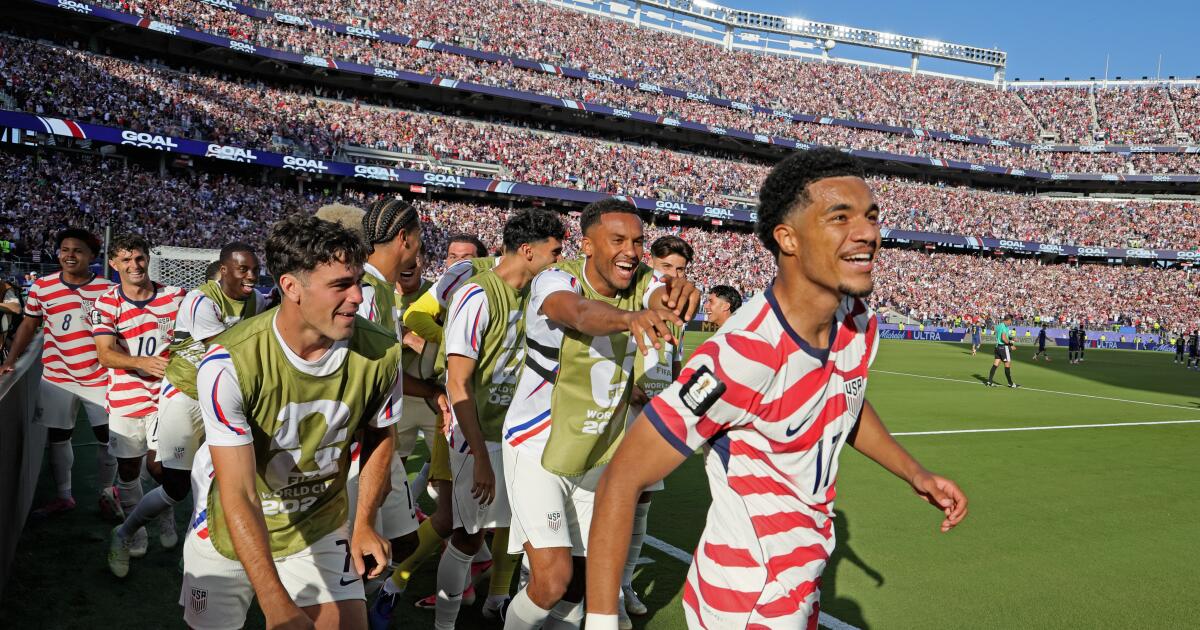
malik tillman

U.S. looks to make more World Cup history in round of 16 vs. Belgium

Mauricio Pochettino’s team continues to do things in this summer’s World Cup that no U.S. team has ever done before.

Its three wins are the most in a single tournament. So are the 10 goals in four games. It has the best goal differential ever and its two shutouts ties a record.

Yet all that means absolutely nothing to the players.

“They’re great milestones,” captain Tim Ream said. “But I don’t think anybody’s even once mentioned the different things that we’re doing. We’re focused on what we’re doing daily on the training ground, because that puts us in the best possible position to to put these performances.

“So yeah, not aware or even worried about records that we’re breaking.”

Well, except for maybe one.

With Wednesday’s gritty 2-0 over Bosnia and Herzegovina, a game the U.S. finished with just 10 men, the Americans won a game in the World Cup knockout stage for just the second time. That sends them on to a round-of-16 meeting with Belgium on Monday in Seattle where a win would be — you guessed it — historic.

“It’s cool and it’s great and it’s an accomplishment,” midfielder Weston McKennie said of the records. “But at the same time, we have high expectations for ourselves. That’s what we expect of ourselves, what we expect of our team.

“We just want to focus on Belgium now and continue to try to make history.”

That chore got a good deal more difficult because of an unwanted team record that was also set Wednesday. When Folarin Balogun scored a goal late in the first half then drew a red card early in the second, he became the first American — and third player ever — to get one of each in the same World Cup knockout game.

“Cool record,” defender Chris Richards said.

But while the goal, Balogun’s third of the tournament, proved to be all the U.S. needed to beat Bosnia, the red card — which cannot be appealed according to U.S. Soccer — means he’s suspended for the game with Belgium.

“It’s just so unfortunate, honestly,” Christian Pulisic said. “Looking back at it, it seems so harsh. I just told him he’s done so much for us, and now we’ve got his back.”

The red card came in the 64th minute with the U.S. protecting a 1-0 lead built on Balogun’s goal just before the intermission. The American striker was battling hulking Bosnia defender Tarik Muharemovic for a loose ball when he inadvertently raked Muharemovic’s right calf with his studs up, then landed on his ankle, twisting it awkwardly.

Brazilian referee Raphael Claus did not flash either card before stopping play at the behest of the video assistant referee. But after consulting a slow-motion reply, Claus gave Balogun a red card for a dangerous challenge.

“For me, never is this a red card,” said Pochettino, now the winningest U.S. coach in World Cup history. “Watching after on TV, never was [it his] intention to step up on the player. That was a normal action in football.”

Maybe. But Claus sent Balogun off just the same, leaving the U.S. to protect a one-goal advantage for the final 30 minutes while playing a man down. It was probably the sternest test the Americans have faced in the tournament.

“It would be easy to have an excuse if they did score,” McKennie said. “But that’s not the type of team we are.”

For Ream, the challenge was actually no challenge at all.

“Would it be weird if I downplayed this and said [I] wasn’t even fazed by it?” he said. “It didn’t feel like we were down a man. We were still able to carve out chances and we were still able to keep hold of the ball. Everybody knew their roles.

“It felt really calm and felt really, really easy and simple for us in that moment.”

And that allowed another hero to shrug off the pain of his own wounds and step up big.

Early in the second half a Bosnian player stomped on Malik Tillman, shredding his boot and cutting his right foot (but not drawing a red card). During the hydration break, Tillman was able to change shoes and in the 82nd minute, his white sock turning red with blood, he found himself standing over a free kick just outside the Bosnian penalty area.

“I’ve been dreaming about this game. I’ve been dreaming about, yeah, maybe taking a free kick and scoring,” said Tillman, who bent the ball off the gloved right hand of Bosnian keeper Nikola Vasilj and into the net for his first World Cup goal. “I trained for this in our practices and then it actually came true.”

So did the team’s dreams of reaching the round of 16, only now they’re arriving without their leading scorer, who will have to watch the Belgium game from the stands. Balogun’s absence, however, creates opportunity for others, with Haji Wright and Ricardo Pepi the most likely candidates to take his place.

And if this U.S. team has proven anything, it’s proven that it loves nothing more than embracing opportunities to prove people wrong.

“We’re going to miss him for the next game but we know that if it’s Pepi or Haji, whoever, is going to step up next and they’re going to do the job just as well as he did,” Richards said of Balogun. “One thing about this team is we’re really a big family and we’re shown it this whole tournament.

“Coming in, there was a lot of question marks about our whole team in general. Game by game we started to put ourselves right. Because we knew we had it the whole time.”
Source link

Born in Brooklyn, raised in London, Folarin Balogun lights up the World Cup for the U.S.

If a pregnant Nigerian woman had been allowed to board a plane 25 years ago, the U.S. team’s path through this summer’s World Cup may have unfolded much differently. Instead, a gate agent turned her away, insisting it wasn’t safe for her to fly from New York to London.

So Florence Balogun returned to Brooklyn, where she had been visiting relatives, and waited for her second son to be born. And when Folarin arrived a few weeks later, entering the world just hours before Independence Day dawned, he did so as an American citizen.

It was that quirk of fate that allowed Balogun, who lived just two months in the U.S., to represent the country on soccer’s biggest stage.

“I’m extremely proud my individual journey will come full circle now,” he said before the tournament started. “Especially the World Cup being here, the opportunity to represent my nation. It’s going to be something special for me.”

The first game certainly was, with Balogun scoring twice in the first half of a dominant 4-1 win over Paraguay, becoming the first American with multiple goals in a World Cup game in 96 years while introducing himself to a country that may have known his name, but not his unique talent.

“If you don’t know the type of player he is, you could see it today,” midfielder Weston McKennie said. “It’s the World Cup, everyone steps up to their maximum. In the past a lot of people maybe have not made him out to be a player like that.

“He showed everyone he’s willing to do the dirty work as well.”

Balogun once had his pick of countries to represent. His birth in Brooklyn made him eligible to play for the U.S., his longterm residency in London made him eligible to play for England and his parents’ nationality qualified him to play for Nigeria.

He picked the U.S.

And he’s not the only one on the American team who had a choice. Half the men on the World Cup roster — including Christian Pulisic, Gio Reyna and Malik Tillman, who each had a goal or an assist against Paraguay — are dual nationals, meaning they’re playing for the U.S. because they want to, not because they have to.

“You’re more American if you were not born over there because you had the choice to choose and you chose America,” Kenneth Dest, the Surinamese-American father of Dutch-born defender Sergiño Dest, said in an HBO Max documentary.

If America is a nation of immigrants, it only seems right that it should be represented in the World Cup by a team of immigrants. Like Tillman and Dest, who were born and raised in Europe, the sons of U.S. soldiers. Or forwards Tim Weah, the Brooklyn-born son of the former president of Liberia, and Alejandro Zendejas, who was born in Mexico but became a U.S. citizen at 13 after his father was naturalized.

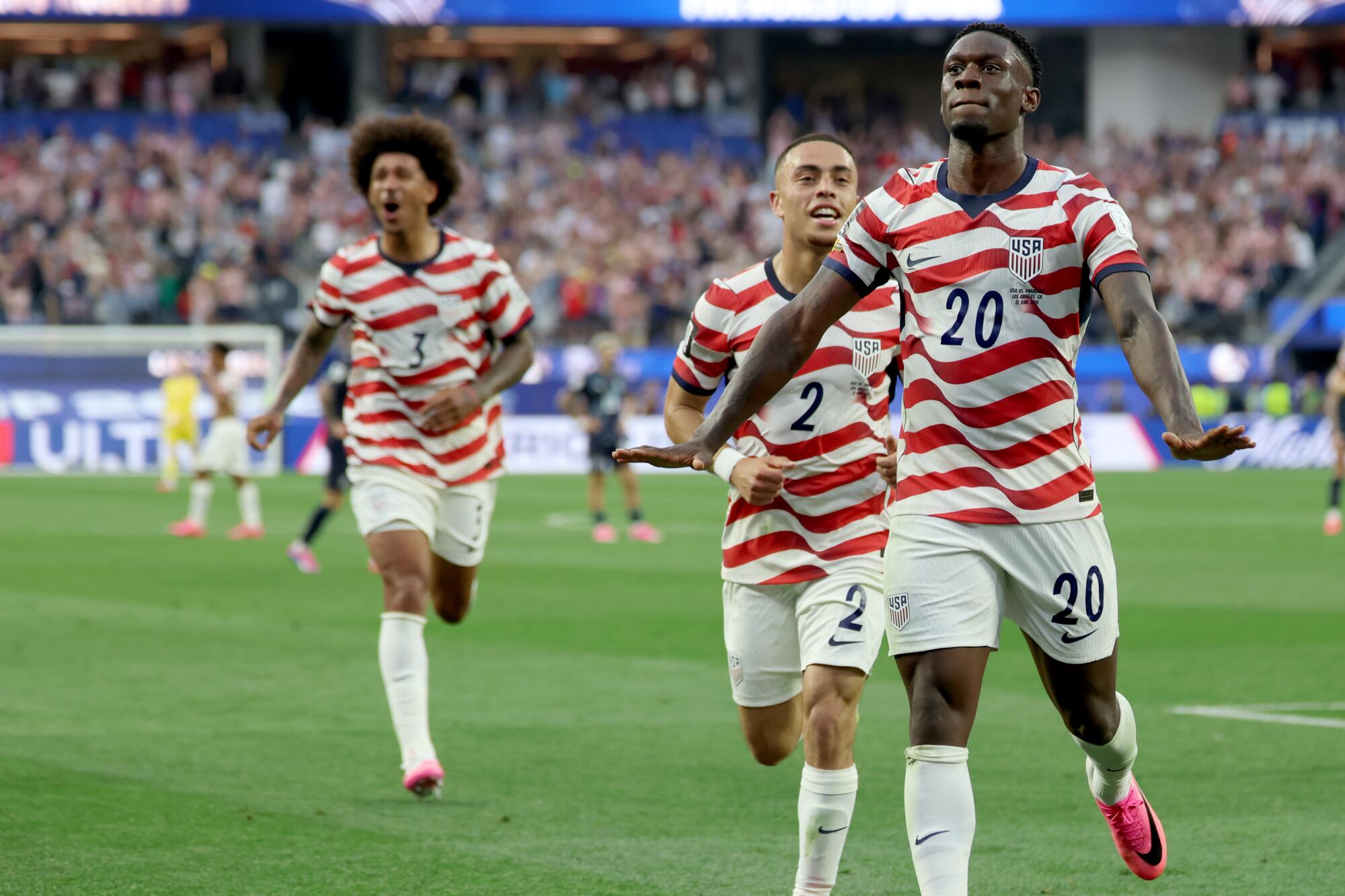
U.S. forward Folarin Balogun, right, celebrates his goal with Sergiño Dest (2) and Chris Richards (3) against Paraguay.

U.S. forward Folarin Balogun, right, celebrates his goal with Sergiño Dest (2) and Chris Richards (3) against Paraguay.

(Robert Gauthier / Los Angeles Times)

The paternal great-grandmother of goalie Matt Turner fled religious persecution in Lithuania, with his Jewish ancestors changing their family name from Turnovski to Turner when they arrived at Ellis Island. The parents of midfielder Cristian Roldan came to the U.S. to escape civil wars in Central America, his father from Guatemala and his mother from El Salvador.

They didn’t wind up wearing the same uniform by accident, however. The recruitment of dual nationals dates to the 1980s under Hungarian-born manager Bob Gansler, who qualified the U.S. for the World Cup for the first time in 40 years with a team that included players born in Uruguay, Greece, Germany and El Salvador.

It really began to scale up about 15 years ago under Bob Bradley and his successor Jurgen Klinsmann. Gregg Berhalter then took it to another level, recruiting more than a dozen dual nationals — including Dest, Tillman, Balogun and Turner — in his five years as coach.

The practice isn’t limited to the USMNT. When France won the World Cup in 2018, 16 of the 23 players on the team came from families that recently immigrated from places like Zaire, Cameroon, Morocco, Angola, Congo or Algeria. More than half the players on Algeria’s team in this summer’s tournament were born in Europe while only seven men on Morocco’s roster are from Morocco.

Even Japan, famously homogeneous, has a Black goalkeeper who was born in Arkansas to a father from Ghana.

“Inclusion always pulls sport forward,” said Ronen Dorfan, a journalist and sports historian based in Budapest.

Still, Balogun’s journey is unusual — and not just because of the way it started.

He was two months old when he and his mother finally made it to London and eight years later he was good enough to enter Arsenal’s academy system. He made his junior international debut with England at 17, then three months later was invited to play four games for the U.S. U18 team.

But Balogun’s future appeared to be with England, especially after he scored seven times in 13 appearances with the U21 team, then followed that up with a career-high 21 goals for Reims in France’s Ligue 1 in 2022-23.

Yet neither performance earned him a call-up to a senior national team that was deep at forward.

So the U.S., which desperately needed a fast, technical, two-footed No. 9, pounced, getting Balogun to withdraw from England’s U21 training camp to make a secret visit to Florida. Once there, U.S. Soccer arranged for him to sit courtside at an NBA game, receive VIP passes to Universal Orlando, attend spring training with the Yankees and meet with a number of U.S. national team players.

With a schedule like this, his visit didn’t stay secret for long. After studying pictures Balogun had posted on social media, some U.S. fans determined he was in Orlando and began peppering his feeds with American flag emojis. Others found him at his hotel and urged him to commit to the U.S., a plea his parents, citing a quirk in fate, had been making for years.

You’re American, they argued. You were born there.

Six weeks later he did commit, with FIFA approving his request to switch allegiances from England to the U.S. A month after that, he scored his first senior international goal in the 2023 Nations League Finals and he’s never looked back. Because if Balogun, 24, felt overlooked in England, he’s felt looked after in the colonies.

“When I committed and throughout this whole cycle and the whole journey to me being at this point, I’ve always said the fans gave me so much motivation, showed me so much support,” said Balogun, who speaks in a pronounced London accent. “The most important thing has been to repay that.

“I just want to continue to show the fans I made the right decision. I want to continue to make the fans proud as well.”

He made a great start on that in his World Cup debut.

Source link