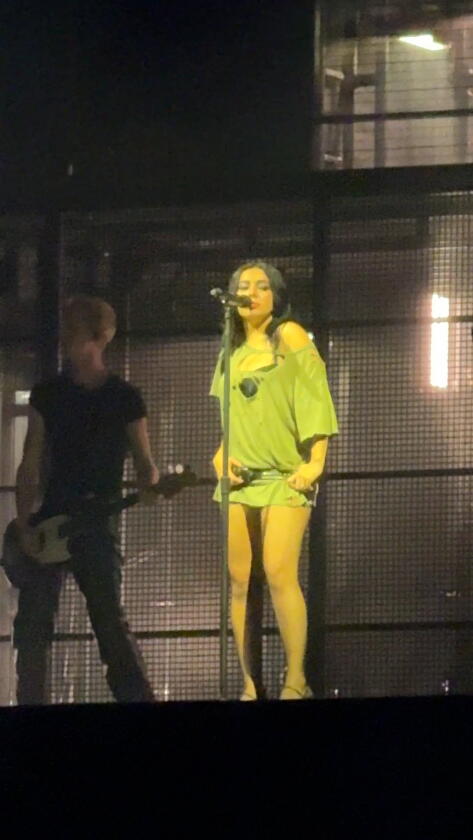
Brothers Leo and Oliver Kremer visited karaoke spots around the globe and almost always had the same impression.
“The drinks weren’t always great, the aesthetics weren’t always so glamorous, the sound wasn’t always awesome and the lights were often generic,” says Leo, a former bassist of the band Third Eye Blind.
As devout karaoke fans, they wanted to level up the experience. So they dreamed up Mic Drop, an upscale karaoke lounge in West Hollywood that opens Thursday. It’s located inside the original Larrabee Studios, a historic 1920s building formerly owned by Carole King and her ex-husband, Gerry Goffin — and the spot where King recorded some of her biggest hits. Third Eye Blind band members Stephan Jenkins and Brad Hargreaves are investors of the new venue.
Inside the two-story, 6,300-square-foot venue with 13 private karaoke rooms and an electrifying main stage, you can feel like a rock star in front of a cheering audience. Want to check it out? Here are six things to know.
The Kremer brothers hired sculptor Shawn HibmaCronan to create an 8-foot-tall disco-themed microphone for their karaoke lounge.
1. Take your pick between a private karaoke experience or the main stage
A unique element of Mic Drop is that it offers both private karaoke rooms and a main stage experience for those who wish to sing in front of a crowd. The 13 private rooms range from six- to 45-person capacity. Each of the karaoke rooms are named after a famous recording studio such as Electric Lady, Abbey Road, Shangri La and of course, Larrabee Studios. There is a two-hour minimum on all rentals and hourly rates depend on the room size and day of the week.
But if you’re ready to take the center stage, it’s free to sing — at least technically. All you have to do is pay a $10 fee at the door, which is essentially a token that goes toward your first drink. Then you can put your name on the list with the KJ (karaoke jockey) who keeps the crowd energized throughout the night and even hits the stage at times.
Harrison Baum, left, of Santa Monica, and Amanda Stagner, 27, of Los Angeles, sing in one of the 13 private karaoke rooms.
2. Thumping, high sound quality was a top priority
As someone who toured the world playing bass for Third Eye Blind, top-tier sound was a nonnegotiable for Leo. “Typically with karaoke, the sound is kind of teeny, there’s not a lot of bass and the vocal is super hot and sitting on top too much,” he says. To combat this, he and his brother teamed up with Pineapple Audio, an audio visual company based in Chicago, to design their crisp sound system. They also installed concert-grade speakers and custom subwoofers from a European audio equipment manufacturer called Celto, and bought gold-plated Sennheiser wireless microphones, which they loved so much that they had an 8-foot-tall replica made for their main room. Designed by artist Shawn HibmaCronan, the “macrophone,” as they call it, has roughly 30,000 mirror tiles. “It spins and throws incredible disco light everywhere,” says Leo.
Karaoke jockeys Sophie St. John, 27, second from left, and Cameron Armstrong, 30, right, get the crowd involved with their song picks at Mic Drop.
3. A concert-level performance isn’t complete without good stage lighting and a haze machine
Each karaoke room features a disco ball and dynamic lighting that syncs up with whatever song you’re singing, which makes you feel like you are a professional performer. There’s also a haze machine hidden under the leather seats. Meanwhile, the main stage is concert-ready with additional dancing lasers and spotlights.
Brett Adams, left, of Sherman Oaks, and Patrick Riley of Studio City sing karaoke together inside a private lounge at Mic Drop.
4. The song selection is vast, offering classics and new hits
One of the worst things that can happen when you go to karaoke is not being able to find the song you want to sing. At Mic Drop, the odds of this happening are slim to none. The venue uses a popular karaoke service called KaraFun, which has a catalog of more than 600,000 songs (and adds 400 new tracks every month), according to its website. Take your pick from country, R&B, jazz, rap, pop, love duets and more. (Two newish selections I spotted were Raye’s “Where Is my Husband” and Olivia Dean’s “Man I Need,” which both released late last year.) In the private karaoke rooms, there’s also a fun feature on Karafun called “battle mode,” which allows you and your crew of up to 20 people to compete in real time. KaraFun also has an entertaining music trivia game, which I tested out with the founders and came in second place.
The design inspiration for Mic Drop was 1920s music lounges and 1970s disco culture, says designer Amy Morris.
5. The interiors are inspired by 1920s music lounges mixed with ‘70s disco vibes
A disco ball hangs from the ceiling.
If you took the sophisticated aesthetic of 1920s music lounges and mixed it with the vibrant and playful era of 1970s disco culture, you’d find Mic Drop.
When you walk into the lounge, the first thing you’ll see is a bright red check-in desk that resembles a performer’s dressing room with vanity lights, several mirrors and a range of wigs. “So much of karaoke is about getting into character and letting go of the day, so we had the idea to sell the wigs,” says Oliver. As you continue into the lounge, the focal point is the stage, which is adorned with zebra-printed carpet and dramatic, red velvet curtains. For seating, slide into the red velvet banquettes or plop onto a gold tiger velvet stool. Upstairs, you’ll find the intimate karaoke studios, which are decorated with red velvet walls and brass, curved doorways that echo the building’s deco arches, says Mic Drop’s interior designer, Amy Morris of the Morris Project.
Sarah Rothman, center, of Oakland, and friend Rachel Bernstein, left, of Los Angeles, wait at the bar.
6. You can order nontraditional karaoke bites as you wait for your turn to sing
While Mic Drop offers some of the food you’d typically find at a karaoke lounge such as tater tots, truffle popcorn and pizza, the venue has some surprising options as well. For example, a 57 gram caviar service (served with chips, crème fraîche and chives) and shrimp cocktail from Santa Monica Seafood. For their pizza program, the Kremer brothers teamed up with Avalou’s Italian Pizza Company, which is run by Louis Lombardi who starred in “The Sopranos.” He’s the brainchild behind my favorite dish, the Fuhgeddaboudit pizza, which is made with pastrami, pickles and mustard. It might sound repulsive, but trust me.
As for the cheeky cocktails, they are all named after famous musicians and songs such as the Pink Pony Club (a tart cherry pomegranate drink with vodka named after Chappell Roan), Green Eyes (a sake sour with kiwi and melon named after Green Day) and Megroni Thee Stallion (an elevated negroni named after Megan Thee Stallion).
Before the Coachella Valley Music and Arts Festival became a world-famous event, it started as a much more modest music festival in Southern California’s desert in 1999.
As the festival kicks off its 25th year, we combed through The Times’ extensive archives to take a trip down Coachella’s memory lane. Scroll through and you’ll see those epic moments from Daft Punk, Beyoncé, Prince and Madonna, but also the iconic large art installations at the festival and just how much the event has grown and changed over the years.
Dennis Carrillo wears a sombrero as a shield against the blistering sun as he and friend Dario Soto, both of Los Angeles, walk toward the stage at the inaugural Coachella Valley Music and Arts Festival in Indio in October 1999, where the temperature hit triple digits.
(Luis Sinco / Los Angeles Times)
Beck was one of the headliners of the original Coachella in October 1999.
(Luis Sinco / Los Angeles Times)
Thousands of music fans wait at the main stage area at the inaugural Coachella in 1999.
(Gina Ferazzi / Los Angeles Times)
Rage Against the Machine was one of the headliners of the inaugural Coachella Valley Music and Arts Festival in 1999.
(Gina Ferazzi / Los Angeles Times)
2001
Due to the financial losses, Coachella skipped a year and returned in April 2001 as a one-day event with a headlining set by Jane’s Addiction and a bill featuring artists such as Weezer and Paul Oakenfold. It drew more than 32,000 people to the desert.
When Coachella returned as a one-day event in 2001, Jane’s Addiction headlined the show.
(Lori Shepler / Los Angeles Times)
Even in its early years, Coachella made art part of the vibe. In 2001, people on stilts roamed the field in front of the main stage.
(Lori Shepler / Los Angeles Times)
Thousands of fans hang out on the main field at Coachella in 2001.
(Lori Shepler / Los Angeles Times)
Paul Oakenfold’s first time playing Coachella was in 2001.
(Lori Shepler / Los Angeles Times)
2002
Coachella went back to being a two-day event in 2002, headlined by Bjork and Oasis. One of the emerging acts on the bill that year was a rock combo out of New York called The Strokes.
Oasis, with guitarist Noel Gallagher, headlined the second day of Coachella 2002.
(Kevin P. Casey / Los Angeles Times)
When The Strokes first played Coachella in 2002, the New York band was just emerging in the rock scene. Singer Julian Casablancas and the group will perform again in 2026.
(Kevin P. Casey / Los Angeles Times)
The first time Bjork headlined Coachella was the 2002 edition of the festival.
(Kevin P. Casey / Los Angeles Times)
Fans watch arm in arm as Oasis closes out Coachella 2002.
(Kevin P. Casey / Los Angeles Times)
2003
The Beastie Boys and Red Hot Chili Peppers headlined Coachella 2003, but the lineup also included The White Stripes, Iggy and The Stooges, Underworld and the Blue Man Group.
Coachella attracted about 35,000 fans per day in 2003.
(Myung J. Chun / Los Angeles Times)
The White Stripes were one of the standout acts at Coachella 2003.
(Myung J. Chun / Los Angeles Times)
The Sahara Tent has always been the heartbeat of Coachella’s dance scene, but in 2003 it was much smaller than the airplane hangar-sized stage it is today.
(Myung J. Chun / Los Angeles Times)
The Blue Man Group performed at the 2003 Coachella Valley Music and Arts Festival.
(Myung J. Chun / Los Angeles Times)
2004
In 2004, the Flaming Lips created an iconic Coachella moment when singer Wayne Coyne traveled over the crowd in a giant inflatable ball. Headlined by Radiohead and The Cure, the festival also included a reunion of the Pixies. It also marked Coachella’s first sellout, with 60,000 attendees per day.
The Flaming Lips’ Wayne Coyne travels over the Coachella 2004 crowd in an inflated plastic bubble.
(Robert Gauthier / Los Angeles Times)
Syd Klinge’s “Cauac” Tesla coil was one of Coachella’s firstart pieces. It made its debut in 2004.
(Robert Gauthier / Los Angeles Times)
Coachella 2004 featured a highly-regarded reunion of the Pixies.
(Robert Gauthier / Los Angeles Times)
Fans brave sweltering heat as they wait for the Pixies to perform at Coachella 2004.
(Robert Gauthier / Los Angeles Times)
2005
Coldplay and Nine Inch Nails headlined Coachella in 2005. Weezer, The Chemical Brothers and Wilco were some of the other notable acts on the bill. Among the memorable moments was the reunion of Bauhaus and singer Peter Murphy performing “Bela Lugosi’s Dead” while hanging upside down like a bat.
Wilco performs before a crowd of tens of thousands at dusk at the 2005 Coachella Valley Music and Arts Festival.
(Myung J. Chun / Los Angeles Times)
Trent Reznor and Nine Inch Nails headlined Coachella in 2005. Reznor will return to the festival in 2026 with German music producer Boys Noize to perform as Nine Inch Noize.
(Myung J. Chun / Los Angeles Times)
Music fans break a sweat dancing in the Sahara Tent during the 2005 Coachella Valley Music and Arts Festival.
(Myung J. Chun / Los Angeles Times)
Allen Writhen, of Santa Maria, takes a spin on a bicycle at the Cyclecide arena at Coachella 2005. Cyclecide, a San Francisco–based bicycle rodeo group, brought bike-centric art installations to Coachella for multiple years.
Prince headlined Saturday night of Coachella 2008, performing a memorable cover of Radiohead’s “Creep.”
(Spencer Weiner / Los Angeles Times)
Kestrin Pantera dances while Marc Goldstein DJs aboard a special Amtrak charter, the Coachella Express, which traveled from Los Angeles to Indio in 2008. The free train service provided transportation to Coachella Valley Music and Arts Festival attendees.
(Spencer Weiner / Los Angeles Times)
Roger Waters performed Pink Floyd’s “Dark Side of the Moon” during the final day of Coachella 2008. His set also included a giant inflatable pig that was let loose into the Indio night.
(Spencer Weiner / Los Angeles Times)
A dance circle develops inside the Do Lab at the 2008 Coachella Valley Music and Arts Festival.
(Jay L. Clendenin / Los Angeles Times)
2009
Coachella 2009 marked the final year the general public could buy single-day tickets to the festival. Paul McCartney headlined opening night and played 50-plus minutes after curfew. When The Cure tried the same thing to close down Sunday, the sound was cut earlier. Sandwiched in between was a headlining set from The Killers. Other notable performers included M.I.A., who stepped in after Amy Winehouse dropped off the lineup, Morrissey, who complained about the smell of burning flesh, and Leonard Cohen.
Paul McCartney headlined the main stage at Coachella 2009 in a career-spanning set that went nearly an hour past the 1 a.m. curfew.
(Spencer Weiner / Los Angeles Times)
Festivalgoers find shade in the Do Lab at Coachella 2009.
(Jay L. Clendenin / Los Angeles Times)
M.I.A. stepped in to perform at Coachella 2009 after Amy Winehouse dropped off the lineup.
(Jay L. Clendenin / Los Angeles Times)
“Bamboo Starscraper” was a 90-foot-tall bamboo tower by Gerard Minakawa that was part of the art at the festival in 2009.
(Jay L. Clendenin / Los Angeles Times)
2010
This year was the first time the festival only offered three-day passes and Coachella drew a record 75,000 people per day, up nearly 15,000 from the previous year. It was also the year Coachella had its first rap headliner with Jay-Z, who brought out wife Beyoncé to perform “Young Forever.” The other headliners in 2010 were Muse and Gorillaz. The eruption of an Icelandic volcano kept some artists from getting to the festival, including The Cribs and Frightened Rabbit. Then there was Sly Stone’s oft-delayed set that ended with him ranting about his former manager and led to a slander lawsuit. The full festival was also livestreamed for the first time.
In 2010, Jay-Z became the first rapper to headline Coachella. He brought out wife Beyoncé as a surprise guest.
(Luis Sinco / Los Angeles Times)
Members of the Old Crow Medicine Show jam in the VIP area of the Coachella Valley Music and Arts Festival at the Empire Polo Club in Indio in 2010.
(Luis Sinco / Los Angeles Times)
DJ Lance Rock and the creatures of “Yo Gabba Gabba!” performed at Coachella in 2010.
(Luis Sinco / Los Angeles Times)
The crowd reacts during Benny Benassi’s DJ set in the Sahara Tent at Coachella 2010.
Snoop Dogg performs with a hologram of Tupac Shakur near the end of the Snoop Dogg and Dr. Dre’s headlining set at Coachella 2012.
(Jay L. Clendenin / Los Angeles Times)
Laura Newton, left, Lucy Holme and Louise Watkins from Britain attended their first Coachella in 2012 and protected themselves from the rain that swept in on opening day with garbage bags.
(Luis Sinco / Los Angeles Times)
David Guetta brought lots of lasers to his performance in the Sahara Tent at Coachella 2012.
(Jay L. Clendenin/Los Angeles Times)
An aerial view of the 2012 Coachella Valley Music and Arts Festival.
“Helix Poeticus,” created by Poetic Kinetics makes its way, slowly, across the polo field at Coachella 2013.
(Jay L. Clendenin / Los Angeles Times)
Flea of the Red Hot Chili Peppers headlined Sunday night at the 2013 Coachella Valley Music and Arts Festival.
(Brian van der Brug / Los Angeles Times)
The Yuma Tent made its debut at Coachella 2013 with air conditioning, a hardwood floor and comfy chairs.
(Luis Sinco / Los Angeles Times)
Tesla coils by artist Syd Klinge go off along with the “Coachella Power Station,” left, by artists Vanessa Bonet, Derek Doublin and Chris Waggoner at Coachella 2013.
(Jay L. Clendenin / Los Angeles Times)
2014
A reunited Outkast, Muse and Arcade Fire headlined Coachella 2014, but one of the most memorable performances was Pharrell Williams’ star-studded set on the Outdoor Theatre. We also saw the debut of Poetic Kinetics’ “Escape Velocity,” a.k.a. the Coachella astronaut, and the mirrored “Reflection Fields” by Phillip K. Smith among the festival’s major art installations.
A nearly 40-foot tall astronaut, “Escape Velocity” by L.A. art collective Poetic Kinetics, is reflected in “Reflection Fields” by Phillip K. Smith at the 2014 Coachella Valley Music and Arts Festival.
(Brian van der Brug / Los Angeles Times)
Andre 3000 of Outkast performs inside a screen box opening day of the 2014 festival. Andre 3000 and Big Boi reunited for the festival.
(Bethany Mollenkof / Los Angeles Times)
Fans pack the Sahara Tent for the performance of Showtek at Coachella 2014.
(Jay L. Clendenin / Los Angeles Times)
Pharell Williams performs at the second weekend of the 2014 Coachella Valley Music and Arts Festival.
Angus Young duck walked in his traditional schoolboy uniform during AC/DC’s Coachella 2015 headlining performance.
(Luis Sinco / Los Angeles Times)
Music fans flock to “Desiderium Eruca,” Poetic Kinetics’ large butterfly sculpture that replaced the “Papilio Merraculous” caterpillar sculpture at Coachella 2015.
(Marcus Yam / Los Angeles Times)
Florence + The Machine was one of the memorable performances at Coachella 2015. Singer Florence Welch broke her foot when she leaped from the stage during Weekend 1.
(Marcus Yam / Los Angeles Times)
Aerial performers spin above the crowd at the Do Lab at Coachella 2015.
After breaking his foot the week before Coachella 2016 during Guns N’ Roses’ Troubadour warm-up show, Axl Rose performed on stage at Coachella atop the motorized throne Dave Grohl previously used on tour after breaking his leg.
(Brian van der Brug / Los Angeles Times)
Alejandro Murcia and Wanda Quintero take a photo in front of R&R Studios’ “Besame Mucho” installation at Coachella 2016. The typographic sign was covered in silk flowers and is among the more memorable art pieces from the year. Today, the installation lives on at Miami International Airport.
(Jay L. Clendenin / Los Angeles Times)
Ice Cube’s performance at Coachella in 2016 led to an on-stage reunion with the surviving members of N.W.A, featuring MC Ren and DJ Yella Weekend 1 with Dr. Dre joining them on Weekend 2.
(Jay L. Clendenin / Los Angeles Times)
Brian Sneed and Claudia Jerez jump as a friend takes their photo in front of the “Katrina Chairs” art installation at Coachella 2016.
The first time Lady Gaga headlined Coachella was in 2017 and it was because she stepped in after Beyoncé had to postpone due to her pregnancy.
(Brian van der Brug / Los Angeles Times)
Crowds of people take photos of Gustavo Prado’s art piece “Lamp Beside the Golden Door”at Coachella 2017. The sculpture featured more than 2,100 mirrors.
(Luis Sinco / Los Angeles Times)
Kendrick Lamar released “Damn.” the Friday of Coachella 2017 Weekend 1, two days before his headlining performance that included ninjas.
(Brian van der Brug / Los Angeles Times)
Olalekan Jeyifous’ 50-foot-tall “Crown Ether” treehouse art installation provided a backdrop for photos at Coachella 2017.
(Brian van der Brug / Los Angeles Times)
2018
Coachella was already regarded globally as a music festival. Then Beyoncé turned Coachella into the pop culture moment of the year. Coachella became Beychella and her Homecoming performance was nothing short of epic, even becoming its own Netflix special. Beyond Beyoncé, Eminem and The Weeknd headlined, but one of the other standouts was Cardi B’s TLC-inspired performance on the main stage. On the grounds, 2018 was the year “Spectra,” the cylindrical rainbow tower, became part of the festival’s landscape.
Beyoncé’s stunning headlining performance at Coachella 2018 celebrated America’s historically Black colleges and universities. Her set also featured cameos from husband Jay-Z, sister Solange and a Destiny’s Child reunion.
(Luis Sinco / Los Angeles Times)
The rainbow-colored cylindrical tower “Spectra” made its debut at Coachella in 2018.
(Christina House / Los Angeles Times)
Cardi B performed a set inspired by TLC at Coachella in 2018.
(Kent Nishimura / Los Angeles Times)
Festival goers walk in front of Edoardo Tresoldi’s “Etherea” wire mesh cathedral structures and Randy Polumbo’s “Lodestar,” which was made with the fuselage of a military jet, at Coachella 2018.
(Maria Alejandra Cardona / Los Angeles Times)
2019
Ariana Grande, Childish Gambino and Tame Impala headlined Coachella in 2019, but the big memories from that year were the rise of artists like Bad Bunny and Billie Eilish as they were becoming bona fide superstars. Arguably the most memorable performance of the year wasn’t even during normal festival hours — it was when Kanye West held a Sunday Service in the campgrounds on Easter Sunday during Weekend 2. Meanwhile, to mark Coachella’s 20th year, Poetic Kinetics brought back the famous roving Coachella astronaut in a new form as “Overview Effect.”
Bad Bunny’s set at Coachella 2019 included a guest spot from J Balvin.
(Mariah Tauger / Los Angeles Times)
Kanye West’s Easter Sunday Service happened outside of the main festival grounds during Weekend 2 of the Coachella 2019.
(Kent Nishimura / Los Angeles Times)
“Overview Effect,” a roaming astronaut sculpture made by Poetic Kinetics, roams around the 2019 Coachella Valley Music and Arts Festival at the Empire Polo Club grounds in Indio.
(Brian van der Brug / Los Angeles Times)
Fans go wild as confetti drops during Tame Impala’s headlining performance at Coachella 2019.
Billie Eilish’s 2022 Coachella headlining turn included a guest spot from Damon Albarn to join her for “Getting Older” and “Feel Good Inc.”
(Dania Maxwell / Los Angeles Times)
Wearing the signature blue wigs of Karol G, music fans cheered the star as she arrived on the main stage at Coachella 2022.
(Gina Ferazzi / Los Angeles Times)
Swedish House Mafia x The Weeknd became a last-minute headliner replacement for Kanye West at Coachella 2022.
(Christina House / Los Angeles Times)
One of the largest art installations at Coachella 2022 was Cristopher Cichocki’s “Circular Dimensions x Microscape,” which was made with more than 25,000 feet of PVC tubes and was five stories tall. At night, images were projected on the piece.
Bad Bunny performs at Coachella Weekend 1 in 2023.
(Christina House / Los Angeles Times)
People walk by Güvenç Özel’s sculpture “Holoflux” at Coachella 2023.
(Christina House / Los Angeles Times)
Doechii performs at Coachella 2023.
(Dania Maxwell / Los Angeles Times)
A reunited Blink-182 joined the Coachella 2023 lineup days before the festival. The band played in the Sahara Tent during Weekend 1 before moving to the main stage Weekend 2 to help fill the gap left by headliner Frank Ocean dropping off the bill.
(Dania Maxwell / Los Angeles Times)
2024
Lana del Rey, Tyler, the Creator and Doja Cat headlined the festival in 2024, but one of the big draws was the reunion of No Doubt, who brought out Olivia Rodrigo. Sabrina Carpenter, who is headlining the 2026 festival, also performed on the main stage during the day. The big changes in 2024 were that the main festival grounds expanded with a larger Sahara Tent on the southern end of the site and the addition of the Quasar Stage.
Tyler, the Creator’s headlining set at Coachella 2024 featured the rapper dressed as a park ranger and an elaborate national park-like stage set.
(Dania Maxwell / Los Angeles Times)
Gwen Stefani of No Doubt performs at Coachella 2024. The band reunited for the festival and brought out Olivia Rodrigo as a guest.
(Christina House / Los Angeles Times)
Doja Cat was the Sunday night headliner at Coachella 2024 and her performance included dancers dressed like yetis.
(Dania Maxwell / Los Angeles Times)
Chappell Roan was one of the breakout stars at Coachella 2024.